Denise Domning's Blog, page 11
August 6, 2018
Lack of Balance
If there was anything in my life I’d like to change it would be my lack of balance. No, I don’t mean my physical balance, which I do admittedly lack as evidenced by my klutziness. Actually, I attribute my physical klutziness to my narrow feet. Because it’s almost impossible to find AA shoes inexpensive enough to wear in a pasture, my off-the-rack shoes are always too loose. Holding them onto my feet requires me to shuffle, instead of step.
It’s my ability to focus that keeps me out of balance. I’m an all-or-nothing girl. What I’m doing at this moment has 100% of my attention. If the task requires learning a new skill, I set aside everything else and stay in that foxhole until I master it. Give me a new piece of software, and I don’t leave the computer until I understand how it works, how to break it and how to fix what I’ve broken.
The only thing that jolts me out of my concentration is the need to feed something, and that doesn’t include me. Me I can ignore, but I won’t ignore my critters. This may be my subconscious reason for keeping animals. They prevent me from morphing into a complete geek.
So, with July promising to be hot and humid, offering a legitimate reason to stay indoors, I finally admitted I needed to learn how to market my own books. It was either that or get a “real” job. Gritting me teeth, I opened up the on-line course I purchased in June and started consuming the how-to videos. If a course left my eyes spinning in my head, I forced myself to watch it again and again and again–however many times it took to stop the spinning. I studied every “things that work” image and did my best to replicate it.
I downloaded the example spreadsheets…. NO-O-O! Not spreadsheets!
Spreadsheets are my worse nightmare. This is because I have dyscalculi. What dyslexia does to letters, dyscalculi does to numbers for me. For example, when I look at a 4, I see an ‘h.”
As you can imagine this made basic math a challenge for me as a child and is why I didn’t become an engineer like my siblings. Over the years I managed to come up with my own workarounds and tricks, but looking at someone else’s spreadsheet is like getting a glimpse into the brain of a person for whom numbers aren’t the enemy. Sure, I could just plug in the numbers the way the course’s author promised. But all that would accomplish is filling the page full of numbers, half of which turn into letters. Instead, I have to reorganize columns and rows until my afflicted brain, which resists with all its might, finally has an “Ah-hah!” moment and understands what it sees.
This weekend, after four weeks of living in detail overdrive, I climbed out of the foxhole long enough to discover my gardens are completely overgrown and all my fruit trees need water. While my animals are fine, my distraction meant I missed the moment the pigs and June the Cow decided they need to graze together, the pigs moving back and forth under the cow. Not necessarily a good choice. This morning, one of the little gilts was wearing a bit of cow manure on her back.
See you next week. I’m dropping back into that hole of mine as I reorganize my favorite spreadsheet one more time.


July 30, 2018
Cross-species grooming
So, it’s been another crazy week here on the farm. We’ve had storm after storm, most of them offering rain–enough that my grass is now knee-deep. And me with no time for mowing. Or for cutting up huge logs that crush my fence.
The storm three days ago included really high winds. As I made my post-storm walk, looking for damage I found that my back cottonwood had dropped a huge widowmaker, a massive branch that easily weighed in at a ton. My initial reaction was excitement. Whoo, it missed the fence!
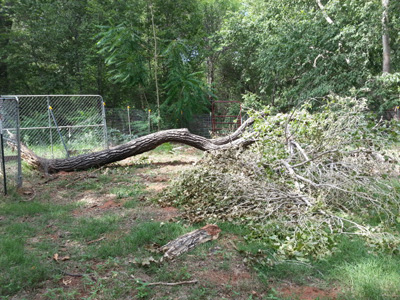 Then sense kicked in. The branch had come to rest leaf-side down, and stood upright, like a thirty-foot tall upside-down tree. Yes, the fences were intact for the moment, but that was only because the branch hadn’t finished falling. Two of its possible paths included a length of exterior fence.
Sure enough. When it finally came to rest, it was across the fence, crushing the fabric. I’ve erected two chain link panels as temporary fencing around the end of the branch to keep my critters enclosed and safe until I can begin whittling that thing down to size. As I watch today’s storm roll in, I’m hoping nothing else comes down for a while. I don’t have that many chain link panels left.
Now onto how my pigs are creating family where none exists.
I’ve mentioned this before but it’s worth stating again. Some ten years ago or so I was listening to an NPR article about a guy who’d started a pig rescue. His rescues were mostly pot-bellied pigs who had outgrown their owners’ homes and expectations. At the end of the article, he said, “You know, cats have staff and dogs have masters, but a pig thinks everything is a pig.” As near as I can tell, that’s the God’s honest truth. Although my now much larger weaner pigs spend much of their day in the back pasture, I’m still feeding then in my fenced orchard. This is because they need to be accustomed to near the front barn. As December closes in I’ll begin inviting them ever closer to that barn and their ultimate end. However, feeding the pigs in the orchard means there’s always a few crumbs of their food left when they’re done. This is something June the Cow has not only noted but come to enjoy. She thinks pig food is pretty darn tasty and I allow her to clean up after the pigs because pig food dust isn’t going to mess with her digestive tract.
Apparently, not everyone on the farm is as copacetic with this arrangement as I am. The biggest of my gilts (girl pigs) has designated herself the future Head Sow. In her little piggy mind, that makes it her job to take umbrage with a cow getting even tiny particles of a meal meant for hogs.
The other day I took a bucket of fallen fruit to the back pasture where I had all my critters that day. The pigs were on the fruit in a heartbeat with June following close after. The sheep, who are more cautious by nature, stayed on the periphery, not really wanting to get involved in the scrum of chickens, turkeys, five pigs, and a cow.
As I watched, Head Sow put her snout on June’s forehead and in a deep piggy voice went, “ha-ha-ha-ha-ha.” That’s hog-speak for “You’re trespassing in our food again and I’m going to take you out of this world when I get a little bigger.”
I expected June to swing her massive head and send that piggy girl flying. Instead, she very gently pressed her head against Head Sow’s snout and carefully shifted the maybe 70 pound gilt to the side. Translation: “You and what army?”
As this was going on at the front of the cow, one of the other little gilts became fascinated with June’s leg. Pressing her snout against the leg, she snuffled her way up then down, ruffling cow hair as she went. June froze where she stood, her head still lowered. Her eyes drifted to half-shut and her face softened in what was clearly pleasure. Up and down the gilt snuffled, then she shifted and put her mouth on the triangular bit of horn at the back of June’s leg. That rough bit of keratin is the toenail of what is now one of a cow’s two vestigial toes. They started with four and over time it became two.
“Crunch, crunch.”
I couldn’t believe it, but that pig was eating toenail! June remained where she was, eyes half-closed. I looked closer at the back of her leg and noticed that the opposite “toenail” had already been chewed to almost flat.
So this wasn’t the first time that my cow had stood still for a pig-pedicure. The gilt shifted under June and went to work on another toenail. All of a sudden, June gave a tiny flinch then carefully stepped over her porcine groomer and went off to graze. I’m guessing the gilt had gone as deep as she could. That reminded me of the day I caught two of my previous gilts sitting on either side of Peanut as he chewed his cud. Each pig was gently running one of the lamb’s ears through her mouth. Like June, Peanut also had a blissful look on his face.
The moral of this story? I’ve lost a fortune on Youtube because I cannot remember to bring my camera or phone with me when I leave the house. Well, that and there’s something special about living in a place where everything’s a pig.
July 23, 2018
Chicken Habits
I wanted to title this post “Seven Highly Unsuccessful Habits of Chicken Herders.” But, however accurate, that was just too long. You see, I’ve done it again to those poor birds. I’ve messed with their routine.
There is no creature on earth more married to routine than a chicken. Chicken memories are written in stone, or maybe grit, since they’ve got pea brains. Move their coop five feet during the day is a guarantee that the hens can’t find the doorway come nightfall.
“We’re doomed, Henrietta! What happened to our home? I swear it was right there this morning,” one hen will cry to another, pointing to where the coop had been as she stands next to the door ramp. (By the way, in my world all hens have names that begin with “H,” because they’re hens.)
It requires three full days, or at least three nights going into the coop and three dawns coming out, before chickens again know where they are. That’s my way of saying I knew what I was in for when I decided to change things up on them.
For the first time since I moved onto the farm I have my fencing the way I want it. That means the farthest pasture, the area where the massive cottonwood stands, is finally enclosed for my hogs. There are a dozen huge trees, sycamore, cottonwood, mulberry, walnut, alder, and ash. It’s always shady and at least ten degrees cooler than anywhere else on the property. The ground is alluvial clay, laid down by Oak Creek, and is badly in need of turning, something the piggies are happy to do for me. And there’s lots water for wallowing and drinking.
Last week the final line of fence went up (thanks to all my friends for their help). After that, I spent five days letting the piglets exploit every possible weakness, following after them, closing up the holes. I used all my favorite building materials: baling twine, handy panels, an extra gate or two, and, of course, U-bolts. Not only are the piggies now trapped where I want them, but last night I put Bear to work, guarding the little guys. Moosie joined him for a while, but sometime during the night he chose to come back to his couch on the porch. There is no keeping that dog where he doesn’t want to be.
As happy as I was to have completed this task, I knew I was in for it with the birds. To keep the pigs in place, the chickens had to move in with them. Unlike chickens, pigs are very smart. If they saw the chickens using the front barn door, they’d find some way to use it, too. So, until the pigs are bigger, the barn door must stay closed.
The retraining began three days ago when I closed the door to their coop during the day, only opening it at dusk and dawn. That meant me coming down every few hours to rescue the group of girls pacing helplessly in front of the closed door. I’d chase them to the new gate and into the pig pasture. By day two, half of the flock was in the right place while the other half spent much of the day staring at the new gate, wondering how to make it open. By day three, most of them were not only where I wanted them, but stayed there. Those few who insisted on escaping did so through the one place where only they, and not the pigs, can get in and out. I’m good with that.
 The back door to the coop, guarded by a handy panel
Since one change at a time is as much as a chicken can tolerate, I didn’t mess with their morning or evening routine until last night. I showed up at the barn around 6 PM with their food. Most of the girls were gathered before that magic gate, waiting for me to let them out so they could go around the corner and into the barn through their usual front door. Instead, I opened the back door to the coop and put their food bowls in their usual places. Not a bird moved toward the new opening. Instead, they all crowded closer to the gate, ready to race for the front door so they could battle each other for food.
If you’ve never herded chickens, let me say it’s much worse than herding cats. Drive a chicken to the left and she’ll go that direction for about ten steps, then do a 180 and race past you at top speed. Drive two chickens in one direction, and they’ll watch you over their shoulders for a moment, then split, each of them going a different direction. I like to think of it as a specialized Crossfit exercise. Dash right at top speed, spin left, slow down to a tiptoe, jerk forward a few steps and lunge right, then race flat out as fast as you can for a hundred feet or more. Repeat.
After making myself crazy for about fifteen minutes, I settled for moving them one by one. By 7 PM I had half of my sixteen birds in the coop. These were the calmest of the birds, or the ones who noticed how close the food bowls were once they were near the new door. They’ll be the ones to find their way home without much help from me tonight. The other eight kept me running until almost dark. Just two more days of this, just two short days.
When I finally returned to the house to gnaw on cold chicken because I was too tired to cook, I thought I smelled burning rubber. Worried that something was smoldering in my house, I checked everything mechanical and electrical. There was no trace of smoke or even heat, which was amazing considering how hot yesterday was. At that point I was too tired to worry any more and went to bed.
It wasn’t until I went to down to free Bear this morning that I realized what I’d smelled the previous night. He reeked of skunk. No wonder Moosie left him.
July 16, 2018
Humidity
Humidity isn’t something most people, including Arizonans, associate with Arizona, but we have entered our season of damp air. For those who don’t know, Arizona has a Monsoon season. Just like in Southeast Asia, our Monsoon storms include torrential rainfall. Where India has accumulating floods, we have flash floods. Flash floods are water on the move, rolling ever faster over land that is too dry to absorb it. I only mention this because this year our Monsoon season opened with a storm that sent a flash flood right through my property.
Actually, the flood might not have happened if not for our previous months of drought. Winter is usually our rainy season in this area, offering up days of steady, drenching moisture and some snow. But this year we had nary a storm from October through March, and only a few, pitiful rainy days between March and the start of Monsoon season. Combine that with the fact that my house sits in Oak Creek Valley while just across the road the land begins to rise in a series of steep inclines that lead to the top of House Mountain. Those hills are all desert landscape–lots of bare dirt, rocks, mesquite, and cactus. With the land drier than usual, it’s no wonder the water rolled.
Let me say, there’s nothing like discovering an impromptu waterfall on your property to remind you of how insignificant you really are. That first storm was so violent that it sent boulders tumbling and overwhelmed all of my drainage routes, leaving piles of debris in its wake. There’s been a welcome spate of rain every day since that first storm, none of them as violent as that first one. As I write this, I’m watching today’s storm clouds piling up behind House Mountain.
While I’m thrilled with the moisture and these cool days–daily temperatures haven’t even come close to 100 degrees in a week–all this moisture means humidity. Fifty-five percent, my thermometer informed me yesterday just before it began to rain. Although it’s nice to have curly hair, I’m dying, wilting, melting into a pile of perspiration. I can see all of you who live or have lived east of the Rockies sneering at me. But this is Arizona. It’s a dry heat! We’re not supposed to drip with sweat.
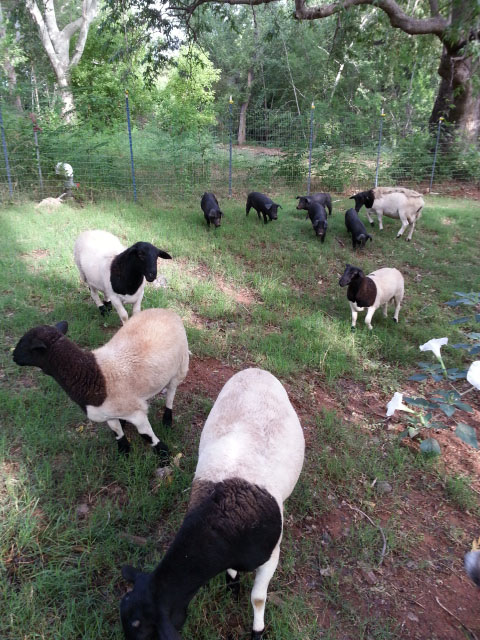 Piggies and sheep in the back pasture
I’m so uncomfortable that I’ve begun making up excuses not to do my hour or so of outside work before I sit down at the computer. The grass is too wet to mow. Why drive fence posts now when the ground will be even softer after this afternoon’s storm? If it weren’t for the piggies, I’d never leave the house.
As I fully expected, they’re already outsmarting me. After pig-proofing the pasture (or so I thought) the other day, I let them out of the orchard. A few hours later I discovered them lounging in the chicken coop after consuming all the chicken food.
I herded them back to the orchard and redid my defenses, then tried releasing them again the next day. Just in case, I made sure all the chicken food was stacked out of their reach. Sure enough, they escaped. I found them in the now half-fenced back pasture, enjoying a wallow.
Rather than get the t-post driver and finishing the fencing, I sighed and left them there. After all, the back pasture is where I want them for the rest of the summer. I blame my laziness on the humidity. My “leetle gray cells” are getting too wet.
July 9, 2018
PCU
It’s official. I’m not selling the farm. What makes my decision official? I bought piglets.
I made the purchase before I realized that I didn’t have a surefire way to bring them home. The last time I bought piglets I still owned my Focus and I only bought two. I put them in a dog crate and brought them home from Chino over Mingus Mountain. Because they were in the back of my little Focus (I still miss that car), I could hear them “urp” each time we went around a hairpin bend. Who knew piglets could get carsick?
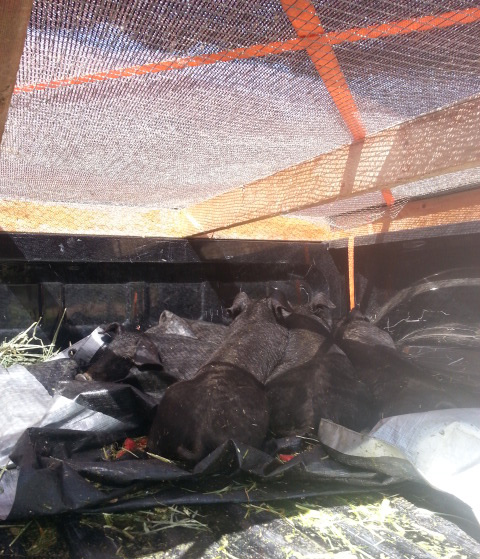 In retrospect, I should have gone with the crate. If you look carefully at this picture, you’ll see the black piglets stacked up in the corner.
This time, I bought five piglets and not two. Hmm, what to do? The original dog crate, the same one that was Peanut’s home for a few months, was too small unless I somehow managed to stack the piglets. Then I looked at my truck. Why buy or try to borrow a larger crate when I have a truck bed? All I needed was a top for the bed, something to keep the piglets from escaping for the duration. What I needed was a PCU, a Piglet Containment Unit.
Amazingly I found it waiting for me in the barn. These days, I’m not building things as much as I’m disassembling them. Last month, I disassembled an enclosure built of 2 x 4s and hardware cloth. (Well, hardware cloth and some chicken wire. This turns out to be an important fact later in the story.) I had six panels, all of them the exact width as my truck bed and less than a foot shorter.
I chose the best panel, strapped it place, and screwed shade cloth to the top. Then using bits of this and that I attached two boards to the end so the PCU reached the tailgate of the truck. Just in case I needed them, I threw a couple extra boards into the cab, then filled the truck bed with hay sprinkled with watermelon and a bit of hog food.
Once again, my piglets weren’t local, but over the mountain. By the time I reached Jerome, the upper right corner–the chicken wire corner–of my PCU had escaped its screw. That’s when I remembered I’d forgotten the drill and extra screws in the barn. Dang. Once I arrived at the ranch, I examined the loose corner. I was sure it was too small an opening for a piglet to use, so I bent the chicken wire around the frame again, and tucked the shade cloth tight around the corner. Silly me.
The first two piglets went in easily, then everything went to hell in a hand basket, as it were. As number three was sliding into the back of the truck, number four, clearly smarter than the rest, shot out of the pigpen. Then just as number five was going into the back of the truck, one of the others discovered my weak corner. Out it went through that tiny hole, right over the side of the truck, dropping more than four feet onto the ground.
Leaving one of the owners to chase the two loose piglets through cow pens, around the alpaca, into the chicken coop in the over-100 degree heat, I brought out my spare bits of wood. A drill and screws were provided and in a moment the PCU was again tight. It took all our combined efforts to catch the two loose babies and once they were in the PCU, I headed for home. As I drove, I mulled over my previous, somewhat sketchy plan for getting the piglets out of the truck and into the orchard. What had seemed an easy task four hours previously now seemed a little naive.
The PCU did its job all the way home. I backed in through the front gates of the orchard, going as far as I could before hitting the interior fence. Then, closing the big gates around the truck, I got my drill and removed my temporary bed cover. Throughout that task, the piglets huddled in the corner farthest from me, shifting corners when I did. They kept their backs aimed toward me and their heads down.
I removed the panel, reached in and grabbed the one on top by its back legs. As I started to lift it, the piglet squealed like it was dying and writhed. Hokey smokes, that thing weighed forty pounds if it weighed one! I lost my grip on one leg and, in an instant, the piglet yanked its other leg out of my grasp. As I watched, trapped behind the half-closed orchard gates, it climbed onto the edge of the truck bed, leapt to the top of the cab, then slid over the windshield to the hood. It hit the ground outside the gates and took off toward the barn, only to see Moosie. Giving a piglet yelp, it did a 180 in the air, and took off toward the back of the property.
It’s now three in the afternoon, 105 and humid. I’m withering into a big clump of damp lint. That I am in the orchard has convinced the sheep and cow its time for dinner, so they’re all calling. Meanwhile, there are four more piglets in the bed of my truck. There’s nothing I can do but keep on unloading piglets.
I’m ready for the next two, and they go right where they belong with no trouble. Then I hit number four, who has clearly been waiting for just the right moment. I grab her legs, she pulls the same trick as her sibling, yanks free and flings herself over the side of the truck bed. But she goes in the opposite direction around the orchard, and immediately runs into fences. Confused, she turns and sees her siblings inside the orchard but has no idea how to get where she wants to go. As she paces the fence line, I unload the last piglet and start after her.
At this point, she’s found her way onto the narrow bridge that crosses the ditch. It leads to a very steep set of stairs, which both she and I recognize at the same instant no pig could ever climb. With me approaching the bridge, that leaves her only one place to go. Just as I say, “Don’t you dare!” in she goes. Knowing just how strong and fast that current is, I race down the ditch to an entry point and jump into the water, intending to catch her as she comes floating past.
Let me stop here to say that even though I have my phone in my back pocket and am still wearing shoes that I had until that moment considered “good”, being in the water is heaven.
Sure enough, even though that piglet is swimming for all she’s worth, she’s moving downstream at a good clip. I grab her as she floats past me. She’s not ready to give up yet, so we wrestle, which results in her going under water a few times. When I’m sure I have a good grip on her back legs, I drag her out onto the bank…only to discover she’s too long for me to lift her completely off the ground. Dripping, my shoes filled with sand, still holding her back legs, I straddle the piglet. This puts her front feet on the ground and her head pointed behind me. Taking toddling steps that she can match whether she likes it or not, I walk her to the orchard. Once she’s in and the gate is latched, I’m cool, tired, and still short a piglet.
I walk the property, looking for holes a piglet might exploit. Fencing has been my mantra for the last couple of years, so I’m pleased to discover only three possibilities. All of them are too hidden for a panicked critter new to the farm to find.
Still kicking myself for not realizing that a piglet could climb that well, I retreat to the house and have a glass of wine. It helps. By the time my glass is empty, I’m positive that the missing piglet has gone to ground like a cat. She’s hiding somewhere near her siblings and will reappear soon. The hours pass. I walk the property two more times while doing chores. There’s no sign of her.
Just as dusk settles in, I walk the property one more time. As I reach the back fence I hear a startled grunt. A tiny black juggernaut shoots past me, heading toward the orchard, Moosie hard on her heels. She is alive and well!
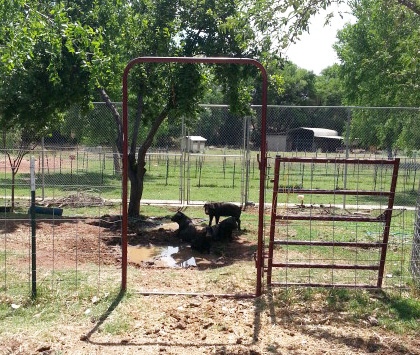 They’re much calmer now
Now I know what to do. Because they lived with Great Pyrenees, the piglets have all greeted Bear like a friend. The four in the orchard have settled down some, and found a “safe space” in the corner of the orchard fence close to June’s pasture. That cow! She’d live in that pasture forever if I let her. So I put Moosie in the house, then lock Bear in with June. Bear complains until I agree to banish the cow. He’s skittish around cows because Dixie thought it was funny to sneak up behind him and headbutt him into a somersault.
Sure enough, when I get up the next morning, I find piglet number five pressed up against the chain link, as much of her body as possible touching the bodies of her siblings on the other side. All I have to do is open the gate, walk around the piglet and she dashes into the orchard.
PCU mission accomplished!
July 2, 2018
Beaver
Over the past eight years (and this month it’s officially eight years that I’ve been a co-owner of this property), I’ve only once seen a beaver. That was about five years ago in July, no less. I was standing on the porch when all of sudden Moosie, then just a pup, went racing down to the Mason ditch. I watched as he walked along the ditch bank his attention on something in the water.
That brought me to the porch railing. It was a four-foot-long beaver, making his or her way lazy way upstream, grazing on the water grass that gets so thick in the warm months. For the record, I considered that scary big. So did Moosie after the beaver brought his head out of the water. As Moosie retreated, the beaver went on his way upstream.
Little did I know what that critter was really doing was scoping out my place. Two weeks later, the beaver returned to harvest a half-grown nectarine tree that I had planted along the bank the previous year. He came back again after I planted three little Elberta Peaches near the ditch and took two and half of them, much to my frustration. I wrapped what was left of the surviving peach tree with black bird netting and it survives today, despite frequent sheep pruning. That seemed to put an end to beaver foraging along the ditch bank, but over these past years I have noticed that along the creek bank there are many small tree trunks chewed into the beaver’s signature arrow point.
I think I’ve mentioned that the creek has been moving at barely a trickle this summer. Until last week I put that up to the flood two years ago. Almost immediately after it receded, there was less water in my side of Oak Creek. The creek splits in two a few properties above me then comes back together about four properties below me. I figured the flood had redirected the water to the other side of the island.
This, I have only just this week learned, is untrue. It turns out that there’s a large and very active beaver dam above my friend Jacquie’s house. She mentioned it the other day when I complained about having so little water in the creek. She said the dam has gotten so large the creek above her is turning into a lake.
If not for her warning, I’d have been even more stunned Sunday morning when I awoke to find Moosie had a cute little plush toy in his mouth. It took me a moment or two to wake up enough to remember that Moosie never plays with toys unless its one of those massive inflatable balls you can sit on. He’s a circus dog wannabe, pushing that ball around in circles with his front paws as if he’s trying to get up on it and do an act. When he can’t, he bites the ball and watches in disappointment as it deflates.
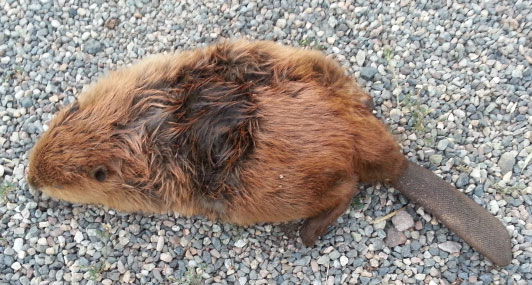 What he carries around with him are the critters he..kills! I stared at the small, lush, brown-furred thing in his mouth. What the heck was that?
Just then he dropped it as if to show me. A baby beaver! It was less than a foot long and chubby, with tiny ears, cute little eyes, and that distinctive tail. She looked so much like a toy that I had to touch her to assure myself she was real.
Now, how in the world did a baby beaver get to where Moosie could catch her? Since he can’t get to the creek at night, there’s only one way. Just as I’ve seen Momma Otter do, Momma Beaver had taken her babies on an excursion up the Mason ditch. She was showing her little ones where to find food and building materials.
That instantly sent me to the ditch bank. My solitary peach was still there. Whew!
Then I looked back at Moosie. He was also still here, and miraculously uninjured.
I cannot imagine that this little beaver was in the ditch by herself, nor can I envision a mother beaver not challenging Moosie as he snapped up her baby. But then Moosie is so fast that he catches fish. Maybe he simply snatched the little one before Momma noticed. Or maybe it was arrogance on her part–that she trusted her size and her teeth to scare off a mere, landlubber dog. Having looked at the little beaver, I’m also certain that she was dead in an instant. Moosie’s got that neck-breaking shake down pat. My guess is that Mother Beaver also knew that, that she gathered up her surviving brood and swam for safety.
Here’s hoping she doesn’t come back loaded for Moose, as it were. Man, even on a baby beaver those teeth are seriously big.
June 25, 2018
Flies, ugh.
It’s only been a few years since I last had dairy cows on the property, but in that short time I completely forgot how awful the flies are. However, before I get into discussing the pestilence of flies, I need to get you caught up on general cow news.
Who knew how annoying it was to be a cow’s bestest ever best friend? I sure didn’t, but Miss June is doing her absolute utmost to teach me. She cries when she can’t see me. She cries when she sees me walking away from her. She bounces after me when I reappear. And, like Tom, she seriously likes my friend Laurie. Tom now knows the sound of Laurie’s car. Within minutes of her arrival, he starts making his way toward the house, gobbling in invitation for her to greet him. As for June, I suspect her first human, the one with whom she bonded, was blonde, as is Laurie. Let me just add, I’m not adverse to letting June pour out her big heart on someone else for a while.
After deciding instantaneously upon seeing June that she was pregnant, once I got her home I began to worry. This is most likely because she lost weight over that first week while she was still viewing the idea of grazing as abhorrent. That’s changed now. She spent all of last week with her nose to the ground, grazing for hours. And this week I’ve watched in relief as her udder slowly and steadily begins to swell. That’s not something that dry and/or barren cows do. It only happens when there’s a baby on board.
That said, it’s also not something pregnant cows do when their baby isn’t due for another 3 months. Of course, I didn’t ask exactly when she was exposed to the bull. Knowing she was due in September was enough, because I tend to drive myself crazy wondering if this day is IT once we hit 270 days.
Now that you know I’m second-guessing myself about owning this particular cow, I’ll move on to the fly situation. Flies love cows. Flies love cows so much that you sometimes wonder how the cows survive being covered in flies. They’re on her back, her legs, her belly, but they especially love to crawl around her eyes. Getting close to her means the flies move from her to me. Ugh. Just ugh.
I bought a (small horse-sized) fly mask for her, which she absolutely refuses to let me strap over her nose. I guess I can’t blame her. Wearing netting over my eyes would drive me crazy as well. Because none of my previous cows were any more excited about fly masks, I also bought a fly spray. Being me, any conventional pesticide-laced spray is out, as that would send me to the hospital. So I opted for a natural spray, which contains essential oils, including citronella, clove, mint, and thyme.
It worked a little, meaning there were somewhat fewer flies in her eyes, but she hated it. The minute I showed up with the sprayer, off she’d go. It’s the only time I was chasing her instead of she chasing me. So I asked Laurie, who works with essential oils on a daily basis. Peppermint, she thought.
Well that’s easy enough. I have an almost unlimited supply of peppermint on the property. Someone, many years ago, planted peppermint along Oak Creek upstream from me. If you’ve ever planted mint, you know what happened after that. Let’s just say it smells like peppermint with every step I take along the creek bank. I harvested an armful of peppermint and made a very strong tea out of it as my spray base, then added some lavender oil because I didn’t have the rosemary, clove, thyme or other oils my recipe book (Google) suggested.
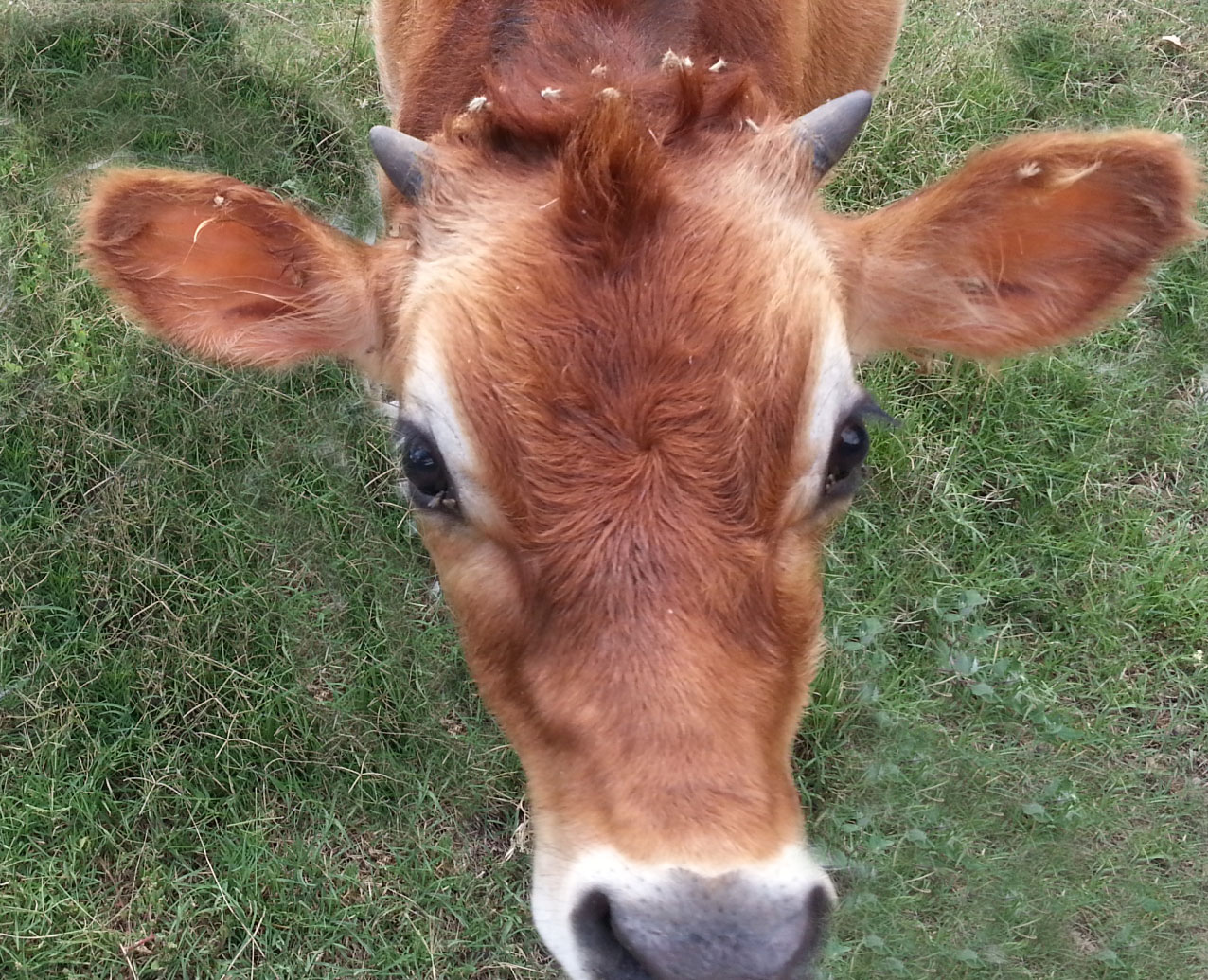 I was completely underwhelmed by the results. I consulted Laurie again, who suggested weaving a wreath of peppermint and putting it around June’s neck. Oddly, that instantly took me to an image of a Medieval illuminated manuscript I once saw. It showed a pair of oxen pulling a cart. Both oxen were wearing wreaths around their necks. The lightbulb went on over my head. Not some festive decoration, then! This was our ancestors trying to keep the flies off their livestock and, by extension, themselves. I have a bay tree. I wonder if a bay wreath would do the trick? This picture is of Brighty’s calf Georgie, who is wearing a crown of Horehound blossoms. That’s a possibility for fly relief as well, or it would be if the sheep hadn’t eaten all the Horehound on the property.
Of course, the real trick would be getting June to wear a bay wreath. Somehow I doubt she’d be willing to go there.
After the peppermint spray failed Laurie got creative. What finally worked was coconut oil mixed with a blend of essential oils: jojoba, lemon-scented ironbark (a type of eucalyptus), geranium, rosemary, jasmine sambak, and black pepper. Laurie spread a little on June’s forehead, on her spine and on her ears. I went out a few hours later and there were no flies on that cow. And she smelled good!
Then, because I had a pile of dried rosemary hanging out on my patio table, I made rosemary tea, thinking to use that as a base for another attempt at fly spray. Instead, I learned that boiling fresh rosemary in plain water is a wonderful way to freshen the air in your house. That, and it makes a great hair rinse. Ask Moosie, I’m sure he’ll agree. That #@$% dog rolled in the guts of something long dead and ended up in my bathtub. I figured the rosemary might work like fleabane, so I doused him with it after I’d finished scrubbing him. He smells much better and is presently fly-free.
As am I. Whew. But now I have to clean my bathroom. Ugh. Just ugh.
June 18, 2018
Summer is here
And how am I certain that summer has arrived? Because on Friday the temperature got over 100 degrees while Saturday brought us a lovely all-day rainstorm. It was overcast, drizzly, and cool, and I had all the windows open. Welcome to summer in Northern Arizona.
As much as I enjoyed the day, my new cow hated it. It seems that June is not only uncomfortable with the idea of grazing on that stuff she walks on, she doesn’t like it when that stuff is wet. She bellowed and complained all day. I finally gave in and provided her with another half-flake of hay. She was so happy that she hopped.
Who knew cows could hop? Then again, I’ve had pigs that skip, so why not a hopping cow? She quite literally put all four feet together, arched her back and hopped three or four times. There was no doubting it was a happy movement, and no words quite describe what it feels like to have a happy 1000 pound cow hopping ecstatically at you.
After she finished off that bit of hay, she attempted the same bellowing tactic a few hours later. That required me proving to her that I am also not a “dumb” animal. She finally gave up. Sunday arrived, warm and sunny, and much to my surprise she spent most of Sunday with her nose to the ground, grazing away. The same is happening today. I’m not certain if the rain made everything taste better or if she just got used to the idea of eating fresh grass instead of dry hay. Either way, whew.
 The next certain sign of summer is a blooming magnolia tree. I’ve mentioned my magnolia in the past, how it shouldn’t grow where it is–not just because this is Arizona, but because of our altitude and colder winters. Somehow, my home’s previous owner managed to find exactly the right spot for it. Mind you, he then surrounded that spot with concrete walls and walkways. It really shouldn’t tolerate it there. I thought I’d lost it in March when my usually evergreen tree began dropping its leaves by the bushel basket-full. That’s when I realized it probably counts on those winter rains we didn’t get this year. I threw the hose on it every other week, but still the leaves fell. Just when I thought for sure it was a goner, every one of those almost bare branch sent out bunches of new leaves. The massive white blossoms followed. Today, I stood under its still somewhat-denuded canopy and inhaled the unbelievably glorious perfume–citrusy, and so thick you could cut it with a knife. Whew, again.
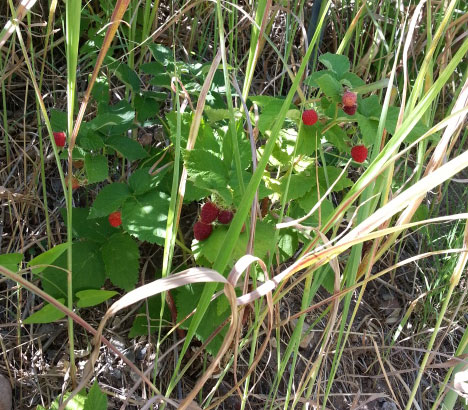 Raspberries in the Johnson grass
The last portend of summer is that I picked a quart of raspberries this morning. Okay, I picked a quart, but only a pint made it back to the house. One for me, one for the bucket.
Like the magnolia, the raspberries suffered over our dry winter. Although I lost quite a few of my bigger plants, I gained a hopeful carpet of six inch tall baby raspberry plants. If this drought continues, I’m either have to put some effort into that hillside or find a new home for my raspberry patch.
Hmm, maybe this fall I’ll dig up a couple dozen bushes, set them aside to overwinter, then put the sheep on the hillside. There’s plenty of Johnson grass for them. They can take everything down to the ground and do pathway maintenance for me. My little flock did a spectacular job cleaning up my mulberry hillside. For the cost of fallen mulberries, they flattened out three new paths, ate all the Johnson grass then started on the sorrel, which for some reason caused the sorrel to start spreading like crazy. That’s good for the ground and good for the sheep.
What surprised me was that the sheep also ate my one surviving rhubarb plant. Seriously! What animal with half a brain eats rhubarb without a pound of sugar as a chaser? Moreover, why rhubarb and not fennel? Fennel isn’t toxic while rhubarb is. I guess I should be glad I still have sheep.
That’s a whew for one last time.
June 11, 2018
June-bug
You know how some people are shoe fanatics, or have shelves full of bobble-heads, or collect those theme plates? Well, I’ve decided I’m an animal-aholic. It’s for this reason that I stay away from the “Farm and Garden” section of Craigslist.
I made a little slip last week. I was remembering the taste of homemade cheese and bemoaning the fact that I have to buy butter these days. I thought, why not? I’ll just look. Right.
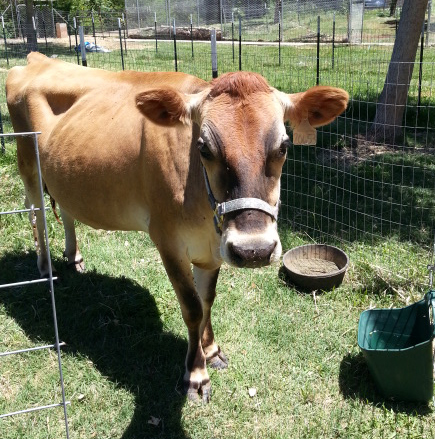 The ad promised a four-year-old Jersey girl exposed to a Holstein-Jersey bull. (Or maybe an Angus, but I’m hoping for spots.) Sweet-natured, good with kids, dry at the moment. I stared at her picture. Everything about her was right, her size, that Jersey face complete with the carefully drawn black eyebrows. Even her name was right. How could I ever forget that I’d bought June in June? As for the price, well it was better than right. It was PERFECT!
I couldn’t stop myself. I had to have that cow. So Friday June came home. Many thanks to Jim and Sharon for their help!
With June due in September I have three months to get used to the idea of milking daily again. I figured this would also give her time to get used to being pastured and eating grass rather than standing in a corral with only alfalfa. This is the third cow I’ve purchased who has spent no time on grass. It’s always interesting to watch them work out that the weird stuff under their feet is edible. June has made a point of trying everything, including spearmint and the water grass in the pond. She seems drawn to Silverleaf Nightshade. Luckily, it’s not in its poisonous stage just now and I recall that my cow Brighty also enjoyed it at about this time in her pregnancy. Hmm, I wonder what it has in it that they want?
Most importantly, I figured she and I would use the summer months getting acquainted. Silly me.
Just as when you buy a used car, when you buy a used cow she comes with her own quirks. Her previous owner did mention that June “always calls to us when we come out.” If I had been less infatuated with that pretty Jersey face, I would have heard, “She’s a talker.”
Boy, is she! I’m betting June was someone’s bottle-fed baby, or perhaps a 4H project. She’s very, very bonded to humans. Well, human women. Not so much human men.
This is good and bad. It means she’s easy for me to handle because she wants to please me. It also gives her the freedom to be interested in everything, because she utterly trusts that she’s safe because she has a human. The downside? Every time I walk away from her, I have a 1000 pound dog on my heels. And every time I close the gate on her, I see it in her eyes. She tells me she’d be just fine living on the porch with the dogs. When I don’t agree, she bellows for me. She bellowed from the moment I put her in the pasture Friday until well into Sunday afternoon. Just as an aside, the Foley guy for Jurassic Park used a cow bellow for the sound of the Tyrannosaur. I’m sure my neighbors were thrilled.
Okay, part of her noise was loneliness. She had a half-grown Angus bull as a buddy on her previous farm. All she has here are two dogs, one of whom made certain June knew he was her new favorite babysitter, and six snobby sheep, who don’t mingle with animals that aren’t their kind. June was completely unimpressed with the dogs, but, having been with goats, did her best to introduce herself to the sheep. They weren’t receptive. Instead, each time she got close enough to offer her nose the way we offer each other our hands, my little flock would scatter. I stepped in and have been penning the sheep into the pasture alley next to June at night, hoping that familiarity didn’t breed contempt. It may be working. Today, Mari and her little ones ran right next to June as they made their escape rather than hopping frantically in a wide arc around her.
Oddly, or maybe not, Tom has made a point of welcoming her, walking circles around his newest and largest hen with his tail fanned and his chest puffed out, informing her she’s now part of his extended flock. Unfortunately for Tom, June isn’t keyed into birds. Worse, my new chickens have never seen cow pie. I might have to teach them how to scratch through it. I need my little rototillers!
Listening to June all weekend almost sent me back to Craigslist to see if there’s another perfect Jersey girl meant to be June’s friend. I resisted with all my might. I’ve got piglets coming in three weeks and in only three months June will produce her own new best friend. As of today I’m not only hoping for a spotty little heifer but that June doesn’t teach her baby to talk.
June 4, 2018
Worm-free
I wasn’t a helicopter parent with my kids, and I’m not a helicopter farmer when it comes to my animals. I’d rather watch and wait to treat something until I’m sure the animal can’t handle it on her own rather than dose proactively. A couple of weeks ago the moment for treating arrived for Tiny, my oldest ewe.
Shortly after she gave birth to her lambs she began to look like she had Scours. That’s diarrhea to you and me. I started checking her eyes, pulling down her lower external lid to look at her internal eyelid. Checking that eyelid is a good way to see if they have blood-sucking internal parasites. At my first check, her inner lid was bright red. Anything paler than that means something is definitely amiss.
She kept having her problem and I kept checking. Everything was rosy for awhile. More importantly, none of the other sheep had the same problem and it seemed to me that if one sheep has parasites, they all should. So I attributed Tiny’s difficulty to her fiendishly clever ability to break into any place that has the food or goodies she loves–chicken food, black-oil sunflower seeds, and my gardens–but give her diarrhea.
At the same time I worked to tighten security, switching from bungee cord closures to chains, from chains to baling twine, etc. When I was certain she was finally locked away from everything, I checked her eyes again. Sure enough, this time when I pulled down her lower eyelid that inner lid was a pale pink. It was time for a dewormer.
The last time I’d used a dewormer on my animals I still had cows. It was an herbal mix that included cayenne, cloves, garlic, and a few other spices. As awful as it sounds, the package said it was good for fowl and all mammals, including humans. In the spirit of discovery, I gave it a try. It was horrible even if I mixed my dose into a cup of raw milk sweetened with my blackberry shrub. I held my nose and drank fast, and hated it except that it made me feel amazing.
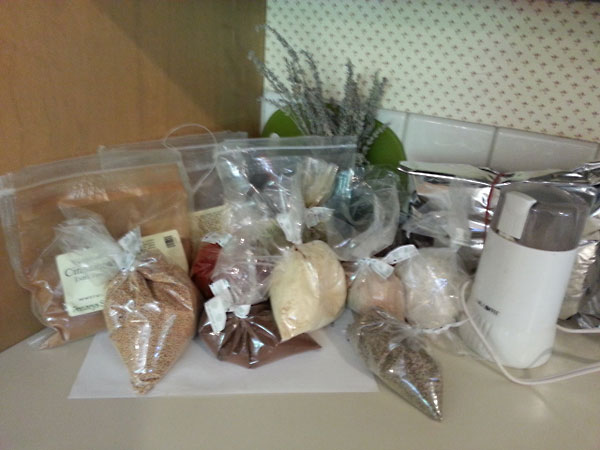 Piles of herbs and spices
So last week, I went online to find the same stuff and couldn’t, which was disappointing. Then I realized I had a freezer full of spices. Hmm. Was this something I could make myself?
I hurried to my favorite recipe book (Google) and did a search. Sure enough, I came up with mix that I thought was similar from a farm site where they also raise sheep. What caught my eye was the suggestion to make dosage balls with molasses. That seemed the perfect way to convince a sugar-addict like Tiny to take it.
I had most of the spices and herbs in my freezer or in the garden. I got the anise and psyllium at Mt Hope, my local co-op, and found the wormwood online with free next-day delivery. The black walnut hull wasn’t available for weeks, but after reading that it was dangerous for horses or pregnant animals, I decided to forgo it. This was, after all, an experiment. I figured the worst thing that would happen was the sheep would burp cloves and the parasites would live on, and I’d have to run to the feed store for a conventional dewormer.
That night I ground and mixed up the herbs and spices. Note to self: when grinding cayenne peppers, even in a grinder with no way to send the powder into the air, a mask is probably a good idea. Cough, hack. Even my nose burned.
The next morning I measured out what I needed to make the dosage balls for that day. I considered wearing gloves, then didn’t. It wasn’t necessary. This was gooey and nothing more. I went down to greet my unsuspecting sheep with a dose for both Tiny and Mari. The babies are still nursing so what their mamas eat, they get as well.
Tiny gobbled down her first dose. Yay! Mari sniffed and looked at me as if to say, “You’ve got to be kidding!” Dang.
That evening I came down with enough for both of them again. This time, Tiny turned up her nose and Mari turned her back. I was undeterred. I climbed the hillside and harvested Pakistani mulberries, then mushed the long sweet berries into the dose balls and tried again. That did the trick, but my hands were purple for a day afterwards. There had to be a better solution.
I tried more molasses the next day. They snapped up the morning dose and turned their back on the evening dose. Purple hands again.
The next day I looked in the cabinet and the light bulb over my head lit up when I saw the agave syrup. I added a drizzle over the balls and mushed it in. The result was very sticky–the doorknob of my barn door is still tacky– but it worked! Even Mari didn’t hesitate to snarf down her dose. That left little Rose looking up at me, wondering what she was missing.
That evening, I again coated the balls in agave, then had the even more brilliant idea to roll them in a little of the cracked corn I feed the chickens. You’d have thought I was offering them a bucket full of Pakistani Mulberries. Rosy demanded a bite and the other three lambs were crowding the fence, sniffing and begging.
It’s been a full seven days now and Tiny’s Scours are gone. I’ll dose her again starting with the new moon for another seven day course as I’m told that’s when the parasite eggs hatch. You know, I might just see what this stuff tastes like mixed with milk and shrub. I bet I still have to hold my nose.
(About food-grade Diatomaceous Earth (DE) First, this is not the stuff you use in your pool filter. Food-grade DE is totally edible if somewhat unpalatable. Okay, completely unpalatable. It tastes like chalk. I know this because I tried it. If you’re a human, it’s easier to take a Silica tablet. There’s been some discussion about how eating DE doesn’t really help with deworming because the DE changes in the digestive track. This may be true, but it’s not going into you to cut up the bugs the way it does if they walk through this on your floor. Instead, it’s delivering Silica to your system. Silica is a vital trace mineral that is presently missing in our food supply due to soil depletion because of our industrial farming practices. Since we’re all deficient in Silica, including our animals, adding it can only do them good.)
HERBAL DEWORMER
1/2 cup whole or powdered Cloves
1 cup Anise Seed powder (optional)
1 cup Cayenne Pepper powder
1 cup Cinnamon powder
1 cup Garlic (powder or minced)
1 cup Ginger Root powder
1 cup Mustard seed powder
1 cup Psyllium seed powder
1 cup Rosemary leaf powder
2 cups Sage leaf
2 cups Thyme leaf
2 cups Wormwood (do not use with pregnant animals)
2 cups food-grade Diatomaceous Earth
Mix all ingredients together and store in a glass jar. Keep in a cool, dark place. Dose animals for seven days, morning and evening, starting with the first night of the full moon. Repeat two weeks later with the new moon.
DOSE BALLS:
1/2 cup (8 Tablespoons) herb mix
1/4 cup (4 Tablespoons) flour to bind
1/4 cup Molasses (can substitute Honey OR use 1/2-2/3 cup organic Peanut Butter)
drizzle of light Agave syrup
enough cracked corn to coat
Mix all ingredients on a sheet of waxed papers, kneading with your fingers until it’s dough-like. Roll into a log and break into 12 even pieces, then shape them into balls. Separate out the number of balls for each animal’s dose, drizzle with agave syrup, then roll in cracked corn until coated.
The dosage is 1 teaspoon per 30 pounds or 1 tablespoon for 100 pounds. Each ball equals approximately 2 teaspoons. It’s better to overdose a little than it is to give too little, so err on the generous side.
Disclaimer: I’m offering this as anecdotal information. It’s not intended to diagnose, treat, cure, mitigate, or prevent any disease. The information on this site is based on the traditional and historic use of herbs as well as personal experience and is provided for general reference and educational purposes only. It is not intended to diagnose, prescribe or promote any direct or implied health claims.
The information and statements presented on this site have not been evaluated or approved by the FDA or USDA. The use of herbs and essential oil for the prevention, treatment, mitigation or cure of disease has not been approved by the FDA or USDA. I therefore make no claim to this effect. I am not a veterinarian or a doctor. This information is not intended to replace professional veterinary and/or medical advice. You should not use this information to diagnose or treat any health problems or illnesses without consulting your vet and/or doctor. I present the information without guarantees, and disclaim all liability in connection with the use of this information. Any person making the decision to act upon this information is responsible for investigating and understanding the effects of their own actions.