Denise Domning's Blog, page 3
June 22, 2020
Turkey Merger
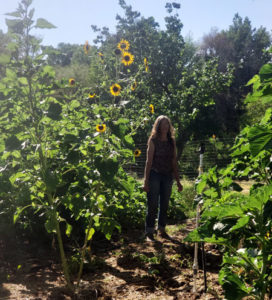
Before I talk turkey I want to offer a garden update. Between the high temperatures and me remembering to water, the first of my all-volunteer sunflowers are now over eight feet tall. I’m in the picture to give you perspective. Because most of my sunflowers are volunteers I doubt any of them will have the single broad head of their parent, which was the Evening Sunset Sunflower. I love that sunflower for its bright red petals. Instead, this second or even third generation will sport up to a half-dozen smaller flowers in all colors from the bright yellow of a traditional sunflower to yellow flowers tinged with rust to a few that are streaked with red and yellow. Not that the color of the flowers matters to the Lesser Goldfinches. They are the reason I encourage the sunflowers to volunteer year after year. These tiny yellow-and-black birds use the sunflower leaves to line their nests, eat the sunflower seeds right out of the heads, and, in the space between flowering and seeding, eat the aphids in my garden. It’s truly a win-win for everyone but the aphids.
Now onto the merging of the two turkey flocks, such as they are.
About three weeks ago I moved my new chicken tractor with my seven Blue Slate turkey poults into my middle pasture. My intention was to raise them in that tractor until the week before Thanksgiving, when they would make their way into my freezer. Much to my surprise by their second week in that pasture Tom’s turkey hens begin showing interest in the little ones. This is especially interesting because the little ones didn’t recognize that the hens were interested in them. Because they were hatched out of an incubator, then put in a cardboard box to make their way here, these babies have no idea how to speak Turkey. Oh, they speak to each other just fine, but another bird speaking that language? Must be a problem with an accent or something.
I watched Tom’s hens circle the tractor for a couple days then decided, with my fingers crossed, to let the little guys do some free ranging. The first day I let them out, they spent the day walking around their coop, searching for the door. Each time a chicken or turkey got close, they’d dart back inside the tractor. After a few days of this, they grew bolder. Still moving as if glued together, they explored the underside of the big white coop that is now the doghouse. By the beginning of week three, they were crossing the field to look at the breeding rabbits. I also moved Bitsy, Babs, and Buddy into that pasture for the duration of their sterile summer months. They seem to be enjoying both the pasture grass and the sheep, especially the lambs, who find rabbits equally fascinating.
That’s when Tom finally noticed the poults. All of a sudden last week, my ancient tom turkey was spending most of his day with them. He’s become very protective, charging at Radha whenever she appears even though she’s doing her best to ignore anything that looks like a turkey.
That dog. She just won’t give in and acknowledge that she can’t play with what belongs to me. Rupert has no trouble with this. He doesn’t bother the chickens, turkeys, ducks or rabbits. As for the sheep, he’s terrified of Tiny, who charges him any time he gets close to her lambs. Not Radha. She sees every threatening move made in her direction as an invitation to play. Still, she hasn’t killed anything lately, including the little bunnies. I wasn’t quick enough getting that bunny tractor covered in chicken wire and there were several more escapes. Radha was delighted to find them for us because she finally gets to chase something really fast. Although she put her mouth on both of the escapees, she didn’t hurt either of them, only held them for an instant then let them go. I’m sure she was hoping they might run again. Much to my surprise, although both rabbits squealed as she caught them, neither died. Instead, their siblings piled on top of them as if to comfort, and we still have all four.
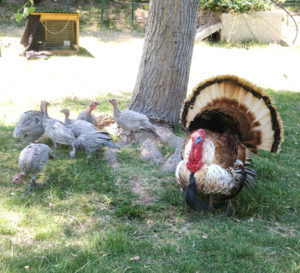 Today, as I watched Tom leading the poults around the pasture, I recognized my opportunity. I could move them into the back barn with Tom and his hens. That would give me an empty chicken tractor. So tonight at sundown, the poults were carried into the barn and settled together on a roost. One slipped off and headed for the chain link door, through which she could see her home. Tom came and stood with her until we fetched her back to join her nest mates.
Tomorrow, I’ll let them out with the other birds and they’ll head back to their previous home. Tomorrow night, they’ll again be carried from the tractor to the coop, and again the night after that. If they’re like all the other birds I’ve done this to, the fourth night will be the night they identify the barn as their new home.
And what’s going into that empty tractor? Why, my month-old Barred Rocks chicks. After what just happened with the poults, I can’t think of a better place to raise these guys, who I intend to live in the back barn, than in the field where my older hens can see them. The ducks will be so pleased to have these chicks out of the brooder coop. Since the ducks spend their day in the pond, I’ve been letting the little guys into their run while they’re gone. Those quackers have had their beaks seriously out of joint over this. They’ve taken to returning to their run three or four times a day to watch the chicks in disgust before going back to the water.
Tough luck, ducks. I have another set of chicks due to arrive at the beginning of July.


June 15, 2020
Too Many Tomatoes?
Is it possible to have too many tomatoes growing in your garden? I’d like to think not, but this year I may well discover the answer to that question.
Like every other gardener in the world (except my youngest sister), I love a fresh, home-grown tomato. This is saying a lot considering that early in my life I became allergic to tomatoes. Living was hardly worthwhile. Gone was the red sauce on spaghetti and pizza. Gone was chili, at least the way I made it. Salads lost their spark.
Years passed until, through the miracle of modern Homeopathy, I regained my ability to eat tomatoes–along with many other foods that disappeared as my immune system crashed. The moment that happened was the same moment I began to garden. If I was lucky enough to be able to eat tomatoes again, then they were going to be the best tomatoes in the world.
I spent many a happy year as a backyard gardener before I arrived on the farm. I acquired a reputation for having a green thumb. I even produced enough veggies to sell some at a few fledgling farmers markets. So, of course the first thing I did when I turned the earth up here was plant tomatoes. I was disappointed. Although I got some fruit, most of the plants didn’t do well. I put that up to deficient soil. My second year I bought Roma tomatoes. They did very well, well enough that I canned tomatoes that year, but again those that I had planted from seed never really flourished. This, when I’d built soil just for tomatoes.
It took a few more years before I recognized a pattern. Even though the recommended planting date for tomato seeds in the Verde Valley is February, bringing them on so early meant they stalled in June. That’s when I started planting my seeds in May, and had far better results. After that, I discovered that I loved San Marzano tomatoes best of all and that San Marzanos will joyfully produce well into October, and sometimes even November. And since I want to raise tomatoes I can put up for the winter, I turned my back on all those other varieties. But I always wondered what it was that happened to my tomato plants between February and June that caused them to fail.
This past winter, while chatting with my insurance agent who is also a farmer, I discovered the name for what was happening to my tomatoes. It’s Verticillium Wilt. Verticillium is a fungus that lives in the soil. Although many hybrid tomato varieties are bred to be resistant to it, the heirloom varieties that I usually plant don’t seem to be. This explains why those hybrid Romas I planted that second year did so well. As for fixes, well, I just happened to stumble on a solution that works for me. That’s to start my seeds in May or June rather than February, and keep my plants growing until the frosts close in.
That I have a bumper crop of tomato starts this year is due to the craziness of our world right now. I tend to be oblivious to what’s going on beyond my front gate. Thus, I was startled to discover that the places where I usually by my seeds had no seeds. Only then did it occur to me that people trapped at home with nothing to do might want to finally start that garden they’ve been talking about for years.
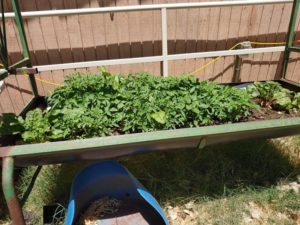 I panicked. I flew to the computer and discovered that it wasn’t just the stores that were sold out. That had me buying seeds (and pre-ordering meat chicks) from any place that would promise to send them to me prior to September. Since the varieties I liked best were almost all sold out–except for the San Marzanos, thank you God!–I bought varieties I’d never before tried. The picture shows my starts. Yes, that is a former feed trough for my dairy cows. It’s also the best starting set up I’ve ever had. In that trough is one package of Boxcar Willies, which are a mortgage lifter tomato, one of Pink Boars, one of Cherokee Purple, which I have grown before and was pleasantly surprised to discover wasn’t sold out, and two packages of San Marzanos.
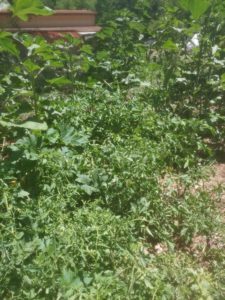 This picture is of my garden. There are Better Boys, started from six-year-old seed, purchased Romas, more Cherokee Purples and some Yellow Pears which seem to be succumbing to the Verticillium. That’s odd for Yellow Pears. They’re usually indestructible. There’s also some other potato leaf tomato variety in there. Unfortunately, I can’t recall the name. Maybe when I see the fruit, it will jar my memory.
So, I don’t know. Are two hundred tomatoes too many? Of course, I may be counting my jars of tomato sauce before they’re canned, but I’m pretty sure I’ll have at least a few. Those Romas are setting on like crazy.
June 8, 2020
Birthing
Any remaining doubts I had about Tiny, my oldest ewe, being pregnant (not just fat) were answered last week. Not that I had many doubts remaining, not after her udder swelled to the size of a volleyball. That’s the big giveaway when it comes to pregnant sheep. Just days before delivering, a ewe’s udder gets so swollen that she walks like, well, like she has a volleyball tucked between her thighs. Then you wait and watch until the ewe wanders away from the flock to be by herself as she gives birth.
I had already written my blog post last week when at 2 PM on Monday Tiny disappeared from her little flock. Thinking that the day was upon us, I’d purposefully put the girls in my neighbor’s upper pasture. It’s a small space and I can see most of it from the house. All the better to keep an eye on my now middle-aged girl. The moment I realized I couldn’t see her from the porch any more, I hurried through the gate and walked the length of the area. One side of the pasture is bordered by a steep hillside that leads down to the Mason Ditch. That area is covered in wild honeysuckle and paradise trees. (For those of you who aren’t from this area, paradise trees were imported from China by the miners in Jerome; they are stinky, allelopathic, and invasive.) If Tiny was down there, I was pretty sure I was going to hurt myself getting to her, or at least end up swimming in the ditch.
When I didn’t find her on the lower hillside, I walked the pasture twice more before I found her. She’d gone up instead of down. The other side of the pasture includes an equally steep hillside that ends at a fence that borders the road. She had tucked herself between that fence and a pine tree.
By this time, Mari, Tiny’s eldest daughter was complaining from near the gate between the properties. This was very unusual. Mari, who was injured early in her life, has always been quiet and shy. It took me a moment to understand. With Tiny sequestered, Mari was next in line for the role as flock bellwether. And if Mari was going to be in charge, then goldarn it, she was going home so she could eat as many mulberries as she wanted.
Ignoring Mari, I climbed up the hill then crawled under the prickly pine boughs through a deep layer of even more prickly pine needles to sit next to Tiny. She didn’t pay any attention to me. Instead, she got up, circled once, then scratched at the ground before laying back down. That’s the sign of active labor.
Ack. If she needed help, this was the worst place for her to be. Not only was the tree in the way, but the top of the hillside is so narrow that I had one hand on the fence to keep from sliding back down. But how to move her when she’d already decided where she wanted to be?
I had no idea, but before anything else happened I was going to need soap and water. Sliding down the hill I went to the gate. The instant I opened it, Mari raced through and headed down to where the mulberries are piled so deeply that everything in the vicinity is stained a dark purple. Behind Mari were the rest of the girls. From the pine tree came an almost frantic bleat. Tiny came slip-sliding down the hill. I could see it in her eyes. As much as she liked that spot, she didn’t want to be too far from her family.
Perfect! Right beside the mulberry is the gate that leads to my neighbor’s middle pasture, a long flat stretch of grass with no pine trees but plenty of shade. Sure enough, when I opened the gate to that pasture, Tiny darted in, moving a few yards inside the fence. I drove the other girls in after her, and watched as she found herself a nice shady spot. Within an instant, she was on her side, her legs stretched out and her neck wrenched to the side as her whole body contracted in labor. A few minutes later, she did it again.
I checked her, looking for tiny little hooves, because that’s what comes first. There was nothing to see. Well, she was only fifteen minutes or so into what’s usually a thirty-five minute process. Still, after last year’s birthing debacle I was concerned. I also was determined not to interfere unless I absolutely had to.
I went to get a bucket of water and a bottle of soap and returned with them and Christina. Tiny was again on the ground, pushing with all her might. When she returned to her feet, the water sack had finally appeared. She stood panting for a moment, then looked over her shoulder at me. “BAA!” she said forcefully, her gaze meeting mine.
This was not a plea for help, nor a cry of frustration. It was a command. Help me, dammit!
I blinked, shook my head, then said, “All right,” and soaped up my hands.
She stood perfectly still as I came up behind her. The water sack was now out and so was one of what should have been two tiny hooves. I stretched my fingers into the birth canal. Sure enough. The lamb had his/her second front leg folded, hoof tucked under its chin. I gently pushed the baby back the way it had come until I could catch the hoof with my finger. I straightened the leg and brought the hoof out to meet the other.
That was enough. Tiny contracted again. What should have pushed that baby out and onto the grass, didn’t. Instead, everything stopped again.
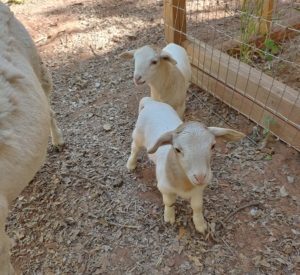 Tiny was watching me from over her shoulder. It was in her eyes. I was the answer to her problem. Clearly, she was waiting for me to solve her problem. So, once again, I gently pushed my hands into the birth canal. Aha. This was a very big baby with a very big head. Together, Tiny and I worked for a few minutes until her baby’s forehead had cleared the birth canal. Then I stepped back, Tiny gave a final push, and a little white and golden lamb with a pink nose and pink eyes dropped onto the grass.
Another albino! Now that was bad news. That pretty much said it was Tiny’s albino son who got to his mother. When and how that happened, I have no idea.
Tiny didn’t care how her lamb came into being. Giving sweet little grunts, she began cleaning her daughter. The little golden girl was on her feet in an instant. As she toddled unsteadily toward Tiny’s udder, Tiny gave a surprised grunt. Just like that, a second albino lamb, this one much smaller and grayer, dropped to the ground. Her little boy was much more delicate than his sister.
Together, Tiny and I got the little guy’s nose cleared and waited anxiously for him to find his feet. By the time he was standing, his sister had given her first little bounce.
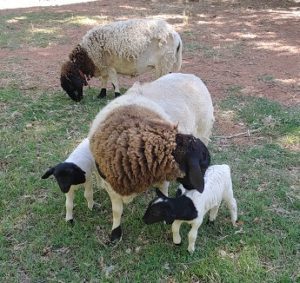 They’re a week old now and the golden girl is still dominating her brother. Three days ago, Rosie dropped two little girls without any help at all, God bless her. These are proper Dorpers, with black heads and white bodies.
It doesn’t matter that all these lambs are beautiful and healthy and strong. I can’t keep any of them for my flock, and that’s a hard lesson to take. Good breeding and good fences, along with carefully locked gates, are far more important than I ever imagined.
June 1, 2020
Rabbit Coop Failure
Firstly, I apologize for missing last week. Technology on the Farm got squirrely prior to the big weekend, and then got worse. By Sunday we had radio, tv, telephone, and internet silence. There we stayed until Wednesday. I thought I’d be able to write one after we were up again, but that was wishful thinking. My days are so full, there was no time for a catch-up blog post.
Now, onto my ‘scape artist rabbits. It’s not that these bunnies are particularly smart. No, it’s that cute little PVC coop I like so much. It just can’t hold my rabbits.
Yesterday evening, on my final round of the day when I double-check that everyone is settled for the night, I stopped at the baby bunny coop, lifted the corrugated top only to stare down in shock. An hour earlier there’d been four little bunnies. Now there were two. I swiftly scanned the coop, looking for evidence of how the two escapees had hopped the coop. There was no torn plastic chicken wire and its edges were still neatly tucked under the pvc frame. That nothing was out of place brought me down onto my knees for a closer look. Only then did I see it, a tiny mound of dirt. Under that was an equally tiny escape tunnel. I hadn’t noticed their efforts because these guys are still very little as is their tunnel. Moreover, the coop sat in deep grass that very nicely hid all signs of their evil plan.
Coming back to my feet, I swiftly scanned the grassy area between the garden and the brooder coop. I’d had a rabbit escape a few days earlier, one caused by a twist in that pliable chicken wire that had left a small gap. The little guy who managed to exit hadn’t fled for parts unknown. Instead, it traveled slowly around the area, moving from coop to coop as if to introduce itself to my other incarcerated animals. I caught up to it as it paused to study the day-old chicks in the brooder coop.
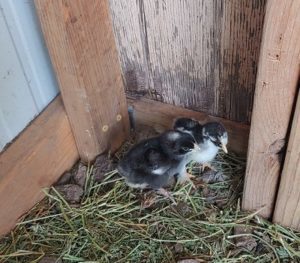 A barred rock chick along with the “surprise” cochin.
Twenty barred rocks chicks plus one “surprise” chick (which appears to be a feather-footed cochin of some kind) arrived on the farm on Friday. Like the Cornish Crosses that arrived a month ago (and already look like they’re four months old), these bits of fluff have proved incredibly healthy. None of them died during their journey and pasty butt has come and gone with no ill effects.
As I reached the brooder coop, the rabbit said goodbye to the chicks, then hopped slowly past the ducks, who watched both of us in suspicious silence. That’s when it realized I was behind it. Turning, it looked up at me as if to say, “Oh, there you are.” I picked it up and took it home to its siblings.
But this time there was no sign of the two bunnies anywhere in the yard. There was no flick of a white tail, no up and down movement of a gray butt through the sea of green. It was well into twilight now and I know two Great Horned Owls hunt the property at night. They sit on the house roof from time to time and talk to each other. I sighed, and chalked the loss of two rabbits up to a coop that was a monumental failure. With nowhere else to put the remaining two bunnies, all I could do was cross my fingers and move the coop to prevent additional use of whatever escape method the first two had discovered.
This morning I still had two bunnies in that coop, which was a relief, but no bunnies outside the coop, wanting to come home. I was certain that meant they were gone, especially since Radha had managed to escape the pastures and her sheep last night to sleep on the porch. This is because Bear no longer spends his nights in the pasture. My big, beautiful boy is slowly approaching his end, and I’ve been keeping him on the porch. While Radha was on the porch, looking guilty I might mention, her chew toy was still down in the pasture. The wrong pasture.
That had me scratching my head as I rescued Rupert. He followed me until we passed the garden, then put his nose to the ground and started circling the coops. This is not unusual as he’ll eat anything closely related to chicken or rabbit food. But when he wasn’t at my side as I started up for the house where his doggie breakfast waited, I turned to look for him. There he was, standing in front of the barn. About three feet from him was a perfectly whole and safe baby bunny. The rabbit looked up at the terrier, then calmly hopped into the barn through the gap I leave to let the barn cats come and go.
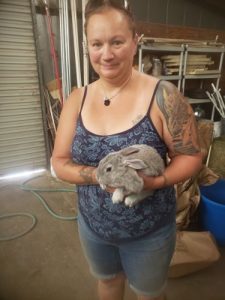 Gotcha! I raced down to the barn. With Rupert whining in complaint, I rushed inside and pulled the big barn door completely shut. The trapped rabbit was now calmly exploring the barn. Must have been the same miscreant who dug the tiny tunnel. I spread a handful of rabbit food on the floor near it. The bunny immediately started toward the food.
Sucker. An instant later, with the rabbit in my firm grasp, I turned for the smaller barn door. From the corner of my eye I caught a flash of white. Sure enough, it was bunny #2, aiming for the alfalfa.
Unlike the first, calm bunny, it took Christina and I, along with a flashlight and some serious moving of stakes, tiles, and leftover grout, to run that one to the ground. As of a half an hour ago, all four were cuddled in the coop, nibbling on broccoli flowers.
It’s definitely time for Plan B. I only hope I can come up with one.
May 18, 2020
Switchel
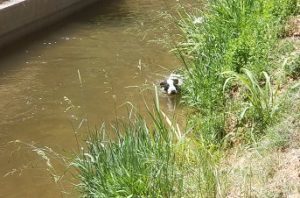 I was going to write about Rupert, who has become a swimming dog now that the temperatures have climbed into the 90s. He slides into the ditch and lets the current float him downstream for a bit, then paddles like heck, gets out and rolls in the grass…and, of course, then runs in joyful, cool, dripping circles.
Me, I’m still stuck on the temperature. 90 degrees! That’s July weather for us. If it’s that hot now, I hate to think what it’s going to be like in July.
It’s the hot, almost humid (for May, that is) days that made me want to post about Switchel. Until last week, I’d never heard of the drink and I’m now really sorry I hadn’t. It’s apparently been around since the 1700s. Some sources say it came from the Caribbean while others say it’s strictly an Colonial American thing. It was alluded to in one of Laura Ingalls Wilder’s books. Knowing that Johnny Appleseed was distributing his seeds so those living on the edge of the wilderness could have apples with which to make Apple Cider and Apple Cider Vinegar, I’m now thinking that those seeds he carried were meant for making Switchel.
I found the recipe while looking for ideas using black eyed peas, which have become a new favorite here on the farm. Out of that list my eye caught on the name: Switchel. I had to see what it was, and that was a concoction made from Apple Cider Vinegar, lemon juice, ginger, and a bit of sweetener, such as molasses or maple syrup. It’s called by a lot of different names, including Haymakers Punch or Switzel. Whatever it’s called, its purpose is to restore hot, tired field hands to full vitality. That’s right. This was the Gatorade of the 18th Century. No, it’s better than our modern replacement drink. Because Switchel is allowed to ferment for a day or two, it’s good for gut health. Two birds, one stone!
Since I’m often a hot, tired field hand I had to give it a try. Of course, I immediately tweaked it. I don’t tolerate lemons, or grapefruit or oranges, but I do tolerate limes and lime juice. Why limes? Who knows. I also didn’t have any fresh ginger. Instead, I used my my emergency back-up jar of preserved ginger, which is chunks of ginger immersed in sherry that I keep in the back of the fridge. It took 5 minutes to make. I happen to have a fermenting cap–it has an airlock and everything–so I used that while it sat on my counter. After it was done fermenting, I put it in the fridge with the ginger jar.
I was ready for my first glass the next day. I’d been breaking up clods of earth all morning. That’s a two step job. First, you break up the dirt, then you throw the bits of bermuda grass for Rupie to chase. He lives for that. At lunch time, I went straight for the jar in the refrigerator. I mixed Switchel with cold water (no ice, though), then took a sip.
My whole body sighed with relief. I LOVED IT! The glass was empty in an instant and the product worked exactly as advertised. I was no longer thirsty or tired. I went back out to the garden and finished the plot without suffering any of the fatigue the hot sun has been giving me these last weeks.
My first jar is gone already and I’ll be making more as soon as I finish typing this. I did a little research on the drink and found some great websites about it. Most of them are fun to read even if you don’t want to try the drink. Although the recipe on this one isn’t the one I’m using for now, start with this one from Cornell University: Switchel, A Time-tested, Thirst-quenching favorite
Here’s my version:
Switchel
1 quart Mason jar with lid
1 2″ chunk of organic ginger (if not organic, peel it to remove the chemicals in the skin)
the juice of 1 lime, pips removed and zested (or not)
1/3 cup Braggs Apple Cider Vinegar
1/4 cup maple syrup
2 cups hot-to-the-touch water. (Too hot and you’ll kill the microbes you’re trying to grow)
Chop or grate your ginger and put it in the mason jar. Add the lime juice, apple cider vinegar, and sweetener. Pour in water, cap tightly then shake vigorously to dissolve the maple syrup. If you’re not using a fermenter cap, loosen the jar lid so air can get in and out, then let the mixture stand on the counter for a day or two. The recipe I used said to strain the liquid into a self-capping beer type bottle, but since I don’t have any of those at the moment I left it in the jar and strained as I made my drink.
To make a drink, fill a glass halfway with Switchel, then add cold water or seltzer of club soda to taste.
To your health!
May 11, 2020
Teen Rabbits
Let me say, if you haven’t experienced life with a teenager of some sort, you just haven’t lived. I, unfortunately, have enjoyed that experience with human children (ugh), puppies (lordy, lordy), ram lambs (someone save me), and calves (OMG, I cannot believe you used your tongue to open that gate!). I am now officially adding rabbits to that list.
Yesterday at dawn I walked down to the front pasture and caught a glimpse of a gray butt moving at a slow hop around one of the adult rabbit tractors. My first reaction was panic. How had the mother rabbit gotten out of her house? Then my sleep-glazed vision cleared and I realized that wasn’t the adult rabbit. That was her half-grown baby.
Which, of course, only made my panic worse. Had I missed plugging a dip in the ground beneath the baby bunny coop? Had something broken into that (admittedly) flimsy PVC and plastic chicken wire house? Were the other three dead? If not, then where were they?
I stopped and scanned the field, then breathed with relief. One was near the coop, one was communing with Mama. There was one checking out the new meat chicks that arrived on Friday. The last one was…IN THE GARDEN EATING BEET GREENS!
That put wings on my heels. As I raced down the incline to the pasture, I wondered how in the world I was going to catch them. I shouldn’t have worried. I’m not sure if it’s because we handle them so much or if American Chinchilla rabbits are simply calm by nature, but when I walked up behind the garden bunny it acted as if it didn’t see me. Snatching it up, I took it back to its home.
Before I dropped it inside the coop, I eyed the structure. 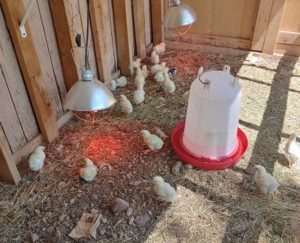 The roof was in place and solid. The plastic chicken wire walls looked fine and there were no obvious dips in the ground around the base of the coop. Lifting the roof, I put bunny one back inside, then bounced after the next nearest one, the one that had been unwilling to get too far from home after escaping. It only took a moment or two before I snagged it.
Putting it in with its sibling or cousin, I went to the rabbit watching the chicks. The bunny looked up at me as if to say, “Oh, there you are. Did you bring food?” That left only the one who was trying to return to its mother’s tractor. A merry chase ensued but it just wasn’t very good at that game and finally stopped to wait for me to pick it up.
As I took bunny number four back to the coop I discovered I’d already lost one of those in the coop. I glanced back at the garden. Sure enough, it was the beet green eater. Whoops. I’d missed something.
Returning the rabbit I was holding to the coop, I got down on my knees in the grass. This time, I examined the coop with my fingers as well as my eyes. There it was. A gash in the plastic chicken wire on one side. Wondering how that had happened (I’m a little slow in the mornings), I found a heavy chunk of wood and pushed it up against the gash. Certain this would keep the bunnies from using that tear as their exit strategy until I could finish my chores and fix the rip, I started my morning feeding.
Rabbit food is the fourth chore on the list–ducks, turkeys and chicks come first. By the time I returned to the pasture with a scoop of rabbit food, I realized that I was once again down a bunny in the teenagers’ coop. Yes, it was the garden bunny, aiming for those beets again. I again easily caught him or her. A little irritated, I returned it to the coop one more time and again examined the walls of their house.
There it was. A brand new gash in the front panel of the coop. I looked at the rabbit in my arms. “You little snort!” I told it. It was unimpressed with my irritation as it struggled to return to the garden of eatin’.
Now I was stuck. I needed to fix their coop but where was I going to keep them until I did? The big metal garbage can I’ve used to hold the four of them when I move their home wasn’t going to work, not when it was going to take more than a few moments to fix this problem. My gaze shifted to the presently empty chicken tractor. Wooden base, impenetrable hardware cloth for walls, three times the space, grass available for grazing at their feet. Yep. Just the ticket.
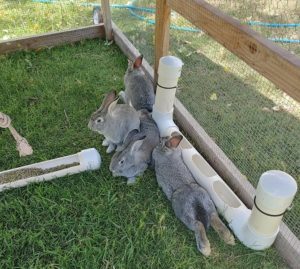 Within moments all four teenagers were in the chicken tractor. They examined their new enclosure with real interest and a moment later I saw my first rabbit binky. I’ll admit I didn’t know I was watching a rabbit binky or that there was even such a thing as a rabbit binky. A binky–when performed by a member of the cuniculus family– is a circling, hopping, joyful movement. Even though I didn’t know what I was watching, I did recognize what it meant, that the rabbit was happy and comfortable.
Only then did I realize how big these guys had gotten and how small that coop of theirs was. They wanted room to move and they were going to keep trying to escape until they got it. They needed to stay in that chicken tractor. That isn’t possible when I have thirty, four-day-old, bright, healthy eating machines in that brooder coop. In two weeks those meat birds will have grown enough to need their chicken tractor.
So the decision has been made. The PVC rabbit coop will be fitted out with heavier plastic chicken wire and used for the younger bunnies, who’ll be ready to leave Babs in a week or two. The teens will stay where they are in the chicken tractor, being moved daily to prevent them from digging their way out, until their new prison, uh, I mean coop, is completed.
In the meantime, I’m celebrating that these smart little brats aren’t big enough to reach the latch on the chicken tractor door.
May 4, 2020
Rabbits, Turkeys, and Gardens
It turns out Bitsy wasn’t pregnant. This confounded Christina, who was certain she’d felt little bunny babies in Bitsy’s belly. (Say that three times fast!) With an eye on the temperature, we put Bitsy in with Buddy three days ago. This is because Spring lasted a nanosecond here and we’re now in mid-Summer with temperatures daily reaching above 90. It seems that rabbit bucks go sterile at 95 degrees, Oddly, so do tomato flowers, whatever that means. But morning temperatures are still pleasantly chilly, reaching down to the high 40s.
I don’t know if that means anything. Does a buck simple snap back into virility when it gets a little cooler or does the weather have to stay cool for a week or two to restore fertility? Temperatures not withstanding, Buddy only managed to “fall off” Bitsy twice. That book of mine says you need three “fall offs” to guarantee impregnation. I guess I won’t know until the last day of May, which would be her due date if Buddy managed his end of the process.
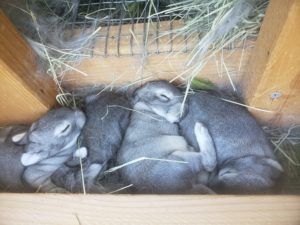 As for Babs, she seems to have taken a dislike to one of her little ones. While the other three are pudgy, little Number 4 is thin. When Number 4 tries to wriggle his/her way under Mama to nurse, Babs invariably moves away. Let me say that while 4 may be thin compared to her siblings, she’s definitely vigorous. They all are. Every day and with their eyes not yet open, these little guys wriggle their way from the back of Babs’ coop to pile together on the grass.
This may be the result of the heat. It could be just too hot in that rabbit fur-lined straw burrow of theirs, while the ground is cool and moist. Whatever the reason, they make out there every day, which gives me an excuse to pick them up. Lordy, but they’re cute!
Which brings me to the turkey poults. They are not cute, but then turkey babies are never really cute, not like chicks. Their beaks are too long and so are their legs. But in this case I don’t care about cute. I care about alive.
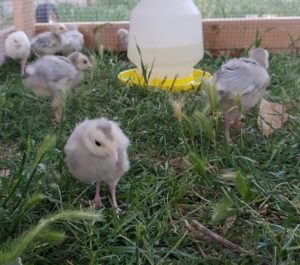 After consulting with my wise turkey-farming friend Lu, we came to the conclusion that the 8 dead poults all died of “starve off.” This is a condition that strikes some of the Heritage breeds, probably because of how they’re being bred as the breed is being restored. In the case of my little ones, their gizzards weren’t working properly and they ended up starving to death even while they were eating.
Although I’ve raised both Narragansetts and Royal Palms, and that mix of breeds that gave me Tom, who is some sort of hybrid of a Bourbon Red, I’ve never before seen this. Or maybe I have seen it, but didn’t recognize it because I had turkey hens to do all the caretaking. I’ve certainly seen poults weaken and die over the years, but never half of the hatch out.
I was down to eight healthy, happy poults when one managed to sniggle its way out of the turkey coop and ended up as a dog toy. With just seven left, I’m now thinking about keeping two to breed for next year, mostly to recoup the cost of these birds. That’s what I get for purchasing pretty rather than buying for purpose.
And achieving purpose brings me to my gardens. I’ve spent a huge amount of time with my hands in the dirt this past week. Those old seeds I planted have proved far more prolific than Buddy the Bunny. The beets are delicious! I’ve made my first batch of Beet Kvass with them and it’s ambrosia! Well, ambrosia if you like the dirt flavor of beets, which I do. We’ve had fava beans and peas with chard. I’ve used beet greens in omelets. Today it was black-eyed peas with fennel, carrots and kale from the garden, along with a bit of onion and Andouille sausage.
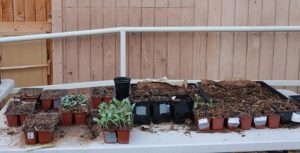 But it’s been the amazing number of old melon seeds that have sprouted that has me running in circles at the moment. All the Hopi watermelons and something called Allsweet watermelon sprouted. I think I got fifty plants from an old package of Italian Muskmelon seeds. There are easily thirty Gallia melon starts and an old package of pickling cucumbers has overfilled its tiny planter.
So much unexpected abundance has Christina and me tearing through my disused garden plots as we try to find space for them all. Thank heavens for the broad fork! When you absolutely, positively have to turn the earth, the broad fork is your friend. Weeds and bermuda grass has been removed. Garden steps have been relocated. I have muskmelons planted under the Pakistani mulberries. Both sets of watermelon sprouts went under the new English Chestnut tree that I put in the center of the old Hugel. Yes, I know I shouldn’t put them together, but I still have to find space for the cukes and the Gallias!
Argh! I’m driving myself crazy because I can’t stand to let a living plant die, especially one that is defying the odds. Then again, if even half of them live, imagine just how sweet my summer is going to be!
January 20, 2020
Waiting on Babs
There are going to be baby bunnies here on the farm! Despite Buddy Bunny’s lack of experience and a wayward sense of direction, he achieved what he was meant to do and created soon-to-be-born progeny. That’s right. Babs is due any moment.
And how can I be sure of this? Because two days ago I put the bunny birthing box into her coop and she went right to work. She started by pulling out her own fur and coating the loamy dirt and decomposing straw that I’d put into the cardboard-lined box as a base for her. She did this the night after she got the box. When I opened her coop the next morning and saw the tufts of gray fur, I remembered that the handy rabbit-keeping book I purchased said to be sure to give the expectant mother lots of fresh straw.
I don’t have straw, but I have plenty of fresh multi-grain hay. This hay is a mix of oats, barley and alfalfa and has been my favorite since I kept dairy cows. I love the fact that it sheds barley seeds everywhere, resulting in beautiful green stands of barley grass that all my animals enjoy.
So I put in a big handful of the hay and Babs went to work. She’d carefully gather a mouthful, using her tongue (I’m guessing) to get it nice and straight in her mouth until it looked like she had overly long green whiskers. Then, hop hop hop, she’d carry it into the private area of her coop then arrange it just as carefully as she when she put it into her mouth. This went on until every last bit of hay I’d given her was gone. I brought more. That went as well. She ignored the last handful.
The only other mammal on the farm that I’ve seen prepare a nest like this was Miss Piggy. She moved her hay a lot more violently, tossing it with her snout and kicking it with her feet, all the while grunting and complaining about her labor pains.
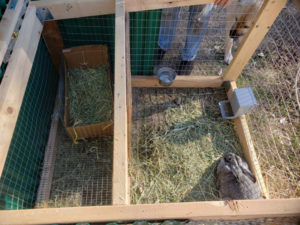 I checked that book, wondered if such feverish nest-making meant Babs was be ready to deliver. In fact, the author states that the pregnant does will only make a nest a few days before they give birth. This is why you wait until the last minute to put in the baby box. Well, Babs didn’t give birth last night. Maybe it will be today, which is day 31 of her pregnancy. This, also according to the author of said book, is the day on which all his does give birth.
I was hoping she might do it during the day, before it was time to write my post, so I could announce their arrival. But Babs is holding on to them. She’s eating but is calm. I just went down to check on her again. She was sitting out front and stayed still for a few pats, then once again went into the back of the coop. She rechecked her preparations, shifting a bit of hay one more time. If not today, then tomorrow.
As for Bitsy, she’s done absolutely nothing with her box except tear at the cardboard lining, then even lost interest in that. Either she’s not pregnant or she didn’t get pregnant with Babs, but instead on her second visit to Buddy, which the author suggests, just in case. I almost hate to take the box out. What if she’s one of those careless mothers who waits until the last moment to prepare the nursery? I’ll leave in the box. The worst thing that can happen is she makes a mess of the cardboard and I replace in twenty-eight days after she once again visits Buddy.
One thing is certain. I have 3 weeks to build that baby bunny tractor! Out of the gardens I go and back into the barn, where carefully sorted reclaimed wood awaits me. Nice!
January 13, 2020
The Return of Joy
Like the returning sunlight after the solstice, joy is beginning to once again creep over the farm. Bear is finally recovering from Moosie’s death.
I knew Bear had been mourning but I didn’t realize just how deeply we had been affected by Moosie’s absence. Much to my surprise, just like Radha, who was missing her sister, Bear’s return to joy arrived in the package that is Rupert.
I think the change must have begun the moment Rupert tried to protect Bear from Radha. I’m sure Bear was startled–if less amused at Christina and I were–at a puppy weighing about a quarter as much as he does trying to protect him. Rupert still does his best to take care of Bear whenever Radha turns her powerful exuberance onto the Big Boy. The minute she begins biting at Bear’s ear, her standard introduction to “Let’s Play,” Rupert thrusts himself between them, barking like crazy. However, I believe Rupert’s reaction now includes a plea that the two giants give up their over-sized play and find a game where he can be included.
This morning I watched Radha race across the fields toward me, moving at her usual, effortless 40 or 45 MPH. I glanced behind her, expecting to see Rupert (who looks more and more like a Jack Russell Terrier every day) doing his utmost (and failing) to catch up to her. This morning, he wasn’t running alone. Instead, Bear was at his side, keeping pace with him, a huge doggy grin on his gigantic face. Radha turned to meet them and it was the Clash of the Titans. Both big dogs rose onto their back feet, Bear’s mouth open in the pretense of threat, Radha growling as if she meant to kill him. As they battled, Rupert danced around them, barking happily when he wasn’t chewing on their ankles. Had anyone been listening, they’d have been certain one of the dogs was being eaten alive.
The play went on for a good five minutes, which is forever for Bear at his age. When Bear finally begged off, they came up to the porch as a pack and sat together, surveying the farm. Or rather, they watched the island across the creek, checking to see if the squirrels or that small herd of White-tailed Deer from yesterday were still there.
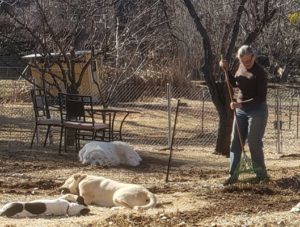 Bear has even begun to take the yappy new guy as a serious asset in farm management. Rupert, being a terrier, noisily reacts to anything and everything that might, maybe, could be, kinda sorta is a threat. These days, if Bear hears Rupert bark, he’s up on his feet, looking for the threat. Rupert is returning the confidence. The other night when Bear began to bark–no doubt at the raccoons that have steadily returned to inhabit the trees beyond the reach of the dogs– Rupert insisted on going down to the pastures to stand at the side of his Biggest Buddy, ready to take on whatever the threat was.
All I could do was grin, then sigh in pleasure. Not only do I have dirt under my fingernails again as the gardens take shape, but I have happy dogs, pregnant sheep, possibly pregnant rabbits, and one Tom turkey who refuses to give in to old age. That’s joy, indeed, and really, what else can anyone ask for in life?
January 6, 2020
A Few Warm Days
A few warm afternoons and all of a sudden everything is thinking spring has arrived. Of course, “warm” is subjective in this case. Since New Year’s Day morning chores have required me to walk out in temps below freezing. The sheep, Bear, the cars and the metal gates are all covered in frost. Before you worry about Bear and the sheep, they don’t notice they’re frost carriers. Indeed, Bear finds the warmth of the house uncomfortable this time of the year. The sheep would likely do the same, but I don’t let them in.
By the time breakfast is over sunlight is finally hitting the house. It arrives well after dawn here because we’re in a valley. As I watch the light spread out across the pastures and barns, I swear that everything alive breathes a sigh of relief and stands taller. Out of the brown remains of last year’s grass, new bright green blades are pushing their way toward the sky and they violets are unfurling their leaves. I’ve tried warning them that this is just a warm snap, that winter is sure to return before much longer. They aren’t listening to me.
Then the catalogs arrived last week. I got my Johnny’s Seed catalog first and spent at least two hours pouring over the contents. There’s a butternut squash variety that looks particularly good and my butternuts did so well last year. Ooh, there are delphinium and foxglove seeds! I love them. Hmm, I’ve always wanted one of those wonderfully overgrown English flower and herb gardens and I have just the place to put it. Yep, that’s definitely happening this year.
The Murray McMurray Hatchery catalog arrived next, just after I’d ordered my first set of meat birds. I again chose their version of the Red Ranger. Those birds did fabulous on grass with some of the roosters pushing ten pounds! Not needing any birds, I browsed through the catalog, enjoying the amazing images of beautiful fowl. Then I turned a page and found the turkeys. My heart quirked. I’ve missed having a flock of turkey on the farm. But as long as Tom’s alive I can’t have any other toms near him as they’ll kill him.
Then my gaze dropped to the bottom of the page, and there it was. The heritage Slate turkey that I’ve been dying to order.
Here’s a picture and the description:
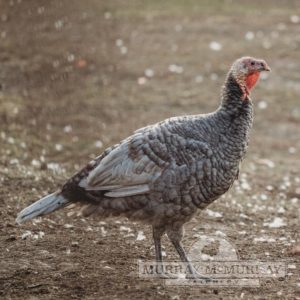 Blue Slate Turkeys are named for their ash blue coloring. Blue Slates — also called Blue or Lavender turkeys — can have a few black flecks on their feathering. Hens are lighter in coloring than toms. Like the Blue Andalusian, the blue gene can produce several colors: solid black, solid blue and blue flecked with black spots. Often Blue Slates are a combination of these colors.
The Blue Slate is a rare, Heritage breed fowl and a very old breed — recognized as a standard breed in the U.S. in 1874. These beautiful birds are medium-sized. Young toms will average 23 lbs., and young hens will average 14 lbs.
That’s it! I’m building another chicken tractor and putting fifteen of those turkeys in it! If they’re in the tractor, they can’t reach Tom. It’s a good thing I’ve got all that recycled wood in the barn. I set aside the catalog and quickly made a list of all the sizes of 2 x 4’s I’ll need for the frame. I’m almost positive I’ll only have to buy a few 12 foot boards. Tomorrow, I’ll sort the wood and figure out what else I need. Then I’ll design that garden and order seeds. I’ll build it with beautiful dark earth I can harvest from one of my veggie gardens, and the compost heap from the chicken coop.
Oh geez! I’m as bad as the grass and the violets, unfurling in a brief spate of warmth as I dream a crazy dream of spring.