Kevin Maney's Blog, page 5
November 5, 2023
The Very No Good Bad Technology That Almost Ruined Hockey
Now that the National Hockey League season is in full swing, we can be thankful that twenty years ago one of the most bizarre experiments in sports television crashed and burned.
No, I’m not talking about Battle of the Network Stars. This is about Fox Sports’ electronic hockey puck and the weird, glowing, comet-tail graphics it produced for the TV screen.
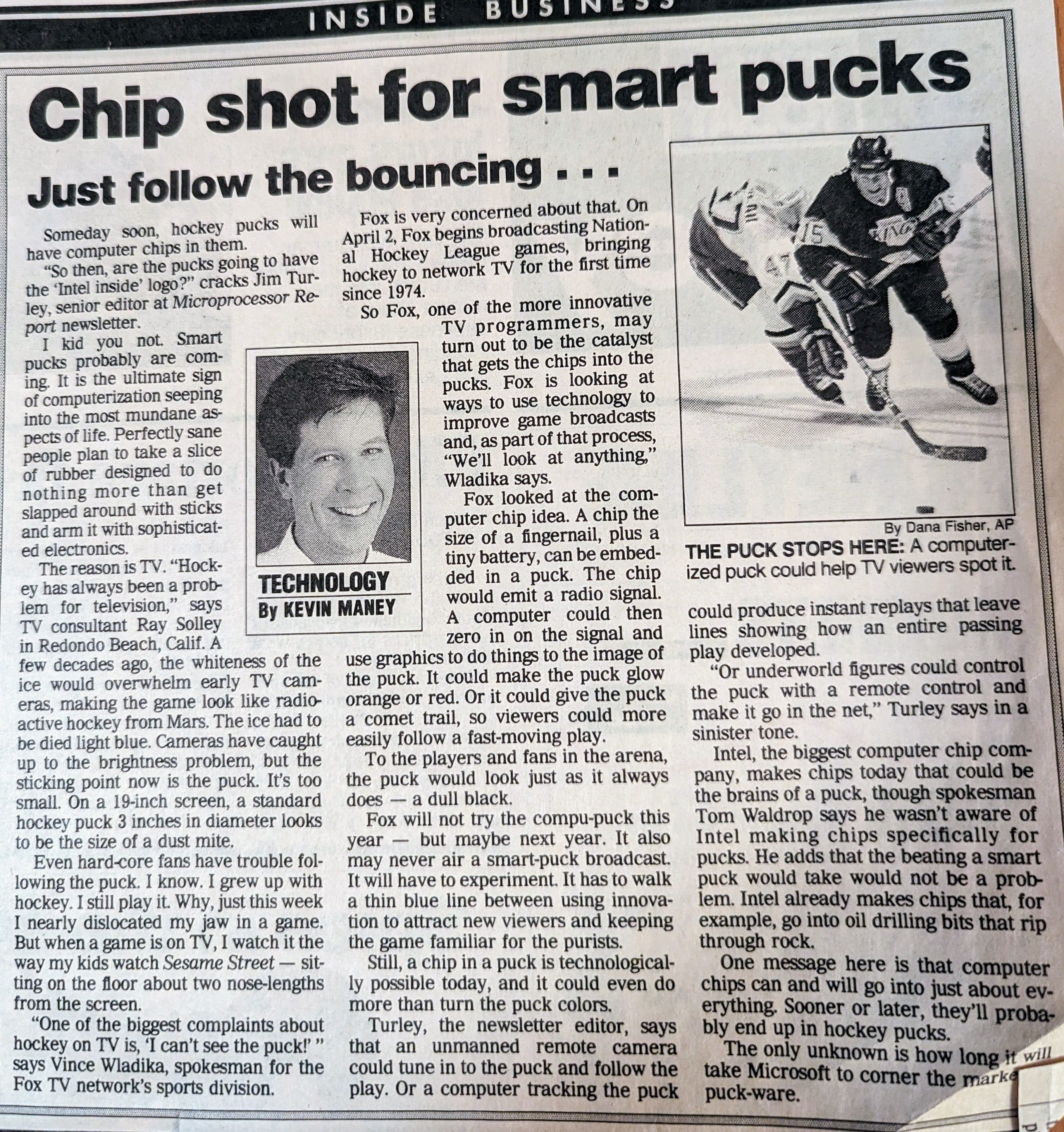
As a columnist for USA Today, I got wind of the concept in March 1995, ahead of most other media outlets. This was long before electronics did much to enhance our sports viewing – before we could instantly see if a pitcher hit the strike zone; before soccer players wore chips that track their movements on the field; before cameras and AI could tell if a tennis shot landed inside the line.
Fox had signed up to start broadcasting NHL games in April 1995 – the first time hockey would be on network television since 1974. Fox was worried that Americans were either too ignorant of hockey or too blind to follow the puck (or both) on a TV screen.
To be fair, 1995 tube TVs were nothing like today’s high-definition TVs. Some TV pictures were so fuzzy, if you had the sound off it could be hard to tell if you were watching Friends or a Congressional hearing. “One of the biggest complaints about hockey on TV is, ‘I can’t see the puck!’” a Fox spokesman, Vince Wladika, told me then.

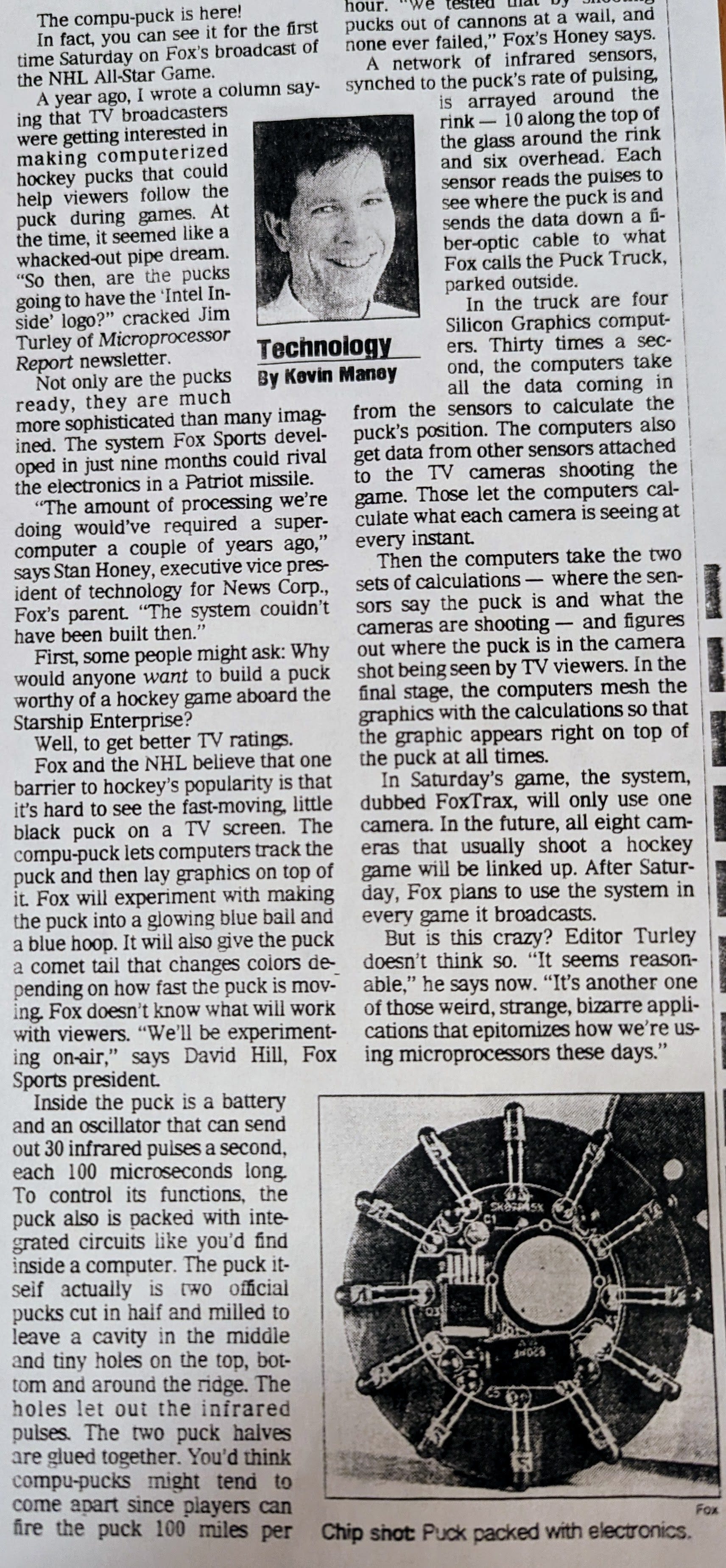
So Fox started looking at embedding chips in pucks, which would allow computers to superimpose graphics over the puck in order to make it easier to follow. In 1995, Fox was just tinkering. In early 1996, what I called the “compu-puck” was ready. Fox branded it FoxTrax.
To make it work, Fox cut pucks in half length-wise, scraped out a little cavity in the middle, and inserted a bunch of electronics that could generate 30 infrared pulses a second. Tiny holes around the ridge of the puck let the pulses out. A network of infrared sensors placed around the rink would pick up the pulses and track the puck. The puck had to be glued back together with some kind of super-adhesive. “We tested that by shooting pucks out of cannons at a wall, and none ever failed,” a Fox VP told me.
Old hockey fans will remember what happened next. Fox used the puck-tracking to make the puck glow with a blue halo around it – this was Fox’s answer to helping viewers see the puck better. When a player took a shot, an orange comet tail would swoosh behind the puck.
Neither seemed to do much to pull in new hockey fans, and the hockey faithful thought it was awful. It turned a game into a combination of live action and cartoon – as if a hockey game broke out during the Roger Rabbit movie. Greg Wyshynski, editor of Yahoo Sports’ long dead Puck Daddy blog, once told a journalist: “Imagine if you were watching the Super Bowl and every time the running back disappeared in a pile of tacklers he started glowing like a blueberry from Chernobyl.”
Fox didn’t actually kill off the compu-puck. In 1998, Fox lost the NHL broadcast rights to ABC, and FoxTrax disappeared. ABC apparently didn’t have any similar desires on glowing pucks.
Looking back now, FoxTrax was a victim of the adjacent possible – something that often happens to technology that gets too far ahead of itself. As Steven Johnson explains in his excellent book Where Good Ideas Come From, inventions that take off and are embraced by the masses land in a zone he called the adjacent possible – just a little ahead of what tech can do and a little ahead of what we as humans can adjust to, but not so far ahead that it seems weird or works too poorly. Getting too far ahead of the adjacent possible is what doomed Google’s glasses. General Magic ran into the same problem when it tried to invent the whole internet in 1992, before there really was a consumer internet.
But the adjacent possible always advances as technology gets better and we get comfortable with new inventions. The creators of the compu-puck went on to show how that works. They left Fox and started the company Sportvision, knowing that the basic idea of using electronics to enhance sports viewing would eventually be right. In time, Sportvision created the baseball pitch trackers we now see on every broadcast, the yellow first-down lines on NFL broadcasts, and a bunch of stuff for Olympic events. The company has since been acquired by SMT.
Once high-definition TVs hit the market, the need to artificially enhance the visibility of pucks for NHL games faded away. Instead, technology now can track pucks and players, generating data and probabilities that coaches can use for training and tactics. A couple of NHL teams use virtual reality for training.
But the glowing puck goes on the list of all-time dumb applications of technology, maybe a little behind shoe stores in the 1920s using X-ray machines for fittings.
These are the two columns - in 1995 and 1996 - that I wrote about the electronic puck. Neither are available online.


October 13, 2023
The Origins of "B2B"
It’s reassuring to find out that there’s at least one thing I know that ChatGPT doesn’t know. I asked it (I’m sorry, prompted it with) the question: “What was the first usage of B2B?”
The AI sputtered back, “It’s challenging to pinpoint the exact first usage, as it likely evolved organically.” It kept going with its reply, throwing a lot of nothing at me. Basically, ChatGPT was like an unprepared college student trying to bluster through an answer to a professor’s question in class.
Well, among the billion-trillion words ChatGPT has hoovered up and trained on, it had to have missed my old USA Today columns…because they’re not digitized. Big, big hole in ChatGPT’s knowledge bank.
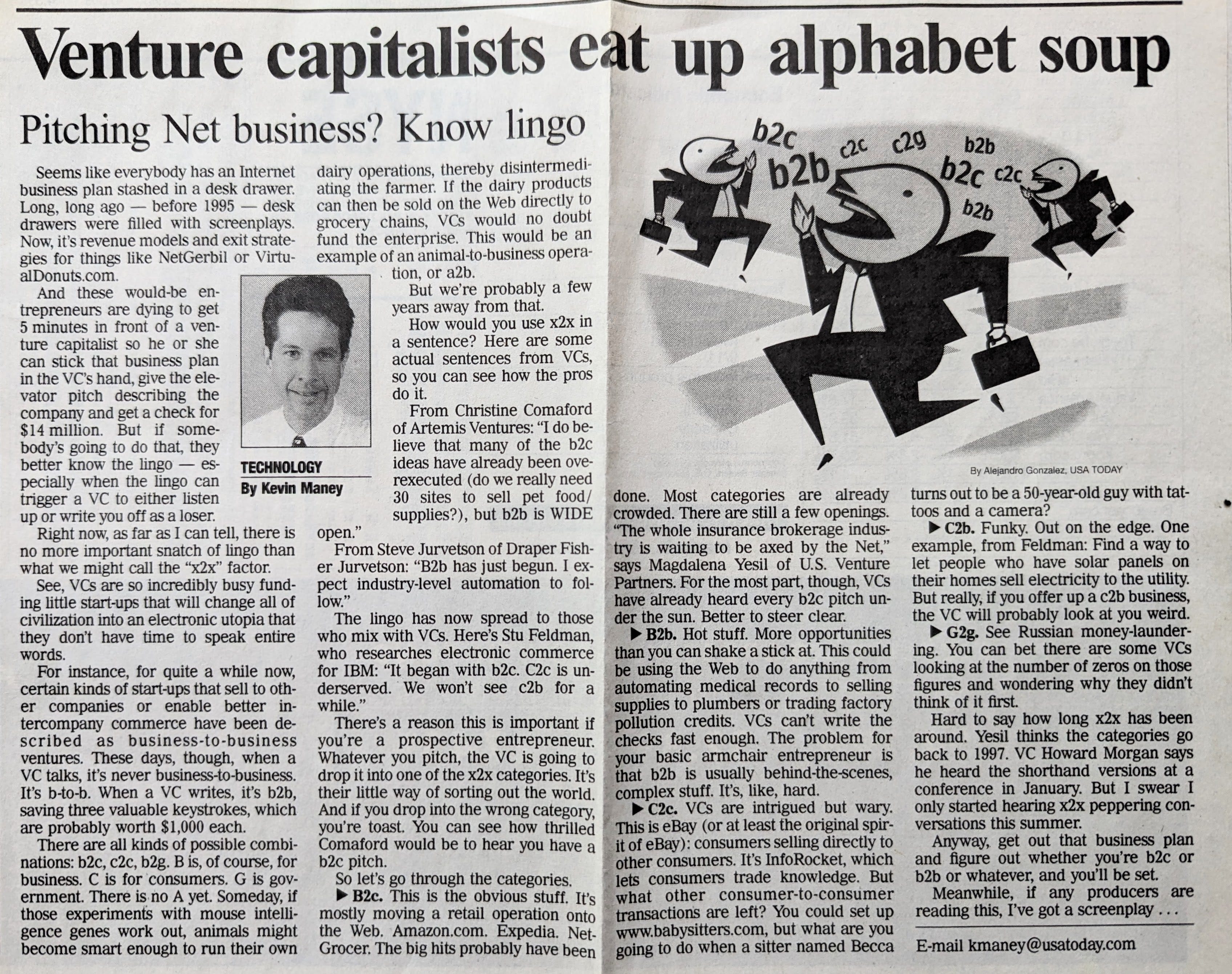
In the fall of 1999, I wrote a piece headlined, “Venture capitalists eat up alphabet soup.” This appeared amid the craziest insanity of the dot-com bubble, when internet fever was at its highest just before the crash of 2000. Major FOMO was in the air, and venture capitalists were writing checks for just about any entrepreneur who could figure out how to buy a URL.
Terms like business-to-business had been around for ages, but, charmingly, people in the pre-internet era had the luxury of time, and used to actually say “business-to-business.”
VCs in 1999 didn’t have any seconds to waste, not even on actual words. As I wrote: “These days, when a VC talks, it’s never business-to-business. It’s b-to-b. When a VC writes, it’s b2b, saving three valuable keystrokes, which are probably worth $1,000 each.”
And yes, at the time, people tended to write it as b2b, in small letters. Apparently b2b hadn’t yet hit puberty and grown up into B2B.
I also explained the emergence of B2C (business to consumer), C2C (consumer to consumer – you know, like eBay in its early Pez dispenser incarnation) and B2G (business to government – which is hardly ever heard anymore even though one of the hottest sectors right now is defense tech, which is solidly in the B2G camp).
One reason we can know that B2B was first used around 1999 by VCs is that before 1999, VCs didn’t see a lot of business-to-business startup pitches. Christine Comaford, then of Artemis Ventures, sent an email to me that I quoted. She said: “I do believe that many of the b2c ideas have already been overexecuted (do we really need 30 sites to sell pet food/supplies?), but b2b is WIDE OPEN.”
Steve Jurvetson, then of Draper Fisher Jurvetson, told me in mid-1999: “B2b has just begun. I expect industry-level automation to follow.” Another VC, Howard Morgan, told me he first heard the shorthand “B2B” at a conference in January 1999.
And then, of course, this kind of categorizing stuck and has since become a common part of the tech ecosystem lingo. It’s one of the first things you find out about a company – whether it’s B2B or B2C. The gulf between the two is huge in the way a company operates, how it goes to market, what kind of valuation it gets.
Now these labels are evolving into more complex formulations, like B2B2C – which indicates a two-sided business that sells to businesses on one side and consumers on the other. Amazon is an example. It markets its online marketplace to manufacturers and retailers who want to sell there, and on the other side sells products directly to consumers.
So, there you have it – a no-doubt-incomplete history of the term B2B. But it’s better than what you’d get from clueless ChatGPT.
Anyway, I gave the AI another chance – a new assignment. I prompted: “Can you make a joke that includes the term B2B?” I was ready to get back something incredibly lame.
It responded: “Sure, here's a B2B joke for you: Why did the B2B company bring a ladder to the meeting? Because they wanted to take their business to the next level!”
Has ChatGPT been training on Henny Youngman?
This is the column as it appeared in USA Today in September 1999. It is not available online.
August 23, 2023
Why There's No Market in MLB for the Knuckleball
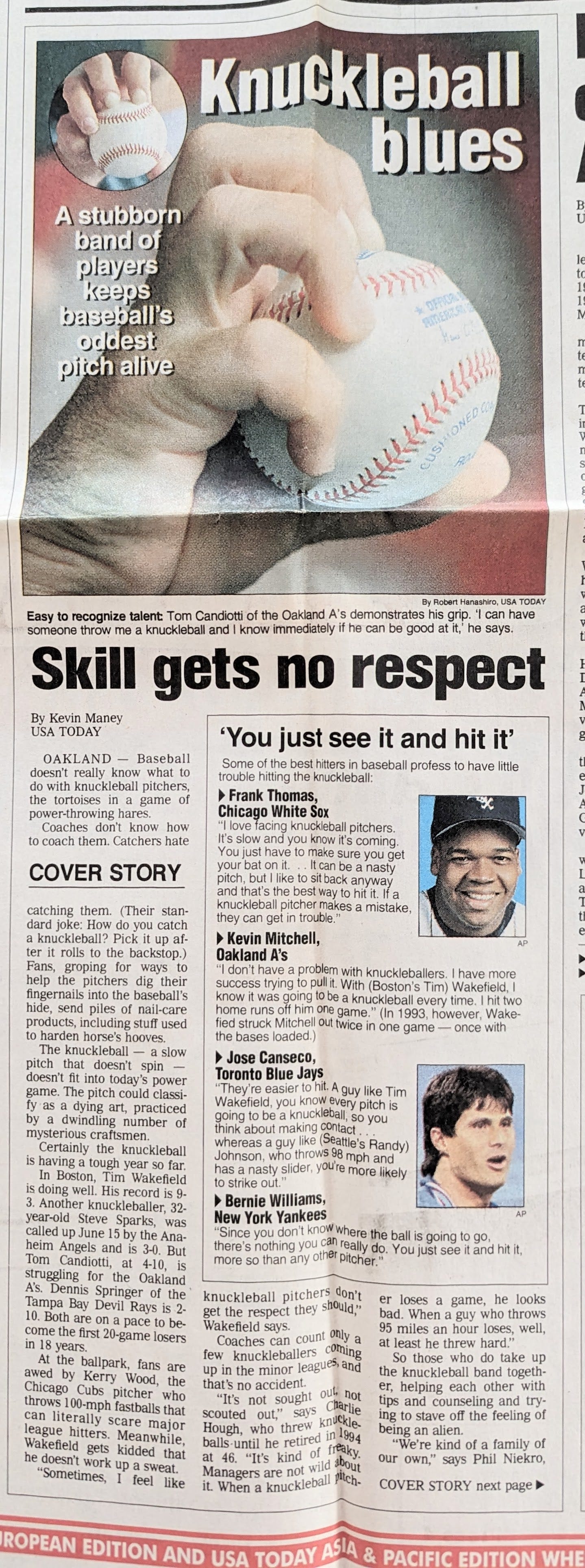
In my long journalism career, I only wrote one pure sports story – about baseball’s dwindling batch of knuckleball practitioners. It appeared in USA Today on July 2, 1998, under the headline, “Knuckleball blues.”
It’s one of my favorite stories, and I can draw a lesson from it for my work these days helping startups create market categories.
As in: Even if a product works really well, it will fail if there is no real market for it. (The “build it and they will come” philosophy generally does not work.) The lack of a market for the knuckleball is why there is currently one player throwing the knuckleball in the major leagues, even though a good knuckleball pitcher can be immensely effective.
To report the story, I traveled to Oakland to spend some time with Tom Candiotti, then a knuckleball-throwing starting pitcher for the A’s. At the time, there were three other knuckleball pitchers in the majors (Tim Wakefield, Red Sox; Steve Sparks, Angels; and Dennis Springer, Rays). I got to hang out in the A’s locker room before and after the game, enjoyed a brief chat with Rickey Henderson, and sat by the dugout during play.
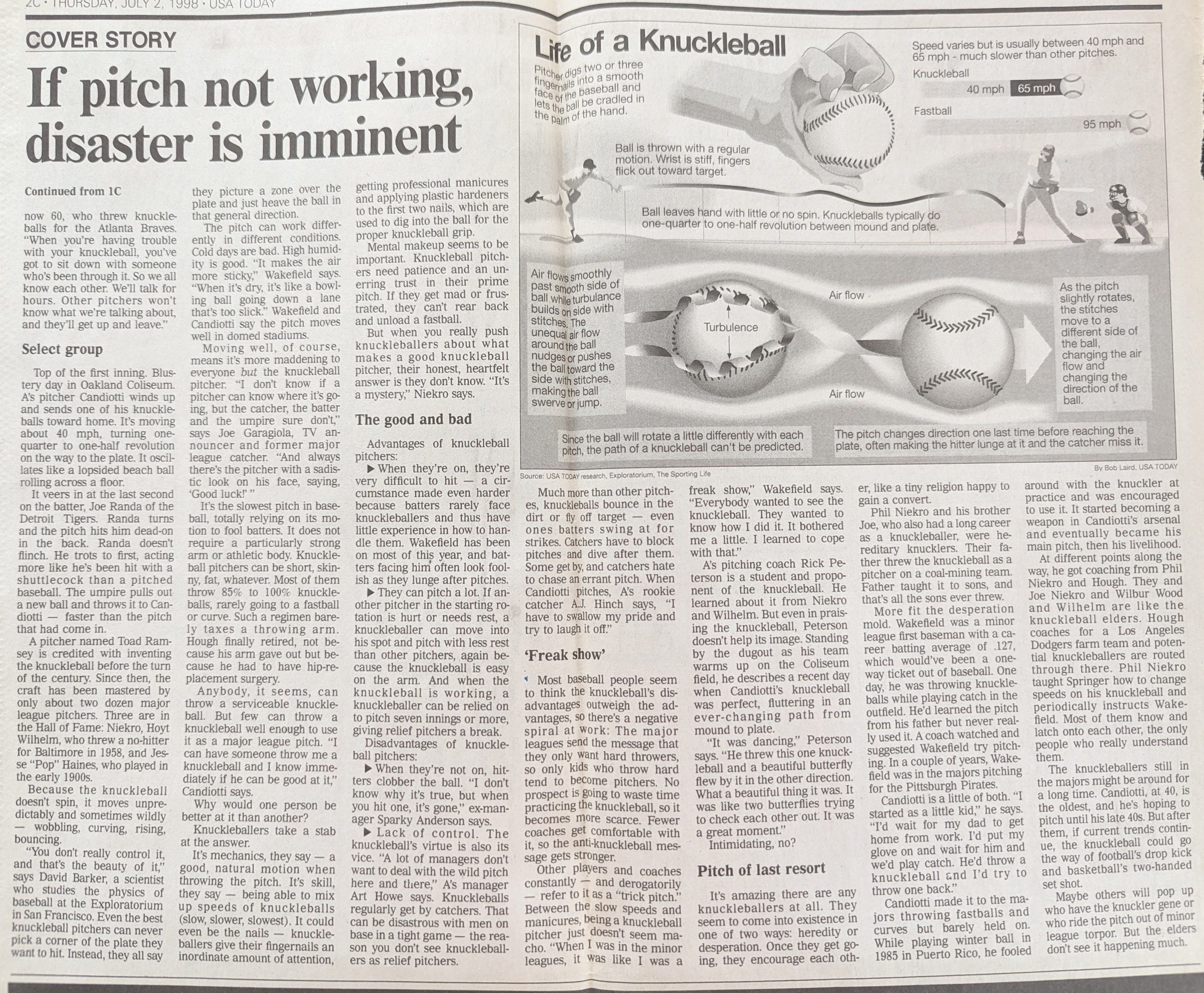
I witnessed and wrote about the slowest pitch in baseball. A knuckler clocks in at between 40 MPH and 65 MPH, in a game that values pitchers who fire fastballs that top 95 MPH. The knuckleball, as baseball fans know, doesn’t spin and wobbles unpredictably on its way to the plate, which is both its blessing (batters don’t know where it’s going) and its curse (the pitcher and catcher don’t know where it’s going, either).
I wrote about one moment in the game that captured a lot about the knuckleball. Candiotti was on the mound. Joe Randa of the Detroit Tigers was at bat. Candiotti wound up and tossed a knuckleball toward the plate.
“It veers at the last second on the batter. Randa turns and the pitch hits him dead-on in the back. Randa doesn’t flinch. He trots to first, acting more like he’s been hit with a shuttlecock than a pitched baseball. The umpire pulls out a new ball and throws it to Candiotti – faster than the pitch that had come in.”
I also interviewed knuckleball legends Charlie Hough and the late Phil Neikro. It turns out that knuckleballers stick together, for the same reasons the weirdo geeks hang out together in high school. “When you’re having trouble with your knuckleball, you’ve got to sit down with someone who’s been through it,” Neikro told me. “So we all know each other. We’ll talk for hours. Other pitchers won’t know what we’re talking about, and they’ll get up and leave.”
I had so much fun with this story.
I was, in fact, first drawn to the story idea because there’s something bizarre about the pitch’s demise in baseball. The knuckleball was invented, baseball scholars say, by a pitcher named Toad Ramsey in the 1880s. In all the time since, the pitch has only been mastered by about two dozen major leaguers. But, astonishingly, three of them (Neikro, Hoyt Wilhelm, Pop Haines) are in the Hall of Fame. So about 12.5% of all knuckleball pitchers became Hall of Famers.
Think about what that says about the effectiveness of the knuckleball. There have been about 20,500 players in major league history. If 12.5% of them made the Hall, there would be 2,562 Hall of Fame players. You know how many players are in the Hall? 270. Less than 1%.
Why, then, does the game just have one knuckleballer today, Matt Waldron of the San Diego Padres? And even he bounces up and down from the minor leagues. The pitch is blatantly effective. Knuckleball pitchers come with other attributes managers and front office types should value, like they can pitch more often because the knuckleball is easy on the arm, and they can pitch till they’re old. Candiotti was 40 when I interviewed him.
It comes down to market perception. The market has been conditioned to dismiss the knuckleballer in favor of flame-throwing fastballers. I explained it in the story:
“Most baseball people seem to think the knuckleball’s disadvantages outweigh the advantages, so there’s a negative spiral at work. The major leagues send the message that they only want hard throwers, so only kids who throw hard tend to become pitchers. No prospect is going to waste time practicing the knuckleball, so it becomes more scarce. Fewer coaches get comfortable with it, so the anti-knuckleball message gets stronger.”
If I look at that through a business lens, it sounds like some of the companies that build a really cool product, and then hardly anyone knows what to do with it. Think of the Segway – amazing piece of technology, but…who thinks about desiring a Segway? Unless you’re a mall cop or city tour guide.
And if that’s true, the situation for knuckleballers isn’t going to change even if another truly great knuckleballer comes along. In business circles, the only way to change this would be to condition the market – in this case, Major League Baseball coaches, scouts and executives – so it believes it needs knuckleballers. Maybe a knuckleball evangelist could launch an educational and thought-leadership campaign that makes the case for having a knuckleball pitcher in every starting rotation.
Yeah, that’s not going to happen.
But it is the only way attitudes would change. So, in all likelihood, the knuckleball will remain a remarkable oddity – the Segway of pitches.
Postscript: Candiotti today is an announcer for the Arizona Diamondbacks. He retired in 1999, and at the time ranked in the top 100 pitchers all-time in starts and strikeouts. He was also inducted into the International Bowling Museum's Hall of Fame on June 27, 2007. I can only wonder if he threw knuckleballs down the lane.
Phil Neikro died in 2020. Charlie Hough is 75 and lives in Honolulu. And Joe Randa, apparently unharmed by Candiotti’s pitch, works for a Kansas City Royals minor league team.