
Christine Valters Paintner's Blog, page 125
October 10, 2015
Abbey of the Arts has a new website! ~ A love note from your online abbess.
Dearest monks, artists, and pilgrims,
 This love note is more of an update on what is happening around the Abbey as we are celebrating many good things!
First, we have a brand new website up, thanks to the stellar work of Lacy Clark Ellman who is a Wisdom Council member and spiritual director, along with star graphic designer. Stop by our new site, and take a look to see what you think. The feedback has already been great about how fresh, spacious, and easy to navigate it is. If you find any broken links or odd formatting on pages we would be most grateful if you could let us know!
We have some new graphics to go with the website as well. First is a beautiful infographic version of the Monk Manifesto and also some great new buttons you can post to your website or blog: Monk in the World and I am a dancing monk. You can find them here for download.
Remember that we offer a free 8-week online retreat on becoming a Monk in the World. You can access that here. If you love the newsletter and the free retreat, let your friends know about the Abbey and invite them to sign up. Our work grows through word of mouth as we do very little advertising.
We are absolutely thrilled to report that six out of seven pilgrimage dates for 2016 are now officially full, including all of the Ireland dates. We do have a few spaces left for Vienna November 12–20, 2016, a magical time to be there as the Christmas markets start to appear. We also keep waiting lists for all dates and do get cancellations, so be in touch if there are some dates you want to join but are currently full.
I shared last week that my next (and ninth!) book is due out in the spring of 2016. You can pre-order Illuminating the Way: Embracing the Wisdom of Monks and Mystics here, and you can read a short excerpt from last week’s reflection here.
Next week I will be back with more reflections on the contemplative and creative life. For now I am savoring all of the gifts this work brings, the most significant of which is a connection with you. You help make up our thriving global community. You bring me hope and joy to know that others are committed to a path of slowness and beauty.
In the meantime, here are some articles by Christine you may have missed:
Writing as a Spiritual Practice
Monk Manifesto at On Being
Webinar on Pilgrimage at Ave Maria Press
Hard to believe but in 2016 Abbey of the Arts will be celebrating 10 years of online presence. We have some lovely offerings in store!
With great and growing love,
Christine
Christine Valters Paintner, PhD, REACE
www.AbbeyoftheArts.com
Monk Manifesto Infographic © Abbey of the Arts
The post Abbey of the Arts has a new website! ~ A love note from your online abbess. appeared first on Abbey of the Arts.


October 7, 2015
Monk in the World guest post: Monty Peregrine
I am delighted to share another beautiful submission for the Monk in the World guest post series from the community. Read on for Monty Peregrine's reflection on listening into silence.
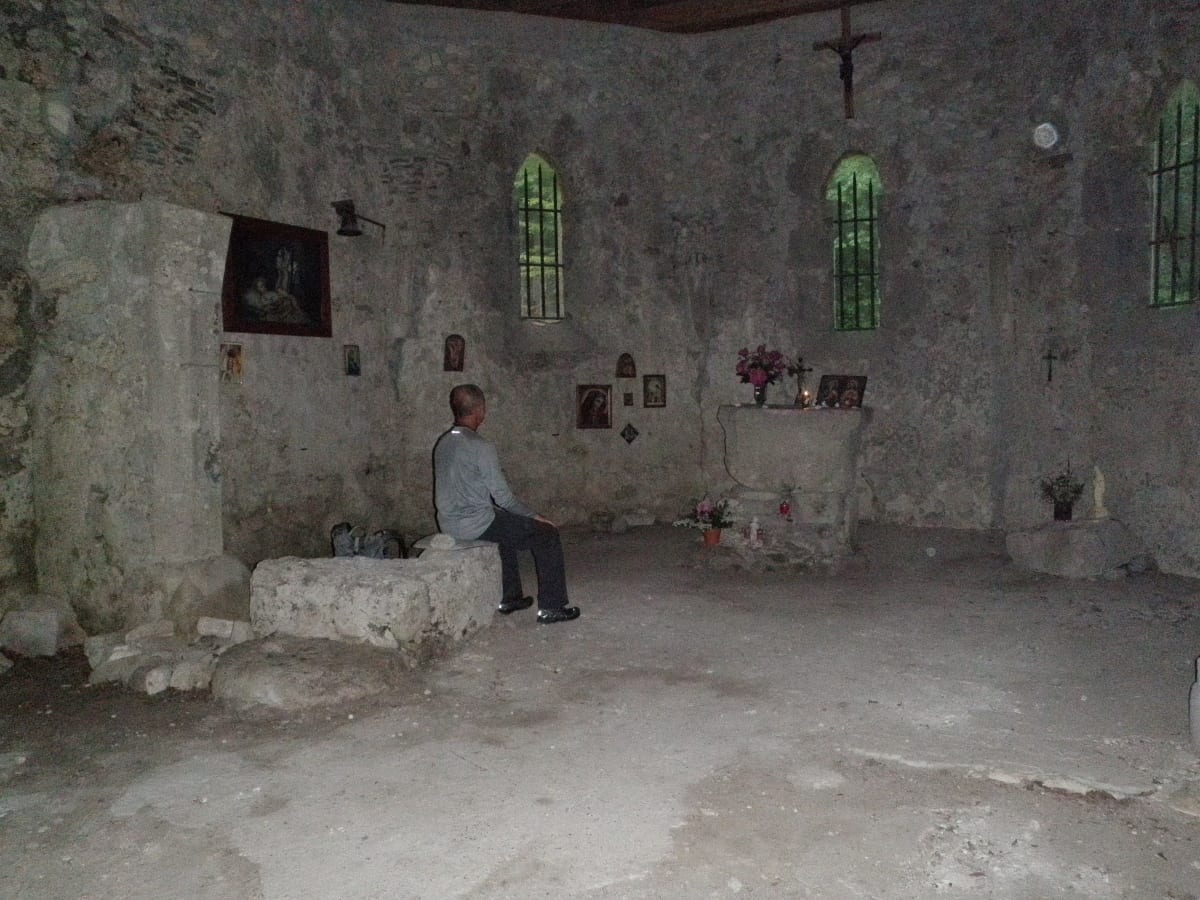
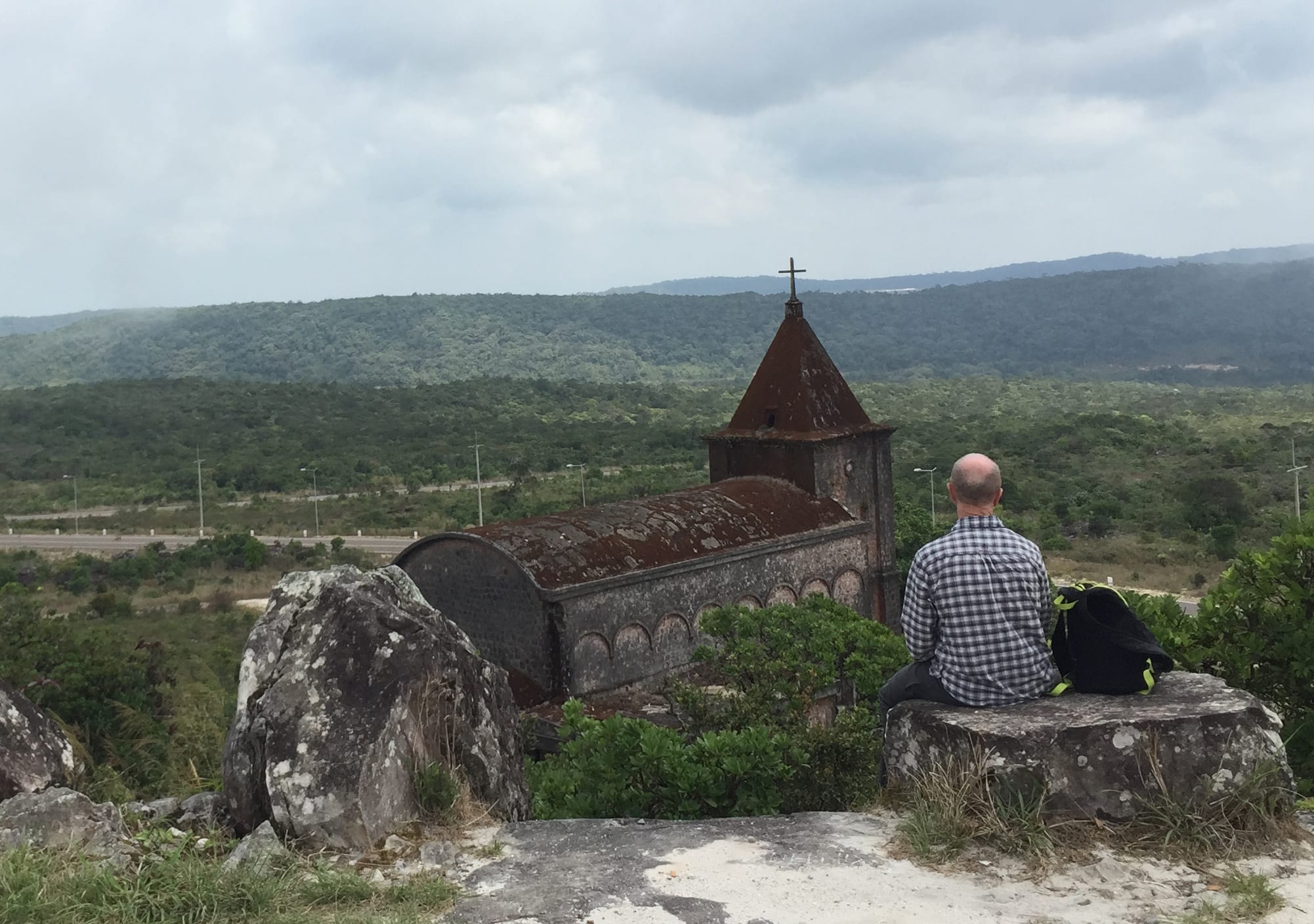
My path as a monk in the world has literally taken me out into the world. I’m called by God and blessed to travel internationally several times a year, praying for and with the overlooked and neglected people of our world. I’ve provided basic eye care for rural campesinos in a one-room, dirt-floored school in Honduras, shared a midnight meal of freshly slaughtered goat, local cheese, yogurt, and melons with nomadic herders high in the Fann Mountains of Tajikistan, prayed with an Ethiopian family in their round mud hut as the matriarch slowly roasted, hand-ground and then brewed coffee from family grown beans, shared early morning yak butter tea with Tibetan monks in their Himalayan monastery, listened to Bosniak Muslims share the heart-rending stories of violence and death during the siege of Sarajevo.
One aspect of my call is specifically to pray with and for people who live in areas that have been ravaged by war. To slowly, meditatively walk among them praying for peace and reconciliation. To bring healing words and prayers to deep, festering emotional and spiritual wounds. To see the real results of our wars, not the ‘talking heads’ version on CNN, Fox News, MSNBC, BBC or whichever slant you prefer. Some of these are old battlefields like the Walk of Peace trail in the Slovenian Alps where over one million men were killed in World War I. Many are from conflicts during my lifetime – the Ho Chi Minh Trail in Vietnam and Laos, the Sandinista-Contra conflict during the 1980s in Central America, the violent, bloody struggle for control of Tajikistan after the Soviet breakup. My pilgrimage into the world has also taken me into areas of current conflicts in Central Asia and the Middle East.
A few months ago my calling led me to hike a portion of Abraham’s Path through the country of Jordan. This pilgrimage was especially significant to me since Abraham is considered the father of my religion as well as the Jewish and Muslim faiths. Although we are all ‘people of the Book’ sharing a common patriarch, like jealous siblings, our enmity fuels much of the violence in the world today. The birthplace of these three religions seemed a good place to walk and pray for peace within the family. The blue United Nations tent camps of the Syrian refugees flooding into Jordan were a constant reminder of my call to prayer.
For several days we walked the same Jordanian foot paths that Abraham is reported to have walked thousands of years ago. We saw the very same mountains and deserts that he saw in millennia long past. Relatively little has changed for many of these people. We shared tea and prayers with Bedouin nomads who still live in goat hair tents driving their camels and goats from oasis to oasis. We visited ancient stone dwellings which have housed the same families for century after century. Of all the unique experiences my friends and I shared that week one stands out above them all.
On this day our hike led us to some ancient Nabatean ruins in the remote Dana Nature Reserve. We had spent the last few hours pondering 2000-year-old high cliff waterworks and ritual sacrifice sites. I actually sat and prayed in the small caves of Nabatean hermits and monks. But the highlight of this whole experience came, as they often do, with a casual comment from Saleh, our Muslim guide who claims descent from the Nabateans. As we walked along one of the ancient footpaths Saleh abruptly stopped, motioning for us to be quiet and still. I assumed he had spotted some elusive wildlife he wanted us to see, possibly a Syrian Serin or maybe a Nubian Ibex. Or possibly a poisonous snake we needed to avoid! As we stood there silent and still for what seemed like an eternity Saleh finally turned to us smiling with joy and whispered, “Listen into this silence”.
Saleh’s simple observation and statement cut through all the gibberish going through my mind. It brought me back to the present. It brought me back to an awareness of the presence of God and the awesome wonder of his creation, to the center of my being and my calling to live this silence. It brought me back to my calling to live as a monk in the world listening into this silence and praying the peace of this silence into the lives of those I meet.
 Monty Peregrine is a wandering pilgrim-monk whom Christ has called to pray among the nations. He serves as a team leader and staff writer for Extreme Missionary Adventures (XMA) where he has led over 160 volunteer teams serving in 34 countries around our world. You can find more of Monty’s musings at www.monasteryofthesoul.com.
The post Monk in the World guest post: Monty Peregrine appeared first on Abbey of the Arts.
New Monk Buttons to Share!
Fellow dancing monk, spiritual director, and graphic designer Lacy Clark Ellman of A Sacred Journey has recently helped Abbey of the Arts create a new website. In addition, she created these wonderful buttons you can share with the world to express your commitment! Also stop by the Monk Manifesto page where we have a beautiful new graphic version of those principles you can print out and post as a reminder!
The post New Monk Buttons to Share! appeared first on Abbey of the Arts.
October 5, 2015
Illuminating the Way: Embracing the Wisdom of Monks and Mystics available for pre-order
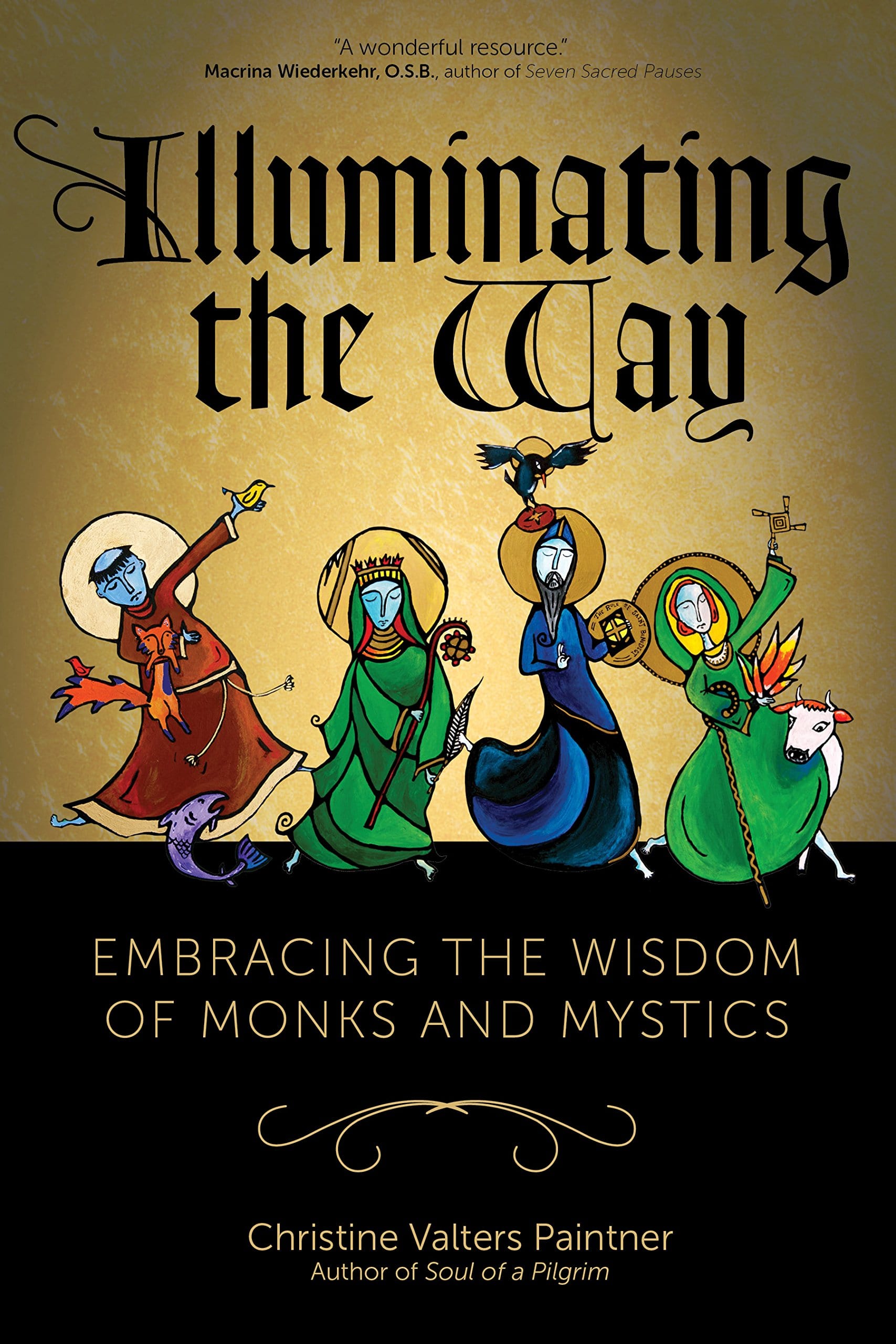 Christine’s 9th book will be released next spring 2016 through Ave Maria Press and is an exploration of 12 monks and mystics through the lens of various archetypes including Artist, Monk, Warrior, Healer, and more. The cover beautifully brings the dancing monk icon figures created by Marcy Hall to life. It is now available for pre-order on Amazon. When you use our links, a small percentage of the purchase price comes back to us at no additional cost to you, which helps support our scholarship fund.
The post Illuminating the Way: Embracing the Wisdom of Monks and Mystics available for pre-order appeared first on Abbey of the Arts.
October 3, 2015
Embrace your inner fool with Francis of Assisi ~ A love note from your online abbess
Dearest monks and artists,
In spring of 2016 my ninth book will be published through Ave Maria Press titled Illuminating the Way: Embracing the Wisdom of Monks and Mystics. I am very excited to offer this set of reflections on the 12 dancing monks that have become the patron saints of our Abbey and connect each of them to an archetypal energy we can discover within ourselves.
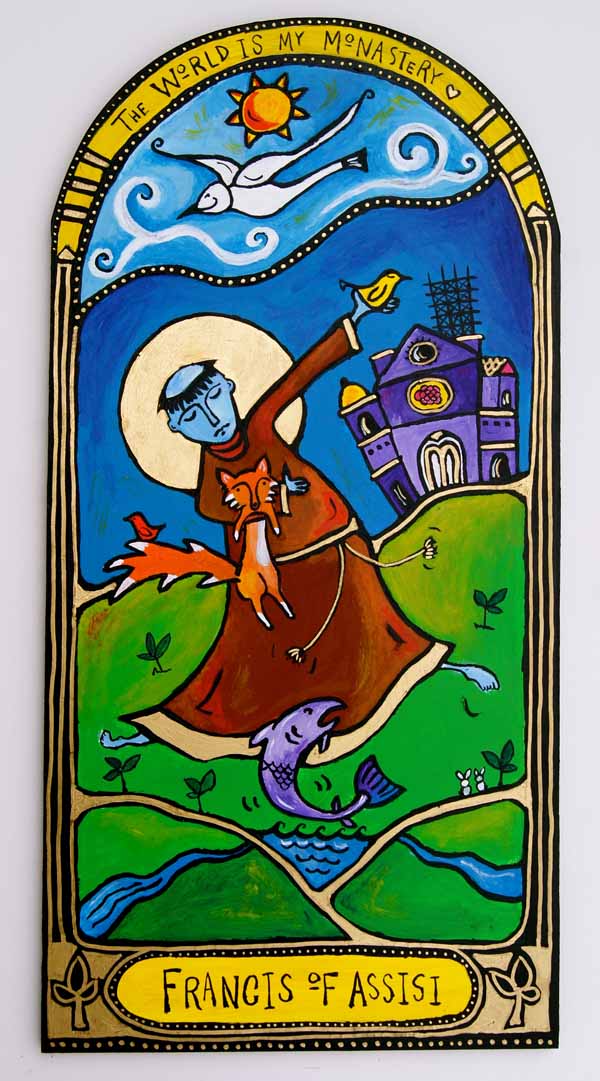 Today is the Feast of St. Francis, beloved by many for his passion for creation, his commitment to service and the poor, and his embrace of the inner Fool – that part of himself that turns the world on its head.
Here is a brief excerpt from my forthcoming book exploring the Fool in relationship to Francis:
“We are fools for the sake of Christ” (1 Cor. 4:10)
There are many aspects of Francis’ foolishness, from stripping his clothing publicly, appearing naked in the church, renouncing his wealth, befriending all creatures, and calling his community of brothers “fools for Christ” reflecting the words of St. Paul above. He tames a wolf and during the Crusades he walks unarmed across the Egyptian desert into the Sultan’s camp where he had every reason to expect his own death, a foolish act indeed.
We are always being called to new revelation and to see the world from another perspective. The inner Fool is the one who helps us to see things anew and to dismantle the accepted wisdom of our times. Paul also writes “Has not God made foolish the wisdom of the world?” (1 Cor. 1:20b) Productivity, striving, consumption, and speed are some of the false gods of our western culture. A life committed to following the Divine path is one which makes the world’s wisdom seem foolish, but conversely, the world looks upon those with spiritual commitment often as the ones who are “fools.”
This can be a challenging archetype for some of us as we often try to do everything possible so as not to look foolish. However, this archetype is the one which helps to subvert the dominant paradigm of acceptable ways of thinking and living. The author GK Chesterton, in his book about Francis of Assisi, explores the idea of Francis seeing the world upside down, which is really seeing it right side up, because we get a totally new perspective. There is a subversive act of truth-telling through the Fool’s humor and playfulness.
The Fool risks mockery by stepping out of socially acceptable roles and asks where are you willing to look foolish? Through the fool we find vicarious release for much we have repressed in ourselves. If we have always lived according to the “rules” or been overly concerned with how things look, the Fool invites us to break open and play. The Fool encourages us to laugh at ourselves, reminding us that humor and humility have the same root as humus, which means earthiness.
We activate the fool when we do something that others have a hard time understanding or accepting. I remember when John and I first began our move to Europe and we sold off or gave away our possessions, various family members and friends couldn’t understand different things we had let go of – how could we release our library of treasured books? How could I burn years of journals? How could John quit his secure job? To some, our choices appeared “foolish” because they didn’t fit their way of thinking about how you move through life. To others, they seemed liberating precisely because it was a different path chosen.
How does Francis call you to your own path of holy foolishness? What have you been longing to do but afraid of looking “foolish” to others?
With great and growing love,
Christine
Christine Valters Paintner, PhD, REACE
Dancing Monk Icon © Marcy Hall (order prints here)
The post Embrace your inner fool with Francis of Assisi ~ A love note from your online abbess appeared first on Abbey of the Arts.
September 30, 2015
Monk in the World guest post: Ally Markotich
I am delighted to share another beautiful submission for the Monk in the World guest post series from the community. Read on for Ally Markotich's reflection on recovering a creative practice.
I’m not sure when it began. Possibly winning third place in a community-wide art contest for the local Fire Hall in fourth grade. Or, maybe when friends and family would “ooh” and “aah” over recently created artwork. However, early on, I believed myself an artist. This label both delighted and concerned me. On my best days, time suspended as I created in the moment and on my worst days, I compared my art to others, insecurities running rampant.
Many days of my childhood were spent in my bedroom, a safe haven from the broken world lurking beyond. Drawing, reading and journaling – these were my friends. They were my sideline companions who let me be myself. Early on, I became aware of how art turned the corners of mouths, smiles rising. My artwork became my gift to others. I waited expectantly for large appreciation. When I was fawned and praised over, I gleamed. When the smile was not all I dreamed it would be, my being was wounded, a part of myself given never to be gotten back.I never wavered in my love and focus of art, and upon high school graduation, I packed up my room and headed to art school. But, four years of art school and countless critiques only left me doubting my artistic abilities. The smiles I yearned for upon gifting my art as a child became the approval I sought from fellow peers and professors in college. My worth became wrapped up in a wily world of overachievement and artwork made to please others. My expression of self folded and the flame I carried for art dwindled. I left college working in several lackluster environments with little creative freedom. I distanced myself from the term “artist”, not believing myself much of anything. I disengaged from the longing to create. Graphic design became a paycheck and not much else. I had entered the desert.
Three years ago, I found myself on an adventure I hadn’t planned. I was aching to know God better, and found myself sitting in an ‘Introduction to Spiritual Formation’ class. These three days away changed my course. While there, a stirring deep within began. I took another class. And another. These classes have expanded my way of being in the world. These times of retreat and learning have nudged me to explore my God-connection creatively. My soul was being awoken after thirteen years of wandering.
Arising from a sound sleep, the recognition of my longing to create began to surface. I gingerly bought a new sketchbook and some inks, fully intending to draw until my heart was content. As I made space in my days for this creating time, I found myself unable to stop pouring words into the sketchbook. Poems, prayers and writings sprawled. This surprised me, but led me to recall the many moments of journaling throughout my life. Journaling has always been my safe haven to express my inner life for noone else’s eyes. This sacred space often begins with anger and usually turns into prayer. With art, I’ve longed for smiles. With writing, I’ve longed to be me.
Nowadays, I’m exploring both art and writing. I’m allowing myself a place to create from within – some days drawing, some days writing. My art is colors and lines; whimsy and expression. There are days when I pick up watercolors or colored pencils, but, honestly, I have a long way to go with healing my former artistic self. I am more apt to write.
When I write, I often look back surprised at what I wrote. I won’t remember writing words, yet it speaks of my truth. This is my space to connect with God. To heal. To grow. To explore new concepts. When I write, I empty all the thoughts in my head and heart and pour out. In ways, it was obvious writing would bring healing – I have long been a writer when I’m struggling with life. Yet, writing feels a luxury to me; I’ve often withheld giving myself the space to write and explore. Now, I’m tending to my life by exploring journaling as a daily spiritual practice. This is giving me time and space to listen where I am each day.
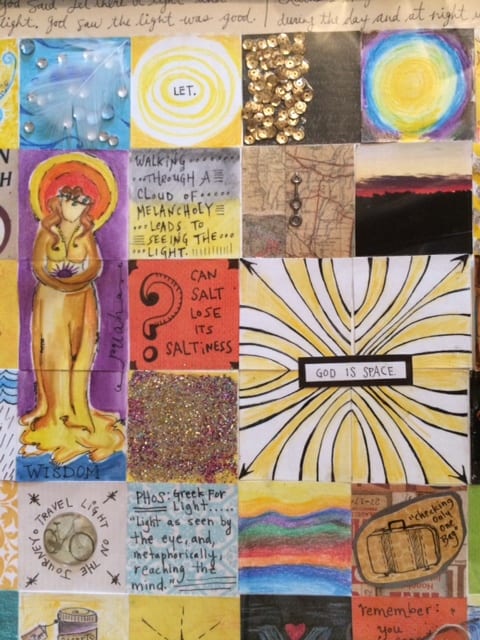
Where I currently sit is pondering how to weave faith and creativity in the tiny corner of the world where I live. I am taking small steps to share this new road I walk. I recently finished facilitating a small group weaving art, lectio divina and Scripture together. When we ended our group, we had bonded as friends, grown as creators and completed an individual 100-square mosaic based on our gleanings of light. In June, I began a website offering ideas for living faith creatively, a section of poetry, and a blog. Blogging has allowed me to expand my vulnerabilty and invite others to reflect on their lives. In addition, blogging about faith and creativity is freeing me from living divided. No longer can I claim to be pleasing anyone other than the one who created me. This is stretching me, releasing me from labels and the need to please.
As I travel the road, I am taking one step at a time. I am unsure where the road will lead, but I am committed to living as I am called. My simple hope as a monk in the world is to embrace my creativity so I can move forth encouraging others to creatively engage their life.
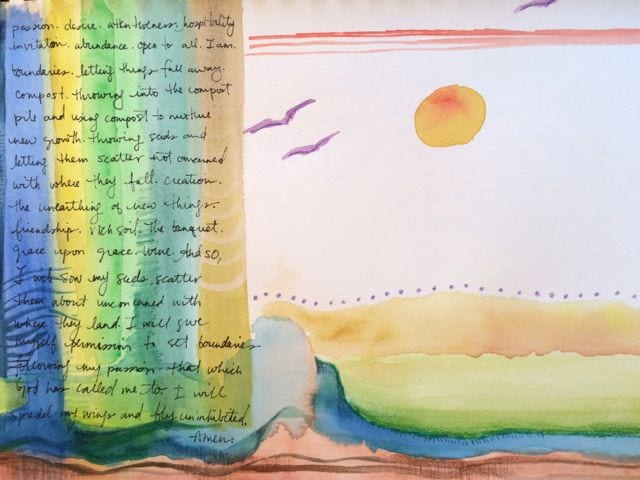
 Ally Markotich is a creative contemplative on a search for the sacred in the ordinary. She is currently enrolled in the Spiritual Formation program at Columbia Theological Seminary in Georgia. You can find more of her ponderings at www.allymarkotich.com
The post Monk in the World guest post: Ally Markotich appeared first on Abbey of the Arts.
September 26, 2015
Celebrate the Feast of St. Michael and Autumn Equinox ~ A love note from your online abbess
Dearest monks and artists,
Included in your love note today is a short excerpt from our current Sacred Seasons mini-retreat for the Autumn Equinox and the Feast of Michaelmas (register here to receive materials all year long to celebrate the turning of the seasons) written by your online Prior John Valters Paintner:
 “Do not fear, Daniel,” the Archangel Michael continued; “from the first day you made up your mind to acquire understanding and humble yourself before God, your prayer was heard.”
~ Daniel 10:12a
The Book of Daniel, named after the hero and not the author of the story, is set during the early days of the Babylonian Exile. It is more an Apocalyptic text than truly Prophetic work. The book itself was written during the Greek occupation of Judea and a time of great persecution (far more so than what the Jewish exiles in Babylon would have suffered). Placing the story in an earlier time and different place allowed the unknown author to avoid trouble with the authorities, but the original audience would have read past the ‘code’ to see themselves in the story of Daniel. (A similar style of writing was used in the Book of Revelation to avoid directly or overtly criticizing the Roman occupation and subsequent persecution.)
The message is one of hope in the midst of what appears to be total defeat. The idea is that since their ancestors survived the Babylonian Exile, the Jews under Hellenistic rule will also survive and one day be restored. The Book of Daniel is arguably the first true revelation about a life-after-death, a great judgment in the life to come.
The Feast of Michaelmas is located in the season of autumn, a time when the warmth and bloom of summer fade. The days are growing shorter and colder . . . and winter is still yet to come. Not only have things taken on a gloomier hue, if you suffer from any kind of seasonal affective disorder, the worst is yet to come.
This must have been how the Jews under the increasingly oppressive reign of the Greeks must have felt. Their ancestors had faced hard times, but perhaps none as hard as this. I can only imagine how difficult it must have been to imagine, let alone see the light at the end of that tunnel. They were in more need of God’s loving embrace than ever.
And so the Archangel Michael, the captain of an army of angels, the defeater of Lucifer, the defender of heaven itself, comes to Daniel – to each of them – and tells them not only not to fear, but that their prayers have already been heard and answered. He becomes an archetype of hope and invitation to surrender into trust.
How do you find courage to endure when times are dark?
A concluding note from Christine:
Autumn Equinox coincides with the Feast of St. Michael on September 29th. In general I am not particularly drawn to angels. Perhaps it is the way some are depicted. Often the sweetness of cherubs is a bit too cloying for me. They feel disconnected from my own experience.
But I do often find myself drawn to statues of St. Michael. Usually he is depicted as this strong presence with a sword and shield. He offers a sense of protection against the forces that threaten to overwhelm us. He invites us to invoke our own inner warrior to provide boundaries on our energy and commitments. I used to resist the idea of warrior, preferring nonviolence and peaceful solutions. But the warrior is an essential ally for us.
This feels a bit like autumn’s invitation as well, the call to remember our own limits as we move into the season of release. How does Michael call you to say no in the days ahead? How might a sacred no offer you the grace of renewal and replenishment?
With great and growing love,
Christine
Christine Valters Paintner, PhD, REACE
Photo: ©
The post Celebrate the Feast of St. Michael and Autumn Equinox ~ A love note from your online abbess appeared first on Abbey of the Arts.
September 23, 2015
Monk in the World guest post: Sherri Hansen
I am delighted to share another beautiful submission for the Monk in the World guest post series from the community. Read on for Sherri Hansen's reflection on composting as a spiritual practice.
[Jesus said,] “Very truly, I tell you, unless a grain of wheat falls into the earth and dies, it remains just a single grain; but if it dies, it bears much fruit”—John 12:24
Spring in Upper Midwest is highly welcomed after long months of cold dark nights and seemingly endless snow. As ice melts and the world becomes green, I never ceased to be amazed and grateful at this promise of rebirth. Like many gardeners, I am eager to get out in my beds and prepare for the new season. Gardening, for me is a spiritual and contemplative practice in being in the present moment. Each day brings the ritual of watering each plant, carefully pinching away spent buds, pulling errant weeds, and reveling in their fleeting beauty.
One of the most important parts of my garden is my compost pile. Compost builds biomass and adds nutrients to flower and vegetable beds. It also recycles compostable materials, keeping them out of rivers, lakes, and landfills. One of the many gardening tasks done each spring is to turn the now thawed compost pile to redistribute oxygen and moisture. This spring, as I raked and turned through the pile, I saw many fragments of flowers and vegetable matter caught betwixt and between the many stages of decomposition and I paused to consider the legacy it provided.
The compost pile seems full of dead foliage and long faded blooms, but it is a reservoir of memories of joy and happiness. It contains roses given to me on Valentine’s Day, irises given to me for my birthday, Christmas poinsettias and Easter lilies. In it are bouquets of flowers that graced my piano at the release concert to celebrate my first solo piano collection publication. The stems of basil plants, now blackened from frost, kept me well supplied for pesto throughout summer. Vegetable trimmings are souvenirs from home-cooked meals shared with friends. Peelings from bushels of apples, cucumbers and tomatoes testify to the work needed to create pickles and sauces to sustain through the long winter.
Yet there is sadness and regret in it, too. My compost contains flowers from relationships also dead and gone. In it are petals which bloomed “more brilliantly than Solomon in all his glory,” but were noticed only after faded from beauty. Brown, withered leaves abound from fleeting crimson autumn glory. Produce that was shoved to the back of the refrigerator and forgotten until spoiled reminds me to be more mindful of the amount I select to consume. The most painful reminder of death, however, were the flowers that once graced my mother’s casket and like we will one day, have returned to dust.
Yet numerous plants have sprouted from seeds to laid rest, often serendipitously. I discovered muskmelons in a flower bed one year and gently laid them to ripen in the summer sun of my sidewalk. I once noticed several unidentified plants from the squash family and was delighted when several varieties of winter squash appeared as well as giant orange pumpkins. For several seasons, plum tomatoes grew directly out of the bin, vines squeezing themselves out of the air vents and supplied all of my tomatoes for dehydrating.
In the Gospel of John, Christ says that one must die in order to gain new life. But death is not absolute. A seed dies and its outer coat decays to reveal new life within. But in order for that life to sprout and blossom, it must be nourished by the compost that once also began as seeds and now is recycled back to the earth. Joy and sadness mingle together to create life anew.
What is in my compost pile? Resurrection.
 Sherri Hansen, MD, OblSB, is a psychiatrist in private practice, a Benedictine Oblate, a church musician and composer, and passionate gardener in Madison, Wisconsin. You can learn more about her and her music at: www.sherrihansencomposer.com
The post Monk in the World guest post: Sherri Hansen appeared first on Abbey of the Arts.
September 19, 2015
The Call to Savor + Join us for Coming Home to Your Body ~ A love note from your online abbess
Dearest monks and artists,
Our upcoming online retreat for women Coming Home to Your Body starts on Monday, September 21st. I have been offering you very brief excerpts to ponder your own ways of contemplative embodiment. Here is the last installment:
 Only by welcoming uncertainty from the get-go can we acclimate ourselves to the shattering wonder that enfolds us. This animal body, for all its susceptibility and vertigo, remains the primary instrument of all our knowing, as the capricious earth remains our primary cosmos.
—David Abram, Becoming Animal: An Earthly Cosmology
One of my favorite poets is Rainer Maria Rilke. A central motivation of his poetry is to explore what it means to live this human life we are given, to discover the inner nature of my particular experience, knowing that this familiar life and body will not ever come again.
This life and body with which I wrestle, but have also grown so fond and familiar are not permanent. I had an encounter with the stark reality of my own mortality five years ago when I was hospitalized with a pulmonary embolism while traveling alone in Vienna, and that experience thrust me into a far more intense appreciation for everything in my life.
As I ponder this reality, a phrase begins to form: “savor this life and this body." Then a question began to shimmer: What if the meaning of my life is to experience my particular life, my unique body, my lens on the world, my encounters with grief and loss, delight and joy, but all as my unique story never to be repeated again? What might I discover by remembering this daily? How might my relationship to my own experience and to this wondrous vessel that carries me through it all be transformed if I not just offer gratitude for my life, but savor it with relish, knowing that this moment will never again happen. What if I were to honor my senses as the sacred thresholds that bring me into communion with the gift that I am in the world? And to trust that this moment carries profound wisdom I need to transform my service to the world.
In the winter days following my hospitalization, with my beloved husband who rushed from the States to be by my side, were incredibly sweet and rich. We walked hand in hand through parks with bare trees, so grateful to be together and be alive and again I found myself deeply in love with this man, in this moment, and I savored the feel of his rough skin against mine. I savored his gaze over at me, so full of love and familiarity. I savored the way his breath made a faint cloud with each exhale on that chilly evening. Food tasted all the more incredible and music so full of sweetness and longing.
Out of this near encounter with death arose a sense of urgency for me in my life. The things I have wanted to do someday, like live overseas, suddenly became much more important to pay attention to now (and was certainly part of the impetus to finally move to Europe a couple of years later as we had longed to do).
The root of the word savor comes from the Latin word saporem which means to taste and is also the root of sapient which is the word for wisdom. Another definition I love is "to give oneself over to the enjoyment of something." When I give myself over to the experience of savoring, wisdom emerges. Savoring calls for a kind of surrender. We have all kinds of stories in our minds about why we perhaps shouldn’t give ourselves over to enjoyment, whether out of guilt or shame or a sense of fear out of what might happen. Yet I would suggest that the monk is called to yield to the goodness of life, to bask in it. It is an affirmation and celebration of God’s creation and an echo of “that’s good” from Genesis.
Savoring calls me to slowness: I can't savor quickly.
Savoring calls me to spaciousness: I can't savor everything at once.
Savoring calls me to mindfulness: I can't savor without being fully present.
It also calls for a fierce and wise discernment about how I spend my time and energy. Now that I know deep in my bones the limits of my life breaths, how do I choose to spend those dazzling hours? What are the experiences ripening within me that long for exploration? Do I want to waste my time skating on the surface of things, in a breathless rush to get everything done when all I need is here in this moment?
There is also a seasonal quality to savoring – this season, what is right before me, right now, is to be savored. It will rise and fall, come into fullness and then slip away. When I savor I pay attention to all the moments of that experience without trying to change it.
And finally, there is a tremendous sweetness to this open-hearted way of being in the world. Everything becomes grace because I recognize it could all be different, it could all be gone. Rather than grasp at how I think this moment should be, I savor the way things are.
Would you like to savor life more deeply in a community of kindred souls? Join me this fall for the journey home again: Coming Home to Your Body: A Woman’s Contemplative Journey to Wholeness. The retreat starts tomorrow! My apologies to the amazing men monks in our community. You will be warmly invited to join us for the Advent online retreat.
With great and growing love,
Christine
Christine Valters Paintner, PhD, REACE
Photo: ©
The post The Call to Savor + Join us for Coming Home to Your Body ~ A love note from your online abbess appeared first on Abbey of the Arts.
September 16, 2015
Monk in the World guest post: Linda Lyzenga
I am delighted to share another beautiful submission for the Monk in the World guest post series from the community. Read on for Linda Lyzenga' reflection on the practice of hospitality in the face of illness.
I had no idea when I signed the Monk Manifesto here at Abbey of the Arts three years ago how a broadened, deepened practice of hospitality would free me from much struggle and anxiety.
Seven years prior, following St. Benedicts example, I had written my own rule of life when I began a course in spiritual formation followed by a spiritual direction practicum. There had been much unlearning to make room for new understandings and I was learning to hold all of life loosely so as to welcome ongoing conversion and transformation. Even then I committed to daily spiritual practices that invited silence and solitude, cultivated community, kinship with creation, and Sabbath rest.
For several years, then, my life was orderly and structured as I framed my quiet contemplative life with spiritual practices. Then early last year, as my health faltered and failed, I found myself in the tension of putting all these spiritual practices to the test and asking, what was the point?
The first shoe dropped and I found myself waiting. The other shoe dropped. Again and again – How many times did I consult with yet another doctor, asking, what now?
As each new complaint presented itself, the practice of gratitude helped keep things in perspective but I must admit that when pain and discomfort were off the chart – songs of lament – born out of loneliness and isolation found their way into my repertoire.
Here was a threshold that invited me to ponder the fact that others have gone before me and they could become companions on the journey of illness and dis-ease.
Now, after much recovery and restoration I’m left with one disorder that is, in the words of my neurologist, “notoriously difficult to treat.”
A treatment plan has been prescribed that holds hope for remission.
The initial prescription was for 2 grams of immune globulin extracted from serum. A gram is an exceedingly small amount. These two grams are diluted – instilled in a liter or so of Dextrose. So, what’s the big deal about these 2 grams? Imagine this – it takes over one thousand plasma donors to contribute to just one gram of the IVIg therapy that I am undergoing.
As I sat tethered to an IV pole for the first five hour treatment, a sense of overwhelming resistance washed over me as I considered the thousands of individuals who helped supply the medicine that was dripping into my veins. Who were these people that this collective infusion represented? I felt swamped and engulfed by all that energy. Nearly drowning in the liter of infused fluids over so many hours, I knew my focus needed to shift if I were to survive more of the same the next day – and in the months (and perhaps years that followed.)
The following day, I arrived at the infusion center with a courageous and hospitable heart and the intention of accepting the gift that these thousands of souls were bringing to me.
The clock ticked in tandem to the drips and for a time, I sat in deep contemplation and simply received the blessing of potentially healing energy made possible by these generous human beings. Rich or poor. Black or white. Gentile or Jew. None of that mattered. We were linked in a profound sacred union. I am not alone. My body as a container now houses the DNA of a multitude of unknown persons – each bearers of God’s image-each one a holy soul.
This experience has taught me much of hospitality – of radical acts of hospitality which welcome the stranger both without and within. And now, a year since the diagnosis with multiple treatments under my belt, there is hope borne of gratitude and the joy of being very much alive.
I now fully commit to being a dancing monk, in the holy disorder that is this online community called Abbey of the Arts – cultivating creative joy and letting my body and heart overflow with inexpressible delights of love.
As I go deeper on the contemplative journey, hospitality abounds as I surrender into Mystery. In him I live and move and have my being.
May it be so for you.
 Linda Lyzenga hails from Michigan in the USA. Now that her husband is retired she loves to travel – especially to see her California kids and grand babies. She is a spiritual director, mentor, and occasional blogger. You can find some of her writing at her blog, or on Facebook.
The post Monk in the World guest post: Linda Lyzenga appeared first on Abbey of the Arts.


