
Christine Valters Paintner's Blog, page 123
November 28, 2015
Join us for Sacred Time this Advent
Dearest monks, artists, and pilgrims,
 Today we begin our journey into the holy season of Advent with our online retreat. The theme this year is Sacred Time: Embracing the Slow Rhythms of the Season. Here is a brief excerpt from the first week’s reflection:
"The seasons, whether of the day, week, month, year, lifetime, or cosmos, invite us into a profound respect for thresholds. In our usual day to day awareness, one moment isn’t especially different from another. In seasonal time, we become aware of the continual invitation to cross a threshold into a deeper awareness. Dawn, day, dusk, and dark each carry different qualities and questions. Spring, summer, fall, and winter each offer new perspectives on the rhythms of life.
Thresholds are what the Irish call “thin places,” where heaven and earth seem nearer to one another. A threshold is a place between, where we are invited into not knowing what the next moment will bring. Of course, we never really do know what life will bring us, but we often march through our days with a sense of sameness and tedium.
This beginning of Advent marks a threshold into a new liturgical season of the year. In the Christian tradition, this is when the New Year begins, we move into a new cycle of readings. As we honor the season ahead, we honor crossing a threshold into a time of growing darkness (if we are in the northern hemisphere, the light will begin to grow in the south).
We honor that this time now is different than what came before. We are in a new season, both of the outward focus of ritual, and the inward focus of our lives. Seasonal time can give us a profound appreciation of the varying textures of our lives. Perhaps you are at a place in your life of discerning a new direction and find yourself at your own threshold.
In this retreat we will focus on the seasons and rhythms of life as a way of embracing a different experience of time. Time as unfolding rather than always running away from us. Time as offering invitations rather than demands that we keep up. Eternal time, present moment time, the fullness of time.
Sacred time is time devoted to the heart, to things that matter, to wonder and beauty, to catching glimpses of eternity. Sacred time is not measured in minutes or hours, but offers us an inner sense of expansiveness."
The retreat starts today. I hope you will consider joining us for an always meaningful conversation with one another about living life with more attentiveness and generosity.
With great and growing love,
Christine
Christine Valters Paintner, PhD, REACE
Photo: © Christine Valters Paintner at Vienna Central Cemetery
The post Join us for Sacred Time this Advent appeared first on Abbey of the Arts.


November 27, 2015
More Reflections from the Wild Edges
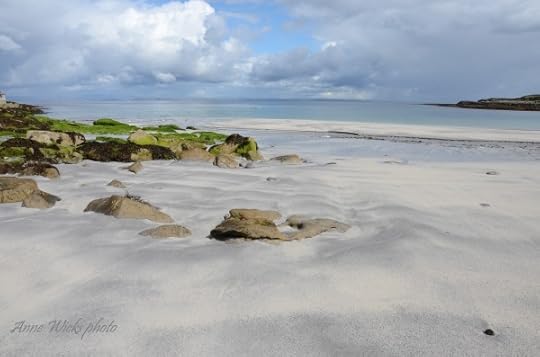 In early September 2015 we had 13 pilgrims join us for a very special pilgrimage and writing retreat on the wild edges of the world. We stayed on the islands of Inismor and Inisbofin, off the coast of Connemara and let the landscape inspire our creative process. I am grateful to these dancing monks for sharing their inspiration so freely with the community. Pour a cup of tea and then savor these reflections from Randy Pierce and Eileen Harakal.
A Desert Owl
I am like a desert owl,
like an owl among ruins.
—Psalm 102:6
Reading Psalm 102 brings to mind the overwhelming experiences I had wandering among the crumbling monastic ruins of Inishmore Island, Ireland during our Writing on the Wild Edges of the World Retreat a couple of months back. St. Macduach’s Church, close behind our B&B, Kilmurvey House, was especially poignant as I celebrated dawn communion with the great cloud of long dead Celtic saints after matins.
This psalm is a lament, a wailing of affliction. However, the solitary within me finds great solace in these words. Rather than despair, they speak to me of precious, private times ‘alone with the Alone’. My God created each of his creatures with unique qualities and characteristics. He made the owls and me eremitic beings, designed and driven to silently wander the nights in solitude.
I am like a desert owl
like an owl among ruins
lone, but not alone
solaced by the Solacer
like an owl among ruins
ancient stones echo my aubades
solaced by the Solacer
communing with saints of old
ancient stones echo my aubades
lone, but not alone
communing with saints of old
I am like a desert owl
© Randy Pierce
Irish Islands
The sky is a landscape of its own, a bowl suspended over open land with no trees or tall buildings to obscure a 360-degree view. The skyscape at first glance looks static, but if you take your eyes away even briefly, something will have happened. Massive gray clouds hurl across the horizon at you, bringing rain on one side of a building and not the other. Off the west coast of Ireland, it can rain for hours, but more likely moments.
Sea and land conspire here. Only the beach is flat, and barely so. No sooner does the land rise than it falls, grass cropped by sheep and wind and time. Even far uphill, the land is littered with small gray seashells.
Stones grow like wildflowers which grow like gardens. Wandering monastics from centuries ago inscribed the land with manuscripts illustrated in stone. Their icons are written now in roofless churches, holy wells, bee-hive cells.
The islands are parceled by stone walls into a sturdy geometry, until you see a wall silhouetted against the sky or the ocean. Chinks of light come through, turning solid stone into gray lace. What is hard, edgy, sharp becomes frail, to be undone by invaders from anywhere else. But in Ireland, stubborn stone prevails. Long after the monks and the marauders have come and gone, always and everywhere what remain are the open space, the rock, the wind, the sea, the sky.
© Eileen Harakal
Photo © Anne Wicks at Kilmurvey Beach on Inismor
The post More Reflections from the Wild Edges appeared first on Abbey of the Arts.
November 21, 2015
A Celebration of Gratitude ~ A love note from your online abbess
Dearest monks, artists, and pilgrims,
The United States celebrates the feast of Thanksgiving this week. I have always loved this time of gratefulness and sharing with loved ones. My heart overflows with gratitude for this beautiful community we have created together. I delight daily in knowing there are dancing monks all over the world.
I share with you an adaptation of a reflection I recently wrote for Spiritual Directors International on gratitude as a spiritual practice:
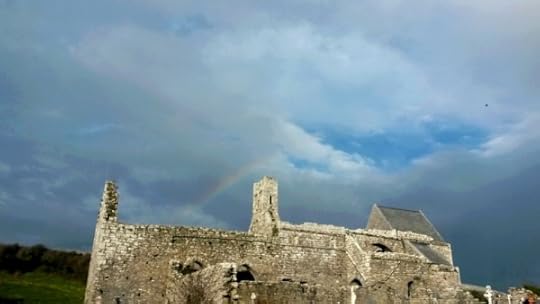 The 5th century monk and mystic Benedict of Nursia counsels in his Rule for monastic life an attitude of contentment among his community. Whatever the circumstances they find themselves in, they are to find some satisfaction with what is in the moment. In a world of self-entitlement and inflated sense of need, learning to be content with what we have has the potential to be quite revolutionary. It means craving less and being more satisfied with what one has.
One way to encourage this this posture of contentment in our lives is gratitude. Gratitude is a way of being in the world that does not assume we are owed anything, and the fact that we have something at all, whether our lives, our breath, families, friends, shelter, laughter, or other simple pleasures, are all causes for celebration. We can cultivate a way of being in the world that treats all these things as gifts, knowing none of us “deserves” particular graces.
We might begin each day simply with an expression of gratitude for the most basic of gifts, life itself. Awakening each morning for another day to live and love, grateful for our breath and a body that allows us to move through our day. Then we can offer gratitude for a home and all the things that are important to us about this place of shelter.
Environmental activist and author Joanna Macy describes gratitude as a revolutionary act “because it counters the thrust of the industrial growth society, or the consumer society, which breeds dissatisfaction. You have to make people dissatisfied with what they have and who they are in order that they keep buying.” Gratitude is a way for us to cultivate a healthy asceticism and reject consumerism.
Gratitude is a practice that can begin with the smallest acknowledgement and be expanded out to every facet of our existence. A simple way to nurture this awareness in our lives is to end each day with a gratitude list. You might write 5-10 things for which you feel grateful each day, lifting up both the large and small moments of grace. It is a way to end the day by honoring the gifts we have received rather than dwelling on where life came up short for us. Consider saving these grateful noticings together somewhere, and after a season of time reading back over the things that made your heart expand and notice what patterns you find there.
Gratitude has a way of transforming our approach to life into one that is more open-hearted, generous, and joyful. Rather than moving through our day feeling cynical or burdened, we can consciously choose our thoughts. This doesn’t mean that we have to offer gratitude for injustices or abuse, we are always called to resist those. But it does mean we might be able to tap into greater joy to replenish us for those moments when we do need to fight for dignity and kindness. Gratitude overflows into joy and makes us feel connected to something bigger than ourselves.
With great and growing love,
CHRISTINE
Christine Valters Paintner, PhD, REACE
Photo: © Christine Valters Paintner
The post A Celebration of Gratitude ~ A love note from your online abbess appeared first on Abbey of the Arts.
November 19, 2015
Listen to Christine's Interview on Soul of a Pilgrim
This past week Christine appeared on the radio show "Out of the Fog" with Karen Hager where she discussed her latest book Soul of a Pilgrim. Tune into the recording where they discuss welcoming in discomfort, preparing for the journey, and coming home again.
Click here to listen to the program>>
The post Listen to Christine's Interview on Soul of a Pilgrim appeared first on Abbey of the Arts.
November 18, 2015
Monk in the World guest post: Michelle Chung
I am delighted to share another beautiful submission for the Monk in the World guest post series from the community. Read on for Michelle Chung's reflection on recovering from perfectionism:
Helpful Tips from the Recovering Perfectionist
When I started practicing contemplative spirituality, I faced quite a culture shock. Being from the Silicon Valley, I was task oriented, perfectionistic, and goal driven… everything the contemplative ways are not. Where were the deadlines and checklists I’m so familiar with? It took quite a while for me to understand and adapt to this new and curious lifestyle.
The contemplative traditions are more “organic”. You can follow a plan and do the exercises, but the results are not so concrete. It’s more like watching plants grow. From day to day, the growth are so minuscule that they are barely noticeable. Similarly, when I started meditating and going on walks, I couldn’t really see where all these changes would take me. What would really come of just ten minutes of being quiet? Then, little by little, the peace and quiet from the few minutes spilled into the rest of my day. The changes didn’t come overnight, but they did come.
Growing up being so result-driven, it was tough for me to develop my “monk” routines when I can’t see the effects right away. Here are some tips that helped me along.
Be persistent
Whether it's a physical routine or spiritual exercise, any deep and lasting change takes time to develop. Because of my perfectionist tendencies, I tend to start a routine with lots of excitement, but stop soon after because I felt like I wasn’t doing things “right”. Eventually, I realized it’s doesn’t matter how pristine your routines are as long as you keep going back to them.
When you start exploring a new path, don't let the feelings of shame or disappointment put you in a downward spiral. Give yourself a break and simply push the delete button and start over. Persistence is the key in our learning process. Remember what motivated you to start this journey. Whether you’ve veered off the path for a day or a month or a year, just pick up where you left off. You'll always be a step further in the process than if you gave up.
Get an understanding about what worked and what didn’t.
When things don’t work out the way we hoped, many of us feel both surprised and disappointed. We shove the experience away and never think about it again. However, that's often why we repeat the same cycle over and over. One way to fail forward is to take a break and review your experience. Take some time to see where things went wrong (or got stuck) and consider how you can do things differently next time.
What helps me process is to write about my experience. First, focus on journaling about your feelings during the process. Try to be honest about any frustration or blockage you face at this stage. This helps to uncover root issues or fears that often sabotage your process. Maybe you need to get better shoes so your feet won’t hurt during your nature walk. Perhaps you’ve set such a lofty goal that even a Zen Master can’t achieve. Or maybe the experience brought up some old memories and unexpected feelings, and it’s time to seek counsel. Whatever it may be, it’s worth spending the time to process through it.
Part of my process also includes solitude time. Solitude and stillness exercises teach us how to let go of the day to day things that monopolize our attention. Sometimes, the answer is right in front of us, but we’re too distracted to see it. Once our focus is freed up from the mundane, we can suddenly see the answer clearly . A few times after I had quieted down my heart, it became clear that my perfectionistic tendency got in the way. I was too focused on getting the result rather than enjoying the process. The real adjustment I needed was to let go of my own expectations.
Be gracious to yourself
I’m very kind and encouraging to my friends. For some reason, I’m always hard on myself. I’m learning to offer myself the same grace and kindness I have for my friends. Something I remind myself often is that I’m just like other people. We are all human beings with weaknesses and limitations. When we remember that we’re but flesh and blood, we become more gracious to ourselves and to others. When we can look at our own weaknesses without shock and shame, it’s much easier to face these issues and work through them…
From time to time, I still fall back to my old driven and perfectionistic habits. The difference is now, I can quickly shift into the rhythm of my new life. Little by little, the seedling of change sprouted, matured, and bore fruit: a life of peace, patience, kindness and joy.
 Michele is a recovering perfectionist. She loves reading and learning about all things contemplative. After a myriad of jobs, she is currently pursuing painting and blog writing. Michele lives in Silicon Valley with her husband and a house full of books. You can find more of her writings at mzchele.wordpress.com.
The post Monk in the World guest post: Michelle Chung appeared first on Abbey of the Arts.
November 14, 2015
What is it the Season For? ~ A love note from your online abbess
Dearest monks, artists, and pilgrims,
I had a beloved spiritual director years ago when I lived in the San Francisco Bay area during graduate school who often asked me this question: What is it the season for?
 I loved this question because my creative heart was always full of new ideas, but one of my great invitations in life has been to discern the season I am in and what it calls for – to say no or not yet to many of the creative ideas stirring in me, to listen for what is truly ripe, to make space for the task that is calling to me most deeply this moment.
There is a beautiful rhythm of rise and fall found in every breath we take, in the rising and setting of the sun each day, in the balance between work and Sabbath time each week, in the waxing and waning of the moon each month, the flowering and releasing of the earth through her seasons, and of course the seasons of our lifetimes.
Discernment essentially means to distinguish between the life-giving and life-draining voices calling to us and learning that our lives each have their own unique rhythm. I like to think of life as a continual process of discovery, a pilgrimage through time and space.
One of the greatest gifts of the seasons for me has been this profound insight into the nature of the world around me. My mother died in autumn twelve years ago and those weeks following her death, when I ached with grief deeper than I had ever experienced before, I would walk among the trees. And as autumn’s journey of letting go moved into winter, the bare winter branches, the pale glow of the sun, the long shadows all spoke to me where I was. When the first signs of new life began to sprout I was still deep in my pilgrimage through the landscape of grief, however the fact of spring did offer me solace. It would take another cycle of the year before I could enter into my own springtime. And in the years since, the seasons have become a source of great wisdom for my own life.
In the monastic tradition, we follow the Hours of the day. Dawn, day, dusk, and dark each become a prayer station inviting us into the gifts of this moment. Over and over I am immersed in this rhythm of rise and fall.
This rhythm of rise and fall calls us to remember that time is not always linear, moving us toward an end goal. Time can also be spiral, moving us in cycles of regeneration, growth, release, and stillness.
Our Advent & Christmas online retreat invites us into a new way of relating to time by calling us deeper into the rhythms of unfolding of each moment. When we bring ourselves fully present to here and now, we touch the eternal and the pressures of daily life briefly fall away. Please consider joining us for a season of slowing down and bring lavish attention to these life-giving cycles.
With great and growing love,
CHRISTINE
Christine Valters Paintner, PhD, REACE
Photo: © Christine Valters Paintner
The post What is it the Season For? ~ A love note from your online abbess appeared first on Abbey of the Arts.
November 11, 2015
Monk in the World Guest Post ~ Patricia Campbell Kowal
I am delighted to share another beautiful submission for the Monk in the World guest post series from the community. Read on for Patricia Campbell Kowal's reflection on living the mystery:
"I commit to finding moments each day for silence and solitude, to make space for another voice to be heard, and to resist a culture of noise and constant stimulation."
This is the first expression of commitment in the Monk of the World Manifesto which has become a foundation for my life. One way I practice this first expression is by sometimes putting my prayer- thoughts on paper. If it stirs a God-thought for me or another this gesture seemingly becomes a spiritual gift. Recently as I practiced this commitment, I went into the loft of my home—a sacred place for me. With pen and journal in hand (just in case) I listened to a visualization meditation I had read in one of Christine's books and had recorded on my smart phone (sometimes too smart for me!) Alas, I sat in quiet, put the ear buds in and listened to my own voice saying the words and directions of another's suggested meditation. One prompt was to just be with the strongest emotion I was feeling and then listen for a word to come. My emotion was “powerlessness” as I was experiencing many transitions around me. Then the word that came was “mystery” as it was beyond me to figure everything out! So, I sat with the word mystery and then I found my pen on paper as I began to realize that we experience mystery in all the passages of our lives, which is I believe, the call of the soul.
The following poem flows from that quiet meditation. It had meaning for me and perhaps it may have meaning for you, so I humbly share it here.
Call of the Soul
The unknown a newborn faces upon its birth She wails in anticipation with her first breath
. . . mystery
like cacophony from geese in the sky heard during spring migration.
The unknown the teen confronts upon his introduction to the adult world He craves the call to independence
. . . mystery
like the feeling of wind on his face while racing downhill on his bicycle.
The unknown a betrothed embraces in a life-partner commitment Neither knows where this excitement will lead
. . . mystery
like the delight of running with abandon in an open field.
The unknown of choosing one’s life-path The final outcome beyond understanding
. . . mystery
like experiencing starlight glitter across the sky.
The unknown in accepting divine guidance Hope and trust guide the sojourn
. . . mystery
like the fulfillment of longing that was always deep within, but secret.
The unknown of letting go of the familiar Conflicting feelings create confusion
. . . mystery
like choosing between sweet and sour, both enticing.
The unknown of saying good-bye to a relationship—once loved or not Sometimes great sadness, sometimes great relief, perhaps both
. . . mystery
like sitting by a runway seeing an airplane vanish into the sky.
The unknown of relinquishment of the earthen body to its final rest A new level of living is the hope
. . . mystery
like deep sleep before awakening.
. . . mystery—The Call of the Soul
 Patricia Campbell Kowal offers Spiritual Direction and Grief Recovery Workshops as a Certified Grief Recovery Specialist. Pat lives with her husband, Bob, in Spokane, WA and together they have three grown children and a first grandbaby due any day! She is grateful for the paths her life has taken.
The post Monk in the World Guest Post ~ Patricia Campbell Kowal appeared first on Abbey of the Arts.
November 7, 2015
A Celebration of Stuff ~ A love note from your online abbess
Dearest monks, artists, and pilgrims,
 In 2012 my husband and I decided to embark on a life adventure. We were living in Seattle and had been traveling to Europe twice a year to explore ancestral landscapes. He was growing more in need of a sabbatical from his position as high school theology teacher. I had recently applied for and received Austrian citizenship through my father.
Between February and May, we began to sort through our things. It is amazing what accumulates in nine years in one place even in a small apartment with only three closets.
“Honey, I just found more stuff,” became a common refrain as one of us would open a new box or look under the bed.
We sorted through clothing and kitchen drawers, making piles for our many trips to Goodwill. My library of a thousand books went to a friend who owned a used bookshop. Some furniture was sold on Craig’s List. The few art pieces we had were given to friends. I slowly burned my pile of old journals in our fireplace, an act that became symbolic of the threshold we were on, and I would carefully carry out piles of ashes.
Eventually we sold our condo and our car, and then put a few things in storage like boxes of family photos and a couple pieces of family furniture. We packed up two large suitcases and headed off.
Dispensing of things felt almost virtuous, and certainly full of the freedom that comes with not having to maintain things or worry about them. My primary spiritual path in life is as a Benedictine oblate and the contemplative way nourishes me. I am inspired by the stories of the desert monks who journeyed out into the wilderness carrying nothing but a deep sense of call and desire to be free.
In many ways it felt like we were heading off into our own wilderness experience. While Vienna, Austria with its sumptuous cafes and gorgeous architecture is hardly the Egyptian desert, we were traveling with what felt essential to us, into a journey that was largely unknown.
In Vienna, our little kitchen with its tiny refrigerator inspired us to shop daily for what we needed in small amounts and we learned to love cooking on the little gas stove and fold-out cutting board which jutted from the wall when needed.
The monastic path of simplicity isn’t just about relinquishing physical belongings. It also invites a holding loosely of our habits and patterns in life which weigh us down. It calls us to release our expectations of what we want to have happen and yield to what actually arrives.
Our time in Vienna was full of opportunities for yielding in a culture where my husband didn’t speak the language and the immigration process for him was filled with bureaucratic roadblocks. After six months, with yet another letter from Austrian officials asking for more documents while the expiration date of his visa loomed, we headed for Ireland in the hope of a better outcome. We landed in Galway, a city of rich artistic culture and the wild west coast beckoning to our imaginations. Immigration went smoothly and we found ourselves falling in love.
Almost two years in, when the next invoice for our annual storage fees back in Seattle arrived and us feeling confident at last that we would not be moving again anytime soon, we decided to finally move our remaining things across the Atlantic Ocean.
They arrived twelve weeks later at the very end of October 2014. As the days grow shorter here and we move into the feast of Samhain, a time when the Irish consider the veil to be very thin between this world and the other world, I found myself sitting on the floor among a dozen boxes. Each one contained albums full of family photos, from my childhood and my husband’s, from each of my parents and my grandparents. Each image sparked a memory, flooding me with renewed connection to stories that had gone silent.
I ran my hands repeatedly over the solid wood of the secretary desk, the one that had traveled from Austria to the U.S. many years ago, and now back to Ireland. I slid open the small drawers, finding small treasures we had hidden before leaving.
Suddenly our spare apartment was littered with stuff: The Northwest Native American rattle carved like a salmon that reminded us of our life before. The soapstone Inuit carving of a bear dancing which I received after my mother died. The oil portrait of my Austrian grandmother, sitting regally in her salmon colored dress. The watercolor given to me by a coworker when I left a teaching position years before.
There was the delicate white china tea and coffee set and silver tray from which Kaffee had long ago been sipped and strudel nibbled. I found the chipped, enameled bell with blue flowers my parents used to ring on Christmas Eve when I was a child.
We are beings who cherish, who remember through touch and smell. We come to love these treasures that witness to our lives and the lives that came before, books that transformed us. We honor writers and artists, mothers and fathers, legacy and lineage. We are connected to the significant moments of our lives through the gold band on our finger or the necklace given to us by a friend who has since passed away.
There are a multitude of things I have absolutely no regrets about giving away when we moved. But there are a few I do wish I had held onto: the sword from my great grandfather who was a general in the Austro-Hungarian army, the cream pearl necklace from my grandmother, the Meissen porcelain set of dishes.
A bird’s nest is an amalgam of twigs and fluff and string. When our things arrived they marked a turning point when I started to feel really at home in Galway, that I wanted to nest. I am still very much a monk at heart, but I have also fallen in love with stuff again.
With great and growing love,
CHRISTINE
Christine Valters Paintner, PhD, REACE
Photo: © Christine Valters Paintner
The post A Celebration of Stuff ~ A love note from your online abbess appeared first on Abbey of the Arts.
November 4, 2015
Monk in the World guest post: Jamie Marich
I am delighted to share another beautiful submission for the Monk in the World guest post series from the community. Read on for Jamie Marich's reflection on gratitude for a sacred convergence:
Dancing Mindfulness Meets Dancing Monks: A Story of Gratitude
Early last summer I received an inbox notification telling me that a woman named Christine from Galway ordered a copy of a DVD I produced called Dancing Mindfulness: LIVE. Although it always warms my heart to fill international orders, I grew even more excited when I saw the domain on her email: Abbey of the Arts. Curious, I looked up her website and immediately experienced a deep, internal sensation that said, “Welcome home!” After watching the video, Christine enrolled in my long-distance training and mentorship program in Dancing Mindfulness. Simultaneously, I began eagerly working through her books, beginning with The Artist’s Rule. In April of this year, I had a chance to go on retreat with Christine and many other dancing monks in Leavenworth, Washington. On this retreat I realized with an even brighter spark that I found a beautiful source of nourishment for my body, mind, and spirit that complements my existing spiritual practice and home in the Dancing Mindfulness community. My heart brims with gratitude for this connection, and my backstory offers some insight into what makes this connection so special.
For many years, I’ve identified as being too “Eastern” in my spiritual practices to really feel accepted by many groups of Christians. Similarly, yogis and individuals I’ve met in Eastern spirituality circles often regarded me suspiciously because I maintain a strong Christian identify. Conservatives tend to find me too progressive and progressives tend to label me as too conservative. I also identify as a bisexual woman. Thus, the “middle,” the beautiful regions of grey that exists between black and white polarities is where I dwell. Raised in an American society that tends to label and compartmentalize various facets of human experience, finding a true sense of belonging has been difficult.
I grew up in an interfaith Christian household—one parent was devotedly Catholic and the other converted to Evangelical Christianity. Fights about religion were so commonplace in my household, I left at the age of 18 pretty certain that there was a God, but not wanting anything to do with organized religion. In my early twenties, I reconnected with Catholicism, the faith of my Baptism. Although my original intent for “finding religion” again was to seek a solution for my own drinking and drug use that escalated out of control at that time, I became deeply grateful that God used this lowest point of my life to reacquaint me with faith. The ritual of the Catholic Mass enlivened me, and I tore into reading about the lives of the saints and the teachings of monastics from both Eastern and Western Christianity. I even found myself working for the Catholic Church for a period of three years (2000-2003), serving as an English teacher and English language liaison for the Catholic Parish of Medjugorje in Bosnia-Hercegovina, a well-known pilgrimage site in the modern Catholic world. I coordinated music for English language Masses, sang in an international group of musicians connected to the shrine, and met many of the people who set me on the path I walk today—that of a sober woman in active recovery who works to help others achieve their own goals of recovery and wellness.
When I returned to the U.S. to begin my graduate studies in clinical counseling at a conservative Catholic institution, I started to get the sense that I did not quite fit in with the church. Quite simply, I asked too many questions. And although I was told by many that I was allowed to ask questions, it became pretty clear that advocating for gay, lesbian, bisexual, and transgender individuals would be frowned upon in traditional circles. Speaking up about pro-life being more than a pro-birth position was clearly not favored, and challenging patriarchal leadership structures was not met with great enthusiasm. Although I’ve met more progressive Catholics in my journey, I was aware of what official church teaching was on these matters and I decided that I couldn’t really be a part of an institution that couldn’t fully accept me. Many years of searching followed on my journey of discovery…
Four years ago I began laying the foundations for a community and training program around a practice I called Dancing Mindfulness, largely to provide a safe space for middle-dwellers like me to find a place of spiritual inclusivity. Dancing Mindfulness appreciates that all human activities can be practiced with mindful intent. Mindfulness is the ancient practice of noticing without judgment. Although the English word mindfulness traces to traditional Buddhist practices, there is nothing inherently Buddhist about it. Many of the early desert monastics whose teachings I’d studied and revered engaged in practices that clearly meet the definition of mindfulness. Whether mindfulness is used as a gateway to higher spiritual growth or as a path to more balanced, centered living, the applications of mindfulness are various. Dancing Mindfulness can be practiced individually, or as part of a formal class. In the Dancing Mindfulness practice, participants can experience seven primary elements of mindfulness in motion: breath, sound, body, story, mind, spirit, and fusion. By dancing through these seven elements, practitioners are able to access their body’s own healing resources and realize the transformative power of their personal creativity.
Inspired by my own work as a clinical counselor with a background in dance, I wanted to create a practice space for dance that was welcoming and user-friendly. What began as a few classes that I taught in my own community of Warren, Ohio and at professional conferences in the fields of recovery and mental health has grown into an international network of facilitators and friends engaging in the practice. Our video, book (releasing Fall 2015 with a foreword by Christine), and growing facilitator training program (available both live and distance-based) are all helping us to reach people seeking healing spaces through dance in both community and clinical settings.
Working with Christine and seeing the model for inclusive, expressive community created by she and John is actively impacting my growth as a leader in my own community. Additionally, in Christine’s writing and the community of the Abbey to which she led me, I’ve been able to experience even greater degrees of healing and reconciliation about my own spiritual wounds experienced at the hands of institutional church. The Abbey also led me to my current spiritual director, Melissa Layer, who is helping me to come out as the authentic person God desires me to be in both my personal and professional lives. In addition to Melissa and Christine, I’ve made countless other friends and connections through the Abbey and the Holy Disorder of Dancing Monks. Several members of our Dancing Mindfulness community are also now taking part in Abbey programming, and in the Facebook group. The gratitude I have for our two communities meeting each other cannot be put into words (which means as soon as I’m done writing this I must dance my gratitude). Although only time will tell how the various connections between souls will continue to manifest, speaking strictly for myself, I celebrate the personal healing that’s already come to me from the sacred convergence.
 Jamie Marich, Ph.D., LPCC-S, LICDC-CS, RMT travels internationally speaking on topics related to EMDR, trauma, addiction, and mindfulness while maintaining a private practice in her home base of Warren, OH. She is the developer of the Dancing Mindfulness practice. Jamie is the author of several books, including her newest, Dancing Mindfulness: A Creative Path to Healing and Transformation with Skylight Paths Publishing.
The post Monk in the World guest post: Jamie Marich appeared first on Abbey of the Arts.
November 2, 2015
Order Dancing Monk Icons Prints for Christmas (by November 18th)
 Our fabulous artist Marcy Hall is making prints available again for the wonderful dancing monk icon series she has painted for Abbey of the Arts. She also has two new Irish saints added this fall: Kevin of Glendalough and Gobnait of Ballyvourney (patron saint of bees!)
In addition she has another beautiful series of Monastic Way/Monastery of the Heart prints for a series she painted for the Erie Benedictines and Sister Joan Chittister. These include figures such as Teresa of Avila, the Dalai Lama, Rumi, Georgia O’Keeffe and more!
Discounts when you order multiple images.
You can see both series here and order your prints>>
The post Order Dancing Monk Icons Prints for Christmas (by November 18th) appeared first on Abbey of the Arts.


