
Trudy J. Morgan-Cole's Blog, page 50
April 20, 2016
It’s the third week in April…
Three weeks ago, I was on vacation in Florida. This was me.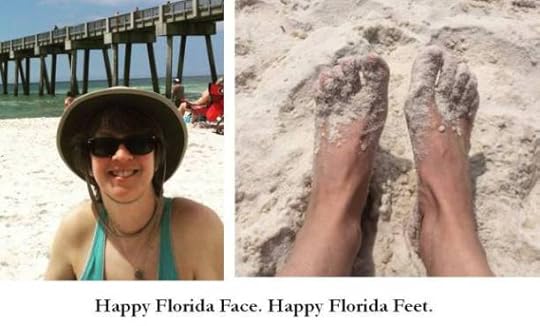
Today I am back home in St. John’s. This is me.
We had a record snowfall today — somewhere between 40 and 50 centimetres. We also had a snow day — surely the last of the season! I can’t help but wish I were back in Florida.
For years I resisted taking a winter vacation because a teacher the only time I can get away is Easter Break and it’s always so expensive and hard to book at that time of year. But we are fortunate enough to have a family member who owns a house in Florida, and last year, after seeing everyone’s pictures of tropical vacation spots all through February and March, and looking at the window at blizzardy scenes such as we saw today, I thought, “No, I must do it. I must get out of here, even for a week, even at Easter.”
The worst part about taking a winter vacation to some place warm is that you have to come back to Newfoundland weather.
The best part is that we did get away, at least for a little while. And we have those memories.
In the meantime, I am taking heart from a little chalk message I left for myself on our hall table, along with some tulips. Have faith!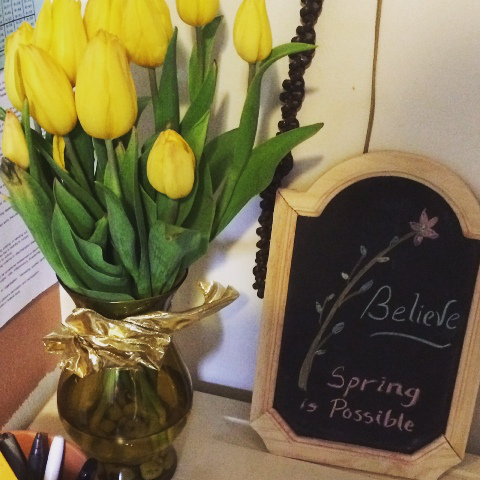



March 15, 2016
Closer Home
This is a pretty cool post for me to be able to do, because I love to talk about the  successes that my writer-friends have had, and Kerry is one of the writers I’ve been friends with the longest. Our relationship goes back to when we were both young aspiring writers living a few houses away from each other on a cul-de-sac in Oshawa, Ontario, and used to go for long walks discussing the books we wanted to write. We’ve kept in touch during all the years since, and Kerry has gone on to release a fantasy trilogy and a paranormal thriller under the name Kerry Schafer. Now she’s branching out in a new direction: this week her novel Closer Home comes out under the name Kerry Anne King. Since my novel What You Want has also just come out in paperback, and since writing women’s fiction is a bit of a change of direction for both of us, we are interviewing each other on our blogs today. I’m excited to tell you a bit more about Kerry and her new book. Read a quick synopsis of the book below, then continue on for my interview with Kerry.

When Lise Redding’s estranged sister, country-pop star Callie Redfern, is killed during a publicity stunt, the small-town music teacher is dragged from her quiet life into the spotlight.
Lise hadn’t spoken with Callie in ten years, ever since Callie’s betrayal split them apart, so she’s shocked to discover that she’s inherited her sister’s massive estate. Not only that, but Lise is now the guardian of her sixteen-year-old niece, Ariel, to whom she’s practically a stranger.
Overwhelmed by grief and her new responsibilities, Lise thinks things couldn’t get worse. But overnight she becomes the paparazzi’s latest obsession. Suddenly she and her longtime friend Dale are plastered over the front pages of the tabloids. Desperate to escape both the media and her memories, Lise sets off with Ariel on a search for the girl’s father. Yet instead of granting Lise a reprieve, the quest brings her face-to-face with long-buried secrets. Only by learning to forgive will she be able to find her way back home.
Trudy: When we first met nearly 30 (!!!) years ago, you were working on a fantasy novel. Since then you’ve published a fantasy trilogy and a paranormal thriller. Is writing women’s fiction something completely new for you?
Kerry: It can’t really be thirty years. You’re a writer – please tell me you’re making that up! I am not going to do the math myself. The answer to your question is, technically, yes. Writing a novel in the women’s fiction genre was actually my agent’s idea, and something new for me. She pointed out that all of my books feature strong women characters, and that I seemed to be passionate about that. As usual, she was right, and making the transition was very natural for me.
Trudy: Your Kerry Schafer books all have what I’d consider a dark side — an unflinching look at things that are terrifying and dangerous. Is there any dark side to Kerry Anne King and Closer Home?
Kerry: Yes, I think so. Maybe there aren’t any dragons or slime toads or invisible blood sucking paranormals, but Closer Home deals with emotional betrayals and complicated grief. In some ways, writing about the darker side of human emotions and relationships is scarier than something obviously fantastical. A lot of us enjoy being frightened by scary stories that we know could never happen to us, but we are all going to have to deal with loss and betrayal at some point in our lives, and we tend to avoid the emotions that come with that.
Trudy: Back when you and I lived on the same block, I was a teacher, you were a nurse, and we were both aspiring writers. Since then, we both went on to get a degree in counselling (although you’re actually using yours and I’m not). Does your counselling background, and your day job, inform your writing in any way?
Kerry: Yes, absolutely, although right now, since I’m working as a nurse again, I’m not technically using my counseling degree either. But patients come in and they all have a story. Some of them are so incredibly brave – these wonderfully bright, transcendent souls who have overcome multiple griefs or who are coping with terrible chronic pain. Some are loving and forgiving, some small and cold and vengeful. When I was working mental health crisis I met people on the very worst moments of their lives. It’s inevitable that those powerful emotions are going to find their way into my writing.
Trudy: Which character in Closer Home did you most enjoy writing about, and why?
Kerry: I loved writing my main character, Lise. She’s a small town woman who is thrust against her will into the bright lights of a big city. Life hasn’t ever been easy for her, and she’s built up a hard protective shell. Grief, along with the sort of crisis that shakes her well regulated life down to the foundation, cracks all of her defenses and pushes her into an emotional growth she would have spent her life avoiding, given a choice. I love writing growth stories, and Lise has plenty of opportunities for that.
Trudy: What was the most difficult thing about writing Closer Home for you?
Honestly? This book almost seemed to write itself. Once I had the characters and the situation down, it was just a matter of finding the words to tell the story. The most difficult thing was a tight deadline, and the reality that I also had a deadline on Dead Before Dying, a paranormal thriller written under my Kerry Schafer line. So there was a lot of juggling between two very different books.
I can’t wait to read Closer Home, and I hope you can’t either! You can read Kerry’s interview with me about What You Want here on her blog. And everyone who comments on this post will be entered in a draw to sing a copy of both books!


March 11, 2016
Things You Can Do With an E-book…
…that you can’t do with a paper book. Here’s the follow-up to the last Shelf Esteem video. This one explores the advantages of e-books, and contains two tantalizing glimpses — one of my underwear (!!) and one of something even more exciting!
That’s right, it’s the paperback of What You Want, finally available for people who want to read on paper not screens. You can get it from Amazon.com, Amazon.ca, or directly from CreateSpace (which ends up in a tiny bit more of the money going back to the writer, just in case you’re interested).


February 18, 2016
Things That Go Wrong With Your E-reader…
… that never happen to your paper book.
It’s the e-reader vs paper book showdown, Part One. Back next week with Part Two in which I explore cool things you can do with your e-reader that you can’t do with your paper book. Trying to show both sides here, folks!


January 29, 2016
Definitely Not a Mommy-Blog
One of the problems I face as I approach the ten-year anniversary of this blog is that the more time goes by, the less sure I am about what my blog really is. Is it a writer’s blog about writing? Well, sometimes, but definitely not all the time. Is it a place for me to work through ideas and post about my views on political and religious issues? Sometimes. Is it a place where I write about my daily life and keep in touch with a far-flung community of friends and readers? It started out that way in 2006, but in the years since, most of that activity has migrated to Facebook, and blogging doesn’t serve quite the same social function it used to. It almost feels like if you’re going to post Facebook statuses about what you did today, you should save blogging for when you have something important to say.
I can tell you what this blog isn’t, that’s for darned sure. It’s definitely not a mommy-blog.
When I started blogging regularly, my kids were eight and six. And a lot of what I wrote about daily life ended up being about parenting. I never thought of myself as a “mommy blogger” because I also wrote about writing, and about faith, and about TV characters I had crushes on … but I did write a lot about parenting because that was my life and my focus at that time. In fact, my blog was one of several that got studied in a mildly infamous academic study of Canadian “mommy blogs,” so I guess at least some people thought that was what the blog was about.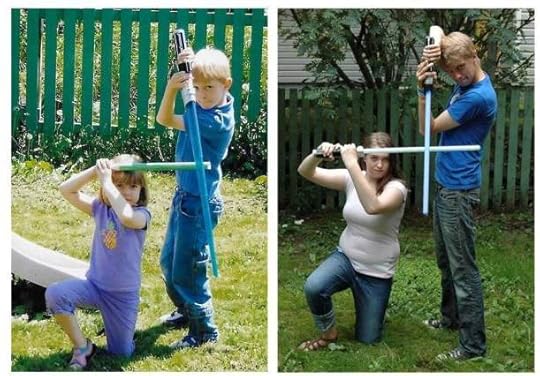
These days, I find I hardly ever blog about parenting. Those same two kids are now almost sixteen and (just as of this last week) eighteen. That’s right: my oldest child is an adult in the eyes of the law. Wow. Just … wow.
Even today, when the heyday of parenting blogs (and perhaps blogs in general) is several years past, you can still find a lot of people blogging about their day-to-day experience taking care of babies, or wrangling toddlers, or raising pre-schoolers or elementary-schoolers.
There aren’t a lot of “mommy blogs” (or daddy blogs) by the parents of teenagers. I wonder why that is?
When your kids are little, it’s so easy to write about the fun moments, the silly things they say, the days you want to remember — but also the frustrating times, the lessons you learn as a parent from the bad days. When they get older, there are still fun moments, still hard days, still lessons learned — but as the kids get older, I think most of us parent-writers are more keenly aware that our kids are not just extensions of ourselves, not just lenses through which we reflect on our own experience. They are their own people, with their own right to privacy. And even as the crazy stress of raising toddlers and preschoolers eases up (how wonderful it is to leave the house for work in the morning knowing that these near-adults will get themselves up and ready for school, and one can even drive there!), the struggles we face — because there are always struggles — are deeper and harder to resolve.
You can tangle with a tantrumming toddler for an afternoon and cuddle that same toddler, tired, at bedtime — and after they’re asleep, blog about what that whole hard day taught you. The struggle to help a teenager emerge into adulthood, and to stand back and not help when your help is not needed, takes months or years instead of hours. And it may be a long time before any of us figures out what we’ve learned from it.
So maybe those are some of the reasons we don’t blog so much.
Don’t get me wrong: I love having teenagers. As a high-school teacher and longtime church youth leader, I’ve always been more comfortable around teens than around little kids, and there are so many things about this time of life — my kids’ blossoming personalities, their growing independence — that I love.
But here’s the thing; it’s no longer a simple system where I tell them what to do, they disobey, I discipline, they learn, I learn. Instead, I tell them what to do, and sometimes they say things like, “I don’t want to do that. I want to do this instead. And since I’m sixteen, or eighteen, or whatever … I’m just going to go do the thing. That you don’t want me to do.”
That taunt our kids liked to fling out when they were really angry at six or eight years old: “YOU CAN’T MAKE ME!!!!” was quite literally untrue then. But now, it pretty much IS true. There’s not a lot you can make a seventeen-year-old do, if he or she doesn’t want to.
It’s not that the parents of teens have no leverage at all. We still have economic leverage: they mostly live in our houses, eat our food, sometimes drive our cars, and may be relying on us to pay for their post-secondary education. I used to be amazed at parents of young adults who continued to bankroll their offspring while those offspring were doing things the parents heartily disapproved of. Now that my own kids are closer to that age, I still believe there are times when a parent has to say, “I can’t stop you from doing this, but I can certainly stop paying your phone and internet bill while you’re doing it.” But I also think a lot of the job of parenting older teens and young adults is the process of making very difficult decisions about when and where you’re going to draw those kinds of lines.
Because the thing is — and of course I always knew this in theory, but it’s different to live through it — your teenagers and young adults are making their own choices now, and they are going to make choices you don’t agree with or approve of. This is not like a toddler choosing to put their hand on the hot stove, where there’s a clear right and wrong. These are the kinds of situations where you have to step back and say, “Am I opposed to this because this is clearly wrong for my kid — or just because they’re not living their life the way I want? And what am I going to do about it?”
Let me be clear: my kids are both good kids. They haven’t given me a minute’s serious trouble so far — and as a teacher of at-risk youth and young adults, believe me, I know what serious trouble looks like. But here’s the thing: even good kids are going to make choices you don’t agree with. Off the top of my head, based on the experiences of my students, my friends’ kids, my kids’ friends, and even a few things my own kids have done, here’s a very short list (there are lots more things I could add) of Things Your Older Teenager May Do That You Might Not Approve of:
date someone you don’t like
break up with someone you DO like
have sex with that person they’re dating that you don’t like (or with the one you do like)
have unprotected sex with the person they’re dating, subsequently presenting you with a grandchild you are in no way prepared for
choose a college major you think will not prepare them for the working world in any way
refuse to go to college at all
drop out of high school four months before earning a diploma
drink beer
smoke cigarettes
smoke weed
stop attending the church/faith community in which you raised them
start attending a church/faith community you not only disapprove of, but think is full of loonies
come out as gay, lesbian or bisexual
inform you that the gender you’ve assumed they were from birth is not, in fact, the gender they identify with
join the armed forces
join a travelling circus
Here’s the thing I can 100% guarantee: if you’re a parent, you read through that list and as you looked at some of the items you thought, “Why is that even on the list? I have no problem with my kid doing that!” And you looked at other items and thought, “That is a deal-breaker! If my kid were doing that I’d move heaven and earth to stop them!!”
Another thing I can guarantee? No two parents are going to parse that list in the same way. We all have different values, and thus, different deal-breakers.
But here’s the tough part: Look at that list and pick out the things that you, personally, disapprove of. The things you really don’t want your kid doing. Add a few of your own if you want. Then look at your new list and ask yourself: which of these are really deal-breakers? And which ones are places where you have to step back and say, “Hey, I think this is wrong, but this kid is nearly an adult now and they have to make their own mistakes and learn the hard lessons on their own. And I need to take a step back.”
When you cross those things off the list, what’s left? A few things, probably, that you know you absolutely cannot live with, probably because in your mind, they seriously endanger your child’s health, safety, or eternal soul. And then you have to ask yourself the next question: “What am I willing to do to try to pressure my teenager not to do this thing?” At this age, sure, we can persuade and encourage and offer guidance, but we can’t force. The only real leverage we have is economic, and if you choose to cut the purse strings or use the old “My house, my rules” yardstick — well, it might work, but you also may end up with a young adult who chooses to move out and maybe even cut ties with you. How far are you willing to go in enforcing your standards on those deal-breakers?
I’m not asking these questions in some kind of wise-advice-giver way, like this is going to turn out to be a self-help article where I give you useful tips. I’m putting this out there to say: this is what my parenting life is like right now, with an almost-sixteen-year-old and an eighteen-year-old. Two good kids who are moving into living lives of their own. And if you have kids in that age group, I’m willing to bet there are elements of this in your life too. I think you’re probably spending hours — maybe late-night hours when it’s hard to sleep — agonizing over the choices they’re making, or are about to make, and how little control you have anymore. And while I personally would never want to go back to the days when I tried to walk across the living room with one toddler clinging to each leg, I have to admit that sometimes, those days were simpler. The dilemmas were frustrating, but easier to resolve. Easier to say, at the end of the day, “Here’s what we’ve learned.”
I don’t know what I’ve learned yet about parenting teenagers, except that it’s beautiful, and rewarding, and hard, and scary. And that’s probably why this is not a mommy blog anymore, if it ever was. But to all my fellow moms and dads who are getting young adults ready to launch into the world — we may not have time or energy or courage to blog or post on Facebook or even share over coffee about all the challenges we face. We no longer have playgroups and Mommy’n’Me get-togethers to commiserate about how tough it is. But we are truly in this together, muddling through, trying to make the right choices. We still need that support and we still need each other.


January 2, 2016
Fifty (Plus)
As many of you know, I turned fifty this year. I didn’t really blog about it at the time — what with social media these days, most of my celebrating, and the pics of the big 5oth bash I threw for myself, happened over on Facebook, so I didn’t write a blog post specifically about reaching that milestone. But yeah, I’ve been alive for half a century, and I’m feeling pretty good about it.
One thing I’ve commented on several times this year — including at my birthday party, bringing tears to a few eyes when everyone was supposed to be celebrating happily — is that it’s hard to reach 50 without thinking of the people you’ve lost along the way. Of course I think of the people from the generations ahead of me, like my mom and my Aunt Gertie, who I wish were still here. But what really gets me are the friends of my own generation who I thought I would grow old with. My friend Jamie, who never made it even close to his 50th birthday. My dear college friend Linda, who turned 50 already fighting the cancer that would take her life at 51.
Just this year, while I’ve celebrated turning 50, I saw one friend cope with the sudden loss of his beloved wife, still in her 40s. I’ve seen another friend of my own age wrestle with a frightening cancer diagnosis. Nothing is guaranteed, especially not long life.
So I will never be one of those people and complain about “Oh, poor me, I’m turning fifty, I’m going to get wrinkles and my neck will look weird!” I am so, so grateful for every year I am given to spend with family and friends, and having fifty of them is AMAZING. Anything more … will be awesome.
So, while I’m not a big fan of New Year’s Resolutions, I did have a few goals I wanted to accomplish in the year I turned 50. Not exactly “bucket list” items, but things that made me say, “Hey, girl, you are turning half a century old, so why wait around to do that thing you’ve been thinking about?” Some of my goals were private and some are goals I could share here on the blog. None of them were exciting things, like “I’m going to climb Mount Everest” or “I’m going to swim with dolphins.” But some of my goals were:
Help my church start a hot-meal program for hungry people. We did this! I had been thinking about it for a couple of years, but the impetus of saying “I’m gonna turn 50 this year and I believe this is important!” is what inspired me to get the ball rolling. Fortunately some great people came on board and our small but successful program is going well.
Plan an event to celebrate the 90th anniversary of women in Newfoundland winning the right to vote. I’ve been interested in the history of women’s suffrage since researching A Sudden Sun, and I thought it would be a great event to be involved with. So after teaming up with the provincial Status of Women Council — yeah, we did that thing back in April.
Release my novel What You Want as a self-published book. Yeah, I know those of you who follow my blog are sick of hearing about this, but it was important to me. I’d been toying with the idea for years, and I really wanted to give it a try. Again, knowing 2015 was my turning-50 year inspired me to get it done. Was it successful? Mixed results, I’d say. I got the e-book out but not the paperback (still hoping to make that happen before I turn 51!) Sales were … not impressive. It’s hard to market a self-published ebook! But I got the book out there, some people enjoyed reading it, and I learned a lot. I’m glad I did it.
Pay more attention to nutrition and fitness. OK, I know eating better and exercising more is on everyone’s to-do list almost every year, but turning 50 has really made me focus on the fact that this is the body that has to take me though to old age and it’s very much in my interest to have it in optimal working condition. My success with this goal is hard to measure because this is not the kind of area where you can say, “I did it!” or “I didn’t!” There’s always room for improvement. But I am paying a lot more attention to what I’m eating and what’s in it, and I had a great time out hiking on the East Coast Trail this spring, summer and fall — though I still struggle with how to get enough exercise in the horrible months of winter. But there are lots more years ahead after fifty to keep working on that.
So, what do I want to do in the year I turn fifty-one?
And would it be wise to share my goals on my blog??
Whatever goals you have this year, whatever age you’re turning — I hope you’re inspired to shoot for a few of your dreams, whether big ones or small ones. And enjoy the ride.


December 18, 2015
Broken

It’s a week from Christmas day. I haven’t had a chance yet to post a picture of my perfect family sitting in our perfect tidy house around our perfectly decorated tree. Well, I say I haven’t had a chance: what I mean is, I don’t have any of those things. I have a flawed family in a messy house where we haven’t yet put up the tree and when we do it will not look like anything you would put in a magazine. I promise.
I try not to get caught up in this pressure to create the “perfect Christmas,” but I did a little bit tonight, just for a few minutes, as we were getting ready to head off to church for the candlelight service. In some churches it’s Christmas morning or Christmas Eve service that brings everyone out; in ours it’s the candlelight music program held on a Friday night a week or so before Christmas that brings out almost all the members as well as their friends and relatives who never come to church any other time, and the former members who still want to show their face and say hi — the typical Christmas church crowd. It’s also a lovely service that our family has always attended and our more musical family members have generally participated in.
Now, you may notice that I don’t blog about parenting here as much as I used to when the kids are small. They’re teenagers now (one is nearly a legal adult, as he likes to remind me) and they have their own privacy to think about, and I try to respect that. But I don’t think I’m violating too many confidences here if I say that I was having a bit of a battle of wills with Nearly Legal Adult who was more-or-less willing to play for the instrumental music at the beginning of the service, but absolutely drew the line at sticking around for the rest of the program. Nope. Not gonna happen.
(Sample dialogue: “But it’s our family tradition! Everybody goes to the Christmas service — even atheists!” “I’m not an atheist, Mom.” “Well, then, agnostics! The place is full of agnostics at Christmas!!”)
And it’s a tough enough service anyway, as so many Christmassy things are, because even though this is the third Christmas since my mom died, every traditional family event is full of memories, and I now realize that continues not just for the year after you’ve lost someone but for all the rest of your life, in little sharp pangs of reminder.
And then, as the oh-so-familiar songs rolled out over the congregation, I looked over the pews, fuller tonight than they are at any time in the year. I saw families united in the church pew for this night only, with one member who probably cries every so often because the others aren’t worshipping together all the rest of the year. Families with a member missing because someone couldn’t or didn’t want to be there — maybe someone who’s far away. Families grieving the recent loss of a parent, a spouse, a sibling — or remembering a loss from long ago that feels as fresh today as ever. People worried about a bad diagnosis who are fearing the losses to come, wondering if this will be the last time they’re sitting here together. The immigrant families who are so far from home and the extended family at this time of year. The parents who are without their kids because the family is split and this is the kids’ weekend with the other parent. And the people who share in the hugs and handshakes and laughter of this night, but who come alone and go home alone — the single, the widowed, the divorced. Some go to their empty houses and thank God for the peace and quiet, and others go home and cry because of how badly they long for any family, even a fractured and flawed one.
What a ridiculous image we’ve been sold, this idea of the perfect family Christmas, everyone sitting around sipping eggnog in their matching Christmas sweaters, happy and united, no missing pieces, no missing peace! I’m not sure where it comes from (though I want to say “capitalism”), but it’s definitely not from the Bible, or from the Christian tradition of celebrating Our Lord’s birth.
The Biblical Christmas story has never been a story about a perfect, united family in a peaceful, serene, well-decorated setting. We know this — we know it’s a story about a couple with no place to go, a desperate search for shelter, a baby born in makeshift surroundings, people making do in less than ideal circumstances. We know theologically that Incarnation is about God taking on that flawed and fragile thing — human flesh — and coming into the midst of our imperfect, broken, hurting world. We know that the story climaxes with the Holy Family fleeing a horrific act of state violence, and that the Biblical story includes the haunting screams of mothers weeping for dead children and refusing to be comforted.
We know all this, and yet we still buy in to the image of the perfect family around the Christmas tree. And though that image is a purely secular invention, some of us Christians want to add to that a picture of a perfect family in a church pew, everybody present, everybody getting along, everybody believing with all their hearts. Even though the most cursory glance around any church sanctuary will reveal what I saw so clearly tonight. There’s not one unbroken family — no, forget that: there’s not one unbroken person — in the whole place. Nor was there ever supposed to be.
It’s a story about brokenness. About light coming in darkness; about God-With-Us when we are most in need of God; about the Prince of Peace coming to a war-torn land; about finding hope in the midst of pain and grief and human frailty. And this Christmas — any Christmas — I want to wholeheartedly reject the Hallmark image of fake perfection and lean into the brokenness of Christmas. Regardless of your religious beliefs or lack there of, I invite you to do the same. Embrace the imperfection. Laugh at the things that make you laugh. Sing the songs that inspire you. Feel the sadness when you think about those who aren’t around the table anymore, and say their names out loud. And if, like me, the memory of someone loved and lost rises up at the very moment the congregation is invited to sing “Joy to the World,” and you want to stand there with tears rolling down your face while everyone sings about joy — you do that. That’s OK. Because you’re broken, and Jesus wouldn’t have bothered being born into any world but a broken one.
(Note: I’ve been blogging for a long time now, and nearly every Christmas I seem to write something like this, about the darker or at least the less merry side of the season. If you want to read some of my other reflections on the not-always-jolly holidays, you can read about light, about flesh, about Advent tragedies, and about grief at Christmas.)


November 15, 2015
NaNoWriMo: A Video Report
Amidst the busyness of the first couple of weeks of November I’ve been doing NaNoWriMo, trying to get closer to a complete first draft of my latest novel. Here’s my vlog report on progress up to a couple of days ago:


October 26, 2015
Pretty. Powerful.
I’m not going to say much about the politics of the Canadian election — I said enough in the weeks leading up to it — except to say that I’m OK with the outcome and I look forward to what the Liberals will do over the next four years to fulfill their promises. I sincerely believe they will do less than we hope, but more than Harper would have done, so call me a cautiously contented Canadian. Instead of politics, I want to talk about the real issue that’s on the minds of Canadians in the wake of last Monday’s election: how incredibly hot our new Prime Minister is. And why it’s problematic to talk about that.
Let’s face it, “the leader of our country is so attractive we’re afraid we might be objectifying him,” is not a situation that arises really often in Canadian politics. Or in the politics of most countries, since the people who rise to leadership tend to be middle-aged men who are not distinguished by their handsomeness. There are exceptions, of course, and beauty is in the eye of the beholder, but let’s be honest: when Stephen Harper became Prime Minister of Canada in 2006, we were not bombarded by a barrage of shirtless Harper photos and a corresponding barrage of articles analyzing whether it was OK to crush on the leader of our country in this shameless fashion.
But now, it seems, we have a problem.
It’s a problem for us feminists because we’ve spent years telling men that they shouldn’t comment on the appearance of women in politics, in business, and in other area of public life. We’ve told them that it demeans a woman in the public sphere when we comment on her clothes, her hairstyle, or her body. Women are so often reduced to their physical appearance, and to comment on, say Hillary Clinton’s hairstyle, is to suggest that her appearance is more important than her policies, her intelligence or her abilities.
As feminists, we’ve sent the message loud and clear (not that everyone has accepted it, but we’ve certainly said it enough): It is completely unacceptable to comment on a political leader’s physical appearance.
Oh. Except. Justin Trudeau.
Is there a double standard? Is it acceptable to say that Justin Trudeau is incredibly attractive — not even hot “for a politician” but for a human being — when you can’t, or shouldn’t, say that about a woman politician?
Obviously, a double standard makes no sense. Fun as it might be for us women to feel like we’re turning the tables and objectifying an attractive man for once, nobody would seriously suggest that it’s OK to say that Justin Trudeau is a hottie and it’s not OK to say the same about, say, Belinda Stronach (remember her?). At least, I wouldn’t suggest that.
While turning the tables sometimes feels good, to suggest that the solution to objectifying people is to have it go both ways is like suggesting that our domestic violence problems would be solved if only more women would start beating up their husbands and boyfriends so we could even things out a bit.
One reason it’s easy to have that double standard is that appearance has not, traditionally, been used as a way to dismiss and diminish men’s accomplishments the way it has for women. Society demands a high standard of physical beauty for women and often reduces them only to a measurement of how closely they adhere to that standard. Unattractive women are constantly trying to be prettier or apologizing for not being pretty enough, and are judged harshly for plain faces and pantsuits; a man has to be staggeringly unattractive before any aspect of his personal appearance — say, his weird, dead-animal toupee — gains as much negative attention as a quite average woman will get for wearing mildly unflattering bangs.
Meanwhile, attractive women in public life constantly strive to prove they’re “more than just a pretty face.” Rarely does an attractive man have to prove that. If a man is good-looking, the general assumption is that he’s good-looking along with other fine qualities.
But the “just a pretty face” dismissal can occasionally be used against men — in fact, we’ve seen it used against Prime Minister Trudeau in just this way, during the election campaign, with the series of Conservative attack ads focusing on his lack of political experience that concluded with the damning line, “Nice hair, though.”
It was the classic dismissal that’s been used so often against women — you’re pretty, but not capable of much else other than decoration — with the added kick that, when used against a man, there’s also a subtle jab at his virility. A real man, some sneering Conservative voters seemed to hint, wouldn’t have quite such nice hair, would he?
But now that he’s soundly trounced the party that created those attack ads, now that he’s on the brink of being sworn in as Prime Minister — is it OK to acknowledge that it is really nice hair?
One the one hand, I don’t think anyone wants to live in some kind of free-for-all sexual harrassment nightmare society where you can’t walk into the boardroom without someone yelling, “NICE BUNS BABY!!!” as you’re about to make your presentation — regardless of the gender or orientation of any of the people involved.
At the same time, I think it would be kind of sad and colourless to live in a world where it was never OK to say out loud that another person is attractive. To some extent, admiring another person’s good looks is like admiring the wonders of nature. If you see a stunningly beautiful person and don’t comment on their beauty, it’s a bit like going to Lake Louise and when people ask you later what it was like, saying, “Well, the temperature was about 22 degrees Celsius with light winds and variable cloudiness during our entire stay,” without ever mentioning, “Oh, and the Rockies are stunning!!”
As with so many things in life, context is everything. I feel perfectly comfortable telling people (of either gender) at my workplace that they’re looking good, because we have a level of comfort and respect there that makes that acceptable. But even there we draw the line at yelling “NICE BUNS BABY!!” when someone’s about to make a presentation. (Actually, we draw the line at making presentations, too, but that’s another story.)
Those of us who aren’t getting slapped with sexual harrassment suits all the time are pretty good at drawing these lines in our personal and work lives, but what about public figures? Well, there are Hollywood actors, who are pretty much paid to be good-looking. Not that they don’t have other skills, but they make millions and millions of dollars for exhibiting the same skills you can see demonstrated (often better) by thousands of people doing regional theatre for little or no money at all. So clearly, part of what they’re paid for is representing a bizarre subset of humans who are bred in special facilities to be far more beautiful than ordinary humans. (If you want to test the theory that Hollywood actors are weird orders of magnitude above the rest of us in attractiveness, watch any movie that’s “based on a true story” and check out the part at the end where they show photos of the real people the movie was based on. They may be quite attractive people in real life but next to the actors who played them, the real humans like trolls).
So nobody seriously suggests we’re being sexist if we say that Jennifer Lawrence is gorgeous or Ryan Gosling is a hottie, because being hot and gorgeous is part of their actual job description. But people who rise to the top in political life (or business, or any other non-acting, non-modelling area of work) are presumed to have gotten there because of their actual skills, not because they’re good looking. And to draw attention to their looks, positively or negatively, is to undermine their power, to suggest (as with the “Nice hair” ad) that how a person looks matters more than what he or she can do.
Yes, women have had to put up with a lot more of this crap than men have (and we still do), but turning the tables isn’t the answer. Neither is banning all discussion of how people look — which would be as silly as refusing to admire the Rockies. I choose to believe there are ways in which we can acknowledge that people — yes, even world leaders — are attractive, without demeaning or objectifying them.
In hopes of doing better at this, I have set some personal guidelines for how I plan to talk about Prime Minister Trudeau.
I will not allow my discussion of the Prime Minister’s “hotness” to take the place of serious discussion about his government’s policies. If, for example, he comes back from Paris without making a bold commitment for what Canada will do to combat climate change, I will not be diverted from my criticism by pictures of him posing in front of the Eiffel Tower.
I will not say anything about the Prime Minister that I would not be comfortable hearing a man say about a female leader. Thus, “Justin Trudeau is a very attractive man, with a beautiful wife and lovely children,” is entirely within the realm of the appropriate. “Canada has the world’s most deliciously f**kable head of government!!!” — less appropriate.
Though if you do think PM Trudeau leads the world in attractiveness, you might want to vote for him here. Observing the beauty of world leaders is, in my opinion, like noting the mighty power of the Himalayas, the broad sweep of the Sahara sand dunes, and the jewel tones of the Amazon rainforest. It’s a celebration of natural loveliness. As long as you don’t suggest that looks are more important than their leadership qualities.

It’s possible for a human being to be both pretty and powerful. And hopefully, we’re moving one step closer to a world where we can appreciate both the prettiness and the power, without needing to imply that one negates the other — for either gender.


October 9, 2015
A tale of Two Muslims (and Two Canadas)

Lately, because I don’t know what’s good for me, I’ve been sharing political articles on my Facebook wall. I get an interesting response from American friends. They seem a little let-down to hear that we have dirty political fights, and politicians who call on our worst prejudices to score votes. “I thought Canada was better than that,” they say.
A lot of Americans seem to cling to the idea that Canada is a kinder, gentler country that their own — and, to be honest, a lot of us Canadians think that of ourselves, too. We’re good people, aren’t we? We’re supposed to be the world’s good guys, with our peacekeepers and our multiculturalism and all the things that make us so, well, Canadian. The very reason so many of us are anxious to see the end of the Harper administration is because we believe that under the leadership of this particular Conservative government, we’re becoming less and less the country we’d like to think we are.
The sad truth is, we’re better than that — and worse than that. Canadians are not inherently different from anyone else. Like all human beings, we are made in the image of God and yet we are dogged by original sin. Or else, if you’d like a less Christian analogy: we are like both The Force and duct tape: we have a light side and a dark side. And both have been on display in this election campaign.
To me, the two photos above encapsulate something important about what’s happening in Canada during this election: about the two visions of who we might be as a country, which are really about two ways of viewing The Other, the outsider. the immigrant.
The photo on the left is one of a series showing Syrian toddler Alan Kurdi dead on a Turkish beach (I chose not to include the more iconic one showing the boy’s face, since some people find it offensive as an invasion of privacy, but you can see it many places online). The photo became an iconic image around the world when it was published on September 3 at the height of public awareness of the Syrian refugee crisis in Europe. It took on particular resonance here in Canada with the knowledge that the Kurdi family, who lost three members tragically trying to cross from Turkey to Greece, had a relative here in Canada. Despite the subsequent lack of clarity over whether the family had, in fact, applied for asylum in this country, the photographs, in the days after they flashed around the world, struck a chord. Here we are, they seemed to say, in this safe and wonderful country, and across the world toddlers who look like our children, whose parents love them like we love our children, are dying in an attempt to reach that kind of safety. Can’t we do more?
It was a bad moment for Stephen Harper’s Conservatives, who were already having a string of bad moments on the campaign trail — the Mike Duffy trainwreck of a trial, the candidate caught on video peeing in a client’s mug, disappointing economic numbers. The wave of empathy for Syrian refugees, the demands that Canada take in more immigrants from that war-torn part of the world — none of this was helping the Harper campaign.
In the two weeks that followed, two things happened that changed the game.
On September 11, Harper hired Lynton Crosby, notorious for running negative (and successful) political campaigns in the US and Australia, to save his faltering bid for re-election. And on September 15, the Federal Court of Appeal upheld the right of Zunera Ishaq, a Toronto woman who emigrated to this country from Pakistan, to wear a niqab (a facial covering that reveals only the eyes) when taking the oath of citizenship, despite a federal government policy forbidding women from doing so.
The Harper government moved quickly to ask for a further appeal of the case, which would prohibit Ishaq from becoming a Canadian citizen. (The court upheld their decision and Ishaq has since taken the citizenship oath wearing her niqab; the Conservatives say that if re-elected they will pursue a ban on the niqab). And the Harper campaign very deliberately dragged the issue into the election spotlight, despite the fact that only two immigrant women have asked for the right to wear a niqab since the government brought in the 2011 ban on face-coverings in the citizenship ceremony. Hardly a pressing issue in a country of 30 million people worried about jobs, the economy, the environment, and all the things we should be talking about during an election campaign.
It’s hard to imagine these two incidents — the hiring of Lynton Crosby and the decision to appeal the Zunera Ishaq decision and make it an election issue — were not connected. And it’s not hard to see the lines drawn from the famous photo of little Alan Kurdi on the beach, to the photo of Zunera Ishaq wearing her niqab. The two photos are about two visions of Canada: the kind of country we want to be.
The photos of Alan Kurdi touched hearts because we can empathize. We can relate. Every one of us who’s ever had a three-year-old, or cared for or loved a three-year-old, can look at the picture of that little boy in his jeans and red T-shirt and little Velcro sneakers, and imagine their own child in that situation — even Stephen Harper could do that. We look at that picture and it slaps us in the face with the realization that these immigrants trying to get out of Syria and into countries they perceive as safer are JUST LIKE US. They love their kids; they want better homes and jobs and lives. They want to be safe and free and happy, like we do. We’re not so different, and that realization makes us want to reach out, to welcome, to include.
That’s a dangerous sentiment, and a dangerous view of Canada, to have running rampant while a Prime Minister who builds his platform on a foundation of fear is seeking re-election. Much of the Harper government’s policy — including the notorious “anti-terrorism” Bill C-51 — is based on making us fear the terrorist, fear the stranger, fear the outsider. Or rather, playing on fears that already exist. Because we are both, light and dark, welcoming and fearful, and our politicians know this. So do the puppet-masters in the shadows, the Lynton Crosbys of the world who decide what becomes an issue and what doesn’t.
When we look at the photo of Zunera Ishaq in her niqab, we see the opposite of what we see in the photo of Alan Kurdi. We see someone who looks different. Foreign; strange; alien. The wave of support for Syrian refugees was quickly followed by government reminders: yes, we want to help refugees, BUT. They are Muslims, they come from ISIS-controlled territory; rather than trying to escape terrorism, they might be terrorists themselves. Sneaking into our country, hiding behind their face coverings. Muslims are not people just like us after all — they are the purveyors of barbaric cultural practices, and we will set up a hotline so you can report on those of your neighbours whose practices are strange and different enough to scare you.
Who do we choose to be? Are we going to be a Canada that looks at the outside world and sees it full of terrifying strangers, or a Canada that looks at the world with eyes of welcome and a willingness to help?
Is it really that simple? Of course not. ISIS is real; terrorism, both at home and abroad, is real; taking thousands of new immigrants into a country, even if every one of them is hard-working and sincere, creates challenges. Adapting to a more multicultural, multi-religious society, in which people can be free to worship as they please but can’t be allowed to violate the rights of others, is a complex problem.
But we don’t like complex problems during election campaigns. Politicians and their strategists like to imagine issues in simple terms. And in simple terms, this election can be imagined as a choice between two reactions to those two photos. What do we see when we look outwards? When we look at immigrants, at “foreigners,” at The Other? Are they just like us, and can our Canada be broad enough to include many different ways of being Canadian?
Which kind of country do we choose?


