
Adam Thierer's Blog, page 157
November 29, 2010
Domain Name Seizures and the "Limits" of Civil Forfeiture
I was quoted this morning in Sara Jerome's story for The Hill on the weekend seizures of domain names the government believes are selling black market, counterfeit, or copyright infringing goods.
The seizures take place in the context of an on-going investigation where prosecutors make purchases from the sites and then determine that the goods violate trademarks or copyrights or both.
Several reports, including from CNET, The Washington Post and Techdirt, wonder how it is the government can seize a domain name without a trial and, indeed, without even giving notice to the registered owners.
The short answer is the federal civil forfeiture law, which has been the subject of increasing criticism unrelated to Internet issues. (See http://law.jrank.org/pages/1231/Forfeiture-Constitutional-challenges.html for a good synopsis of recent challenges, most of which fail.)
The purpose of forfeiture laws is to help prosecutors fit the punishment to the crime, especially when restitution of the victims or of the cost of prosecution is otherwise unlikely to have a deterrent effect, largely because the criminal has no assets to attach. In the war on drugs, for example, prosecutors can now seize pretty much any property used in the commission of the crime, including a seller's vehicle or boat. (See U.S. v. 1990 Toyota 4 Runner for an example and explanation of the limits of federal forfeiture law.)
Forfeiture laws have been increasingly used to fund large-scale enforcement operations, and many local and federal police now develop budgets for these activities based on assumptions about the value of seized property. This has led to criticism that the police are increasingly only enforcing the law when doing so is "profitable." But police point out that in an age of regular budget cuts, forfeiture laws are all they have in the way of leverage.
Sometimes the forfeiture proceedings happen after the trial, but as with the domain names, prosecutors also have the option to seize property before any indictment and well before any trial or conviction. Like a search warrant, a warrant to seize property requires only that a judge find probable cause that the items to be seized fit the requirements of forfeiture—in general, that they were used in the commission of a crime.
The important difference between a seizure and a finding of guilt—the difference that allows the government to operate with such a free hand—is that the seizure is only temporary. A forfeiture, as here, isn't permanent until there is a final conviction.
The pre-trial seizure is premised on the idea that during the investigation and trial, prosecutors need to secure the items so that the defendant doesn't destroy or hide it.
If the defendant is acquitted, the seized items are returned. Or, if the items turn out not to be subject to forfeiture (e.g., they were not used in the commission of any crimes the defendant is ultimately convicted for), they are again returned. Even before trial, owners can sue to quash the seizure order on the grounds that there was insufficient (that is, less than probable) cause to seize it in the first place.
All of that process takes time and money, however, and many legal scholars believe in practice that forfeiture reverses the presumption of innocence, forcing the property owner to prove the property is "innocent" in some way.
In current (and expanding) usage, forfeiture may also work to short-circuit due process of the property owner. (Or owners—indeed, seized property may be jointly owned, and the victim of the crime may be one of the owners, as when the family car is seized when the husband uses it to liaison with a prostitute.)
That's clearly a concern with the seizure of domain names. This "property" is essential for the enterprise being investigated to do business of any kind. So seizing the domain names before indictment and trial effectively shuts down the enterprise indefinitely. (Reports are that most if not all of the enterprises involved in this weekend's raid, however, have returned under new domain names.)
If prosecutors drag their heels on prosecution, the defendant gets "punished" anyway. So even if the defendant is never charged or is ultimately acquitted, there's nothing in the forfeiture statute that requires the government to make them whole for the losses suffered during the period when their property was held by the prosecution. The loss of the use of a car or boat, for example, may require the defendant to rent another while waiting for the wheels of justice to turn.
For a domain name, even a short seizure effectively erases any value the asset has. Even if ultimately returned, it's now worthless.
Clearly the prosecutors here understand that a pre-trial seizure is effectively a conviction. Consider the following quote from Immigration and Customs Enforcement Director John Morton, who said at a press conference today, "Counterfeiters are prowling in the back alleys of the Internet, masquerading, duping and stealing." Or consider the wording of the announcement placed on seized domain names (see http://news.cnet.com/8301-1023_3-20023918-93.html), implying at the least that the sites were guilty of illegal acts.
There's no requirement for the government to explain the seizures are only temporary measures designed to safeguard property that may be evidence of crime or may be an asset used to commit it. Nor do they have to acknowledge that none of the owners of the domain names seized has been charged or convicted of any crime yet. But the farther prosecutors push the forfeiture statute, the bigger the risk that courts or Congress will someday step in to pull them back.


November 28, 2010
Mueller's Networks and States = Classical Liberalism for the Information Age
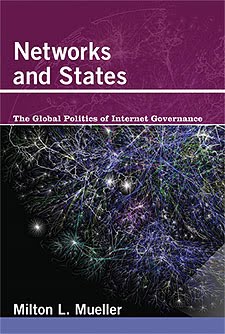 Milton Mueller, a professor at Syracuse University's School of Information Studies, is a familiar figure to anyone who follows Internet governance issues. He has established himself as a leading Net governance guru thanks to his extensive academic record in this field with books like Ruling the Root: Internet Governance and the Taming of Cyberspace (2002) and his work with The Internet Governance Project and the Global Internet Governance Academic Network. Mueller's latest book, Networks and States: The Global Politics of Internet Governance, continues his exploration of the forces shaping Internet policy across the globe.
The de Tocqueville of Cyberspace
What Mueller is doing – better than anyone else, in my opinion – is becoming the early chronicler of the unfolding Internet governance scene. He meticulously reports on, and then deconstructs, ongoing governance developments along the cyber-frontier. He is, in effect, a sort of de Tocqueville for cyberspace; an outsider looking in and asking questions about what makes this new world tick. Fifty years from now, when historians look back on the opening era of Internet governance squabbles, Milton Mueller's work will be among the first things they consult.
Mueller's goal in Networks and States is two-fold and has both an empirical and normative element. First, he aims to extend his exploration of the actors and forces affecting Internet governance debates and then develop a framework and taxonomy to better map and understand these forces and actors. He does a wonderful job on that front, even though many Net governance issues (especially those related to domain name system issues and ICANN) can be incredibly boring. Mueller finds a way to make them far more interesting, especially by helping to familiarize the reader with the personalities and organizations that increasingly dominate these debates and the issues and principles that drive their actions or activism.
Mueller's second goal in Networks and States is to breathe new life into the old cyber-libertarian philosophy that was more prevalent during the Net's founding era but has lost favor today. I plan to discuss this second goal in more detail here because Mueller has done something quite important in Networks and States: He has issued a call to arms to those who care about classical liberalism telling us, in effect, to get off our duffs and get serious about the fight for Internet freedom.
The Case for Cyber-Libertarianism / "Denationalized Liberalism"
Mueller says his "normative stance is rooted in the Internet's early promise of unfettered and borderless global communication, and its largely accidental and temporary escape from traditional institutional mechanisms of control." (p. 5) Faithful readers of this blog won't be surprised to hear that I love the sound of that, but let me spend a second on the semantics of "cyber-libertarianism," since it's a subject near and dear to my heart.
As Berin Szoka and I noted in our essay, "Cyber-Libertarianism: The Case for Real Internet Freedom," many scholars and pundits mistakenly conflate cyber-libertarianism and Internet exceptionalism. They are not identical. Rather, as Berin and I argued, they are close cousins. Properly defined, cyber-libertarianism is essentially the application of traditional libertarian thinking — which is more properly defined as classically "liberal" — to Internet policy issues. Berin and I define "cyber-libertarianism" as "the belief that individuals — acting in whatever capacity they choose (as citizens, consumers, companies, or collectives) — should be at liberty to pursue their own tastes and interests online." Internet exceptionalism, by contrast, is the belief that the Internet has changed culture and history profoundly and is deserving of special care before governments intervene. But that does not necessarily tell us what sort of philosophy or core tenants ultimately animate exceptionalism going forward.
Just as there's an unfortunate tendency by some Internet policy scholars to conflate cyber-libertarianism with Internet exceptionalism, others mistakenly equate it with cyber-anarchism. This is an even bigger mistake. Just as classical liberalism or traditional libertarianism do not represent a complete rejection of the State, "cyber-libertarianism," properly-defined, acknowledges that the State (or States) will have a role to play in society, albeit a quite limited one. What matters is the general sphere and trajectory of political power. Make no doubt about it, the cyber-libertarian is quite skeptical of coercive State power in almost all its forms, but he does not dismiss the exercise of State power outright. [Note: These issues were explored in detail by the late Harvard philosopher Robert Nozick in his 1974 book, Anarchy, State and Utopia, in which Nozick explained that to properly understand libertarianism, one had to first make the case against anarchism. This was a very different formulation of libertarianism, which previous scholars and advocates had constructed contra collectivism or statism.]
Returning to Mueller's book, there are times when he, too, blurs the line between cyber-libertarianism and Internet exceptionalism. Regardless, he's generally on the right track in seeking to reinvigorate cyber-libertarianism, or as he also refers to it, "denationalized liberalism." He argues:
Cyber-libertarianism is not dead; it was never really born. It was more a prophetic vision than an ideology or "ism" with a political and institutional program. It is now clear, however, that in considering the political alternatives and ideological dilemmas posed by the global Internet we can't really do without it, or something like it. That primal vision flagged two fundamental problems that still pervade most discussions of Internet governance: (1) the issues of who should be "sovereign" — the people interacting via the Internet or the territorial states constructed by earlier populations in complete ignorance of the capabilities of networked computers; and (2) the degree to which the classical liberal precepts of freedom get translated into the context of converged media, ubiquitous networks, and automated information processing. (p. 268)
Quite right. After walking through the various issues and case studies presented in the book, Mueller makes a convincing case for giving cyber-libertarianism another chance; a chance that it really never had. "At its core," Mueller continues, "denationalized liberalism favors a universal right to receive and impart information regardless of frontiers, and sees freedom to communicate and exchange information as fundamental and primary elements of human choice and political and social activity." (p. 269) Moreover, "this ideology holds a presumption in favor of networked, associative relations over hierarchical relations as a mode of transnational governance," he argues. "Governance should emerge primarily as a byproduct of many unilateral and bilateral decisions by its members to exchange or negotiate with other members (or refuse to do so)." (p. 269) Finally, he says, "a denationalized liberalism strives to make Internet users and suppliers an autonomous, global polity." (p. 270) In essence, it's about free will, freedom of action, and freedom of association. Again, it's essentially classical liberalism for the Information Age.
Mueller admits that "such an ideology needs to answer tough questions about when hierarchical exercises of power are justified and through which instruments they are exercised." But we can see what denationalized liberalism means in concrete terms when Mueller addresses freedom of expression and global Internet governance. His thoughts are worth quoting at length here because this illustrates why the purity of his approach is both laudatory but will be highly controversial to many. I've highlighted the most contentious bits:
Just as it is legitimate and necessary to insist on citizens' procedural rights with respect to the exercise of content regulation by their states, so it is legitimate, necessary – and far more important – to insist on eliminating as much censorship as possible in line with substantive free expression rights. We must uphold the concept of freedom of expression, and insist on the right of individuals to access information and communication others regardless of what state they reside in. We must, in other words, question the scope of national sovereignty over communications. If citizens a right to be informed that their government is blocking access to external information, then perhaps it is not too crazy to ask whether they also have a right to get that information without interference by their national government. If people have rights and expectations regarding the procedural mechanisms by which censorship is exercised, then perhaps they should also have rights and expectations about the minimizing the scope of censorship.
The governance of the Internet needs to explicitly recognize and embrace the principle that there are limits to national sovereignty over the flow of information. This claim is based on the truth that there are many transnational communities or polities, created by global electronic communications, whose individual members have their own intrinsic rights to communication among themselves. (p. 208-9)
Some will dismiss Mueller's approach based simply on its far-reaching implications. He's making a powerful, beautiful case for the preeminence of individual speech/communication rights over the State, but in doing so in the context of Internet governance, he's essentially saying that there can't be much Internet governance. And what governance there is must be very tightly limited. Don't get me wrong; I love the sound of that. It's the next logical step in the progression of liberty: taking the case for freedom of association and expression to the global level. But that movement will obviously run into resistance at every juncture and require nation-states and various other entities to make certain sacrifices. It's a fight worth having, however.
On the Insuperability of Economic and Social Internet Regulation
A very crucial point that Mueller makes at various points throughout the book is that, from the perspective of Internet governance and individual rights, it is almost impossible to imagine an expansion of global Net governance for speech that does not also entail more significant economic regulation, or vice-versa.
The Internet makes economic and social liberalism virtually insuperable: if one truly wants to regulate content and conduct in cyberspace to enforce socially conservative values, one must impose server economic regulations upon it and erect barriers to trade. And if one's political base is animated by fears of foreigners and terrorist attack, and the ideologues and special interest groups within one's coalition exploit those fears to elevate national security and surveillance over civil liberties and privacy, the openness and freedom of the Internet starts to be perceived as an enemy to be attacked. (p. 262)
This has long been one of the core tenants of traditional liberalism / libertarian philosophy, of course, so it's nice to see Mueller extend it to cyberspace here. There's just no getting around the fact that our speech and economic rights are even more fundamentally intertwined and it's even truer in the Information Age.
The Importance of Technological Agnosticism
I also want to align myself with Mueller's proper understanding of cyber-libertarianism or denationalized liberalism as fundamentally agnostic as it pertains to proprietary versus commons-based form of production. Mueller argues:
Denationalized liberalism embraces both property and commons and seeks to leverage their complementarities. It recognizes the coexistence and interdependence of markets, exclusive property rights, and shared/unowned resources in communication and information. It rejects the false idea that commons and property are mutually exclusive, totalizing principles for economic organization, seeing them instead as distinctive methods of organizing access to resources with their own virtues and failings. (p. 270)
This is a point that I have often stressed in my debates with Zittrain, Lessig, and Wu where I have argued that the whole "open vs. closed" debate is typically greatly overstated or misunderstood and that the best of all worlds is a dynamic, experimental one that allows for many different models or cultural and economic production to co-exist. I won't belabor that point here since you can read those other essays for more detail. But this is a crucial point in the ongoing battle of ideas on this front if we are to unify the burgeoning movement.
What Shall We Call This Philosophy / Movement?
It's interesting to me that Mueller goes back and forth between the terms "classical liberalism," "cyber-libertarianism" and "denationalized liberalism" when describing his ideology. I suspect he's struggling with the same issue many of us here do: Finding a word or term that carries less political baggage than "libertarianism" but that hasn't been co-opted by others, as "liberalism" has.
"Laissez-faire" would certainly be one label for this movement, but it's too encumbered with capitalistic notions for some to embrace. "Classical liberalism" is the proper historic term, but one that has lost its original meaning, at least here in the United States. Today, "liberal" is synonymous not with a love of liberty but a love of government power. "Voluntary exchange" — of information, goods, money, or whatever else — is what Mueller is really getting at here. It doesn't roll off the tongue nicely, but what separates this movement from others is volunteerism and a general openness to bottom-up, experimental, evolutionary dynamism over hierarchical, top-down, coerced visions of political organization.
Regardless of what we call this philosophy, Mueller has made a beautiful case for it and he has given the movement its marching orders:
In short, we need to find ways to translate classical liberal rights and freedom into a governance framework suitable for the global Internet. There can be no cyberliberty without a political movement to define, defend, and institutionalize individual rights and freedoms on a transnational scale. (p. 271)
Amen, brother. Sign me up!
Even if you aren't compelled to join the cause, however, I highly recommend you pick up Mueller's Network and States, anyway. It's a terrific survey of the current state of Internet governance and an important work of political science since it offers us a useful spectrum of Net governance viewpoints. It belongs on the bookshelf of every serious student of cyberlaw and information technology policy.


November 24, 2010
Net Neutrality Regulation, Accountability & Democracy
Proponents of Net neutrality regulation continue their full-court press to get the Federal Communications Commission (FCC) and its chairman, Julius Genachowski, to unilaterally push through a new industrial policy regime for the Internet. The latest word, according to Politico, is that the agency is pushing back its scheduled December open meeting from Dec. 15 to Dec. 21 to give the agency more time to plot its next move. There's no word yet what the agency's regulatory blueprint will look like, so it's impossible to critique the agency's plan at this point. I've made the case against Net neutrality regulation here before, however, and I'm sure those same concerns and critiques will apply to whatever the agency ends up adopting.
What's most concerning about the way this process is playing out currently is just how anti-democratic it is. I understand the zeal of the pro-regulatory forces on this issue, but there is simply no good excuse for advocating that 3 unelected officials at an independent regulatory agency rush through a vote to regulate a such a massive and important sector of the American economy.
It used to be the case that a broad and non-partisan coalition of academics and organizations supported the non-delegation principle, which, generally speaking, refers to the notion that only democratically elected officials should be in a position to pass laws and make the really important decisions about the future course of our polity and its economy. Of course, when it comes to the economy, I'd prefer most of those decisions be left to marketplace experimentation. However, to the extent regulation is deemed necessary and that regulation governs such a massively important portion of the American economy, that determination should definitely be made by elected leaders in Congress and not delegated to bureaucrats who would ram through regulations with 3 votes and sketchy plan for reordering that sector.
On this point, I strongly recommend the work of David Schoenbrod, a professor at New York Law School and the author of Power Without Responsibility: How Congress Abuses the People Through Delegation. Here's a great overview of his work in which he addresses the arguments against the anti-delegation principle. In sum, there really aren't any good arguments against it. "The genius of our Constitution was that the people would get to decide how much government they want," Schoenbrod notes. If critics believe that "the people's welfare would be advanced by giving up some of that decisional power, let the people so decide through the constitutional amendment process," he argues. "Instead, the insiders have done that for them" and that undercuts accountability, transparency, and true democracy.
That's a principle that many people of different political persuasions have long supported. Regrettably, however, when it comes to Net neutrality regulation, it's increasingly clear that the ends justify the means for proponents. To hell with democracy and accountability, they say. We want regulation and we want it now! That's obviously the rallying cry of radical pro-regulatory organizations like Free Press and Public Knowledge. What's more surprising, however, is how even more mainstream advocates of Net neutrality regulation seem willing go down that path. That's a real shame because I know some of them have fought against unaccountable exercises of power by the FCC in other contexts. Yet, in this case, it appears that they are turning a blind eye to the dangers of delegating so much authority to a regulatory agency that, quite frankly, has a fairly miserable history of (mis)managing its own affairs and the markets it oversees.
The recent elections had a impact on all this, obviously. With presumably less of an appetite in Congress now for expansive regulation of the Internet economy, advocates of Net neutrality mandates want the FCC to do all the dirty work here. Regardless of the merits of the arguments for or against such regulation, it's simply not good for our democracy when we shift all those really important decisions to bureaucracies, which are less accountable to the people and wear reforms take longer to push through when things go bad.


Kudos on Open Kinect
 After freak-outs and backpedaling, Microsoft has revised its stance on the so-called "hacks" of the Kinect. Wired's Tim Carmody reported on Monday that Microsoft seems to have indicated that it won't be taking legal action against anyone who has found new and "unsupported" uses for the Kinect. Shannon Loftis and Alex Kipman—two Microsofties involved in the creation of the Kinect—were featured on NPR's Science Friday and when asked if anyone would "get in trouble" for their Kinect creations, they responded with "No" and "Nope, absolutely not" respectively.
This is a refreshing change of course from Redmond. Embracing your most enthusiastic fans and harnessing their creative power for the betterment of your product certainly makes a heck of a lot more sense than prosecuting those folks under the DMCA.
To be fair, Carmody notes that Microsoft had reason to hold off on taking this stance immediately. Microsoft wanted to verify that the Kinect was being used as-is, as opposed to anything in the XBOX 360 being modified. This is incredibly important, because, as Carmody succinctly notes:
If Kinect's whole-room camera, robust facial-recognition software, and portal for video and audio chat are seen as insecure, it's a nightmare.
Too true. Microsoft's sensitivity on the topic is easy to understand when this massive security concern is taken into consideration. However, it seemed evident from the get-go that all of these "hacks" had nothing to do with hijacking the XBOX's software for the Kinect, but rather simply plugging the hardware it into another device entirely—namely a PC running Windows or Linux.
So, kudos to Microsoft on sorting out their feelings when it comes to the Kinect. Too bad they had to do so in public.


November 23, 2010
Netflix Blows It All Up
So now you can pay Netflix $7.99 a month and stream all the video you want? Damn cool if you ask me!
What does the Netflix decision mean for consumers—two words: More choice! This is what functional markets deliver. There was a time when if you missed an episode of your favorite show, that was it. You might have gotten lucky and caught it on its single rerun, but that was hit or miss. These days, I can watch The Office at 8 p.m. on Thursday nights. Or I can record on my DVR and watch it later that night. Or I can watch it the next day on my PC by visiting nbc.com. Or I can watch it on-demand from my cable box. Or I can wait a few months and watch it on DVD. Or, soon, via Netflix stream.
I can't help but wonder if this makes moot all the handwringing about the FCC's desire to place conditions on the online services a merged Comcast-NBC Universal can offer. Come on, Netflix has blown up the whole cable TV model.
Remember when everyone from Congress down to city utility commissions were demanding the cable industry create "a la carte" pricing plans, allowing subscribers to pick the channels they wanted and pay only for those. Netflix, as the ultimate video-on-demand service, has come close to doing so, absent any government mandate.
I don't consider myself a TV junkie, but I'll allow that I watch my fair share. Yet except for sports and news, I rarely watch regular programming at the time it airs. I timeshift nearly everything with my DVR.
In the past couple of years, I find myself doing a more dramatic form timeshifting. Thanks to DVDs, I can wait a year or two for a series to really prove itself before committing the time to watch. My wife and I came to "The Office" and "Burn Notice" late, catching up on past seasons on disk before (recording and) watching shows as they regularly air now.
Do I still pay for cable? Sure. But I dropped premium services such as HBO because I know I can eventually get "The Pacific" and "Big Love" on DVD. If Netflix pulls Web streaming off to the extent it hopes, all I may need is basic cable.
Naturally, Netflix's streaming service is disruptive enough to stir up the usual "concern" in legislative circles as to whether something or other about it is unfair. You can bet someone's going to accuse Netflix of trying to monopolize streaming licenses, just like you can bet that Congress or one of the federal watchdog agencies is going to insist Web streaming constitutes an individual market, and is not one of many business models for entertainment distribution. The Federal Trade Commission exhibited this mentality when it blocked the merger between Blockbuster and Hollywood Video. It ignored the measurable threat Netflix posed to both companies' survival and persisted in seeing brick-and-mortar video rental as its own sector, distinctly separate from video rental via the mail. Although the FTC desired to preserve consumer choice, both companies ended up in bankruptcy.
That's why the best thing regulators can do now is let this play out.
The big question is whether Netflix will be able to stock enough streaming titles to encourage people to use their service instead of DVD or on-demand cable. Cable companies have the right to protect their investment in programming. They should not be forced to yield licenses or programming exclusivity to Netflix. Similarly, the government should not prevent Netflix from seeking competitive advantageous content agreements with studios and distributors. Regulators should also avoid the temptation to "encourage competition," namely by propping up failing business models to protect favored companies and segments. They're big boys now. Let 'em play.





Tyler Cowen answers your questions

On the podcast this week, Tyler Cowen, professor of economics at George Mason University, general director of the Mercatus Center, and founder of the popular economics blog Marginal Revolution, answers questions from Surprisingly Free listeners and Marginal Revolution readers. Cowen discusses why people will be appalled that we ever questioned intrusive searches by TSA, what should have been done to minimize unemployment and other harm from the financial crisis, how the "famous American formula" for good government is broken, what might force us to sit around opening cans of dog food with our teeth, and which global sites should be connected by Stargate portals to create the most value. He also asks, "Why read books?", speculates about the value of his blog, addresses price discrimination of chicken McNuggets, talks about a modern day Athens in Asia with good food, suggests that internet comments are a relatively harmless form of stupidity, and opines about the best thing that government does.
Related Links
"Books of the year, 2010″, by Cowen at Marginal Revolution
"What is the case for the Fed?", by Cowen at MR
"Sentences [about TSA and flying] to ponder", by Cowen at MR
"The Road to Medicare, not The Road to Serfdom", by Cowen at MR
To keep the conversation around this episode in one place, we'd like to ask you to comment at the web page for this episode on Surprisingly Free. Also, why not subscribe to the podcast on iTunes?


November 22, 2010
What's An Internet Monopolist? A Reply to Professor Wu
[This guest post is by Joshua Wright (George Mason University) and Geoffrey Manne (International Center for Law & Economics), who blog regularly at Truth on the Market]
We've been reading with interest a bit of an blog squabble between Tim Wu and Adam Thierer (see here and here) set off by Professor Wu's WSJ column: "In the Grip of the New Monopolists." Wu's column makes some remarkable claims, and, like Adam, we find it extremely troubling.
Wu starts off with some serious teeth-gnashing concern over "The Internet Economy":
The Internet has long been held up as a model for what the free market is supposed to look like—competition in its purest form. So why does it look increasingly like a Monopoly board? Most of the major sectors today are controlled by one dominant company or an oligopoly. Google "owns" search; Facebook, social networking; eBay rules auctions; Apple dominates online content delivery; Amazon, retail; and so on.
There are digital Kashmirs, disputed territories that remain anyone's game, like digital publishing. But the dominions of major firms have enjoyed surprisingly secure borders over the last five years, their core markets secure. Microsoft's Bing, launched last year by a giant with $40 billion in cash on hand, has captured a mere 3.25% of query volume (Google retains 83%). Still, no one expects Google Buzz to seriously encroach on Facebook's market, or, for that matter, Skype to take over from Twitter. Though the border incursions do keep dominant firms on their toes, they have largely foundered as business ventures.
What struck us about Wu's column was that there was not even a thin veil over the "big is bad" theme of the essay. Holding aside complicated market definition questions about the markets in which Google, Twitter, Facebook, Apple, Amazon and others upon whom Wu focuses operate—that is, the question of whether these firms are actually "monopolists" or even "near monopolists"—a question that Adam deals with masterfully in his response (in essence: There is a serious defect in an analysis of online markets in which Amazon and eBay are asserted to be non-competitors, monopolizing distinct sectors of commerce)—the most striking feature of Wu's essay was the presumption that market concentration of this type leads to harm.
While Wu describes network externalities as one possible reason for the presence of firms with large shares in these markets, and gives some lip service to the notion that monopolists of the 2.0 variety might provide some consumer benefits, consider the following use of language to describe market outcomes:
"Market power is rarely seized so much as it is surrendered up, and that surrender is born less of a deliberate decision than of going with the flow."
"We wouldn't fret over monopoly so much if it came with a term limit. If Facebook's rule over social networking were somehow restricted to, say, 10 years—or better, ended the moment the firm lost its technical superiority—the very idea of monopoly might seem almost wholesome. The problem is that dominant firms are like congressional incumbents and African dictators: They rarely give up even when they are clearly past their prime. Facing decline, they do everything possible to stay in power. And that's when the rest of us suffer."
Wu's claim is that the modern "information monopolies" will be socially harmful. Consider the first quote above. These firms do not earn and keep their share by satisfying consumer demand from active consumers with preferences; it is "surrendered" by forces beyond the consumers' control. And with the second, why would we be concerned about time limits if these concentrated markets (again, lets assume arguendo the market definitions Wu has in mind for now) were generating competitive results?
One need not read the tea leaves here. Wu cuts to the chase when he writes that "info-monopolies tend to be good-to-great in the short term and bad-to-terrible in the long term." Benefits come early, but "the downside shows up later, as the monopolist ages and the will to innovate is replaced by mere will to power. … The costs of the monopoly are mostly borne by entrepreneurs and innovators. Over the long run, the consequences afflict the public in more subtle ways, as what were once highly dynamic parts of the economy begin to stagnate."
Professor Wu seems to long for the good old days of antitrust—when big was bad not only as a matter of economics, but as a matter of law. He writes, apparently assuming the economic truth of his theory of monopoly, that:
These negative effects are why people like Theodore Roosevelt, Louis Brandeis and Thurman Arnold regarded monopoly as an evil to be destroyed by the federal courts. They took a rather literal reading of the Sherman Act, which states, "Every person who shall monopolize…shall be deemed guilty of a felony." But today we don't have the heart to euthanize a healthy firm like Facebook just because it's huge and happens to know more about us than the IRS.
I do not think Professor Wu could have made it any more clear that his view is that market concentration in Internet markets is a net loss proposition for consumers. If not an explicit endorsement of "big is bad" antitrust policy, it's at least a rosy-eyed ode to that golden era when enforcers had more "heart." His stance is crystal clear. Now, we think that view is wrong. And we were just getting ready to write a short blog post responding to Wu's column when things got a bit more interesting.
Thierer's excellent response makes a few of the points above, but mostly focuses on the definitional question of "what's a monopoly." Adam's main allegation is that Wu uses the term "monopoly" inappropriately by merely focusing on market structure—whereas Adam would prefer that it is used only when competitive harm accompanies the concentrated market. That is, Adam would not define a single seller of product X who sells at the competitive price because of the threat of entry as a monopolist, but Wu would. It is Wu's use of a "welfare-neutral" term that gets Thierer going:
Which gets to perhaps most stunning thing about Wu's editorial today: He never even posits a "harm" that might be coming from the rise of these "new monopolists." That's not surprising, of course, since he'd be hard-pressed to make the case that the sky is falling or that consumers are somehow the victims of some horrendous plight. Hell, most of these services don't cost consumers a dime! And they are constantly innovating and offering an improved consumer experience. If this is "monopoly," then give us more!
What Tim Wu is really doing is propagating the simplistic old saw that "Big Is Bad." We could argue about how big is too big, but we shouldn't confuse that debate with Wu's mistaken redefinition of the term "monopoly." He has intentionally watered down the term "monopolist" such that it now means any combination of big firms he personally doesn't approve of in markets that he has defined far too narrowly. That's not a proper understanding of the term "monopoly" and it most certainly isn't an accurate representation of the real world of exciting digital innovation and ingenuity that we live in today.
What's odd about the entire debate is, as mentioned above, Wu's WSJ piece seems entirely clear where he stands on the welfare issue: the presence of a dominant firm in internet markets is bad for consumers. The column expresses a confidence in the "badness" of concentration that, in our view, just isn't warranted by the current theoretical and empirical evidence in the industrial organization literature. But rather than debate that (more important) point, we've got what we think is a bit of a sideshow on whether Thierer and Wu are talking about textbook definitions of monopoly, the legal definition, or something else.
What's more—after Wu's original WSJ piece ringing the alarm, or at least going to level orange, on Web 2.0 Robber Barons, his reply to Thierer takes the incredibly odd tack of offering a "corrective" to Thierer. After all, Wu's new post points out, all he was saying was that the presence of a dominant firm creates a monopoly, and he isn't saying anything about welfare. It's all market structure: There's nothing to see here, move along. Thierer's claims that Wu said anything about redefining monopolist are "sowing confusion and misleading the public" and are owed to his incorrect substitution of the "legal" definition of monopoly rather than a pure economic definition.
Now, Wu knows full well that he has constructed a long meditation in the Saturday Wall Street Journal fretting about Internet monopolies. I'm sure he can point to all kinds of qualifying words in his piece that permit plausible deniability of his apparent claim that big is, indeed, bad. But the effect (and, presumably, the intent) of Wu's piece is, as we have said, quite clear: We all suffer from these monopolies and they should be destroyed. For Wu now to claim that he's merely pointing out that, good or bad, there are some firms that have large shares of certain online markets (as he casually defines them) is preposterous. For him to hide behind an allegedly-economic definition of monopoly (which, by the way, requires an economic definition of the relevant market—an analysis that is wholly absent from Wu's piece) is even more preposterous, not least for his apparent complete lack of understanding of the economic definition of monopoly.
Here is Wu's final answer on the true, "economic" definition of monopoly:
A monopoly is any firm that has a dominant share in the market for a given good or service (legal definitions range between 40% – 70%) resulting in power over that market. That is the beginning and the end of the definition. There is no further requirement that the firm be evil, gigantic, have caused consumer harm, be long-lasting, or anything else.
This is wrong, or at least woefully misleading. As every Industrial Organization and Intermediate Microeconomics textbook makes clear, other than in the literal sense (as in "a single seller in a market"—which is the definition in Carlton & Perloff's Modern Industrial Organization), a monopoly is a firm or firms that are not price-takers—in other words, that can control prices and maintain supra-competitive returns by charging an equilibrium price above marginal cost. As Carlton & Perloff describe it "in contrast to a price-taking competitive firm, a monopoly knows that it can set its own price and that the price chosen affects the quantity it sells. Whenever a firm can influence the the price it receives for its product, the firm is said to have monopoly power or market power. The terms monopoly power and market power typically are used interchangeably to mean the ability to set price above competitive levels." Wu's attempt to distinguish from Thierer on the grounds that he is using a truly economic definition paints him into a bit of a corner here. He surely does not mean the literal "single seller" definition. But then, what is left? If Wu is asserting the proposition that Google and EBay and Facebook all face downward sloping demand curves and thus have economic market power, i.e., the ability to price over marginal cost, well, so do nearly all firms in the economy. On the other hand, if he's saying that these firms have the power to control market prices and conditions (and not just their own prices), then this is indeed (by definition) a concession that the definition turns on the ability to engage in conduct that is socially harmful. We think that Wu's position—in the WSJ piece—is the latter. But to the extent it is, it is a position that is incomplete from an economic perspective.
Monopoly as an economic concept—once used outside the strict "single seller" context—is not simply about the number of firms competing but, rather, in Irving Fisher's phrase, "the absence of competition." The fact that competition is extraordinarily complex means that facile definitions like "having a dominant share" or "one firm in a market" are inadequate and it is well-understood that markets with only one seller can be competitive. Wu's effort to bring in market power is closer, but now we're talking about market definition and a host of other concepts that are, in fact, completely absent from Wu's assessment.
As Adam points out, there is a lot of competition among Wu's purported monopolists, but the failure to see this (or to point it out) is a function of Wu's crabbed market definitions. But on Wu's own terms, it's really hard to see the above-marginal-cost pricing in these markets. From the point of view of the buyers whom Wu is using to define his markets, these monopolists are really pathetic at extracting profits, as most of them give away their products for free and/or have brought so much efficient competition that they have dramatically lowered prices overall (think Amazon). I guess once Amazon puts all other retailers—including Wal-Mart, Target, Best Buy, Barnes & Noble, etc., etc.—out of business we'll all suffer mightily. But that simply isn't going to happen (and, meanwhile, the presence of all these retailers (all with substantial online presences, as well as off) puts paid to Wu's claims about single firm dominance.
By the way—also well-worth a read on this is the DOJ's Section 2 Report, especially Chapter 2 on monopoly power, or Josh's piece on the distinction between economic market power and market power in antitrust law. In a nutshell: market share is, at best, the beginning, not the end, of the monopoly power analysis.
But that's all beside the real point, isn't it?
The real debate is over whether concentration in internet industries systematically leads to reduced innovation, consumer welfare, and economic growth. We thought perhaps we'd chime in with a post and attempt to tempt Wu to engage in that debate. After all, the WSJ article was filled with assertions and anecdotes about the certainty of future harm following from a so-called "age of monopolists." That debate is where the action is. Indeed, one of the primary changes in antitrust economics over the past 40 years has been a shift from reliance on market concentration as a predictor of competitive effects to other, more reliable measures. For example, the changes to the most recent Horizontal Merger Guidelines. But lets not get distracted. It would be a great debate to have.
But it now appears that Professor Wu—at least in his blog posts—has stood down on that front. Forget the odes to 1960 antitrust and forget the promises of economic stagnation and consumer harm to come. The point was merely, we are told, to point out that sometimes (if one assumes a particular market definition) one can find firms with large shares in Internet markets and this might be good, might be bad, or none of the above. Well, that's not saying much about internet markets and frankly, its not saying much of anything at all, is it? We can all certainly agree that the ubiquity of two-sided markets, network externalities, and other features of internet markets can sometimes lead to relatively concentrated markets or the presence of a dominant firm. We can probably also all agree that these market structures are often efficient, involve serious competition for the market, and lead to boons for consumer welfare.
We could all agree on that, right? Maybe. Maybe not. But let us be frank about this: the policy preferences in Wu's WSJ piece are not well-camouflaged and they should be of concern to those who actually care about consumer welfare arising from these important—and oft-demonized—firms. Does anybody who read the WSJ piece really believe that the point was that Internet markets get concentrated sometimes? We don't. Thierer didn't—and he got a "correction" on the definition of monopolization for his efforts.
We're not so interested in the corrective on the definition of monopoly. But, Professor Wu, how about a debate on the merits of the substantive claims that concentration in Internet markets leads to consumer harm? Or the merits of the good old days of antitrust?


Tech Lobbying, Entrepreneurship, and the Innovation Economy
As he noted, Adam Thierer's lead article in the most recent Cato Policy Report is called "The Sad State of Cyber-Politics." It goes through so many ways tech and telecom companies are playing the Washington game to win or keep competitive advantage.
It's a nice set-up to a Washington Post opinion piece from this weekend in which TownFlier CEO Morris Panner talks about the growing riches accruing to Washington influencers:
We are creating so much regulation – over tax policy, health care, financial activity – that smart people have figured out that they can get rich faster and more easily by manipulating rules on behalf of existing corporations than by creating net new activity and wealth. Gamesmanship pays better than entrepreneurship.
Thierer sees some hope for the tech sector, for a few reasons:
Smaller tech companies have thus far largely resisted the urge [to engage with Washington]. Hopefully that's for principled reasons, not just due to a shortage of lobbying resources. Second, the esoteric nature of many Internet and digital technology policy discussions frustrates many lawmakers and often forces them to lose interest in these topics. Third, the breakneck pace of technological change makes it difficult for regulators to bottle up innovation and entrepreneurialism.
Panner's broader piece calls for "a national campaign to create transparency in our legislation and a national moratorium on the creation of commissions, regulators and czars. It is time for Congress to do the hard job of saying what lawmakers mean in clear and easy-to-understand language." He continues, "We should reject bills that are thousands of pages or that delegate vast authority to unelected regulators."
That would be a start.


November 19, 2010
Five Ways Congress Can Fix COICA Copyright Bill
Yesterday, the Senate Judiciary Committee unanimously approved the "Combating Online Infringements and Counterfeits Act" (COICA). The bill would enable the U.S. Attorney General to obtain a court order disabling web domains that are "dedicated to infringing activities."
These "rogue websites" are a real problem, as the website "Fight Online Theft" explains, so it's a good thing that Congress is working to address them through COICA. However, some of the bill's provisions raise profound constitutional concerns, and the bill lacks adequate safeguards to protect against the unwarranted suspension of Internet domain names, as the website "Don't Censor the Net" explains. COICA also doesn't provide a mechanism for website operators targeted by the Attorney General to defend their site in an adversary judicial proceeding. This week, a group of over 40 law professors submitted a letter to the U.S. Senate arguing that COICA, in its current form, suffers from "egregious Constitutional infirmities."
To address these concerns, CEI issued a statement today urging Congress to amend COICA to provide for more robust safeguards, including:
Providing a meaningful opportunity for Internet site operators to challenge before a federal court an Attorney General's assertion that their site is "dedicated to infringing activities" prior to the site's suspension;
Requiring that the Attorney General, upon commencing an in rem action against a domain name, make a reasonable and good faith effort to promptly notify the site's actual operator;
Clarifying the definition of an Internet site "dedicated to infringing activities" to ensure that Internet sites with nontrivial lawful uses that facilitate infringing acts by third parties will not face domain name suspension if their operators:
Comply with legitimate takedown requests from rightsholders;
Do not receive a financial benefit directly attributable to infringing activities;
Do not design their site primarily for the purpose of facilitating infringing activities; and
Do not induce infringing activities.
Instructing the Department of Justice and federal prosecutors not to request that domain name registrars, registries, or service providers suspend domain names that have not been deemed to be "dedicated to infringing activities" by a federal court; and
Requiring the Department of Justice to compensate domain name registrars, registries, and service providers for any reasonable costs they incur in the course of disabling infringing domain names.


The Sad State of Cyber-Politics
When it comes to technology policy, I'm usually a fairly optimistic guy. But when it comes to technology politics, well, I have my grumpier moments. I had at particularly grumpy moment earlier this summer when I was sitting at a hearing listening to a bunch of high-tech companies bash each other's brains in and basically calling for lawmakers to throw everyone else under the regulatory bus except for them. Instead of heeding Ben Franklin's sound old advice that "We must, indeed, all hang together, or assuredly we shall all hang separately," it's increasingly clear that high-tech America seems determined to just try to hang each other. It'd be one thing if that heated competition was all taking place in the marketplace, but, increasingly, more and more of it is taking place inside the Beltway with regulation instead of innovation being the weapon of choice.
That episode made me think back to the outstanding 2000 manifesto penned by T. J. Rodgers, president and CEO of Cypress Semiconductor, "Why Silicon Valley Should Not Normalize Relations with Washington, D.C." I went back and re-read it upon the 10th anniversary of its publication by the Cato Institute and, sadly, came to realize that just about everything Rodgers had feared and predicted had come true. Rodgers had attempted to preemptively discourage high-tech companies from an excessive "normalization" of relations with the parasitic culture that dominates Washington by reminding them what Washington giveth it can also taketh away. "The political scene in Washington is antithetical to the core values that drive our success in the international marketplace and risks converting entrepreneurs into statist businessmen," he warned a decade ago. "The collectivist notion that drives policymaking in Washington is the irrevocable enemy of high-technology capitalism and the wealth creation process." And he reminded his fellow capitalists "that free minds and free markets are the moral foundation that has made our success possible. We must never allow those freedoms to be diminished for any reason."
Alas, as I point out in my new Cato Policy Report essay "The Sad State of Cyber-Politics," no one listened to Rodgers. Indeed, Rodgers's dystopian vision of a highly politicized digital future has taken just a decade to become reality. The high-tech policy scene within the Beltway has become a cesspool of backstabbing politics, hypocritical policy positions, shameful PR tactics, and bloated lobbying budgets. I go on in the article to itemize a litany of examples of how high-tech America appears determined to fall prey to what Milton Friedman once called "The Business Community's Suicidal Impulse": the persistent propensity to persecute one's competitors using regulation or the threat thereof.
It's a sad tale that doesn't make for enjoyable reading, but I do try to end the essay on an upbeat (if somewhat naive) note. If you are interested, you can find the plain text version on the Cato website here and I've embedded the PDF of the publication down below in a Scribd Reader.
Sad State of Cyber Politics (Cato Policy Report)


Adam Thierer's Blog

- Adam Thierer's profile
- 1 follower

