Beth Tabler's Blog, page 188
May 22, 2022
Review – Illborn by Daniel T. Jackson
must-read for anyone who enjoys character-driven fantasy, complex and psychological interrogations of religion, the fallibility of humans, and propulsive, well-written narrative.
Illborn is a chonky 700 page book is brimming full of compelling character-driven fantasy, intriguing religious concepts, unique geographical and cultural diversity, and a prologue that will absolutely leave your jaw on the floor.
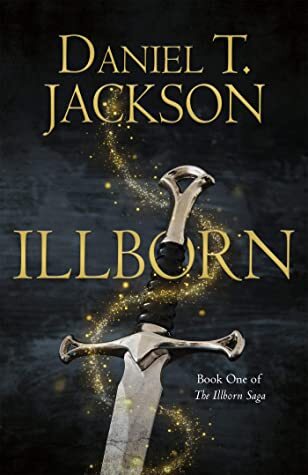 Daniel T Jackson’s debut novel is an assured and confident start to the Illborn saga. Following four young men and women who start to exhibit strange supernatural powers, Illborn takes us through their journeys of discovery. They have to contend not only with what is happening within themselves emotionally, spiritually, and mentally, but also with all the external factors around them. How their family and friends might react, and how the religious establishment of the Holy Church of the Lord Aiduel will see them. Are they prophets? Angels? Heretics? What do each of the four individuals’ unique powers mean and what is their purpose? The author tells four disparate stories of young men and women divided by class, culture and geography, all linked together in one shared dream that they must learn to understand.
Illborn is set in a medieval world, ruled by the established Holy Church of Lord Aiduel who, 800 years ago, united all the peoples of Angall before ascending to heaven. Make no mistake, the church is an overbearing presence throughout this book, something that not all readers may get along with. But, being someone who finds the history of the crusades fascinating, I really enjoyed this aspect of the world. This book’s approach to religion really reminded me of the crusades and the conflict in the middle east at that time. Daniel T. Jackson definitely explores the concepts of faith and the establishment, how those two are vastly different, how the establishment is a human construction prone and vulnerable to corruption, self-service and the festering of dark secrets. Always it is human fallibility that taints the faith, not the religion itself.
The world-building here is tremendous, Jackson presents a living, breathing world, each separate country has its own class system, its relationship to the church, if any at all, and its own army and culture. The approach to the magic system, though not completely understood even at the end of the book, is a really fascinating concept, very much internal and of the mind. Linking it with a possibly connection to a religious figure very much had me wanting more information.
Let’s talk about the four-character povs that we follow. We have Arion son of Duke Conran Sepian, the third greatest noble house in Andar, who has a complicated relationship with his father and who dreams of joining the Royal Academy of Knights against his father’s wishes. Next, we have Allana who, after committing murder, is on the run. Her morality and limits dissolves as her motives become darker and more selfish. Leanna is the most devout to the Holy Church and swearing an oath, against her parent’s wishes, joins the Holy Church as a sister. After experiencing a vision, her faith becomes stronger, but she soon learns of corruption within the establishment. Lastly we have Corin, the youngest son of Akob who belong to the people of Karn, a clan in a far off continent to the other three. After being expelled from the clan for being a coward, he soon learns to survive in the wild, and through his growing power, becomes a different man.
Each of these stories were so different and unique, all of them had compelling arcs, even though I found a couple of the characters quite unlikeable. Allana, who I initially liked, who underwent trauma from a sexual assault, soon becomes a manipulative and selfish character who’s motivations and actions I found difficult to sympathise or agree with. But the beauty of Jackson’s writing is I needed to know what happened next in her story. His ability to end every chapter, of each pov character, on a cliff-hanger, made for an exciting, propulsive read. As mentioned, its 700 pages, but I flew through this in a week. The pacing is near pitch-perfect throughout. Leanna’s internal thoughts and prayers were constant and sometimes overbearing, but I understood why she was written that way. Her devout, almost blind faith in the Holy Church is at once a blessing and a crux to her character.
Corin’s story felt very different from the other three, as it took place on a different continent, far from the Holy Churches influence. The culture and social structure was reminiscent of Norse social structures and I really got into Corin’s story. I felt for him the most being outcast and ridiculed for not wanting to be what his society expected him to be. Physically and psychologically he is very different from the rest of his family and clan and what he goes through and his fascinating character growth, I found really compelling.
Daniel T. Jackson’s Illborn is a must read for anyone who enjoys character-driven fantasy, complex and psychological interrogations of religion, the fallibility of humans and propulsive, well-written narrative. I am really looking forward to his next book and revisiting these four characters, to see how their powers evolve and the true meaning behind their shared dream.
This is a strong 4/5 for me.
Check Out IllbornThe post Review – Illborn by Daniel T. Jackson appeared first on BEFOREWEGOBLOG.


Review of Paper Girls, Vol. 1 by Brian K. Vaughan, Cliff Chiang
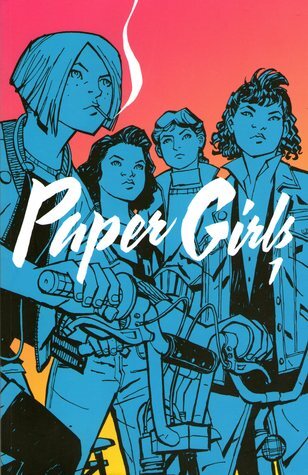
“I’m not going to stand here and be eaten by some bitch’s dinosaur. I am finally doing something with my life.”
― Brian K. Vaughan, Paper Girls, Vol. 1
Summary
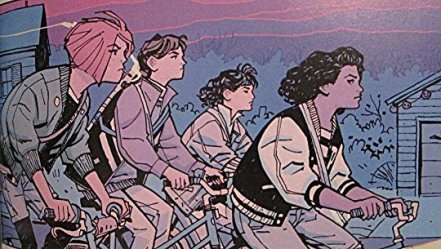
From the publisher, “In the early hours after Halloween of 1988, four 12-year-old newspaper delivery girls uncover the most important story of all time. Suburban drama and otherworldly mysteries collide in this smash-hit series about nostalgia, first jobs, and the last days of childhood.”
My Thoughts on Paper Girls Vol. 1
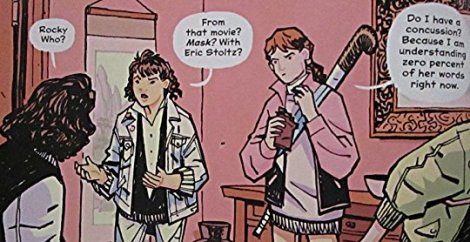
I am just starting Paper Girls, so my review is limited to the first volume. With that said, I can tell you volume 1 is an absolute rabbit hole. Half the time I had no idea what was going on. There are dinosaurs, crazy disfigured teenagers from the future, and some old dude with an Apple logo on his shirt. I have no idea what the four girls’ names are that star in the story. All I know is one is Vietnamese, one is adopted, one is Jewish, and one is a spirited red-head on her way to being a criminal. I wish I had a bit more than cliches to tell you, but I honestly have no idea.
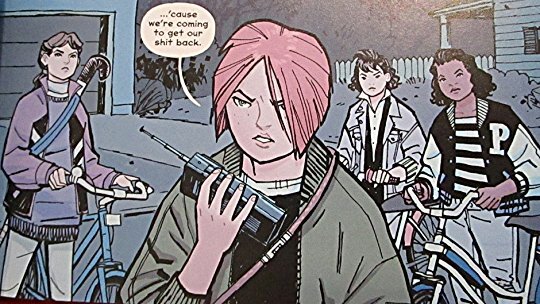
“…you girls… reminded us… of us…
…kids just trying… to make a living…
are always… the good guys…”
― Brian K. Vaughan, Paper Girls, Vol. 1
Here are the things I absolutely know for sure. First, this series is an unmistakable nod to the 80s and pop culture. The book is full of Bon mot’s about 80’s fashion, movies, music, language, and general attitudes about the world. This speaks to me. I remember being one of these girls in the eighties. Secondly, this book is no Saga, but that is ok. It doesn’t have to be. It has badass girls, friendship, space, time travel, and dinosaurs. I mean cmon. It is pretty damn impressive. Thirdly, it has tons of room to grow and develop. The first book is apparently setting the stage for more awesome. I am not in love with it, but the characters are fresh and exciting, the story is rad if not slightly confusing and the graphics are clean. Lastly, don’t get too deep into why this series is called Paper Girls. It isn’t some clever allusion to young girls with paper-thin identities or emotions. The girls run a paper route… I am on to volume 2. Looking forward to it. It can’t get any weirder or more confusing but it sure is fun
Check Out Paper Girls Vol. 1
.
Read Some of Our Other Review
Review – Against All Odds by Jeffery H. Haskell
Review of John Dies at the End by David Wong
The post Review of Paper Girls, Vol. 1 by Brian K. Vaughan, Cliff Chiang appeared first on BEFOREWEGOBLOG.
May 21, 2022
Review – Picard The Last Best Hope by Una McCormack
Babylon Five was our last best hope fo…oh wait, wrong franchise. It’s actually an Abraham Lincoln quote but that’s what the title of this book reminded me of. I should note that I am an enormous Star Trek fan. I am an enormous Star Trek fan that is also a fan of Star Wars. I am a double agent of both franchises and cannot be trusted because I have violated the sacred taboo of loving both. However, I will say how much I love the fact that both franchises are still going strong. While not without its flaws, Discovery was awesome and I was tickled when I got to see Picard. I watched that television show three times.
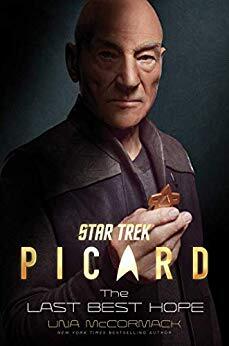 Star Trek: Picard is a sequel series to the era of TNG, Deep Space Nine, and Voyager. It’s been decades since Star Trek: Nemesis both in and out of universe with the supernova of Star Trek (2009) forming a major part of the plot. Romulus has been destroyed, the Federation didn’t do much to help its refugees, Data is dead, and synthetic life-forms have been banned after the Federation’s equivalent of 9/11 that ended up destroying Mars. It’s a solid series and while people think I’m criticizing it by saying it reminds me heavily of Mass Effect, I love Mass Effect and enjoyed its complicated plot of secret societies, synthetic lifeforms, and post-War on Terror politics.
There’s a lot of unanswered questions about Picard, though, that are primarily the result of how we got from Point A to Point B. As much as I loved the series, I felt like the best possible opener would have been a two part episode that pretty much depicts this book’s exact series of events. I wanted to see Admiral Picard at the top of his game, evacuating Romulans by the thousands, and non-sentient synth labor on the verge of automating Federation labor to the point the Singularity was one step closer. I wanted, somewhat sadistically, to see all of that torn down in order to lay the foundation for the events of the show.
This book delivers and more.
I’m a huge Una McCormack fan and consider her Cardassian novel, The Never-Ending Sacrifice, to be one of the highlights of all Trek literature. She had a really formidable task ahead of her with the job of addressing all of the questions that fans of the show had about events. She had to detail the politics of the Federation, Romulan Empire, and the galaxy as a whole while telling an interesting story. In a very real way, this is a novel that consists entirely of running the logistics of a large-scale evacuation. There’s no pew-pew and it’s almost entirely characterization that show-watchers will know is destined for the mother of all downer endings. The fact she also has to keep track of continuity across movies, series, and a few books makes the task seem nearly insurmountable. Yet, she manages to pull it off.
The very concise and not at all spoilery summary of the story is as follows: The Romulan star is going to go supernova. This is a slight retcon from Star Trek (2009) but simplifies the physics tremendously. The Romulan Empire has an incredible effort ahead of it but is, begrudgingly, willing to let the Federation assist in the evacuation of some of the citizens. Well, close to a billion of them. Captain Picard, overwhelmed with the sheer scale of the problem, reluctantly accepts a promotion to Admiral in order to supervise the effort. This means saying goodbye to the Enterprise but will allow him to do as much good as virtually anything else he’s done in his lifetime. Unfortunately, the Federation barely has the resources to evacuate a billion people even if it throws everything at the problem. This is, after all, an organization that lost virtually its entire fleet at the Battle of Wolf 359. Starfleet does not possess the ships to move all the refugees and even if it did there’s the matter of finding a place to settle them.
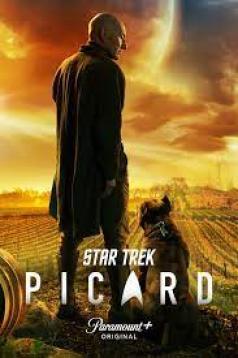 Jean Luc is confident that everything will work out for the best with sufficient grit and determination. For the most part, he has no real reason to think otherwise. The Federation isn’t entirely happy with the Romulan Free State and there are people upset about having to empty their pockets to help a billion “enemy” refugees. However, the Federation is not the people of 21st century Earth nor are the Romulans the war-torn refugees we too often turn out backs against. Unhappy as they may be about emptying their pockets, empty their pockets the Federation does. Geordi and Bruce Maddox also set out to find a science-based solution to the infrastructure problems they face as is typical in Trek. There’s a couple of scheming politicians and Romulan nasties who stand in the way in the greater good but it’s nothing our heroes haven’t dealt with before.
But it’s all going to go horribly-horribly wrong. The greatest twist of this book is that it is not a twist at all. Star Trek: Picard is based around Jean Luc Picard’s greatest failure. Even moreso than being taken by the Borg really. Both times, it’s not really his fault but the end results are catastrophic beyond belief. It’s essential that moment when Kirk fails to raise the shields in The Wrath of Khan because he’s handled this a dozen times, only a thousand times worse. It’s not that the Federation didn’t try to do its part, its not that the heroes of the book (using the term loosely with professional creep Bruce Maddox) didn’t do their best, it’s just that the scale of the disaster is beyond anything that can be dealt with before the supernova goes off. To crib from Babylon Five again, “It was our last best hope for peace. It failed.”
I really liked the depiction of Romulus in this book as it doesn’t really shy away from the fact it’s a totalitarian dictatorship. Trek fans are naturally optimistic but real life has unfortunately shown that authoritarian governments are disinclined to deal in good faith or surrender any power for the benefit of others. The Romulan government would benefit greatly by sharing the data about how screwed they are with its people. They would benefit greatly from not just asking the Federation for help (which they never do, they just reluctantly accept it) but asking everyone else in the Alpha as well as Beta Quadrants. Grand Nagus Rom would only charge slightly above cost, much to the horror of his people. Martok might even lend a shuttle. However, that would mean showing weakness and the Romulan government would rather most of its race go extinct than allow that. Real life shows that this is all too realistic.
If I had any complaints, I would say that I do kind of wish there was a way that this could have been reconciled with novel continuity. That is impossible, though, because the events of Star Trek: Destiny preclude any reconciliation with Picard. The Romulans in the books are also in a far better place alliance and leadership wise than the ones who stupidly lead their people to ruin in the books. Still, I really would love to see how the Typhon Pact would deal with the sudden destruction of Romulus. Another issue is that we don’t see how Spock was dealing with the issue or how his use of Red Matter affected things. I like to think he saved countless billions of lives on the Romulan colonies but I think both the homeworld as well as Remus are out of luck. Bruce Maddox is also a creep, as mentioned, and I would have much preferred Doctor Jurati’s perspective on all this.
In conclusion, if you have watched Picard then you should read this book. If you haven’t watched Picard and are planning to then this is a great book to read beforehand. It’s a darker and grittier Trek but not because of the characters. They’re as idealistic and good as they’ve always been. It’s just this time it isn’t enough. I feel Una also cleared up a lot of mistakes from the 2009 movie and created a realistic (for a bid budget sci-fi universe) problem that is a marathon rather than a race to solve.
I could rate this a 4.5/5 for the Bruce Maddox parts and lack of Spock but I’m giving it the whole enchilada because it affected me that much.
Check Out Picard The Last Best Hope by Una McCormackThe post Review – Picard The Last Best Hope by Una McCormack appeared first on BEFOREWEGOBLOG.
A Conversation With Hannah De Giorgis – Author of Threads in Time

In your story Threads in Time, your lead character is named Lyndall Huxley. How did you go about creating her? Is she pulled from life or entirely from your imagination?
Lyndall materialized in my mind as quite a distinctly formed character from the beginning. For me, it was important to create a strong female protagonist (in quite a male-dominated time-travel genre) whose tale is, to a certain extent, a coming-of-age one. And then, as the story developed, her character grew and evolved with it. I would say she’s a hybrid – an amalgamation of imagination and real-life inspiration. After all, we write from what we know. She is named after a wonderful feminist character from a little-known nineteenth-century novel, The Story of an African Farm by Olive Schreiner, and her family name is a thinly-veiled(!) salute to Brave New World. Lyndall finds herself in an alien world, which leads her on a life-changing journey of many twists and turns.
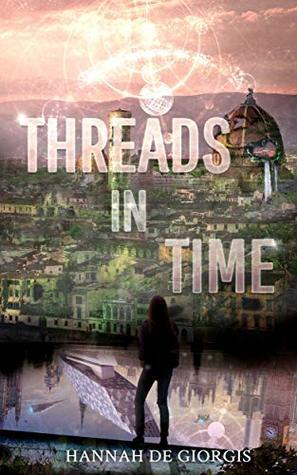
Book Synopsis
Twenty-two-year-old Lyndall Huxley wakes to find herself thousands of years into the future. Something went wrong with the programme for which she volunteered – a programme that employs Einstein’s laws of relativity to send travellers forward in time. The ruins overrun by green woodland in which she wakes are a far cry from the urbanised world she left behind in the 2200’s. Lyndall embarks upon a journey that will leave her questioning her very identity. She must choose between the new life that beckons and the old life from which, even thousands of years later, she cannot escape. She will discover that the mission was never about sending people into the future. Much more is at stake.
What inspired you to write Threads in Time?
I was preoccupied with Einstein’s theories of relativity for a while. I wrote my master’s dissertation on how T.S. Eliot’s portrayal of time was influenced by the scientific movements of the period. As such, time – or its enigmatic nature – was on my mind. I found myself wondering: if it’s theoretically possible to shoot off into space at such a speed that time slows down relative to the time on earth, what if a program were developed based on that premise? What if something went wrong for one of the volunteers and thousands of years passed rather than a few hundred? How would that feel? What would this new future world look like? I found it intriguing to sketch out two future worlds: the nearer future where Lyndall is from – twenty-third century London, which is over-urbanized and overpopulated – and then the far off future into which she’s precipitated, thousands of years down the line, where any urban civilization seems to have completely regressed and the natural world has taken over again. It offered so much room to speculate, and such an unlimited scope for the imagination. The arc of the story came naturally from there.
When did you first realize you wanted to be a writer?
I was very young. I loved escaping into stories when reading, but then I discovered that writing them offered a much richer sort of escapism – one that was cathartic too. I knew early on that I would always love creating these worlds to get lost in; and that I could perhaps even one day provide a similar sort of escape for others. As it turns out, my teenage self was right! That profound love for writing only grew.
What was the process for getting Threads in Time published?
A challenging one! The writing of it was only the beginning and that came more naturally. The re-drafting and preparing for publication was probably the most challenging. It doesn’t help that I’m a compulsive editor so recognising the point at which you can tip the balance and overedit was difficult.
What was the first book that made you cry?
The first book that I can remember making me cry was The Peppermint Pig. It’s a children’s book but ends (*spoiler alert!*) with the little-girl protagonist’s best friend – the pig – being sent to the butcher. I was inconsolable! I think I might’ve even rewritten a separate ending for myself…
Do you want each book to stand on its own, or are you trying to build a body of work with connections between each book?
For this trilogy, I think I’d like it to be a combination of the two. The first one, especially, could be a standalone but, simultaneously, narrative strands are spun that are calling to be drawn out and tied up. The second and third installments will better fit a trilogy arc, but I hope will be compelling enough, and structured well enough, to also stand alone should someone read just one. Obviously, readers will get much more out of the story if they read the whole trilogy (and hopefully will be hooked enough that they’ll be compelled to in any case!). After the trilogy is behind me, I have ideas for so many more novels that will be entirely separate.
What was an early experience where you learned that language had power?
I think it started with observing the power of delivering language in drama – whether that was a poignant line in a movie or reading poetry in class. I would get so frustrated in school when the most beautiful, emotive poems were read in such monotonous, bored tones. But, even then, I could recognize the power of the words. As I grew up, there were moments when, reading, I would stumble across a thought or an experience that I had imagined was particular to me, captured in the words of someone else but far more eloquently described than anything my teenage self could’ve expressed. It made me realize just how powerful language can be. It captures the human condition: it can be unifying and consoling on the one hand but, equally, on the other, it can also be devastating. Yet language comes in so many different forms and, when it comes to novels, there’s nothing more potent than the magic of being consumed by an enthralling story!
Visit Threads in Time on Goodreads
About the Author – Hannah Di Girogis

Hannah was born and raised in the Cotswolds, England. After teaching English in Florence, Italy, for a time she moved to London, where she recently completed a Master’s in Modernist Literature at University College London. Prior to that, she studied English Literature at Birkbeck, University of London, where she graduated with first-class honours and won the John Hay Loban prize for the student who shows the most promise in literature. Threads in Time is her debut novel. She now lives in London with her husband. To sample more of her writing – her blog, poetry, and short stories – visit her website.
Purchase Threads in Time
The post A Conversation With Hannah De Giorgis – Author of Threads in Time appeared first on BEFOREWEGOBLOG.
#bookcook Harry Potter’s Pumpkin Juice
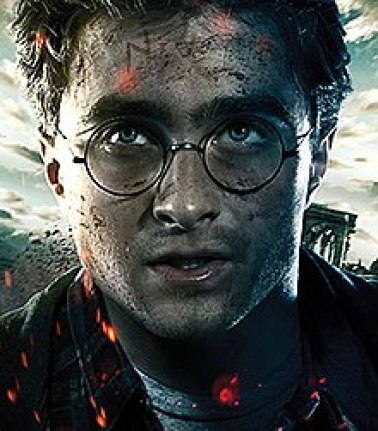
Harry Potter is such a wonderful tale and full of recipes that are fun to make. Especially in regards to pumpkin stuff.
This week’s fun recipe is for pumpkin juice. That kinda sounds gross. But, cmon. It is Harry Potter though, so it must be magical.
This week’s recipe is from favfamilyrecipes
Pumpkin Juice
The juice recipe serves 16
4 liters apple cider apple juice works fine too
1 15 oz pumpkin puree
1/2 c. sugar
2 tsp. pumpkin pie spice
2 tsp. vanilla
INSTRUCTIONS
Combine all ingredients in a large pitcher and stir well.
Pour over ice in individual glasses.
Stir again before each serving.
The post #bookcook Harry Potter’s Pumpkin Juice appeared first on BEFOREWEGOBLOG.
May 20, 2022
REVIEW – A TIME OF COURAGE – JOHN GWYNNE
Well, the journey ends, but it was a wonderful trip. A few days ago, I received “A Time of Courage”, the final installment in Gywnne’s “Of Blood and Bone” saga, which actually wraps up the entire “The Faithful and the Fallen” cycle that began with “Malice”. My anticipation to read this book got the better of me, and since I had a few days away from regular work, I resolved to devour it in a few days worth of reading, which I managed to do, finishing this morning. Wow, is all I can say.
 The climatic final battles of the Order of the Bright Star and their allies versus Asroth and his minions made for an incredible read. You will root and cheer for Riv, Bleda, Byrne, Keld, Drem, Cullen, Meical, and the rest, and trust me, they need it. There is plenty of tragedy and not everyone you hope will make it out alive does, is all I can say without being too spoilerish. And some of the loses will definitely bring a tear to your eye if you have fallen in love with many of this saga’s heroes, as I have. There’s also is a tale of the final days of one the long-dead Banished Land favorites and their family that will also have the reader reaching for their tissue box.
Gywnne is a clever, inventive writer who takes the classic fantasy trope of “Dark Lord” versus noble heroes, and throws in enough twists, betrayals, thrilling action scenes, and even some well-sprinkled romance so that you still worry of the outcome, and are glued to every page. I have thoroughly enjoyed everything I have read by Gwynne, and while it is bittersweet to leave the Banished Lands and their characters behind, I can’t wait to see what Gwynne has in store for us next!
Don’t miss out on reading “A Time of Courage”, it is an excellent novel and kudos to Gwynne for not disappointing with the conclusion to this epic series, no let-down here, it was well worth the wait!
Check Out A Time For Courage and the Full SeriesThe post REVIEW – A TIME OF COURAGE – JOHN GWYNNE appeared first on BEFOREWEGOBLOG.
Netflix’s Altered Carbon – Dark, Complicated and Beautifully Crafted
Netflix has crafted a dark and enthralling tale of noir that combines science fiction and cyberpunk with a straightforward detective story. It is visually stunning and does great justice to the sourcebook. Better yet, the plot additions to the original story that make it fit for TV add to the richness of the story. I know many people won’t agree with me on this, but I like how the humanized Tak. They gave him a slightly bigger heart. They also expounded on the cyberpunk themes; what it means to be human and how one holds on to their humanity when facing forever. Humanity basically becomes an ouroboros and is not so subtly hinted through the story.

Image courtesy of Netflix.
The Netflix version added more substance to some of the supporting characters that fleshed them out. Especially the role of Poe who plays a Hotel and was the most intriguing character on the show. The AI is played by Jimi Hendrix in the source material, but Poe is a much more fitting nod to the stories’ noir influences. Instead of just going with a creepy over-enthusiastic AI, they gave him a soul and a shotgun. It is ironic because Poe is both the least human and most human character on the show.
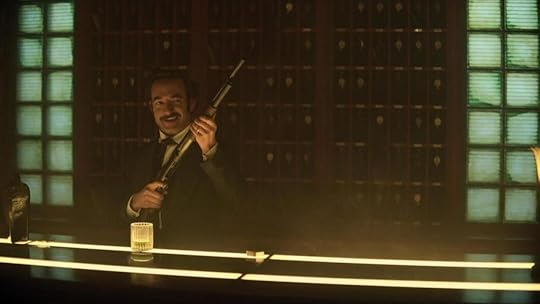
Image courtesy of Netflix.

Side by Side comparison.
I can’t say much more about the story because it is a “who done it,” and I don’t want to give it away. However, if you are a fan of cyberpunk, binge-watch it. It is well worth the time.
Read the Book that Inspired the Show
The post Netflix’s Altered Carbon – Dark, Complicated and Beautifully Crafted appeared first on BEFOREWEGOBLOG.
May 19, 2022
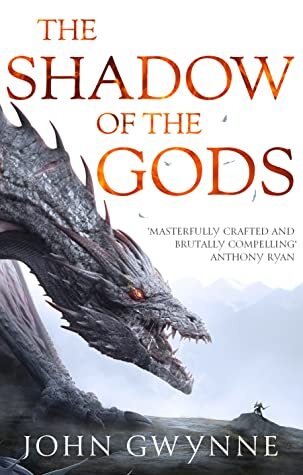
REVIEW – THE SHADOW OF THE GODS BY JOHN GWYNNE
Let’s be clear, John Gwynne has nothing to prove.But he went ahead and proved it anyway.
He already has plenty of accolades: David Gemmell Morningstar Award, BookNest Award, bestselling lists, and more. He is already acknowledged in the fantasy world as one of it’s brightest stars, thanks to his famous ‘The Faithful and the Fallen” and “Of Blood and Bone” series.
 But he went ahead and proved it anyway.
He proved that he can get even better. Somehow, he accomplished this, with the debut entry of his new “The Bloodsworn Trilogy”, called “The Shadow of the Gods”. When a writer of this calibre shows that he still has another gear, that he can turn things up quite a notch, and exceed already lofty expectations, it is incredibly impressive. Gwynne will have your “thought-cage” spinning with the dizzying brilliance of his latest novel.
The concept of “The Shadow of the Gods” is an intriguing one. In this Norse-inspired world, a war has taken place between the gods, where all of them were either killed or imprisoned, and they have left the land that humans inhabited partially devastated in the wake of the conflict. These gods took the form of mammoth beasts, such as dragons and giant wolves. Because of the havoc they wreaked on the land, called Vigrid, for the most part, the gods are reviled, rather than revered. While there are still some devotees to these seemingly callous gods, most people shun them, hoping they stay dead, and vanquished. The gods may have vanished, however eerie, tangible traces of them remain. Such as major human cities constructed inside or even on top of their bones. The dichotomy is that humans still covet the protection of the gods, and believe that the carcasses of the individual deities that were worshipped can ward off further evil.
With incredibly beautiful prose, compelling human drama, fantastic world-building and realism, and of course Gwynne’s trademark – some of the most gripping and realistic battle scenes this side of GRRM or Bernard Cornwell – “The Shadow of the Gods” deftly marries dark and high fantasy into a blood-soaked, gritty, ingenious saga, full of heart, romance, humour, stunning plot twists, and overall, pure magnificence on a completely epic scale.
The plot pivots around three main POVs. The first is Orka, an indomitable warrior, married to another awesome fighter, Thorkel, with whom she has a son, called Breca. The three are simply trying to lead a peaceful life on their farm, however someone in the vicinity is stealing children and murdering their parents. The three are drawn into political intrigue and danger, as they begin to unravel what is behind the sinister kidnappings and killings.
The second POV is Varg, a fugitive on the run, haunted by the death of his sister, and thirsting for vengeance. Varg’s life changes when he encounters the eponymous Bloodsworn crew, as he seeks to trade bondage for battle, and find a true family to belong to.
The third POV is that of Elvar, a warrior of noble birth, trying to prove herself, and seek glory, among a hardened group of sellswords, called the Battle-Grim. The loyal and fearless Elvar will end up on one of the greatest quests ever dared: to seek the sacred tree Oskutred (the equivalent of Yggdrasil), and uncover its treasures. But the costs will be high, and formidable enemies, betrayal, and the unleashing of ancient evil await her.
“The Shadow of the Gods” is sure to make the vast majority of ‘Fantasy Book of the Year” lists, and that is entirely well-deserved. Many may have considered Gywnne to be a jarl in the nobility of fantasy wordsmiths – safe to say with “The Shadow of the Gods”, he has ascended to princedom, and no doubt kingship awaits. I have long been a huge John Gwynne fan, and no secret he is one of my influences as a writer. He has truly outdone himself, and “The Shadow of the Gods” is a masterpiece.
I will be anxiously awaiting book two of “The Bloodsworn Saga”!
Check out our interview with the Bearded LegendCheck Out THE SHADOW OF THE GODS by John GwynneThe post REVIEW – THE SHADOW OF THE GODS BY JOHN GWYNNE appeared first on BEFOREWEGOBLOG.
The Only Thing Left is Wrath and Sheep

About
From the publisher, “Ever since Great Grandfather Isom killed a man over some sheep, a black cloud has hung over the Rath family. Now, over a century later, Ira Rath, the coldest hitman ever to walk on Alabama soil, has taken a job that will decide the fate of his cursed family once and for all. Writer Jason Aaron (Southern Bastards, Scalped) and artist Ron Garney (Weapon X, Thor: God of Thunder) reunite, to bring you the story of a Southern family, whose only heirloom is violence.”
Stats
4 out of 5 Stars
Paperback
136 pages
Published April 28th, 2015 by Marvel (first published April 14th, 2015)
Awards
Will Eisner Comic Industry Awards Nominee for Best Writer (for Jason Aaron) (2015)

My Thoughts
Are we captive to our darker biology or can we rise above our inner desire and step away from our baser urges? That is the question that Jason Aaron asks in this powerful southern noir-style story “Men of Wrath.” One hundred years ago the patriarch of the Rath family, Isom, stabbed a man in the neck over some sheep. Since then “folks began to take notice of the Raths.”
The Raths have an issue with Wrath.
Since then, for the last 100 years, each generation of male Rath children has expressed their wrath in different ways. Isom’s son, Alford, witnessed his father murder a man in a pasture and has had a dangerous mean streak culminating with him catching rabies and murdering his entire family save for one son, Monroe. The son who ended up having to kill him to protect himself. Thus the family line of wrath continues. Monroe begat Ira, a Cynical hitman from Alabama who has no problem with the expression of rage in his line of work. He will murder anything: men, women, children, priests anything that gets in his way of doing his job. Ira, in turn, had a son named Ruben. Here is where the story gets interesting. Ruben is often on the cusp of violence, yet he chooses not to express it. He is in every way the polar opposite of his father. Ira does not care for family when everything Ruben does is to protect them. He fights his natural Rath family tendencies where all Ira does is express them. His sensitivities get him in trouble with the wrong people, and a hitman is dispatched to take care of Ruben. There is no familial love between Ruben and Ira, and Ira goes after Ruben.
“Somethin’ started back then with Isom. Somethin’ that’s been passed down in our family from father to son ever since. Somethin’ that’s gotten a little bit meaner and bloodier with each generation. Used to be folks in Choctaw County never paid much mind to Isom and his kin. They weren’t troublemakers or drunks.Weren’t catholics. Werren’t much of anything at all. Just another bunch of poor white farmers in a county full of ’em. But after that day…The day Erastus Grievers laid down among his sheep and died. Folks began to take notice of the Raths.”
Excerpt from Men of Wrath by Jason Aaron
I want to say that Ira is the protagonist of the story, but that isn’t accurate. Ira is what he is, he neither revels in it or seeks change. He is a murderous bastard who hates everyone. His inner monologue is the narration of the story; the real protagonist is his relationship with his son Ruben. Although I will not give away the explosive climax of the story, know that it is true to the Rath family name.
The artwork of the story, done by Ron Garney, evokes dark and early Frank Miller. The linework is bold, thick and uncompromising. The perpetual darkness and heaviness match the dialog and setting of the story perfectly. Not only do you read the inner monologue of Ira wrath, but you can also feel it from panel to panel.

Men of Wrath is a short and dirty story of man’s inherent darkness, and if one can rise above their baser natures. All told in the dark and gritty southern crime noir format reminiscent of Southern Bastards, Sin City, and Blacksad. It is excellently written and beautifully illustrated/penciled. This is not a story for the easily offended, but if you can keep going through the violent panels, the ending is well worth the journey.
Check Out Men of Wrath
The post The Only Thing Left is Wrath and Sheep appeared first on BEFOREWEGOBLOG.
May 18, 2022
Review – Duckett & Dyer Dicks For Hire by G.M. Nair
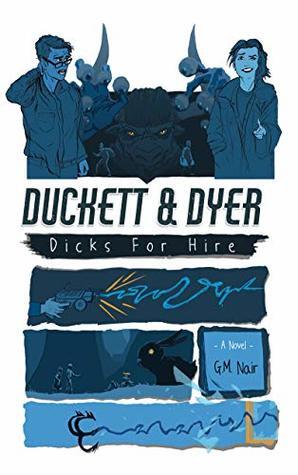 I usually avoid science fiction and crime novels. Not because I think there’s anything wrong or bad with these genres but rather because the science is generally over my head, and I am anti-social enough already. I don’t need to learn any new tricks from literary criminals. That said, I happily admit to faulty research before purchasing the self-published Duckett & Dyer series by G.M. Nair.
Little did in know I was in for a hilarious, universe hopping, interstitial bad-guy hunting, against-all-odds story of lifelong friendship and loyalty. Now, the last bit comes off as a tad schmaltzy but in all honesty, that’s the big takeaway from all three books. Michael Duckett and Stephanie Dyer, no matter how irritated they get with each other, simply do not know how to NOT be friends. And there’s the charm.
Michael Duckett is a neurotic, anxious, keep-your-head-down, worker drone. He has a pointless job with the city’s largest company, The Future Group, and is pretty sure what he does doesn’t matter to anyone in the organization. His paycheck barely covers the bills in the crappy tenement apartment he shares with Stephanie. Michael just keeps on keeping on.
Stephanie Dyer is a larger than life dreamer, into everything while doing nothing. She is positively unpredictable and keeps Michael on his toes. Stephanie Dyer impulsively forges ahead and damns the consequences.
Both have a talent for being in the wrong place at the wrong time and the results are spectacular.
“Please Don’t Drink the Poison Even Though You’re Thirsty”
In Dicks For Hire, advertisements for the detective agency “Duckett & Dyer, PI’s For Hire” have been popping up all over the city. Neither Michael nor Steph have any idea why. Nevertheless, Michael’s phone rings constantly with potential business. One particularly insistent ‘client,’ searching for her missing fiancé, drags the bickering duo into an investigation which literally opens up the spaces between universes and drags them into the crosshairs of a local police detective, Rex Calhoun.
“Thanks, In Advance”
The One-Hundred Percent Solution sees Michael fired from The Future Group for not being a team player. Worried about keeping the roof of their less-than-desirable step-down apartment/offices over their heads, Michael and Steph are involuntarily recruited to investigate some shady dealings by his former employer. Recruitment along the lines of, “Do this or we’ll kill you. Don’t worry about the assassin running around killing people associated with the company. No pressure. Oh and by the way, you dodged a multi-verse, demon worshipping, cult-bullet by being fired. Good job.” No big deal.
“A Talking, Gender-Fluid, Reverse Werewolf”
In case you were wondering if Duckett & Dyer work on cases which are less universally threatening, well, they do. Kinda. The Mystery of the Murdered Guy jumps from case to case while Michael and Stephanie grow into their roles as entrepreneurial private investigators. The aforementioned reverse werewolf, a very angry otherverse Santa Clause, performative train-jacking, and a lady who keeps losing her cats all make appearances. If you read the first two books, you’ll see some old friends (acquaintances?) along the way.
G.M. Nair delivers a weird and supremely entertaining triple-hit with this series. The science isn’t overwhelming and rendered believable to non-science readers like me. The crimes are so far beyond human reality that the bad guys don’t have a chance. The humor is slick and smart. Traipse around the multi-verse with Duckett & Dyer for a few days. Maybe you’ll meet yourself along the way.
Check Out G.M. Nair’s BooksDuckett – Dyer: Dicks for Hire – The Mystery of the Murdered Guy Playlist
The post Review – Duckett & Dyer Dicks For Hire by G.M. Nair appeared first on BEFOREWEGOBLOG.