Beth Tabler's Blog, page 221
July 27, 2021
Read-A-Long for Joe Abercrombie’s A Little Hatred as Part of The Age of Madness Trilogy
 Beth Tabler
 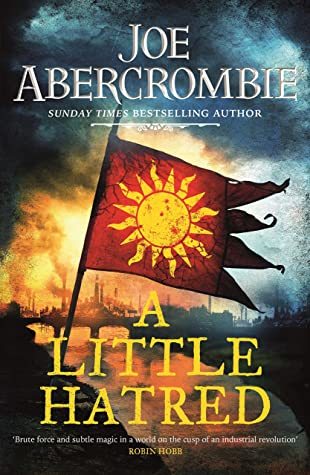 A Little hatred by joe abercrombie Purchase Here
 Joe Abercrombie, a little hatred About“When one man knowingly kills another, they call it murder! When society causes the deaths of thousands, they shrug and call it a fact of life”―
The chimneys of industry rise over Adua and the world seethes with new opportunities. But old scores run deep as ever.
On the blood-soaked borders of Angland, Leo dan Brock struggles to win fame on the battlefield, and defeat the marauding armies of Stour Nightfall. He hopes for help from the crown. But King Jezal’s son, the feckless Prince Orso, is a man who specialises in disappointments.
Savine dan Glokta – socialite, investor, and daughter of the most feared man in the Union – plans to claw her way to the top of the slag-heap of society by any means necessary. But the slums boil over with a rage that all the money in the world cannot control.
The age of the machine dawns, but the age of magic refuses to die. With the help of the mad hillwoman Isern-i-Phail, Rikke struggles to control the blessing, or the curse, of the Long Eye. Glimpsing the future is one thing, but with the guiding hand of the First of the Magi still pulling the strings, changing it will be quite another…
I am relatively new to the worship of the Lord of Grimdark, Joe Abercrombie. Previously I had read The First Law series and found his work to be completely enthralling. His characters always teeter on that fine edge between good and evil.
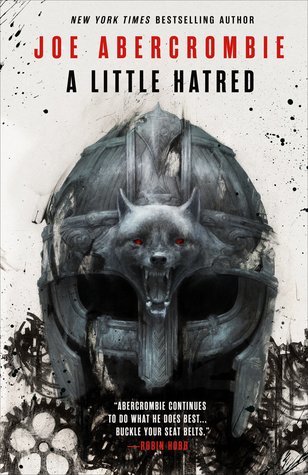 We like them enough that we don’t want them to be offed, but we are always a bit unsure. This unsteadiness with characters is right at the heart of why grimdark is such a powerful genre. Good, bad, or every gray shade in between, you know when reading a grimdark book, you are in for a wild ride. That ride might not be fun; you might get knocked out of the train and run over a few times, but fantastic nonetheless.
The wiser a man is, the more he stands ready to be educated.
A Little Hatred starts roughly 30 years after the last book of the Last Argument of Kings. Angland is in the midst of an industrial revolution. The city is coughing on the soot from chimneys, the river runs thick with dye chemicals, and the poor get poorer, and the rich get richer. The divide between the two is getting ever wider. The city is under multiple threats, both foreign and domestic. The Breakers, who are tired of the rot of the ownership and working conditions, cause a union uprising that halts production and manufacturing in the large-scale factories. It is a powder keg of individualistic interests. Some honest pay for honest work. Other’s want to stay in their luxury at the expense of workers’ rights. In the middle of all this upheaval is a collection of gritty characters and fighting to control their piece of the pie. Savine dan Glotka, a businesswoman caught in the middle of the turmoil. Rikke, the Dogman’s daughter, and her slow creeping madness caused by The Long Eye. Gunnar, a bespectacled fighter who might be one of the best characters I have ever read.
Some of these names might seem somewhat familiar to those readers who have read The First Law series. Some of the characters are entirely new. But what is the same is Abercrombie’s ability to create characters that stick with you. You will always want to know more, and by the end of this book, you will be highly invested and clamoring to jump into the second and very soon the third book when it is released. There is a reason why he is called Lord of Grimdark…
Along with reading this fantastic book, Gollancz contacted me and 13 other sites to be a part of a read-a-long. Of course, yes. A million times, yes.
 Read-A-long Chapters hopes and hatreds
 Hope and Hatreds starts off with three men, Jurand, Glaward, and Whitewater, discussing packing a man named Barniva in a box full of salt. There is quite a lot of bloviating between the three of them. There is a fourth man in the conversation Leo. But unlike the first three, he lacks the braggadocio of them and is more reserved and angry at them as he needs to concentrate. The men go on to discuss the “correct” weapon to use in a fight and Leo replies, “”You’re all missing the point…you take a weapon, but you never know if you’ll fight with it, or hand it to your opponent and fight with whatever he brings. What you need s something you can use but the other bastard can’t.”” In response, the mood changes and they ask if Leo is is talking to her. “Her” being his expert tactician mother.
We come to find out that the discussion is about Leo’s single hand combat with Stour Nightfall. The three men offer more and more useless ideas about what weapons to use, while leo sinks slowly into fear. Rikke walks up claiming that she should, “whip the lot of them.” Leo notices how much she centers him and sees to the heart of things. She tells him to fight heard and dirty and to remember who he is, The Young Lion and how she has seen the lion beat the wolf with her long eye.
The begin the fight, and it is decided that it is the Lion’s pick on what to fight with, the Lion gives the pick back to his opponent. It is decided to fight with what the weapons are that they came with.
where names are made
This chapter is a long detailed and dirty fight between The Young Lion and Stour. They go back and forth, and for much of the chapter, Stour had the upper hand. But ultimately, Leo begins to fight extremely dirty and instead of killing Stour as the audience chants at him, he decides to spare Stours’s life and promptly passes out.
the poor pay the priceThe Poor Pay the Price is a conversation between Malmer, Broad, Heron where they discuss the terms set in their previous bargain. Full pardon’s, but at what cost? later in the chapter it describes the events of the evening with the “wary queue of the filthy, hungry, and dispossessed” filing out to meet lines of smiling women carrying loaves of bread. Food and their bellies and the poor “froathing ” at the thought of the prince. Broad was just happy to see his family fed. This chapter also touches on the great disparity between the poor at the rich. Especially, when Savine steps from the queue and declares whom she is. Broad hissed out at May, did you know about this? “Course I did. I arranged it.” “It’s high time someone put this family first.”
the new womanThis chapter is about the reuniting of Orso and Savine and how different Savine is now that she has tasted extreme poverty and come out, barely alive. She is unsure of herself. It is all bumbling outfits, and broken buttons as the two of them embrace.
lost causesValmer and Vick are talking. This time Valmer is the prisoner and Vick is surprised by her appearance as one of his jailers. We learn some surprising backstory on Vick. Vick remembers a moment in the camps when a convict went through the ice and two others slid on their bellies to try and save him, they two also died. If you want to survive you better get a good sense for lost causes.
the new manThis chapter starts with Orso awaking with a start thinking that he had dreamt the past evening, only to find that he was next to Savine. His cheerful mood quickly turns sour as he sees that Malmer, the man he promised amnesty to for the Breakers. It was all for naught. The power that he thought he had was an illusion.
two of a kindLeo and his mother are chatting about the recent fight. Leo is sore and scarred from it. Rikke is displeased as she believed that Nightfall should have died instead of been given mercy. Leo later goes to see Stour Nightfall, he does not gloat. He asks that as a life debt to Leo that Stour be his friend instead of his servant. You cannot have a wolf for a pet. Stour reminds Leo of the kind of man he is and decided that the two of them are pretty alike after all.
empty chestsThis chapter is a conversation between Rikke and Leo where they discuss the outcome of the fight. Later Rikke goes and has a conversation with her father.
like rainSavine returns home with Broad and family in two. Broad remarks at the delivery of the waitstaff. Savine meets up with Zuri, and Savine is genuinely glad she sees her. This takes Zuri aback a moment. Savine introduces Haroon and Rabik. Savine leaves the company to go have a bath, and leaves Zuri with the Broads. May speaks up for the family and explains who they are and how they kept Savine alive. Zuri asks the Broads what they can do in the service to Savine. Zuri asks Broad what he did. ” I was in the army…for awhile.” “You have seen action?” She replies. “Some in Styria.” But “nothing that would be useful in a lady’s service.” “You might be surprised.” She responds. This leads me to believe that we are going to see some exciting interactions between Lady Savine, Zuri and Broad in the future.
Check Out My Other Reviews
Review – Battle Ground by Jim Butcher (Dresden Files #17)
Review – The Ikessar Falcon by K.S Villoso
Beth Tabler
Elizabeth Tabler runs Beforewegoblog and is constantly immersed in fantasy stories. She was at one time an architect but divides her time now between her family in Portland, Oregon, and as many book worlds as she can get her hands on. She is also a huge fan of Self Published fantasy and is on Team Qwillery as a judge for SPFBO5. You will find her with a coffee in one hand and her iPad in the other. Find her on: Goodreads / Instagram / Pinterest / Twitter


July 24, 2021
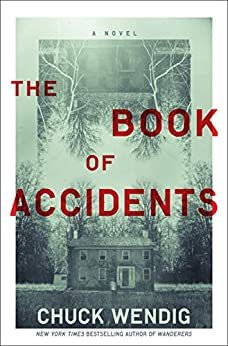
Review – The Book of Accidents by Chuck Wendig
Beth Tabler 4/5 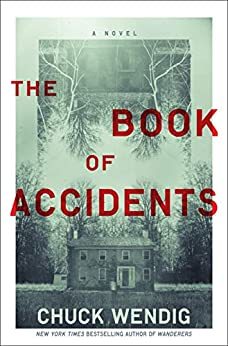 The Book of Accidents by chuck wendig Purchase Here About
 A family returns to their hometown—and to the dark past that haunts them still—in this masterpiece of literary horror by the New York Times bestselling author of Wanderers
Long ago, Nathan lived in a house in the country with his abusive father—and has never told his family what happened there.
Long ago, Maddie was a little girl making dolls in her bedroom when she saw something she shouldn’t have—and is trying to remember that lost trauma by making haunting sculptures.
Long ago, something sinister, something hungry, walked in the tunnels and the mountains and the coal mines of their hometown in rural Pennsylvania.
Now, Nate and Maddie Graves are married, and they have moved back to their hometown with their son, Oliver.
And now what happened long ago is happening again . . . and it is happening to Oliver. He meets a strange boy who becomes his best friend, a boy with secrets of his own and a taste for dark magic.
This dark magic puts them at the heart of a battle of good versus evil and a fight for the soul of the family—and perhaps for all of the world. But the Graves family has a secret weapon in this battle: their love for one another.
Wendig is a study of different types of horrors. If you haven’t read many Wendig books, Chuck writes with various styles and themes. Each one of his novels, whether horror or science fiction, approaches its theme originally. So, if I were to read passages from five different books blindly, I could not pull out a specific Wendig-type style. He is an expert at matching tone to the story.
Also, I assume that Chuck is a reader, a man who appreciates the written word. I expect that, because he enjoys books as much as he does, it comes through in his storytelling.
For instance, one of the earlier stories in his bibliography is the first book of the Miriam Black series, Blackbirds. Black is an alcoholic anti-protagonist who is cursed with the vision of the death of every person she physically comes into contact with. She is also brash and crude. The story is dark and twisty with a slight mystery element, but mostly it is about Miriam trying to survive in a world that hates and reviles her. She reminded me a lot of a much darker Jessica Jones-type character, written with a specific tone of roughness and desperation.
Another of my favorite books that I have read in the last five years is Wendig’s Wanderers. It is an epic horror survival story, which is often compared to Stephen King’s The Stand. Again, excellent writing skills. When I read it, I could not say that it was a Wendig book, unlike a Stephen King book, which I could pick out in three pages.
All this brings me to The Book of Accidents, which seems very much like an amalgamation of various styles siphoned and condensed down into a gothic horror novel that touches on many of the cornerstones of horror. The Book of Accidents effectively has elements of preternatural horror, body horror, psychological, some apocalyptic, Lovecraftian, and even psycho-killer-style scenes. Wendig distilled the virtues of each of the horror disciplines down to an incredibly atmospheric read that even now, thinking about it, I know that I did not catch every little nuance, and it deserves a second read.
The story starts with Nate Graves back in his hometown, following the death of his abusive father. Nate, his wife Maddie, and their son Oliver move into Nate’s childhood home. A home full of memories, mostly bad ones. Those previous traumatic memories haunt Nate as if they are ghosts. Oliver is an empath. He instinctually feels the pain of those around him. The less pain and slower rural lifestyle that the family is hoping for is meant to help Oliver deal with his abilities. However, Wendig describes that even smaller, more rural towns are full of horrors, just like big cities.
As the story progresses, Nate slowly begins to succumb to his brutal past and the PTSD of his childhood. He sees things that are not there; he has bouts of anger and depression. Maddie also has difficulties adjusting to life in this small town. She blacks out while chain-sawing a wood sculpture, and her creations come to life. At this point in the story, it is difficult to tell what is real and what could be a psychological breakdown from stress. However, Maddie is the glue that holds the family together. As her ability to deal with the reality of the events before her diminishes, she has difficulty coping, which begins to fracture the family.
The Book of Accidents plays on the horrors of the mind and the horrors of the unknown, but much more importantly, it is a story about family and the invisible ties that bind individuals to each other and their past events. Nate has a great fear of passing the violence of his childhood on to Oliver through his actions. And in turn, Oliver senses the turmoil inside his father.
Oliver has a difficult time adjusting to school life. He eventually makes friends with other like-minded kids but runs into conflict when one new friend, an older boy named Jake, causes problems in Oliver’s relationships. But from the get-go, readers pick up that Jake is more than meets the eye.
Wendig takes all of these bits and pieces of horror and conflict and creates a cohesive narrative that culminates in many jaw-dropping moments. It jumps from serial killers, dark and evil books, demons, ghosts, and even science fiction elements. If I were to tell you more, it would spoil the surprises. Oddly enough, in any other hands, this book would be an incohesive mess. But it all works. The serial killer angle and his disappearance moments before death, the psychological pain of Oliver’s classmates, what Maddie does to make sure that they all survive… it all works, and not for one moment does this book let up. It is like a symphony starting with many discordant and uncomfortable notes that come together so fully the force of the cacophony nails you to your chair.
The Book of Accidents is another fantastic horror novel to add to Wendig’s already impressive repertoire. It is a book of shock and pain and the thin grey line between good and evil. It touches on family and relationships as much as the supernatural. He grinds it all together in a blender and what comes out is a hard-hitting story. It is an excellent book that will appeal both to readers who are new to Wendig’s catalog and those of us who have read many of his stories. Go check it out.
Check Out My Other ReviewsReview – Battle Ground by Jim Butcher (Dresden Files #17)
Review – The Ikessar Falcon by K.S Villoso
Check Out Some of Chuck's Other Books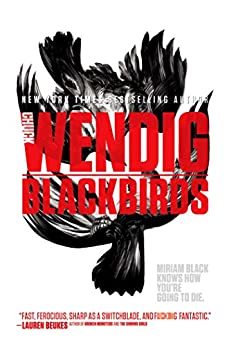
 If You Liked This - Please Share the Love Beth Tabler
 Elizabeth Tabler runs Beforewegoblog and is a heavy contributor on Grimdark Magazine and is constantly immersed in fantasy stories. She was at one time an architect but divides her time now between her family in Portland, Oregon, and as many book worlds as she can get her hands on. She is also a huge fan of Self Published fantasy and is running a team for SPFBO7. You will find her with a coffee in one hand and her iPad in the other. Find her on: Goodreads / Instagram / Pinterest / Twitter
July 23, 2021
Interview With Author Chuck Wendig
Chuck Wendig "..A lot of the prescient stuff wasn’t particularly insightful or prophetic on my part—it’s not like we didn’t know pandemics could happen or that white supremacy was a problem. But the Black Swan / Blue Dot thing was hahaha yeah, that was a little freaky....." Chuck Wendig is a New York Times and USA Today best-selling author, both non-fiction and novels. His recent books include Wanderers, which is a Locus, Bram Stokers, and Goodreads award Nominee. As well as the series Miriam Black, Force Awakens, the Invasive Duology. You can find him on his blog Terribleminds or his Twitter account @wendig, where he might be talking about writing, birds, apples, or sandwiches, depending on the season.
Chuck was kind enough to chat with me about his writing and his upcoming horror novel, The Book of Accidents.
Reading your stories, I have noticed that you don’t do a lot of worldbuilding. You establish a setting and go, or maybe jump right in as you did with Wanderers because [gestures around] the scene is pretty much already set. Is that a conscious choice or how the words flow out of you creatively?
[CW] Worldbuilding is something I love very much, coming from a roleplaying game background (both playing and writing) but it also can be an anchor that drags a story down—I do as much worldbuilding as is ideally needed to get to the next section of the book. It’s a bridge, in many ways. Not to say you can’t or shouldn’t build other pieces of glorious architecture. Every book is different, and I don’t think every story needs to be mercilessly screaming WELL THIS MUST SERVE A POINT OR YOU WILL BURN IT DOWN. But for my mileage I do prefer to focus more on the characters, and through them, worldbuilding is revealed.
As someone who is deathly afraid of ants, I read Invasive because apparently, I enjoy creeping myself the hell out. One of the first lines of my review was “Chuck Wendig, you are a maniac.” Why ants?
[CW] Ants are awesome and weird, that’s why. Like bees, they are eusocial, and have behaviors that are both individual and group-based—I’ve always been interested in them. In fiction form they also make a nice metaphorical stand-in for anxiety.
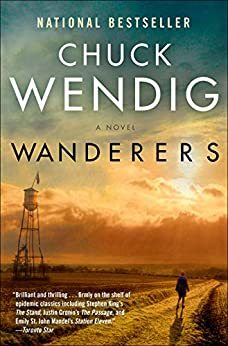 Wanderers is an epic story. When you sat down to write it, did you have any idea the depth of scope it was going to cover? Or did you always know that it was going to be a huge story?
[CW] I knew it was huge, but mayyyyyybe not 280,000 words huge.
What kind of research did you do for Wanderers? While we did not have a great sleepwalking plague of 2020, there are certain similarities between the governmental response in the face of a health crisis and how things played out in your novel. Wanderers was remarkably prescient. Especially the Black Swan AI versus Blue Dot AI.
[CW] I’m a lazy writer, and much of the research for the book was not done for the book, but was rather just stuff I read that I found interesting. A lot of the prescient stuff wasn’t particularly insightful or prophetic on my part—it’s not like we didn’t know pandemics could happen or that white supremacy was a problem. But the Black Swan / Blue Dot thing was hahaha yeah, that was a little freaky.
Tell me a bit about your newest book, The Book of Accidents. It seems like a complicated horror story to sum up with a small blurb. A lot is going on. Off the top of my head, I can think of a few of the different horror types in it: Lovecraftian, paranormal, post-apocalyptic, psychological, and serial killers, all as part of the narrative. As the author, how would you describe it to prospective horror readers?
[CW] A lot is going on, indeed. It starts simple, as a family moving to a haunted house that was once the home of the father, a home of abuse and trauma. And from there, it certainly goes places. I like to focus on the family aspect: What happens when your family is at the center of great evil? How do they survive? How do they help each other? They are haunted by not only apparent specters, but also by generational trauma and cycles of abuse, and how do you break that circuit? How do you exorcise that kind of evil?
One of the central parts of the story is the dynamics of family and the effect family can have on someone for good or evil. The story rang with authenticity, especially the scenes depicting familial violence. What kind of research did you do to portray the characters so accurately?
 [CW] No real research there—I have my own family and grew up in a haunted house, so I had enough idea ammunition for this. It’s a very personal book.
When you were writing The Book of Accidents and wading into the kind of horror and darkness described in the story while writing during a pandemic with the horror and darkness in the real world, how did you shake it off?
[CW] I wrote this before the pandemic, actually (though edited it during). We originally were going to release this book in October of 2020, but before the pandemic the publisher (wisely) opted to move the date—not, in fact, because of prophesying the pandemic but because there was going to be a huge, tumultuous election at that time and it would be hard to get traction with media attention for a book. And then, as it turned out, there was TOTALLY a global pandemic so I’m pretty glad we didn’t release then. (We are still of course in that pandemic, but it’s certainly an easier, calmer time.)
How do you separate yourself when writing such complex themes during such a difficult time like 2020?
[CW] I don’t really separate myself? I’m writing a book for a reason and that reason is personal, so I don’t try to give myself great distance from the work. Especially in first drafts.
Talking about horror stories in general, I found The Book of Accidents dark but not bleak. It treads the line bringing you to the brink of despair only to have a small glimmer of hope to grab on to in the distance. Do you find that to be an essential aspect while writing horror in general?
[CW] That’s usually my aim—dark, but not bleak. There’s enough despair in this era, and I’m not interested in adding to it. Just the same, I feel like horror fiction helps us contextualize real-world horror. I often compare it to how a sorcerer creates a summoning circle in which to conjure demons: that circle is a safe place to fight those monsters, and that’s horror fiction to me. It’s a safe place to fight monsters.
Finally, I would love to know what you’re reading and what books you are excited about in 2021?
[CW] I just read Christopher Golden’s Road of Bones and it’s fucking legit, stellar “adventure horror” that just fires up my readerly happiness. Always excited for new Stephen Graham Jones. New Caitlin Starling, too. Kiersten White’s debut with Del Rey. Delilah Dawson’s The Violence. C’mon. This is a great time to be a horror reader.
Interview originally appeared in Grimdark Magazine
Buy Chuck's Books Check Out Some Of Our Other interviews Interview – Kristyn Merbeth Author of the Nova Vita Protocol
Interview – Author Grady Hendrix
July 22, 2021
Review – Drowned Country by Emily Tesh
Beth Tabler 4/5  Drowned Country by Emily Tesh Purchase Here
 Emily Tesh, Drowned Country AboutIf Tobias answered, Silver did not hear it. A moment later he shook his head hard. The Hallow Wood asked nothing and offered nothing; it only was―
Drowned Country is the the stunning sequel to Silver in the Wood, Emily Tesh’s lush, folkloric debut. This second volume of the Greenhollow duology once again invites readers to lose themselves in the story of Henry and Tobias, and the magic of a myth they’ve always known.
Even the Wild Man of Greenhollow can’t ignore a summons from his mother, when that mother is the indomitable Adela Silver, practical folklorist. Henry Silver does not relish what he’ll find in the grimy seaside town of Rothport, where once the ancient wood extended before it was drowned beneath the sea―a missing girl, a monster on the loose, or, worst of all, Tobias Finch, who loves him.
My Thoughts
Last year I reviewed one of the most atmospheric books I had ever read—Silver in the Wood by Emily Tesh. It was whimsical, verdant, and dark. When I think about it a year later, I still get the mental picture of a deep lustrous forest with secrets to keep. Silver in the Wood was the first book in the Greenhollow Duology. The second, Drowned Country, is as good as the first one, although the tone is slightly different.
Drowned Country brings us many of the characters from the first story, specifically of the two male leads of Tobias and Silver. Where Silver in the Wood was very much Tobias’s story to tell, Drowned Country is Silvers. It has been two years since the first novel has taken place. While in the first story, the setting of the deep dark woods was a character as much as Tobias was. Now in Drowned Forest, the temperament of the story has changed to much more character-driven narrative.
Silver has a difficult time finding his footing as the new wild man of the forest. He is sulky, petulant, and bored. Tobias has taken to working with Silver’s mother, the aging monster hunter Adela Silver. Adela asks Silver to come to help her with her newest monster problem. There is a 900-year-old vampire afoot and a missing ingenue that needs rescuing. Silver is bored and wants to get back some of the excitement that he had when he was not the wild man. Thus starts their adventure. Things certainly do not pan out as we think they will.
Most of the story is the tension between Silver and Tobias. There is a certain charm between the two of them, a lightness that comes off easily and is a testament to how good Tesh’s writing is. Their relationship had an effortless quality to it. I spent much of the book wishing they would work things out. The background story of elves and Maud is less important than their relationship. It is what they were doing at the time, but it is not all-encompassing.
The small detractor I found with this novel is that I wished it was longer, and the plot felt more important. I wanted it fleshed out. It had some pretty vague points that lost me as a reader. And, because of its vagueness, it lost some of the atmospheric quality. I couldn’t picture it as well as her first book, Silver in the Wood.
In the end, Tesh did a great job with this book. It is a fine ending or beginning depending on how you look at it to this Duology. I loved the romance between the two of them; there is a slow burn quality to it that is almost steamy. This book gave me some warm fuzzies.
I am sad that the series is over, but in many ways, the journey of Silver and Tobias is just beginning.
If You Liked This - Please Share the Love Where to find it? Procurement
I received a copy of this from Tor.com in exchange for my open and honest review.
Beth Tabler Elizabeth Tabler runs Beforewegoblog and is constantly immersed in fantasy stories. She was at one time an architect but divides her time now between her family in Portland, Oregon, and as many book worlds as she can get her hands on. She is also a huge fan of Self Published fantasy and is on Team Qwillery as a judge for SPFBO5. You will find her with a coffee in one hand and her iPad in the other. Find her on: Goodreads / Instagram / Pinterest / Twitter
July 21, 2021
Review – Silver in The Wood by Emily Tesh
Beth Tabler 4/5 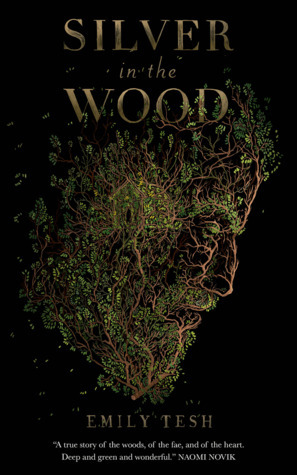 silver in the wood by emily tesh
 emily tesh, silver in the woodThere was a time three thousand years gone you could have walked from one end of the country to the other never leaving the shadow of the trees. “The Green Man walks the wood,” he tried explaining. “But the wood remembers.―
About“He knew it the same way the woodsman knew it, because he knew trees: but he also knew it with the knowledge of the Wild Man of Greenhallow, who felt every slow green beat of the forest’s heart.”
There is a Wild Man who lives in the deep quiet of Greenhollow, and he listens to the wood. Tobias, tethered to the forest, does not dwell on his past life, but he lives a perfectly unremarkable existence with his cottage, his cat, and his dryads.
When Greenhollow Hall acquires a handsome, intensely curious new owner in Henry Silver, everything changes. Old secrets better left buried are dug up, and Tobias is forced to reckon with his troubled past—both the green magic of the woods, and the dark things that rest in its heart.
This is a slow burn of a story. I read one of the other reviewers describe this story as having its own music. It dances and sways to its own rhythm and prose. Much like the beat of the forest, you get the sense that there is a deep thrumming that exists from page to page. It adds a deep atmospheric quality to the narrative. The only issue is that it is a very specific type of story. It has an almost misty type quality to it that is like viewing a story through a keyhole.
Tesh wove a lovely and romantic but restrained love story around the green man myth. Instead of just a myth steeped in legend, Tesh humanizes the green man with backstory. Tesh explains how the green man experience time, yet tries to humanize himself and not get lost with the woods. And how he deals with dryads and his very fun cat, Pearl.
“Tobias had thought and thought about it, for four hundred years, until he’d reached the conclusion that Fabian must have loved him, after all, in his own way. That was the worst of it. The thing that woke now every year was always glad to see him.”
I don’t think that this type of storytelling appeals to the masses. But, if you enjoy fae type quality in storytelling you will enjoy this story. It is beautifully done.
check out some of our other reviewsReview Nophek Gloss by Essa Hanson
Review American Elsewhere by Robert Jackson Bennett
If You Liked This - Please Share the Love Beth Tabler Elizabeth Tabler runs Beforewegoblog and is constantly immersed in fantasy stories. She was at one time an architect but divides her time now between her family in Portland, Oregon, and as many book worlds as she can get her hands on. She is also a huge fan of Self Published fantasy and is on Team Qwillery as a judge for SPFBO5. You will find her with a coffee in one hand and her iPad in the other. Find her on: Goodreads / Instagram / Pinterest / Twitter
July 17, 2021
Review – The Revenge of Eli Monpress by Rachel Aaron
 By Eleni A.E. 10/10
 10/10 (officially) – 12/10 (in my heart)!
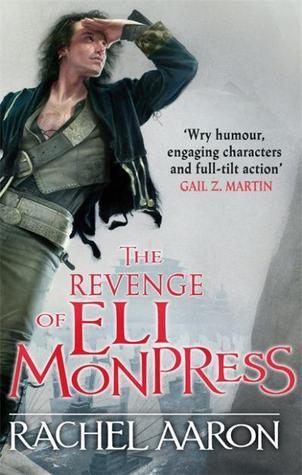 The revenge of eli monpress by Rachel aaron Purchase Here About
 Eli Monpress is vain. He’s cocky. And he’s a thief.
But he’s a thief who has just seen his bounty topped and he’s not happy about it. The bounty topper, as it turns out, is his best friend and master swordsman, Josef. He’s been keeping secrets from Eli. Apparently, he’s the only prince of a rather feisty country, and he’s been ordered to come home to do his duty. This means throwing over personal ambitions like proving he’s the greatest swordsman who ever lived.
Family drama aside, Eli and Josef have their hands full. The Spirit Court has been usurped by the Council of Thrones and someone calling herself the Immortal Empress is staging a massive invasion. But it’s not just politics – the Immortal Empress has a specific target in mind: Eli Monpress, the greatest thief in the world.
This omnibus edition contains: THE SPIRIT WAR and SPIRIT’S END
My ThoughtsHello dear reader, I am back to regale you with my thoughts on the second volume of this wonderful series. If you read my review of volume one which comprises books 1 through 3, you’ll remember how much I loved it, and I am back to tell you how much more I adored books 4 and 5; as you can tell from my rating, it was a lot! Truly, it’s been nearly two weeks between the time I finished reading and the time that I’m writing this review, and I still grin like an idiot any time I think about it.
So let me try and tell you why.
While the first three books are of a more episodic/standalone nature, the last two entries in Aaron’s series span one continuous plot, making for 964 pages of uninterrupted fun, action, plot twists, and feels. Moreover, the tone changes a bit as well (something we’d already started feeling with book three granted) turning more serious than the utter lighthearted fun we were treated to with the first two books. Dare I say, Aaron nailed this progression perfectly! Her text maintained the same humor, lightness, and clever sprinkling of small details that hinted at big things, but this time the scale became grander, the stakes higher than ever, and there was a new darkness behind it all as all mysteries began to unravel properly. Eli and his friends are finally getting in over their heads, Miranda is as well, and yet they never lose spirit. Aaron’s character work is indeed one of the places where her writing shines the most, as her dialogues feel natural, with little passing comments that fill in those gaps in between plot advancing speech and exchanges, that are often overlooked. I think one the best aspects in all of Aaron’s protagonists in fact, is that they are all such vivid characters ready to jump off the page, by also being incredibly stubborn and when stuck between a rock and a hard place, they make their decisions out of pure spite to prove others wrong and/or personal conviction. And when their own trust in themselves wavers, the ones close to them hold them up until they can stand on their own again.
This in particular is something I will not be able to explain properly without spoilers, but it is perhaps my favorite thing in the whole series because in these two books we get so much more insight into Eli and Josef’s inner characters, as well as into their dynamic more specifically!! So let me try and put it this way. There is not a blind sort of faith in one another, where characters can see no wrong in the actions of others that they care about, nor are there instances where a character is argumentatively told to get over their issues and push forward because they are stronger than their insecurities/failings. But rather, there are several instances of characters metaphorically tripping and falling, and, depending on the situation at hand, their comrades either sit down in the mud with them and provide the silent comfort of just being there regardless, or they will pick them up in a way that says, I will support you because I know that you can get through this on your own, but until you can stand firm on your own two legs and see that for yourself, I will be here to help you without judgement. In turn, there is the beauty of characters understanding when they need the help and accepting it or asking for it. The utter delight in Eli when Josef begrudgingly begs the other for help, will stay with me forever, for many a reason.
I don’t know if I properly conveyed this, dear reader, but it really made me feel warm inside to read character dynamics like this. There are people in our lives who mean well but, in the end, their aggressive positivity or denial of an issue, doesn’t always help us. Sometimes we just want to sit in the mud or need to be helped quietly along until we’re ready to move forward on our own again. And other times we need to just get up and say I’m going to do this and have friends be there to say ok I’m coming with.
Moving on, the magic continues to be mesmerizing, with the living spirits still as fun and contributing to the plot in a way that gives a deeper dimension and background to everything. I also love that spirits and humans see the world differently and thus butt heads in how to deal with things, but ultimately issues can always be resolved through some smooth talking or with reasonable arguments.
Last thing I want to mention is the main villain. OH. BOY.
Although she makes occasional appearances in the first three books, she’s not really an active antagonist in the story until the second volume. Aaron however wove her in oh so well from the beginning because in lieu of what she is effectively, it makes sense that she would be deeply rooted in everything that goes on. I’d go so far as saying that when it comes down to it, she is absolutely and undoubtedly terrifying. She is so powerful and emotional but also cruel and manipulative in a way that is both incredibly subtle and glaringly obvious to those who have seen past her façade. It is something that the reader can feel from the very start of the series too, but then we get to see the moments when the individual characters crack her veneer, and it is so effective. Just a superb and multifaceted villain all around!
Ultimately, there are just so many things I loved in this series and in these last two books of it specifically, however I will wrap this up by saying: this book had everything I enjoy in a story and more. Realistic, vivid, intriguing, and varied characters; a wonderful magic system; enthralling action sequences; hilarious quips and antics; an overall warmth and lightheartedness to the story, without sacrificing depth and darkness. I chuckled, laughed full heartedly, gasped, and awwwed, there were even a few surprised nooooos and several deeply satisfied yesses. And all thanks to Aaron’s storytelling, the way she wove her characters with all the different quirks and traits, the magic world she built, and finally the utter satisfaction that came with how she wrapped up her story in a way that called back to the very beginning of this unforgettable adventure.
The Revenge of Eli Monpress certainly has earned a spot on my list of favorite endings ever, and the simple joy and deep chested laugh that it drew out of me in that last page still makes me smile wide. In short, I strongly recommend this book to everyone for it will fill you with genuine warmth and, at the very least, a subconsciously upturned mouth corner.
Until next time,
Eleni. A. E.
Check Out More ReviewsReview – The King’s Henchmen by Craig Halloran
Review – The Living Dead by George A. Romero and Daniel Kraus
Review – Witchsign by Den Patrick
If You Liked This - Please Share the Love Eleni A.E.
Eleni is a Greek student who grew up in Italy, and is currently working on getting her BA Honours degree in Literature from a Scottish university! When not typing away for her disseration, she can be found reading all the SFF she can get her hands on, and reviewing it for fun when inspiration strikes and she just needs to share her passion for reading. Alternatively, she will definitely be with a needy Westie in her arms watching series or movies. You can find her writing on her shared blog with her course mate at https://latenightbookscom.wordpress.com/ where there are also posts about other literary genres, or follow her day to day ramblings on Twitter @eleni_argyro or Instagram @the_words_we_read .
July 16, 2021
Graphic Novel Review – Johnny Cash: I See a Darkness by Reinhard Kleist
 About
About
“Never. Don’t believe everythin’ you read in the papers. But I tell you this Johnny Cash knows what it’s like to be behind bars. The man is a story-teller. He lives his songs.”
My ThoughtsFrom the publisher, “The first and only illustrated biography of “The Man in Black,” Johnny Cash, the most famous country singer of all time Cash was a 17-time Grammy winner who sold more than 90 million albums in his lifetime and became an icon of American music in the 20th century. Graphic novelist Reinhard Kleist depicts Johnny Cash’s eventful life from his early sessions with Elvis Presley (1956), through the concert in Folsom Prison (1968), his spectacular comeback in the 1990s, and the final years before his death on September 12, 2003.
Already a bestseller and award-winner in Europe, Johnny Cash: I See a Darkness vividly portrays the unpredictable life of a loner, patriot, outlaw, and music rebel, making this unique biography a compelling read for multiple generations of graphic novel and music fans.”
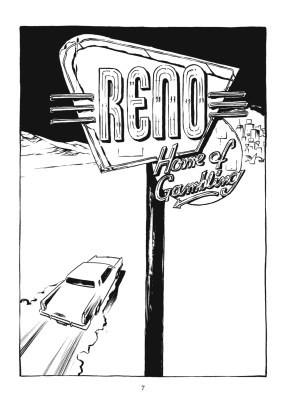
We open on a familiar scene. A man in black is facing mysteriously off into the distance. A guitar is leaning against his legs. A car driving furiously towards a sign reading, “Reno. Home of Gambling.” Already the reader is enticed by a shot of who we know as Johnny Cash fighting and shooting a man in Reno, being arrested, and heading off to a foreboding prison. Anyone familiar with Johnny Cash’s music knows what this introduction is referring to.
“But I shot a man in Reno
Just to watch him die
When I hear that whistle blowin’
I hang my head and cry
I bet there’s rich folks eatin’
In a fancy dining car
They’re probably drinkin’ coffee
And smokin’ big cigars
But I know I had it comin’
I know I can’t be free
But those people keep a-movin’
And that’s what tortures me”
Folsom Prison Blues – Johnny Cash
If you aren’t familiar with this bit of music history, it matters not. Kleist is building a mental image for you. Johnny Cash, the man, the brooder, the singer. While the movie “I Walk The Line (2005) concentrated on Johnny Cash and June Carter Cash’s romance, “I See Darkness” concentrates on a darker, more brooding, and drug filled Cash. All this happens before his days when he became clean and sober and a devout Christian. Whether this is an accurate portrayal of Johnny Cash during this part of his life is up to interpretation. Cash passed away in 2003 taking much of his mysterious life with him. Even though this is billed as an illustrated biography, Kleist is telling a story and building an image of the almost fictional music legend through selected pieces of Cash’s life. Occasionally to preserve the dramatic tone of the story, facts get skewed.
“Sometimes I am two people. Johnny is the nice one. Cash causes all the trouble. They fight.”
Johnny Cash
The story is told chronologically from Cash’s beginning up until his first kiss with June Carter Cash. Much of it is centered around Cash’s iconic performance at Folsom State Prison in 1968. There he met the narrator of his story, Glen Shirley. Later Sherley was made famous by Cash during Cash’s performance of Sherley’s song, “Greystone Chapel” at Folsom Prison. Throughout the novel, Music is used as a means to network and increase Cash’s social clout elevating himself from a poor cotton farmer to a famous musician known the world over. Also, it allowed Cash a vehicle and an audience of fans that Cash can exercise his proverbial demons on.
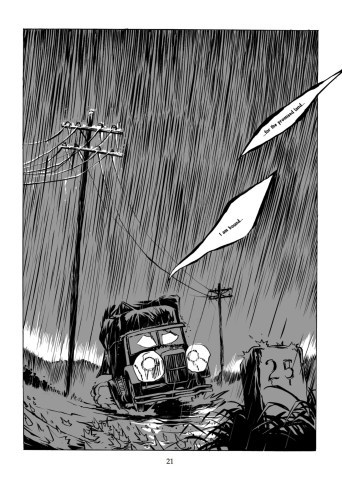
The imagery is cinematic in scope. Often the story depicts scenes that look as if they have been shot by a movie cinematographer. One of the earliest settings in the story is the Cash family attempting to drive to their new home in the south. The car is set akimbo to the road while rain that falls from the heavens splashes the ground like gunshots and in the foreground is a lonely gravestone marked with the letter 25. That level of emotional storytelling of Cash’s life is wrung from every word and panel. We the readers are living these moments as much as John is. We are plowing through the rain leaky busted family car. Praying that we will make it to the new farm ok. Or we become enraged inside watching our beloved older brother Jack speak his last words, “A beautiful river… is flowing both ways.
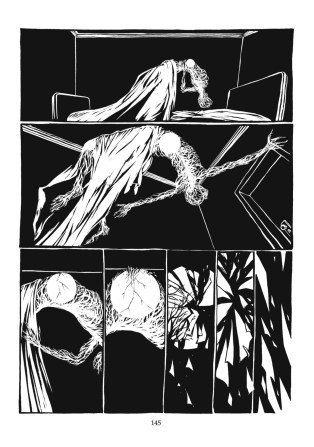
No, I ain’t going that way…Ya, that’s the way I wanna go. Ma, can you see it?” Or later in the story when Johhny is attempting to become clean from all his drug use and his figure is torn and ripped apart by scraggly lightning bolts arcing from his boy. As a reader, I can feel that I can see that, I feel as if I know at that moment a little about how much that ripped John apart to do.
“In his review at Comics Bulletin, Jason Sacks describes another scene which demonstrates Kleist’s skill with a brush. “At the nadir of his drug addiction, (Cash) wanders blithely into a cave with just a flashlight that’s low on batteries. Using blacks almost as a second character in the scene, Kleist literally shows the blackness that has come to envelop Cash’s soul at that moment in time. When Cash literally and figuratively emerges into the light, that light seems to shine straight from Heaven — a deeply healing light that reflects Cash’s emergence to finding some measure of peace. (The Comics Journal)”

In walking out of the cave and into the light, Cash literally walks into the arms of his Momma and the love of his Life June Carter. Exemplifying Cash’s next stage of his life. Drug-free.
Finally, the story ends as it begins, with an adaption of one of Cash’s songs with him as the star. Ghost Riders of the Sky. A song about a lone cowboy facing down his demons. Much as Cash has been a lone cowboy faces his demons much of his life.
“An old cowboy went riding out one dark and windy day
Upon a ridge, he rested as he went along his way
When all at once a mighty herd of red-eyed cows he saw
A-plowing through the ragged sky and up the cloudy draw
Their brands were still on fire, and their hooves were made of steel
Their horns were black and shiny and their hot breath he could feel
A bolt of fear went through him as they thundered through the sky
For he saw the riders coming hard and he heard their mournful cry
Yippie yi ooh
Yippie yi yay
Ghost riders in the sky”
Kleist boils down Johnny’s story to the drama of being the man in black. It isn’t entirely biographical in nature as we do not get to know him as anything other than his persona. However, it is a very gratifying read, especially for the fan. If you are interested in getting a better picture of Johnny Cash, I recommend reading “Cash” by Johnny Cash.
Check Out Some of Our Other ReviewsNovel Review – The Prince and the Dressmaker by Jen Wang
Review – The Wolf of Oren-Yaro by K.S. Villoso
Journal, The Comics. “The Comics Journal.” The Comics Journal Frank Frazetta Interview Comments, 17 Feb. 2010, classic.tcj.com/review/johnny-cash-i-....
July 14, 2021
Novel Review – The Prince and the Dressmaker by Jen Wang

Stats
Paperback
288 pages
Published February 13th, 2018 by First Second
Original Title The Prince and the Dressmaker
ISBN162672363X (ISBN13: 9781626723634)
Edition Language English
Awards
Harvey Awards for Best Children or Young Adult Book AND nominated for Book of the Year (2018)
Goodreads Choice Award Nominee for Graphic Novels & Comics (2018)

About
From the publisher, “Paris, at the dawn of the modern age:
Prince Sebastian is looking for a bride―or rather, his parents are looking for one for him. Sebastian is too busy hiding his secret life from everyone. At night he puts on daring dresses and takes Paris by storm as the fabulous Lady Crystallia―the hottest fashion icon in the world capital of fashion!
Sebastian’s secret weapon (and best friend) is the brilliant dressmaker Frances―one of only two people who know the truth: sometimes this boy wears dresses. But Frances dreams of greatness, and being someone’s secret weapon means being a secret. Forever. How long can Frances defer her dreams to protect a friend? Jen Wang weaves an exuberantly romantic tale of identity, young love, art, and family. A fairy tale for any age, The Prince and the Dressmaker will steal your heart”
My Thoughts

This book follows the story of two main characters, The Prince Sebastian as he comes to terms with who he is and what he enjoys doing. Sebastian enjoys dressing up in beautiful woman’s clothing, and Francis. Francis is a talented dressmaker and Sebastian’s best friend that creates works of art for him to wear. Together they explore friendship and navigate what it means to love someone unconditionally.
I fervently wish that books like this existed when I was a preteen/teenager. I think that if I have had access to literature of this quality and subject content, maybe the world would have not seemed so strange and foreign when I left my protective bubble as a child and became an adult. Not only is this book well written and beautifully executed, but it is also an important subject because people are people no matter how they want to dress, or how they see themselves.
“My whole life is other people deciding what’s acceptable. When I put on a dress, I get to decide what’s silly.”
The Prince and the Dressmaker primarily deals with being different and how people will love you and accept you given half the chance. The prince is an enjoyer of beautiful clothes, he likes big and beautiful dresses, specifically those of a seamstress that he has befriended. Together they form a partnership based on friendship and eventually love.
I love the partnership these two form, you can tell that these two not are attracted to each other, but that they genuinely enjoy each other companionship. The ease in which Wang wrote their scenes has an effervescent lightness that made it so sweet to read without ever straying into saccharin territory. This story is the perfect blend of sweetness, authenticity, joy, sadness and ultimately love overlayed with Jen Wang’s gorgeous illustrations.
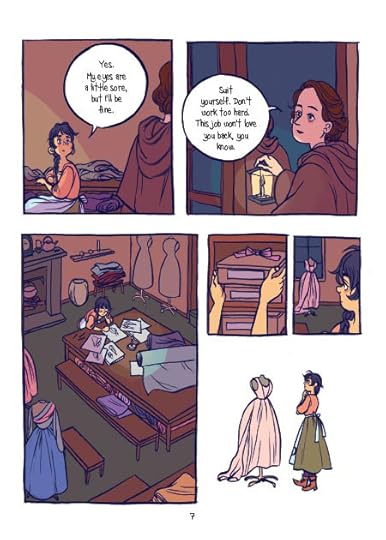
Even though the Prince and the Dressmaker is marketed to teenagers and young adults, I wholeheartedly recommend this book to anyone. It is on a rare occasion that a book could appeal to so many readers equally and for all different reasons. It is beautifully done, and a short read. You won’t be disappointed in its content.
Check Out Some of Our Other Reviews
Graphic Novel Review of Fell, Feral City by Warren Ellis
Graphic Novel Review – Habibi by Craig Thompson