Scott Batson's Blog, page 3
November 8, 2024
How World of Warcraft Made Me A Life Long Reader

I started playing World of Warcraft when it was in Beta and it consumed over a decade of my life. It introduced me to the power of stories


October 24, 2024
Three Simple Tricks To Make You A Faster Reader
 Photo by Patrick Tomasso on Unsplash
I was never a person who “devoured” books. Even as an English major, I struggled to keep up with my reading assignments and over summer breaks, I was lucky to get through one novel.
But since 2019, I’ve been getting through 40 to 50 books a year. And I’m not just skimming — I have pretty good retention of the details I read and can recall specific things even four years later.
How did I start reading four times as many books per year? It’s not that I suddenly had a lot of time on my hands — in fact, I’ve had two kids in the past few years, and time is limited. The biggest change for me: I learned how to actually read faster.
I’m not a “speed reader.” If you want to learn how to get through a page in a few seconds, this article isn’t for you. But if you have a passion for reading and want to legitimately read the words on the page at a faster rate, I have your back.
Basic Reading HabitsBefore I get into improving the words you read per minute, let me just list some reading habit changes you can make. There are so many articles with similar tips, so I won’t fixate on them.
Read multiple books at a time! This is the biggest one, in my opinion. Sometimes you just aren’t in the mood for a particular book on a particular night. Try to have three books going at once across different genres and pick up the one that sparks your interest.Give up on books. Life is too short to push through books you don’t like. Even if all of your friends loved it, it’s okay to put it down.Listen to audiobooks. Some might make the argument that audiobooks aren’t real books to which I say… whatever. I don’t believe every free minute needs to be filled with audiobooks or podcasts, but it’s surprising how much you can get through by putting your headphones in while you do the dishes or fold laundryDon’t check your phone so much. This one is obvious but maybe the hardest to change. Reading takes ramp-up time to get into a rhythm, so looking away for even a minute can add a lot of time to your reading journey.Okay, now that we’ve talked about “habits” let’s get into actually reading more words per minute.
Reading FasterThe average reading speed for an educated adult in America is around 250 words per minute. If you consider that A Game of Thrones (a rather lengthy novel) is 292,727 words, that means it would take roughly 20 hours of dedicated reading to finish it.
That’s a lot.
Now consider that the average speaking speed in America is around 200 words per minute. Reading is only slightly faster than speaking. Why is that?
Well, for many of us, when we’re taught to read, we’re taught by reading aloud to our class. I remember the panic of having to stand up and recite a paragraph or two in elementary school, terrified I would slip up on a word and everyone would make fun of me.
The 90s were brutal.
From a teaching perspective, this makes sense. The teacher needs to hear how you’re reading to assess and correct. The issue is we aren’t taught another way of reading past that. For many of us, we go through life reading at the rate of a second grader.
SubvocalizingMost people read about as fast as they speak. That’s because we “subvocalize” when we speak.
For some people, you can literally see their lips moving when they are silently reading. For many, though, something else is happening entirely.
In 1899, H.S. Curtis conducted an experiment to record the movement of the larynx when people silently read. What he learned was that there was substantial movement even if the reader wasn’t making any sound.
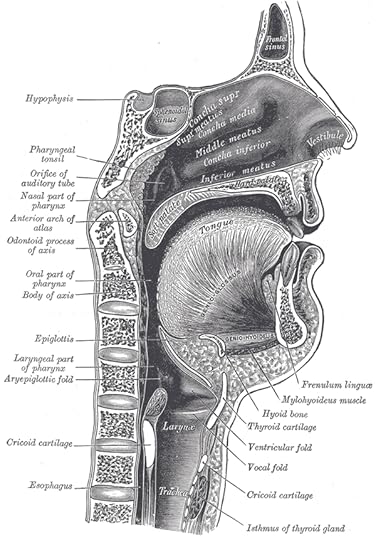 Public Domain, https://commons.wikimedia.org/w/index.php?curid=504492
Has your throat ever been sore after reading even though you weren’t speaking? That’s why. You might not realize it, but you are subvocalizing the word. It’s an important developmental step in learning a language. It’s how we learn new words and rhythms. It’s one of the ways children develop speech.
The problem is that it’s not always necessary. In fact, there are a lot of times when you don’t do it at all. Why can you read street signs instantly and draw the meaning from a small group of words? There are times when we instinctively read without subvocalizing, but it’s hard for us to tap into that.
So, how can we stop subvocalizing and try to tap into that part of the brain that can ingest words quickly without having to sound out each one?
It might sound silly, but sticking your tongue to the top of your mouth helps. Making that conscious effort to press your tongue to the roof of your mouth can stop you from moving your larynx and sounding out each word.
Chewing gum can have the same effect. Essentially, can you preoccupy your mouth?
Give it a try. You may notice immediate results. I’d say I was about 10% faster within the first few hours of trying this. Over time, you’ll become even faster if you can stick to it.
Reading with a guideThe second issue most people have with reading slower is that their eyes wander. They jump to the next line, paragraph, or a few words ahead, etc. For some people, this can be a more drastic issue, but for most of us, it happens without us noticing. Especially now that we’re used to skimming web pages to find the information we want, we’re adept at jumping around.
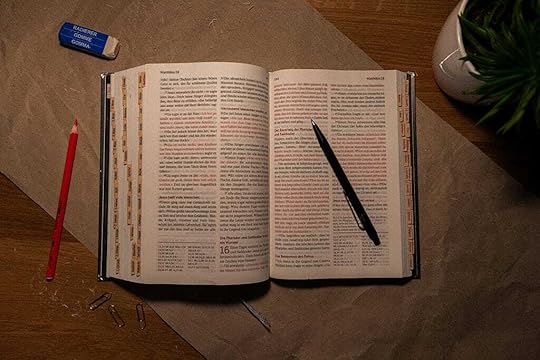 Photo by Tim Kuhn on Unsplash
Reading with something that keeps your eyes on track makes a huge difference. This is why you see a lot of people reading with a pencil or their finger to help keep their place, guiding along a line on a page.
Or you can use something like an index card to literally block everything below the line you’re on. Many people find this less distracting as they don’t have to constantly move something as they read.
Personally, I’ve found using a pencil is the most helpful, mostly because it helps transition to the next strategy:
Reading in thirdsRemember how we can read street signs instantly even if they are only a few words? Our eyes can pick up multiple words at once and take in their meaning. What we need to learn is how to train our brain to do that when there is a large chunk of text.
If you’re using a pencil, rather than guiding it along every line, you can jump it along the page in “thirds.” Take this line from A Game of Thrones for example:
 Excerpt from my copy of “A Game of Thrones”
You would visually break it up into thirds (this doesn’t have to be exact) and jump the pencil to the center of each third.

Much like reading a street sign, you can begin to train your brain to read multiple words at once. You don’t have to fixate on every individual word — since that’s what leads to subvocalizing. Instead, let your eyes and your mind take in a selection of words and derive the meaning.
It’s tough at first, but like everything, the more you do it the easier it becomes.
You Don’t Always Have To Read This WayI don’t always use these techniques. If I want to get through something quickly, I can focus and leverage the stuff above and fly through it.
But sometimes, I want to take my time. Some authors have a rhythm to their prose. Some moments in a story just need to be taken in slowly. The important thing to remember is that these techniques are just tools and they don’t have to become the only way you consume books.
TL;DRStick your tongue to the top of your mouth while you read or try chewing gum. This will help you to stop “subvocalizing” each wordUse a “guide” (i.e. a pencil) to keep your eyes focused on what you’re reading. Or try blocking most of the page with an index cardLearn to read in “thirds” taking in multiple words at a timeI hope you found this helpful! If you have any other helpful tips for reading quickly, let me know!
[image error]How I Became A Faster Reader With 3 Simple Tricks

I learned how to double the number of words I read per minute with some easy, useful tricks
3 Simple Tricks To Help You Actually Read Faster
I learned how to double the number of words I read per minute with some easy, useful tricks
October 4, 2024
Why Rings of Power Doesn’t Work, In Tolkien’s Own Words

The Rings of Power focuses on historical events and figures that simply aren’t interesting. Even Tolkien knew that when he wrote The Lord…
September 12, 2024
How Harper Lee Wrote “To Kill A Mockingbird” With Help

The careers of Harper Lee and Truman Capote are inseparably linked. However, the childhood friendship was strained by success and jealousy…
Why People Doubt Harper Lee Wrote “To Kill A Mockingbird”
The careers of Harper Lee and Truman Capote are inseparably linked. However, the childhood friendship was strained by success and jealousy…
Harper Lee’s Complex Friendship With Truman Capote
The careers of Harper Lee and Truman Capote are inseparably linked. However, the childhood friendship was strained by success and jealousy
August 13, 2024
Writing An Award Winning Short Story

How I took a silly science fiction idea from a bloated first draft to a story worth $500
July 25, 2024
Origins of Deadpool

Before you watch Deadpool 3, learn how the character was created, almost cancelled, and recruiting his own Hollywood superstar