
Stephen K. Ray's Blog, page 58
March 23, 2023
The Human Mind is Amazing
The post The Human Mind is Amazing appeared first on Defenders of the Catholic Faith.


Our Sold-out March Group arrives in Israel
Some people may object to me, calling this land Israel, expecting me instead to call it Holy Land. It is, of course, the Holy Land, but it’s also the state of Israel since 1948. We landed in the airport in Tel Aviv, which is contained in the heart of the State of Israel.
Anyway, our group arrived in good sted today with no luggage lost, and everybody in good humor. We drove up to Tiberias and got settled into our Ron Beach Hotel where everybody had a great dinner and Mass on the seashore of Galilee. Good night’s sleep and ready for tomorrow to open the day with Mass at the Mount and Beatitudes.
The post Our Sold-out March Group arrives in Israel appeared first on Defenders of the Catholic Faith.
March 22, 2023
“Be not ashamed of the Cross of Christ; but though another hide it, do thou openly seal it upon thy forehead”
 Church Father, St. Cyril, Archbishop of Jerusalem (c. 315–87) in his “Catechetical Lectures.”
13. All kings when they die have their power extinguished with their life: but Christ crucified is worshipped by the whole world. We proclaim The Crucified, and the devils tremble now. Many have been crucified at various times; but of what other who was crucified did the invocation ever drive the devils away?
14. Let us, therefore, not be ashamed of the Cross of Christ; but though another hide it, do thou openly seal it upon thy forehead, that the devils may behold the royal sign and flee trembling far away.
Make then this sign at eating and drinking, at sitting, at lying down, at rising up, at speaking, at walking: in a word, at every act. For He who was here crucified is in heaven above.
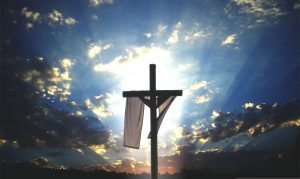 If after being crucified and buried He had remained in the tomb, we should have had cause to be ashamed; but, in fact, He who was crucified on Golgotha here, has ascended into heaven from the Mount of Olives on the East.
For after having gone down hence into Hades, and come up again to us, He ascended again from us into heaven, His Father addressing Him, and saying, Sit Thou on My right hand, until I make Thine enemies Thy footstool.
15. This Jesus Christ who is gone up shall come again!
The post “Be not ashamed of the Cross of Christ; but though another hide it, do thou openly seal it upon thy forehead” appeared first on Defenders of the Catholic Faith.
March 21, 2023
Cartoon on Protestantism and the Bible
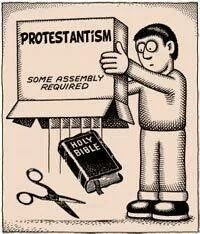 When I look back on my experience I find this cartoon has a ring of truth.
There were many verses of the Bible that I either didn’t realize existed (though that may seem strange) or that we just ignored. Other verses did not fit our Protestant theology so we kind of set them aside or did mental gymnastics to try and force them to fit our traditions, kind of like forcing a square peg into a round hole. We virtually cut virtually them out of the Bible in the sense that we ignored or reasoned them away.
Other verses I just read with my “Baptist glasses” on and twisted them to fit my old tradition. One person told me, “There are some verses that don’t fit my theology so I just set them on the shelf.
Looking back it makes me happier than ever to be a Catholic.
The post Cartoon on Protestantism and the Bible appeared first on Defenders of the Catholic Faith.
March 20, 2023
For those hesitating about our Poland Pilgrimage – watch this short testimonial from last week!
Is it safe and easy to travel to Poland on pilgrimage? YES! In a few minutes Doug and Shannon will share their experience in Poland just last week. They mention two guides Olga and Jacek. These are OUR two guides we will be using in August of this year!
Join us before the it is full — and it is filling fast!
The post For those hesitating about our Poland Pilgrimage – watch this short testimonial from last week! appeared first on Defenders of the Catholic Faith.
March 19, 2023
10th Anniversary of Pope Francis as Pope – A Somber Occasion: Article by George Weigal, Autobiographer of Pope JP II
March 13 ought to have been a happy day in Rome. But the mood in and around Vatican City before, during, and after the tenth anniversary of Pope Francis’s election was more somber than festive—and not because the anniversary fell during Lent. Rather, the melancholy reflected the current atmosphere in the Holy See, which has gone unremarked for too long and deserves candid description.
The prevailing mood in today’s Vatican is one of trepidation. That’s not only what those who question the pontificate’s direction think. It’s also the judgment of some who are comfortable with the past ten years, and who applaud Pope Francis’s efforts to display God’s mercy in his public persona, but who also know that “kinder, gentler” does not characterize papal governance behind the scenes. Because papal autocracy has created a miasma of fear, parrhesia (the “speaking freely” Francis encourages) is not the Roman order of the day, except in private. Even then it is rare, because trust among Vatican officials has broken down. When a brave soul dares to question or criticize the current line of papal policy, it’s almost invariably in the company of those of like mind. Serious, fraternal, charitable debate over the current condition of the Church and of the “synodal process” is largely non-existent. Silos are everywhere.
Living and working in this slough of dysfunction is enervating, and the inconsistencies and contradictions in papal pronouncements and policy that have become achingly apparent are not helping lift hearts.
At the beginning of the pontificate, Francis praised his predecessor’s decision to abdicate and suggested that abdication was an option for him. Now the pope says he considers the papacy a job “for life.”
The pope’s ambiguous role in the Rupnik affair—the quick lifting of the self-inflicted excommunication of a prominent Jesuit artist, Fr. Marko Rupnik, who committed multiple acts of sexual predation and sacrilege—has intensified concerns about Francis’s commitment to cleaning the Church of the filth of sexual abuse.
The financial reform of the Holy See, while not without accomplishments, has stalled far short of completion; both the Vatican’s structural deficit and its vast unfunded pension liability remain to be seriously addressed.
The German bishops openly defy Roman authority, much of institutional German Catholicism seems comfortable with apostasy, and a schism is not out of the question. The papal voice in response to this crisis is, at best, muted. Yet the authority of American bishops to provide for the liturgical nourishment of some faithful Catholics is squashed.
Bishops and cardinals who have a tenuous grasp on fundamental truths of the Catholic faith continue to be appointed, in part because of the (typically unreported) fact that Pope Francis often governs in an imperious manner with little concern for established procedure.
The somber mood in Rome these days also reflects embarrassment over the dramatic decline of the Vatican’s moral authority in world affairs: the result of both inept papal commentary and Vatican policies that create the impression that the Church is abandoning her own. Very few senior churchmen are enthusiastic about the Holy See’s kowtow to the Marxist mandarins of the People’s Republic of China, whose Communist Party now plays a prominent role in naming bishops. The Holy See’s accommodating approach to the brutal thugocracies in Cuba, Nicaragua, and Venezuela breeds more embarrassment. When opposition leaders plead for the Holy See to vigorously defend the persecuted Church and imprisoned Catholic dissidents in those countries, their requests often go unanswered—or they’re told by a (very) senior Vatican official that, while he is personally sympathetic, the pope insists on a different approach.
And then there is the fear engendered by a systematic effort to deconstruct the legacy of St. John Paul II. The John Paul II Institute for Studies on Marriage and Family at the Pontifical Lateran University has been gutted; its new, theologically woke faculty attracts very few students. The approach to the moral life that has dominated the “synodal process” thus far is a flat-out rejection of the basic (and classic) structure of Catholic moral theology that undergirds the Polish pope’s 1993 encyclical Veritatis Splendor—just as the deliberate ambiguities in the 2016 apostolic exhortation, Amoris Laetitia, undercut John Paul II’s teaching in the 1981 apostolic exhortation on marriage and the family, Familiaris Consortio.
How any of this is an expression of the “joyous” pope recently celebrated by one enthusiast—how any of this amounts to what another votary deemed the recovery of the Church’s “true authority”—is not self-evidently clear.
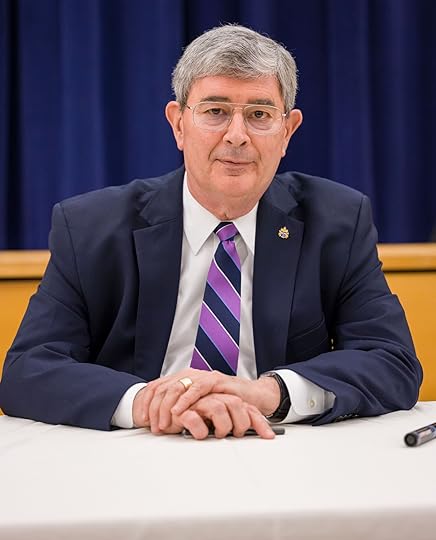
All of it is, however, terribly sad. Today’s Roman atmospherics reflect that sadness.
George Weigel’s column is syndicated by the Denver Catholic, the official publication of the Archdiocese of Denver.
George Weigel is Distinguished Senior Fellow of Washington, D.C.’s Ethics and Public Policy Center, where he holds the William E. Simon Chair in Catholic Studies.
First Things depends on its subscribers and supporters. Join the conversation and make a contribution today.
The post 10th Anniversary of Pope Francis as Pope – A Somber Occasion: Article by George Weigal, Autobiographer of Pope JP II appeared first on Defenders of the Catholic Faith.
March 18, 2023
Bet You’ve Never Heard of this Heroic, Selfless Woman
 Remember this lady?Irena SendlerDied: May 12, 2008 (aged 98) in Warsaw, Poland
During WWII Irena got permission to work in the Warsaw ghetto, as a Plumbing/Sewer specialist. She had an ulterior motive.
Irena smuggled Jewish infants out in the bottom of the tool box she carried. She also carried a burlap sack in the back of her truck, for larger kids. Irena kept a dog in the back that she trained to bark when the Nazi soldiers let her in and out of the ghetto.
The soldiers, of course, wanted nothing to do with the dog and the barking covered the kids/infants noises. During her time of doing this, she managed to smuggle out and save 2500 kids/infants.
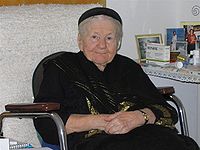 Ultimately, she was caught, however, and the Nazi’s broke both of her legs and arms and beat her severely.
Irena kept a record of the names of all the kids she had smuggled out, in a glass jar that she buried under a tree in her back yard. After the war, she tried to locate any parents that may have survived and tried to reunite the family.
Most had been gassed. Those kids she helped got placed into foster family homes or adopted.
In 2007 Irena was up for the Nobel Peace Prize. She was not selected. Al Gore won, for a slide show on Global Warming. Later, an ther politician, Barack Hussein Obama, won for his work as a community organizer for ACORN.
The post Bet You’ve Never Heard of this Heroic, Selfless Woman appeared first on Defenders of the Catholic Faith.
March 16, 2023
Baptists at the Council of Nicea?
 Written by Fr. Hugh Barbour, O.Praem.
Nicea, August 24, A.D. 325, 7:41 p.m. “That was powerful preaching, Brother Athanasius. Powerful! Amen! I want to invite any of you folks in the back to approach the altar here and receive the Lord into your hearts. Just come on up. We’ve got brothers and sisters up here who can lead you through the Sinner’s Prayer. Amen! And as this Council of Nicea comes to an end, I want to remind Brother Eusebius to bring the grape juice for tomorrow’s closing communion service . . .”
Ah yes, the Baptists at the Council of Nicea. Sound rather silly? It certainly does. And yet, there are those who claim the Church of Nicea was more Protestant in belief and practice than Catholic. I recently read an article in The Christian Research Journal, written by a Reformed Baptist apologist, who argued this very point.
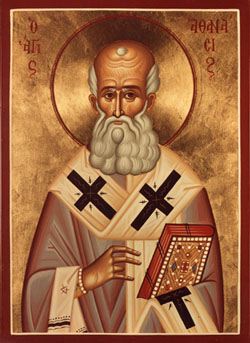
No, I’m not making this up. The article, “What Really Happened at Nicea?” actually claimed the Fathers of the Council were essentially Evangelical Protestants.
As a trained patristics scholar, I always feel a great deal of sadness and frustration when I encounter shoddy historical “scholarship,” whether it be in the pages of The Watchtower, a digest of Mormon “archaeology,” or a popular and usually well-produced Evangelical Protestant apologetics journal. But this article was so error-laden, so amateurishly “researched,” and so filled with historical and theological fallacies, that I simply couldn’t let it stand without response.”
(Lower two pictures: Left is an icon of St. Athanasius; lower right: the Council of Nicea)
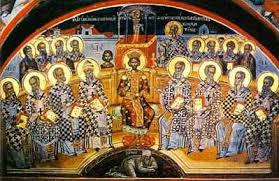
For the full article “‘Ancient Baptists’ and Other Myths” by Fr. Hugh Barbour, O.Praem. – click HERE.
Read more about St. Athansius, the star theologian at the Council of Nicea. Dave Armstrong’s article proves the full Catholic teaching of St.Athansius and the Council of Nicea. Click HERE.
The post Baptists at the Council of Nicea? appeared first on Defenders of the Catholic Faith.
March 14, 2023
Questions I Answered on Catholic Answers Live: John the Baptist, Jesus and the Wilderness
We discussed a lot of things like why John chose that place to baptize, why was he in the wilderness, what did he eat and why. Also, what was his upbringing, did he know Jesus as a child, how was a fulfillment of Elijah and much more.
Then, we answered these questions:
Questions Covered:
19:17 – Why did the death of John receive the distinction of being known as the Passion of John the Baptist?23:02 – Could the sign of the cross be traced back to John the Baptist?29:44 – Since Jesus and John were cousins, is it possible for both of them to be in the temple when they were 12 years old?35:43 – Can you tell us about John’s disciples becoming Jesus’ disciples?42:10 – Steve, you will be coming to my area and I just want you to thank you for talking about Jesus and the Eucharist.45:08 – Jesus refers to John as blessed among women. Since this line is also evidence for Mary being sinless, can we also say that John was conceived without sin?47:14 – Jesus said as high as John ranks, he still ranks as low as women. If that’s the case, where does that put me?50:18 – Would Mary have been baptized by John? Were women baptized in general?The post Questions I Answered on Catholic Answers Live: John the Baptist, Jesus and the Wilderness appeared first on Defenders of the Catholic Faith.
March 13, 2023
Why was John the Baptist said to be the Least?
In response to a question on Catholic Answers Live last evening, I promised to post a more thorough answer to a question asked.
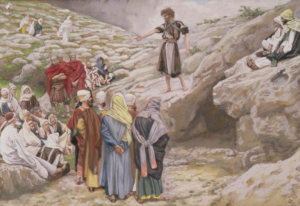 The question is about Matthew 11:11 and why Jesus says about John the Baptist, “the one who is least in the kingdom of heaven is greater than he.” Why did he say that and what does that mean?
Most commentators willingly admit that this verse is difficult to interpret. To say that John is the greatest and then seemingly contradict that statement by saying he is the least in hard to reconcile.
But it seems what Jesus meant is the make a distinction between the Old and New Covenants. John is the last and greatest of the Old Prophets, the fulfillment of Malachi’s prophecy (Mal 6:5). He is still under the Old Covenant, without the grace of the Church and the sacraments. As St. Jerome wrote, “We understand it simply, that every saint who is already with the Lord is greater than he who yet stands in the battle; for it is one thing to have gained the crown of victory, another to be yet fighting in the field.” (Thomas Aquinas, Catena Aurea: Commentary on the Four Gospels, Collected out of the Works of the Fathers: St. Matthew, ed. John Henry Newman, vol. 1 (Oxford: John Henry Parker, 1841), 413.)
One Catholic commentary suggests, “This seems to describe John as one who straddles the threshold of the Old and the New. Insofar as John has one foot in the time of preparation, he is less than the saints of messianic times.” (Curtis Mitch and Edward Sri, The Gospel of Matthew, Catholic Commentary on Sacred Scripture (Grand Rapids, MI: Baker Academic, 2010), 154.)
So it seems Jesus is making a comparison between the life of the Old Covenant without the indwelling Holy Spirit and about how rich and blessed it is to enter the Church and have all the graces and new life of the New Covenant following the death and resurrection of Christ.
The post Why was John the Baptist said to be the Least? appeared first on Defenders of the Catholic Faith.
Stephen K. Ray's Blog

- Stephen K. Ray's profile
- 27 followers

