
Stephen K. Ray's Blog, page 54
May 9, 2023
The Disappearing Christians in the Holy Land – an interview with Steve Ray
Catholic Drive Time on Guadalupe Radio interviewed me about the situation of Christians in the Holy Land. They now make up less than 1.5% of the population. They are leaving in droves to find better opportunities for their children in the West — especially to the US, Canada and Australia.
There are more Nazarenes living around Flint Michigan than there are in Nazareth. If we lose the Christian presence in the Holy Land our grandchildren will not have a “Holy Land” to visit like we can do today. I hope you enjoy the interview and take it to heart.
My interview starts at the 33:30 minute make — so you can forward the video to start our 1/2 hour interview.
The post The Disappearing Christians in the Holy Land – an interview with Steve Ray appeared first on Defenders of the Catholic Faith.


May 8, 2023
Did Catholics Know the Bible Before Vatican II?
CV NEWS FEED // A false belief persists that for hundreds of years, English-speaking Catholics did not have access to the Bible in their native tongue, or any other language besides Church Latin.
In addition, popular history books assume that the Church barred Catholics from reading Holy Scripture in the vernacular until after the Protestant “Reformation” or even up until Vatican II in 1962. It is also commonly held that until very recently, Bible fluency was a characteristic of Protestants, but certainly not Catholics.
Nico Fassino, author and operator of the independent Church history website “Hand Missal History Project,” recently debunked these myths.
On Monday, Fassino posted a Twitter thread introducing and sharing excerpts from a research project of his that documents pre-Vatican II English Bible readings at Mass – dating all the way back to the year 971. Fassino describes his project as “exploring Catholic history through the untold and forgotten experiences of the laity across the centuries.”
Here are a few examples of how Catholics have encountered the Bible in English for thousands of years!
Christendom 1000 – 1300Fassino shows that Catholic clergy incorporated English into the Liturgy of the Word as soon as it first evolved as a distinct language. To quote the prominent Church historian Father John Lingard, “for the instruction of the people, the epistle and gospel were read, and the sermon was delivered in their native tongue” in medieval England,” similar to what happens today during a Mass in the Extraordinary Form.
While the majority of the liturgy was conducted in Latin, the readings and the homily were given in English, for the primary purpose of ensuring that the common people could understand and live the Good News.
To back up his research, Fassino includes multiple images of texts: homilies and gospel readings in Old and Middle English. He states that by the end of the 1300s, “the use of these texts was so widespread and successful that many layfolk (even the poor and uneducated) were able to memorize a significant amount of the scripture cycle in the vernacular.”
The Renaissance and ‘Reformation’ EraWith the invention of the printing press in the mid-15th century, the Gospels and New Testament letters began to be mass-produced in English even prior to the state takeover of the Church.
Many of the early editions are nearly indistinguishable from those found in today’s missal books, with both Sunday and daily Mass readings listed in chronological order. Some also included explanatory footnotes or even full-length homilies underneath the readings to help parishioners more clearly understand them.
Fassino explains that these early “missals,” mass-printed in vernacular languages, were commonplace all across Europe, not just in England. He estimates that by 1500, hundreds of thousands of copies were in circulation. Martin Luther himself, the leading figure of the Protestant Reformation, noted this in one of his writings, dated 1534. Luther wrote that he noticed the Catholic Church “remarkably and effectively preserved … the text of the Gospel, recited from the pulpit and in sermons of the vernacular of any country.”
In 1582, the Douay-Rheims Bible (DRB) was published. This particular English translation is still read by many in the Church to this day. The DRB contained a chart that listed readings taken from both the Gospels and epistles to be used at Mass. This table alone serves as substantial evidence that the DRB was “used by priests to recite the scriptures to their flocks in English,” as opposed to solely in Latin, Fassino points out.
1700 – 1900Fassino gives several examples of bishops who decreed that Mass readings be given in the common tongue, as opposed to Latin. Catholic bishops issued instructions to that effect in 1791 in Maryland, in 1822 in England, and in 1826 in Ireland.
As a result, more English “epistle and gospel” missals were explicitly labeled “for pulpit use.” Like the Renaissance-era proto-missals, many of these books also included commentaries that could be used to develop homilies. It is clear that preaching in English not only used in Catholic churches in the 18th and 19th centuries, but it was also encouraged by the hierarchy.
1900 – 1962In the decades leading up to the Second Vatican Council, “Epistles and Gospels for Pulpit Use” missals continued to circulate throughout the English-speaking world.
In the 1930s, as the Great Depression raged on, Bishop Edwin O’Hara of the Diocese of Great Falls in Montana led the charge to revise and modernize the DRB. Centuries old, the DRB translation used many outdated words and phrases. The effort by O’Hara and others resulted in the “first official, national, modern Catholic translation of scripture in America,” two-and-a-half decades before Vatican II.
Around the same time, there were significant improvements in audio technology. Microphones and speakers began to see wide use in Catholic parishes. Just as the printing press enabled more Catholics to have access to English translations of scripture, the microphone, as Fassino explains it, allowed “others, even members of the laity, to begin to participate in reciting vernacular scripture.”
This was the beginning of the modern-day lector. In 1958, an order from Pope Pius XII recommended the use of lay lectors in churches.
Also read my article “Catholics, Don’t Read the Bible!“
Want to learn more about the history and fullness of our Catholic faith? Follow “Hand Missal History Project” on Twitter @HandMissals . Follow Nico: @NicoFassino .
The post Did Catholics Know the Bible Before Vatican II? appeared first on Defenders of the Catholic Faith.
May 7, 2023
Altars & Tables in the Bible – Central to the Salvation Story
Altars permeate the Bible from the beginning of Genesis all the way through Revelation. And if you think the topic is boring, you’re mistaken.
The word is used over one 500 times in the Bible, and the original Hebrew word comes from the root word “to slaughter”.
Enjoy the 15 minute conversation and introduction to a central theme of salvation history.
The post Altars & Tables in the Bible – Central to the Salvation Story appeared first on Defenders of the Catholic Faith.
May 6, 2023
What does the word “Christian” mean? Why are we therefore spiritually Jewish?
What does the word “Christian” mean?
The first believers in Jesus were not called Christians. In fact, they were called Nazarenes, or people of “The Way”.
Acts 24:5 For we have found this man [St. Paul] a plague, one who stirs up riots among all the Jews throughout the world and is a ringleader of the sect of the Nazarenes.”
Acts 9:2 “[Saul of Tarsus] asked [the High Priest] for letters to the synagogues at Damascus, so that if he found any belonging to the Way, men or women, he might bring them bound to Jerusalem.
Acts 24:14 But this I [Paul] confess to you, that according to the Way, which they call a sect, I worship the God of our fathers, believing everything laid down by the Law and written in the Prophets.
It was not until later that the derogatory word “Christian” was applied to those who followed Jesus the Christ. Since the followers of Jesus were first considered a sect of Judaism, “Christian” was probably a title to differentiate them from mainline Judaism.
Acts 11:26 “For a whole year they [Barnabas and Saul] met with the church and taught a great many people. And in Antioch the disciples were first called Christians.”
It is obvious that by this time that “Christ” had become an accepted name for Jesus, along with it being title.
So, what does “Christ” mean? It is not Jesus’ last name as in Steve Ray or Jesus Christ. No, Christ was a title — Jesus the Christ. It is the Greek word for “the anointed”. It is the Greek word for the Hebrew Messiah.
Hebrew — Messiah = Greek — Christ
John 4:25 The Samaritan woman said to him, “I know that Messiah is coming (he who is called Christ). When he comes, he will tell us all things.”
So, when someone is called a Christian, they are literally being called a follower of the Jewish Messiah. In this sense, we are all Jewish!
Scott Hahn quotes Pope Pius XI and expands a bit. “Anti-Semitism and anti-Judaism are spiritually destructive and stupid. In the words of Pope Pius XI: ‘Spiritually, we are Semites.’ You cannot be a good Catholic until you’ve fallen in love with the religion and people of Israel” (The Lamb’s Supper: The Mass as Heaven on Earth).
So as a Christian, you are a follower of the Jewish Messiah. We Gentiles have come back to dwell in the tents of Shem. What? Let me explain.
Noah had three sons. Ham, Shem and Japheth. Ham moved into the region of Egypt and Africa. Shem lived in the Middle East of today. Japheth represents the Gentiles who lived in the West, toward Europe.
Noah’s blessing on Japheth contains a Messianic prophecy (adding a new promise in addition to the promise of Genesis 3:15). The blessing of Japheth reads, “God enlarge Japheth, and let him dwell in the tents of Shem.” (Gen 9:27).
The Israelites from the line of Shem dwelled in the Middle Eastern regions. God would work through Shem’s line (from whom Israel springs); but Japheth will be brought back to “dwell in into the tents of Shem,” back into connection with the faith of Shem’s descendant Jacob and share in its promises.
With the coming of the Jewish Messiah, the preaching of the Jewish apostles, and the establishment of the Church, the Gentiles from the lands of Japheth came back to the faith and promise of Abraham “in the tents of Shem.”
The Church is built on Jewish foundations and to believe in Christ and join the Church is to figuratively enter the tents of Shem (Catechism 60). God promises Abraham that “In you shall all the nations be blessed.” (Gen 12:3). Those nations, the Gentiles are US.
Catechism 60 “The people descended from Abraham would be the trustees of the promise made to the patriarchs, the chosen people, called to prepare for that day when God would gather all his children into the unity of the Church. They would be the root onto which the Gentiles would be grafted, once they came to believe.”
But, not only am I spiritually in connection with Jews and Judaism by virtue of believing in the Jewish Messiah, but I also found out through a DNA test that I am genetically 0.6% Jewish. I was delighted to discover I have the blood of Abraham in my veins. Even though I am 98% Northern European (as is my wife Janet), I am part Ashkenazi Jew from a few centuries ago from my German and French family line. My wife Janet is also 0.6% Ashkenazi Jew.
So, we are Nazarenes, people of the Way and Christians. Our heritage goes back to the Jewish root.
The post What does the word “Christian” mean? Why are we therefore spiritually Jewish? appeared first on Defenders of the Catholic Faith.
May 2, 2023
My new book on Genesis out soon!
The editing and tweaking is done! Ignatius Press told me it is on its way to the typesetter — then to the printer.
The title corresponds to my commentary on St. John’s Gospel. The title is “Genesis, a Bible Study Guide and Commentary.“ It is 500 pages. Very excited.
There are few things I’ve enjoyed more than writing this book. Genesis is the second longest book in the Bible (by word count), second only to Jeremiah.
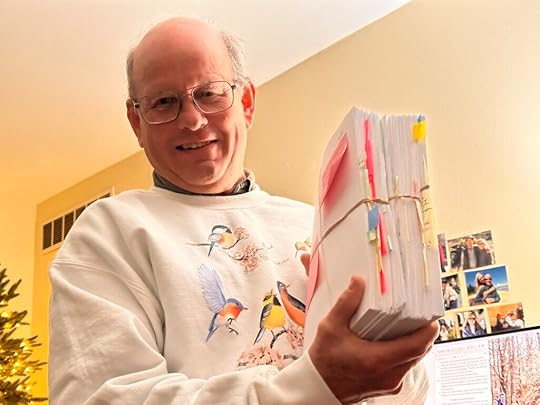
This picture is me sending the initial edited manuscript six months ago.
The post My new book on Genesis out soon! appeared first on Defenders of the Catholic Faith.
April 30, 2023
Back to Mass Today; Knees better bit-by-bit; very encouraging
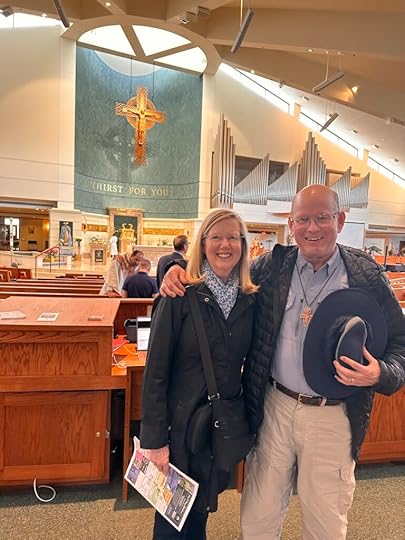
Today I went back to Mass for the first time in three weeks since my knee surgeries. I never dreamed it would be possible so soon. My eyes welled up with tears to be back in the house of the Lord.
Thanks again to my lovely daughter Emily who brought me communion for those three weeks.
Getting better bit-by-bit and and starting to feel a bit normal again. Sleeping much better. Long way to go still but progress is being made and there is light at the end of the tunnel.
Thanks to ALL of you for your prayers, advice and support. It has meant more than you will ever know.
The post Back to Mass Today; Knees better bit-by-bit; very encouraging appeared first on Defenders of the Catholic Faith.
April 26, 2023
Here’s what happens to the Bible without the authority of the Catholic Church!
Here’s what happens when you eliminate the authority of the one, holy, Catholic and apostolic Church. The Bible can never stand alone on its own, and when it does as promoted by Protestants usually, it loses its authority, and only becomes a book of opinions that the majority can manipulate.
What this guy says is absolutely true, if and when you disregard the authority of Christ’s Church and her Sacred Tradition and magisterium.
The Bible has no inherent authority pic.twitter.com/n3PViwB1eE
— Dan McClellan (@maklelan) April 22, 2023
The post Here’s what happens to the Bible without the authority of the Catholic Church! appeared first on Defenders of the Catholic Faith.
3rd week anniversary after knee surgery – an update :-)
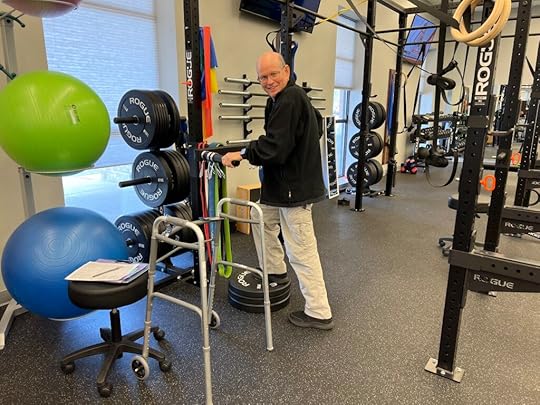
Everything is getting better a little at a time. Day by day strength and mobility are increasing. The pain is gone when resting. It’s amazing that three weeks ago today I was in the hospital wondering what in the world hit me.
I am visiting the physical therapist three times a week and they are excellent. I am able to walk around even without a walker. They said my range of motion is doing excellent.
So, things are looking up and I’m hoping to be somewhat back to normal in about a month. I really want to say thanks to all those who prayed for me and shared their thoughts and sympathies. You have no idea how much it all meant.
Janet has been a champ and I couldn’t have done it without her. God bless you all and thanks!
The post 3rd week anniversary after knee surgery – an update :-) appeared first on Defenders of the Catholic Faith.
April 24, 2023
Feast Day for a Deserter? Yup! Read the Story of St. Mark
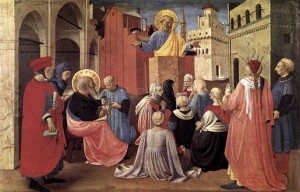 Peter preaching in Rome; Mark writing down his words
His voice boomed over the crowds in Rome as it had done all around the Roman Empire. The large fisherman was aging but his voice was still filled with intensity and conviction. The thronging crowds listened with curiosity.
Rome was the hub of the civilized world and Peter preached the message of a Jewish rabbi named Jesus from the far away country of Israel. Many in the crowd had believed in Jesus and had become part of this new society called the Church—the Church of which Peter was the acknowledged head. Standing at his side was his fellow-worker and secretary John Mark.
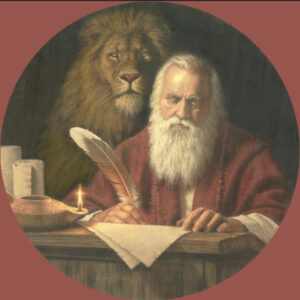 Mark was his Roman name, John his Jewish. He lived in Jerusalem with his mother Mary and associated with the apostles (Acts 12:12). As Barnabas’ cousin, he had been one of Paul’s first missionary companions around AD 45 (Acts 13:5; Co 4:10), but had left Paul and for a time and journeyed with Barnabas (Acts 15:37). It caused a great contention!
Mark later ministered again with Paul (Philem 24; 2 Tim 4:11) around AD 61, this time in Rome, sarcastically named “Babylon”, where he was Peter’s fellow-worker and interpreter (1 Pet 5:13). Peter probably baptized Mark himself since he calls him his son. Peter sent Mark to preach the Gospel in Egypt and today the largest church in Cairo is dedicated to St. Mark who first brought the Gospel.
For the rest of the story on St. Mark, click here.
The post Feast Day for a Deserter? Yup! Read the Story of St. Mark appeared first on Defenders of the Catholic Faith.
Stephen K. Ray's Blog

- Stephen K. Ray's profile
- 27 followers

