
Stephen K. Ray's Blog, page 108
January 17, 2022
Renaissance Madrigal of Psalm 150 sung gloriously in Latin – sit back and enjoy!
Find a quiet moment, relax, read Psalm 150 below and then listen to this glorious rendition composed by William Byrd (c. 1540-1623), an English convert from Anglicanism to the Catholic Church.
1 Praise the Lord!
Praise God in his sanctuary;
praise him in his mighty heavens!
2 Praise him for his mighty deeds;
praise him according to his excellent greatness!
3 Praise him with trumpet sound;
praise him with lute and harp!
4 Praise him with tambourine and dance;
praise him with strings and pipe!
5 Praise him with sounding cymbals;
praise him with loud clashing cymbals!
6 Let everything that has breath praise the Lord!
Praise the Lord!
(English Standard Version Catholic Edition (n.p.: Augustine Institute, 2019), Ps 150:1–6.) For more of their music, click here.
Thanks to Aleteia
The post Renaissance Madrigal of Psalm 150 sung gloriously in Latin – sit back and enjoy! appeared first on Defenders of the Catholic Faith.


Responding to an Atheist
A friend wrote me this morning:
Steve:I’m not often stuck with an atheist, but I am today. I posited that without a God there is no objective morality, everything is relative, just your opinion or that of society/culture or that of Government. This leads to things like the Wannsee Conference and worse.His response was, ” Really? So you must think slavery is okay, and that people should stone disobedient children, and that women should be treated as second-class citizens, for instance” If you could give me a pointer or two I would very much appreciate it. Thanks David
So, I responded before rushing out the door:
Set the Bible aside for the time being. Discussing the civil law of Israel 3,000 years ago has nothing to do with your current discussion on the existence of God unless, of course, he wants to be held accountable as an “atheist” for the cruel, inhumane, and immoral conduct of the atheistic Soviet Union and Communist China — which he must then embrace as an atheist. He will never agree to that and I don’t blame him..
You don’t need to answer his responding question. His response is a red herring — something to get you off the topic — and dodged your question. Keep the ball in his court! Ask your question and make him answer it. He has no answer to your question which is why he dodged it. He wants to judge a Christian’s practice with his ideal, but we can just as easily judge his practice by our ideal (an example later with abortion).
If you stomped on his toe, he would object and say that was wrong to do. But, why is it wrong? If I can do it, why is it wrong? What makes stomping wrong and not-stomping right? God has written the moral law on our hearts and he has it too and practices it a thousand times a day, but won’t admit it or acknowledge it. I am the kind of guy that would actually do that. When we were at an amusement park with a half-hour line to the roller coaster I saw a man with a T-shirt ahead of us that said “No Rules”. I said to my kids, “I will be right back!” I walked through the line and I pushed “Mr. T-shirt” back and I took cuts right in front of him. He was furious and asked what I was doing. I said, “The line is long so I am cutting in front of you.” He objected loudly. I told him to read his shirt. After he objected further I queried him whether the slogan applied only to him and not to me. And was it just a stupid T-shirt that he never considered the implications before he put it on. I went back and had a great conversation with my kids about objective morality and the fact that everybody believes that there is a right and wrong but they have no idea where that concept came from and how it is built into them, or why. I would suggest you get C. S. Lewis’s Mere Christianity right away and read the first 1/3 of it which shows your atheist acquaintance to be a fool. He writes,The moment you say that one set of moral ideas can be better than another, you are, in fact, measuring them both by a standard, saying that one of them conforms to that standard more nearly than the other. But the standard that measures two things is something different from either.You are, in fact, comparing them both with some Real Morality, admitting that there is such a thing as a real Right, independent of what people think, and that some people’s ideas get nearer to that real Right than others. Or put it this way. If your moral ideas can be truer, and those of the Nazis less true, there must be something—some Real Morality—for them to be true about. (C. S. Lewis, Mere Christianity (New York: HarperOne, 2001), 13.)When your friend objects to Israel’s civil law — which he fails to realize was not unjust under the primitive circumstances of this ancient culture, and far more civilized than the nations around them — what then is his philosophical or moral basis for saying it is wrong? At the time, the majority of people thought it was a good system and just. Is he saying he has another criterion that is superior? Where did he get that, what object basis does he have for that? In his universe, in Germany 51% could say that Nazis were correct and the 49% weak and therefore incorrect and demolished. Without a Higher Morality, democracy can be the most abusive governmental system. In his world, “might is right” unless he has some overarching Moral Law which can only come from a higher power outside of himself. He may object to taking the life of intransigents 3000 years ago, but is he, therefore, pro-life today and crusading to save the millions of innocent children killed in his mother’s womb. At best your friend is a miserable hypocrite. At one of my conferences, a young Catholic lady came to talk to me with her atheist fiancé. After a long discussion, I asked him what his basis was for right and wrong. Admitting there was no objective higher law or morality, he said that his basis was ultimately what made him feel good and happy. So I made him repeat it — his whole basis for morality and conduct was ultimately what made him feel good and happy. He said yes. I asked the girl if she was sure she wanted to marry a guy who had that as his philosophy of life. She stepped back and told him she would need to give this marriage some more thought. Realize too, that some people are just dishonest or fools and it is more profitable to speak to a telephone pole than to them. Jesus said of some, leave them and shake the dust off your feet. Remember too, that a lot of these so-called atheists have a deeper problem than philosophy. Find out what it is. Some have been hurt, lost a loved one, or feel unjustly treated by the world so they blame God. It is not that they don’t really believe in Him, rather, they are angry at Him and therefore try to ignore Him or act as though He doesn’t exist. Just as often they have “daddy issues” and have a hard time perceiving God as loving or forgiving and view him through the lens of their earthly and abusive, neglective father.
Dig into his past and you will likely find the real reasons….
The post Responding to an Atheist appeared first on Defenders of the Catholic Faith.
January 14, 2022
“Are You Saved?” – Questions I Answered on Catholic Answers Live
Always a blast being the guest on Catholic Answers Live. This time the topic was “Are You Saved?” Some good questions and a fun show. Enjoy!
I got asked the first question by the host Cy Kellett. He asked me, “Are you saved, Steve?” I answered. Then I briefly explained my view as a Baptist and what has changed.
Here are the questions I answered…
05:11 – In Matthew 7:21-23, Jesus talks about being saved and doing the will of his father in heaven. What does the will of the father mean in relation to entering the kingdom of heaven? 13:38 – When Jesus tells the disciples to eat the bread and drink the wine, he’s just talking directly to them. Where in the bible does it say those items are supposed to be distributed to the people? 17:24 – What does God mean when he says we need to pick up our cross? 23:45 – I have a friend who claims she went to hell and while there, she was tormented by demons. What does the Catholic church say about life after death experiences? 35:43 – Will my mom still be saved if she used to be Catholic but she’s now protestant? 46:03 – Is water baptism necessary for salvation? 51:15 – The bible says that when Jesus died on the cross, people were risen into heaven. Were any of the people that died before Jesus taken into heaven? https://catholicconvert.com/wp-content/uploads/2022/01/ca220110b.mp3The post “Are You Saved?” – Questions I Answered on Catholic Answers Live appeared first on Defenders of the Catholic Faith.
January 12, 2022
Join me in Nebraska! Lots of Speaking Events Coming up this Year – Busier than ever!
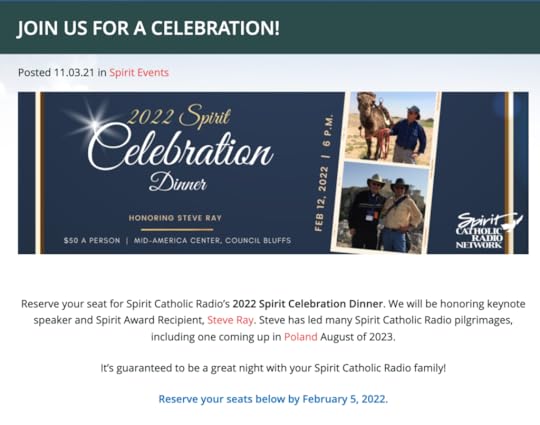
So honored to be the speaker for the Spirit Catholic Radio Celebration in Omaha Nebraska February 5. These folks have done a remarkable job over the last years to spread the Good News of Jesus Christ and his Church across the Midwest.
My topic will be “Swimming Upstream, Living a Catholic Life in a Pagan World”. We can no longer “go with the flow” and still be faithful Catholics. We have to say, enough is enough, and begin swimming against the flow and working to reclaim sanity and truth and life in our country.
Jesus said we are in the world, but not of the world. We will take time to look at the first Christians and how this despised band of simple people turned the world upside for Jesus Christ in 300 short years, transforming the Roman Empire into a Christians society.
Hope you can join us!!
The post Join me in Nebraska! Lots of Speaking Events Coming up this Year – Busier than ever! appeared first on Defenders of the Catholic Faith.
January 7, 2022
Israel has OPENED! Our upcoming pilgrimages will fly again after almost 2 years! Excited!
 Israel has finally opened its borders for pilgrims and tourists. We are excited!
You can read Thursday’s announcement (1/6/22) about the opening HERE. It was posted by the Israeli news outlet Haaretz with the headline “Israel to lift covid travel restrictions on all countries from midnight”.
After almost two years of closures, we can now fulfill our six upcoming trips to Israel. April is already sold out! May still has seats available.
Check out our upcoming pilgrimages at www. FootprintsOfGod.com or click here.
Our brand new buses are ready for you and the team is rested and excited to go!
Join us before the crowds start coming back 

The post Israel has OPENED! Our upcoming pilgrimages will fly again after almost 2 years! Excited! appeared first on Defenders of the Catholic Faith.
“Palestine” – What is the origin and meaning of the word?
I often hear people refer to Jesus as a Palestinian Jew or that the land was called Palestine even back in the times of the Old and New Testaments. But, most people have no idea where the word Palestine came from. The many names of this land through history are fascinating and the title Palestine is very intriguing. People have lived on that narrow strip of land for thousands of years. Were they all Palestinians?
Canaan was the name of the land at the time of Abraham, named after the pagan peoples called Canaanites. Its boundaries were east of the Mediterranean Sea, south of modern-day Lebanon and Syria, and west of modern-day Jordan, with the Jordan River as the border.
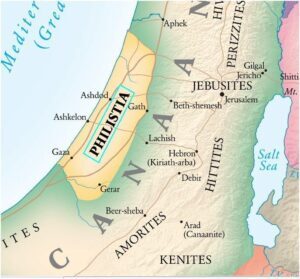
When Joshua conquered the Promised Land, Canaan was renamed Israel. The name Israel was given to Jacob earlier when wrestling with the angel (Gen 32:28). The people living in Israel were called the Israelites, or the children of Israel.
Around 900 BC, the kingdom of Israel split between north and south. The north was called Israel and the south was called Judah. After the Jews returned from exile in Babylon around 400 BC and especially during the time of Christ, the land was roughly divided between Galilee in the north, Samaria of the Samaritans in the middle, and Judea in the south. Jerusalem was in Judea, from which comes the name Jew and Judaism.
A short digression to set the stage. During much of the history described above, there was a narrow strip of land along the Mediterranean Sea called Philistia, the land of the Philistines. Remember Goliath the Philistine? They were the perennial enemies of God’s people Israel.
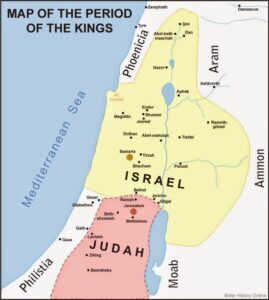
In 70 AD, the Romans destroyed the temple in Jerusalem and scattered the Jews. Being in control, the Romans renamed the land Palestine. Palestine derives from the word Philistia. In other words, presumably, to erase the memory of the Jews and their land, the Romans renamed the land after their archenemies, the Philistines.
The Encyclopedia Britannia writes, “The word Palestine derives from Philistia. … The name [Philistia of the Philistines] was revived by the Romans in the 2nd century CE in “Syria Palaestina,” designating the southern portion of the province of Syria, and made its way thence into Arabic, where it has been used to describe the region at least since the early Islamic era.” The area was referred to as Palestine (or, land of the Philistines).
The Jewish Encyclopedia explains, “Vespasian officially designated the country as “Palestine” on the coins which he struck after the suppression of the Jewish insurrection in 70 CE., implying thereby the territory of the Jews.”
On the WorldHistory.org website we read, “Emperor Hadrian was so enraged by Jewish resistance that he re-named the province Syria Palaestina (after the two traditional enemies of the Jews, the Syrians and the Philistines) and banished all Jews from the region, building his city Aelia Capitolina on the ruins of Jerusalem.”
To refer to this land during biblical times as Palestine, as in “Jesus was a Palestinian Jew” or “Palestinian Jews built synagogues visited by Jesus” is actually anachronism because the land was not renamed Palestine during biblical times.
In 1948, David Ben-Gurion proclaimed the land as the State of Israel. U.S. President Harry S. Truman approved on the same day.
Not a few refuse to accept the State of Israel and will not use the name. Many now call the land “the Holy Land” not only because it was made holy by the Lord’s presence and actions, but to avoid offending Jews and Palestinians.
The land is officially called “The State of Israel” (excepting the portions called the Palestinian Territories in the West Bank and Gaza) but many Palestinians refer to it all as “occupied Palestine”. Israeli Jews reject reference to the land as “Palestine”, and many Palestinians abhor the name “State of Israel”.
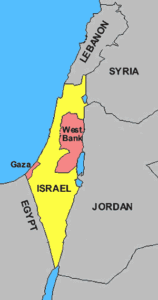
And both tend to see the usage of “Holy Land” as a denial of their rightful ownership or presence. It is, however, in reality, the State of Israel and Israel has a right to exist and to call their land the State of Israel.
Pray for the peace of Jerusalem!
Footnotes:
https://www.britannica.com/place/Pale...
“Palestine”, Singer, Isidore, ed. In The Jewish Encyclopedia: A Descriptive Record of the History, Religion, Literature, and Customs of the Jewish People from the Earliest Times to the Present Day, 12 Volumes. New York; London: Funk & Wagnalls, 1901–1906.
https://www.worldhistory.org/palestine/
The post “Palestine” – What is the origin and meaning of the word? appeared first on Defenders of the Catholic Faith.
January 5, 2022
Epiphany? So What?
What is Epiphany anyway? And why should I care?
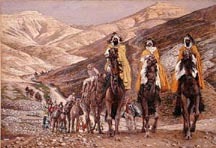
The Feast of the Epiphany – the Magi, the Baptism of Jesus and the Miracle of Cana all combined – is really quite fascinating. It was actually a celebration in the Church long before Christmas was celebrated and eventually overshadowed Epiphany.
John Paul II gave 52 Homilies that mention the word Epiphany, or are centered on the Epiphany. The word epiphany means a sudden insight, a revelation. In Christian terms it refers to the manifestation of Jesus’ divinity to the world. The Baptism of Our Lord was such an epiphany as the voice of God revealed the true nature of his Son. In Cana the disciples saw his glory and believed, and the Wise Men understood who he was so that even the Gentiles saw the glory of God.
 Today is January 6, the Feast of Epiphany and I have stood in the exact three places many times. Epiphany was more important than Christmas in the early Church and was celebrated earlier in the centuries.
For Steve‘s article “Did the Wise Men Meet the Shepherds” click here. To read about the Epiphany in the Catholic Encyclopedia, click here.
For brochures of upcoming pilgrimages and cruises, click here. You can also contact our Reservations Team at 866-557-2364, or write them at FootprintsOfGod@ctscentral.net. .
**************************
Catechism on Epiphany: “The Epiphany is the manifestation of Jesus as Messiah of Israel, Son of God and Saviour of the world. The great feast of Epiphany celebrates 1) the adoration of Jesus by the wise men (magi) from the East, together with 2) his baptism in the Jordan and 3) the wedding feast at Cana in Galilee. In the magi, representatives of the neighbouring pagan religions, the Gospel sees the first-fruits of the nations, who welcome the good news of salvation through the Incarnation. “
“The magi’s coming to Jerusalem in order to pay homage to the king of the Jews shows that they seek in Israel, in the messianic light of the star of David, the one who will be king of the nations. Their coming means that (us) pagans can discover Jesus and worship him as Son of God and Saviour of the world only by turning towards the Jews and receiving from them the messianic promise as contained in the Old Testament. The Epiphany shows that “the full number of the nations” now takes its “place in the family of the patriarchs”, and acquires Israelitica dignitas–(is made “worthy of the heritage of Israel”).” CCC 528
The post Epiphany? So What? appeared first on Defenders of the Catholic Faith.
Dr. Robert Malone, the Virus, the Vaccines, Real Science and Politics
There is a lot of information about the virus and the vaccine — much of it contradictory. Unhappily, much of it is political and positions tend to fall in the direction of the political positions taken.
I don’t trust a lot of what I read and hear and I’m certainly not a conspiracy theorist — I never have been.
This is why I was so intrigued by the recently-banned Dr. Robert Malone. He is at the center of the controversy from the beginning and his medical and scientific credentials are impeccable.
This 3-hour interview is long but extremely informative. If you want to know what is really going on, from the virus to the vaccine, from the truth to the politics and more it is worth watching and sharing. It is being watched everywhere even though banned by the mass media and political circles. Social media has canceled him and you will see why.
From Catholic Vote’s “The Loop”: TOP VIROLOGIST BLACKLISTED A prominent scientist’s interview with podcaster Joe Rogan is gaining wide attention. Dr. Robert Malone, a leading virologist who played a central role in the invention and development of mRNA vaccines, has been attacked in the media for his criticisms of the COVID-19 vaccine rollout and its attendant mandates. Last week Twitter permanently banned Malone. The social media giant later banned video of his interview with Rogan. READ
The post Dr. Robert Malone, the Virus, the Vaccines, Real Science and Politics appeared first on Defenders of the Catholic Faith.
January 4, 2022
Why Tolkien attended Daily Mass
J.R.R. Tolkien lived through some of the darkest periods in human history. He fought in World War I, survived the Spanish flu pandemic, endured the Great Depression and witnessed the horrors of World War II.
In the midst of it all, Tolkien made it a habit to attend daily Mass.
His typical daily schedule started off bright and early by biking to Mass at St. Aloysius Catholic Church at 7:30 with his sons Michael and Christopher. Afterwards, they biked home to eat the breakfast his wife Edith had prepared for them.
When his son Michael was having personal struggles, Tolkien urged him to turn to the Eucharist, expressing to him how the Eucharist kept his faith alive during dark times.
Out of the darkness of my life, so much frustrated, I put before you the one great thing to love on earth: the Blessed Sacrament … There you will find romance, glory, honour, fidelity, and the true way of all your loves upon earth.
In a separate letter to Michael, he again reiterated this fact, and shared how daily Mass was an essential part of his faith.
The only cure for sagging of fainting faith is Communion. Though always Itself, perfect and complete and inviolate, the Blessed Sacrament does not operate completely and once for all in any of us. Like the act of Faith it must be continuous and grow by exercise. Frequency is of the highest effect. Seven times a week is more nourishing than seven times at intervals.
Tolkien would go on to become one of the most popular authors of all time, and much of his creative drive was due to his intimate relationship with Jesus Christ, present under the appearance of bread and wine in the Eucharist.
In the midst of the darkness, Tolkien saw the light of the Son, and it gave him a hope that would endure.
Taken from Aleteia, Philip Kosloski – published on 09/22/21
The post Why Tolkien attended Daily Mass appeared first on Defenders of the Catholic Faith.
Ronald Reagan Tells Soviet Jokes, that could now apply just as well to China
Just under 3 minutes but boy, do I miss this president. How far we have fallen. These jokes of Reagan’s can easily be applied to the Chinese Communist Party (CCP) and unhappily, also to some of the Leftist elites and the direction they are pushing for our country.
The post Ronald Reagan Tells Soviet Jokes, that could now apply just as well to China appeared first on Defenders of the Catholic Faith.
Stephen K. Ray's Blog

- Stephen K. Ray's profile
- 27 followers

