Michele Tracy Berger's Blog, page 61
January 2, 2016
Affirmations-366Days#2
Affirmations-366Days#2: I claim my creative gifts even in the face of envy, doubt and fatigue.
For new readers, here’s why I’m committing to writing affirmations during the next 366 days.



January 1, 2016
Affirming Your Creativity in the New Year: Affirmations-366Days#1
Feeling worthy is a learned behavior.
—Beverly McIver
Happy New Year!
How lucky are we that we have another year to explore our creative passions and dreams.
Last month, I got the nub of a terrific idea from meeting the writer James Maxey. He is using the energy of 2016, being a leap year, to spur him on to write every day and aim for 366,000 words by the end of the year. Intense, I know!
I loved the idea of attempting something inspiring, mind-stretching and ambitious for my creative life in 2016. I thought about what I need in my creative life and what other creative folk might need.

I asked myself the question: What could I share with you on a daily basis that would support a positive mindset as we approach our creative work?
Answer: Affirmations!
I was lucky enough to meet renowned visual artist, Beverly McIver at a professional development conference. She talked at length about how important it is that creative people do the inner emotional work to support the (often) long path to professional success. Anxious and unhelpful self-talk and inner critics often stop us before we can even get to our projects.
What I need as a writer is lots of practice in self-kindness, plain and simple. I have technique, craft, discipline and perseverance in spades. Many creative people struggle with simply being self-accepting. As you know, we can think the meanest things about ourselves.
Over the years, I have found affirmations to be a potent tool in combating unhelpful self-talk/criticism. The use of affirmations has come a long way. An affirmation is a short, simple, positive declarative phrase that as Eric Maisel says, in Coaching The Artist Within, “you say to yourself because you want to think a certain way…or because you want to aim yourself in a positive direction.”
You can use them as ‘thought substitutes’ to dispute self-injurious thoughts (as a cognitive behavioral approach), or to provide incentive and encouragement when those seem to be in short supply. Affirmations as writer and coach, Rochelle Melanader notes in her book WRTE-A-THON: Write Your Book in 26 Days (and live to tell about it), helps to “challenge and reframe assumptions.”
Now that many psychologists, mental health workers and coaches advocate the use of affirmations, they’ve become respectable. Gone are the days that affirmations made you only think of Shirley MacLaine, flouncy scarves, and quartz crystals. (Though for the record, I’ve liked each of the above at different times in my life.)
So, my commitment to you and myself is to post an original affirmation every day through the end of the year. It’s a fun and daunting goal! Some affirmations will focus generally on creativity, but many will focus on writing. I imagine some will be serious and others will be a bit more whimsical. They will usually arrive without commentary, but occasionally I may offer some additional thoughts. I encourage you to use the affirmation as you see fit. You can say it to yourself several times a day, write it down or adapt the words to your liking. Periodically, I’ll be writing about the different ways creative people use affirmations and the current research on the use of affirmations.
My greatest hope is that the affirmations I write will be there when you need them most. And, that they will embody a tone and energy that can carry you past the sometimes insistent, unhelpful and inaccurate voices in our heads.
Affirmation #1- The more creative work I release into the world, the happier I am.


December 27, 2015
Best 2015 Writing Tips from Author Interviews
One of the things I deeply enjoy about my blog is conducting author interviews. I love finding out how writers create magic on the page and what sustains them when working on long projects. My blog allows me to reach out to new and established writers after I hear them give a reading, or learn about them online, and ask for an interview. Every time an author agrees to an interview, I feel excited and inspired. My goal is to ask thought-provoking questions that get at the heart of their ideas about craft. I look forward to checking my email and seeing how they play with and sculpt answers to my questions. Interviewing and helping to promote writers is a passion and gratitude generating activity for me.
At the end of each interview, I always ask an author: What’s your best writing tip that you’d like to share?
Below, I have collected the most intriguing answers from writers I interviewed in 2015.
Keep this list close at hand. The advice is inspiring and offers a great way to jump-start your new year of fresh writing. And, look forward to even more author interviews in 2016!
*To see the full interview, click on the author’s name.
Camille Armantrout, co-author, Two Brauds Abroad: A Departure from Life As We Know It
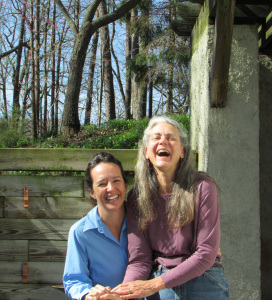
Camille (right)
What’s your best writing tip that you’d like to share?
Pay attention to your writing patterns. If you discover, as I did, that your words flow in the morning, clear your am calendar to take advantage of that creative burst. Keep pen and paper handy at all times, in your pocket or purse, on your bedside table, and in the car.
Karoline Barrett, Bun for Your Life
What’s your best writing tip that you’d like to share?
Just one? That’s hard! I’d have to say, don’t get bogged down with self-doubt, just write!
Samantha Bryant, Going Through the Change: A Menopausal Superhero Novel
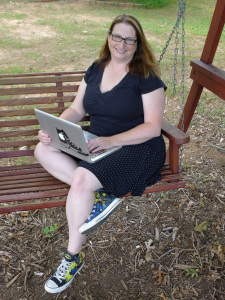
What’s your best writing tip that you’d like to share?
The one thing that truly made a difference for me was committing to a daily writing habit. For me, I did that with Magic Spreadsheet, a gamification tool for writers created by Tony Pisculli, which awards points for meeting a daily minimum word count.
For many years, I struggled to write while meeting all the rest of my responsibilities as a teacher, wife, mother, dog-mom, sister, daughter, etc., etc., etc. I would get a few hours once a month or so, and spend half of them just trying to get back in the flow.
But, once I committed to writing at least 250 words every day, come hell or high-water, that problem disappeared. It’s not hard to find my way back into the story if I’ve only been away twenty-four hours. It made the time I had more productive. Over time, with practice, I became able to write more words in one hour than I used to write in a four or five hour session. I began to finish things. So there it is: write every day.
Laurie Cannady, Crave: Sojourn of a Hungry Soul

What’s your best writing tip that you’d like to share?
Write a page every day, no matter what, and don’t be afraid to allow your narrative to reveal things to you. When I first began writing memoir, I thought I had to write everything, as accurately as I could remember, to some self-imposed end. It took years to realize that my narrative had its own end and its own way in which it wanted to be relayed. So, writing a page a day was a relief. I allowed the scenes to unfold as they pleased and once that writing was done, I was able to shape all that I had written into Crave.
Amy Ferris, Shades of Blue: Writers on Depression, Suicide and Feeling Blue
What’s your best writing tip that you’d like to share?
write as if no one – not one single soul – will ever read what you’ve written.
yeah, write that kinda balls-out scary heart-wrenching beautiful truthful.
Mur Lafferty, The Shambling Guide to New York City
What’s your best writing tip that you’d like to share?
Never give up. That’s the fastest way to failure.
James Maxey, Bitterwood: The Complete Collection
What’s your best writing tip that you’d like to share?
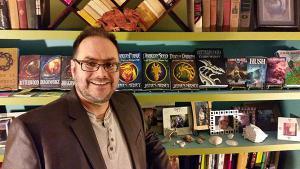
Momentum matters. Going back to my last answer, the biggest trap beginning authors can fall into is to write only when you feel inspired. If you practiced piano only when you felt inspired, would you ever master the piano? If you only went out and ran when you felt inspired, would you ever build the endurance and mental stamina needed to run a marathon? A key thing to understand is that any time you sit down to write, you aren’t working only on the story or chapter in front of you. You’re working on your entire career. If you want to “make it” as a writer, odds are you will write millions of words over the course of decades, maybe tens of millions. To get there, you’ve got to put your butt in the chair and slog out the words on days when you’re tired, or a little sick, or worried about your family or your job. You’ve got to keep tapping the keyboard when you are certain you are writing the worst sentences ever recorded onto a hard drive, when you hate every last character in your novel and can think of not one original idea for where you’re taking the plot. Because, you know what? Writing is where the magic happens. You can sit around daydreaming all you want, but until you start typing, you don’t actually know what’s going to emerge. Again and again I’ve discovered that, as I’m slogging through something I don’t want to write, something will spark and the next thing I know I’m on fire. I start out telling myself I can quit for the night if I make to 500 words, and the next thing I know it’s 3 a.m. and I’ve got 5000 words that just sparkle.
Jennifer Steil, The Ambassador’s Wife
What’s your best writing tip that you’d like to share?
Go away. Go far, far away. The best thing any writer could do for herself is to go out into the world and have adventures that will give her something to write about. Take risks. Go to difficult places and do impossible things. If you want a guaranteed fantastic story, give up a comfortable life and move to the most difficult country in the world. Stories will find you. In abundance. Of course, if you already have an uncomfortable and crazy life where you are, you’re all set!


December 25, 2015
My holiday wish for you
My holiday wish for you…
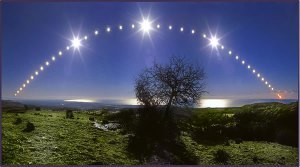
My wish for you is that during this holiday season, you are able to slow down and breathe, take time to be present and enjoy those who are dear to you. And that you laugh a lot!
Thanks to all of you who have read or followed my blog this year.
In 2016, I hope to continue to inspire you and also be inspired by your boundless creativity.
Wishing you a Happy Holiday season-
And a Peace-Filled 2016.


December 20, 2015
Winter Writing Prompts and More!
Tuesday will mark the Winter Solstice, ushering many of us into the winter season. Winter is an ideal time for you to take stock of the light and dark aspects of your creativity.
So much of creating is about cultivating the willingness to explore the unknown, uncharted and mysterious places of the imaginative psyche. Often it feels as if we are in the dark while creating.
We can use the cycle of the season to go inward. During winter, you can review your creative accomplishments of the year and plant dream seeds for the future. As you turn into the muck of your own fertile landscape, you mirror the outward cycle of the earth.

The prompts below can support your creative practice during winter:
Three new ways that my creativity expressed itself this year were…
What continues to interest me about my creative practice is…
I took the most risk this year in creating…
The enticing new project that wants to be born in 2016 is…
The project that needs more incubating time is…
The project that needs to be transformed, or even let go is…
One successful way that I kept my inner critic at bay this year was…
Harnessing support for my creative life during the winter season looks like…
A fear or worry about my creative life that I could release into the light is…
The three things I tend to say over and over again about my creative projects are…
As another source of inspiration I have included is a link to ‘Wake Up Your Magic’ coach Susan Guild’s ‘Tele-Share’ where she invited myself and writer Wendy Fedan to talk about how to deepen and grow one’s creativity practice. We called it a Creativity Bash! We recorded it last year at this time and covered the following topics:
-Discover how to take your creativity to the next level
-Learn your creative cycles
-Understand what “following the energy” means to take action on your creative projects i.e., following “the Divine breadcrumbs”
-Uncover your mood blockers
-Pay attention to your body’s physical and reactions to pain and strain
-Live following the nudges to your creative dreams
This call was fun and magical. Enjoy!


December 13, 2015
Creating Superheroes, Bad Wizards, Dragons and Being the 2015 Piedmont Laureate: Author Interview with James Maxey
I’ve always thought that it’s pretty cool that I live in a region of the state (known as ‘the Piedmont’), that names a Laureate each year. James Maxey, the current Piedmont Laureate is the first speculative fiction writer ever chosen to hold that title. His announcement received lots of buzz and many writers and fans of speculative fiction delighted in the news.
James Maxey is the author of the Bitterwood fantasy quartet, Bitterwood, Dragonforge, Dragonseed, and Dawn of Dragons, as well as a pair of superhero novels, Nobody Gets the Girl and Burn Baby Burn. His Dragon Apocalypse series combines both superheroes and epic fantasy, and so far three books have been published, Greatshadow, Hush, and Witchbreaker with a fourth one in the works. He has also published numerous short stories, the best of which are reprinted in the collection, There is No Wheel.
He writes fast-paced, action-driven pulp fiction with a strong emphasis on character growth and world building. He deals with larger-than-life characters adventuring in exotic worlds. Readers who delve past the dragons and superheroes on the covers will discover stories that explore the deeper aspects of the human condition, from the highly personal—love, hate, grief, anger, faith and hope—to larger societal issues, like the balance between individual freedoms and social order.
I met James last month at the NC Comicon. We had a fantastic discussion about the writing life. I bought his book Greatshadow and have fallen in love with the characters and the unique narrative structure he uses. I encourage you to check out his work as this month Greatshadow is free and his Bitterwood series is only 99 cents!
I’d never met any writer who also had the duties of a laureate and found myself curious about all kinds of things: What does the Piedmont Laureate do? What had been the best and most difficult parts of the year for James? What kind of reception did he receive as a speculative fiction author?
In the midst of his busy end-of-the year schedule, James graciously agreed to an interview. I’m delighted to welcome James Maxey to The Practice of Creativity.
-Tell us what it is like being the 2015 Piedmont Laureate.
The Piedmont Laureate is chosen each year by the United Arts Council, the Durham Arts Council, the Raleigh Arts Commission, and the Orange County Arts Commission. The mission of the Laureate is to promote reading and writing, and each one is chosen to represent a particular genre or form of writing. My focus as Piedmont Laureate was speculative fiction, a broad label covering fantasy, science fiction, steampunk, superheroes and many more genres set in worlds not quite our own. I write about these things because I read about these things.
As Piedmont Laureate, I’ve taught several writing workshops, some focused on speculative fiction, others with a broader focus on writing in general. I’ve also led several discussions at libraries and museums, and done readings at Mordecai House, Burwell School, and libraries. It’s been a crazy busy year. I’ve lost count, but I think I’m close to 30 events for the year. It’s definitely kept me busy.
-You’re the first (but hopefully not the last), Piedmont Laureate that primarily writes speculative fiction. Do you think that your selection, in part, represents an increasing literary respect for speculative fiction?
Hmm. I’m going to parse your question carefully and say that there is definitely an increasing cultural respect for speculative fiction. You’d have to be blind not to see that the box office each year is dominated by movies with a speculative fiction theme, and some of the biggest publishing success stories of the last twenty years have come from the speculative fiction domains. You also see the same themes now making big inroads on television.
That said, I still think there’s some literary snobbishness in regards to speculative fiction. One common prejudice I encounter all the time is the notion that speculative fiction is mainly for kids. There’s also a wide perception in the literary establishment that the genres are kind of trashy, valuing sensation over thoughtfulness. And, I’m sad to say, that’s probably true. 95% of published speculative fiction is trashy. But, how does that make it any different than any other subset of literature? 95% of everything is crap. Still, it does bug me that the undeniably great work that gets done in the genres doesn’t get more respect. When I spoke at the NC Museum of Natural Sciences about science fiction back in October, someone in the audience made a comment that it seemed like science fiction was all about concepts, and not much attention was paid to characters. I think this is a pretty common notion. In the marketing materials for my own books, the first thing that gets pitched is the big idea behind the book, with the characters not mentioned until the second line. In fact, looking at the publisher’s blurb on the back of my novel Bitterwood, it’s the third line before my title character is mentioned! People who actually dive into my work will find it full of unique characters with rich backgrounds and complicated personalities. To develop my protagonist Stagger in my novel Greatshadow, I detailed his family history all the way back to his great-grandfather, showing how choices made almost a century before his birth shaped the type of man Stagger was going to become. The fact that my novels have dragons on the cover doesn’t mean that I haven’t put character development first.
-What have you most enjoyed about being the 2015 Piedmont Laureate?
The best part of being the 2015 Piedmont Laureate is that I’ve got to meet and talk with a lot of nerds. When I was growing up, liking comic books, Star Trek, Lord of the Rings, etc. was a pretty sure way of getting yourself branded a nerd and isolated from the rest of the pack. But once computers started infiltrating themselves into our day to day lives back in the mid-eighties, it seems like nerds have gone from social pariahs to a dominating force in popular culture. When I was a teenager, wearing a Superman shirt to high school would have marked me as a loser. Go to Target or Walmart today, and at least half the shirts have superhero logos on them.
Before this year, most of my public events have been at science fiction conventions, and I still assumed that speculative fiction was a modest subset of the culture despite what I was seeing in Walmart. But doing events this year at libraries, the Sertoma Arts Center, Museums, and historical sites like Mordecai House and Burwell School, I’ve discovered nerds everywhere. The nerd stereotype that I fit into in my teens—young, male, white, skinny, and socially awkward—has been completely blasted away. At the NC Comicon where we met, the room seemed evenly split between male and female, and was far more diverse in age and race than Hollywood would have you believe. Nerds unite!
-How has being the 2015 Piedmont Laureate changed your writing schedule and/or relationship to writing?
Definitely, for worse and for better. The worse is the fact that, in 2015, I haven’t actually done much writing. I’ve produced about 100,000 words of new fiction this year, a pretty low ebb. For much of the last ten years, the second I finished one novel I’ve dived into another. Going months without actively working on something leaves me feeling uneasy. It turns out, not writing books is actually a lot easier than writing them. It’s kind of terrifying to discover that I can enjoy my life just fine without constantly being hunched over my keyboard. The best thing is that I’ve had a little time to step back and think about what I’ve accomplished with my writing, and what I still want to accomplish. A dozen books into my career (counting books written but not yet published), I found myself wondering if I was just repeating myself. If you look at my characters Sorrow in Witchbreaker and Sunday in Burn Baby Burn, they both have fairly similar goals and personalities (though vastly different moralities, once you dig deeply into their motivations). In last year’s Bad Wizard, I found myself returning again to some of the faith versus reason themes I’d already explored in my Bitterwood saga. Fortunately, this last year I’ve given a lot of thought to books I’ve read that I consider to be truly great. It’s helped me recognize that there are still huge philosophical questions that interest me that I haven’t tackled in depth yet, and also helped me think about how I can really swing for the fences in the books I have yet to write.
I’m going into 2016 with the goal of writing 366,000 words. I’ll actually be teaching a workshop at the Orange County Library on January 9 called “366: Your Most Productive Year of Writing Ever,” where I’ll be showing how I’m setting my goals and the time management tools I’ll be using to meet them, plus some tricks I’ve learned over the years to help me write even on the days when I feel utterly uninspired and uncreative. (Anyone interested in this free workshop can email me at james@jamesmaxey.net for details or to sign up.)
-What are you working on right now?
Back in the spring, before the bulk of my Laureate duties kicked in, I wrote the first draft of my final Dragon Apocalypse book, Cinder. Rewriting it and getting it out before X-Con in May is my first priority. After that, I plan to write a superhero novel called Big Ape. It’s a companion book for an unpublished novel I wrote a few years ago called Cut Up Girl. The two novels will cover the same years of story from the perspective of two different fledgling superheroes. Some of the plot points intersect, though each book can be read alone without requiring the other to make sense. But, if you do read both books, a fuller picture of the world and both characters will emerge. I think Cut Up Girl is a great book, with a story unlike anything else you’ve likely seen in a superhero adventure. But Big Ape is the book I’m really excited about. Since it stars a character who is half-human, half-chimpanzee, I plan to really dig down into just how much human nature is actually animal nature, and do what I can to search for what it is that truly defines being human. The character is also utterly isolated, neither fully man nor animal, stranded between two worlds he feels he can never fully be part of. Working through this existential loneliness will, I hope, give this book a powerful emotional weight.
If a reader wants to try your work, what do you recommend?
If a reader wants to get a taste of my work for free, through the end of the year my novel Greatshadow is available as a free ebook. Greatshadow is one of my personal favorite books, featuring what I think is my best love story, some of my best humor, and a cast of quirky and unique characters. And, did I mention it’s free?
However, while I love Greatshadow, there’s no question that my most popular books by far are the four novels of my Bitterwood saga, now collected in a single volume as Bitterwood: the Complete Collection. The collection is also my best reviewed work. As of this morning on Amazon, it’s got 15 reviews, and 14 of them are 5 stars, with a single four star review in there, because there’s no pleasing everyone.
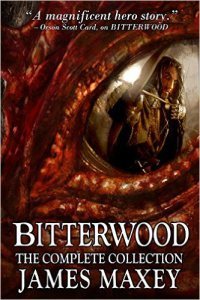
And, for the month of December, Bitterwood: The Complete Collection, is available as an ebook for only 99 cents at most major ebook retailers. I think people respond well to the entire series because it does tell a truly epic story of a war between dragons and mankind. It features my most troubled protagonist in the character of Bitterwood, and a huge cast of other great characters, both human and dragon, as they struggle to survive in a world descending into anarchy. And, whenever people come up to me at cons and tell me what they enjoyed about the books, they always mention the dragon Blasphet, who is probably the single best villain I’ve ever managed to create. He’s so enthusiastic in his wickedness that he completely takes over the book every time he’s on the scene. Usually my antagonists are under the illusion that they’re the true hero of the book. Blasphet knows he’s the villain, and just runs with it.
-Would you share with us your best writing tip?
Momentum matters. Going back to my last answer, the biggest trap beginning authors can fall into is to write only when you feel inspired. If you practiced piano only when you felt inspired, would you ever master the piano? If you only went out and ran when you felt inspired, would you ever build the endurance and mental stamina needed to run a marathon? A key thing to understand is that any time you sit down to write, you aren’t working only on the story or chapter in front of you. You’re working on your entire career. If you want to “make it” as a writer, odds are you will write millions of words over the course of decades, maybe tens of millions. To get there, you’ve got to put your butt in the chair and slog out the words on days when you’re tired, or a little sick, or worried about your family or your job. You’ve got to keep tapping the keyboard when you are certain you are writing the worst sentences ever recorded onto a hard drive, when you hate every last character in your novel and can think of not one original idea for where you’re taking the plot. Because, you know what? Writing is where the magic happens. You can sit around daydreaming all you want, but until you start typing, you don’t actually know what’s going to emerge. Again and again I’ve discovered that, as I’m slogging through something I don’t want to write, something will spark and the next thing I know I’m on fire. I start out telling myself I can quit for the night if I make to 500 words, and the next thing I know it’s 3 a.m. and I’ve got 5000 words that just sparkle.
James Maxey’s mother warned him that reading all those comic books would warp his mind. She was right. Now an adult who can’t stop daydreaming, James is unsuited for decent work and ekes out a pittance writing down demented fantasies about masked women, fiery dragons, and monkeys. Oh god, so many monkeys.
In an effort to figure out how Superman could fly, James read books by Carl Sagan and Stephen Jay Gould and Stephen Hawking. Turns out, Superman probably wasn’t based on any factual information. Who would have guessed? Realizing it was possible to write science fiction without being constrained by the actual rules of science proved liberating for James, and led to the pseudo-science fiction of the Bitterwood series, superhero novels like Nobody Gets the Girl, the secondary world fantasy of the Dragon Apocalypse series and the steam-punk visions of Bad Wizard.
James is a graduate of the Odyssey Writing Workshop where he studied with Author in Residence Harlan Ellison, as well as a graduate of Orson Scott Card’s Literary Boot Camp. He honed his craft over many years as a member of the Writer’s Group of the Triad and continues to be an active part of the Codex Writers’ online community.
James lives in Hillsborough, North Carolina with his lovely and patient wife Cheryl and too many cats. For more information about James and his writing, visit jamesmaxey.net.


December 6, 2015
Ten Tips for Breaking Through World-Class Procrastination
Last week’s post was about the emotional roots of procrastination. For many of us, the hardest part of a creative project is starting. This week, I thought I’d offer ten tips that I have used to breakthrough bouts of procrastination.
Call up another creative friend and ask for 5 minutes of their time. You get to talk nonstop about how hard/awful/challenging ‘x’ is for you and how scared you are, etc. They do nothing but listen. Then you’ll switch roles and you will be the listener. I used to do this exercise often, with a good friend, when I was writing parts of my dissertation.
I don’t know where I heard this next tip, but I believe this is a cognitive therapy technique: Say aloud to yourself, “I am choosing to watch another episode of Scandal (insert favorite TV show here) instead of doing my writing.” There is something powerful about verbalizing a choice aloud. Sometimes, you may decide, yes I really do want to watch TV instead of writing and consequently, you won’t feel guilty. However, there will be other times that as soon as you actually verbalize what you are choosing to do instead of writing, you’ll make the choice to write instead.
Prepare a small reward for yourself for every 100 words. I have mentioned Mur Lafferty’s excellent I Should Be Writing podcast before. Recently, I heard her talk about using M&Ms as a reward during a particularly difficult patch of novel writing. She’d line up the M&Ms and reward herself with a few for every 100 words. Maybe M&Ms doesn’t do it for you. The point is to have something fun and relatively harmless that can motivate you when you’re stuck. It doesn’t happen often, but there are some days that writing even 100 words feels daunting and I need a reward.
Write a short gratitude list before beginning your creative work.
Start a freewrite with “The gifts of procrastination are…” “My payoff for procrastinating is…”
Assign an inner critic other (impossible) jobs to do while the other half of you is busy with the mad dash of creating.
Try a centering breath (e.g. alternate nostril breathing or watching the breath with four counts in and out).
Write down several of your ideas on index cards–throw them in the air and choose one to move forward on.
Remind yourself that thinking about creating is not the same thing as actually creating.
Take ten full deep breaths and then slowly drink a glass of water. Then ask yourself: What I most want to create right now is? Freewrite or doodle your answers. This is a super easy strategy that works to unblock creativity. Slowing the breath down helps to interrupt whatever negative voices are in our head that are blocking us from doing the next thing. And, much of being creative is about the ability to take the next small step. Drinking a glass of water not only refreshes us, but also helps us to stay in the present moment. Finally, asking yourself a direct question about what’s next encourages your inner wisdom to deliver up some answers.
What are your tips for dealing with procrastination?


November 29, 2015
Exploring ‘World-Class’ Procrastination
There are exquisite pains and gifts within procrastination. When we put off beginning or completing a creative dream, we escape judgment and failure. . . Most of us are involved in procrastination to some degree–let’s bring it out into the open, speak of it with gentleness and humor–admit when it’s crushing us or stopping our joy.
–SARK, The Bodacious Book of Succulence
In July, I asked readers to take a one question poll and answer the following: What is the biggest obstacle you face in your creative life?
The second highest response after ‘finding consistent time to work on projects’ was ‘procrastination’.
I consider myself a recovering ‘world-class’ procrastinator. I often procrastinated with writing and creative projects because of fear, anxiety, ambivalence, not knowing how to ask for help and support, discomfort with ambiguity in the creative process, and not knowing how to start or stop a project. My procrastination pattern was both deep-seated and well-developed.
As creative people, many of us are struggling with world-class perfectionism issues. We usually suffer alone without support or guidance. We often feel guilty and angry about our behavior, but we rarely stop to ask why and how we developed these ways of being in the world. The work of one of my mentors, Susan Ariel Rainbow Kennedy aka SARK has been of enormous help to me. Many of her books explore the varied facets of procrastination. Until we look at our emotional history of procrastination, our ability to change, interrupt and soften this pattern will be ineffective.
The questions below come from SARK’s Bodacious Book of Succulence. They invite you to explore more deeply the pains and gains regarding procrastination.
Procrastination
Are you aware of procrastination in your life?
How does procrastination affect you?
In what ways do you stop yourself from experiencing joy or success?
When do you first remember feeling procrastination?
Were your parents procrastinators?
Is someone close to you a procrastinator?
What gifts do you receive from procrastinating?
My additional questions:
Do you delay on projects important to you even when you feel physical or emotional pain?
When you procrastinate do you find yourself saying that working last minute helps spur creativity?
Who might you become without this pattern of procrastination?
What kinds of activities do you never procrastinate on?


November 28, 2015
Wake Up Your Magic’s Creative Genius of the Week!
Happy post-Thanksgiving!
I am delighted and honored to have been chosen as the ‘Creative Genius of the Week’ by creativity coach and author Susan C. Guild. I met ‘Suz’ two years ago through a life-changing online writing program called ‘Write it Now’ (WINS), hosted by the brilliant Susan Ariel Rainbow Kennedy aka ‘SARK’. Every time I read something by Suz or heard her speak on the class calls, I was inspired and felt that I had met a kindred spirit. We share a similar approach to exploring creativity as a path to self-discovery. Suz is an author, entrepreneur and creator of ‘Wake Up Your Magic’. Through WUYM, she hosts an amazing monthly teleshare where she interviews creative professionals, hosts workshops and offers products and services focused on connecting people to their creativity. I love Suz’s fun approach to life and living her purpose through teaching the transformative power of creative practices. And, I am very appreciative that she has been a great believer in my work.
Suz is featuring some of my best and juiciest blog posts as part of the ‘Creative Genius of the Week’ series on her Wake Up Your Magic Facebook page (see Nov 23 onward). Also explore her Wake Up Your Magic website.


November 22, 2015
7 Habits that Hamper Creativity
This week a colleague of mine sent me an article about productivity, “7 Super Common Habits That Productive People Ditch (Because Who Has Time for That?)”
This is a great article as it highlights behavior that can derail us at work. The author presents compelling research and evidence that the habits listed below make us less effective. However, I also looked at this list and thought that many of these habits can hamper creative work, too. I used the categories as a jumping off point for thinking about how these habits affect our creative aspirations and how we can change them.
1. Checking Email Constantly
Guilty! When I’m not fully committed to writing or I don’t know what to write next, email becomes a constant temptation. It’s so immediately rewarding.
Solution: Take 5-7 minutes at the beginning of your writing session to outline your goal for that time. And make the goal manageable and specific. So, instead of, “I’ll work on Chapter 3,” try instead, “I’ll add sensory details to the second scene in Chapter 3.”
2. Waiting for Things to Be Perfect
Perfectionism is a type of inner critic. Often perfectionism is about delaying anticipated possible rejection or disapproval of one’s work.
Solution: Let others know that you intend to submit your manuscript (or whatever you want to get accomplished), by a certain date. Post it on Facebook or social media where people will hold you accountable. Savor the experience of letting something go. Remind yourself that if something of yours is rejected, that’s OK. You’ll survive.
3. Multitasking
I find that I multitask when I have anxiety about doing the next aspect of a task, especially if I don’t have a clear sense of what I need to do. Or, if I think that the task is going to be very difficult. It’s easier to do several things to avoid the challenge of deeply focusing on one thing. Multitasking is often a creativity killer. Creativity needs our focus and presence.
Solution: Ask yourself, are you multitasking because you haven’t efficiently budgeted the appropriate time for your creative work? Are you multitasking because you are stuck? If you need help with something, reach out to your creative community.
4. Inviting Interruptions
Don’t you hate when you are in the flow of your creative work and someone interrupts you? It’s imperative that you set up the optimal conditions so that you won’t be interrupted.
Solution: For some people that means putting a sign on their door letting others know that they are unavailable for a certain period of time.
5. Being Disorganized
Being disorganized according to many organizational experts is when you can’t get your hands on needed information within 2 minutes. I like to give myself a bit of a broader time period. I should be able to find something within a half hour or less. Can you find things in your studio? Do you have a record of where you are submitting your stories? Do you capture your great ideas in places where you can easily find them later?
Solution: Schedule quarterly cleaning and organizing sessions. Need more tips of how to get started getting your creative space organized and not get overwhelmed? See my spring cleaning for the creative life posts.
6. Failing to Delegate
This is a hard one as most creative professionals are juggling multiple jobs, a family and other commitments.
Solution: More support is always a good thing. Are there things on your to-do list that you can trade with someone else, even for a short period of time? I’ve known writers who detested writing query letters and so traded this task with another writer. They then completed a task that their writer friend found difficult.
7. Never Saying No
Creative work takes time of all sorts, including incubating, developing and implementing. If you habitually say yes to things that don’t support your creative life, you’ll find yourself frustrated and resentful.
Solution: Practice saying no ten different ways. Eliminate what’s not essential and things that drain your energy.
Do you have any of these habits? If so, how are you working on them?
See the full article here.