Sarb Johal's Blog, page 4
September 2, 2021
Terror Attack in Auckland Today
With the terrible news of the terror attack in Auckland this afternoon, there will be a desire to understand what has happened and why.
This is a normal reaction to a terrible eventWhile we can’t control what has happened, we can control the amount that we are exposed to repeated talk about it that adds little value, or exposing ourselves to repeated imagery or video too. Be careful not to expose young people and children inadvertently to this either. Little ears hear very well and can jump to conclusions that make children feel unsafe. But yes, they may know something has happened. Keep your explanation simple, short, and make sure they know they are safe.
We are already frazzled through being in lockdown, and our headroom, or adaptive capacity, to deal with more stress is less that it would otherwise be. You may feel scared, alone, and wonder what lies in store in the future. Again, these are normal reactions to a horrible event.
Remember, police officers were on hand to deal with the threat as quickly as they good in these awful circumstances. Responders gave care to those who were injured as soon as possible. Those who rushed to assist were present and did their job in that moment.
My thoughts and sympathies with those injured in this attack, their loved ones, and those who witnessed this terror. Please take care, reach out for help if you need it. 1737 is a good first point of contact to get trained help.
And please, go easy on yourselves, each other, and those who perhaps share the same nationality / community as the perpetrator, but have nothing else to do with this attack.
The post Terror Attack in Auckland Today appeared first on Sarb Johal.


August 19, 2021
Staying the Alert Level 4 Lockdown Course
One of the difficulties of lockdown is staying focused on the collective goal and avoiding stay-at-home fatigue. This occurs after a period of restriction, when we start to get cabin fever and feel tempted to break the rules, even if the virus hasn’t changed and the risk remains the same. During the initial lockdowns, one study following cellphone data showed that people started going out more frequently and travelling longer distances from home, after they passed that one-month mark of being confined to their home.
One simple explanation for stay-at-home fatigue that has been used by economists is called ‘diminishing marginal utility’. During the first few days in lockdown, you probably had the opportunity to do things in the house that you were fairly enthusiastic about. Maybe you binge-watched Netflix, or built a blanket fort with your kids. But after several weeks at home (in the first lockdowns) your kids were driving you nuts, you got tired of trying to direct their learning, you sank into the dregs of Netflix shows and you just wanted it to stop.
In other words, you used up all the ‘high utility’ (i.e. high happiness) activities and were scraping the bottom of the barrel. Cue stay-at-home fatigue, and the creeping desire to get out.
We might hit this point earlier, this time aroundMany of us also appear to be driven by what it called ‘idleness aversion’. This may be a conditioned thing that we’ve grown to expect in life, but briefly, it’s our desire to get out of the house and do something, whether it’s a visit with friends or a trip to the burger place that’s more a craving than a necessity. Research shows that we don’t actually like sitting around and doing nothing for extended periods of time all that much.
1. Reduce the overwhelm. You’ve done this before, you can do this again. Think about what worked for you last time and do more of that.
2. Make a public promise. If this fits with you, tell people what you are doing. When you go public with your intentions, it immediately strengthens your resolve, so announce it to friends and family on Facebook or by email. A public commitment shifts your own thinking about your seriousness. No one wants to be embarrassed in front of others.
3. Set up accountability partners. Recruit people like you to help you stay the course and build each other’s resolve. Create a system of accountability so that you can report your actions, successes and failures every day. This may be a friend or it could be on Facebook, or in a forum of some kind. Don’t just announce it once and then disappear; let the world know about your progress, and your successes.
4. Expect difficulties. There will be life situations that might get in the way of your efforts and it is so easy to allow them to undermine all your hard work. Think in advance of possible problems that might arise and decide how you will deal with these situations and how you can stick to the plan.
5. Think of the consequences. Another way to strengthen your resolve is to think of the consequences before you take an action that will lead to them. Not just for you, but for everyone and all the effort that’s been put in so far. Pondering consequences certainly isn’t a magic pill, but it can help if you usually don’t think about the consequences until they become real. Because that will most likely be too late.
6. Imagine others you respect can see you. Last but most definitely not least, you can benefit from some social pressure. Next time you want to choose the easy way out, imagine other people whose opinion you respect can see you. Would you still take that unnecessary trip if they could see you? And what would disapproval from them feel like to you? Yes, you’re essentially manipulating yourself, but if it works to strengthen your resolve to stick with a course of action that you value right now, then it’s certainly a tool you can go to.
This is extracted from my book, Steady, available at sarbjohal.com
The post Staying the Alert Level 4 Lockdown Course appeared first on Sarb Johal.
August 17, 2021
Keeping Well in Alert Level 4 New Zealand 2021
We are well into our first day back at Alert Level 4 as an entire nation, and I’m watching the 1pm update as new cases are announced and the genomic sequencing points to the variant originating in NSW, Australia.
If you’re feeling anxious, it’s important to understand what stokes your anxiety and what calms it. Checking your newsfeed and social media might be something that makes you feel worse, not better. If that sounds like you, maybe check trusted sources of news 3 times a day – once in the morning, during or after the 1pm update, and once in the early evening. It’s important to stay informed but not to overwhelm yourself.
What do you do for the rest of the day?We know that the people who seemed to do better in the lockdowns last year seemed to have absorbing activities that took up their attention, and that they found absorbing and enjoyable. So, line up some projects for you and the kids. Chunk up your time so that you can switch activities after an hour or so, make sure you get a bit of body movement in, as well as connecting to people online or over the phone that make you feel good.
Understand that you have control over your behaviour – even though there’s a lot that feels out of control right now. Stay home. If you need to leave to get food or medicine, plan your trip: how will you stay 2m distant from other people? Where’s your mask? Is your QR code scanning app ready? Is bluetooth switched on? Got your sanitiser? To have the best chance, you need to do all these things, not just some of them when you feel like it.
All the things, all the time.Finally, your emotions can feel overwhelming – try to let them go. If you find yourself in an endless loop of “what if?” Scenarios and constantly worrying, you can write your worries down and that releases your mind to do other things that can absorb you.
Find out more in my series of lockdown videos on my YouTube channel. There’s so much content to help you there.
Take care, be kind, and we can do this.
The post Keeping Well in Alert Level 4 New Zealand 2021 appeared first on Sarb Johal.
August 16, 2021
Community Case of COVID-19 Detected in Auckland, August 2021
With this community case in Auckland, we have far less room for lack of consistency in our protective behaviour. We don’t know for certain, but it’s likely that the variant is Delta.
Where we may have got away with not sticking to public health measures so solidly with previous occasions, the odds are stacked against us this time.
We should be prepared to act consistently in every place we are at and at all times to protect ourselves and each other.
We’ll be best at doing this is we can stay calm and act where we have the ability to cover all our bases effectively – because when we are not calm, we can miss things, like forgetting to scan, or not masking up when we really need to be.
So take time to prepare yourself and think things through.Pack a mask, plan how you’re going to stay distant, take your sanitizer, remember what worked for you when working at home for you and your family.
The objective here is to isolate cases, and to make sure the virus doesn’t spread any further. Stay physically distant, wear a mask, wash your hands and get vaccinated when it’s clear what that process might look like after we find out more later today.
So we need to do all the things, all the time to maximise our chances of getting out of this situation quickly, and in parallel, to build up community protection against the worst effects of the coronavirus.
The post Community Case of COVID-19 Detected in Auckland, August 2021 appeared first on Sarb Johal.
A Different Work-Home Life
This week has started off very differently for a number of reasons. I quit my academic job in late 2018 for many different reasons, but a major driver was wanting to spend more time being able to spend more time as a lead parent. And, for a while, this plan was going well. Arrangements altered in August 2019, but they really changed in early 2020 when it was clear that the pandemic was happening and possibly imminent onshore. My accumulation of skills and knowledge needed to be put to good use, so I stepped out of the lead parent role and my wife took this back on again. Without her sacrifice and support for our family in a myriad of different ways, there is no way I could have done all my work over the past 18 months. And for that, I am truly grateful.
But this week, things have changed again. Yesterday, my wife returned back to work for the first time in two years. I have stepped back into more of a lead parenting role – this time with three children, instead of two. And of course, our youngest develops chicken pox just when this happens, meaning that her planned extended kindergarten days are not possible, as she remains in quarantine at home this week.
The regular domestic challenges perhaps?
Yes, life goes on – goals evolveBut day-today life continues, ever-changing. For my work, this means a couple of things which might be worth knowing for you.
First, I’ll be working fewer hours. If you’d like to talk to me about some work you’d like me to get involved with; such as projects, advice, strategic communications, public speaking, and even media appearances or commentary, it would be great if you could reach out to me early. I’d love to help you if the fit is right for me (and for you) but my time is limited.
Second, I’ll be working on a system where you’ll be able to book up to 30 minutes of time with me, online, for an initial consultation on your project. Please note, I am not doing therapeutic consultations right now, or for the foreseeable future.
Third, I’m looking for select opportunities to work with organisations at an advisory level where I can make my skills and experience count. For the right organisations, I’m happy to look at occasional advice being pro-bono. Please get in touch if you’d like to talk about an opportunity, or pass the message on to anyone you think might benefit.
I love my work.
I’m honoured and privileged to do the work I do – and I recognise that it’s not been an ordinary path for a psychologist to take. But I’ve also been struck by how many of my contemporaries have recently been diagnosed with serious health conditions. This is causing me to pause and reflect upon exactly how I spend my time and energy now, and to plan how I do this in the future.
I suspect that a pillar of this will be to spend less time workingThe post A Different Work-Home Life appeared first on Sarb Johal.
July 29, 2021
Guest on Selfie Podcast with Kristen Howerton
It was a pleasure to be invited to talk about pandemic mental health with Kristen Howerton on her Selfie podcast.
Kristen is a Marriage and Family Therapist, the mom of four children within four years via birth and adoption, and has been blogging at Rage Against the Minivan as a coping skill since 2006.
I hope you’ll enjoy our conversation, which starts around 21 minutes into this episode.
The post Guest on Selfie Podcast with Kristen Howerton appeared first on Sarb Johal.
July 27, 2021
Heading South
Over the last few days I’ve had the privilege of traveling down south to Twizel and Timaru for a couple of meetings. This was a postponed trip from a couple of weeks ago, when we had both bad weather in the area I was traveling to, and a possible outbreak of the coronavirus in Wellington which we were trying to manage.
In the meantime, I had run a webinar session for the Timaru Hospital Grand Round, but it was good to be talking in person to the community.
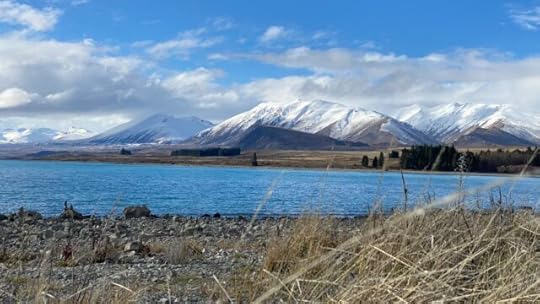
First stop after flying into Timaru and then driving across the country (just lovely – check out the photos interspersed in this blog entry), was Twizel.
 Tekapo on the way to Twizel
 More Tekapo, before the clouds came in
I caught up with the organisers who kindly sponsored and hosted me for this trip – South Canterbury DHB and Mackenzie District Council – and then had a community session at the Events Centre discussing the mental and social health challenges. Lots of gear questions, comments and lively discussion after I’d finished my session, and then a light supper for further chats too.
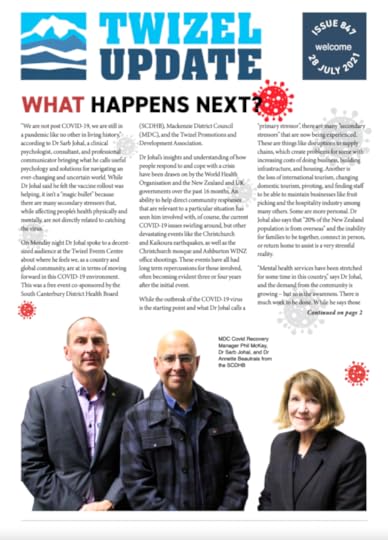
Find the full article in the Twizel Update here.
Up early the next day to head back to Timaru at dawn Just after dawn
There wasn’t a frost so the roads were in good condition, and I made great time to the hospital. I had another interesting discussion with a group interested in discussing the stresses and strains of the last 16 months and what may be yet to come in the context of suicide prevention.
 Caroline Bay in Timaru
All in all, a really engaging and interesting time for me, and I hope I developed some value for all the participants in the discussions we had and presentations I gave.
If you would like to engage me to talk with you or your organisation about how I can help you understand the possible mental and social consequences of how we move through this pandemic and beyond, please get in touch.
I’d love to talk with you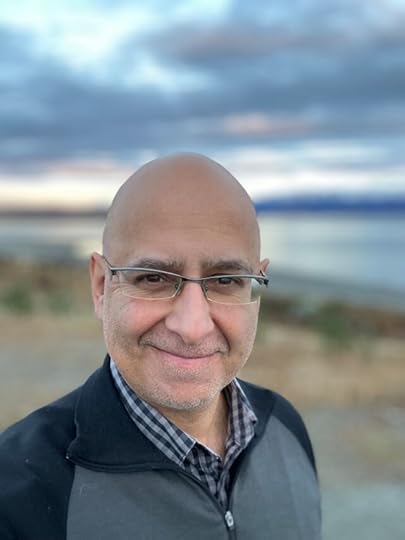 Another terrible work day
 Flying home
The post Heading South appeared first on Sarb Johal.
July 25, 2021
Do You Say No?
I get occasional emails from people who I trust and follow – they may me think or point me to good information. If you’ve subscribed to an email list, maybe this will sound familiar. Last week I got one piece of advice that made me pause to think why I disagreed with it so strongly.
“I rarely regret doing something (but almost always regret not doing it).”
Is this something that resonates with you? For me, I found myself railing hard against this advice, even though I recognise that it is something that would have appealed to an earlier, younger version of me.
What I’ve noticed more recently is that I get more done and gain more satisfaction from doing exactly the opposite of this practice.
I have got much better at saying no“Thanks for letting me know, and please keep letting me know about possible potential opportunities, but for this one, it’a a no, thank you.”
Politely, but still no. When I say yes, I have to weigh up the potential opportunity against how much this takes me away from my core purpose: the intersection of what I like doing, and what I am good at. At this point in my life and career, I have realised that too many times I have taken on projects where I may have been good at executing the task, but it hasn’t stimulated my interest enough to keep me engaged over the long term. As a result, though it may have led to more opportunities, they took me further away from my sweet spot of where my talents and interests intersect. I’ve done some intense reflection over the past couple of years on my values, interests, and vision for my life over the next decade or two. I wonder, how do you choose what you do?
Of course, there is always opportunity to learn, but that almost comes as a separate category for me now – taking on a project, or collaborating on one, where it stretches and grows and develops me in a way that takes more time and careful scaffolding. It’s not something to be taken lightly; without careful planning, it can scatter your time and energy everywhere.
I don’t think it is an accident that I find myself drawn to interests and activities that I was doing as an emerging adult. Without the pressures of career paths and other other obligations, I was much more free to choose what I did. The best thing I can do now is to recapture this and re-embody this experience, though differently now, tailoring it for my constraints, circumstances and all the experience I have accumulated in the ensuing decades since I was 18.
So, I wonder, do you say no?Please feel free to drop me a note below – I’m genuinely interested in how you respond to advice like saying yes to all opportunities, because I think it contributes to experiences like burnout and drifting from your sense of purpose.
The post Do You Say No? appeared first on Sarb Johal.
July 1, 2021
Invited Speaker on TEDxSantaBarbara’s Making Waves Series
I am so pleased to have been invited to speak LIVE with Mark Sylvester on the “Making Waves” series of conversation with influencers and disruptors at TEDxSantaBarbara. We spoke about a wide range of topics concerning how we can better manage our expectations and mental health as we progress through this coronavirus pandemic.
You can watch our conversation here. I’d love to hear your thoughts about it – once you’ve watched, please come back and comment below – thank you.
The post Invited Speaker on TEDxSantaBarbara’s Making Waves Series appeared first on Sarb Johal.
June 24, 2021
What Effect Will The Wellington COVID19 Episode Have On Potential Vaccine Uptake?
We will know more about the situation in Wellington soon. But I’ve been thinking: what might happen when vaccines become more widely available at the end of next month?
It’s clear that NZ is vulnerable right nowWith variants circulating around the world and entry points into NZ, people maybe taking a more careful look at the risk it exposed them to right now with various travel bubbles remaining open.
One issue is that when cases are detected at a place of origin, people from that place may already be in NZ. And they may be infected.
Also: authorities in other places might have a different appetite for risk meaning that they may take slower or different actions than we would in NZ.
With a largely unvaccinated population, that’s a risk we are trying to manage. But with more infectious variants in this phase of the pandemic, the situation has changed from when Alert Levels and criteria were set (though they have evolved somewhat).
In the interim, there’s a good argument to consider whether we need more stringent advice about behaviour to keep ourselves safe while we are relatively vulnerable through low vaccination coverage.
It seems a fair trade-off: if the travel bubble is to remain open, then there needs to be a higher level of compliance with behavioural measures to prevent spread of the virus should there be an outbreak.
How we do this is a political decisionWe can make it easy and remind people to mask-up, stay physically distant, and scan. But this seems to happen after a threat appears – which is not tight enough for the situation we find ourselves in.
As we go through this period of understanding the Wellington situation, we may find that people’s attitudes may shift. There will be people who were always going to take up the vaccine, and those who will not.
But this current episode may lead people to re-assess their position and decide to take up the vaccine for their own, and their loved ones’ protection.
We should be prepared for this increased desire to take up the offer of a vaccine.
The post What Effect Will The Wellington COVID19 Episode Have On Potential Vaccine Uptake? appeared first on Sarb Johal.