Sarb Johal's Blog, page 2
February 24, 2022
How to tell people you have tested positive for Covid-19
As we can see from case numbers today and most likely in days to come, this is going to become an increasingly more common experience.
Even though it’s a new thing to do, and it’s never easy to tell someone you may have an infectious disease and that you may have been a situation where others could have been exposed, despite your best efforts and intentions.
It’s important to know that Omicron is incredibly infectious.
More and more people around you are going to get itYou might have fear that you may get blamed, or that it might somehow shift the dynamic of your friendship of relationship. And maybe you don’t want the focus to be on you and your status, but you want to let people know because it’s the responsible thing to do. Maybe they’re about to see someone who might be especially vulnerable to the worst effects of Covid-19. So, even though it might be difficult, it’s the right thing to do.
Some people who have been through this experience have reflected that they needed a little time alone to figure out what the point of not sharing it with those who may have been exposed might be. Once they decided it wasn’t wise for them to keep it secret, they first shared the news with people they knew would be supportive, answering their questions, informing them, and sharing compassion with them.
Perhaps you feel a need to let people know you didn’t get it through being reckless or irresponsible, and that you’re also doing your part to help protect them and others that they care about, as well as wider society.
So yes, you might experience feelings of shame to start with– but as the numbers rise, that will fall away. Shame won’t have any place to help people move forward in this pandemic. So, figure out who it’s safest to share with first, take heart from those responses, and then go through your list, sharing to help protect them and others.
The post How to tell people you have tested positive for Covid-19 appeared first on Sarb Johal.


February 20, 2022
The Omicron Spread, Opinion Article in The Guardian
Read more about how we all have different expectations of behaviour as Omicron spreads in NZ and that being considerate is still key as we never know what others are experiencing.
The post The Omicron Spread, Opinion Article in The Guardian appeared first on Sarb Johal.
February 14, 2022
Omicron incoming
Prepare for surging case numbers over the next days to come. It will take some time for us to come to terms with this changing reality. Already, people are coming forward to be tested in greater numbers in Auckland – this will probably increase the number of identified cases in days to come.
What can you do? First, get boosted if you have become eligible. Some people may try to time their booster with where they think the maximum risk may be present in their community. Whatever your reason, all the public health advice is to NOT DELAY any longer. Get boosted NOW if you are eligible. Two shots do not appear to be an effective protection against Omicron.
Next, Check in on those around you. Listen to what they are experiencing, and if they need help, see how you can help safely.
Don’t forget to check in with yourself. Be kind to yourself when things go wrong or if you didn’t get everything on your list done today. Make sure you’re taking time to relax and unwind — and if you need help, please ask.
Choose consideration towards yourself and others. In our daily lives, we understand that being considerate is the oil that greases the wheels and helps us to get through. Remember, life can be tough for everyone and we never know what another person may experience, so when you can be considerate, take that option.
Pause before reacting. In uncertain times, it’s easy to feel stressed, irritated and to lash out at others, and that can make a tough situation worse. Try to pause and breathe before reacting, and consider whether you really need to make that comment. If you end up in an argument with people close to you, try to address the rift as soon as possible, so that resentments don’t fester.
Consider how you can help the most vulnerable. Ina crisis there is a risk that existing inequalities become entrenched and new ones emerge. Consider what you can do to help, either directly or indirectly, those in the community who may be vulnerable or struggling. For example, you could make a food parcel to leave on someone’s doorstep, or you could donate money to a local support agency.
You can find a bookful of tips I’ve compiled in my new book, Finding Calm https://www.penguin.co.nz/books/finding-calm-9780143776802 Or there’s a lot I’ve provided for free on my twitter feed and on my website too: sarbjohal.com
You can support my writing here https://ko-fi.com/sarbjohal
The post Omicron incoming appeared first on Sarb Johal.
February 9, 2022
Navigating Omicron: Safe Uncertainty
Transitioning into what happens next is likely to be bumpy. What comes next – some people are talking about endemicity – is undefined. Whatever comes next will look very different in different places in the world, continuing to magnify and intensify inequities that pre-existed the pandemic.
The strength of feeling reported in the media about some people want to ‘move on’ and creating a narrative that the pandemic is over is strong. It’s an example of over-correction and a move towards a type of “safe certainty” that may leave us vulnerable to further changes in how the pandemic tracks of 2022 and beyond. It essentially leads to ‘stuckness’ and encourages zero further adaptive response as the pandemic changes. More about stuckness later in these notes
But Red CPF looks like it is going to go for a long timeThough this has been triggered now, the perverse outcome of flattening the curve through vaccines / boosters / behavioural maintenance of public health measures means it may stretch the curve out for some weeks to come. This may mean an extended period at Red and fatigue and despondency following this longer time at Red. It also potentially bolsters a view that the threat was not that serious in the first place and that the modelling was incorrect. Such is the nature of acting to prevent public health threats – when they do not materialise, people may surmise that the threat wasn’t that serious in the first place. This then lessens potential for buy-in into further interventions for resurgence of omicron, subsequent variants or other health threats to come, e.g. winter influenza.
This makes it critical to create a narrative of hope while avoiding talk of clean pandemic exit. Building a multilayered reality of safe uncertainty will be critical. Also, consider tightening tempo of switching in and out of CPF levels.
Safe uncertainty – what is it and what does it facilitate?Safe uncertainty is about feeling comfortable, where the world is just about safe enough to continue with psychologically rich experiences, to explore more in our environments again. It is about just having enough structure and control and no more.
It’s about being able to mitigate the largest of risks while encouraging enough fluidity, spontaneity and freedom to welcome new possibilities and opportunities.
A culture of safe uncertainty is about being able to predict, plan and mitigate, but balanced with the ability to adapt and improvise, staying curious, and stretching boundaries to escape the experience of stickiness – for planners and those subject to the planning.
It requires an ability to recognise and let go of safe certainty to solve the problem of feeling stuck. But we also want to avoid the zone of unsafe uncertainty and the danger that accompanies this, both objectively, and as a feeling.
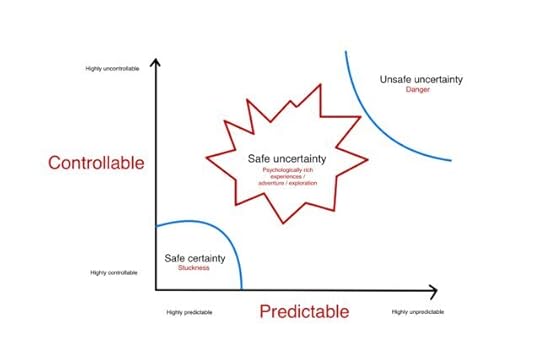
(Adapted from the work of Mason, Stacey, Critchley and Vanstone)
We are now, in some senses, split between the risk-takers and the risk-averse. As we go through omicron and through to whatever comes next, we may see more schisms revolving less around vaccines and mandates, and more around lifestyles and comfort levels of living with the coronavirus, under conditions of safe uncertainty.
The irony is that both the risk averse and the avid risk-takers currently share the position of stuckness but for different reasons. The risk-averse don’t want things to change – they want to be safe and certain in their behaviours and their environment. And from the perspective of the avid risk takers, they experience a stuckness because they see the world as safe, and certainly so – with an unshakable belief that there is nothing here to worry about so we should return to all-brakes-off as soon as possible. To a large extent, they are in a position of unsafe certainty, which may have been stoked through repeated exposure to mis or dis-information.
What might this look like?We are creatures of habit. Even if we think ourselves to be progressive social thinkers or devil-may-care risk-takers, why do we seek to repeat the same experiences all the time? For example, we may have a favourite position we like to be in when we get on a bus or when we go to a cafe, or get on a plane. We think to ourselves that there is some kind of benefit or comfort in doing things as we have always done them. Sitting at the front of the pane and in the aisle means I’ll be able to get off reasonably quickly. Or maybe you’ll get that double seat on the bus or train to yourself. But have you experienced the somewhat ridiculous panic or surge of irritation when your routine changes, even just a little?

You can be sent into acute anxiety if your usual seat is taken on the bus, plane, train or cafe. It’s understandable that we want our lives to be predicable, unsurprising and without incident. There’s nothing wrong with this and it comes from a place of safe certainty – a position where I know what is going to happen and I know what to do when it happens.
Let’s say, for example, we expect case numbers to go up by a certain amount because we know what to do when they go up by that certain amount. But when they don’t go up by much when we expect them to go up by more, or they go up by much more, then it breaks this sense of predictability, this safe certainty.
In order to maintain a position of safe certainty, we need to deny the possibility of novelty or difference. We just do what we usually do so we don’t have to think or break stride in the usual habits we have developed.
Outside this predictable, controllable norm is a place of unsafe uncertainty – where you feel you do not know what is going to happen next, and don’t know what to do if it happens. It feels dangerous.
And although perhaps there is some plus side to change and something different happening, some will want to sacrifice the possibility of this for the comfort and predictability of safe certainty, even if it leads to stuckness. This is preferable to feeling like we are in danger. This has been the dominant position, and remains so – we give up possibility and opportunity in favour of certainty and predictability that keeps everything the same and perhaps rather stuck.
Now, at some points in the pandemic, this is a good thing. But perhaps there is another way forwards than the two polar opposites of unsafe uncertainty and safe uncertainty i.e. danger and stuckness.
Safe uncertainty is having just enough structure… just enough control and just enough governance to mitigate the biggest risks but allowing enough fluidity, spontaneity and freedom to enable new possibilities and opportunities.
Within negotiated parameters, people are encouraged to try new things and learn from them if they don’t work. There are guard rails, but they are just enough to mitigate against the worst outcomes. There is good-enough prediction and planning, and masterful adapting and improvising.
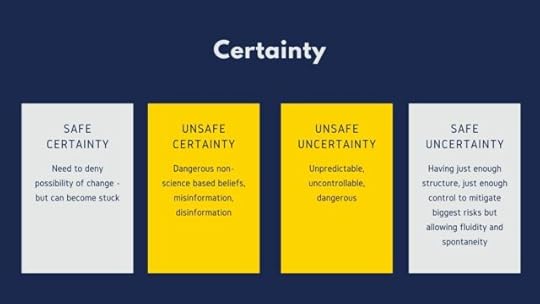
From a strategic communications perspective, the goal of the message therefore is about a lighter tough determining how society will function within pandemic constraints – but providing good-enough guard rails for those who are risk averse, and messaging that this is how it will remain unless something comes up. When the pandemic changes, be prepared to adapt and improved fast – authorities will make it as painless as possible as we tighten and shore up the protections and increase control with this lasting no longer than is absolutely necessary.
In some ways, this place of safe uncertainty can surprisingly mark a return to something like 2019, albeit in a changed environment. Life might be different in the constraints that we may have, but the WAY we do life may look similar. People who live their life from a place of safe certainty can be adventurous, able to explore new possibilities, learn new skills, while finding novel ways to make a living, bring up kids, lead active social lives and protect themselves from harm through misadventure. We will have a new set of tools that we need to use wisely to protect from that potential harm.
Where you might be in this model at any one time is dynamic. But if people find themselves in the safe certainty quadrant, then people may need to ask themselves what they are prepared to let go of, given the level of protection they may have already adopted eg vaccinated and boosted.
What are the small experiments they could make in their lives within those guard rails that mitigate against the biggest ill-effects? How can people give themselves an experience of safe uncertainty?
Perhaps anchoring to a different data point rather than case numbers may be useful. A dashboard of three or four indicators may be helpful e.g. hospitalisations, or benchmarking to other societal hazards may be useful, as might the level of protection such as community immunity like vaccine coverage including booster doses administered and young people covered by vaccines.
Lessons from airline security on safe uncertaintyIf you remember back to what air travel was like before September 11, 2001, you may be forgiven for having fairly hazy memories of it. The world changed quickly, such that travelling by air was vastly different to what we had experienced expire, despite previous terror attacks that had brought down planes and killed many people.
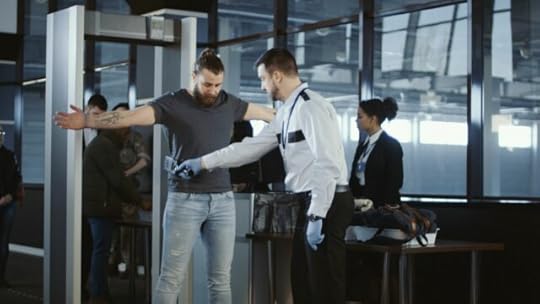
However, the transformation of security and air travel came in waves, not unlike a pandemic. In the years that followed, each newly uncovered terror scheme exposed an unforeseen vulnerability that required a new rule. First came locked cockpit doors, more armed air marshals and bans on box cutters and sharp objects. Later, suspicion fell on bottles of liquid, shoes and laptops. Flying did not return to normal, nor did it establish a new routine. Instead, everything was permanently up for revision.
This is where we are today, and the pandemic is driving this. For almost two years people have lived with shifting regimes of mask-wearing, tests, lockdowns, travel bans, vaccination certificates and other paperwork and public health measures. As outbreaks of fresh cases and variants ebb and flow, so these regimes can also be expected to come and go to match them.
This is navigating safer uncertainty. This is the price of living with a disease that has not yet settled into its endemic state – whatever this ends up meaning.
Big shifts aren’t just driven through terror attacks or pandemics. Just 15 years ago, modern smartphones did not exist. Today, more than half of the people on the planet carry one. Shifts happen fast, and we are still catching up with the impacts of these technological innovations, how they affect us, and the spread of disinformation that they have facilitated is just one dimension of their impact.
So, we may see a desire to return not just to 2019, but a simpler time entirely, however unrealistic this might be. However, it’s good to counterbalance any sense of oppression and unpredictability with some benefits that have been accrued over the past two years. We have discovered that perhaps we prefer working from home, at least part of the time. Perhaps the unparalleled rapid development of effective vaccines can be technologically focused on other pressing problems of our era.
Whatever we do, there’s a sense that, as The Economist says, the pandemic is like a doorway – once you pass through, there is no going back. Instead, we have to find a new equilibrium in this age of predicable unpredictability. And maybe that might be the frame – the pandemic is a doorway, and we need to find the new balance in these predictably unpredictable times.
The post Navigating Omicron: Safe Uncertainty appeared first on Sarb Johal.
January 30, 2022
Staying vigilant
As we watch and wait it’s important not to be lulled into a false sense of safety in this new uncertainty.
The experts tell us that we will likely experience a lag before we detect cases and confirm that there are indeed more omicron cases in the community. So, we need to maintain our safe behaviours while this process unfolds, while we get on with our everyday lives under red alert settings. This means returning to the basics of distancing, using appropriate masking behaviours where and when appropriate, checking in to places we are visiting so we can track if we may have been exposed to the virus, or if we have exposed others, and making sure we are vaccinated and boosted if eligible.
It’s these behaviours that are likely to reduce our risk of exposure, and also becoming less seriously ill if we get infected and develop Covid-19 symptoms.
But all this is simultaneously reminding us of times we had hoped we had left behind, but it is also a new challenge as omicron behaves differently.
For some, it offers hope that we may enter another stage of the pandemic that somehow signals a different path towards a life that feels more manageable, and for others, it may put us on alert for increased danger.
For those for whom this offers hope, the danger is a complacency that sneaks in, or perhaps is more consciously applied in your everyday life.
We need to watch out for thisFor those for whom is signals danger, we need to simplify so we do not feel overloaded. Understanding that our behaviours are keeping us and the ones we care about as safe as we can be. Recognising that we can only control what is under our personal control. Taking on as much as we can manage for now.
So, yes, there will be a tension here, but hopefully, there remains a large middle ground as we seek to balance the clinical and disease impacts for those personally affected and those whose job it is to take care of them, with a wider desire to return to a more manageable, everyday life.
But it remains that we need to be aware, in the back of our minds, that this reminds time of uncertainty. Things can change and perhaps fast. So preparing ourselves for that before it happens seems a wise thing to do.
The post Staying vigilant appeared first on Sarb Johal.
January 27, 2022
Stop telling me to calm down
“Stop telling me to be calm!” And anyway, why’s it so important? You’ve had the experience of people – me included – telling you that being calm is important, right? Often, telling us to be calm produces the exact opposite effect.
For example, remember being told, ‘don’t jump on the bed’? What did you do? We jump on the bed and then we may lie about it so not to get into trouble. And for adults, just like kids,the same can also be true. It provokes the opposite reaction to what we intended. One of the most common phrases that seems to evoke the complete opposite reaction is when someone tells us to “Calm down” or “Relax!” We may become flooded with more arousal or even anger than before they said these words.
So, we know that just saying ‘calm down, doesn’t workIf we think about why, then we might be able to figure out what we can do to help instead. ‘Calm down’ might be a red flag because it fails to recognise our feelings, and invalidates the emotions we may be experiencing, like fear, anxiety, or anger. Hearing ‘Calm down’ may actually be received as a message that we are not being taken seriously. And the problem is that once this reaction of feeling dismissed is triggered, we have a window in which we can soothe ourselves, or risk an escalation of the situation, making it even more difficult to find calm. We know that the neurochemical that triggers the initial bout of stress hormone is used up in about 90 secs. So, yes, the situation may cause your flare up for those 90 secs. After that, continuing to think angry thoughts like, ‘how dare they!’ only triggers more stress hormone.
So how do you step away from the thought that your experience is being dismissed, or that you are being belittled?First, you can try distraction. This is where your phone can be handy – not to rant about it on social media, but to access your photo library to look at pictures of things that make you happy. Venting your rage won’t make you feel better – it only escalates your rage. Second, use belly-breathing techniques: When you feel your anger or anxiety revving up, simply hit the brakes with some focused belly-breathing. Set a timer for 60 seconds and breathe in and out through your nose, counting each breath. Take good full breaths — not too fast and not too slow. Just breathe at a normal pace, whatever that is for you, inflating and deflating your belly in each breath. Close your eyes or look down at the floor while breathing.
Now try itHow many breaths did you manage in 60 seconds?
There is no right answer, but once you know how many breaths you take in 60 seconds, you won’t even need a timer. You can use this technique any time you feel you need to slow down a bit or when you want to feel less shaky and anxious. The beauty of this is that it only takes 60 seconds to change what is happening in your body and shift from revving up to slowing down.
This is why my new book is called ‘Finding Calm‘. Calm is something you learn to do, you choose to do, rather than an instruction or invalidation.
The post Stop telling me to calm down appeared first on Sarb Johal.
January 22, 2022
Omicron community outbreak in New Zealand
We are moving from a place of what people can call a place of relative safe certainty to, hopefully, a place of safe ‘uncertainty’ again. We know what we can do to remain safer & slow down & reduce the clinical burden on people, the health system & containing outbreaks
Understand that you have three systems that govern your reaction: your threat system, your calming system and your drive system.
To manage your sense of threat, understand and act upon what you can do to reduce your personal, family and community consequence of becoming infected – for example, getting vaccinated and boosted as soon as you are eligible.
To get into more calm mental states, understand that you can feel tired getting into this red alert state under the traffic light system. Get rested, do things that make you feel calmer.
Do the things you need to do to make you feel safe – that can help too. It’s not a lockdown, but you need to familiarise yourself with what you can do, with who, where, and under what circumstances.
Your drive system is important too – and I note that there were some details released recently about setting expectations about what happens after the omicron wave peaks – what happens next.
And though that’s too early to say, don’t underestimate how important this will be for helping ppl prepare for what comes next & perhaps moving to a more sustainable way of living in these times, or if the virus becomes a serious threat less than a pandemic, but still a genuine concern.
A word about dissonanceIt takes work to decode messaging, to find the nuance – it’s a bit like the lead up to early 2020, when the original virus that saw wide transmission was spreading around the world, and we were preparing for it to hit our shores.
We are constantly being presented with arguments or scenarios that are closer to the poles of each position.
“It’s safe to travel in NZ, but don’t travel to where it’s not safe.”
“Prepare and stock up, but please don’t hoard and take everything – just take what you need. “
“It’s milder than Delta, but it’s still serious, so get vaccinated and boosted as soon as possible.”
At one end is that the primary health consequences are too much to bear for individuals and the health and welfare system.
The second is that the secondary consequences of safeguards are mounting up such that these themselves are too much to bear, and the solution is to take away all safeguards, because “it’s not that serious, anyway”.
The path through this, as always, somewhere in the middle ground. That this is a serious threat, and it threatens to overwhelm our resources to cope – that’s why we feel anxious …
It’s the assessment that what we are experiencing or about to experience may stretch us to the amount where we may not have the resources to cope as we would like to. This is appropriate and a spur to action.
Here’s a couple of things you can do:Activate your calming system. Uncertainty is synonymous with the COVID pandemic and many other pressures of modern life. When your brain is countering as if you are in imminent danger, it’s difficult to do anything else.
Activities like deep breathing pushes the brake and allow us to access the more creative and strategic facets of our minds, to bring new solutions to bear rather than repeating the same action again and again. We want to move to a position of being safe under renewed uncertainty.
Identify unproductive worrying: Unproductive worries make us feel anxious and uncertain, and this can become a vicious cycle. Instead of letting the worries go round and round in your head, try keeping a worry journal.
Set aside a defined period, say 15 minutes, when you give yourself permission to worry. Write all your fears down in a notebook. The journal can act as a parking space, so your unproductive worries don’t keep circling around your mind looking for a space to park.
Take care out there, and, as always, stay considerate.
The post Omicron community outbreak in New Zealand appeared first on Sarb Johal.
November 28, 2021
Omicron: What Now?
Omicron is making its way around the world, and this is hard. Hard for everyone who has been looking forward to engaging with life again, everyone who is tired, and everyone who just wishes this was over. I hear you, I see you. It is difficult to think about this, but we must.
We won’t get back to how thing were. It’s been clear that things will be different for some time now, and #Omicron is a congregate examples of this. Although the tide of the pandemic may have been waning, there is a new influence, and the tide may rise again. We need to prepare.
But there is much uncertainty, including an understanding of the biology of the Omicron variant. But this underlines the importance of taking a precautionary approach., with vaccines, public health measures and new meds.
At the moment, I see lots of anger and denial: but mostly anger: “You’re threatening to take away my imagined future life again.”
In play with still to come: Bargaining: “Okay, if we close borders and understand the variant, everything will be better, right?”
There’s sadness: “I don’t know when this will all end.”
And, finally, there’s acceptance: “Omicron is happening; We have to figure out how to proceed.”
Each new encounter with the pandemic produces different measures that we need to adapt to. This will include #Omicron too. The grief we feel persists because the counter-factual remains the same: if we don’t take action, we will still have grief, but most likely on a greater scale. Striking the balance between this and the accumulated secondary impacts of almost 2-years of public health measures will be tough.
Add to this, a resuming experience of ambiguous loss — things that have not yet taken shape in our lives but involves lost dreams, imagined futures, the feeling of stable safety that so many of us used to have in our lives, as well as the sense of living in a stable world, rather than this constantly shifting parallel universe we can sometimes feel like we have been teleported to, where we can feel safe one minute, and be thrown into despair the next.
If you want to do one thing to help, that can also make you feel better, get vaccinated if you haven’t already, and get a booster if you are due.
The post Omicron: What Now? appeared first on Sarb Johal.
November 1, 2021
Shelf Life
It’s been a tough couple of years. I’m writing this at the start of November 2021, just to get some thoughts down on paper. I have noticed that my motivation has crashed over the last few days, and I’ve been wondering why. I’ve been feeling periodically tired for months now. But most of the time, I’ve been able to get myself back up again relatively quickly. My productivity has been remarkable – writing three books, more media than I’ve ever done before, podcasts, and a Psychology Today column too – despite the situation we find ourselves in. Or perhaps, precisely because of the situation we find ourselves in.
Being a psychologist, doing what I do, has been a solitary furrow to plough. And what I do is increasingly detached from what my professional peers do – leaving me wondering why I continue to do it. Yes, I’m still a psychologist, but in NZ, my experience and what I do feels unique.
And very lonelyI’ve been working at home, on my own, for endless months now. And I think I’m reaching the point where I am considering calling time on doing things as I have been doing them. I need some sort of break – not just a holiday, but a discontinuity. Something different.
Possibly even an early semi-retirementYes, radical I know. I ventured my plan in a little WhatsApp group with friends that I still have from primary school.
“Are we old?”, was one reply. Older yes, but there is something else going on.
“Maybe this is burnout?”, I ask myself. I suspect not. I think it’s more about having been a psychologist for 30 years and wanting to explore different ways of being in the world. I still get excited about possibilities. But I increasingly think and feel like I am approaching my shelf life as a practicing psychologist.
I recently posted this on LinkedIn:
“Doing. Thinking. Feeling. Being. These are states we humans spend time in. One or two are likely to feel more comfortable than the others. Understand your dominant states. Develop the others. Switch to what comforts you when times are tough. Stretch yourself when the time is right.”
I’ve spent a lot of time doing, thinking and feeling these past two years. But not enough time being. And perhaps not enough time feeling and experiencing in broader ways: Being a Dad, being Sarb, being a husband, being a son, being a brother, being a part of community. Yes, but I’ve been helping, but I get very little feedback or connection with others with what I do and how I choose to do it. So, it’s hard to keep on doing it. I get excited when I think about making more YouTube videos and exploring how I might start a new series on being a father, of young girls, who is older than the average dad, or more podcasts, or writing.
These are the activities where I feel most alive, most usefulBut, I have been reflecting that I derive a decreasing sense of excitement and engagement from my daily practice of being a psychologist. I want to spend more time being and exploring, mining and reflecting on just being present to see what emerges. That my children are constantly reminding me they miss me is also a call to action to change things.
I’ve banked over thirty years as a Psychologist. I’m not ready to call it a day just yetWe are still in the middle of a global pandemic and I think I still have useful contributions to make. But I am setting the clock and hitting start as I consider what my next chapters might look like. I’m giving myself a few months to think about it and come up with a plan.
My last booked work for this year is in the middle of this month. Other stuff will come up, but I’m going to get back to making fun YouTube things, engaging with that community, and continue to look for opportunities to serve that public mental health agenda for a while yet. But right now, I feel like my identity is too enmeshed with my practice as a psychologist.
Get in touch if you’ve any reflections and thoughts, or drop a comment on my blog, tweet, or LinkedIn post – wherever you find these reflections. Are you going through a similar experience?
The post Shelf Life appeared first on Sarb Johal.
October 26, 2021
We need to talk about humiliation
The Government’s rhetoric about getting vaccinated has hardened. The conversation started with relying on intellectual arguments to convince people that getting vaccinated is the right thing to do through presenting data. It then moved to a persuasion stage, trying to understand the influence of emotions, and working through trusted connections to have conversations designed to comprehend the position of the unvaccinated person, to answer questions, to reassure them, to correct any misunderstandings and to suggest that they have perhaps been mislead, to explaining that in the greater scheme of things, getting vaccinated is the least risky thing to do. At least, that is the position we hope they arrive at.
Let me acknowledge the burden this is placing upon those tasked to have those conversations, or who take it upon themselves to do so. The straightforward conversations have probably mostly been done by now, and I worry about people putting themselves in line for some pretty toxic pushback.
The Government is now outlining real consequences for those who remain unvaccinated in the coming weeks.
Although we are still in the persuasion phase, the balance is tiltingThere are many emotions at play at the moment. There is grief, sadness and fear that the old Alert Level system that has served us so well is on its way out. There is a lack of clarity and confusion about how and when the Covid Protection Framework will protect us, and what it achieves: where is it leading us to?
In an interview last week, I spoke about enabling people to change their minds and receive the vaccine without losing ‘face’.
Face is a multi-faceted term, inextricably linked with culture and other concepts like honour and its opposite, humiliationHumiliation is the emotion you feel when your status is lowered in front of others. Research shows it’s a multi-dimensional, unpleasant experience: it seems to involve feelings of powerlessness, a loss of self-esteem or status (dishonour), and feeling small.
Being called out in public and being corrected and told that you are wrong are experiences that can lead to humiliation. Just think back to a time when you stumbled over a word when reading in class at school, and when your teacher corrected you and the class laughed – how did that make you feel?
What’s worse, mapping this experience onto a cultural history of being told you’re wrong and worthless and a personal history of being told you’re wrong, and you can see where a strategy that, inadvertently, leads to humiliating experiences can rapidly go off the rails.
The behaviour associated with feelings of humiliation includes retaliation. We have certainly seen anger – not all explained by humiliation, but perhaps a certain and important proportion of it. But the more dominant response is one of withdrawal or avoidance. Withdrawal, avoidance and driving people underground is the last thing you want when trying to mount a public health response.
Also, when people perceive that when someone in their network with whom they share a group identity has been humiliated, they seem to go out of their way to protect them from further harm. Think about people who are perhaps less willing to be full and frank with contact tracers. Could this be part of what motivates them to behave in this way?
So, what can we do?When people feel humiliated, and you want to re-engage them again, they need a path that helps them to move forward while saving face – or at least not diminishing their status any further, and perhaps even offering a staging post towards regaining it again.
I know that the New Zealand Herald today reported how the Prime Minister considered a system that was used in Germany – where unvaccinated people were offered a pathway to take part in at least a subset of non-essential daily life activities through daily testing that they had to pay for. The Prime Ministers’ argument was that a negative test is less “bulletproof” than being tested, but it was about use, and conservation, of testing resources.
Perhaps we should consider this pathway through another lens. One that frames a centre path, that gives a choice out of the dichotomy of vaccinated / unvaccinated, as a staging post. A centre path that provides some agency, where a wrap-around service and analysis can be designed to minimise risk to our communities. They are going to be using essential services like supermarkets and health centres, vaccinated or not.
People can feel like they are being backed into a corner …and being tarnished as an anti-vaxxer, when they may need more time and / or resent being given little choice but to take the vaccine and feel humiliated. We neither want to encourage people to withdraw and go underground, with public health implications, or for them to come out swinging, feeding furious polarisation of social media and wider toxic discourse and division in our communities.
At the moment, the Government is walking a fine line between providing incentives to get vaccination and exercising coercive power. I wonder if a middle-path safety valve could be designed, taking strength away from polarised positions that could threaten the social fabric upon which we will need to work together as we enter the next stage of the pandemic – adaptation to future phases. The indications are that few people would take this middle path and if they did, they probably wouldn’t walk it for too long, as they see that the daily inconvenience and costs mount. But it serves as a viable pathway out of a dichotomous choice to a place where public health remains protected and social cohesion doesn’t come under so much fire. And that they eventually decide, on a balance of risk, that taking the vaccine is their way forward after all.
The post We need to talk about humiliation appeared first on Sarb Johal.