
Corey Robin's Blog, page 93
November 16, 2013
My Life
I turn sentences around. That’s my life. I write a sentence and then I turn it around. Then I look at it and I turn it around again. Then I have lunch. Then I come back in and write another sentence. Then I have tea and turn the new sentence around. Then I read the two sentences over and turn them both around. Then I lie down on my sofa and think. Then I get up and throw them out and start from the beginning. And if I knock off from this routine for as long as a day, I’m frantic with boredom and a sense of waste.
Pretty much.


November 12, 2013
Socialism would mean…
A student of mine, who’s writing her masters’ thesis on the relationship between the Tories and Burke, found this brilliant campaign poster from 1929.
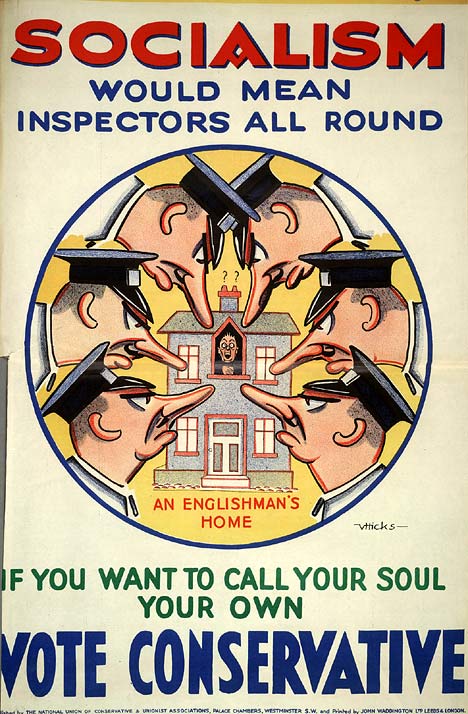
Tory Party poster, 1929


November 8, 2013
A Footnote to History
From Alan Dershowitz’s just published autobiography:
I loved Brooklyn College, and Brooklyn College loved—and still loves—me.
He then adds a footnote, which reads:
Though not the Political Science Department, in which I majored.
I guess this little exchange was the last straw:


ALEC supports worker collectivism and redistribution of wealth
From Gordon Lafer’s report for the Economic Policy Institute:
In Wyoming, a bill co-sponsored by a group of ALEC-affiliated legislators and backed by the Restaurant Association would have given employers the right to force employees to pool their tips.159 While employees may have previously pooled tips, this was done voluntarily. In many restaurants, bussers, who are legally considered tipped employees, in fact receive little tip income.160 In such cases, employers are required to pay them the regular minimum wage. By forcing more highly tipped wait staff to pool earnings, employers may avoid this obligation—essentially cutting the take-home pay of wait staff by making them pay the bussers’ wages, with employers pocketing the difference as increased profits.
In 2011, Maine legislators adopted a new law declaring that “service charges” do not legally constitute tips, and that they are therefore not the property of wait staff and may be taken by the employer.161 The statute—sponsored by an ALEC task force member and supported by the Restaurant Association—does not require restaurants to notify customers that the “service charge” does not go to servers; many patrons likely believe this charge constitutes the gratuity, and therefore provide little if any additional tip.162 As in Wyoming, then, the Maine law constitutes a direct transfer of income from employees to owners, accomplished through the latter’s political power.
Footnote 162 reads as follows: “The law stipulates that an ‘employer in a banquet or private club setting may use some or all of any service charge to meet its obligation to compensate all employees’”.


Speak, Memory
All that’s solid melts into air.
Schocken Verlag* was a German publishing house established in 1931 by Jewish department store owner Salman Shocken. In 1939 it was shut down by the Nazis. It slowly made its way to New York, where it eventually became Shocken Books. In 1987 Shocken was acquired by Random House. Eleven years later, Random House was acquired by Bertelsmann.
During World War II, Bertelsmann was the largest publisher of Nazi propaganda, including “The Christmas Book of the Hitler Youth.” It also made use of Jewish slave labor in Latvia and Lithuania.
Confronted about the company’s past in 2002, a Bertelsmann spokesman said, “The values of Bertelsmann then are irreconcilable with the company today. The company is now a global player in the media industry.”
Because the one thing the Nazis definitely were not were global players.
“Common sense tells us,” wrote Nabokov, “that our existence is but a brief crack of light between two eternities of darkness.”
* I learned of this history in the London Review of Books, and gleaned additional details from Wikipedia and the BBC.


November 7, 2013
Right to Work Laws are Good for Unions, but not for the Chamber of Commerce
The Chamber of Commerce is one of the biggest advocates in the US of right to work laws, which allow individual workers to get the benefits of a union contract without paying union dues. Their purpose is to make it harder for unions to collect dues and thereby weaken them financially.
Back in 2005, a member organization of the Chamber of Commerce in Owensboro, Kentucky asked the Chamber if it could stop paying dues to the Chamber yet still get the benefits. This is what the Chamber said:
The vast majority of the Chamber’s annual revenues come from member dues, and it would be unfair to the other 850+ members to allow an organization not paying dues to be including in member benefits.
Hard to argue with that.


November 2, 2013
LBJ on Black Power
Lyndon Johnson, from his memoirs (1971):
When asked about black power in 1966, I responded: “I am not interested in black power or white power. What I am concerned with is democratic power, with a small d.” As I look back now, that answer seems totally insufficient. It is easy for a white man to say he is “not interested in black power or white power.” Black power had a different meaning to the black man, who recently had had to seek the white world’s approval and for whom success had come largely on white people’s terms. To such a man, black power meant a great deal—in areas that mattered the most—dignity, pride, and self-awareness.


October 31, 2013
Dayenu at Yale
A conference at Yale inspires this little variant on the classic Passover songs Chad Gadya (“One Little Goat”) and Dayenu (“It would have been enough!”) The “he” in the verse is God.
Had He only convened a conference on the Age of Revolution at Yale—Yale!—it would have been enough. Dayenu!
Had He only convened a conference on the Age of Revolution at Yale—Yale!—at which there were no women panelists, it would have been enough. Dayenu!
Had he only convened a conference on the Age of Revolution at Yale—Yale!—at which there were no women panelists, and called the center that organized the conference “The Center for the Study of Representative Institutions,” it would have been enough. Dayenu!


October 30, 2013
The Right to an Education: This Won’t Hurt a Bit
Gawker recently obtained the audiotape of a captive audience meeting at a firm in Georgia where truckers are trying to organize a union. Anti-union employers often hold these mandatory meetings, where they subject employees to extended lectures on the evils and ills of unionization.
As captive audience meetings go, this one is relatively benign. The workers speak up, some voice tentative pro-union sympathy, there’s a back and forth, there’s little intimidation, not even of the more informal or implicit variety. That’s often not the case.
Even so, the tape has some creepy moments that reveal the paternalism of management’s opposition to unions and its treatment of workers more generally.
Early in the tape, a manager tells the workers:
We have the right to educate you and we’re going to exercise that right.
Set aside the assumption that management is a wise teacher; the worker, an ignorant student.
There’s a menacing quality to the statement, which is peculiar if you think about it. The right to an education is usually invoked by and on behalf of students, not teachers. It’s a claim to agency by the powerless, not an assertion of prerogative by the powerful. It references an active process—as much as they demand to be educated, so do students promise to educate themselves. Here, however, education denotes an entirely passive process, where the teacher crams information down the student’s throat.
Perhaps that’s why one worker slyly raises his hand to ask, “And those of us who choose not to be educated?” As if he’s talking about root canal or some experimental surgery.
Later on in the tape, another manager says of the captive audience meeting and the “facts” they’re giving the workers:
This truly is for your best interests.
Libertarians and conservatives like to claim that unions violate not only the freedom of the individual but also her dignity and autonomy. That’s because, the argument goes, the union (and its allies in government) presumes to know better than the individual worker what is or is not in her interests. It’s the nanny and the nanny state.
Yet as the tape reveals, it’s management who truly makes that claim. Sometimes explicitly, as is the case here, sometimes implicitly. What, after all, is the premise, if not the point, of the captive audience meeting other than that the worker is not in a position to know what’s good for her?
Captive audience meetings don’t dwell on how a union will hurt management, though there’s that, too. (At one point, a manager tells the workers, “You mentioned for me guys and I know a couple of you all say don’t take it personally. I can’t help take it personally…It does hurt, it does sting.”)
No, the purpose of the meeting is to explain to workers how a union will hurt them. Because they’re not educated, see?


When Richard Nixon Met Karl Polanyi
In 1969, while he was working on Richard Nixon’s Family Assistance Plan, which would have guaranteed an income of $1600 plus $800 in food stamps to every family of four, Daniel Patrick Moynihan was deputized by Nixon to investigate the historical accuracy of one of Karl Polanyi’s claims in The Great Transformation.
Polanyi had argued that Britain’s Speenhamland system—like Nixon’s plan, it would have guaranteed an annual income to poor families, regardless of whether they worked or not—had the perverse effect of making the poor poorer. Reiterating claims made by Marx and Engels, Polanyi wrote that Speenhamland allowed, even encouraged, employers to hire workers at below-subsistence wages (the poor were guaranteed an income regardless of whether they worked). Because workers would start losing their income supports once they earned more than a subsistence wage, and because employers were more than happy to have local parishes supplement or subsidize wages, Speenhamland effectively put a cap on wages. Productivity went down, and with it, poor rates and income supports. The long-term result, said Polanyi, was increased immiseration among the poor.
Few people have attended to Polanyi’s caveat that had the working poor not been prohibited by the Anti-Combination Laws of 1799-1800 from organizing themselves they might have been able to reverse these effects. (Admittedly, that point only gets a passing mention in Polanyi’s chapters on Speenhamland.) Instead, his argument has been taken as Exhibit A of Albert Hirschman’s perversity thesis: policies designed to achieve positive ends, particularly when those ends relate to the poor, often produce the opposite of their aims. (Hirschman himself made a nod to these linkages.)
When Nixon began mooting his version of Speenhamland in the early part of 1969, talk of perversity (in all senses) was very much in the air. In mid-April, the economist Martin Anderson—then a White House staffer, but previously a devotee of Ayn Rand; Anderson has also been credited with bringing Alan Greenspan, another Randian, into government—prepared a report on the history of poor assistance, which was essentially little more than a series of extracts about Speenhamland from The Great Transformation.
So troubled was Nixon by this history that he had Moynihan personally undertake an assessment of Polanyi’s findings. Moynihan set his staff right to it, resulting in a team of bureaucrats surveying all the most up-to-date historical literature on Speenhamland.
As Fred Block and Margaret Somers—from whose wonderfully informative 2003 article in Politics & Society “In the Shadow of Speenhamland: Social Policy and the Old Poor Law” I have cribbed this story—concluded:
The Family Assistance Plan was ultimately defeated in the U.S. Senate but only after Richard Nixon had a conversation about the work of Karl Polanyi.
Update (12:30 pm)
There’s an ungated version of Block’s and Somers’ article here.


Corey Robin's Blog

- Corey Robin's profile
- 163 followers

