Jacob Robinson's Blog, page 18
February 14, 2022
The Weird, Magical World of Modern Day Quora
In the late 2010s, people began to see the question-answering website Quora as a beacon of knowledge on the internet. Venture capitalists, startup founders, content marketers, and thought leaders alike drove towards the website to answer thought-provoking questions and at the same time drive traffic towards their website. Now, in 2021, almost all that interest has faded away. What happened?
For those unfamiliar, Quora is sort of like the luxury, superpremium-ice-cream version of Ask Jeeves. That might seem silly to a lot of people, but for a while this looked like a really good idea! It provided a place to discuss genuinely important topics from business, technology, etc., etc. Yet what we ended up getting was… Ask Jeeves for people who wanted to look smart. Quora in almost every sense is now a failed experiment, but I think it’s important to first discuss what Quora was meant to be, then going into the bizarre mess it is now. And, finally, discussing what a future iteration of Quora might be, and how it can fix the problems that the original Quora manifested. Let’s get started!
What Quora was meant to beImagine a place where you could ask an open-ended question – say, “What is some of the best machine learning research happening right now?” – and get detailed, verified answers from experts in the field. These answers could then generate further discussion, which could lead to a plethora of high-quality content. At the same time, these experts could use their posts to crosslink their own websites or content, thus serving as a viable platform for generating up-and-coming creators.
This was the original vision for Quora. As I mentioned before, it is relatively reasonable and quite valuable. It’s easy to discuss stuff on the internet, it’s just not easy to discuss stuff well. The internet is filled with junk content and trolls, and so it requires some heavy moderation to keep the quality high.
The problem with well-moderated pages is that they are hard to monetize, and therefore make a profit. For websites that aren’t made for profit, such as LessWrong, or those who get their funding elsewhere, like HackerNews, this isn’t a problem. But Quora was a startup, and its main goal was growth. They couldn’t afford to pay gate or kick the majority of users out. So… what happened?
What Quora isAnd now we get to my favorite part of this article: the part where I get to shit on Quora with no remorse. Okay, that’s not exactly true. I’ll start with the good things about modern Quora. The first is that, mechanically speaking, the website is perfectly fine. There are no notable bugs, and on the outside looking in you’d think by their marketing and design that they perfectly achieved their end goal, thank you very much.
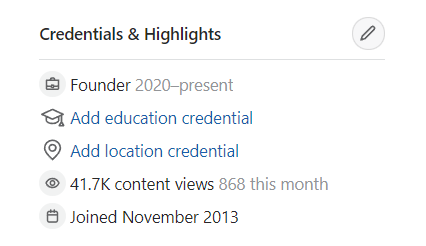
The second good thing about Quora is that they really did achieve one of their goals: it’s quite easy to get a lot of views on your answers! The image above is my profile, displaying my all-time view count as of December 2021. Now, take in mind that while I joined in 2013, I only started posting at the tail end of 2018, and even then only for a few months. 40k+ views is a lot for a handful of questions answered! It is worth noting, however, that the way Quora counts these views is ambiguous. Is it just the number of views on a question? If so, then that means your answer was actually likely not read, assuming it was not the top answer. There are indeed pages on Quora that link to specific answers, but I am skeptical of this being the page tags that are used to calculate these analytics, just because I have never received a top answer except for once or twice, and therefore should not have this many views. Or perhaps I am just lucky, and the system is working perfectly as intended. Either way, this is mostly a digression – it’s time to get into the “weird, magical world” that the title of this article suggests.
The modern Quora is less akin to a meeting of academic and industrial minds and more of a secondary website for Facebook boomers to post their memes and stories. This outcome is very strange to me, and is where the intrigue in this case really picks up. If you were to tell me Quora failed, I would assume it just turned into another Ask Jeeves or Yahoo Answers. But that is not the case – while you do see literal questions being asked from time to time (as we will later see), these are actually quite rare. Instead, Quora failed and became some sort of modern EbaumsWorld, a sort of time-traveling vortex into the Reddit front page of 2008. Really, the best way for me to describe this is to just show you.
I have taken screenshots of the first 4 posts I have seen on the homepage of Quora. This is not some sort of weird anomaly – I have been on the homepage of Quora many times, and invariably these top 4 posts look pretty much the same every time. If you do not believe me, I implore you – go to Quora right now and look at the first 4 posts on the front page. Unless something has drastically changed since I wrote this article, it will be this same level of quality.
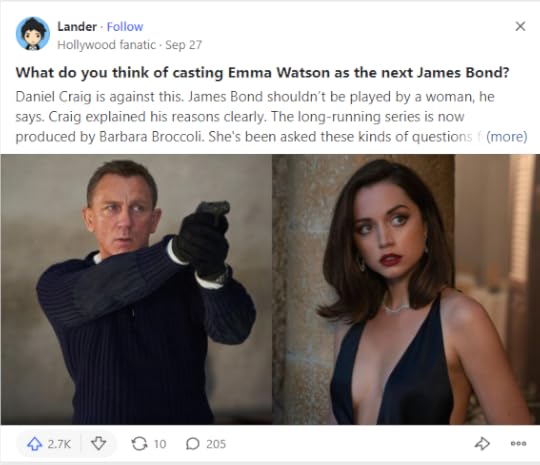
This first exhibit is quite funny. I could honestly see the headline of the Facebook article reshare on this: Daniel Craig OUTRAGED about James Bond being PLAYED BY A WOMAN. You would see that it was shared by your Trump-voting uncle, and when you click on the link it turns out to be some heavy “Anti-SJW” blog run by one guy in Indiana.
Okay, politics aside, you can see why this is a bad quality post. The question is far too specific to ever generate real discussion, almost to the point where it appears to be leading. I have a running theory that the way these Quora posts come into existence is that some guy uses one account to post the question, and the other to immediately post the answer, then goes back to the old account in order to star it. Regardless of whether that’s true, this isn’t really a true “film” discussion. This is moreso nonsense tabloid talk. And you’ll notice that the so-called expert’s credential is simply “Hollywood fanatic”. How does one become a Hollywood fanatic? Just read a lot of issues of People Magazine and TMZ? My point here isn’t to put down our good friend Lander – he’s simply using the system to his advantage. The more important issue is that the system has been designed to reward this sort of content. Onto the next exhibit.

This is the second post on the front page, and in many ways is similar to the first – so I won’t spend too much time on it. This one is obvious clickbait. Really, the worst picture ever photographed of a celebrity is them making fun of an old lady? I mean, yeah, that’s a dick move. But I have a hard time believing that the most inappropriate celebrity photo of all time is some no-name Playb*y (Allah curse its name) model making fun of someone at the gym. I’m pretty sure this happens like, every other week. More proof that Quora is incentivizing lower-quality content.

Okay, yes, this is an ad and therefore not entirely Quora’s fault. But it is technically the third post, and it is so ridiculous that I felt the need to post it. This feels like a parody – like something out of Scarfolk Council or Alan Wagner’s work – but no, it is a real Motley Fool ad. I don’t want to blame the site too much for this, but I suppose if I had to make some sort of critique I’d recommend some filtering for advertisers as well.

And, alas, we reach the fourth and final post. This is another piece of clickbait, and I honestly think this is the worst question of the three. This is more of a subreddit prompt than an actual discussion topic. To the “expert”’s credit, she does cite a real story on this – originally I assumed she had been making the whole thing up, but after reading her source I think this is actually just greatly exaggerated with a few pieces removed. Either way, this is absolutely the sort of story you would see on Ebaumsworld back in the day. Once again, I see the headline: MOST SHOCKING THING YOU’LL READ TODAY: You won’t believe what turned THIS MAN into a PSYCHOTIC PEDOPHILE. Not the least bit of a hint of enlightening content.
The reason I choose these four posts is because this is likely what you’d see if you first opened up the timeline. And, like I said, I’m not cherry-picking here. These are actually the first four pieces of content that show on this feed. What happened?
The lack of content moderation is obvious here. But I want to focus more on hitting this problem at its source. While the answers are poor, they do follow their prompt – which means that the issue therein lies with the question moderation specifically.
Let us now begin the Quora Question Lightning Round.
As before, these have not been cherry-picked. I took a couple of topics that I follow (standard Hivemind stuff – business, technology, entrepreneurship, podcasts, etc.) and grabbed a few of the most recent questions. By delving into this mess, we get some insight on how the top-of-the-pile questions end up being so atrocious in the first place. Let’s take a look.

To start us off, I’d like to give an example of a question that I think does match the original “rational discussion” pitch of Quora. I think if you got a few historical or literary experts to answer this question, the results would be rather lively and interesting. And I think a website that had questions like these all the time, on a variety of different topics, would be really nice. Alas, it was only one of two questions that I found which fit the bill. As for the others, well… let’s get to those.

You’re an incel, I think. I mean, this isn’t WebMD. What topic is this even under, anyway?

Alright, out with it – who fucked you over? I mean, if the guy already sold it for $11 billion and didn’t give you a piece, something tells me you just aren’t getting that money. No need to post a Quora question about it in desperation. Especially not one that speaks to the issue in vague terms.

Scouting for clients, I see. Don’t think Quora is the best place for this. Well, maybe it is if you’re a question answerer. Other than that, you’re better off just looking for some resources on Google.
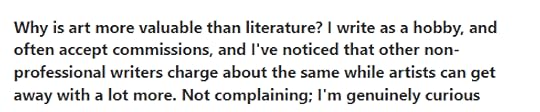
You know whenever someone ends with “Not complaining; I’m genuinely curious”, then they’re absolutely livid. This question is bad in general for its 3 sentence set-up, but I think even if you were to distill it down (“Why is art more valuable than literature?”) it’s a leading question that doesn’t go anywhere if you don’t let people say “Well, actually, it isn’t”.

Yes son, it’s very cool. Now don’t forget to do your math homework. Also, it’s your turn to wash the dishes after dinner.

No god, no GOD! Listen, I’ll let you do whatever you want. I’ll let you advertise your Fiverr page, I’ll let you ask if you have a tumor, I’ll let you talk about your cool superhero OC, but for the love of Christ Almighty please DON’T post IT BUZZWORDS in the QUESTIONS TAB!

…No? I mean, don’t they teach you how to phrase questions in fourth grade?
To this guy’s credit, I do think the question “What are some creativity constraints that artists can utilize?” does pass the sniff test in terms of high quality questions that would be appropriate for the site.

Really? Really? You can literally, actually Google this. In fact, I just did. The answer is “BackRub”. You’re welcome.

Ahh, this guy’s clever. While I can’t deny that using Quora to source content writing prompts is a good idea, I do have to say that it once again doesn’t align with the vision. Remember what I said earlier about incentivizing the wrong behavior.


I package these last two together because I, yet again, have a theory. I think this is the same person asking both questions because they are both poorly written and confusing in the same way. Call it a hunch.
I think I spent 5 minutes reading each of these, and I still don’t think I 100% understand them. This guy is like the James Joyce of asking questions on Quora. If my intuition is correct I believe the top one is asking about how to best invest your money with a small capital base (not a terrible question to ask vetted investing experts) while the other one is… asking if it’s okay to feel smarter than stupid people? Or feeling stupid because you feel smart when the other people are stupid, which isn’t very smart because… nevermind. I’m not going to bother with that one.
Alright, I’m finished with bullying anonymous question askers. I think I’ve gotten my point across: one of the reasons why Quora answers are so low quality is because the questions aren’t moderated enough. Imagine being some big-shot investor or founder who is invited to answer questions on the platform, and the choices you get are these ones. You would chuckle softly then close out of the window, never to return again.
This is the state of Quora, something that is less akin to a discussion platform for experts and more akin to people-watching. To be fair, I could spend hours on Quora looking at the dumb things people say – yet that’s not the point of the platform. But was Quora doomed from the start, or is there still a way to fix it?
Could Quora still happen?Despite what looks may portray, this isn’t a Quora hit piece, nor is it a hit piece on any of the people I might have mentioned. It’s the reason why I didn’t name this article “Quora Sucks, Here’s Why” and instead described this as a weird, magical world. Because it is! It just isn’t exactly how the developers intended, nor does it likely provide any value to society beyond entertainment.
The big problem I think with Quora is how it was built from the ground up. My argument for stricter quality control doesn’t work for two reasons: 1) it would cause less people to post on the platform, and 2) it would require higher personnel costs in moderation. And the reason these points don’t work is because Quora is built as a startup, which focuses on revenue growth over all else. Traditional “intellectual” communities like LessWrong and HackerNews don’t have this problem because of reasons I’ve previously explained.
So, if we could rebuild Quora, what would we do? Well, we first change the model. Say that Quora was a closed community with a subscription price attached – sure this would cause some gatekeeping, but for a good cause. The problem with this approach comes in when people pay the toll and they still post bad content, in which case you can A) ignore them and have a 2021 Quora all over again, or B) kick them off and deal with the headaches of those people then trying to appeal or get a refund. Not a great result.
Perhaps, then, we could try something else. Say we have a free service that is strictly moderated, so that questions and answers are still thoroughly checked but no one becomes too much of a hassle since obtaining the privilege was free in the first place. Where we instead get the profits from is through a premium membership, that gives some sort of bonus content. We can look towards other knowledge platforms for examples: perhaps a community-driven knowledge database (like Golden Wiki), a discussion board (like LessWrong), or some sort of ability to AMA with more prestigious individuals (Quora already does this for free but it provides some hardcore whiplash going between those AMAs and the base site). In this case, we can see our nu-Quora as a sort of aggregator service, one which combines many ideas in this sort of luxury knowledge enterprise and combines them into a singular service. Would it work? Who knows – nobody’s tried it yet.
Anyway, I’m done talking to you now. This is already my longest blog post (even without the pictures), and to be honest I don’t really know why. Apologies to the Quora team in advance.
If you like this post, feel free to subscribe to my newsletter down below. Have a knowledge-based website you’ve made, or found on your own? I want to hear about it – post it in the comments below or @ me on Twitter (@astukari). Bye for now!



February 7, 2022
Risk/Return Bets in Entrepreneurship

As a person trained in finance and investing, I’m always interested when I see these principles apply to other parts of life. But perhaps there is no better place where the lessons of investing could come into play than in entrepreneurship.
(You may also be interested in reading Relationships, Careers, and Investments, which more talks about the opportunity in finding these bets)
Investing and entrepreneurship have always been explicitly tied together, so this blog post is by no means a groundbreaking revelation. There is not too much difference between the job of a venture capitalist and the job of a startup founder. But there is no real great place where these similarities are described in depth, nor their callbacks to the singular concept of risk management.
Let’s start with the obvious: a VC and a founder are both scouting for market opportunities. A founder has an idea they’d like to build, whereas the VC would like someone to build it for them. But each is looking for the same thing: a return on investment.
The basic law of risk management states that, as risk increases, the potential return also increases. This is not strictly accurate – some bets have high risk and low return (particularly bad) whereas others have low risk and high return (particularly good). The former bets are thrown out of the market as silly opportunities, whereas the latter events are quickly eaten up. That leaves those opportunities which fit our basic law.
Another important thing to note is that, in this specific market, the plays are always bets, and not really investments. I.e. Those who are in the startup game are inherently speculators, and have to have a good sense of risk management over just plain skill or mathematical knowledge. Low risk low return games are for income generators, who tend to be bootstrapped and do not develop the attention of VCs.
So, these two points bring us to the title of this article: there are risk/return bets in entrepreneurship. But how do you value these bets?
Well, the traditional method is to use the tools of expected value. With entrepreneurial activity, an expected value looks something like (size of addressed market) * (percentage of market share), which is the value, and then some sort of probability measure which grants you the expected value. There are a whole lot of ways of going about this, though it is easier to do for startups who have already proven that the market does exist (this is why most non-seed VCs look for that exponential growth in revenue).
But something else is quite interesting here. Risk, in this universe, is malleable. It is not like in the investing world where you have someone else do it for you, and thus have less control over the overall process. You can change the demand, and thus affect the overall nature of the risk/return bet!
For example, good marketing is all about changing demand. Your product can either be a silly little toy or a life-changing device depending on how well it’s marketed. You can even just say “Fuck it”, and fake the demand – this is what a ponzi scheme is! (I said these were examples, not things you should do). The lesson here being that, when your bet is intrinsically tied to the demand of a product, there’s a lot of ways to influence this, ethically or not.
If you’re a little queasy about changing demand yourself, there’s some other methods to use. A pretty popular one is crawling, also often referred to as sprinting or “making a Minimal Viable Product (MVP)”. The method behind this is actually quite clever. You start with an idea you have that you think people might like. Then, you make up a solution that happens to look like a fully resolved version of this idea. In reality, you haven’t made anything! But that’s alright – that step comes later.
Next, you use some sort of cue to “gauge interest”. For example, the most popular version of this is an email sign up form. You put up some sort of sign that says “Coming Soon!” and then ask people to put in their email to keep up to date. The more emails you get, the more likely it is there is a real market for this product, in which case you can build without worrying too much about whether you’ll waste your time making a tool for no one. Of course, this tool isn’t perfect – many people will freely show interest in something, only to scatter at the first sign of a price point. Still, at some level you have the law of large numbers at your side.
Anyway, that’s a summary of bets in the startup/entrepreneurship sphere. Hope you found some interesting ways of thinking about this problem!
January 31, 2022
On Dealing With Chaos
Here’s a few thoughts I have on anxiety, playing defensively in life, and generally how to deal with bad things.
Life is less about learning how to operate in optimal conditions and more about learning to operate in dreadful ones. Life is easy when everything is sunshine and roses. Anyone can do that. When it’s rain and decay, train yourself. The people who are remembered are the ones who operate well in these latter conditions.
Playing defensively protects you from the harsher damages of randomness. We fear chaos and uncertainty. Defensive actions protect you from both. But be careful — too much defense and you’ll never score.
I’ve lived long enough to know that disasters usually resolve to good outcomes and sure things resolve to disasters. Things always end up okay in the end. But that doesn’t mean God won’t make you fight for it.
Always be wary of those who are eager to make you feel guilty. More than likely, they’re trying to get something out of you. Instead of immediately lowering your defenses, try to understand what they could be after.
Social ostracization can be combated with charisma. Artistic luck can be combated by business skills. There is always a move. Life is never over with zero moves left in play. It can only end that way if you convince yourself that it’s true.
Anxiety is medicine for growth. Stomach it, and you will succeed. You train physically by testing your muscles until they get sore, giving them a few days of rest, and then trying the whole thing over again. For mental tasks, you live in anxiety until you get the job done, get a few days of rest, etc. etc.
Don’t worry about rejection. Worry about progress. Taking rejection personally slows applying, and thus also slows growth. It’s better to put applications (whether they be careers, relationships, fundraising, or otherwise) on a conveyor belt and have them go in and out as quickly as possible.
Thinking you can’t do it is part of what’s holding you back. Why not just try? So you fail — and what? Does failing really make it so scary, that you’d rather not do it at all?
Fear of failure is what prevents success. Our fears drive our anxieties, and our anxieties drive what we do and do not accomplish. Fight back the anxiety, reduce the fear — only then can you do the full scope of what you’re capable of.
Observation: Those who are more willing to face their personal troubles/demons appear to be more resilient as a whole. The opposite, of course, is also true: if you hide from yourself, if you aren’t willing to sometimes delve down those deep caves and get hurt, then you’re going to lose a chunk of your potential. That doesn’t mean you have to go to those places alone — in fact, it’s better if you have some support — but it doesn’t mean you should ignore them, because they certainly aren’t going away.
You’ll figure it out. Don’t worry too much. Take a deep breath. Trust me — you’ll figure it out.
You cannot ask life for a new playing board and rules — rather, you must take the rules and the board and make the best move with it. Your life is not ruined because something bad happens to you — hell, it is not ruined if you do that thing. You cannot mope, whine, complain about your circumstances. It’s part of the game that sometimes in life strategy is thrown out the window and you’ve gotta play the game by ear. Get good at doing both.
January 24, 2022
There Is No Metaverse

Every few months, the Hivemind at Silicon Valley picks up a trend. Once it was ecommerce. Another time it was machine learning. Then, it was blockchain. Now, they’ve decided to pull all these trends together and wrap them into a neat little bow: the metaverse. That’s all well and good, but… what if I told you there was no metaverse?
Okay, well obviously there’s no metaverse now. No one is claiming that. Rather, they’re claiming the promise of a metaverse – that one day we’ll have a virtual world that’s much better than our own, with its own thriving economy, immersive games, conference rooms (?), and more. The point of this blog post is to say this promise is also zilch. There is no metaverse now, and there will be no metaverse later. I’ll be breaking this post up into 3 parts – the past, the present, and the future – to fully break this down.
The early days of the metaverseThe best place to start with this is that the metaverse has already been attempted. Depending on your level of knowledge, this might be strange to you – while the idea of a metaverse has existed for a while now, it seems like attempts at it have only been feasible as of recently, right?
Well, no. Prototypical metaverses have been in production essentially since the idea of a metaverse first came to light. Naming all previous attempts would be much too exhaustive, so instead I’ll focus on the three most famous: Second Life, Entropia Universe, and Worlds.com.
These games feature, in my opinion, all the central concepts of a metaverse: a virtual reality where people create avatars and can interact in a self sustaining world with a real economy that translates back into material wealth (Worlds.com is an exception to this last rule, as it does not have an exchangeable currency). These games peaked in popularity sometime within the mid to late 2000s, a period I’ll refer to as “The First Metaverse Revolution”. They got heavy press and media coverage for a time, only to fall into obscurity. What happened?
The first problem was that these three games failed to achieve the attention of two key demographics: traditional gamers and normal people. Gamers, who are notoriously against exchangeable currency, didn’t see any value in the games and instead went back to their worlds in Garry’s Mod and World of Warcraft, worlds which clearly did not have the attributes of a metaverse yet seemed perfectly fine. Normal people on the other hand, continued to focus on their normal lives, which they were shockingly content with. These metaverse games ended up with massive crashes to their player base, and grew into a pool of porn enthusiasts, fraudsters, and other generally unsavory characters.
The second problem was that the management teams behind these metaverses were woefully incompetent in terms of how to set it all up. I don’t say that to shit on a poor random Linden Labs employee – I’m saying that nobody knows how to manage a metaverse! I mean, how the hell does a small group of people develop and stimulate what is essentially a better version of life? With an economy, culture, society, all that jazz? But I digress – this conversation is better held near the end of this post. What’s important here is to know that the games became too unwieldy for their owners to handle.
That all being said, we are of course talking about the FIRST metaverse revolution. We’ve learned a lot since then, about building an audience, having the right technology, and even governing a virtual world. So, what does the metaverse look like now?
Candidates for the metaverseI’ll split modern day contenders for the metaverse into two categories: blockchain and non-blockchain (since you people seem so obsessed with your ‘cryptocurrencies’). Arguably the biggest and most serious metaverse contender, generally speaking, is Roblox, which is not based in blockchain. Blockchain candidates consist of ‘games’ such as Decentraland and Axie Infinity, though very few of these are actually built out at this point. Some people have thrown out the idea of general MMOs like Fortnite or Final Fantasy XIV being metaverses, but these games hold no metaverse features and their developers have said they have no plans for creating a metaverse. So I’m not counting these ones.
We’ll dive into each of these. I’ll start with Roblox, a children’s building game developed around the same time as the First Metaverse Revolution. Roblox did not start with the intention of being a metaverse, but rather developed the plan later (“coincidentally” around the time of its IPO). Because of this, Roblox is sort of a “one foot in” scenario. It has worlds, but they are all split among a marketplace of games. It has currency, but it can only be exchanged if it is obtained via game development. It has a culture, but this is mostly made up of children since the game, up until very recently, was only ever marketed towards children. This poor strategic vision is worsened by other problems with its tech and security platform, with everything from a plaintext code that allows for bypassing of 2FA to a 72 hour network outage. Its language of choice for the engine, Lua, is nearly completely extinct save for its existence on the platform, leading to an oftentimes buggy experience. That all isn’t to say that Roblox could not eventually solve these problems – many of them are often signs of a fast growing startup – but the fact that the game seems to be held together with sticks and duct tape lead me to believe it will take one incredibly lucky roll for the game to reach its metaverse status.
Let’s move on to blockchain games. This one I have to speak more generally on, because – as of writing this article – there is no real blockchain metaverse. There are promises of blockchain metaverses, such as Decentraland’s promise that its acreage will one day be a part of a wider game, but there is nothing currently under production. This leaves most blockchain metaverses looking like far-off pipedreams at best and borderline ponzi schemes at worst. Yet, as I’ve mentioned before, this is something that time will prove the answer on.
The logic of the metaverseWell, it’s high time we got to the meat and potatoes of this article. As I mentioned at the very beginning, my main argument isn’t that there is no (current) metaverse, but that there is no metaverse period. In other words, you can’t make a metaverse. I address my reasoning as follows, in order of (in my opinion) least to most importance.
Firstly, keeping tech up to date is a bitch. We already talked about this issue when we mentioned Roblox, and it’s also what made the first generation of metaverse games fall. Some games, such as Entropia Universe, have rebooted into more modern engines – but the games still hold this old philosophy on technology that, for an ambitious project like this, cannot hold. A similarly utopian idea, EPCOT, also fell to this same idea. It’s worth noting that EPCOT is often used as a model for the metaverse.
The next issue I promised to bring up is that of managing the metaverse. Having a traditional corporate team working on and updating something of this scope just isn’t gonna cut it. Blockchain games have tried to cull this problem by making the game creation decentralized and thus democratic, and in theory this could work. But it’s also worth mentioning that democracies have a well known problem of failing in their birth years, especially with outside interference (interference that the metaverse is bound to get). I suppose with enough iterations this problem could perhaps be solved, but it does put a dent in the metaverse logic.
My third point is one that my design brain personally finds vital, but your mileage may vary. It’s a problem of aesthetics: a game with every style at once is going to be ugly. The reason (well… one of the reasons) why the Ready Player One film was panned was because you had all these IPs, characters, and styles in this world and what you ended up getting was just shit on a canvas. It’s the same reason why urban planning exists: sure, one cool looking house might be neat, but if you have a million different houses each with their own unique style it starts looking like throw up and less like art. When you put all the colors of the rainbow together, it makes black. This is by no means a game-breaking argument, but it’s something that I think more people pay attention to than you may think. Games like Garry’s Mod, Roblox, and VR Chat get around this by having each “place” be isolated from every other game, thus giving some resemblance of a theme. And that works. But if the whole point of the metaverse is that it’s a unified world, then how is this problem going to be approached?
Another, more existential issue to the metaverse is that it might already exist, we just don’t think about it that way. Because, let’s be honest, the metaverse is the Internet. It follows all the rules of the metaverse. We have our anonymous avatars, our cultures, our societies, our exchangeable currency. The only thing is that it’s not in VR. Well, okay – it actually is in VR. But I suppose it’s not a game, and the fact that it’s not a game is a vital issue to fix? I’m not seeing the logic here. The Internet seems to have already brought in all the advantages and disadvantages that Neal Stephenson and others proclaimed about the metaverse, and in this case I’m pretty sure everything else is superfluous.
But we can also go one step further, and I think this is the point which really drives the nail into the coffin for the metaverse. It might be – just might be – the case that people are perfectly fine with the real world, thank you very much. Sure, the real world comes with its problems – but I don’t see any crucial issues with IRL that the metaverse could possibly fix. What, the real world isn’t as fun? Is that really such a crucial issue that we need to get at? Is that even really the point? Should everything be more fun? Say the metaverse did exist. At the end of the day, you’re unplugging into the real world. It’s your real hunger, life, currency, relationships, etc. that matter. What is the metaverse then, besides just a neat little toy?
Sure, it’s true: the future often starts off looking like a toy. But the difference is that you can’t see any future in the metaverse. Machine learning right now is a toy, used to generate funny faces and make especially interesting text adventures. But there’s a clear point 10 to 20 years down the line that you can see where machine learning will be vital in our lives. There is no such line for the metaverse. I’m not saying you shouldn’t try to make a metaverse at all – by all means, go ahead and try. But temper your expectations, and understand exactly what you’re building for.
January 17, 2022
The Work After Work

At some point down the road, almost all traditional work will be automated by AI and machine learning. This leaves the question — what will be left for us to work on?
It’s a weird question to think about, because it’s one that has a lot more to do with psychology and economics and less to do with business and technology. The “Great Automation” that will occur down the line has to do with a wider trend of resources getting less and less scarce as our methods for developing them improve. I’ll combine these two ideas together to help us get at least a little bit closer to the answer of the work after work.
Let’s start with the beginning. If the ML revolution goes off without a hitch, all algorithmically-based work — driving, accounting, retail, consulting (thank god), programming, etc. — goes away. This is easy stuff for ML to do once it gets a hang of it. It is the things that aren’t algorithmically based, the more abstract fields like writing, art, research, cooking, etc. — that AI probably couldn’t take over. Yes, we have AI that knows how to write. We have AI that can make unique images out of prompts and can look at genes and find out the best ways to make new drugs. But there’s two problems with this: 1) They can’t do them very well, and 2), by consequence, their ceiling on this isn’t very high. Just because GPT-3 can write an essay that vaguely makes sense doesn’t mean it’s going to write a book on the same level as Dostoevsky.
Now, where this takes a turn is in AI-assisted work. If Dostoevsky had access to a powerful writing AI that could do most of the heavy lifting for him, his work would likely be both more effective AND efficient. Not only is at least some of the AI output usable (saving him time in writing), but also the AI generates unique ideas that he may be able to go off of and use to write a better story. This gives us a good idea for how things might work.
However, we’ve only really touched art so far. And, as much as I do like fiction better than non-fiction, you can’t really make nation-state economies out of it. We trade primarily in things that make our lives more convenient. Art is nice, but it doesn’t have this flavor (which is why art sells at a heavy discount). The good news is that AI-assisting follows quite nicely into entrepreneurship. AI can work, but it can’t work by itself (sigh no we aren’t talking about general intelligence in this article, go away, I’ll make one later maybe). However, if it had a general manager of sorts — a person with a vision of one a more convenient and efficient future could look like — then perhaps the two would make a great team, while also keeping the economy afloat.
Another issue — and the more pressing short-term one at that — is what happens to the people who don’t know anything about AI. To this question I ask what happened when people didn’t learn how to code after the Internet revolution. The answer was… nothing! The tech just got more friendly and people figured it out on their own. Hell, we have NoCode trending now for goodness sake. We did just fine!
I think the worry behind workforce retraining is the rather derogatory (though perhaps not purposely so) assumption that you can’t train truck drivers to do anything but truck driving. Or replace “truck driving” with any other low-skill, easily automated work. People can pick up new skills easily if the design is friendly and especially if it correlates to their future survival. How long does it take someone to learn NoCode? A teenager probably a few hours — an old school truck driver, maybe a few months? But a few months is a far cry difference from never being able to learn something. When you’re staring at statistics and spreadsheets all day it’s easy to forget about humankind’s ability to adapt.
In conclusion: the work after work will be different, that’s for sure. But it won’t be life-threatening. Chances are it will be just like the Internet, gradual enough that we can learn the important stuff over time and transition in a perfectly reasonable manner. We might have snags — especially on an individual or group level — but the work after work will be much more exciting than trying.
January 10, 2022
The End of Gender

The concept of the bi-directional gender identity is doomed to end. What will happen to humankind when it does?
Perhaps I should start this off by addressing the elephant in the room. Like you, dear reader, I once thought that the gender identity discussion was pure baloney. Here is proof. However, I’ve begun to soften up to reality: I now think that it is an inevitability that the dichotomy of male and female cease.
Notice that I am not making a moral judgment here. I am saying that such a thing is an inevitability. I do not dare this early on in the process say whether it is good or bad. What I am saying is, alas, we don’t get a choice. Perhaps that sounds fatalistic. But life is fatalistic — things happen outside of your control.
Before I get too deep into the cultural meat of things, let’s get the silly biological stuff out of the way first. Yes, you are born with either a penis or a vagina. Some even argue that you can be born with both a penis and a vagina, or two penises, or none of the above, or some other possible customization option we haven’t unlocked yet. Honestly, I find this discussion awfully boring and we won’t be addressing it. We’ll stick with the identity stuff.
The main argument for why gender identity split — and why it continued to split — was an increasing trend towards individualism. People no longer wanted to be defined by dichotomies or groups — they wanted to be defined by themselves. And while that doesn’t mean dichotomies or patterns don’t exist, it does mean that people will go far to shed them off. This was done with sexuality, and culture, and now gender. People now realize that many of the factors that have traditionally defined boy or girl have no bearing in reality. So they threw them out.
I would also rather brazenly argue that people’s main problem with the gender split wasn’t with the split itself. Rather, it’s because people are becoming more extremist. They do not just want to have their own gender identity, but they want you to acknowledge it! They want it to be part of the social curriculum — to further culturalization in favor of the gender split, no matter what the cost. But I would argue that the gender split and the extremism are two different cultural markers that just happen to intersect very well with each other. While it is true that splitting up gender identity would be a liberal policy, as I mentioned this individualist branding is much longer term. Extremism in politics only flared up again rather recently — while it’s not clear who’s to blame for it, there are some very clear potential culprits (cough the Internet).
It’s not clear how the gender identity game will go in the short term. I have no argument for gender studies breaking through and making their way into the public consciousness now, only that it is destined to happen. It seems clear that people are tired of being thrown into groups of all sorts, and would rather stick with having their own unique, customized style. This comes with its own problems, but perhaps that’s for another post.
January 3, 2022
State of the Union 2022
December 27, 2021
Favorites of 2021
Another year has been completed, which means I have another round of recommendations of movies, books, games, and more. Let’s get into it.
Check out previous years favorites: 2019, 2020
BooksThe Story of Philosophy: [From Reading List] Another late arrival to the list. Read this book twice and could honestly still get more out of it. An excellent primer on the essentials/who’s who of philosophy.How Music Works: [From Reading List] An incredible look at music from many different angles — from the music itself, to the environment of the music, to the more business-related principles. The book is also beautifully designed, and because of that I’d recommend reading a physical copy if you get the chance.A Random Walk Down Wall Street: [From Reading List] If I had to recommend one book on investing, it would be this. Others would recommend The Intelligent Investor but I’d argue that Random Walk has the same principles distilled into it plus several updates and bonuses. If you know nothing about how investing works and would like to learn, this book will get you 90% of the way there.Sun and Steel: [From Reading List] I don’t necessarily agree on all of what Mishima says here, but I do believe his approach to fitness as meditation and philosophy is excellent. It was a real eye opener to me, in finally motivating me to work out regularly and actually enjoy it rather than bemoan it.The Four Hour Chef: [From Reading List] This is the third Tim Ferriss book I’ve read (after Workweek and Body) and it’s the first I’ve genuinely enjoyed. The bits on learning, cooking, and survival tactics are all interesting and keep up the book in a good pace. A lot of Tim’s writing is genuinely funny, and comes littered with anecdotes of knowledge.MoviesDo the Right Thing: A fun, colorful, meaningful movie. I don’t think I really need to describe this film too hard, and I honestly think that an attempt to describe it will just end up messing with the experience. Go watch it!Safe: There are a lot of “underground hits” in this year’s movie playlist, but it doesn’t quite get as underground as Todd Hayne’s Safe. Which is somewhat hard to believe, since the movie had a decently large budget. This movie is the perfect combination of abstract horror alongside well-written story and dialog. There is a lot I like about this movie, and highly recommend anyone to see it (that is, if you can find it streaming anywhere). Mishima: A Life In Four Chapters: A month or so after finishing Sun and Steel, I decided to check out Paul Schrader’s attempt at a documentary on his life. Besides being astonished by the dream team that put this together (produced by George Lucas and Francis Ford Coppola? Music by Philip Glass??) I really love how Schrader attempted a more abstract method of telling this story, using elements from Mishima’s books to show how he put his personal story inside of his writing. Needless to say, I am Mishima-pilled at this point. Expect next year’s book favorites to be filled with Mishima!House: I had been told that this movie was mostly just a goofy mess that was a decently entertaining watch, but what I got out of it was far different. Yes, it’s true, House is goofy. Very goofy, and very fun. But more than that, there’s a level of true art that permeates the whole thing — a near 1:1 replication of the childhood experience. Reading the background of this film, it appears it is all based around a series of dreams which the director’s daughter had. And this film certainly feels like a dream. It is equal parts terrifying and calming, triumphant and anxiety-inducing. It genuinely feels like a little girl’s dream developed into reality, which is not something I think I’ve ever seen happen. Pink Floyd’s The Wall: Last year, I listened to The Wall for the first time. I thought it was alright — a few good songs here and there in an overall confusing and muddled album. Then, I watched The Wall, and did a complete 180. It’s clear that The Wall the album was always made with the film in mind, and the visuals and narrative of the movie help illuminate the overall point of the art as a whole. The Wall will probably go down for awhile as one of my all-time favorite movies, and by virtue the album goes up quite a few pegs on its own. MusicDonda LP 2: You might claim that it’s cheating to put down one of the listening party variants of this album onto the best music list, mostly because this is a version that did not make the final cut of the album and therefore is not representative of the “true” way Donda was meant to be listened. To which I say… fair, but it’s also my list and I don’t care. The Listening Party 2 version of Donda contained some great production, lyrics, and instrumentals that either did not make the final album or was wholly butchered in the process (Looking at you, Junya). Not only that, but LP2 contains a track listing that actually makes sense. I didn’t think you could really argue that the listing of the tracks themselves made that much of a difference in the quality of an album, but Donda certainly proved me wrong in that regard.Sometimes I Might Be Introvert: I put Gray Area on my favorites of 2019 list and then named a short story after it, so needless to say I was looking forward to what else Little Simz had to offer. This album features much of the same great production as Grey Area did, and while some might argue it’s pretty much more of the same, that’s exactly what I was looking for at this point. Violent Femmes: I had listened to the Violent Femmes before (most people have heard Blister In The Sun, and I also listened to Add It Up) but I was surprised by how high-quality the album was as a whole. Third Eye Blind: Okay, this is practically cheating. I’ve known TEB is one of my favorite albums for years, but I technically never finished listening to the entire album until this year. Just like how I said for Donda LP 2, it’s my favorites list. I make the rules, damn it!Gimix: That’s right! Avalanches once again make their way into the favorite music list. At this point it’s a little shocking how Avalanches is the Favorites post every time despite only making an album once every five to ten years. Unfortunately I have now reached the end of the Avalanches backlog, and so we might not see them again for awhile. Expect the Heavenly equivalent of this once I finally get to the Talulah Gosh backlog. GamesThe Legend of Zelda Breath of the Wild: It took me a while to finally beat this game, since I got it when it was released in 2017. But that was mostly due to me setting it down for a while. Once I finally got into the game, it took me probably a month or so to get through it. A really fun physics wonderland — it’s one of those games that I hope more people rip off, just because I want to see a genre develop for it.Cyberpunk 2077: Okay, this one is weird. Even I admit this one is weird. But I think if any game deserves a spot on this list, it’s this one. Let me start off by telling a story: First of all, I have never really been a big fan of CD Projekt Red. I thought the Witcher games were alright, but nothing to write home about. So when Cyberpunk 2077 was first announced, I just wasn’t interested. I didn’t look at trailers, I didn’t follow the news, and I didn’t preorder. It was only once the game came out, and everyone was reporting on how bad it was, that I then decided to buy it. Why, in that moment, did I decide to spend $60 on morbid curiosity? Who really knows. If I recall correctly they were giving refunds pretty actively during that time, and so I might have figured that buying and trying it was a relatively riskless play. But it ended up being a good call, because I absolutely fell in love with it. Yes, the game is flawed — it’s a mostly buggy piece of shit, with graphics or audio breaking every 5 minutes or so. But it’s playable, and its gameplay is solid enough to enjoy. But the real sinker for me was the story: this was easily the most immersed I have felt in a game in years, perhaps ever since the release of New Vegas. I think it really says something about how easily I was able to feel part of this world and be engaged in its overall storyline despite all the problems the rest of the game had. Would I recommend it? Perhaps not. Is it one of my favorites of 2021? Absolutely. Mount and Blade Warband: An oldie but goldie. Technically there’s no way to beat Warband, but I decided to add it to my “beaten” list given the amount of hours I had put into the game. I think this is the closest thing I have played to just being crack distilled into a downloadable product. Prepare for your entire evening to be gone in a flash if you choose to play this game. Bloodborne: Speaking of taking a while to beat, I bought Bloodborne back in 2015 and only just earlier this year finished it off. Think that says a lot about how much I’ll have to prepare to beat the rest of the Souls series. Still, this one was easily my favorite of the bunch given just how fast and fluid the gameplay worked. Devil May Cry 3: This year, I had beaten the entire original DMC trilogy. 1 was kind of an annoying mess, and 2 was easy yet also a slump. 3, on the other hand, was where things really got going. Most of the gameplay flaws in DMC are fixed by the time 3 rolls around, and I also believe it has the most entertaining (and coherent) storyline of the original series. Looking forward to eventually playing 4 and 5!
December 20, 2021
External Mentors

It’s always recommended that you surround yourself with people who are a good influence on you. The reality is, however, that this is not always possible. So what other options do you have?
The obvious answer that came to most over the years is that of the external mentor — a figure found through reading (or, in our modern day, Youtube videos and podcasts) that serves as a mentor, despite no direct relationship. There’s plenty of examples of famous figures who were brought up initially in childhood through these methods, and so it’s clear it must work to some extent. And, if we’re taking good old Lindy into effect, then the mentors of olde are likely much better mentors (in terms of experience) than what you’re getting nowadays anyway.
But what are the cons of external mentors? Well, the obvious one is that there is no personal connection. Having that personalized advice and long-term meaningful relationship is something you’re never going to get from a book, no matter how hard you can try to pretend. This can create at best occasional glimmers of loneliness, and at worst the development of parasociality.
So, it’s better to start with external mentors, and eventually build up to internal ones. Read, but talk to others as you do so. Learn the fundamentals from the masters, and then find someone who you can lean on for support. That way, you’ll always find your mentor.
December 13, 2021
Heroism

Two topics I have a lot of interest in but unfortunately have not written a lot about at this point in the blog are social narratives (i.e. the collective unconscious) as well as their tie-in with the concept of heroism. In this post, I’ll be trying to nab two birds with one stone and talk a little about both.
Social narratives refer to the fact the stories told across cultures tend to have the same story structure. For example, there is not too much difference between the Epic of Gilgamesh (an ancient Mesopotamian story written in the 2000s BCE) and Harry Potter (a story written by a UK novelist in the 2000s CE). This specific pattern was identified by psychologist Joseph Campbell as the “Hero’s Journey”. The story involves a young lad, who goes through a transformation to fight off an evil entity and come out a much better person than before.
The question becomes: why is this such a popular story to begin with? Why do we identify with it so much?
The reason is that we identify with the hero, in that in some ways it reflects our Ubermensch. We wish to transform into better people, to show the courage to fight off the chaos in our life, and to make friends and turn our lives into fulfilling ones. The Hero’s Journey isn’t just a blueprint for stories — it’s a blueprint for life.
So, in what ways can you take your story into your own hands? How can you be the hero today?