Andy Burnham's Blog, page 7

September 23, 2025

Kroghenlund Runddysse
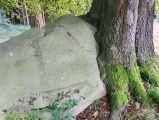
Megalitgrav (Burial Chamber) in Svendborg. A tree has grown up against the large capstone, shaping itself around the stone to the point where it appears almost fused with it. More photos on our page.
 •  0 comments  •  flag
Share on Twitter
Published on September 23, 2025 07:06

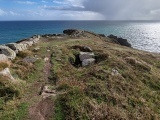
Trewavas Cliff Chambered Cairn

The remains of a clifftop chambered cairn, possibly once a Scillonian entrance grave. You can see one capstone in position, one misplaced capstone and one stone of the kerb. There is an ancient settlement (see photos on our page) and fresh water on the headland as well.
 •  0 comments  •  flag
Share on Twitter
Published on September 23, 2025 07:03

September 21, 2025

Hersoug

In a large sloping grassy field easily visible from the local round is a round barrow located on a smaller flat hill which is part of the barrow, making it a very rare "step barrow" known only in a handful of sites in Norway. The base is 40 metres in diameter and 2 metres in height and flattened with a mound of top, making the step appearance. The top part of the barrow is 12 metres in diameter and 1,5 metres in height. This detail is easier to see on LIDAR maps because of the vegetation which consists of large and small trees and scrub.
 •  0 comments  •  flag
Share on Twitter
Published on September 21, 2025 02:57

September 20, 2025

Palazzo Besta

This Renaissance building in Teglio (Sondrio province) is known for its frescoes and its stüe: typical rooms entirely covered with wood panels. Most importantly, the ground floor houses an extensive collection of Bronze Age Steles. The stones come from the Teglio area, most of them are in very good conditions, all are accompanied by illustrative material and there are several information panels.
 •  0 comments  •  flag
Share on Twitter
Published on September 20, 2025 12:45

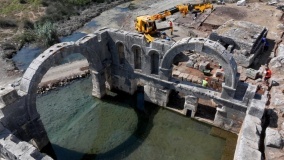
Myra Nymphaion

Healing waters of Roman Empire to flow again after 1,850 years, details on our page. A 2nd century CE Roman "healing water complex" in Antalya Province, Turkey with aqueducts, baths and cisterns. It was built over a natural spring rich in magnesium, iron, sulphur and phosphorus.
 •  0 comments  •  flag
Share on Twitter
Published on September 20, 2025 12:37

September 19, 2025

Losone Schalenstein

Carved stone in Tessin - the stone plate is the underlay of a grape press. In the courtyard of San Lorenzo church located in Via San Materno.
 •  0 comments  •  flag
Share on Twitter
Published on September 19, 2025 16:16

September 18, 2025

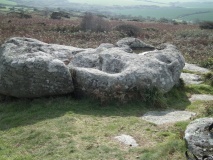
Creeg Tol

This outcrop of rock, also known as the Giant’s Footprint, is beside the footpath from the A30 lay-by kissing gate to Boscawen Un, though you may not notice it there on your way to the circle. There is a small, presumably modern stone circle close by, photos of that are on our page. You would be more aware of it when walking back to your vehicle, turn left down a little path beneath the overhead electricity wires. It is marked on the OS Explorer map. The huge rock stands to the NW of Boscawen Un [the circle can be seen from its summit], and St Buryan church tower is about SSW in direction.
 •  0 comments  •  flag
Share on Twitter
Published on September 18, 2025 06:15

Ny Søby Langdysse

A very nice, neolithic long barrow of nearly 40 metres in length, situated on the island of Tåsinge. On the road 9 between Svendborg and Rudkøbing, turn west on Vornæsvej in Bregninge village. Follow this road for ca. 8 km, until its name has changed to Knasterhovvej.
 •  0 comments  •  flag
Share on Twitter
Published on September 18, 2025 06:05

September 17, 2025

Rechnitz Kreisgrabenanlagen Circle Fort
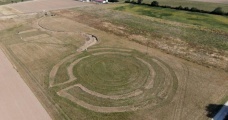
A team of archaeologists believes that three impressively sized circular ditch structures from around 4500 BC, discovered by the team in what is now southeastern Austria, are evidence of some of the most impressive Stone Age settlements ever found in Europe. Researchers spent roughly six years using aerial archaeology and geomagnetic surveys in the municipality of Rechnitz (located near the border with Hungary) to discover the ring-shaped structures, which are virtually invisible to the naked eye. They found pits and post holes that, in conjunction with ceramic discoveries, help to illustrate the Neolithic settlements. Teams will further analyze material and soil samples to uncover more information on the origin of the agricultural land and its subsoil.
 •  0 comments  •  flag
Share on Twitter
Published on September 17, 2025 06:07

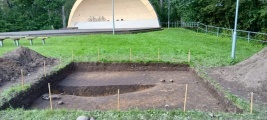
Skankalne Hillfort

Bronze Age settlement and Neolithic finds discovered at this hillfort in Latvia, as well as evidence for occupation well into the Iron Age - more details on our page. Sitting between the left bank of the Salaca River and a tributary gorge, near the historic Lībiešu homestead in Valmiera Municipality, Latvia, its irregular oval plateau is encircled by a defensive rampart up to five meters high and 70 meters long, separating it from the surrounding landscape.
 •  0 comments  •  flag
Share on Twitter
Published on September 17, 2025 05:59