Andy Burnham's Blog, page 2

November 22, 2025

Park Gate
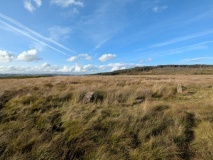
A relatively well-preserved embanked stone circle located on a boggy plateau on the moorland above Beeley, at the northern end of a cairnfield. The circle consists of ten stones in a ring, approximately 12.5m by 12m in diameter with a further stone, completely buried, to the north-west. If the stones were evenly spaced, there may originally have been as many as twenty in the circle.
 •  0 comments  •  flag
Share on Twitter
Published on November 22, 2025 11:31

November 20, 2025

Ystum Cegid Isaf

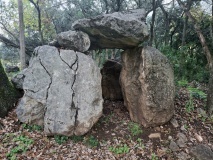
A photo from 2024, one of a few rescued from our 'plugole' which is where where failed uploads end up. More mystery photos in our gallery - can you identify any of them?. Situated within dry stone walling between two farmer’s fields. The chamber looks like it would have been about 1.8m (6ft) in height when originally built. The substantial capstone, roughly a trapezoid in shape, looks a bit precariously balanced on the four remaining supporting stones. The capstone measures about 4.5m (15ft) at its longest point and 3.3m (11ft) at its widest.
 •  0 comments  •  flag
Share on Twitter
Published on November 20, 2025 16:07

Blogging with the Megalithic Portal Site Visit Logs

The Megalithic Portal offers the facility to log sites you've visited, and our dedicated contributors have now added almost 55,000 individual entries to our site visit logs! As well as a simple list of places you have visited, you can also record your visit logs in a 'blog' format with images and maps. This added feature should make ancient sites travel blogging easier.
 •  0 comments  •  flag
Share on Twitter
Published on November 20, 2025 11:35

Dolmen de Cal Boixadera

Burial Chamber (Dolmen) in Cataluña
 •  0 comments  •  flag
Share on Twitter
Published on November 20, 2025 11:27

Mingoose Tumuli

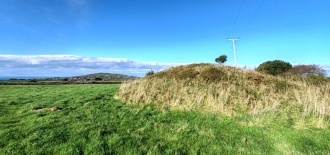
Originally there were at least 7 barrows found between Mingoose and Hurlingbarrow, Now only 3 remain. The barrow is believed to be associated with the ancient game of hurling from which the place-name Hurlingbarrow derives. There are no indications of a surrounding ditch. An urn was reported to have been excavated from this barrow by an antiquarian although there are no further details.
 •  0 comments  •  flag
Share on Twitter
Published on November 20, 2025 07:38

November 19, 2025

Little Hograh Moor BS1

John D Hunter writes: When I first came across this pair of stones, many years ago now, my first impression was that they are standing stones, and I am still of that opinion. They are in a position on Little Hograh Moor which gives them a commanding view over an area known as Crown End, a prehistoric settlement area on Westerdale Moor.
 •  0 comments  •  flag
Share on Twitter
Published on November 19, 2025 10:43

Bakewell Churchyard

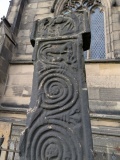
Two ancient crosses in Bakewell Churchyard; this one on the eastern side of the church near the wall is the 2.1m (7 ft) plus tall shaft of a glorious engraved cross - scrollwork and beasts are identifiable. On the side facing the church the lower part of a cruciform image can be made out. This cross is either 8th or 9th century. Also worth checking in the porch and west end of the church for dozens of fragments - a mixture of Anglo Saxon and Norman - photos of these are on our page.
 •  0 comments  •  flag
Share on Twitter
Published on November 19, 2025 08:53

November 18, 2025

Cloontreem Wedge Tomb
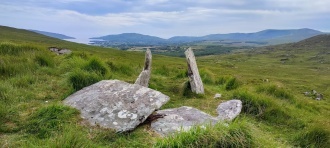
In rough mountain pasture, on a level patch of ground sheltered by a rock outcrop to the east, on lower south-facing slope of Maulin Hill, towards the west end of the Beara peninsula. There are cupmarks on the most easterly roof stone. It has a ruined gallery represented by two erect side stones and one upright and one fallen just next to these.
 •  0 comments  •  flag
Share on Twitter
Published on November 18, 2025 08:41

Sainte-Barbe alignement

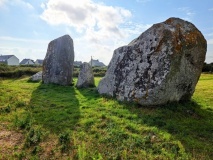
An interesting and strange place, slightly off the tourist trails to the west of the D.781 Carnac to Erdeven road near to the village of Ste Barbe. At the western end is a row of really massive stones running across between the rows creating a sort of horseshoe shape. There are just 4 stones, but two of them are the biggest standing stones I have seen anywhere, more than 5 metres in height, possibly 4 to 5 metres in width, and up to 2 metres thick. These must have taken a massive effort to get into position.
 •  0 comments  •  flag
Share on Twitter
Published on November 18, 2025 08:31

November 17, 2025

Stepleton Enclosure
The site of an oval Neolithic causewayed enclosure on the south-eastern, or Stepleton, spur of Hambledon Hill. The remaining arc can be seen to the centre right. Part of a complex of Neolithic monuments which occupy all three spurs of the hill. Surveyed by RCHME in 1996. The remains of the Stepleton enclosure were recorded during an earlier survey in 1959 and completely excavated during Roger Mercer's 1974-86 excavation, having already been severely damaged by modern ploughing. Mercer's excavations confirmed the causewayed nature and Neolithic date of the enclosure.
 •  0 comments  •  flag
Share on Twitter
Published on November 17, 2025 10:01