Andy Burnham's Blog, page 4

November 6, 2025

Templo de Patlachique

High above the southern edge of the Teotihuacan Valley (Mexico) rises Cerro Patlachique — a peak now shown to have served as a major pilgrimage shrine long before, during, and after the heyday of the city of Teotihuacan (c. CE 150–550). Recent lidar mapping and the documentation of 40 carved stone “monuments” (petroglyphs and boulders moved into place) reveals that the summit was a ritual locus devoted primarily to water and mountain deities, calendrical observances, and regional pilgrimage.
 •  0 comments  •  flag
Share on Twitter
Published on November 06, 2025 10:55

Gabii

Archaeologists in Italy recently found a massive stone basin dating back more than 2000 years in the remnants of a once-powerful rival of Rome, the now ruined town of Gabii (pictured), about 11 miles to the east. The structure may be one of the earliest examples of large-scale Roman public architecture outside of temples and city walls, demonstrating how Roman architects were influenced by the Greeks.
 •  0 comments  •  flag
Share on Twitter
Published on November 06, 2025 10:43

October 17, 2025

Borth Submarine Forest
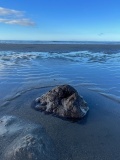
A submerged forest, preserved in peat from the later Neolithic/ early Bronze Age, one of eight known submarine forests along the Welsh coast. Best visited after a storm, though in normal conditions some stumps are visible at or beyond the low tide line. Tree species such as willow, hazel, pine, oak and birch are present and some are easily identified from their well preserved bark. In addition to the stumps, a hearth, tools and animal bones of a similar age have been found in the peat.
 •  0 comments  •  flag
Share on Twitter
Published on October 17, 2025 10:57

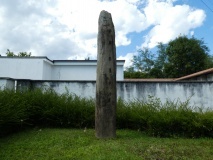
Lugnacco Menhir

A 3.8 metre tall menhir in a little garden outside a house in the village of Lugnacco, Piemonte
 •  0 comments  •  flag
Share on Twitter
Published on October 17, 2025 10:48

October 15, 2025

Maenclochog Church

In St Mary's Church, Maenclochog near Fishguard are two Ogham/Latin inscribed stones. One of the stones recalls COIMAGUUS, while the other ANDAGELLUS, the son of CAVETUS. It seems plausable that they were brothers - Romano-Britons of the 6th century CE. There are also Ogham markings on both stones.
 •  0 comments  •  flag
Share on Twitter
Published on October 15, 2025 05:44

October 14, 2025

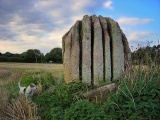
The Queen Stone

A squatter version of the Devil's Arrows, near Ross-on-Wye. Very grooved, probably due to the action of rainwater. It doesn't look it but it is 7ft (2.1m) tall. On private land quite a way from the road, in a field in the bend of the River Wye, at Symonds Yat.
 •  0 comments  •  flag
Share on Twitter
Published on October 14, 2025 01:47

October 13, 2025

Vielsted Runddysse 1
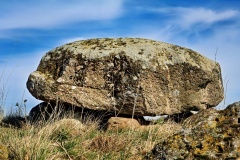
One of Denmark's most impressive and well-preserved dolmens with 19 large kerbstones visible. The chamber has 4 orthostats (uprights) and a large capstone as you can see. Lots more photos on our page.
 •  0 comments  •  flag
Share on Twitter
Published on October 13, 2025 03:17

October 11, 2025

Broadsands Chambered Tomb
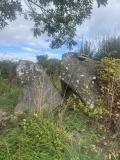
A Neolithic chambered tomb or passage grave located on the southern slope overlooking the Torbay coast at Broadsands. This megalithic chamber has a single parallel-sided entrance passage 3.8 metres long and 1.2 metres wide lined with alternating orthostats and dry stone walling set within a near circular cairn 12 metres in diameter at construction but later reduced to 7 metres north east by 9 metres east west.
 •  0 comments  •  flag
Share on Twitter
Published on October 11, 2025 07:05

October 10, 2025

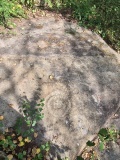
Skjelin-Østre

This rock art site is one of the largest and most interesting in Østfold discovered the last 10 years. When I visited I could find at least 5 ship figures of the typical bronze age type with high front and back ends and vertical lines thought to resemble crew. I could also find at least 6 "sun circles" and spiral figures, at least 50 cup marks and pairs of soles. A pair of footsole carvings on top of the panel is unusually deeply carved.
 •  0 comments  •  flag
Share on Twitter
Published on October 10, 2025 10:46

October 9, 2025

Chavín de Huantar

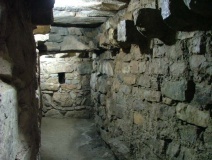
Recently excavated deposits sealed in an underground gallery at Chavín contained twenty-three bone tubes that are associated with consumption of psychoactive plants elsewhere in the region. Direct evidence of this psychoactive plant use has recently been published in the Proceedings of the US National Academy of Sciences, details below. An archaeological site in Peru with ruins including a pyramid type structure constructed beginning about 850 BCE and occupied until about 300 BCE by the Chavín, a major pre-Inca culture.
 •  0 comments  •  flag
Share on Twitter
Published on October 09, 2025 04:43