Andy Burnham's Blog, page 10

September 1, 2025

Clovelly Dykes
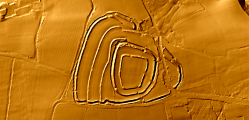
A complex series of earthworks covering more than 20 acres (8.1 ha) #HillfortsWednesday situated on the high plateau behind the coast - one of the largest and most impressive Early Iron Age hill-forts in Devon. Excavations were most recently carried out in 2018 and 2019.
 •  0 comments  •  flag
Share on Twitter
Published on September 01, 2025 04:58

August 29, 2025

Side Pike

A Recumbent Stone Circle (RSC) has been rediscovered by Steve Dickinson in the heart of the Lake District National Park World Heritage Site. It is on the south side of Great Langdale valley on the northern slopes of Side Pike, where the valley turns north-west into Mickleden, under the Early Neolithic stone axe blade creation sites on Pike o’Stickle, Loft Crag and Harrison Stickle.
 •  0 comments  •  flag
Share on Twitter
Published on August 29, 2025 04:17

August 28, 2025

Berezan' Runestone

Discovered in 1905 by Ernst von Stern, on Berezan' Island (also known as the Island of St. Aitherios) where the Dnieper River meets the Black Sea. The runestone is 48 cm wide, 47 cm high and 12 cm thick, and kept in the museum of Odesa. Pictured is a faithful replica currently on display at the Historiska Museum in Stockholm. The original was made by a Varangian trader named Grani in memory of his business partner Karl. They were probably from Gotland, Sweden.
 •  0 comments  •  flag
Share on Twitter
Published on August 28, 2025 13:43

The Van

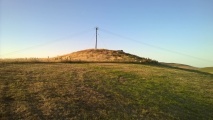
The name given to a hill in Powys which has two tumuli on top of it. One is in excellent condition and really stands out when viewed from the A44 or A481.
 •  0 comments  •  flag
Share on Twitter
Published on August 28, 2025 09:58

Lutry Menhirs

Found in 1984 during the excavation of the foundations for a parking garage. In the middle of the Swiss town of Lutry on Lake Geneva, an alignment of 14 closely spaced menhirs with the largest stone around 4 metres tall. One menhir originally had engravings: two crossed lines, five circles, and a rod with a ring (?) thought to be a human representation. This has been replaced with a reproduction. They date from ~1800 BC.
 •  0 comments  •  flag
Share on Twitter
Published on August 28, 2025 09:54

Menhir de La Lancha

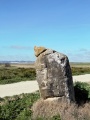
New Paper: The Menhir as an Oral Tradition in Cattle-Raising Territories: First Geological Provenance Analyses at the Antequera Heritage Site, Spain. A standing stone by the side of the the CA-6105 road in Andalucía.
 •  0 comments  •  flag
Share on Twitter
Published on August 28, 2025 01:30

August 27, 2025

Coetan Arthur Dolmen

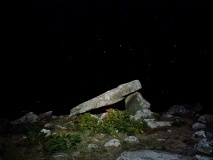
Impressively situated on the hillside close to St. David's Head, Coetan Arthur is the collapsed chamber of what is presumed to be a passage grave which also has a round barrow. The massive capstone measures approximately 5.9 metres by 2.6 metres and is supported on one side by an orthostat approximately 1.5 meters in height.
 •  0 comments  •  flag
Share on Twitter
Published on August 27, 2025 14:36

Marton Churchyard Cross

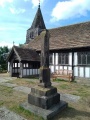
A medieval cross (14th or 15th century) in the churchyard at St James' and St Paul's, Marton. The 14th church is one of the oldest surviving timber framed churches in Europe and one of only a few in England. The cross head blew down in 1991 and is now inside the church. (does anyone have a photo of the head?)
 •  0 comments  •  flag
Share on Twitter
Published on August 27, 2025 00:56

August 26, 2025

Stèles de Saint-Jean-Trolimon

Two stèles in Finistère, (re)placed in front of the gate to the church.
The right one, tallest of the two, measures about 2.5m, the left one is smaller at 2m tall.
 •  0 comments  •  flag
Share on Twitter
Published on August 26, 2025 01:13

August 24, 2025

Callanish 4

Hulavig in the name Ceann Hulavig is a word derived from the Norse. The spelling is an attempt to Gaelicise the name. Garynahine (which itself is an Anglicised spelling of Bear-r-aitjh na h'AilTihe) is the nearest village.
 •  0 comments  •  flag
Share on Twitter
Published on August 24, 2025 09:35