Andy Burnham's Blog, page 236

April 14, 2019

Easthill
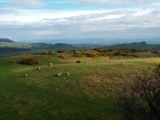
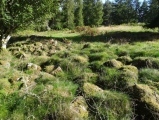
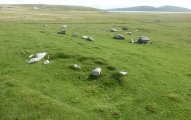
A small stone circle setting on top of a group of hills called Easthill. The circle sits on top of a grassy knoll overlooking Dumfries, with a commanding view of the north, east and south. The circle itself is made up of ten stones with a few other stones that have rolled down the hill over time that could have been part of this circle. There is a possibly aligned stone lying a hundred and fifty feet to the east.
 •  0 comments  •  flag
Share on Twitter
Published on April 14, 2019 15:40

Cuween Hill

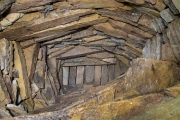
Erland Cooper records part of his new song First of the Tide inside Cuween Hill chambered cairn, more details in the comments on our page. Also the head of a Neolithic dog recreated using a skull discovered in the same cairn in 1901 - again more below.... Cuween Hill chambered cairn (Orkney) is set on a hillside overlooking the Bay of Firth. The site is still covered by an earth mound although 19th century attempts to gain access have disturbed the top of the corbelled roof which is now covered by flat stones. However, within the cairn the walls and corbelling up to a considerable height are intact and in excellent condition.
 •  0 comments  •  flag
Share on Twitter
Published on April 14, 2019 04:45

April 13, 2019

Tankerville Arms Cist

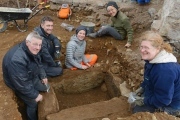
Bronze Age Cist discovered in Wooler, Northumberland. During recent building work at the Tankerville Arms Hotel, digger driver Steven Turtle turned up a surprising find when he uncovered an unknown Bronze Age burial. No beaker was found in the burial though they found a small flint knife measuring around two inches in length.
 •  0 comments  •  flag
Share on Twitter
Published on April 13, 2019 15:50

Grabhügel Süßer See

A Bronze Age round barrow was found at the bottom of the Süßer See lake near Seeburg and Aseleben (Saxony-Anhalt/Germany). The barrow has a diameter of 6 m and is probably 3400 years old. Today, it is located 4 m beneath the surface of the lake.
 •  0 comments  •  flag
Share on Twitter
Published on April 13, 2019 15:20

April 12, 2019

Holsteen

A group of stones excavated from the sandy ground in Limburg, Belgium. Due to the most striking feature of the stones, the site itself has been called "Holsteen" (hollow stone). The northernmost stone, easy to identify by the fence surrounding it and the information board next to it, is a polijststeen (polishing stone) used by the inhabitants and hunters in the Neolithic era. After the Neolithic, the stones were completely covered with sand. They were discovered again in 1862.
 •  0 comments  •  flag
Share on Twitter
Published on April 12, 2019 15:16

Barmkyn of North Keig

Hillfort in Aberdeenshire. A bivallate Iron Age hillfort is located on the summit of a prominent hill overlooking the stone circle of Old Keig. The outer rampart is in better condition than the inner one. The latter survived as a low bank of 5m width and 0.5m height. Remains of the entrance can be seen in the eastern part of the fort.
 •  0 comments  •  flag
Share on Twitter
Published on April 12, 2019 11:05

April 11, 2019

Gochang 6th Course Dolmens
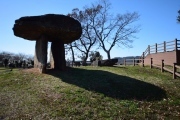
Five dolmens including one fine table type, three 'go' board type and one capstone type (pictured) lie on a gentle hill. Away from the main groups of Gochang dolmens (South Korea - see nearby sites list for more photos),
 •  0 comments  •  flag
Share on Twitter
Published on April 11, 2019 16:49

April 10, 2019

Sgalabraig

A souterrain was discovered about 1906 at this location in North Uist, and was re-opened in September 1964 when a 4m long by 1.1m deep and 0.8m wide walled passage was revealed. The site now appears as a slight hollow and a line of stones. It is not known whether the souterrain survives, but it is possible.
 •  0 comments  •  flag
Share on Twitter
Published on April 10, 2019 12:22

April 9, 2019

The Written Stone

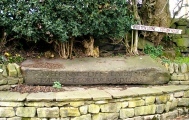
At the northern end of Written Stone Lane in the village of Grimsargh, near Longridge, Lancashire, is a very curious and mysterious stone slab, with an even stranger inscribed message carved onto its side in large letters. Also carved into the stone is the name Ralph Radcliffe and date 1655, although this very long slab of gritstone might be much, much older.
 •  0 comments  •  flag
Share on Twitter
Published on April 09, 2019 07:11

Hjulkorsgraven

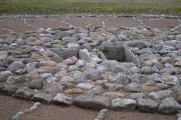
A sunwheel grave is dated to the 4th of 5th century AD. It measures 17 m in diameter. See further down our page for an aerial view. This grave was originally part of the Lilla Bjärs burial ground. After the grave was excavated it was moved to its present location.
 •  0 comments  •  flag
Share on Twitter
Published on April 09, 2019 07:04