Cara Gilger's Blog, page 2
April 25, 2022
Book Review: Baptized in the Water
In spiritual direction we talk about how tears are holy because they signify that which is beyond words. Tears are a sign that the spirit of God is near to our hearts, that something is holy and sacred. This Easter Sunday was a particularly precious one as my oldest made her confession of faith and I had the honor of baptizing her. I cried for the faith that we have carried and passed on, for the choice she has made to grow in God’s love and for the incredible community of pastors, mentors, friends and family that surrounded us.
Knowing that this special day was coming, I was delight to receive a review copy of Glenys Nellist newest book Baptized in the Water: Becoming a Member of God’s Family. I had planned on giving it to my oldest daughter as a baptism gift, but decided instead to give it to her younger sister. You see, the season leading up to my oldest daughter’s baptism has been a season of preparation. She has attended classes and studied her Bible. She has met with a mentor and written a Statement of Faith. We’ve talked about it as a family at dinner and on long walks. But something unexpected happened with all this conversation—little sister kept getting more and more nervous about her baptism. Specifically, if she had to be immersed and whether she could wear her hot pink swimming goggles in the baptistry.
While she has several years before she will be baptized in our tradition, I wanted to set her seven year old mind at ease and Baptized in the Water was the perfect conversation tool to talk to her about all the ways different parts of the Christian tradition baptize. With clear and inclusive writing and bright illustrations, Baptized in the Water is a wonderful book to introduce baptism and talk about it with your young kids. Written for families who practice infant, child or adult baptism, it focuses on God’s welcome of you at your baptism and the joy that comes from being a part of this faith tradition. It incorporates scripture in ways that kids can understand and makes the connect between Jesus’s baptism long ago and our baptisms now.
Baptism for our tradition is one that marks a commitment to grow in your faith life with God. Faith takes nurture and useful tools to cultivate God’s presence and Baptized in the Water is one such tool for families to use.
Thank you to ZonderKidz for the review copy. I am hosting a giveaway on Instagram if you are interested in winning a copy of the book.


March 23, 2022
New Favorite Childrens Books on Faith
I just started teaching kindergarten through second grade Sunday school, a longtime dream. It made me realize it’s been a while since I’ve done a roundup of children’s books to form young faith. There are several really exciting and creative titles out since my last round up. I love including a mix of specifically faith-oriented books as well as books that build character and can tie into a particular theme in faith or make a connection to a Bible story.
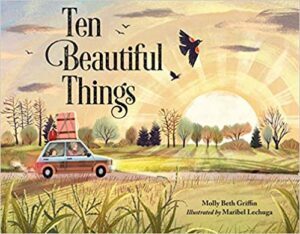 Ten Beautiful Things by Molly Beth Griffin
Lily is not happy to be moving in with her grandma in boring Iowa but then her grandma challenges her while they are driving to notice ten beautiful things and Lily’s perspective changes. This is a beautifully illustrated book that matches the theme well with its vibrant and detailed images. I would use Ten Beautiful Things to teach mindfulness and noticing practices for elementary age kids. In the spring this would be the perfect book to read and then send kids on a noticing walk outdoors. You could also use Mary Oliver’s instructions for living a life “pay attention, be astonished, tell about it” to guide the practice and it would pair with the book well.
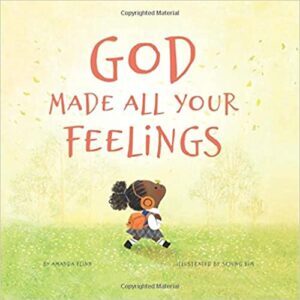 God Made All Your Feelings by Amanda Flinn
Emotional intelligence is faith work. When we teach our children (and ourselves) to listen to what is happening in their feelings and body we teach them how to listen to God. Which is why I was delighted to see God Made All Your Feelings. Spanning different kinds of feelings, each reflection has an accompanying scripture and call to connect to God, which I really love as part of the tool kit kids are building. You can also see my list of books on emotional intelligence and grief in addition to God Made All Your Feelings as a resource for your family.
 Saturday at the Food Pantry by Diane O’Neill
This is a tender story that addresses the sensitivities of food insecurity and dignity. Molly has never been to a food pantry but it’s different than the grocery story and when Molly runs into a classmate who doesn’t want to be seen, she begins to wonder. Saturday at the Food Pantry would be a great addition to the kids corner of your own food pantry or a way to talk to kids about all the ways that we get food and how to give one another dignity. It’s also a good way to introduce young kids to the idea of food insecurity.
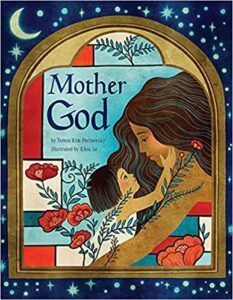 Mother God by Teresa Kim Pecinovsky
A beautiful and imaginative book that takes the image of God as mother found in scripture and spools it out into everyday images. “God pulls off each tiny sock” and “God is a skillful seamstress.” Weaving in images of motherhood from humans and nature, Mother God is a book that expands the imagination so that kids can see God in more places in their lives. This would be a great resource near Mothers Day to talk about important women in our lives or a opening story to talk about the different kinds of people that God uses to reveal God’s love.
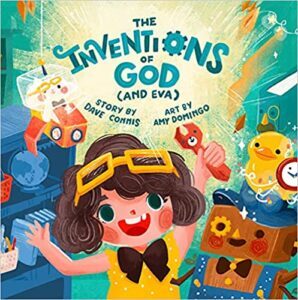 The Inventions of God (and Eva) by Dave Connis
The Inventions of God (and Eva) is the perfect read for your spunky, creative pre-schooler, as you follow Eva along as she invents Mr. Robotreestuff. The author parallels how Eva delights in inventing the way God delights in creating. The illustrations are bright and dynamic and God is not personified but rather is illustrated as a dynamic and messy light. The only drawback on this book is that the author chose to use male pronouns for God. It’s an easy correction to use inclusive pronouns on the fly as you read but be mindful about that adjustment.
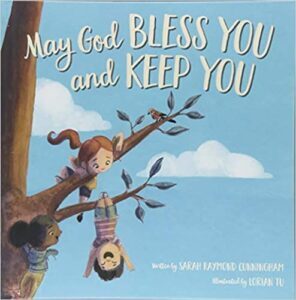 May God Bless You and Keep You by Sarah Raymond Cunningham
A sweet book that follows a child throughout their day—the ups and downs and everything in between—to talk about how God blesses us and keeps us in all kinds of situations. May God Bless You and Keep You has a nice cadence to it that would make a great bed time book for little ones and the perfect way to reflect on where God showed up in your day and in your little one’s day.
As always, I hope that these selections enrich your home library and how you talk about faith with your children. You can see my other lists of children’s books on faith such as 20 Books to Enrich young Faith and 11 Books to Enrich Young Faith and you can always find my full list at Bookshop.org.
March 14, 2022
Book Review: Bare Tree and Little Wind
As a progressive Christian parent, I struggle to find Lent and Easter books that can manage a story that is complex and nuanced in both a developmentally and theologically appropriate way. The story of death and resurrection needs to be handled in an developmentally responsible way—images of death and torture and the things those images are used to emphasize or claim about God are often troublesome and sometimes worse. I have worked with too many adults with religious trauma rooted in using scary images to frighten them as a child into a more religious life, to not be incredibly warry about it. For me, I want my children to know the way God’s love triumphs over the world’s violence. I am not interested in Easter theology that emphasizes that our badness was justification for God’s tolerance of violence for a larger purpose.
Which is what made Bare Tree and Little Wind: A Story for Holy Week by Mitali Perkins such an unexpected little read. Instead of focusing on the blood and death part of the story, Bare Tree and Little Wind: A Story for Holy Week tells the story of Easter using the wind as the character through out the story, from Palm Sunday to Ascension little wind moves about the trees with a posture of curiosity for what is happening. There are also ecological elements to this story that could be used for a hands on lesson.
The story is a bit abstract for little readers, but no more so than the Christmas stories that look at the manger through an animal point of view. And the dynamic and intricate illustrations more than make up for it. I had only one pause around the theology of Bare Tree and Little Wind at the end, when it narration talks about Jesus returning. I mention this dynamic so that you as the parent or Christian Educator are prepared to frame. In our house we don’t believe in a literal second coming, we believe that Christ returns every time we respond with love and compassion. So in reading it with my kids, that’s how we framed the waiting and longing for Jesus to come again.
January 4, 2022
Interview with author Heidi Haverkamp
I had long appreciated Rev. Heidi Haverkamp’s writing at the Christian Century but fell in love with her perspective on faith when she launched her newsletter Part Time Hermit. There was something about her reflections that appealed to my bookish, pastoral sensibilities—the wrestling with the idea and practice of being cloisters away (sort of) from the noise of modern life (sometimes). When I saw that Heidi was set to release Everyday Connections: Reflections and Practices for Year C, I knew it was a resource that would enrich my spiritual life and Heidi would be an author that readers would benefit from getting to know a bit better.
CG: The longer I am on my journey and particularly in these late stages of the pandemic, I appreciate a sense of steadiness in my spiritual life. Those daily habits that stretch months or seasons ground me in a different way. I love that your newest book offers a full year of daily devotions. Tell me what drew you to a project that spans 365 days?
HH: Thanks, Cara! Like you, my daily practices bring so much to my life, although I will be honest and say that I am not always able to do them every single day. Still, starting my day with something meaningful for my life and the world is important to me. So, when my publisher asked me to consider creating this resource, which is based on a sermon commentary series called Connections, first I knew I wanted to craft a book I would also want to use. I wanted to create something to help readers engage with their daily life and the world in a way that is open-ended and flexible, but also serious and weighty, with ideas, prayers, and questions worth their time and attention, not just rhetorical or filler. I also wanted to create something that readers wouldn’t feel they must use every day, 365 days a year. The book is organized around weeks not days. So, a reader can turn to a certain week and choose what they are most drawn to read or practice, or what they have time for, week by week and season by season.
CG: When I read Everyday Connections, the first thing that came to mind about the way you’ve structured the devotional around the four Revised Common Lectionary texts is that it walks the balance between contemplation and action beautifully. Each day there is an invitation to reflection, there are spaces to write and there are questions to explore. Is that a balance you were aware of as you created the structure and wrote the book?
HH: Very much so. Mostly, I wanted to include a lot of options for folks. We’re all different in what speaks to us or works for us as spiritual entry points — even on a week-to-week basis sometimes! Also, we’re used to having options and variety (thanks, internet!) so, rather than fight against our varying attention spans, I wanted to create a resource that offered many doorways into the readings. One week, someone might have the time and desire to read all the scriptures and think about them all together. Another week, maybe they only have time for one scripture that really is speaking to their life. Or a reader doesn’t have much time and just needs to write a sermon one week, so scans all the entries to find a question or insight that gets their juices going. Or a reader feels bored, and goes looking for a question, quote, or a spiritual practice that turns things upside down, somehow, spiritually for them that week.

CG: As you wrote the book and as you sit with it now, what spiritual practice for reflecting on scripture resonated with you? In other words, what is giving you joy in your own scripture reading and reflection?
HH: A practice that has become quite meaningful to me is writing out a passage of scripture in longhand. I was introduced to this because of an article I wrote a couple of years ago, covering some churches that were trying to handwrite the whole Bible as a pandemic group project, illuminating passages with drawings and personal notes, too. Writing a passage out in my own handwriting opens up a whole new dimension in encountering the words, I find, different than just reading or hearing. Sometimes I do this in my journal but mostly I use scratch paper, so I feel free to just scribble and interact with the words as they meet me that day. Maybe I’ll rewrite one phrase or word over and over, or rephrase the words in my own voice, or make some drawings in the margins. I offer this as a spiritual practice in Everyday Connections, but more in the upcoming volume Year A (coming in Fall 2022) than in Year C, since Year C was mostly written by the time I wrote that article. I’m working on Year B, now – the last of the three, which will be out in Fall 2023.
CG: A lot of the work I am doing right now centers around helping congregations think through how to regather their communities on this side of the pandemic. Small gatherings seem to make the most sense for both safety and social reasons and so I was delighted to see that Everyday Connections includes a small group guide. Individual spiritual reflection is somewhat different than a small group spiritual reflection, so I am curious what the thought process was behind creating a resource that could be used both ways?
HH: When I wrote my last book, Holy Solitude, I thought I was writing a book only individuals would use. I mean, it’s about solitude! But I was surprised how many requests I got from readers and pastors, asking for help creating a format to use with a small group. Many folks, it seems to me, are finding community and spiritual growth in small groups these days and looking for books and resources to help them go deep, both in study and in their questions about their personal life, call, and spiritual longings. I have loved being part of groups like this in my own life and churches, and wanted to encourage people. Especially to be in conversation with something that can feel as stodgy as the Revised Common Lectionary! Another fun thing about Everyday Connections is that different folks in the group can choose different reflections or activities, but still talk about the same readings and themes. Whether you prefer to study as an individual or in a small group, you deserve to have something significant, deep, and dynamic as a resource. That was my goal in crafting this series the way I did.
CG: Yes! It seems people are looking to find a balance between solitude and connection. You have a newsletter about hermit life that I absolutely look forward to getting in my inbox. What draws you to the hermit life and what does that have to do with cultivating a spiritual life?
HH: I’ve dreamed of being some kind of hermit since I was a kid. I’ve always loved being on my own — reading, wondering, writing, walking, or just cleaning the house or making dinner. One of the great gifts of my life is enjoying spending time with God in this way. But for years, I didn’t prioritize it. I felt I couldn’t – it seemed selfish and useless. It was never on my to-do lists and never written in my calendar. But I have come to feel that solitude is not just a hobby but part of my vocation as a person and as a priest because it helps me write, it helps me listen better to others as a spiritual director, it helps me love my neighbor more fully, and it just helps me be myself, as God created me. I mean, I also love people, and my husband, my family, and my friends – so I like to joke that I’m a “part-time hermit.” Being in community enriches my solitude – I don’t want to be the kind of hermit to go off into the woods and never be around human beings again.
If there are readers out there who love solitude but feel it’s a waste of time or selfish to take time alone, I pray they will reconsider. Even short pauses of solitude or a couple hours now and then can be a great gift for your spiritual life and your life with God. It almost doesn’t matter how you spend it – reading, walking, people-watching, yard work. But social media, the internet, or streaming don’t leave much room in your head to listen for your own thoughts or to notice the world and the Spirit around you, which I think are the best spiritual gifts of spending some time alone.
CG: I often think about Mary Oliver and the way she sought solitude in the forest and yet her work connects so many. Our solitude breeds a sort of unexpected wonder and connection.
Is there something even the most extroverted and social of us can learn from hermit practices?
HH: Some people come to me for spiritual direction or find me online and tell me something like, “I know I really should spend more time in solitude!” Maybe. But solitude isn’t like exercise or protein: something all humans have to do or ingest to be healthy. God made us all different, with different ways of being spiritually whole and feeling God’s love. I hope folks will follow their own longings, whether it’s for solitude or something else.
Still, maybe extroverts can benefit from two lessons of “hermit values.” First, to become aware of the temptation in Western and capitalist life to ceaseless busyness, noise, and usefulness. This is not how humans were created to function. We need creative time, quiet time, social time, and time to be aimless, because our brains and our bodies need time to rest and reflect. Second, if there is something in your life that brings you spiritual deepening or joy but seems silly, selfish, or wasteful (which is how solitude felt to me for much of my adult life), I hope you will reconsider and find ways to let your heart have what it longs for! God put these desires on our hearts for a reason, I think – perhaps having to do with feeling joy at being alive or delighting in being ourselves.
CG: Sometimes we take our spiritual lives so seriously we forget that God delights in us and that cultivating delight is holy. Where can people find you if they want to connect or follow your writing?
People can find me on my website and if they are interested in reflections on the hermit life, they can sign up for my newsletter Part Time Hermit. I am also on Instagram and Facebook.
November 10, 2021
Book Review: Twas the Season of Advent
The older my children get the deeper we’ve tried to cultivate intentional practices around Advent. It’s a beautiful season to cultivate the Christian practice of waiting. Waiting on God, waiting on love’s light to enter in. This season grows more and more important as they have aged because let’s be honest, capitalism wants their hearts. It wants their whole hearts and it works the hardest to capture their attention and desires around Christmas time.
As a family we’ve cultivated practices that have worked developmentally with our kids and the rhythm of our lives. Over the years we’ve enjoyed building an affordable picture book Advent calendar. We’ve committed to a weekly worship practice. We’ve protected our sabbath time carefully so we could rest and spend time with our community.
As the kids have gotten older their activities have started to run later. At the same time their attention span for picture books has shortened but not totally disappeared. We have sensed we needed a shift in our Advent practice; a bridge to take us from a picture book heavy practice to something that can encourage more reflection. We aren’t ready to give up the beautiful illustrations and lyrical storytelling of picture books but we need something that’s a little bit…more.
With this conundrum rattling around in the back of my mind, I was delighted to receive a copy of Glenys Nellist’s newest book Twas the Season of Advent for review. The book is structured to work in several different ways. Each page has a beautiful illustration and is assigned a different day–like a devotional. Each page or day begins with a few stanzas to illuminate the story on the page, for parents of littles you could just read those stanzas and as you move through the book, it reads like a story. If you have older kids, each page also has a long section of text to expound on the part of the story for the day and concludes with a prayer. Families can use Twas the Season of Advent as either a storybook or a daily devotional for your family, depending on what age they are. This makes it the perfect book to invest in for the long haul because it can easily be used for preschoolers through late elementary.
This is a book I look forward to gifting, using and keeping as a part of our family library this holiday season.
October 20, 2021
Spiritual Direction: An Update & Announcement
In the spring of 2020 I began the three year training process to receive my certification in Spiritual Direction through Southern Methodist University’s Perkins School of Theology. I wanted to add some tools to my tool bag that would deepen my practice of congregational consulting and clergy coaching. For me, Spiritual Direction made sense with my philosophy of congregational consulting. I don’t market a one-size fits all model or a program I recommend regardless of context and resources. When I consult with congregations, it involves clear goals and deliverables but also deep institutional and organizational listening.
As my study and practice of Spiritual Direction has deepened, so has my appreciation for it as a spiritual tool for many of the ministers I work with in a variety of settings. While I have over the years utilized Spiritual Direction for my own discernment, I discovered a deep appreciation for the spiritual practice of Spiritual Discipline in this uncertain time in leadership, ministry and in the world.
I am now in the practicum part of my education, which means I am excited to share, I can take on directees as a student Director. If you or someone you know are interested in what Spiritual Direction is you can explore my Spiritual Director One Page. You may also reach out to me via my contact form if you’d like to see if we might be the right fit for your spiritual journey.
September 7, 2021
When a Nap Won’t Fix It
Early in congregational ministry a dear friend and colleague had the chance to see the great preacher and teacher Fred Craddock speak. When asked about clergy fatigue by an audience member he responded “if you are tired in ministry, take a nap.”
As we slogged our way through parenting young children and pastoring congregations we’d occasionally quote Craddock back to one another. In the unique vernacular of friendship “if you are tired, take a nap” became code that equal parts called the other to account for maintaining a rhythm of rest and the butt of an unspoken joke about how exhausting motherhood and ministry could be. We knew that Craddock’s advice was from a bygone era and incredibly dismissive. And yet, much like the cranky toddlers we were parenting, many of our ministry troubles wouldn’t disappear with a nap, but a rhythm of rest could and often did bring the necessary perspective needed to tackle a problem or make a pivot in either church or home life.
“If you are tired, take a nap,” was a mentality that worked more or less until this past year. Both a call to rest and a joke about how underwhelming our models of rest are in the face of late stage neo-liberal capitalism (aka Pharaoh’s economy), it more or less worked. Vacations were scheduled at semi-regular intervals. We followed the advice of specialists and influencers putting as much on auto-pilot as possible with Hello Fresh and Amazon subscribe. And what we didn’t have the privilege or resources to manage we maintenanced just enough to keep us sane. It was not a perfect system, but it was a system. A system built on work and occasional naps. And Covid blew it up.
Instead, in this late stage pandemic ministry I am a special kind of tired that no nap can touch. Not even a weekend away in an AirBnB can touch the mental and emotional fatigue from the micro-decisions that feel like a slow death by 1,000 papercuts. The decision about how we gather–indoors or outdoors? With masks or masks optional? For how long? With food or BYO snacks? What happens when numbers increase? What do we do when they decrease? Add to this the micro-decisions that go into navigating a parenting terrain that meets your child’s social-emotional and academic needs and the end of each day leaves me wiped.
Do not worry, this is not a think piece of the bone weary tiredness of parents or pastors. Mostly because I, like you, am exhausted and leery of pieces that either lament with no solution or offer cheery, unreasonable solutions.
I am here only to say that if you are tired, it’s ok if a nap doesn’t cut it. It’s ok if you have whiplash from the excitement of innovation and the disappointment of pivoting. It’s ok if the things that only shakily supported you, no longer do. And it’s ok if you are still reshaping your rhythm. You need more than a nap.
August 24, 2021
Interview with Author and Activist Lindsey Krinks
Sometimes there’s a book that comes along and hits all your buttons as a reader, that was the case for me when I picked up Lindsey Krinks’s Praying with Our Feet: Pursuing Justice and Healing on the Streets. In the vein of Fr. Gregory Boyle’s Barking to the Choir, Krinks is a master storyteller that takes the small moments of her ministry with unhoused members of the Nashville community and artfully weaves them together with thoughtful theological reflection, personal narrative and insight that is neither saccharine or oversimplified. The stories she tells are beautifully crafted as well as providing insight into the struggle of the unhoused that provide insight to both veterans to justice work and those who are curious about the issues and want to learn more. I was delighted when Lindsey was willing to be interviewed about Praying with Our Feet because it is one of the few books this year that I read in under and day but has stayed with me for months.
Cara: We have never met, but our time and relationships in Nashville overlapped, which made this a particularly moving book for me. The specific places and people of Nashville felt like a homecoming. But I also find that the more specific a story is, the more universal the message can be. What are some of the larger practices that create dignity for the unhoused that other communities can learn from?
Lindsey: A couple years ago, my friend Susan told a group of social work students about how dehumanizing her experience of homelessness was. “Just because I live under a bridge doesn’t mean I don’t have feelings,” she said. “I deserve to be treated with the same respect that you give to a man in a three piece suit.” If we truly knew how much trauma, disenfranchisement, violence, and loss people on the streets have experienced, we would stand in utter awe of their resilience and ability to survive. It’s also a beautiful thing to see friends like Susan reclaim their dignity and worth in the shadows of a system that is stacked against them at every turn.
I often tell college students and church groups that the way we treat people on a micro and macro level matters. When you see the person standing on the median asking for spare change, the simple act of looking them in the eye, waving, and greeting them with warmth affirms their human dignity and can literally change their body chemistry. If people want to go a step further, it’s so helpful to carry things like socks, snacks, and water in your car to hand out to people. Some folks even make care packages to hand out by putting survival items in a gallon ziploc bag. It’s also fine to give a few bucks if that is something you’re comfortable with… it’s like a modern-day version of giving alms. That kindness matters, and kindness on a systemic level is justice.
The macro level work can seem more difficult, but anyone can take steps and be part of creating the kin-dom of God in the here and now. Maybe it looks like educating yourself and your community and raising awareness about homelessness, affordable housing, racial justice, and other issues. Maybe it looks like talking to your council member or attending a public meeting or demonstration. Maybe it looks like supporting or volunteering with an organization that is doing the work. We all have a role to play, and the prophets are imploring us to act.
Cara: In some ways Praying with Our Feet feels like a love letter to the parts of Nashville many people don’t see. What is it you want people to see that often goes unseen in urban areas?
LIndsey: Absolutely. Getting to see and know Nashville “from below” has transformed me and how I see everything, including Scripture, including God. We forget that the land is a living thing. We forget that there was a time before we divided up our cities and towns into slices of property that could be owned and exploited for gain. We forget the blood that has been spilled, the people who have been silenced and displaced, and even the struggles that have been won beneath our very feet. Asking questions and learning about the history of places that matter to us is a dangerous and transformative practice.
When we’re in urban spaces, my hope is that we can train our eyes to look beneath the shimmer and shine. Look beneath the underpasses, in the alleys, in the patch of woods, down the train tracks. Look for those who have been pushed out. Ask them about their stories. The way we treat the most marginalized members of our society is the way we treat God.
Cara: Krista Tippett once said “if we tell a truth about love, it’s a hard truth.” I feel like Praying with Our Feet tells a hard truth about love and what it means to love our neighbors. What was the hardest truth you told in Praying with Our Feet about what it takes to love your neighbor and even yourself?
Lindsey: Oh, this is such a good question. If I’m honest, the absolute hardest truth for me on a personal level has been learning and believing that my wholeness matters, too. If your readers are familiar with the Enneagram, I’m a “3,” or what they call “The Achiever,” and I have a strong “2” or “Helper” wing. That means that I have a strong tendency to prioritize tasks and the needs of other people at the expense of my own health and even some of my relationships. I’ve done a lot of work on myself over the years, but if I’m not careful, the tendency to work myself to the bone and to try to earn my worth in the eyes of others can creep back in.
The amazing thing that happened for me was this: While I was busy fighting for a world where everyone could be more whole, my community, my husband, and my friends on the streets reminded me again and again that I was enough. That I didn’t have to earn or prove anything. That my wholeness and well-being mattered, too. I do have to give a shout-out to the retreat center at the Abbey of Gethsemane and my therapist (lol), but truly, community is everything. It was through loving my neighbor that I learned to love myself.
Cara: You talk about the burn out in justice and non-profit work candidly in Praying with Our Feet , what is breathing life into your work right now? What is sustaining you?
Lindsey: This year has been so difficult, not only because of COVID, but also because my husband Andrew and I lost our home in a tornado and had a baby on top of everything. Our baby is just turning one and while he is amazing, I’ve really struggled, as a mother, to keep up with some of the contemplative practices that have sustained me in the past. To be real, I think I’ve been on autopilot lately with my spirituality. But even still, I can feel this deep sense of love sustaining and guiding me quietly like a rudder. It’s love for the people we serve and accompany. Love for the earth and nature. Love for God and for our sweet little family. Love for all the change-makers who are continuing to move forward against all odds.
Cara: I love your honesty about the way motherhood has changed your practices. They are constantly reshaping my own and I don’t think we talk about that shifting ground nearly enough.
I appreciate the way Praying with Our Feet critiques the role of the church in caring for the unhouse in a community, referring to the “religious and nonprofit industrial complex.” There are several stories that show readers the fleeting and toxic ways these groups operate in urban communities. Many of my readers are church leaders, so what do you think the role of the church is in this work? Or another way to put it is: how should the church show up if they want to depart from their toxic history and become co-conspirators and collaborators in housing justice in their community?
Lindsey: One of my favorite quotes (and I have a lot of favorites!) is one about the role of the church in times of injustice. This quote is by a Catholic missionary and priest named Donal Dorr and it has stayed with me since I started doing this work: “The church cannot be content to play the part of a nurse looking after the casualties of the system. It must play an active part both in challenging the present unjust structures and in pioneering alternatives.”
So often, we forget that if the church is going to embody good news to the poor, then we have to get our hands dirty in the struggle for a better world. Challenge unjust structures, says Dorr. Pioneer alternatives. What unjust structures, systems, and rules need to be dismantled? What creative solutions can we co-create and implement with our communities?
At some point, we have to find ways to move from just doing charity and service work to being in solidarity with marginalized people and communities. Solidarity always begins with closer proximity and relationships. It involves listening and “moving at the speed of trust,” as author adrienne maree brown puts it. It grows from there, one step at a time, and maybe a leap of faith here and there. There is also an element of critical self reflection that we need to do about the roles we’ve had – individually and collectively – in propping up unjust structures over time. If we’re not willing to do our work, we’re probably not ready to be in relationships of solidarity. Personal transformation and systemic transformation go hand in hand.
The beautiful and encouraging thing is that the work of justice is never meant to be carried alone. It is both a burden and a gift that we shoulder together. It invites us into deeper relationships and creative partnerships with other faith communities, non-profits, and movement organizations. And as the old story by Flannery O’Connor goes, “the life you save may be your own.”
Cara: What are you praying for right now?
Lindsey: Every night, I pick my one year old son Larkin up in my arms before bedtime and carry him outside to say our prayers. The Talmud reads, “Never pray in a room without windows,” and so we take that a step further! I want him to know a faith that faces outward, not just inward. We pray for our friends on the streets, our friends in prison, and all those who aren’t free. We pray for our cats and family and friends, “Mama Earth,” and so much more. But every night, we close our prayer by saying, “We pray for the coming of a new and better world.” I look forward to the day he realizes that we pray that prayer with our lips and hearts, but we are also called to pray it with our feet.
Cara: Never pray in a room without windows–that’s beautiful. If readers want to connect with you and your work in Nashville, where can they find you?
Lindsey: You can follow the work of the Open Table Project in Nashville on Facebook and Instagram as we disrupt cycles of poverty, journey with the marginalized and provide education about issues of homelessness.
Like what you’ve read? Want more? Sign up for This Gathered Word, a twice a month newsletter (because we’re not spammy) and get original content you can’t find here on the blog. Reflections on faith and living, book recommendations and other good, nerdy fun. Sign up HERE.
August 2, 2021
This Too Shall Pass, Because This Too Shall Last
Over the weekend I had the honor of representing Disciples Divinity House at Vanderbilt Divinity School in the ordination of my newest colleague. As part of her ordination, she invited women clergy who had been a part of her journey to write a letter of encouragement for her own ministry. It was meaningful to reflect: What did I need to hear as a new minister? And knowing what I know now, these 13 years into this odd and wondrous calling would it change? Did I have any wisdom that would be of value to another clergy woman who’s gifts shine so brightly and yet are so uniquely different from mine? What can you possibly say in the face of so much beauty and heartache and grace? I tried and thought I might share an except of what I wrote:
I was honored when the preacher for your ordination reached out to ask me to write you a letter. Since then I’ve prayed about what I wish someone might have said to me upon my ordination or what I needed to hear in the harder days of ministry that might sustain my spirit or give me grounding. And this is what I keep returning to:
This too shall pass, but only because this too shall last.
That is to say, many of the deepest challenges in ministry have a way of fooling you into thinking that this too shall last—it won’t. The hard seasons always pass, giving way to bright spots of grace, a deeper sense of God’s presence and relationships that are deeper and richer for having endured hardship.
And of course this too shall last. The things that have sustained me in ministry are the things that last from season to season, from hardship to joy and around again; a life of spiritual discipline, friendship that fosters no bullshit and a deep commitment to one another’s thriving, a prayer life that remains wildly open to the movement of God’s spirit, mentors that prioritize your thriving over their egos. The things that last are the things that will sustain you in the seasons that pass. They are the anchor in the storm, a reminder of the sure and steady presence of God.
I pray that God gives you abundantly the things that last and remains a steady presence in the things that pass. I pray that God give you joy to balance ministry’s sorrow and humor to balances the darkness in the world. I pray that you find callings that fit each version of yourself that you and God are shaping, even in this moment.
With all my prayers,
Rev. Cara Gilger
July 29, 2021
The Long Work of Blooming
Our family garden spanned the whole north side of our home nestled in a wooded acre of red clay land. My mom would wake my brother and I early in the morning in the heat of summer to go out a weed before the day grew hot and sticky, a rhythm she had adopted from her childhood on a farm in Iowa. We would grumble but do our work well, knowing she would come out and inspect, giving us no rest until it was done right. So we plucked and pulled and complained and sang and plotted our days.
I remember when I was very little and still excited by the small miracle of seed transforming to plant, flower yielding fruits and vegetables that would be canned for winter. I was so excited about the long squash blossoms that I poked my finger down the still tight blossom willing it to open. Thinking I was wise in giving nature a little press, I came to the garden a few days later to do my weeding and discovered that the flower had wilted. Unlike the other flowers who had spread radiant yellow and were in the beginning phases of forming fruit, this one lay brown and withered.
I had forgotten about this hard lesson of childhood until recently. As a friend named on Twitter “creativity is taking 50% longer in these times” and my time has been cut back with the round the clock responsibilities of parenthood without the support of school and other social structures. Instead of recognizing that creativity happens slower under stress and the window of time in which to be creative has shrunk and being gracious with myself, I was once again standing in the garden, impatiently poking my finger deep inside the bloom of something not yet ready to flower, surprised when everything blooming turned to wilt.
We are not in a culture that appreciates the long arch of wisdom, the way that only time can compost experience into wisdom and insight. We struggle to revere our elders as repositories of knowledge and hard-earned insight. We value what is fast and efficient over what is thoughtful and sustainable. We mistake the urgency of living this one life with the rush of capitalism. God does not desire our fast production, that has only ever been about us. God desires our hearts.
Sometimes the very best things–insight, writing, work, accomplishments come slowly over time. As we adjust and readjust to the longer timeline of Covid, I am trying to learn into the slowness of time and the goodness that comes in a project, in a life, in a season that unfolds not at my pace but at the holy pace of the Spirit. As the timeline shifts, the questions do too. I am no longer asking “how do we make it through this?” but “how do we thrive within this?” The pacing is changing to create space for flowering in the midst of the day-blinding sun of this too long pandemic. The reminder to slow down is a reminder that God wants my thriving, not my work.
Like what you’ve read? Want more? Sign up for This Gathered Word, my twice a month newsletter (because we’re not spammy) and get original content you can’t find here on the blog. Reflections on faith and living, book recommendations and other good, nerdy fun. Sign up HERE.