Paul Athanasius Robinson's Blog: Realism Rampant, page 2
February 24, 2019
January Interview with Angelus Press

Angelus Press interviewed Fr Robinson about his book for its January/February 2019 issue.
Father, it has now been nine months since the publication of your book, and it seems to have stirred up some controversy!
Indeed, it has. And while I did not write the book for that purpose, I did anticipate that it might make some waves.
What has the controversy centered on?
Really, something that is a small part of the entire work, namely, the contents of chapter 7 (there are 11 chapters all up). In that chapter, I voice some strong objections to Young Earth Creationism (YEC) and point out that Catholics are free to embrace the Big Bang Theory, if they wish.
Why do you object to YEC? Isn’t that the safest of positions?
On the contrary, I find it to be quite dangerous. It runs straight into theological, philosophical, and scientific problems.
To read the rest of the interview, go to the Angelus Online website.


January 22, 2019
The Reinterpretations of Catholic Biblicism: Science & Conclusion

Science
The last reinterpretation to which Catholic biblicists commit themselves in their isolation of the Bible as the exclusive source of knowledge is in the realm of science. Because they believe in a global Flood that is impossible under current physical laws, a young universe in contradiction to a mass of observable data, and a centrality for the Earth that runs counter to Newtonian gravitation and Einsteinian relativity—because their exegesis commits them to ‘dogmas’ that are overturned by legitimate science, they must turn against science itself.
The primary way they do this is by pretending that the situation in science now is not any different from what it was in the past; effectively, there has been no advance in science. Nothing that has been discovered in the past 200 years solves any mysteries about the universe or teaches us anything conclusive. Thus, we must just fall back on what the Bible and the Fathers have said.
Agnosticism in science
As we saw above with Fr Vigouroux’s acceptance of geology’s proof of long ages, Catholic biblicists tend to conclude that anyone who accepts that science can make proofs and that those proofs can influence one’s interpretation of the Bible is doing a discredit to the Bible.
But this is simply not the case: a Catholic who uses legitimate science as an assistant to find the Bible’s true meaning is simply following Catholic tradition. To follow the letter of the Fathers, one must accept a young universe; but to follow the spirit of the Fathers, one must reconcile the Bible with the legitimate science of one’s day, and so accept an old universe. Fr Vigouroux points this out extremely well when he says:
The key issue in this present question is not the details, since the Fathers did not agree on them amongst themselves; the key question is the principles that they followed and which were common to all of them. These principles are that it is necessary to make use of reason, of science, in its certain facts, in order to interpret the Mosaic cosmogony … This principle of our masters in the faith is likewise our own. If we do not agree with them in the details, it is not because the principle has changed. It is rather because science has progressed. We are doing what they would have done in our place. They accepted what the scientists of their time taught; we accept what the scientists of our day teach.
The Fathers believed that reason making inferences from empirical observations does teach us about reality. When those inferences are conclusive, we must be careful not to interpret the Bible in a sense contrary to them. It is precisely because the Bible is inerrant that it cannot contradict science and so must not be interpreted against it. Science can attain truth. As such, it can establish for us what the Bible does not contradict.
Here we have the crux of our entire dispute with the biblicists: may a Catholic or may a Catholic not use science as an assistant in the interpretation of the Bible? Is science a legitimate intellectual discipline that is able to attain truth and makes progress over time? Should we, as Catholics, be careful to respect science and reason in our interpretation of the Bible?
In the end, it would seem that Catholic biblicists, like the Protestant Creation Science movement, mainly use science in an attempt to destroy science. This is similar to the famous Muslim thinker Al-Ghazali, who wrote a philosophical book arguing that philosophy is useless!
It is the idea that science cannot prove anything that leads biblicists to accuse progressive creationists of being overly credulous in scientific matters. For Mr. Owen, the geology of Charles Lyell was just ‘wild speculations’ and Fr. Maximilian Kolbe’s adherence to heliocentrism was due to him being caught up in the cult of Copernicus in his native Poland! On the contrary, St. Maximilian held to heliocentrism because it is supported by solid science. He studied the evidence and found it to be compelling.
In order to show how badly biblicists reinterpret science in order to discredit it and leave the Bible alone on the field of knowledge, perhaps it would be well if we considered the question of heliocentrism in more detail.
The way science works
Science seeks to use empirical evidence as a means of determining the physical properties of our universe. It becomes ‘settled’ or probabilistically conclusive when a scientific theory has attained a preponderant and, sometimes, an overwhelming weight of certainty. It is the long term successful result of an investigative process that starts with a question. In the case of geocentrism and heliocentrism, the question is, “Does the sun or the earth move, or both, and how do they move?”
The question and the proposal of theories to answer it is the starting point, stage one. Next comes the hunt for empirical evidence, stage two. This consists of gathering data from reality, as much as possible, to find which theory is correct. At first, there is not enough data, and multiple competing theories are equally plausible to cover that data. The evidence from reality is too limited to strongly prefer one theory over another.
For instance, both Greek philosophers and medieval scholastics proposed theories on geocentrism and heliocentrism. They realized that the observed movement of the stars could be explained by their actual movement relative to a stationary Earth or by their apparent movement relative to a moving Earth. Since it is easier to think of the Earth as stationary, because of our relative position, geocentrism won out through the ages. But it did not win out on the basis of empirical evidence, since both systems could ‘save the appearances’ or account for the evidence available at the time.
This all changes when science reaches the third and final stage, the stage when empirical evidence ‘chooses sides’, as it were. The accumulating data starts to clearly favor one theory over the others, and this process develops until the point is reached where the whole body of evidence can only be accounted for by the favored theory. The other theories still have sufficient explanatory power to cover certain pieces of the puzzle, but they are utterly inadequate to circumscribe and unify the body of empirical data. At that point, we declare the favored theory the winner and endow it with the phrase ‘settled science’.
In the case of geocentrism and heliocentrism, Galileo’s discoveries of the phases of Venus and the moons of Jupiter marked the time when empirical evidence started to favor heliocentrism over geocentrism. Galileo’s problem was that he thought he had reached settled science when, in fact, he had only attained certain positive signs in favor of heliocentrism. As indicated in The Realist Guide to Religion and Science (p. 281), it was only when telescopes became sufficiently precise to observe stellar parallax in the 1800s that empirical evidence was weighty enough to turn heliocentrism into settled science. Since then, the empirical data counting against geocentrism has become a mountain, which is why geocentrists are sometimes compared to flat-earthers by those who are familiar with the scientific evidence. Let us look at some of that evidence.
Evidence against geocentrism
The most obvious evidence counting against geocentrism is gravity. It is an attractive force. The heavier a body is, the greater force of attraction it has. Now, the Sun contains 99.86% of the mass of the solar system. As for the remaining 0.14%, 99% of it is contained in the four gas giants Jupiter, Saturn, Uranus, and Neptune. Earth, in other words, is like a pea surrounded by massive boulders. Its attractive force is minuscule in comparison with the rest of the bodies in the solar system. As such, it is gravitationally dominated by the Sun, which causes the Earth to rotate in an elliptical loop every 365.256 days at a distance of 150,000,000km from the Sun.
This same principle holds for the Moon in relation to the Earth. Since lighter bodies rotate around the heavier bodies, in proximity to them, to which they are attracted gravitationally, the lighter Moon rotates around the heavier Earth every 27.3 days. The same principle holds for all of the moons of all of the planets.
To get around this obvious problem, geocentrists claim that the entire universe is revolving and, somehow, the collective residue of its forces in the vicinity of our galaxy counteract the force of the Sun on the Earth and cause the Sun and the planets to rotate around a stationary Earth. They insist that the theory of General Relativity “allows for” this to work for a stationary Earth, but the astute reader notices that it only “works” if General Relativity is made specific and absolute, the very opposite of what the theory holds.
When geocentrists are asked to make their own case, they fail to deliver. They do not actually take the known facts about the stars, compute their gravitational forces in relation to the Earth, model what influences those forces have on the solar system, and demonstrate how they necessarily cause a massive boulder to rotate around a pea. To do such a thing would reveal that the forces of the distant stars on the Earth are negligible in comparison to the influence of the Sun on the Earth. But, until geocentrists make such calculations, they cannot claim to be doing any real science (see also “Here Comes the Sun”).
Another piece of evidence against geocentrism is gravitational bulge. Bodies that rotate on their own axes bulge in the middle and are somewhat flattened at top and bottom. All of the bodies of the solar system, including the Sun, rotate on their respective axes, and so possess this gravitational bulge to a greater or lesser degree. The geocentrists, following their literal interpretation of the Bible, claim that the Earth is stationary, that it does not rotate on its own axis. This makes them unable to say how the Earth’s equatorial bulge is not produced by the same cause that is producing such a bulge in the other planets.
Then, we have known for over a century now that the universe is expanding. The vast and detailed data that we have been able to collect from our telescopes and satellites indicate that all major bodies in the universe are moving away from one another. If such is the case, then there is no center of the universe and so the Earth cannot be the center.
Finally, heliocentrism—the idea that the sun is the gravitational center around which the planets of our solar system rotate—makes a few predictions about how we will observe stars from Earth. The first is that changes of the position of the Earth throughout the year will cause slight shifts in the observed positions of stars in our night sky, depending on their distance from us. This is called stellar parallax. The second is that changes of the velocity of the Earth’s rotation around the Sun will cause different shifts in the observed positions of stars in our night sky, depending on the angle at which they are observed from the Earth. This is called stellar aberration.
It turns out that both of these predictions have been confirmed to exact precision for the stars that we observe. There is no way for geocentrists to account for these phenomena using the known physical forces of the universe. It is true that they have attempted to rearrange the universe so that the same phenomena could be observed with the Earth being at the center of the universe, a rearrangement that they call the Neo-Tychonian model. However, this model:
1. does not have the universe rotate around the Earth, but rather around the Sun, and so is not really geocentric.
2. does not manage to yield the same phenomena that we observe with stellar parallax and stellar aberration. The wobbling universe that they propose to explain stellar parallax does not explain stellar aberration, and vice versa. They have never proposed any model that can explain both (see “Geocentrism and Stellar Aberration: Illuminating the Earth’s Motion”).
For these reasons, it seems clear today that a workable geocentric model is not even possible at the theoretical level. This is why geocentrism is not taken seriously by the scientific community, and should not be taken seriously by Catholics, especially as an alleged matter of faith. The question has been settled far beyond a reasonable doubt. Even the reasons that I have supplied are far from exhaustive. There is quite simply no real science behind geocentrism and the evidence brought forward to support it is nothing more than smoke and mirrors. The rhetoric of The New Geocentrists is just an elaborate reinterpretation of scientific fact in order to support their interpretation of the Bible.
Conclusion
Catholic biblicists begin by taking their strictly literal interpretation of the Bible as a revealed truth. They then make the claim that this revealed truth has been “believed and taught by all of the Fathers, Doctors, Popes and Council Fathers in their authoritative teaching”. As such, it is a “fundamental doctrine of creation”, a “traditional doctrine for faithful Catholics”.
Once they have anchored themselves in this position, they then proceed to reinterpret the copious evidence that refutes that position.
In theology, it is a fact that the Fathers were divided on the meaning of ‘day’ in Genesis 1; that Popes of the 19th and 20th centuries have stated that Catholics are not obliged to follow the Fathers on that question and other questions related to science; that Catholic Biblical manuals, the Catholic Encyclopedia, and Catholic catechisms have advised against the YEC reading of the Bible; that the very secretary of the Pontifical Biblical Commission who signed its decrees on this question held that ‘day’ meant a long period of time; that it is impossible to find any linking of a belief in long ages to Modernism in the great battle against Modernism in the pontificates of Leo XIII and St Pius X; and that such holy figures as St Maximilian Kolbe had no problem with long ages.
In the face of all of this evidence weighing against a strictly literal interpretation of day as being a Catholic doctrine, the reaction of the biblicists is to reinterpret the evidence. They claim that it is not permissible to believe in an ancient universe if none of the Fathers did; that the PBC teaches that one is only permitted to believe that ‘day’ means either 24 hours or no time at all; that Fr Vigouroux himself did not have a correct understanding of the PBC decrees that he himself signed; that both Leo XIII and Vatican I taught the YEC understanding of Genesis. They even imply that Pope Pius XII supported their reading of Genesis.
None of these claims are true. They are simply statements without any basis in fact.
Further, in history, it is a fact that YEC is not a position that has ever been supported in the Catholic world as a reaction to the advances of science in the past 200 years. It has its real origin in the reaction of American fundamentalist Protestants to the Scopes trial of 1925.
Since the Catholic biblicists cannot find any real support for their opinion in the historical Catholic reaction to the advance of science, they have to reinterpret history. They claim that the freedom in interpreting Genesis on scientific matters that has always been accorded to Catholics really only began during the pontificate of St Pius X, that is, at the very moment that Modernism was being aggressively suppressed in the Church. They claim that the granting of this freedom was part of a ‘pseudo-scientific assault’ on the Bible; that practically the entire Catholic world was contaminated with this pseudo-science; that somehow a belief in long ages and the Big Bang Theory necessarily puts a Catholic into the company of Teilhard de Chardin and Charles Darwin.
These claims, as well, are without any basis in fact. The fight against Modernism has never been a fight against long ages, some of the finest Catholic minds of the past two centuries have explicitly endorsed long ages, and it is impossible to find anything like the Kolbe Center in the pre-Vatican II Catholic world.
Finally, in the realm of science, it is a fact that we now know much, much more about our universe, our solar system, and our Earth than was known in the past, thanks to the powerful investigative instruments that technology has developed. The empirical evidence from these instruments has made it clear, beyond a shadow of a doubt, that the Earth revolves around the Sun, that the universe is expanding, and that both the universe and the Earth are immensely old.
The reaction of the Catholic biblicists to the empirical facts is to reinterpret them. On the one hand, they claim that the evidence is inconclusive, that it has no probative value, and, in fact, that science can never provide us anything conclusive. This leads them to scoff at anyone, such as St Maximilian Kolbe or Fr Vigouroux, who draws any conclusions on the basis of solid scientific evidence. On the other hand, they pretend their own theories about geocentrism or a global Flood can be provided a certain scientific respectability, that is, that those theories can be argued on the basis of science.
In short, Catholic biblicists do not defend Catholic doctrine, but a doctrine of their own making. They reinterpret the magisterium against the very promulgators of that magisterium. They vilify perfectly orthodox Catholics for not believing in a doctrine that is no doctrine at all. And they falsify the legitimate findings of modern science. All of this is done in order to defend and dogmatize their interpretation of Genesis. The freedom that the Church gives, they seek to take away.
This article would be well rewarded if the members of the Kolbe Center and other Catholic biblicists would cease claiming that YEC is a ‘traditional Catholic doctrine’ but would rather recognize that these things do not pertain to our Catholic faith. Catholics are at liberty to hold divergent opinions on these questions, just as the saints were. (cf. Providentissimus Deus, §19)
January 19, 2019
The Reinterpretations of Catholic Biblicism: History
History
Catholic Scriptural interpretation in general
If we turn to the true history of the interaction between the Church’s interpretation of the Bible and the profane sciences, we discover the following: apart from the question of monogenism, that the universe has a beginning, and a prudential error in the Galileo case that was later corrected, the Church has always accorded her children complete freedom in questions of science.
The reason for this is clear: science poses no threat to Church teaching. Whether the universe is ancient or young, whether the earth is at the center or the side of the universe, whether the Flood was global or local—either way, Church teaching is not undermined. This is precisely why the Church is willing to be so flexible in her interpretation of the Bible. Science poses no risk to her faith, because her faith in no way depends on a scientific interpretation of the Bible.
This is again one of the reasons why the Catholic spirit has always been careful to balance reason with faith, to use science and philosophy as secondary assistants in the interpretation of the Bible. As Fr Vigouroux remarks, if we want to find a universal principle of exegesis among the Fathers in interpreting Genesis, it is that “it is necessary to make use of reason, of science, in its certain facts, in order to interpret the Mosaic cosmogony”. We would be unfaithful to our Catholic heritage if we did any differently.
Catholic interpretation of Genesis
As it stands, when geology began to develop in the first half of the 1800s, and geologists started to discover accurate methods for dating the earth, Catholics had no difficulty in accepting that the Earth is much older than 6000 years.
We can find Cardinal Wiseman discussing progressive creationism in a positive light back in the 1840s, in his Lectures on Science and Revealed Religion, lecture 5. We can read the back issues of La Revue Biblique and discover that a young age for the Earth was abandoned by the end of the 1800s. This is even before the great breakthroughs of astronomy in the first decades of the 1900s made clear that the universe itself bears clear evidence of being remarkably ancient. Not only was this no stumbling block for Catholics, it was even a Catholic priest, Fr Georges Lemaître, who was the first to form a coherent theory out of that evidence. His theory was not seen as being Modernist, but was embraced by Pope Pius XII as proof of the truth of the Bible.
If the Catholic magisterium, at any time, would have seen fit to warn Catholics that believing in an ancient universe would undermine their faith, it would have been during the pontificate of St Pius X. That fearless scourge of the sewer of heresies was intensely concerned about Scriptural questions, founded the Pontifical Biblical Institute for the training of Catholic exegetes and, as mentioned, endowed the Pontifical Biblical Commission with his own papal magisterial authority. But when we read his encyclical against Modernism and the 65 condemned propositions associated with it in Lamentabili, most of which concern Scripture, we do not find a single proposition dealing with the age of the universe or the universality of the Flood. And this was certainly no oversight on St Pius X’s part, as if he omitted these questions out of ignorance or negligence. No, he omitted them because they are not part of Catholic dogma and holding to an ancient universe or a local Flood in no way commits a Catholic to Modernism.
This is why Fr Vigouroux, other Catholic Scriptural manualists, and the Catholic Encyclopedia are able to present a wide range of acceptable views on the interpretation of Genesis 1. This is why the Kolbe Center and other Catholics biblicists are not able to find any real support for their ‘traditional doctrine’ in the magisterium. This is why even St Maximilian Kolbe himself is not willing to collaborate with the Kolbe Center in dogmatizing young earth creationism.
Reinterpretation of Catholic history
Catholic biblicists, instead of admitting their true heritage by allowing that an ancient universe is not an idea that is in any way unorthodox, rather choose to reinterpret history. As we have seen, they start by claiming that holding to a young Earth/universe is part of Catholic doctrine. They then are able to apply the label Modernism to any who deny that ‘dogma’. This leads them to conclude that the crisis in the Church began during the pontificate of St Pius X, “since the pseudo-scientific assault on the literal historical truth of the sacred history of Genesis appears to have entered the seminaries of Europe during or soon after the pontificate of St. Pius X”! In fact, as we have seen, the acceptance of long ages preceded that pontificate by many decades, and so they must move the crisis back much further.
Regardless, the ‘traditional Catholic dogma’ commits Catholic biblicists to impugning the orthodoxy of Catholics who were the very models of orthodoxy. Thus, Hugh Owen does not hesitate to use his own St Kolbe as an example of someone who was contaminated long before the Second Vatican Council. He even claims that the reason St Kolbe does not agree with him is that St Kolbe did not have sufficient time to reflect on the Immaculate Conception!
Taking his boldness in critiquing Catholic authority to an even greater level, Mr Owen disparages Fr Vigouroux for accepting long ages and accuses Fr Vigouroux of not adhering to the very documents that Fr Vigouroux signed. The reader will excuse me quoting this passage of Mr Owen at length:
As mentioned above, one who wants to remain obedient to those authoritative decrees must precisely allow the possibility of long ages and accept the decision of the Catholic Magisterium that Young Earth Creationism is not Catholic dogma. One must also abstain from accusing perfectly orthodox Catholics of being “intoxicated with confidence in … wild speculations” in science because they believe in long ages, especially when they are such formidable authorities as Fr Vigouroux and St Maximilian Kolbe.
If Catholic biblicists want to establish that belief in long ages is somehow a creeping Modernism, then they must cite actual sources from the pre-Vatican II era that identified it as such. If, as I have found, no Catholic writers of the time saw that belief as being contrary to Catholic dogma or a sign of unorthodoxy, then they must stop seeing it as a threat to faith.
Moreover, if they refuse to admit the interpretation of magisterial documents given by the very signatory of those documents, then it should be clear that it is impossible to convince them of their error. Their position becomes unfalsifiable when they will not accept the known meaning of texts of the magisterium.
Protestant interpretation of Genesis
If we want to find the true origin of what is today known as the Young Earth Creationist movement, we must look outside the sacred precincts of the Catholic Church and discover it among American Evangelical Protestants.
The evangelical fundamentalist movement started in the USA at the dawn of the 20th century, and was a response, on the part of American Protestants, to the Protestant Modernist crisis that had its origin with the writings of German rationalists in the late 1700s. That movement in Europe gradually worked to undermine the entire credibility of the Bible, but did not cross over the Atlantic in full force until the late 1800s. This motivated a series of articles to be written by Protestant Evangelicals that were later published under the title The Fundamentals in the 1910s.
To their credit, the fundamentalists began by allowing for an ancient earth and contented themselves with only attacking Darwinian evolution on Biblical grounds. This all changed, however, with the Scopes trial that took place in 1925 in Tennessee. Here is how Barry Hankins describes the fundamentalist response to the trial’s aftermath:
It is this movement that dogmatizes a strictly literal and scientific reading of Genesis. The Creation Scientist exegetes set an inescapable dilemma before the believer: either accept our literal interpretation of the Bible or reject the Bible. As Whitcomb and Morris say:
If we want to discover the real source of the other “dogmas” that Catholic biblicists claim to be taught authoritatively by the Fathers, Popes and Councils, it is not with the Church, but with this fundamentalist Creation Science movement. These dogmas include:
It also includes novel interpretations of Scripture, not found in Catholic sources, such as interpreting 2 Pet 3:3-4 as being against uniformitarianism, when, in fact, it supports uniformitarianism.
In the dispute over how Genesis should be interpreted in light of the vast scientific developments in the past two centuries, there have been three main schools:
1. Catholic – Genesis should not be interpreted against the findings of science that the earth rotates around the sun, the universe is ancient, and a geographically universal Flood is physically impossible with the laws of nature as we know them.
2. Modernist – Genesis should be classed with the ancient mythologies of the non-Israelite peoples. It is a poetic story without historical or factual value.
3. Protestant fundamentalist – Genesis should be interpreted against the findings of science, especially concerning the age of the earth and universe, and the possibility of a globally universal Flood.
The first opinion may accurately be termed ‘Catholic’ because it is found everywhere in authentic sources of Catholic teaching: statements of the Magisterium, catechisms, seminary manuals, Biblical journals, and imprimatured books. After much searching, I simply cannot find the position of the ‘traditional Catholic doctrine’ of the Kolbe Center in the very sources that provide us that traditional Catholic doctrine. Because of this, it seems clear that the Kolbe Center is simply reinterpreting, against the facts, the third position as being Catholic and the first position as being non-Catholic.
Catholic Scriptural interpretation in general
If we turn to the true history of the interaction between the Church’s interpretation of the Bible and the profane sciences, we discover the following: apart from the question of monogenism, that the universe has a beginning, and a prudential error in the Galileo case that was later corrected, the Church has always accorded her children complete freedom in questions of science.
The reason for this is clear: science poses no threat to Church teaching. Whether the universe is ancient or young, whether the earth is at the center or the side of the universe, whether the Flood was global or local—either way, Church teaching is not undermined. This is precisely why the Church is willing to be so flexible in her interpretation of the Bible. Science poses no risk to her faith, because her faith in no way depends on a scientific interpretation of the Bible.
This is again one of the reasons why the Catholic spirit has always been careful to balance reason with faith, to use science and philosophy as secondary assistants in the interpretation of the Bible. As Fr Vigouroux remarks, if we want to find a universal principle of exegesis among the Fathers in interpreting Genesis, it is that “it is necessary to make use of reason, of science, in its certain facts, in order to interpret the Mosaic cosmogony”. We would be unfaithful to our Catholic heritage if we did any differently.
Catholic interpretation of Genesis
As it stands, when geology began to develop in the first half of the 1800s, and geologists started to discover accurate methods for dating the earth, Catholics had no difficulty in accepting that the Earth is much older than 6000 years.
We can find Cardinal Wiseman discussing progressive creationism in a positive light back in the 1840s, in his Lectures on Science and Revealed Religion, lecture 5. We can read the back issues of La Revue Biblique and discover that a young age for the Earth was abandoned by the end of the 1800s. This is even before the great breakthroughs of astronomy in the first decades of the 1900s made clear that the universe itself bears clear evidence of being remarkably ancient. Not only was this no stumbling block for Catholics, it was even a Catholic priest, Fr Georges Lemaître, who was the first to form a coherent theory out of that evidence. His theory was not seen as being Modernist, but was embraced by Pope Pius XII as proof of the truth of the Bible.
If the Catholic magisterium, at any time, would have seen fit to warn Catholics that believing in an ancient universe would undermine their faith, it would have been during the pontificate of St Pius X. That fearless scourge of the sewer of heresies was intensely concerned about Scriptural questions, founded the Pontifical Biblical Institute for the training of Catholic exegetes and, as mentioned, endowed the Pontifical Biblical Commission with his own papal magisterial authority. But when we read his encyclical against Modernism and the 65 condemned propositions associated with it in Lamentabili, most of which concern Scripture, we do not find a single proposition dealing with the age of the universe or the universality of the Flood. And this was certainly no oversight on St Pius X’s part, as if he omitted these questions out of ignorance or negligence. No, he omitted them because they are not part of Catholic dogma and holding to an ancient universe or a local Flood in no way commits a Catholic to Modernism.
This is why Fr Vigouroux, other Catholic Scriptural manualists, and the Catholic Encyclopedia are able to present a wide range of acceptable views on the interpretation of Genesis 1. This is why the Kolbe Center and other Catholics biblicists are not able to find any real support for their ‘traditional doctrine’ in the magisterium. This is why even St Maximilian Kolbe himself is not willing to collaborate with the Kolbe Center in dogmatizing young earth creationism.
Reinterpretation of Catholic history
Catholic biblicists, instead of admitting their true heritage by allowing that an ancient universe is not an idea that is in any way unorthodox, rather choose to reinterpret history. As we have seen, they start by claiming that holding to a young Earth/universe is part of Catholic doctrine. They then are able to apply the label Modernism to any who deny that ‘dogma’. This leads them to conclude that the crisis in the Church began during the pontificate of St Pius X, “since the pseudo-scientific assault on the literal historical truth of the sacred history of Genesis appears to have entered the seminaries of Europe during or soon after the pontificate of St. Pius X”! In fact, as we have seen, the acceptance of long ages preceded that pontificate by many decades, and so they must move the crisis back much further.
Regardless, the ‘traditional Catholic dogma’ commits Catholic biblicists to impugning the orthodoxy of Catholics who were the very models of orthodoxy. Thus, Hugh Owen does not hesitate to use his own St Kolbe as an example of someone who was contaminated long before the Second Vatican Council. He even claims that the reason St Kolbe does not agree with him is that St Kolbe did not have sufficient time to reflect on the Immaculate Conception!
If St. Maximilian Kolbe had been allowed more time to ponder the mystery of the Immaculate Conception, we have no doubt that his meditation would have led him to the realization that the long ages of progressive creation, with its conflation of the order of creation with the order of providence, cannot be harmonized with the dogma of the Immaculate Conception, rightly understood.
Taking his boldness in critiquing Catholic authority to an even greater level, Mr Owen disparages Fr Vigouroux for accepting long ages and accuses Fr Vigouroux of not adhering to the very documents that Fr Vigouroux signed. The reader will excuse me quoting this passage of Mr Owen at length:
Fr. Robinson cites Fr. Vigouroux approvingly as a theologian of recent times worthy of emulation, but this commendation will not bear close examination. Just 13 years after the anathema of Vatican I cited above and only two years after Pope Leo XIII wrote in Arcanum that the creation of Eve from Adam’s side on the sixth day of creation was “known to all” and impossible for anyone to deny, Fr. Vigouroux dared to assert that “geology” had “established” that God did not create the entire material universe in six days or in an instant but over long ages of time. Intoxicated with his confidence in the truth of the wild speculations of Lyellian geology, Vigouroux went on to boast that “it was reserved” to his time “to discover the true meaning of the cosmogonic days”—the days of Genesis 1. It is apparent from the content of the PBC decrees cited above that they do not support the claims of Fr. Vigouroux, and Fr. Robinson has not offered a single sound reason from theology or natural science why Catholics should not remain obedient to those authoritative decrees.
As mentioned above, one who wants to remain obedient to those authoritative decrees must precisely allow the possibility of long ages and accept the decision of the Catholic Magisterium that Young Earth Creationism is not Catholic dogma. One must also abstain from accusing perfectly orthodox Catholics of being “intoxicated with confidence in … wild speculations” in science because they believe in long ages, especially when they are such formidable authorities as Fr Vigouroux and St Maximilian Kolbe.
If Catholic biblicists want to establish that belief in long ages is somehow a creeping Modernism, then they must cite actual sources from the pre-Vatican II era that identified it as such. If, as I have found, no Catholic writers of the time saw that belief as being contrary to Catholic dogma or a sign of unorthodoxy, then they must stop seeing it as a threat to faith.
Moreover, if they refuse to admit the interpretation of magisterial documents given by the very signatory of those documents, then it should be clear that it is impossible to convince them of their error. Their position becomes unfalsifiable when they will not accept the known meaning of texts of the magisterium.
Protestant interpretation of Genesis
If we want to find the true origin of what is today known as the Young Earth Creationist movement, we must look outside the sacred precincts of the Catholic Church and discover it among American Evangelical Protestants.
The evangelical fundamentalist movement started in the USA at the dawn of the 20th century, and was a response, on the part of American Protestants, to the Protestant Modernist crisis that had its origin with the writings of German rationalists in the late 1700s. That movement in Europe gradually worked to undermine the entire credibility of the Bible, but did not cross over the Atlantic in full force until the late 1800s. This motivated a series of articles to be written by Protestant Evangelicals that were later published under the title The Fundamentals in the 1910s.
To their credit, the fundamentalists began by allowing for an ancient earth and contented themselves with only attacking Darwinian evolution on Biblical grounds. This all changed, however, with the Scopes trial that took place in 1925 in Tennessee. Here is how Barry Hankins describes the fundamentalist response to the trial’s aftermath:
In the three decades after the Scopes trial, the strategy of fundamentalists began to shift from antievolution to pro-Creation Science … John Whitcomb Jr. and Henry Morris developed the theory that came to be known as Creation Science as an alternative to Darwinian evolution. Creation Science is part of “flood geology”, which was first developed by a Seventh-day Adventist pop scientist named George McGready Price (1870-1963). Creation Science proponents teach that the Old Testament event known as Noah’s flood is responsible for the earth’s geologic strata, giving the appearance that the earth is ancient when in fact the earth is less than ten thousand years old and was created pretty much as we see it today. (Evangelicalism and Fundamentalism: A Documentary Reader, p. 97)
It is this movement that dogmatizes a strictly literal and scientific reading of Genesis. The Creation Scientist exegetes set an inescapable dilemma before the believer: either accept our literal interpretation of the Bible or reject the Bible. As Whitcomb and Morris say:
When confronted with the consistent Biblical testimony to a universal Flood, the believer must certainly accept it as unquestionably true. … The decision then must be faced: either the Biblical record of the Flood is false and must be rejected or else the system of historical geology which has seemed to discredit it is wrong and must be changed. The latter alternative would seem to be the only one which a Biblically and scientifically instructed Christian could honestly take. (The Genesis Flood: The Biblical Record and Its Scientific Implications, p. 118)
If we want to discover the real source of the other “dogmas” that Catholic biblicists claim to be taught authoritatively by the Fathers, Popes and Councils, it is not with the Church, but with this fundamentalist Creation Science movement. These dogmas include:
“That God stopped creating new kinds of creatures after He finished creating Adam and Eve and that we cannot extrapolate from the order of providence in which we are living back to the beginning of creation to explain the origins of man and the universe
That [human death], deformity, disease and man-harming natural disasters entered the world because of the Original Sin of Adam
That Noah’s Flood was a global flood which totally destroyed the face of the Earth so that it is impossible to extrapolate from observations of the present-day Earth to understand what the Earth was like before Noah’s Flood, much less what it was like in the first-created world before the Original Sin.”
It also includes novel interpretations of Scripture, not found in Catholic sources, such as interpreting 2 Pet 3:3-4 as being against uniformitarianism, when, in fact, it supports uniformitarianism.
In the dispute over how Genesis should be interpreted in light of the vast scientific developments in the past two centuries, there have been three main schools:
1. Catholic – Genesis should not be interpreted against the findings of science that the earth rotates around the sun, the universe is ancient, and a geographically universal Flood is physically impossible with the laws of nature as we know them.
2. Modernist – Genesis should be classed with the ancient mythologies of the non-Israelite peoples. It is a poetic story without historical or factual value.
3. Protestant fundamentalist – Genesis should be interpreted against the findings of science, especially concerning the age of the earth and universe, and the possibility of a globally universal Flood.
The first opinion may accurately be termed ‘Catholic’ because it is found everywhere in authentic sources of Catholic teaching: statements of the Magisterium, catechisms, seminary manuals, Biblical journals, and imprimatured books. After much searching, I simply cannot find the position of the ‘traditional Catholic doctrine’ of the Kolbe Center in the very sources that provide us that traditional Catholic doctrine. Because of this, it seems clear that the Kolbe Center is simply reinterpreting, against the facts, the third position as being Catholic and the first position as being non-Catholic.
January 16, 2019
The Reinterpretations of Catholic Biblicism: Church Magisterium
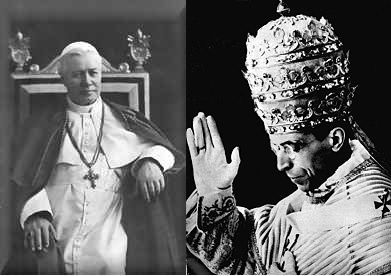
The Church’s Magisterium
The Catholic YEC is convinced that his strictly literal interpretation of Genesis is the only true one, and is likewise convinced that it is a dogma of the Catholic faith—not in the sense of a de fide dogma, but in the sense of an established “traditional doctrine”. Other phrases used are “the Church’s traditional understanding of the sacred history of Genesis”, “the traditional doctrine for faithful Catholics”, “the traditional teaching of the Church on creation”, “the traditional teaching on fiat creation”, and “the traditional Catholic doctrine of creation”.
Included in this “traditional doctrine”, in the mind of the Kolbe Center, are not only the standard YEC ideas about a young universe and a global flood, but also geocentrism, a rejection of uniformitarianism, and sin as the only possible source of natural evils such as disease and death, including for animals and plants.
The claim that YEC and all of these affiliated ideas are part of Church teaching is extraordinary and most certainly false. To bind Catholics to believe these ‘doctrines’ is to impose upon them far more than the Church herself does. There is no basis in the Church’s magisterium for claiming that any of these beliefs are binding on Catholics. And, as we will see later in this article, it is not the Catholic Church, but rather Protestant fundamentalists, who have pressed these interpretations of the Bible as non-negotiable for Christians.
This belief of the YEC Catholic biblicist that his own biblical readings are Catholic truth leads him to crusade for “the traditional doctrine”, to argue that it is taught by the magisterium, to accuse heliocentrists of liberalism, progressive creationists of undermining the Bible’s inerrancy, Big Bang Theorists of favoring Modernist exegesis, uniformitarians of exalting fallible human reason, and so on.
Let us see how he tries to find support for his doctrine in various statements of the Magisterium.
The Pontifical Biblical Commission
In 1909, the Pontifical Biblical Commission, under St Pius X, issued a number of decrees relating to the interpretation of the first chapters of Genesis. These decrees are important for Catholics, because St Pius X accorded them magisterial authority, stating in Praestantia Scripturae that “all are bound by the duty of conscience to submit to the decisions of the Biblical Pontifical Commission” (Dz 2113).
The decrees of 1909 clarified for Catholics, among other things, that the word for ‘day’ in Genesis 1 can be understood either in its literal sense as a natural day or in a non-literal sense as a certain space of time (Dz 2128).[1] In other words, the Church was clarifying that the YEC interpretation of Genesis is not the only one possible, that an ancient universe interpretation can be reconciled with Scripture and with the faith, and thus that YEC is not Catholic doctrine.
Hugh Owen of the Kolbe Center is not willing for an ancient universe to be an orthodox idea. Thus, he cannot allow that this PBC decree or anything else that the Magisterium has said counts for allowing Catholics to believe in long ages. The only thing for him to do is reinterpret the PBC decree, and even against the very secretary of the PBC who signed the decree.
Mr Owen begins by claiming “that the PBC insisted that the only acceptable interpretation of ‘day’ in Genesis 1 is one in which ‘the Church and the Fathers’ ‘lead the way’.”[2] He then applies his principle by saying that, since none of the Fathers held that the universe is ancient, that opinion is not permissible.
Perhaps he would be correct if the PBC stated what he claims. But it does not. In question 6, it says that we should follow the example of the Fathers in making allegorical and prophetical interpretations, after having determined the literal and historical sense.[3] This means that it is perfectly acceptable to make allegorical interpretations, not that we have to follow the Fathers in all of their interpretations. This is clear from question 4, where the PBC says that
in interpreting those passages of these chapters that the Fathers and Doctors have interpreted in divers ways without leaving anything definite or certain, it is permitted, subject to the judgment of the Church and the analogy of faith, to follow and defend that opinion which each one has prudently found correct. (DH 3515).
We have it on magisterial authority that the Fathers do not present a doctrinally-binding, unanimous consensus on the first chapters of Genesis. Although Catholic YECs claim binding consensus of the Fathers on a host of matters, Pius XII wrote in Divino Afflante Spiritu that
[T]here are but few texts whose sense has been defined by the authority of the Church, nor are those more numerous about which the teaching of the Holy Fathers is unanimous. There remain therefore many things, and of the greatest importance, in the discussion and exposition of which the skill and genius of Catholic commentators may and ought to be freely exercised, so that each may contribute his part to the advantage of all, to the continued progress of the sacred doctrine and to the defense and honor of the Church (Divino Afflante Spiritu §47)
The early chapters of Genesis do not fall into those “few texts” on which the Fathers are unanimous, as Pius XII made clear:
For not a few things, especially in matters pertaining to history, were scarcely at all or not fully explained by the commentators of past ages, since they lacked almost all the information which was needed for their clearer exposition. How difficult for the Fathers themselves, and indeed well nigh unintelligible, were certain passages is shown, among other things, by the oft-repeated efforts of many of them to explain the first chapters of Genesis . . . (Ibid., §31).
Since the Fathers interpreted Genesis 1 in many different ways without leaving anything certain, there is no doctrinal obligation for Catholics to follow the Fathers by holding that the universe is young. This is made obvious by the PBC stating in question 8 that ‘day’ can be interpreted as meaning a certain period of time. Incredibly, Owen claims, on the basis of his false principle indicated above, that ‘certain period of time’ can only mean instantaneously:
Rightly expounded, the PBC decrees of 1909 leave exegetes without any choice for the length of the creation period except for “six 24-hour days” or an instantaneous creation.
In other words, Owen only allows for ‘certain period of time’ to mean the opposite of what it means, ‘no time’, for what is instantaneous does not take place in time.
Moreover, he will not allow the very signer of the decree, Fr Fulcran Vigouroux, to provide him with the correct interpretation of the decree. Fr Vigouroux, as I have explained elsewhere, was the Secretary of the Pontifical Biblical Commission for almost the entire pontificate of St Pius X. Before having that role, while having that role, and after having that role, he firmly believed in an ancient universe and that ‘day’ in Genesis means a long period of time. In his Manuel Biblique, Ou Cours d'�criture Sainte a l'Usage Des S�minaires, Vol. 1: Ancien Testament; Introduction G�n�rale, Pentateuque, he states: “there is every reason to think that the word ‘day’ is a figurative expression which here means an ‘epoch’.”
Needless to say, it does not belong to any Catholic to interpret the statements of the magisterium. The Church being like any other authoritative body, it is for her legislators to interpret the laws that they promulgate, not the “legislated” or those to whom the laws apply. What I am seeking to do in this article and what I invite Catholic creationists to do is discover the authentic mind of the Pontifical Biblical Commission.
Many other perfectly orthodox pre-Vatican II figures could be quoted in support of the fact that Catholics have freedom on the question of ages, that they are not impinging on the inerrancy of Scripture, on the traditional teaching of the Church, or the authority of the Fathers, by holding that the universe is ancient. Both the 1913 Catholic Encyclopedia and the My Catholic Faith catechism, for instance, state this. The great Scripture manualists all allow for an ancient universe.
How then, we may ask, can Catholic YECers presume to understand a PBC decree in sense contrary to the understanding of the secretary of the PBC? How can they expect a document to have any meaning at all if the intended sense of ‘a certain period of time’ is ‘in no time’? But these reinterpretations of the magisterium simply become a necessity when one refuses to budge on one’s own interpretation of the Bible. Ironically, they bring Catholic creationists under the very censure of St Pius X against those who refuse to accept the decrees of the PBC.
Other Magisterial Documents
These are not the only statements that Catholic biblicists reinterpret in support of their dogma of a 6000 year old universe. They often quote, for instance, the following passage from Pope Leo XIII’s encyclical on marriage, Arcanum Divinae:
God, on the sixth day of creation, having formed man’s body from the slime of the earth and having breathed into his face the breath of life, gave him a companion whom He miraculously formed from the side of Adam when he was locked in sleep.
What they presume, in this passage, is that Pope Leo is understanding the word ‘day’ in the same way that they understand it, a presumption that is by no means evident. If ‘day’ means ‘epoch’, then there is no problem reconciling this passage with belief in an ancient universe. Since Pope Leo appointed Fr Vigouroux to be secretary of the PBC shortly before his death, we may expect that he had no difficulty with such an interpretation.
They believe that another quotation, this time of Vatican I, completely seals their case. It reads as follows:
If anyone says that it is possible that to the dogmas declared by the Church a meaning must sometimes be attributed according to the progress of science, different from that which the Church has understood and understands, let him be anathema (Dz 1818).
This quotation, however, refers to dogmas of the Church and the age of the universe is certainly not a dogma of the Church. This is, in fact, the entire question under dispute. As I have mentioned, Catholic biblicists assert that what they call the ‘traditional Catholic doctrine of creation’ includes, as dogma, the creation of the universe fully formed and its creation a mere six to ten millennia ago. But this claim is all their own and certainly not that of the magisterium. One finds, for instance, in Ludwig Ott’s Fundamentals of Catholic Dogma[4], no mention of such dogmas, but rather clear statements about the flexibility of interpretation allowed, such as the following:
The Biblical account of the duration of and order of Creation is merely a literary clothing of the religious truth that the whole world was called into existence by the creative word of God. The Sacred Writer utilized for this purpose the pre-scientific picture of the world existing at the time. The numeral six of the days of the Creation is to be understood as an anthropomorphism. (p. 93)
Hugh Owen complains that “again and again, the progressive creationists and theistic evolutionists accuse the members of the Kolbe Center of exalting their private opinions above the Magisterium of the Church.” The reason for this accusation is evident. They are interpreting the magisterium against the magisterium. They are inventing their own dogmas.
[1] The Latin of the decree says “Utrum … sumi possit vox dies sive sensu proprio pro die naturali, sive sensu improprio pro quodam temporis spatio”. The Denzinger-Hunermann English translation (DH) renders ‘sive sensu proprio sive sensu improprio’ as literal or non-literal sense.
[2] These quotations, unless otherwise noted, are taken from http://kolbecenter.org/scoffers-will-...
[3] “Presupposing the literal and historical sense, may an allegorical and prophetical interpretation of certain passages of these same chapters, corresponding to the luminous example of the holy Fathers and the Church herself, be prudently and usefully applied? Yes.” (DH 3517)
[4] This work is a standard reference for Catholics to discover the doctrinal weight of Catholic beliefs.
January 13, 2019
The Reinterpretations of ‘Catholic’ Biblicism: Introduction
In this four part article, Fr Robinson considers how Catholic biblicists falsify the data of theology, history and science in order to support their claim that a young Earth and geocentrism are doctrines of the Catholic Church. The remaining installments of the article will appear in the succeeding weeks.
Introduction
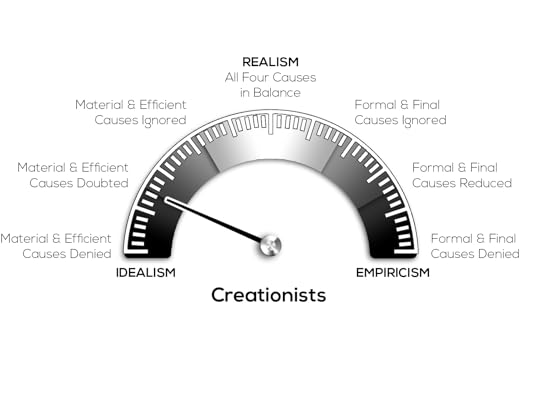
In The Realist Guide to Religion and Science, I try to stake out the territory of reasonable religion and reasonable science by using realism. Realism is a view of human knowledge that accepts both the data of our senses and the concepts of our mind as being true of reality. It is contrasted with idealism, which holds that only concepts are true, and empiricism, which holds that only sense data is true.
Despite the fact that idealists and empiricists hold opposite views on what is true, they yet have various characteristics in common. For one thing, they both truncate reality, reducing it to only what can be known either by concepts or the senses. For another, they are both unable to have a coherent view of reality, a view that is logically consistent with its own assumptions.
There is a third characteristic shared by these two epistemologies, however, that I would particularly like to highlight, and that is their ability to reinterpret the facts. At first, there may be just a few pieces of evidence that come in against their worldview, and the empiricist or idealist dutifully passes that evidence through their particular reality filter, reinterpreting it to suit their truth. But this is only the beginning of their reinterpretation skill. Over time, the evidence mounts, and the reinterpretation filter starts to wear down. New resources of creativity have to be summoned. In the end, many empiricists and idealists are up to the task. Despite the immense strain on their credibility, they cling firmly to their worldview, mountain of evidence be damned.
Allow me to provide a few examples from the empiricist side. Empiricists believe that reality just must be only material. There is absolutely no possibility for the immaterial to exist. In chapter 9, I mention how atheists were determined that the universe be eternal, self-existing, and uncaused, to serve their materialistic worldview. Then, their own science taught them that the universe began in time, is contingent, and manifests all of the signs of being caused by a transcendent, omnipotent being.
That, at least, is the only sane inference that a believer in the Big Bang can make. But the confirmation of the Big Bang Theory failed to turn some atheist scientists into theists. They were the scientists with the most robust reality reinterpretation filter. Being committed to materialism as an unchangeable first principle, they had to find a way to fit the Big Bang into their materialism, rather than make a rational inference from the Big Bang. What was that way? To say that the universe emerged from nothing by vibrations of a quantum vacuum, because of the pre-existing laws of physics!
By saving their materialism in such a way, such scientists end up sacrificing everything else: their own credibility, their own rationality, and even science itself, since they slay the principle of causality on which science operates by having universes spontaneously emerge.
In chapter 10, I show how some scientists in origin of life studies manifest similar resources of creativity. When confronted with the staggering fact that all life on Earth contains a coded language that is interpreted by cellular mechanisms in order to run the processes of physical life, they do not thereby conclude the obvious: there is a supreme intelligence at the source of life. On the contrary, true believers in empiricism can never have recourse to immaterial explanations, no matter how reasonable they are. They would rather serve up this compelling argument: life is that complex, so it must have been seeded on Earth by space aliens!
Needless to say, this idea, which they embellish with the fancy name of “directed panspermia”, is of no credit to science and, of course, is not scientific.
But it is not just scientistic empiricists who can reinterpret facts to fit their cherished ideas; religious believers can do the same. Sts. Augustine and Thomas Aquinas warn Catholics not to cling stubbornly to their own interpretation of the Bible when it is contradicted by the facts. Doing so exposes religion to mockery just as much as clinging to materialism in the face of so much evidence against it exposes science to mockery. We do not want religion to be mocked; we want it to be respected. But, for it to be respected, it must be reasonable.
Some Catholics have fallen into this trap of dogmatizing their particular interpretation of the Bible. Specifically, they hold that Genesis must be interpreted as teaching that the earth is 6000-10000 years old and was created fully formed either in six, 24 hour days, or instantaneously. Any long-age interpretation, they opine, “calls into question the inerrancy of the chronological information contained in the sacred history of Genesis”. In other words, their reading of Genesis must be the true sense of Scripture, and so one who believes that the universe is ancient is not simply supporting a possible interpretation of Scripture, but is contradicting the very truth of Scripture.
In their defense, these Catholic biblicists believe that the interpretation which they defend is not their own, but that of the Church. They even go so far as to claim that their position has been “believed and taught by all of the Fathers, Doctors, Popes and Council Fathers in their authoritative teaching”.
The main problem is that these statements are quite manifestly false. Specifically, they are opposed by three classes of facts: those contained in the Church’s magisterium, in history, and in science. To get around these facts, Catholic Young Earth Creationists (YEC) must reinterpret them in order to save the dogmatic status they impose on their reading of Genesis. Let us consider the facts in each of these areas and their reinterpretation.
December 18, 2018
Why does God allow evil?
If God is in control and causes all things to work for the good in believers, how do things like the Holocaust happen?
Imagine that one day, in a far-off world, three new countries came into being with three new rulers. These three rulers had immense powers to rule their people; they were so powerful that they could even control the minds of the nation’s citizens, if they wanted to. But each of the rulers had a very different idea about how his nation should be run.
The first ruler, named Shu Gar Dadie, governed the nation of Secularia. His idea was that the very best thing for his people was to let them do whatever they want. He would try to govern them as little as possible, so that they could have full exercise of their free will. For Shu, absolute liberty was the core element of humanity, the supreme law for human existence. To execute this law, he would make sure that, if this or that person did not have the resources to be able to do what he or she wanted, the ‘government’ would provide it for free.
Shu was immensely happy with his plan, as he was convinced that his nation would be the best civilization that ever existed, and so he immediately put his plan into execution. The citizens of Secularia started pouring into the government offices, asking for all manner of things that they desired. If they asked for a comfortable house to live in, the government would build it. If they asked for advanced public transportation, the government would widen the roads and lay down the rails for the trains. If they asked for new equipment for farming the countryside, the government would hasten to supply it.
What Shu found, however, was that, over time, most people did not ask for these things. He started to get many alcoholics who wanted free liquor, sexual predators who wanted free pornography and prostitutes, unwed mothers who wanted unlimited abortions, generally disgruntled malcontents who wanted a hitman to knock off their least-favorite person, obsessive gamblers demanding another supply of $10000 for their next spree on the poker machines.
Prime Minister Dadie was a bit surprised at these requests, but he was a man of principle. The will of the people is supreme! He would give them everything that their hearts desire; their will was his will. If he inflicted punishments, laid down laws, or exhorted his people to this or that type of behavior, that would only be to constrain their free will and so hamper their humanity. No, Dadie was a man of strict policy and he would stay with the plan.
After ten years of PM Dadie’s rule, Secularia crumbled, becoming the shortest-lived country in human history. To this day, if you visit the former site of its capital city, you can hardly find a trace of it, such was the thoroughness of the self-destruction its citizens worked on themselves and on one another by their unbridled wills.
The second ruler, the lord of Puritania, was named Calvin N. John. He completely despised Shu Gar and all of his hopeless policies. Calvin wanted his land to be full of order and regularity. He did not want there to be any lying, cheating, or stealing; no murdering, no sexual disorders, no evil anywhere at any time.
Cal began by issuing his decrees and threatening severe punishments for those who disobeyed them. At first, the populace was terrified of King Cal and was careful not to fall awry of the laws. But, over time, the atmosphere in Puritania became oppressive. Some people wanted to break the law out of defiance, just to manifest that they had a will of their own.
That was when the public executions began. King Cal used them and other means to inspire a greater fear in the people, so that they would refrain from doing any evil. But he found that the more force and terror he used, the more the populace was spinning out of control with bursts of rebellion. It was chafing under a rule that managed minor details with the same rigor as the most basic laws.
At a certain point, King Cal decided that enough was enough: he would have to employ mind control to achieve perfect regularity in his realm. He looked into the minds of all of the citizens at every moment. When someone was getting ready to speak a lie, King Cal would distract his mind. When a married man would begin to lust after an unmarried woman, King Cal would blot her out of his memory. When anyone started to have the first movements of anger, King Cal would step in and quiet the mind. While at the beginning, Calvin only did this occasionally, he realized, over time, that he would have to control all the minds all the time if he was to have any real order. He could not let go of any of his citizens for a moment; he could not ever trust them to think the right thoughts to will the right choices.
The results were quite effective: murder, adultery, lying, stealing, all evils were wiped out of Puritania. But a strange thing happened to the people. They started to realize that their minds and so also their activities were being controlled. They began to fear to do anything on their own, to have any of their own personal thoughts. For, if they did, they knew that some force would grab their minds and take them over, something they did not want to happen. It was like always being about to take a step on your own and always being prevented from taking it. At Sisyphus—who was condemned by the gods to roll a rock up a hill forever—could at least roll his rock most of the way up the hill. The subjects of King Cal could not even begin the first step of their own activity. Thus, the best thing to think and do was nothing.
Today, if you go to Puritania, you will see the cleanest and most methodical cities in the universe. But, if you stare into the face of someone there, you do not see anything, just a blank, soulless, zombie-like gaze into the near distance.
The third and final kingdom was ruled by someone named Realist E. Wisdom. When his people were wondering whether they should call him ‘king’ or ‘president’ or ‘grand poohbah’, he suggested that they just refer to him as Father Wisdom. They did this and also decided to name the kingdom Realia after him.
Father Wisdom wanted the very best for his citizens. He realized that this was not always what they wanted for themselves and so that he would have to assist them. At the same time, he did not want to assist them to the point that he took away their free will. That would not be the best for them, as then they would no longer be human.
As such, Father Wisdom decided on a compromise: he would go ahead and influence their choices, but he would do so in such a way that his influence would not take away the freedom of those choices. He would map out the way for them to find happiness, but not force them to follow it.
There were several things that Father Wisdom did to achieve this delicate balance. First of all, he made sure that every child in the kingdom was born with a pre-programmed guide for how to achieve happiness through the good and avoid the unhappiness of evil. He called this guide Conscience 1.0.
The guide worked pretty well as far as it goes, but it certainly did not take away the free will of the people in Realia. There were not a few people who did not like the pre-programmed rules and wrote a new program which they called Conscience Warp and which they claimed was far superior to Conscience 1.0. Over time, so many people were installing Conscience Warp on their children that there were not many copies of Conscience 1.0 left.
This is why Father Wisdom needed to provide some additional help. He did this in three main ways. The first way was to send some delegates out periodically in his name to remind people of the right path to happiness and show them how much damage Conscience Warp was doing to the population. When this happened, some people would listen to the delegates and get back on track with Conscience 1.0, though generally, they were not well received. Once, Father Wisdom sent his son Carnate Wisdom to help people get back on track, because so many were irrationally opposed to his assistance. During C. Wisdom’s visit to the population, he codified Conscience 1.0, so it would not get lost and also expanded and clarified it into the Conscience Deposit. In order to make his visit lasting, he established an organization to keep track of the CD and try to promote it throughout the nation. Though Carnate was killed by the promoters of Conscience Warp, he came back from the dead and Father Wisdom gave him the power to be at many places at once throughout the kingdom, in something called the Real Presence. This was the most powerful means for him to assist his organization to hold on to CD and lead the universal CD community to happiness.
The second way was to provide each person with little mental nudges throughout their life, delicate impulses to do the right thing, each of which he called a ‘freedom act’. Some people appreciated these nudges, while others totally ignored them.
The last way was to guarantee a free and open line of appeals. Those who wanted his help, who really saw him as their father, and who liked his freedom acts, could call upon him at any time and be assured of a hearing. All they had to do was open their hands, put them together, and look to the sky. It might take a while for the help to arrive, but it would eventually do so.
Despite all these efforts to lead his people to happiness and assist them to be perfect, Father Wisdom realized that, as long as free will existed, there would always be evil. He could not take evil away without taking free will away. But he did not like Calvin John’s solution to this difficulty and so he decided to deal with evil and its attendant sufferings in such a way that he would not take away either free will or evil, but he would bring the best possible outcome from the existence of evil.
What he decided on was a punishment and rewards based system that would correspond both to his own providential arrangements for his people’s welfare and their pursuit of their best interests. Basically, he announced to his people that he would keep track of all of the deeds and decisions they made throughout their entire life. Then, when each of Realia’s denizens died, they would pass on to one of his other kingdoms. Before doing so, the tally for their entire life would be taken and their punishment or reward would be assigned to them.
Those who were unjust during their life and had paid no attention to CD and what was best for them would reside in Hocky Styx, where all such people live. Those who were just during their life, did good and avoided evil would go to Cloud Empyrean. Once you passed on to these other regions of Father Wisdom’s domains, there was no possibility of changing your conscience. You would either have the Conscience Warp or the Conscience Deposit forever and so would be fixed in either the bad or the good that you had chosen.
It was in this way that Father Wisdom was able to attain the best solution for dealing with his citizens’ use or abuse of their free will. He would assist his people to be good, but would not force them. For those who choose to accept his assistance, no matter what they suffer in their life in Realia, good will come out of it—a personal good for themselves, a communal good for those around them, and a final and lasting good in Cloud Empyrean: a personal good because they are most fulfilled in following Father Wisdom; a communal good because that results in the most harmonious and peaceful society; and a lasting good because they get to enjoy both of those goods forever after death in the Empyrean.
For those who refuse Father Wisdom’s assistance, well, they are not really going to have a good time doing what is worst for themselves in Realia. But, then, they will have hell to pay afterwards when they get to Hocky Styx. In this way, no matter what happens in Realia, it all comes out right in the end.
If the third ruler is God, then I think there is an adequate answer for suffering in this life. If the first or the second ruler is God, then suffering in this life would seem to be meaningless.
Imagine that one day, in a far-off world, three new countries came into being with three new rulers. These three rulers had immense powers to rule their people; they were so powerful that they could even control the minds of the nation’s citizens, if they wanted to. But each of the rulers had a very different idea about how his nation should be run.
The first ruler, named Shu Gar Dadie, governed the nation of Secularia. His idea was that the very best thing for his people was to let them do whatever they want. He would try to govern them as little as possible, so that they could have full exercise of their free will. For Shu, absolute liberty was the core element of humanity, the supreme law for human existence. To execute this law, he would make sure that, if this or that person did not have the resources to be able to do what he or she wanted, the ‘government’ would provide it for free.
Shu was immensely happy with his plan, as he was convinced that his nation would be the best civilization that ever existed, and so he immediately put his plan into execution. The citizens of Secularia started pouring into the government offices, asking for all manner of things that they desired. If they asked for a comfortable house to live in, the government would build it. If they asked for advanced public transportation, the government would widen the roads and lay down the rails for the trains. If they asked for new equipment for farming the countryside, the government would hasten to supply it.
What Shu found, however, was that, over time, most people did not ask for these things. He started to get many alcoholics who wanted free liquor, sexual predators who wanted free pornography and prostitutes, unwed mothers who wanted unlimited abortions, generally disgruntled malcontents who wanted a hitman to knock off their least-favorite person, obsessive gamblers demanding another supply of $10000 for their next spree on the poker machines.
Prime Minister Dadie was a bit surprised at these requests, but he was a man of principle. The will of the people is supreme! He would give them everything that their hearts desire; their will was his will. If he inflicted punishments, laid down laws, or exhorted his people to this or that type of behavior, that would only be to constrain their free will and so hamper their humanity. No, Dadie was a man of strict policy and he would stay with the plan.
After ten years of PM Dadie’s rule, Secularia crumbled, becoming the shortest-lived country in human history. To this day, if you visit the former site of its capital city, you can hardly find a trace of it, such was the thoroughness of the self-destruction its citizens worked on themselves and on one another by their unbridled wills.
The second ruler, the lord of Puritania, was named Calvin N. John. He completely despised Shu Gar and all of his hopeless policies. Calvin wanted his land to be full of order and regularity. He did not want there to be any lying, cheating, or stealing; no murdering, no sexual disorders, no evil anywhere at any time.
Cal began by issuing his decrees and threatening severe punishments for those who disobeyed them. At first, the populace was terrified of King Cal and was careful not to fall awry of the laws. But, over time, the atmosphere in Puritania became oppressive. Some people wanted to break the law out of defiance, just to manifest that they had a will of their own.
That was when the public executions began. King Cal used them and other means to inspire a greater fear in the people, so that they would refrain from doing any evil. But he found that the more force and terror he used, the more the populace was spinning out of control with bursts of rebellion. It was chafing under a rule that managed minor details with the same rigor as the most basic laws.
At a certain point, King Cal decided that enough was enough: he would have to employ mind control to achieve perfect regularity in his realm. He looked into the minds of all of the citizens at every moment. When someone was getting ready to speak a lie, King Cal would distract his mind. When a married man would begin to lust after an unmarried woman, King Cal would blot her out of his memory. When anyone started to have the first movements of anger, King Cal would step in and quiet the mind. While at the beginning, Calvin only did this occasionally, he realized, over time, that he would have to control all the minds all the time if he was to have any real order. He could not let go of any of his citizens for a moment; he could not ever trust them to think the right thoughts to will the right choices.
The results were quite effective: murder, adultery, lying, stealing, all evils were wiped out of Puritania. But a strange thing happened to the people. They started to realize that their minds and so also their activities were being controlled. They began to fear to do anything on their own, to have any of their own personal thoughts. For, if they did, they knew that some force would grab their minds and take them over, something they did not want to happen. It was like always being about to take a step on your own and always being prevented from taking it. At Sisyphus—who was condemned by the gods to roll a rock up a hill forever—could at least roll his rock most of the way up the hill. The subjects of King Cal could not even begin the first step of their own activity. Thus, the best thing to think and do was nothing.
Today, if you go to Puritania, you will see the cleanest and most methodical cities in the universe. But, if you stare into the face of someone there, you do not see anything, just a blank, soulless, zombie-like gaze into the near distance.
The third and final kingdom was ruled by someone named Realist E. Wisdom. When his people were wondering whether they should call him ‘king’ or ‘president’ or ‘grand poohbah’, he suggested that they just refer to him as Father Wisdom. They did this and also decided to name the kingdom Realia after him.
Father Wisdom wanted the very best for his citizens. He realized that this was not always what they wanted for themselves and so that he would have to assist them. At the same time, he did not want to assist them to the point that he took away their free will. That would not be the best for them, as then they would no longer be human.
As such, Father Wisdom decided on a compromise: he would go ahead and influence their choices, but he would do so in such a way that his influence would not take away the freedom of those choices. He would map out the way for them to find happiness, but not force them to follow it.
There were several things that Father Wisdom did to achieve this delicate balance. First of all, he made sure that every child in the kingdom was born with a pre-programmed guide for how to achieve happiness through the good and avoid the unhappiness of evil. He called this guide Conscience 1.0.
The guide worked pretty well as far as it goes, but it certainly did not take away the free will of the people in Realia. There were not a few people who did not like the pre-programmed rules and wrote a new program which they called Conscience Warp and which they claimed was far superior to Conscience 1.0. Over time, so many people were installing Conscience Warp on their children that there were not many copies of Conscience 1.0 left.
This is why Father Wisdom needed to provide some additional help. He did this in three main ways. The first way was to send some delegates out periodically in his name to remind people of the right path to happiness and show them how much damage Conscience Warp was doing to the population. When this happened, some people would listen to the delegates and get back on track with Conscience 1.0, though generally, they were not well received. Once, Father Wisdom sent his son Carnate Wisdom to help people get back on track, because so many were irrationally opposed to his assistance. During C. Wisdom’s visit to the population, he codified Conscience 1.0, so it would not get lost and also expanded and clarified it into the Conscience Deposit. In order to make his visit lasting, he established an organization to keep track of the CD and try to promote it throughout the nation. Though Carnate was killed by the promoters of Conscience Warp, he came back from the dead and Father Wisdom gave him the power to be at many places at once throughout the kingdom, in something called the Real Presence. This was the most powerful means for him to assist his organization to hold on to CD and lead the universal CD community to happiness.
The second way was to provide each person with little mental nudges throughout their life, delicate impulses to do the right thing, each of which he called a ‘freedom act’. Some people appreciated these nudges, while others totally ignored them.
The last way was to guarantee a free and open line of appeals. Those who wanted his help, who really saw him as their father, and who liked his freedom acts, could call upon him at any time and be assured of a hearing. All they had to do was open their hands, put them together, and look to the sky. It might take a while for the help to arrive, but it would eventually do so.
Despite all these efforts to lead his people to happiness and assist them to be perfect, Father Wisdom realized that, as long as free will existed, there would always be evil. He could not take evil away without taking free will away. But he did not like Calvin John’s solution to this difficulty and so he decided to deal with evil and its attendant sufferings in such a way that he would not take away either free will or evil, but he would bring the best possible outcome from the existence of evil.
What he decided on was a punishment and rewards based system that would correspond both to his own providential arrangements for his people’s welfare and their pursuit of their best interests. Basically, he announced to his people that he would keep track of all of the deeds and decisions they made throughout their entire life. Then, when each of Realia’s denizens died, they would pass on to one of his other kingdoms. Before doing so, the tally for their entire life would be taken and their punishment or reward would be assigned to them.
Those who were unjust during their life and had paid no attention to CD and what was best for them would reside in Hocky Styx, where all such people live. Those who were just during their life, did good and avoided evil would go to Cloud Empyrean. Once you passed on to these other regions of Father Wisdom’s domains, there was no possibility of changing your conscience. You would either have the Conscience Warp or the Conscience Deposit forever and so would be fixed in either the bad or the good that you had chosen.
It was in this way that Father Wisdom was able to attain the best solution for dealing with his citizens’ use or abuse of their free will. He would assist his people to be good, but would not force them. For those who choose to accept his assistance, no matter what they suffer in their life in Realia, good will come out of it—a personal good for themselves, a communal good for those around them, and a final and lasting good in Cloud Empyrean: a personal good because they are most fulfilled in following Father Wisdom; a communal good because that results in the most harmonious and peaceful society; and a lasting good because they get to enjoy both of those goods forever after death in the Empyrean.
For those who refuse Father Wisdom’s assistance, well, they are not really going to have a good time doing what is worst for themselves in Realia. But, then, they will have hell to pay afterwards when they get to Hocky Styx. In this way, no matter what happens in Realia, it all comes out right in the end.
If the third ruler is God, then I think there is an adequate answer for suffering in this life. If the first or the second ruler is God, then suffering in this life would seem to be meaningless.
November 28, 2018
The Fathers’ Understanding of Genesis 1
What follows is the conclusion of an essay by Fr Fulcran Vigouroux (1837-1915) entitled “The Mosaic Cosmogony according to the Fathers of the Church”, . A ‘cosmogony’ is a viewpoint on the origin or creation of the world or universe. In his essay, Fr Vigouroux explains the diversity of opinions of the Fathers on the proper interpretation of Genesis 1. He then justifies interpreting the word ‘day’ in Genesis figuratively as an epoch or a long period of time.
Fr Vigouroux wrote his essay in 1882. His words are important for Catholics because they provide a perspective on the state of the question at that time and also because of the theological authority of Fr Vigouroux himself. He went on to become the first secretary of the Pontifical Biblical Commission and held that post for most of the pontificate of St Pius X, from 1903 to 1913. He was considered to be a great anti-Modernist Catholic exegete and a formidable ally of St Pius X in the battle against Scriptural interpretations that undermine the faith. The most important declarations of the PBC appeared during Fr Vigouroux’s term as its secretary, and he likely collaborated in putting together the condemned propositions found in Lamentabili, the majority of which concern errors in Scripture. The works of Fr Vigouroux are so important that many of them are still in print today, including this essay. What follows below is a translation of pages 113-123 of La Cosmogonie Mosaïque: d'après les Pères de l'Êglise.
Conclusions
After having studied in detail the ideas of the Fathers on the Biblical cosmogony, let us take a backward glance, in order to draw some conclusions from the study.
The first thing that strikes us in the exposé just given is the diversity of thought that the ancient ecclesiastical authors had on the scientific interpretation of the first chapter of Genesis. As much as they agree on the dogmatic sense of the preface of the sacred book, to that same degree do they differ on the manner of understanding the mode and the details of creation. We have seen how they were divided into two opposed camps on one capital point, the duration of creation. Some, such as Clement of Alexandria, Origen, Saint Athanasius, Saint Augustine and others, believed that it took place in an instant. The others believed that it took place successively. The differences become all the greater in the various particular questions.
What does this lack of agreement among the Fathers mean for us?
Well, even if these venerable writers had been unanimous in their scientific explanation of the origin of the world, we would in no way be obliged to conform ourselves to their opinions, because science is not a deposit that has been preserved by tradition, as revealed truth is. In matters of faith, we must believe quod semper, quod ubique. In matters of science, we must accept the certain progress that the accumulation of the observations of experimenters have brought us in the train of the centuries. We are no more bound by the scientific ideas of the Fathers than the scientists of today are bound by the ideas of the scientists of the past. We can reject those ideas, without lacking in respect to their authors, with the same liberty that today’s astronomers have rejected the system of Ptolemy.
But if the exegete could maintain his independence, even if the Fathers had been an agreement, how much more does he have the right to form his personal opinion in the midst of the conflict and the fluctuation of opinions that have existed throughout history.[i] The theologian himself has the right to choose the opinion that pleases him more, in dogmatic matters, when the ancient tradition is divided and vacillating, at least when the Church has not since settled the question. But the infallible authority of the Church has not only never pronounced on the scientific interpretation of the Biblical cosmogony, but has not even pronounced on the question of simultaneous creation.[ii] Thus, it is a proven and incontestable fact that the Catholic can explain the Mosaic cosmogony by giving it the sense that appears to him to be the most conformed to the facts of true science, with the sole condition that he observes the rules of hermeneutics and interpretation of the sacred books.
Having noted the independence and the rights of the exegete in scientific matters, let us now examine to what point one can claim that we today diverge from patristic teaching.
The key issue in this present question is not the details, since the Fathers did not agree on them amongst themselves; the key question is the principles that they followed and which were common to all of them. These principles are that it is necessary to make use of reason, of science, in its certain facts, in order to interpret the Mosaic cosmogony. The motive which led the Alexandrian school to hold to a simultaneous creation was, as we have seen, the desire to reconcile the Bible with the philosophical systems which were then in vogue, as those systems seemed to contain the truth.[iii] Most ecclesiastical writers have likewise based their cosmogonic interpretations on what they believed to be the science of their time. We have heard Saint Augustine proclaiming with force the necessity of making exegesis agree with scientific fact, “acquired by reasoning or experience”.[iv]
This principle of our masters in the faith is likewise our own. If we do not agree with them in the details, it is not because the principle has changed. It is rather because science has progressed. We are doing what they would have done in our place. They accepted what the scientists of their time taught; we accept what the scientists of our day teach.[v] Thus, there is only a change in the interpretation because there is a change in the science, and this change cannot be blamed on theology, but on science itself which, by its nature, makes progress. No one would do well to reproach science for its progress. Why should we forbid ourselves from making use of it, since we are not abandoning the fundamental and essential points of our traditions, but, on the contrary, we continue to apply the principles which have guided the interpreters of holy Scripture in all times? The more knowledge of nature we have, the more the sacred text becomes clear for us; but its authority always remains the same.
Let us go even further and show that not only do we maintain the rules laid down by our Fathers, but that we maintain an important part of their explanations. Although, on one hand, we are in no way obliged to accept the scientific ideas of the Christian doctors, and although, on the other hand, they were not professional scientists, yet the vast majority among them were men imminent by their intelligence and their virtue, and the penetration of their mind made them discover, in the sacred texts, truths as yet unknown by the world and now confirmed by the discoveries of our age.
Among these truths, let us pause especially on the one which is the most important in the cosmogony, that of the sense that should be given to the word ‘day’ in the narrative of Genesis. Contemporary exegetes, who accept the findings of geology, maintain that this word must not be understood in a proper sense, as a duration of 24 hours, but in a figurative sense, as simply signifying time. Well, they are not the first authors to put forward this opinion. We find it first in the Fathers.
It is true that no Father of the Church explicitly taught that the six days of creation were periods of an indeterminate length. We have mentioned that Saint Justin and Saint Gregory Nazianzen held that there was a long interval of time between the creation of matter and the creation of light.[vi] We do not, however, encounter any conclusive text in the writings of the Fathers, aside from the words of Saint Bede that we have quoted.[vii]
We have mentioned that Saint Augustine and the Venerable Bede said that the seventh day did not have an evening; but neither of them held nor suspected the idea of what is today called the day-epoch. All the efforts that have been made to interpret some texts of the Bishop of Hippo in this sense have been fruitless. How could he have maintained that the six days of Genesis designated a long space of time when he taught that they only signified an instant? Several passages of the Fathers that we have cited[viii] attest that they saw clearly that the Bible uses the word ‘day’ in an indefinite sense. But, because of the level of science at their time, they could not have imagined making an application of this sense to the first chapter of Genesis. We cannot doubt, however, that many of them, in conformity with their principles, would have adopted the system of the day-epoch, if they lived today.
For the rest, whatever is involved in these points of detail, it matters little. From our historical exposition, there rises in a peremptory fashion an entire famous patristic school, that of Alexandria in the East, and a great number of Latin Fathers, Saint Augustine at their head, holding that the word ‘day’, in the first chapter of Genesis, must not be understood in a proper sense, but in a figurative sense. They do not explain it in the same way that we do, I well understand, but it does not remain any less certain that we are not making an innovation in interpreting the word in a figurative sense.[ix]
Moreover, some of the reasons which the Fathers used to establish their opinion still keep all of their value today. We can repeat with Origen that the Bible itself gives us to understand that the days of Genesis are not ordinary days, solar days, since it teaches us that, during the first three days, the sun did not yet exist. We also have the right to remark with him and with Saint Augustine that the word ‘day’, in scriptural language, does not always designate a space of 24 hours, since, at the beginning of the second chapter of Genesis, it designates the entire period of creation: “These are the generations of the heaven and the earth, when they were created, in the day that the Lord God made the heaven and the earth, And every plant of the field before it spring up in the earth, and every herb of the ground before it grew” (Gen. 2:4).
But the Fathers have not only furnished us with reasons that can be exploited in favor of the modern discoveries of science. Some of their explanations are completely in agreement with them.
Most scientists today hold that the universe existed at first in an uninformed state. It was only successively that the first matter underwent transformation and produced the diverse creatures which make up the world today.
As we have seen, this is the same opinion as that of Saint Ephrem, Saint Basil, Saint Gregory Nazianzen, Saint Gregory of Nyssa, Saint Ambrose, Severian of Gabala and others as well. Although Saint Augustine held to a simultaneous creation, he nevertheless explained it in certain passages of his writings in terms that one could almost reproduce in a modern treatise on origins:
“In the beginning”, he says in the first book of his On Genesis against the Manichees, “God created the heaven and the earth. The whole creature made and produced by God is designated by the words heaven and earth. The creature is so called, using the name of visible things, because of the weakness of the little ones, who are so little able to comprehend invisible things. Thus, matter was created first of all in a confused and unformed state, so that individual beings which have a single form might be taken from it; that is what the Greeks call, I believe, chaos. This unformed matter, that God took from nothing, was thus firstly called heaven and earth, and it is written ‘in the beginning God created the heaven and the earth’, not because it already existed (the heaven and the earth), but because it was destined to exist.[x] We consider the seed of a tree, we say that it contains the roots, the trunk, the branches, the fruits, and the leaves, not because they are there, but because they are going to come out of the seed. It is in this sense that it was said ‘in the beginning God made the heaven and the earth’, that is, the seed of heaven and earth, when the matter of heaven and earth were still confused [in a single whole]; because it was certain that the heaven and the earth would come out of it, this matter is already called [by anticipation] the heaven and the earth… We find innumerable examples of similar locutions in the Holy Scriptures.”[xi]
So it is that we find that a great number of Fathers in the East and the West explain the origin of the world, following Genesis, the way that modern scientists do.
We have had occasion to remark as well that several among them, along with the scientists of our days, do not think that the sun, properly speaking, was created on the fourth day. If the details that they gave on the subject are not so exact, on account of the ignorance in their day about the true nature of light, it does not remain less true that their ideas resemble modern theories.
The same holds true for some other points of detail that it is not worthwhile to get into. What we have already said will suffice for the end that we have set for ourselves. It seems that we have demonstrated that Catholic exegesis has never changed its principles and that it does today what it has always done: it sees the very word of God in Holy Scripture, but brought down to the level of men and consequently expressed in human language. In every age, Christians have made use of the sciences in order to interpret the Bible; every scientific discovery cast a new light on some point of the sacred text. The Fathers saw therein a part of the truth, the part that the science of their times permitted them to see; we continue their work in making use of the science of our day and, like them and with them, we believe that nulla unquam inter fidem et rationem vera dissension esse potest (there can never be any real disagreement between faith and reason).
[i] It is certain that the authority of the Fathers is only definitive in matters of faith and on the condition that they are unanimous. That is what the Church has always taught. The First Vatican Council, repeating in practically the same terms what the Council of Trent said on the subject, expresses itself in this way: “But, since the rules which the holy Synod of Trent salutarily decreed concerning the interpretation of Divine Scripture in order to restrain impetuous minds, are wrongly explained by certain men, We, renewing the same decree, declare this to be its intention: that, in matters of faith and morals pertaining to the instruction of Christian Doctrine, that must be considered as the true sense of Sacred Scripture which Holy Mother Church has held and holds, whose office it is to judge concerning the true understanding and interpretation of the Sacred Scriptures; and, for that reason, no one is permitted to interpret Sacred Scripture itself contrary to this sense, or even contrary to the unanimous agreement of the Fathers” (Dz 1788). No Father, by himself, represents the doctrine of the Church. It is their number and their agreement that makes for their authority in matters of faith and morals in regard to the instruction of Christian doctrine.
[ii] “Holy Scripture, it is perfectly true, does declare a few momentous facts, so few that they may be counted, of a physical character. It speaks of a process of formation out of chaos which occupied six days; it speaks of the firmament; of the sun and moon being created for the sake of the earth; of the earth being immovable; of a great deluge; and of several other similar facts and events. It is true; nor is there any reason why should we should anticipate any difficulty in accepting the statements as they stand, whenever their meaning and drift are authoritatively determined; for, it must be recollected, their meaning has not engaged the formal attention of the Church, or received any interpretation which, as Catholics, we are bound to accept; and, in the absence of some definite interpretation, there is perhaps some presumption in saying that it means this, and does not mean that. And this being the case, it is not at all probable that any discoveries ever should be made by physical inquiries incompatible at the same time with one and all of those senses which the letter admits, and which are still open.” Cardinal Newman, lecture on “Christianity and Physical Science”, in The Idea of a University, p. 330.
[iii] Origen even explicitly stated that profane knowledge is necessary for anyone who wants to study Holy Writ. Philocalia, c.xiv, In Gen., vol. III, t. xii, col. 88. St Gregory the Miracle-worker reports that he taught his disciples physics and astronomy before explaining the Bible to them. In Orig., n.8, PG, vol. X, col. 1077. cf. Mgr Freppel, Origène, t.I, p.45f.
[iv] “Certissima ratione vel experiential teneat.” De Genesi ad litt., bk. I, c.xix, n.39. Just before this, in n.38, when speaking of possible errors made by interpreters on the subject of the light created on the first day, St Augustine says: “Quod si factum fuerit, non hoc habebat divina Scriptura, sed hoc senserat humana ignorantia.” He also says in bk, II, c.1, n.2, col.224: “Nunc quemadmodum Deus instituerit naturas rerum, secundum Scripturas ejus, nos convenit quaerere, non quid in eis vel ex eis ad miraculum potentiae suae velit operari.” St Thomas draws from this the following principle: “Augustine remarks (Gen. ad lit. i) that in the first founding of the order of nature we must not look for miracles, but for what is in accordance with nature.”
Cardinal Franzelin summarizes, in the following terms, the usefulness of the study of the natural sciences for the exegete: “Interpretatio in locis Scripturae quae agunt de rebus naturalibus, multum juvari potest per scientias naturales.” Tractatus de tradit. et Script., 2nd ed., 1875, p.731.
It is appropriate to recall that one of the reasons which St Thomas gives for favoring the opinion of St Augustine is taken from the fact that it makes it easier for us to defend the Bible against unbelievers. “Haec positio (the opinion of the Fathers who read the Mosaic cosmogony in a literal sense) et communior et magis consona videtur litterae quantum ad superficiem, sed prior (the opinion of St Augustine) est rationabilior et magis ab irrisione infidelium defendens” (In II Sent. d. xii, a.3).
[v] Christianity, far from being harmful to science, has rather been like its nourishing mother. A scientist who can hardly be suspected of favoring Christianity, Mr. de Candolle, who is very favorable to the theories of Darwin, made the following very correct statements: “Non-Christian countries are complete strangers to the scientific movement. We must not conclude from this that it is necessary to be a Christian to be a distinguished scientist, since we have many examples to the contrary. It is merely permissible to say that the Christian religion, by its general influence on civilization, has been favorable for the sciences. At the very least, we can affirm that it has been the only religion in the modern age which has assisted serious scientific development.” A. de Candolle, Histoire des sciences et des savants depuis deux siècles, 1873, p.120. See also de Smedt, La Bible et la science, in Revue des questions scientifiques, Jan 1877, vol.I, p.98f.
[vi] Huxley und Mivart, Das Ausland, 1871, p. 1248.
[vii] We should remark that, in these passages, they are not speaking of the Mosaic days, but of the time which preceded them.
[viii] At times, passages from the Fathers or from theologians are cited which do not prove what they are intended to prove. Thus, for example some quote this sentence from Banez: “Dies potest accipi pro quacumque duration et mensura.” In reality, that theologian does not accept such an explanation. He formally states: “Dies qui narrantur Gen. c.1 esse proprie naturales dies atque distinctos.” In I, q.73, a.2, Scholastica Commentaria, Douai, 1614, t.II, p.97.
[ix] We see from this what we should think about the assertions of certain freethinking naturalists who claim that Catholic doctrine obliges Catholics to understand the six days of creation as days of 24 hours: “Until the time that the official Catholic authority,” Mr. Huxley says, “the Archbishop of Westminster, formally stated that Suarez was wrong (in regarding the days of Genesis as days of 24 hours), and that Catholic priests are free to teach their flocks that the world was not made in six natural days… I thought myself obliged to believe the doctrine of Suarez to be the only one sanctioned by the infallible authority, such as it is represented by the Holy Father and the Catholic Church.” Mr. Darwin’s Critics, Contemporary Review, Nov 1871, p.456. Those who write such sentences may be naturalist scientists, but they are completely ignorant of Catholic beliefs.
[x] Non quia jam hoc erat sed quia hoc esse poterat.
[xi] De Genesi contra Manich., l.I, c.v-vii, n.9-11, t.I, col.1052-1053.
November 16, 2018
The Realist Guide a Finalist in the Best Book Awards 2018

The Realist Guide to Religion and Science was made an award-winning finalist in the Religion: Christianity category of the 2018 Best Book Awards sponsored by American Book Fest. The awards for this category and also for the category Religion: Christian Inspirational are listed here. The press release for the competition may be found here.
November 8, 2018
Interview on Voice of Charity
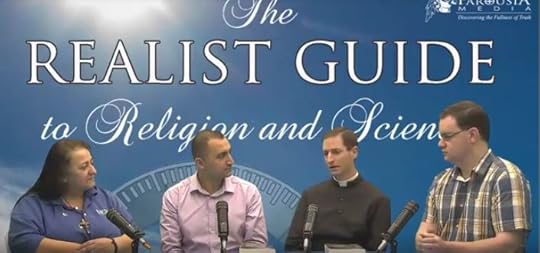
Voice of Charity radio, in affiliation with Parousia Media, graciously granted an interview with Fr Robinson about his book on Wednesday, 31 October.
The interview can be viewed on:
YouTube
In the interview, Fr Robinson has a discussion with Charbel Raish, founder of Parousia Media; Salwa Elias with EWTN; and Mark Griffin. They talk about discerning a vocation, geocentrism, flat earth theory, Adam and Eve, and more.
October 26, 2018
Review of The New Biology: Discovering the Wisdom of Nature
 The New Biology: Discovering the Wisdom in Nature by Robert M. Augros
My rating: 5 of 5 stars
When you first start investigating a topic, it is necessary to read several books before you are able to discern the different positions taken on that topic and who has the best arguments. This can involve suffering through not a few mediocre books. But it can also involve stumbling on a book that far surpasses the others in excellence, by the fact that it suddenly shines a brilliant light on the subject in comparison with which the light of the other works were only glimmers.
That was how I felt reading The New Biology: Discovering the Wisdom in Nature by Robert Augros and George Stanciu. I have read many books now on biology and the disputes over Neo-Darwinism. Some of them were exclusively scientific; others were exclusively philosophical. The best among them, such as Stephen Meyer’s Signature in the Cell and Darwin’s Doubt, were both scientific and philosophical. The New Biology, written by a Thomist philosopher and a theoretical physicist, surpasses even Meyer’s masterpieces.
This is so for several reasons:
1. The presuppositions on which the authors are working, the arguments which they are making, and the basis of those arguments, are always made crystal clear to the reader. One always finds this in books that are honestly seeking for the truth.
2. The book is chock full of scientific facts, real and solid empirical evidence from the biological world. Many of these facts were not discussed in other books, which made me feel as if I had previously been systematically presented a truncated vision of lifeforms, while this book was providing me the full picture.
3. There are many wonderful illustrations throughout the book, drawn by Michael Augros, whom I take to be the son of Robert and the author of the excellent book Who Designed the Designer?.
4. The book is brief! It does a fantastic job of compacting an entire spectrum of philosophical argument and scientific fact within the confines of 230 pages.
5. The words of empiricist biologists, who do not agree with the authors’ conclusions but cannot but concur with their notice of the facts, are amply quoted throughout the book. This gives the reader a convincing impression of the fairness of the book.
6. Best of all, the book does not just criticize Darwinism on the scientific side and present an alternative scientific view, as the Intelligent Design movement does. It moves beyond the strict confines of science to speculate on the interventions of God in the physical order. This is more satisfying for the reader who is, as most of us are, looking for a complete view of reality.
There are nine chapters in The New Biology. The first chapter points out how the methods of physics have lately been applied to all realms of science, including biology. Those methods have revealed that nature cannot be reduced to matter. Likewise, in biology, the methods of physics show that purely mechanistic accounts of lifeforms are inadequate. I was pleased to find, in this chapter and a later one, a very similar account of the relation between biology and physics as that which I presented in chapters 3 and 10 of The Realist Guide to Religion and Science.
The second chapter masterfully points out the characteristics of the organism that set it apart from human machines: “its astonishing unity, its capacity to build its own parts, its increasing differentiation through time, its power of self-repair and self-regeneration, its ability to transform other materials into itself, its natural action from within, and its incessant activity” (p. 31). Modern biology is not able to arrive at a definition of life, something that should be the starting point for the science, because of its bondage to Cartesianism. If we allow, however, with Aristotle, that living things have a living form, above matter, then the definition is simple: “life is the capacity for self-motion” (p. 32).
Chapter 3 explains the differences between animals and man, as my own book does in its chapter 11. Fascinating scientific facts are brought forward to show that “sensation is neither reducible to matter nor does it emerge out of matter” (p. 53) and that animals have sensory awareness. This does not, however, mean that animals are intelligent. On the contrary, clever experiments with animals lead us to this inevitable conclusion (p. 72):
Animals [] deal with phenomenal appearances, not with what things are. They do not distinguish between sense qualities of a thing and what the thing is. Consequently, they are incapable of understanding causes.
Once more, in this area of biology, a reductionist mechanistic model of humans and animals is inadequate. What is needed is a new biology that is hylemorphic, allowing for the presence of both form and matter in living things.
After chapter 3, the book turns to a consideration of Darwinism and provided, for me, the high point of its already brilliant contents. Up to this point, I had not seen such a clear and compelling critique of evolutionary theory. Since that critique spans from chapter 4 to 8, I will take those chapters as a block. On pages 157-158, the authors explain the assumptions behind natural selection, in Darwin’s own words. They can be reduced to three:
1. Population growth – plant and animal populations increase at a geometric or exponential rate
2. Competition – plants and animals struggle against one another and their environments for food and survival
3. Gradualism – life forms have an unlimited plasticity whereby they continually accumulate little differences over time which cause them to transform into different species
It turns out, when we perform detailed field studies that were not available at the time of Darwin, that all three of these assumptions are found to be false.
1. First of all, in regard to population growth, Darwin thought that “every single organic being may be said to be striving to the utmost to increase its numbers” (p. 124). This creates an intense competition among animals to thrive and survive, to be the winner in the reproduction race, which in turn drives the process of evolution.
What we find, on the contrary, is that species do not increase without limit. Rather, they have built-in natural regulations that lower birthrates when overcrowding occurs. The authors point out that
the birth rate or the age of first reproduction depends on population density in many large mammals, including white-tailed deer, elk, bison, moose, bighorn sheep, Dall’s sheep, ibex, wildebeest, Himalayan tahr, hippopotamus, lion, grizzly bear, dugong, harp seals, southern elephant seal, spotted porpoise, striped dolphin, blue whale, and sperm whale. Increases in population density alter birth rates in small mammals also. (pp. 125-126)
Other assumptions related to population growth made by Darwin have also been shown to be false: the assumption that almost all animals of reproductive age mate, when in fact “a large nonbreeding portion of the adult population is the norm in many species” (p.126); the assumption that litter and clutch sizes remain the same, when in fact they vary according to the amount of food available; the assumption that “animals and plants produce as many eggs and seeds as physiologically possible” (p. 127), when in fact production varies greatly according to circumstances.
2. Nor is nature in a state of fierce competition—Darwin’s second assumption behind his doctrine of natural selection. That state is needed to justify ‘survival of the fittest’ as being the driving cause of natural selection. Instead of competition in nature, there is rather cooperation. Nature is not “red in tooth and claw”, but rather replete with harmonious co-existence.
If we define competition as “whenever two or more individuals or groups ‘strive together’ for something in short supply” (p. 91), we find that nature employs many strategies to prevent competition:
• geographical isolation of species that could eliminate each other;
• the division of lifeforms living in the same habitat into different ecological niches, that is, different diets, different periods of activity, different changes introduced into the environment, and so on: “among the most thoroughly documented principles in the science of ecology is the dictum that two species never occupy the same niche” (p. 93);
• mutual sharing of resources—space, light, water and food—so that as many as possible can survive, rather than the pursuit of mutual elimination;
• periodic migration of birds, fish, mammals, and insects to avoid competition;
• sequential flowering of plants to avoid competition in attracting pollinators;
• even predators are kind to their prey by never eliminating its species and also maintaining with it a dynamic equilibrium;
• symbiotic relationships between animals such that two species have a mutual interdependence: this interdependence is even found between the whole of the plant kingdom, which produces oxygen needed by animals, and that of the animal kingdom, which produces carbon dioxide needed by plants.
In short, population is regulated internally by the plants and animals themselves. It is not regulated from the outside by a fierce competition between them. Nor are they at war with their environment, the topic taken up in chapter 5.
3. The third assumption behind natural selection, gradualism, maintains that little variations in species can continue indefinitely and turn into major variations over time. In other words, there is no limit to the degree to which species can change. I was gratified to find the authors of The New Biology pointing out (pp. 214-216), as I did in The Realist Guide to Religion and Science (pp. 446-449), that this effectively eliminates the very existence of species, which then makes it impossible for natural selection to account for the Origin of Species.
Besides this, empirical evidence does not support gradualism. First of all, plants and animals do not allow for unlimited change. They have fixed boundaries beyond which they cannot be pushed. Here is some of the evidence cited by Augros and Stanciu (p. 159):
Between 1800 and 1878, crossbreeding increased the sugar content of sugar beets from 6 percent to 17 percent. But fifty years of subsequent experiments produced no further increases. All experienced breeders recognize the constraints. Luther Burbank: "I know from my experience that I can develop a plum half an inch long or one two and a half inches long, with every possible length in between, but I am willing to admit that it is hopeless to try to get a plum the size of a small pea, or one as big as a grapefruit."
Secondly, the fossil record is the opposite of what gradualism predicts (see also The Realist Guide making this point on pp. 457-462). For Darwin, minor groupings come first and major groupings only much later. In fact, the major groupings came first and the minor ones only much later.
This “pattern of shift from few species in many groups to many species in fewer groups” flatly contradicts Darwinian gradualism; for if evolution proceeded by species accumulating small variations, we should see over long periods new orders, classes, and phyla emerging with increasing frequency. But just the opposite occurs in the fossils. Darwin’s model is backward. (p. 169)
The fossil record starts with vastly different ‘themes’ of animals and then diversifies with variations on each of those themes, and the variations progressively have fewer differences between them. What this means is that the entire diversity of biological form is present at the beginning and simply works itself out over time, rather than there being no diversity present at the beginning and it being produced over time by natural selection.
The third thing counting against gradualism is the fixity of species. Many species have been observed to go for hundreds of millions of years without any substantive change. This is another instance of reality being the opposite of what Darwinism predicts.
If Darwinism is so obviously contrary to everything we observe in the biological world, what is responsible for the diversification of life? Augros and Stanciu speculate that “some process develops new regulatory gene patterns that eventually produce new body plans and hence new species” (p. 181). In other words, there is an internal genetic mechanism in living things that sometimes causes DNA that is superfluous to be engaged and produce a new species over time.
I am a little skeptical about the plausibility of such a scenario. The authors themselves admit that “much research remains to be done” (p. 186), and perhaps this research has been done in the 30 years since their book was published. But I agree with them that their model is at least “a consistent model that truly illuminates the facts”.
As for the origin of life itself, that can only be God (p. 191). This is evident from the fact that DNA contains a language, a conventional code. Such codes, by the fact that they are conventional, cannot be products of chemical or physical necessity.
In short, I recommend The New Biology for its excellent exposition of the empirical evidence against Darwinian theory and for the sincere effort it makes to respect philosophical realism. It is a shame that it is no longer in print. However, there are used copies available, one of which I acquired from Thrift Books. The book is well worth the purchase for those who are looking for a remarkably clear and concise cross-disciplinary look at the facts of modern biology.
View all my reviews