The Reinterpretations of ‘Catholic’ Biblicism: Introduction
In this four part article, Fr Robinson considers how Catholic biblicists falsify the data of theology, history and science in order to support their claim that a young Earth and geocentrism are doctrines of the Catholic Church. The remaining installments of the article will appear in the succeeding weeks.
Introduction
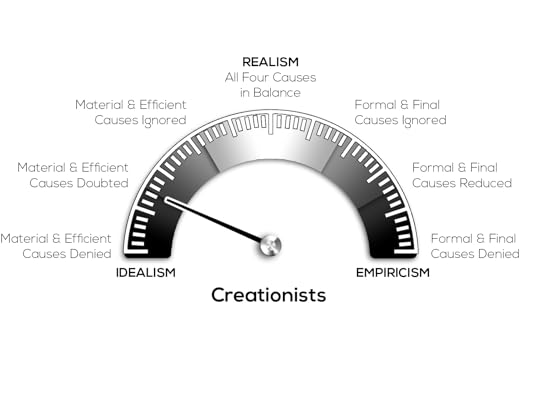
In The Realist Guide to Religion and Science, I try to stake out the territory of reasonable religion and reasonable science by using realism. Realism is a view of human knowledge that accepts both the data of our senses and the concepts of our mind as being true of reality. It is contrasted with idealism, which holds that only concepts are true, and empiricism, which holds that only sense data is true.
Despite the fact that idealists and empiricists hold opposite views on what is true, they yet have various characteristics in common. For one thing, they both truncate reality, reducing it to only what can be known either by concepts or the senses. For another, they are both unable to have a coherent view of reality, a view that is logically consistent with its own assumptions.
There is a third characteristic shared by these two epistemologies, however, that I would particularly like to highlight, and that is their ability to reinterpret the facts. At first, there may be just a few pieces of evidence that come in against their worldview, and the empiricist or idealist dutifully passes that evidence through their particular reality filter, reinterpreting it to suit their truth. But this is only the beginning of their reinterpretation skill. Over time, the evidence mounts, and the reinterpretation filter starts to wear down. New resources of creativity have to be summoned. In the end, many empiricists and idealists are up to the task. Despite the immense strain on their credibility, they cling firmly to their worldview, mountain of evidence be damned.
Allow me to provide a few examples from the empiricist side. Empiricists believe that reality just must be only material. There is absolutely no possibility for the immaterial to exist. In chapter 9, I mention how atheists were determined that the universe be eternal, self-existing, and uncaused, to serve their materialistic worldview. Then, their own science taught them that the universe began in time, is contingent, and manifests all of the signs of being caused by a transcendent, omnipotent being.
That, at least, is the only sane inference that a believer in the Big Bang can make. But the confirmation of the Big Bang Theory failed to turn some atheist scientists into theists. They were the scientists with the most robust reality reinterpretation filter. Being committed to materialism as an unchangeable first principle, they had to find a way to fit the Big Bang into their materialism, rather than make a rational inference from the Big Bang. What was that way? To say that the universe emerged from nothing by vibrations of a quantum vacuum, because of the pre-existing laws of physics!
By saving their materialism in such a way, such scientists end up sacrificing everything else: their own credibility, their own rationality, and even science itself, since they slay the principle of causality on which science operates by having universes spontaneously emerge.
In chapter 10, I show how some scientists in origin of life studies manifest similar resources of creativity. When confronted with the staggering fact that all life on Earth contains a coded language that is interpreted by cellular mechanisms in order to run the processes of physical life, they do not thereby conclude the obvious: there is a supreme intelligence at the source of life. On the contrary, true believers in empiricism can never have recourse to immaterial explanations, no matter how reasonable they are. They would rather serve up this compelling argument: life is that complex, so it must have been seeded on Earth by space aliens!
Needless to say, this idea, which they embellish with the fancy name of “directed panspermia”, is of no credit to science and, of course, is not scientific.
But it is not just scientistic empiricists who can reinterpret facts to fit their cherished ideas; religious believers can do the same. Sts. Augustine and Thomas Aquinas warn Catholics not to cling stubbornly to their own interpretation of the Bible when it is contradicted by the facts. Doing so exposes religion to mockery just as much as clinging to materialism in the face of so much evidence against it exposes science to mockery. We do not want religion to be mocked; we want it to be respected. But, for it to be respected, it must be reasonable.
Some Catholics have fallen into this trap of dogmatizing their particular interpretation of the Bible. Specifically, they hold that Genesis must be interpreted as teaching that the earth is 6000-10000 years old and was created fully formed either in six, 24 hour days, or instantaneously. Any long-age interpretation, they opine, “calls into question the inerrancy of the chronological information contained in the sacred history of Genesis”. In other words, their reading of Genesis must be the true sense of Scripture, and so one who believes that the universe is ancient is not simply supporting a possible interpretation of Scripture, but is contradicting the very truth of Scripture.
In their defense, these Catholic biblicists believe that the interpretation which they defend is not their own, but that of the Church. They even go so far as to claim that their position has been “believed and taught by all of the Fathers, Doctors, Popes and Council Fathers in their authoritative teaching”.
The main problem is that these statements are quite manifestly false. Specifically, they are opposed by three classes of facts: those contained in the Church’s magisterium, in history, and in science. To get around these facts, Catholic Young Earth Creationists (YEC) must reinterpret them in order to save the dogmatic status they impose on their reading of Genesis. Let us consider the facts in each of these areas and their reinterpretation.


No comments have been added yet.