The Fathers’ Understanding of Genesis 1
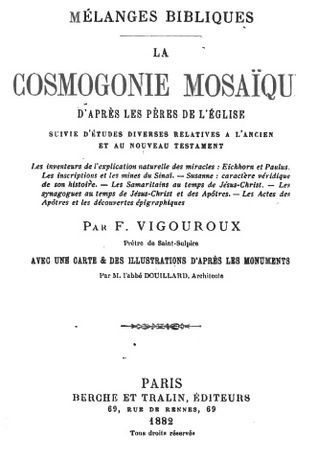
What follows is the conclusion of an essay by Fr Fulcran Vigouroux (1837-1915) entitled “The Mosaic Cosmogony according to the Fathers of the Church”, . A ‘cosmogony’ is a viewpoint on the origin or creation of the world or universe. In his essay, Fr Vigouroux explains the diversity of opinions of the Fathers on the proper interpretation of Genesis 1. He then justifies interpreting the word ‘day’ in Genesis figuratively as an epoch or a long period of time.
Fr Vigouroux wrote his essay in 1882. His words are important for Catholics because they provide a perspective on the state of the question at that time and also because of the theological authority of Fr Vigouroux himself. He went on to become the first secretary of the Pontifical Biblical Commission and held that post for most of the pontificate of St Pius X, from 1903 to 1913. He was considered to be a great anti-Modernist Catholic exegete and a formidable ally of St Pius X in the battle against Scriptural interpretations that undermine the faith. The most important declarations of the PBC appeared during Fr Vigouroux’s term as its secretary, and he likely collaborated in putting together the condemned propositions found in Lamentabili, the majority of which concern errors in Scripture. The works of Fr Vigouroux are so important that many of them are still in print today, including this essay. What follows below is a translation of pages 113-123 of La Cosmogonie Mosaïque: d'après les Pères de l'Êglise.
Conclusions
After having studied in detail the ideas of the Fathers on the Biblical cosmogony, let us take a backward glance, in order to draw some conclusions from the study.
The first thing that strikes us in the exposé just given is the diversity of thought that the ancient ecclesiastical authors had on the scientific interpretation of the first chapter of Genesis. As much as they agree on the dogmatic sense of the preface of the sacred book, to that same degree do they differ on the manner of understanding the mode and the details of creation. We have seen how they were divided into two opposed camps on one capital point, the duration of creation. Some, such as Clement of Alexandria, Origen, Saint Athanasius, Saint Augustine and others, believed that it took place in an instant. The others believed that it took place successively. The differences become all the greater in the various particular questions.
What does this lack of agreement among the Fathers mean for us?
Well, even if these venerable writers had been unanimous in their scientific explanation of the origin of the world, we would in no way be obliged to conform ourselves to their opinions, because science is not a deposit that has been preserved by tradition, as revealed truth is. In matters of faith, we must believe quod semper, quod ubique. In matters of science, we must accept the certain progress that the accumulation of the observations of experimenters have brought us in the train of the centuries. We are no more bound by the scientific ideas of the Fathers than the scientists of today are bound by the ideas of the scientists of the past. We can reject those ideas, without lacking in respect to their authors, with the same liberty that today’s astronomers have rejected the system of Ptolemy.
But if the exegete could maintain his independence, even if the Fathers had been an agreement, how much more does he have the right to form his personal opinion in the midst of the conflict and the fluctuation of opinions that have existed throughout history.[i] The theologian himself has the right to choose the opinion that pleases him more, in dogmatic matters, when the ancient tradition is divided and vacillating, at least when the Church has not since settled the question. But the infallible authority of the Church has not only never pronounced on the scientific interpretation of the Biblical cosmogony, but has not even pronounced on the question of simultaneous creation.[ii] Thus, it is a proven and incontestable fact that the Catholic can explain the Mosaic cosmogony by giving it the sense that appears to him to be the most conformed to the facts of true science, with the sole condition that he observes the rules of hermeneutics and interpretation of the sacred books.
Having noted the independence and the rights of the exegete in scientific matters, let us now examine to what point one can claim that we today diverge from patristic teaching.
The key issue in this present question is not the details, since the Fathers did not agree on them amongst themselves; the key question is the principles that they followed and which were common to all of them. These principles are that it is necessary to make use of reason, of science, in its certain facts, in order to interpret the Mosaic cosmogony. The motive which led the Alexandrian school to hold to a simultaneous creation was, as we have seen, the desire to reconcile the Bible with the philosophical systems which were then in vogue, as those systems seemed to contain the truth.[iii] Most ecclesiastical writers have likewise based their cosmogonic interpretations on what they believed to be the science of their time. We have heard Saint Augustine proclaiming with force the necessity of making exegesis agree with scientific fact, “acquired by reasoning or experience”.[iv]
This principle of our masters in the faith is likewise our own. If we do not agree with them in the details, it is not because the principle has changed. It is rather because science has progressed. We are doing what they would have done in our place. They accepted what the scientists of their time taught; we accept what the scientists of our day teach.[v] Thus, there is only a change in the interpretation because there is a change in the science, and this change cannot be blamed on theology, but on science itself which, by its nature, makes progress. No one would do well to reproach science for its progress. Why should we forbid ourselves from making use of it, since we are not abandoning the fundamental and essential points of our traditions, but, on the contrary, we continue to apply the principles which have guided the interpreters of holy Scripture in all times? The more knowledge of nature we have, the more the sacred text becomes clear for us; but its authority always remains the same.
Let us go even further and show that not only do we maintain the rules laid down by our Fathers, but that we maintain an important part of their explanations. Although, on one hand, we are in no way obliged to accept the scientific ideas of the Christian doctors, and although, on the other hand, they were not professional scientists, yet the vast majority among them were men imminent by their intelligence and their virtue, and the penetration of their mind made them discover, in the sacred texts, truths as yet unknown by the world and now confirmed by the discoveries of our age.
Among these truths, let us pause especially on the one which is the most important in the cosmogony, that of the sense that should be given to the word ‘day’ in the narrative of Genesis. Contemporary exegetes, who accept the findings of geology, maintain that this word must not be understood in a proper sense, as a duration of 24 hours, but in a figurative sense, as simply signifying time. Well, they are not the first authors to put forward this opinion. We find it first in the Fathers.
It is true that no Father of the Church explicitly taught that the six days of creation were periods of an indeterminate length. We have mentioned that Saint Justin and Saint Gregory Nazianzen held that there was a long interval of time between the creation of matter and the creation of light.[vi] We do not, however, encounter any conclusive text in the writings of the Fathers, aside from the words of Saint Bede that we have quoted.[vii]
We have mentioned that Saint Augustine and the Venerable Bede said that the seventh day did not have an evening; but neither of them held nor suspected the idea of what is today called the day-epoch. All the efforts that have been made to interpret some texts of the Bishop of Hippo in this sense have been fruitless. How could he have maintained that the six days of Genesis designated a long space of time when he taught that they only signified an instant? Several passages of the Fathers that we have cited[viii] attest that they saw clearly that the Bible uses the word ‘day’ in an indefinite sense. But, because of the level of science at their time, they could not have imagined making an application of this sense to the first chapter of Genesis. We cannot doubt, however, that many of them, in conformity with their principles, would have adopted the system of the day-epoch, if they lived today.
For the rest, whatever is involved in these points of detail, it matters little. From our historical exposition, there rises in a peremptory fashion an entire famous patristic school, that of Alexandria in the East, and a great number of Latin Fathers, Saint Augustine at their head, holding that the word ‘day’, in the first chapter of Genesis, must not be understood in a proper sense, but in a figurative sense. They do not explain it in the same way that we do, I well understand, but it does not remain any less certain that we are not making an innovation in interpreting the word in a figurative sense.[ix]
Moreover, some of the reasons which the Fathers used to establish their opinion still keep all of their value today. We can repeat with Origen that the Bible itself gives us to understand that the days of Genesis are not ordinary days, solar days, since it teaches us that, during the first three days, the sun did not yet exist. We also have the right to remark with him and with Saint Augustine that the word ‘day’, in scriptural language, does not always designate a space of 24 hours, since, at the beginning of the second chapter of Genesis, it designates the entire period of creation: “These are the generations of the heaven and the earth, when they were created, in the day that the Lord God made the heaven and the earth, And every plant of the field before it spring up in the earth, and every herb of the ground before it grew” (Gen. 2:4).
But the Fathers have not only furnished us with reasons that can be exploited in favor of the modern discoveries of science. Some of their explanations are completely in agreement with them.
Most scientists today hold that the universe existed at first in an uninformed state. It was only successively that the first matter underwent transformation and produced the diverse creatures which make up the world today.
As we have seen, this is the same opinion as that of Saint Ephrem, Saint Basil, Saint Gregory Nazianzen, Saint Gregory of Nyssa, Saint Ambrose, Severian of Gabala and others as well. Although Saint Augustine held to a simultaneous creation, he nevertheless explained it in certain passages of his writings in terms that one could almost reproduce in a modern treatise on origins:
“In the beginning”, he says in the first book of his On Genesis against the Manichees, “God created the heaven and the earth. The whole creature made and produced by God is designated by the words heaven and earth. The creature is so called, using the name of visible things, because of the weakness of the little ones, who are so little able to comprehend invisible things. Thus, matter was created first of all in a confused and unformed state, so that individual beings which have a single form might be taken from it; that is what the Greeks call, I believe, chaos. This unformed matter, that God took from nothing, was thus firstly called heaven and earth, and it is written ‘in the beginning God created the heaven and the earth’, not because it already existed (the heaven and the earth), but because it was destined to exist.[x] We consider the seed of a tree, we say that it contains the roots, the trunk, the branches, the fruits, and the leaves, not because they are there, but because they are going to come out of the seed. It is in this sense that it was said ‘in the beginning God made the heaven and the earth’, that is, the seed of heaven and earth, when the matter of heaven and earth were still confused [in a single whole]; because it was certain that the heaven and the earth would come out of it, this matter is already called [by anticipation] the heaven and the earth… We find innumerable examples of similar locutions in the Holy Scriptures.”[xi]
So it is that we find that a great number of Fathers in the East and the West explain the origin of the world, following Genesis, the way that modern scientists do.
We have had occasion to remark as well that several among them, along with the scientists of our days, do not think that the sun, properly speaking, was created on the fourth day. If the details that they gave on the subject are not so exact, on account of the ignorance in their day about the true nature of light, it does not remain less true that their ideas resemble modern theories.
The same holds true for some other points of detail that it is not worthwhile to get into. What we have already said will suffice for the end that we have set for ourselves. It seems that we have demonstrated that Catholic exegesis has never changed its principles and that it does today what it has always done: it sees the very word of God in Holy Scripture, but brought down to the level of men and consequently expressed in human language. In every age, Christians have made use of the sciences in order to interpret the Bible; every scientific discovery cast a new light on some point of the sacred text. The Fathers saw therein a part of the truth, the part that the science of their times permitted them to see; we continue their work in making use of the science of our day and, like them and with them, we believe that nulla unquam inter fidem et rationem vera dissension esse potest (there can never be any real disagreement between faith and reason).
[i] It is certain that the authority of the Fathers is only definitive in matters of faith and on the condition that they are unanimous. That is what the Church has always taught. The First Vatican Council, repeating in practically the same terms what the Council of Trent said on the subject, expresses itself in this way: “But, since the rules which the holy Synod of Trent salutarily decreed concerning the interpretation of Divine Scripture in order to restrain impetuous minds, are wrongly explained by certain men, We, renewing the same decree, declare this to be its intention: that, in matters of faith and morals pertaining to the instruction of Christian Doctrine, that must be considered as the true sense of Sacred Scripture which Holy Mother Church has held and holds, whose office it is to judge concerning the true understanding and interpretation of the Sacred Scriptures; and, for that reason, no one is permitted to interpret Sacred Scripture itself contrary to this sense, or even contrary to the unanimous agreement of the Fathers” (Dz 1788). No Father, by himself, represents the doctrine of the Church. It is their number and their agreement that makes for their authority in matters of faith and morals in regard to the instruction of Christian doctrine.
[ii] “Holy Scripture, it is perfectly true, does declare a few momentous facts, so few that they may be counted, of a physical character. It speaks of a process of formation out of chaos which occupied six days; it speaks of the firmament; of the sun and moon being created for the sake of the earth; of the earth being immovable; of a great deluge; and of several other similar facts and events. It is true; nor is there any reason why should we should anticipate any difficulty in accepting the statements as they stand, whenever their meaning and drift are authoritatively determined; for, it must be recollected, their meaning has not engaged the formal attention of the Church, or received any interpretation which, as Catholics, we are bound to accept; and, in the absence of some definite interpretation, there is perhaps some presumption in saying that it means this, and does not mean that. And this being the case, it is not at all probable that any discoveries ever should be made by physical inquiries incompatible at the same time with one and all of those senses which the letter admits, and which are still open.” Cardinal Newman, lecture on “Christianity and Physical Science”, in The Idea of a University, p. 330.
[iii] Origen even explicitly stated that profane knowledge is necessary for anyone who wants to study Holy Writ. Philocalia, c.xiv, In Gen., vol. III, t. xii, col. 88. St Gregory the Miracle-worker reports that he taught his disciples physics and astronomy before explaining the Bible to them. In Orig., n.8, PG, vol. X, col. 1077. cf. Mgr Freppel, Origène, t.I, p.45f.
[iv] “Certissima ratione vel experiential teneat.” De Genesi ad litt., bk. I, c.xix, n.39. Just before this, in n.38, when speaking of possible errors made by interpreters on the subject of the light created on the first day, St Augustine says: “Quod si factum fuerit, non hoc habebat divina Scriptura, sed hoc senserat humana ignorantia.” He also says in bk, II, c.1, n.2, col.224: “Nunc quemadmodum Deus instituerit naturas rerum, secundum Scripturas ejus, nos convenit quaerere, non quid in eis vel ex eis ad miraculum potentiae suae velit operari.” St Thomas draws from this the following principle: “Augustine remarks (Gen. ad lit. i) that in the first founding of the order of nature we must not look for miracles, but for what is in accordance with nature.”
Cardinal Franzelin summarizes, in the following terms, the usefulness of the study of the natural sciences for the exegete: “Interpretatio in locis Scripturae quae agunt de rebus naturalibus, multum juvari potest per scientias naturales.” Tractatus de tradit. et Script., 2nd ed., 1875, p.731.
It is appropriate to recall that one of the reasons which St Thomas gives for favoring the opinion of St Augustine is taken from the fact that it makes it easier for us to defend the Bible against unbelievers. “Haec positio (the opinion of the Fathers who read the Mosaic cosmogony in a literal sense) et communior et magis consona videtur litterae quantum ad superficiem, sed prior (the opinion of St Augustine) est rationabilior et magis ab irrisione infidelium defendens” (In II Sent. d. xii, a.3).
[v] Christianity, far from being harmful to science, has rather been like its nourishing mother. A scientist who can hardly be suspected of favoring Christianity, Mr. de Candolle, who is very favorable to the theories of Darwin, made the following very correct statements: “Non-Christian countries are complete strangers to the scientific movement. We must not conclude from this that it is necessary to be a Christian to be a distinguished scientist, since we have many examples to the contrary. It is merely permissible to say that the Christian religion, by its general influence on civilization, has been favorable for the sciences. At the very least, we can affirm that it has been the only religion in the modern age which has assisted serious scientific development.” A. de Candolle, Histoire des sciences et des savants depuis deux siècles, 1873, p.120. See also de Smedt, La Bible et la science, in Revue des questions scientifiques, Jan 1877, vol.I, p.98f.
[vi] Huxley und Mivart, Das Ausland, 1871, p. 1248.
[vii] We should remark that, in these passages, they are not speaking of the Mosaic days, but of the time which preceded them.
[viii] At times, passages from the Fathers or from theologians are cited which do not prove what they are intended to prove. Thus, for example some quote this sentence from Banez: “Dies potest accipi pro quacumque duration et mensura.” In reality, that theologian does not accept such an explanation. He formally states: “Dies qui narrantur Gen. c.1 esse proprie naturales dies atque distinctos.” In I, q.73, a.2, Scholastica Commentaria, Douai, 1614, t.II, p.97.
[ix] We see from this what we should think about the assertions of certain freethinking naturalists who claim that Catholic doctrine obliges Catholics to understand the six days of creation as days of 24 hours: “Until the time that the official Catholic authority,” Mr. Huxley says, “the Archbishop of Westminster, formally stated that Suarez was wrong (in regarding the days of Genesis as days of 24 hours), and that Catholic priests are free to teach their flocks that the world was not made in six natural days… I thought myself obliged to believe the doctrine of Suarez to be the only one sanctioned by the infallible authority, such as it is represented by the Holy Father and the Catholic Church.” Mr. Darwin’s Critics, Contemporary Review, Nov 1871, p.456. Those who write such sentences may be naturalist scientists, but they are completely ignorant of Catholic beliefs.
[x] Non quia jam hoc erat sed quia hoc esse poterat.
[xi] De Genesi contra Manich., l.I, c.v-vii, n.9-11, t.I, col.1052-1053.


No comments have been added yet.