
Sue Heavenrich's Blog, page 11
October 3, 2019
The Dark Lord Clementine
 The Dark Lord Clementine
by Sarah Jean Horwitz
336 pages; ages 9 - 13
Algonquin Young Readers, 2019
Last month I was checking out the pile of books in my To Be Reviewed basket… and was just about to put this in the “later” stack when I flipped it open to read the first sentence. Good thing I did, because… well, I’ll let the book speak for itself.
Clementine Morcerous awoke one morning to discover that her father had no nose.
And really! How could I put it down after that!
I love the premise: Clementine’s father, the Dark Lord, is wasting away. And if he disappears completely, she is the only one to carry on his name – and his life’s work. But Clementine isn’t nearly as dark as her dad. We can see this when she’s in the garden and there, away from the spiky, carnivorous, bloodsucking plants, she’s raising flowers. Dark Lords do NOT raise flowers!
What I like about this book:
There is mystery. What is happening to her father? Who is responsible for chipping bits off him?There is fear. How will Clementine get on with managing the estate should her father’s magic disappear?There is a longing. While on a trip to town to buy bread and candles and other necessities, Clementine hides in the trees behind the schoolyard to watch the kids play. Wouldn’t it be fun to have friends?There is a challenge. Someone wants to usurp the Dark Lord’s power. Or are they really after something else?There are unexpected allies. Like Sebastian, who wants to be a knight and had seen Clementine hiding in the forest. And while there is no sword in the stone, there are plenty of swords stuck in the ground, courtesy of the Lady of the Lake, who has really bad aim.There are adventures.And there is an inside glimpse of the sorts of intellectual property disputes that rage between Evil Overlords.Mostly, there is a lot of fun!
 Thanks for dropping by today. On Monday we'll be hanging out at Marvelous Middle Grade Monday with other bloggers. It's over at Greg Pattridge's blog, Always in the Middle, so hop over to see what other people are reading. Review copy provided by the publisher.

September 26, 2019
The Lady's Guide to Petticoats and Piracy
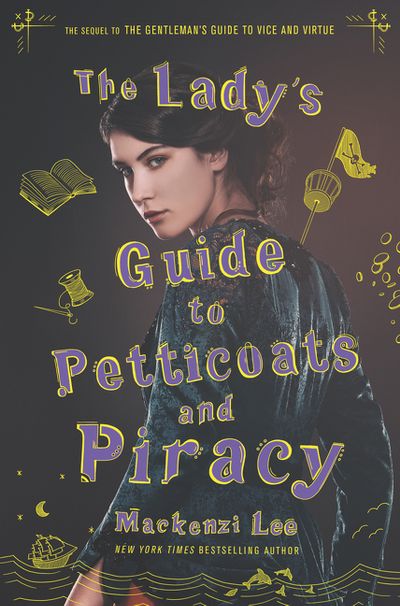 The Lady's Guide to Petticoats and Piracy
by Mackenzi Lee
464 pages, YA
Katherine Tegen Books (Harper Collins), 2018
When I heard someone mention the title of this book, I hoped it might be nonfiction. You know, a tell-all about famous women pirates.
But I was delightfully surprised to find it an adventure tale spun in the eighteenth century starring a young woman who desperately wants to become a doctor. That is SO not socially acceptable for her family’s station, besides which no hospital (or physician) will accept her as a student.
Plus there’s her name, Felicity Montague: a star-crossed name if ever there was. And this intriguing first line: “I have just taken an overly large bite of iced bun when Callum slices his finger off.” We learn that Felicity works in the bakery that Callum owns. And he’s a bit distracted as they wash the dishes, which is how he ends up slicing the tip of his finger off. Felicity, who has been reading medical treatises for so long, is now faced with an actual medical emergency.
And not to put too much of a damper on her relationship with the baker, she reveals that “with a chunk of his finger missing, Callum is the most interesting he has ever been to me.” Then we dive into Felicity’s mind. She is thinking about the 27 bones four tendon, three nerves, two arteries, and other aspects of hand anatomy. Callum, on the other hand, would like Felicity as his wife. She could do worse than marry a baker, he posits…
We know she’s going to leave before she knows it. She’s got a brother in London. Surely he’ll take her in. Before long, Felicity is up to her eyeballs in intrigue. My favorite part is where she runs off to join a pirate expedition to protect sea monsters – a far cry from applying to medical studies. But science is science.
The writing is fun to read! For example: “…traveling with Johanna and Sim will be like trying to wrangle kittens into the bath…” This is the kind of writing that leaves the sting of sea salt on your face and your hair tangled in knots by the wind.
And then – there’s Back Matter. As many of you know, I love back matter, and Mackenzi Lee does not disappoint (though I will point out the distinct lack of end notes). She talks about women characters in historical fiction and then addresses the aspirations of her three women characters. And she shares stories of real-life women in history who inspired each of them. And so we learn about women in medicine, scientist, and piracy in the seventeenth and eighteenth centuries.
Review copy discovered @ my library.
September 19, 2019
Astro-Nuts to the Rescue!
 Astro-Nuts Mission One: The Plant Planet
by Jon Scieszka ; illus by Steven Weinberg
220 pages; ages 8-12
Chronicle Books, 2019
If you’re looking for a funny, smart book that combines climate change with a zany space adventure, then look no further. AstroNuts begins with a count-down to an emergency blast-off. Emergency, because “humans finally crossed a BIG RED LINE – putting more than 400 ppm (parts per million) of CO-2 (carbon dioxide) into my beautiful atmosphere.”
Yep, the story is told by planet Earth, and boy does Earth have a story to tell. It’s about four super-powered animal astronauts who launch into space to search for a Goldilocks planet. You know… not too hot, not too cold, juuuust right! ”Like I used to be,” says Earth. “Before you got here.”
Need a quick lesson on climate change and why 400 ppm is so important? Read this and this.
So, our mutant heroes arrive at a planet full of plants. No dangerous animals, but… viney vines wind around the rocket. Alas, our trusty Astronuts are captured by intelligent vegetation and imprisoned in a plant cell (complete with a map blueprint diagram).
Will they escape? Will they go on another mission? Will they find a Goldilocks planet before we humans set off a huge extinction brought on by our inability to moderate our addiction to fossil fuels?
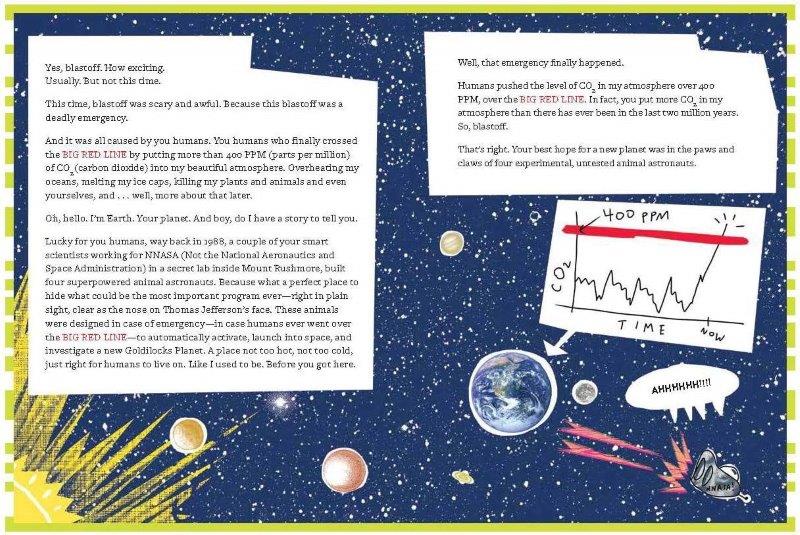 And now, a word from our sponsor - Earth.
What I like about this book: I love the point-of view. I love the occasional astronaut reports, the glitch computer, and “Official NNASA transcripts”. The illustrations are fun, the presentation combines elements of comics, and there’s a bit of atmospheric chemistry tossed in. Plus I love the way the Astronuts harness the golgi apparatus and a bunch of mitochondria to escape the plant cell. There are plenty of space references some readers will appreciate and new words, such as “snotrocketing” (verb). And no, it’s not in the glossary.
There’s also a couple pages at the back of the book that describe how the collage illustrations were created. And a challenge for readers to create their own collage artwork, along with a link to an Astronut website where you can download some helpful printouts.
Thanks for dropping by today. On Monday we'll be hanging out at Marvelous Middle Grade Monday with other bloggers. It's over at Greg Pattridge's blog, Always in the Middle, so hop over to see what other people are reading. Review copy provided by the publisher.September 12, 2019
Hide and Seek ~ Splish and Splash!
If you’re looking for some fun books featuring animals, these might fit the bill.
themes: animals, colors, adaptations
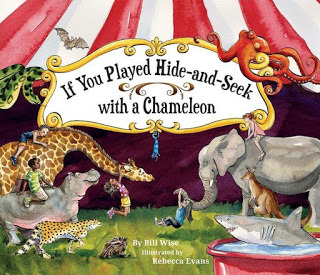 If You Played Hide-And-Seek with a Chameleon
by Bill Wise; illus. by Rebecca Evans
32 pages; ages 8 - 12
Dawn Publications, 2019
If you played games with animals, would you win or lose?
Come to the Animal Fair and play games with twelve different animals – from basketball to twister. There’s the pie-eating contest with a hippo. Of course you’d lose that because a hippo has the biggest mouth of all the land animals. And of course, if you play hide-and-seek with a chameleon, you’d lose! Because … chameleons!
What I like about this book: Each game is matched with an animal whose natural traits would give it a great advantage. Shoot hoops with a giraffe? Race against a cheetah? A paragraph of animal facts accompanies each game, explaining why you have no chance against your animal competitor. Except the snail; you might have a chance against a snail.
I like the bright and fun illustrations that invite you to imagine yourself as part of the games. And I really like the back matter – four pages of fun facts, a challenge to look closer, and great STEM activities.
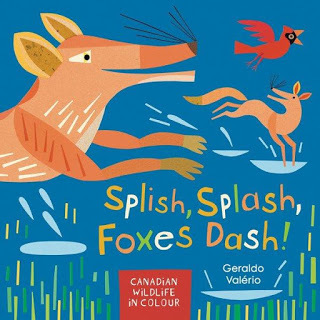 Splish, Splash, Foxes Dash! Canadian Wildlife in Colour
by Geraldo Valério
24 pages; ages 2 - 5
Owlkids, 2018
Red, yellow, blue, here they come… Canadian animals in colour!
Brown features a duck, dabbling under the water. Green caterpillars munch green leaves. Pink prawns pirouette.
What I like about this book: The language is fun: dabble, pirouette, perch and peck. The colors are bright, and the illustrations are created using paper collage. Text on the page is simple and direct. But don’t fear; there is Back Matter! That’s where you’ll find out more facts about the animals featured in the book.
Beyond the Books:
Go on an animal color-safari. If you can get to a zoo, great! If not, walk through a pet store. Look at the colors and patterns of the animals.
Make collage art to show one of your favorite animals doing something it would normally do. Use up old magazines, newspapers, and gift wrap to create your art. You can check out some of Geraldo Valério’s art at his website – just click on a book.
Today we're joining Perfect Picture Book Friday, an event where bloggers share great picture books at Susanna Leonard Hill's website. Review copies provided by the publishers.
themes: animals, colors, adaptations
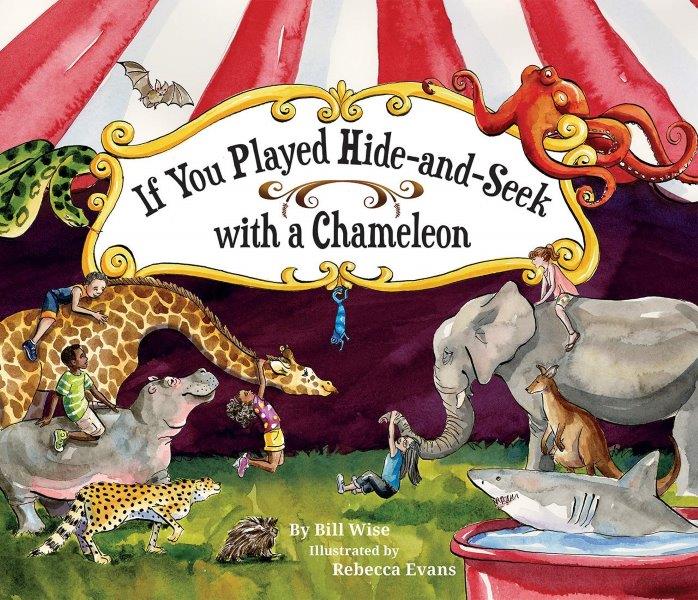 If You Played Hide-And-Seek with a Chameleon
by Bill Wise; illus. by Rebecca Evans
32 pages; ages 8 - 12
Dawn Publications, 2019
If you played games with animals, would you win or lose?
Come to the Animal Fair and play games with twelve different animals – from basketball to twister. There’s the pie-eating contest with a hippo. Of course you’d lose that because a hippo has the biggest mouth of all the land animals. And of course, if you play hide-and-seek with a chameleon, you’d lose! Because … chameleons!
What I like about this book: Each game is matched with an animal whose natural traits would give it a great advantage. Shoot hoops with a giraffe? Race against a cheetah? A paragraph of animal facts accompanies each game, explaining why you have no chance against your animal competitor. Except the snail; you might have a chance against a snail.
I like the bright and fun illustrations that invite you to imagine yourself as part of the games. And I really like the back matter – four pages of fun facts, a challenge to look closer, and great STEM activities.
 Splish, Splash, Foxes Dash! Canadian Wildlife in Colour
by Geraldo Valério
24 pages; ages 2 - 5
Owlkids, 2018
Red, yellow, blue, here they come… Canadian animals in colour!
Brown features a duck, dabbling under the water. Green caterpillars munch green leaves. Pink prawns pirouette.
What I like about this book: The language is fun: dabble, pirouette, perch and peck. The colors are bright, and the illustrations are created using paper collage. Text on the page is simple and direct. But don’t fear; there is Back Matter! That’s where you’ll find out more facts about the animals featured in the book.
Beyond the Books:
Go on an animal color-safari. If you can get to a zoo, great! If not, walk through a pet store. Look at the colors and patterns of the animals.
Make collage art to show one of your favorite animals doing something it would normally do. Use up old magazines, newspapers, and gift wrap to create your art. You can check out some of Geraldo Valério’s art at his website – just click on a book.
Today we're joining Perfect Picture Book Friday, an event where bloggers share great picture books at Susanna Leonard Hill's website. Review copies provided by the publishers.
September 5, 2019
My Name is Wakawakaloch!
My Name Is Wakawakaloch!
by Chana Stiefel; illus. by Mary Sullivan
32 pages; ages 4 - 7
HMH Books for Young Readers, 2019
theme: names, friends, problem-solving
Wakawakaloch was in a volcanic mood. Everyone was bungling her name.
Schools in our neck of the woods are just getting started this week, and teachers are faced with learning new names. So I thought this might be a fun book for the new year!
In this book, the kids at school mangle Wakawakaloch's name. They call her Walawala or Wammabammaslamma. But those aren’t her names, and Wakawakaloch gets so mad that she wants to change her name to something easy to pronounce. Besides, she can’t ever find a T-shirt with her name printed on it. Gloop would be a good name, right?
What I like about this book: I love the language: the image of Wakawakaloch being volcanic. I like the mis-names that kids give her. And I like when Wakawakaloch sees images of her great-great-great-great-great-grandmother’s acts of bravery, and understands how powerful her family's name is. Not only that - she comes up with a way she can help other kids with unusual names. It involves T-shirts.
I also like the end papers with illustrations of children and how to pronounce their names. No Wakawakaloch, but there is a Chana (like the author) and, according to the handy-dandy guide, the way to pronounce her name is Kh-ah-nah. Make sure you begin with a throat-clearing “ch” ant the beginning!
Beyond the Books:
Check out this brief interview with Chana , and
Names are important. Where does your name come from? You might discover an exciting family tale when you ask about your name.
Write down the way you say your name. And when you meet new friends, ask how to say their names. You don’t want to bungle it up!
Today (or as soon as it starts up again) we're joining Perfect Picture Book Friday, an event where bloggers share great picture books at Susanna Leonard Hill's website . Review copy provided by my friends at Blue Slip Media.
by Chana Stiefel; illus. by Mary Sullivan
32 pages; ages 4 - 7
HMH Books for Young Readers, 2019
theme: names, friends, problem-solving
Wakawakaloch was in a volcanic mood. Everyone was bungling her name.
Schools in our neck of the woods are just getting started this week, and teachers are faced with learning new names. So I thought this might be a fun book for the new year!
In this book, the kids at school mangle Wakawakaloch's name. They call her Walawala or Wammabammaslamma. But those aren’t her names, and Wakawakaloch gets so mad that she wants to change her name to something easy to pronounce. Besides, she can’t ever find a T-shirt with her name printed on it. Gloop would be a good name, right?
What I like about this book: I love the language: the image of Wakawakaloch being volcanic. I like the mis-names that kids give her. And I like when Wakawakaloch sees images of her great-great-great-great-great-grandmother’s acts of bravery, and understands how powerful her family's name is. Not only that - she comes up with a way she can help other kids with unusual names. It involves T-shirts.
I also like the end papers with illustrations of children and how to pronounce their names. No Wakawakaloch, but there is a Chana (like the author) and, according to the handy-dandy guide, the way to pronounce her name is Kh-ah-nah. Make sure you begin with a throat-clearing “ch” ant the beginning!
Beyond the Books:
Check out this brief interview with Chana , and
Names are important. Where does your name come from? You might discover an exciting family tale when you ask about your name.
Write down the way you say your name. And when you meet new friends, ask how to say their names. You don’t want to bungle it up!
Today (or as soon as it starts up again) we're joining Perfect Picture Book Friday, an event where bloggers share great picture books at Susanna Leonard Hill's website . Review copy provided by my friends at Blue Slip Media.
August 1, 2019
A Break to Indulge in Summer Reading
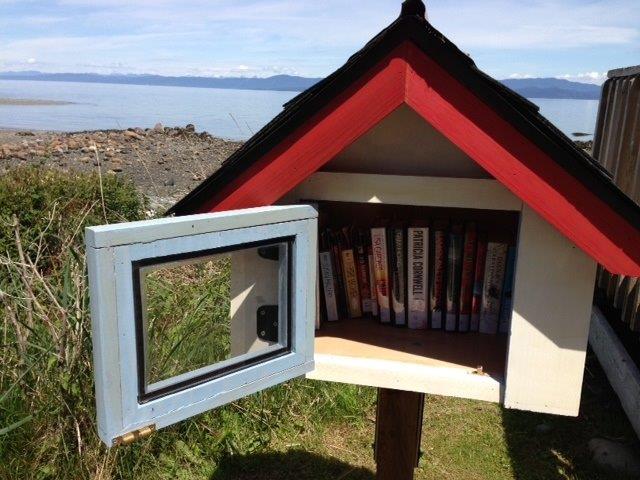
Sally’s Bookshelf is taking a break from book reviews to indulge in summer reading. While Sally's gone ...
Check out your library's summer reading program. Grab some books for the next road trip. Build a fort (and read in it).Read a good bug book - and then go find some bugs.Write haiku in sidewalk chalk.Learn to identify trees - then tie a hammock between a couple of them and read.
July 25, 2019
Operation Frog Effect
 Operation Frog Effect
by Sarah Scheerger
320 pages; ages 8-12
Random House Books for Young Readers, 2019
Some books have a prologue. This book starts its story on the jacket cover with a letter to the reader from some kids:
Hi--
It's us, Ms. Graham's class. We didn't mean to mess things up. But we did. We took things too far, and now Ms. Graham is in trouble--for something we did. We made a mistake. The question is, can we fix it? Ms. Graham taught us that we get to choose the kind of people we want to be and that a single act can create ripples. So get ready, world--we're about to make some ripples.
Sincerely,
Kayley, Kai, Henry, Aviva, Cecilia, Blake, Sharon, Emily (and Kermit, class frog)
The thing is – everyone makes mistakes. This book explores what happens when your mistakes hurt someone else. It begins with a rescued frog who becomes a resident in Ms. Graham’s fifth grade classroom. And is told through the perspectives of eight students through the pages of their journals:
Blake ~ who would rather draw than write words (and makes excellent frog noises)Emily ~ who is feeling hopeful about her first day of school, but heartbroken when she thinks her two best buddies are leaving her outKayley ~ who seems to have her nose in a snit most of the timeSharon ~ who writes in verseHenry ~ who sees the world through the eyes of a film director (or screenwriter)Kai ~ who writes his journal entries to the frogCecelia ~ who misses her abuelita tremendously and writes letters to her, including “words to practice” that are translated to Spanish; besos y abrazos!Aviva ~ BFF of Kayley but wants to include Emily but then what will Kayley think?
It’s fifth grade and for some kids, the academic pressure is on - which leads to stealing (or borrowing) ideas for the egg drop challenge. There are lunch table exclusions (and inclusions), making new friends (and worrying whether that means you have to leave old friends behind), and desk-top letter boxes. There are group projects that sometimes go sideways – which is how the gang of eight end up in hot water.
Mostly, fifth grade is about learning who you are – and the kids in Ms. Graham’s class get an A for effort. This book came out near the beginning of the year, but makes a perfect summer read.
 Thanks for dropping by today. On Monday we'll be hanging out at Marvelous Middle Grade Monday with other bloggers. It's over at Greg Pattridge's blog, Always in the Middle, so hop over to see what other people are reading. Reviewed a copy from my library system
July 18, 2019
Taking Cover
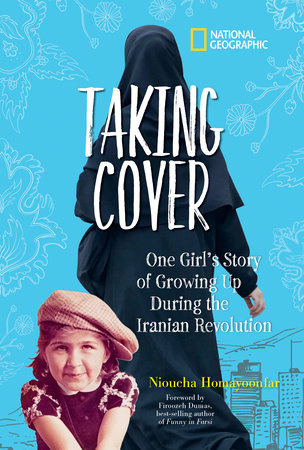 Taking Cover, One Girl’s Story Of Growing Up During The Iranian Revolution
By Nioucha Homayoonfar
160 pages, ages 12 & up
National Geographic Children’s Books, 2019
“I knew I was in trouble when the white jeep made a U-turn. Driven by the Zeinab Sisters (or the Black Crows, as I called them), it raced toward me and screeched to a stop.”
This book opens like an action movie: a young girl is snatched off the street, pushed into the back of a car, and taken to an apartment building that’s under construction. There she’s locked in a room.
For what? Showing the tiniest bit of skin. A sliver of her wrist. A crime, in the eyes of the “Moral Police” and the religious leaders who, after the revolution, control Iran. Post-revolution, the country has become a place where women and girls have lost the rights to work, attend school, have an opinion.
Though it sounds like a dystopian novel, this is a true story of one girl’s life – Nioucha – and what happened to her country after the fall of the Shah.
But Nioucha didn’t always live in Iran. She spent her early life in Pittsburgh, PA until she was five years old. That was when her father wanted to move back to his home country, back to relatives and a vibrant civilization that he missed.
Things were fine, at first. But when Nioucha was eight years old the Shah went into exile and the country moved in a different direction. Where she was once free to run and play and go to school, now her world is circumscribed by rules. Her loss of rights begins simply: she must wear a scarf. Girls must attend a separate school from boys. There is mandated religion class. She can’t be seen in public with a boy who is not related.
This is a book about how easy it is to lose your freedom. Lose your voice. So Nioucha uses her words and stories to give voice to those who are still taking cover. And maybe to warn us about just how easily we could lose the rights we take for granted.
Thanks for dropping by today. On Monday we'll be hanging out at Marvelous Middle Grade Monday with other bloggers. It's over at Greg Pattridge's blog, Always in the Middle, so hop over to see what other people are reading. Review copy provided by the publisher.July 11, 2019
A Possibility of Whales
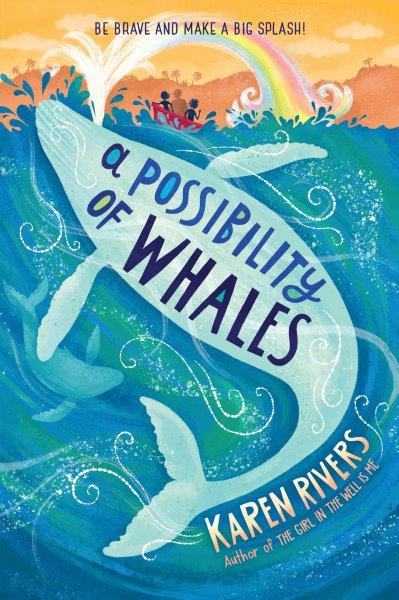 A Possibility of Whales
by Karen Rivers
288 pages; ages 8 - 12
Algonquin Young Readers, 2019 (paperback)
On her fourth day at the new place, Natalia Rose Baleine Gallagher walked down the long, lumpy trail to the beach that lay at the bottom of the slope.
We learn a lot about Natalie, or Nat (as she’s called):
Nat is 12 years oldshe’s moved a lot – dad’s jobthe Baleine in her name is silent – a secret between her and her momher dad is famous – he’s an actorNat loves possibilities – and there are many
Life as the daughter of a famous actor is challenging, and Nat wants just to be Nat. Not XAN Gallagher’s daughter. She also wants to know what kind of mom abandons her baby? “Even in nature, when animals were faced with actual danger, mother animals stuck by their babies,” she once told a friend. The friend who she left behind. The friend who, we learn, did One Terrible Thing.
Nat has found other friends. Harry, who she meets in the girl’s bathroom at her new school in Canada. Harry who is a boy on the inside regardless of the fact their birth certificate says they are a girl. Harry, who plans to write a book to help other kids feel OK in their own skin.
There is Bird, a woman she knows only on the phone. A secret friend, and maybe her mom…
What I like about this book: I like the chapter titles. For example: “The things you find when you aren’t looking.” I like the postcards that Nat writes to Solly – or at least attempts to write. I like that Nat collects words from a diversity of languages to help her understand how she feels about things, and how to describe things. And I like the adventure to Baja with Harry’s family, where Nat discovers that she is definitely not ready to grow up.
Because of her middle name, Nat loves whales. I think she’d be a whale if she could. She loves to watch them, listen to their calls.
Want to learn more about baleen whales? Check out this NOAA website.
You can listen to a recording of a humpback whale here.
Thanks for dropping by today. On Monday we'll be hanging out at Marvelous Middle Grade Monday with other bloggers. It's over at Greg Pattridge's blog, Always in the Middle, so hop over to see what other people are reading. Review copy provided by the publisher.July 4, 2019
Celebrate Independence Day & Weekend
Drop by for a book next week. But this weekend head out to celebrate the Fourth of July!
Sue Heavenrich's Blog
- Sue Heavenrich's profile
- 5 followers
Sue Heavenrich isn't a Goodreads Author
(yet),
but they
do have a blog,
so here are some recent posts imported from
their feed.

