Timothy P. Brown's Blog, page 94
December 27, 2022
Today's Tidbit... Jim Thorpe Kicks from the Sideline
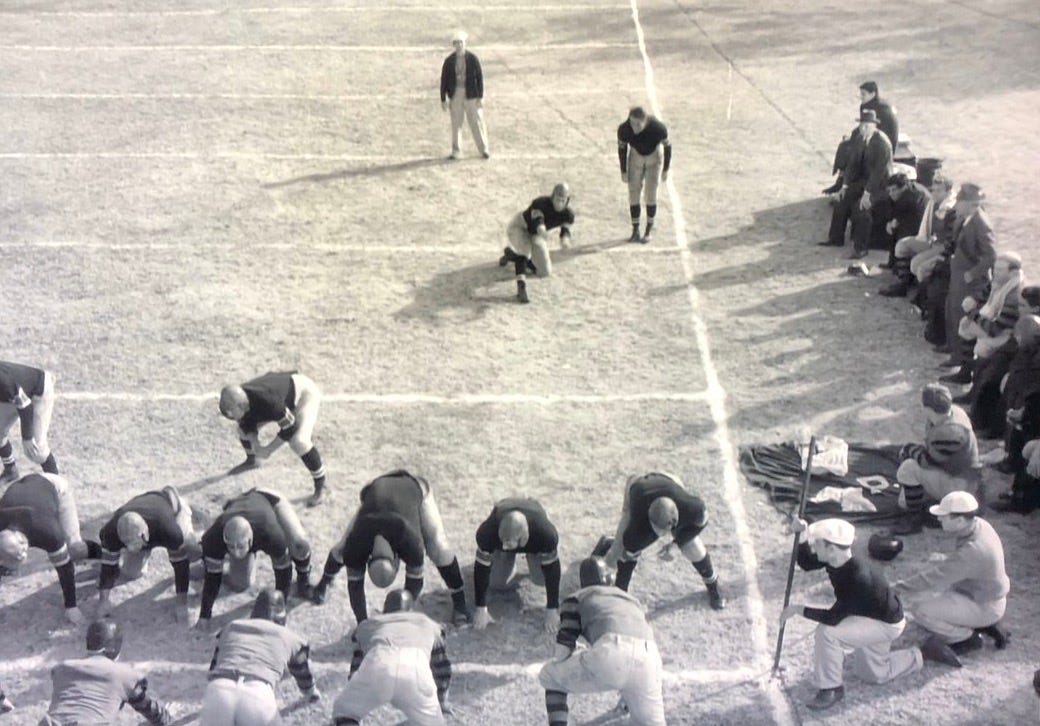 Still of kicking from the sideline from Jim Thorpe - All American.
The image above is a great football image despite not being a football image in the strict sense. It is a Hollywood still from Jim Thorpe - All American, so the pictured kicker is Burt Lancaster, not Jim Thorpe.
I like the image because it shows an element of football that disappeared almost ninety years ago with the introduction of hash marks. As noted in the past, until hash marks appeared on the field, scrimmage plays began wher...


December 26, 2022
Today's Tidbit... The 1921 San Diego East-West Christmas Classic
Although the Rose Bowl and Shrine Bowl are the only postseason games to survive the 1920s, there were numerous attempts to hold games in warm-weather cities between college or all-star teams over the holidays. One was the San Diego East-West Christmas Classic, played only in 1921 and 1922. The 1922 game saw West Virginia take down Gonzaga 21-13, but it was the 1921 game that was most memorable.
The 1921 game occurred 101 years ago today after rain fell in San Diego for eight days. While the San D...
December 25, 2022
Today's Tidbit... Favorite Tidbits of 2022
 Fullback Fred Cone, dressed as Santa Claus, as Clemson prepares for the Gator Bowl. (1949 Clemon yearbook)
This was a big year for Football Archaeology since it did not exist until April, at least not under this name and format. Previously, I had a site called Fields of Friendly Strife, which I created to support my first book of the same name. However, as that site began covering football history in general, I decided to rebrand and reorient my efforts.
Fields of Friendly Strife contained long-fo...
December 24, 2022
Today's Tidbit... George Allen, Weighted Footballs, and Special Teams
George Allen was a highly-detailed coach, as evidenced by several books he wrote, including his 1960 Complete Book of Winning Football Drills. It includes more than 500 drills covering everything imaginable. (This will not be the last Tidbit mentioning one of his drills.)
Allen played end at Albion College and Marquette, where he transferred as part of the Navy's V-12 during WWII. After graduation, he coached Morningside (IA) for three years and Whittier for six years and published the Encycloped...
December 23, 2022
Today's Tidbit… 1876 IFA Rule #10: Tackle
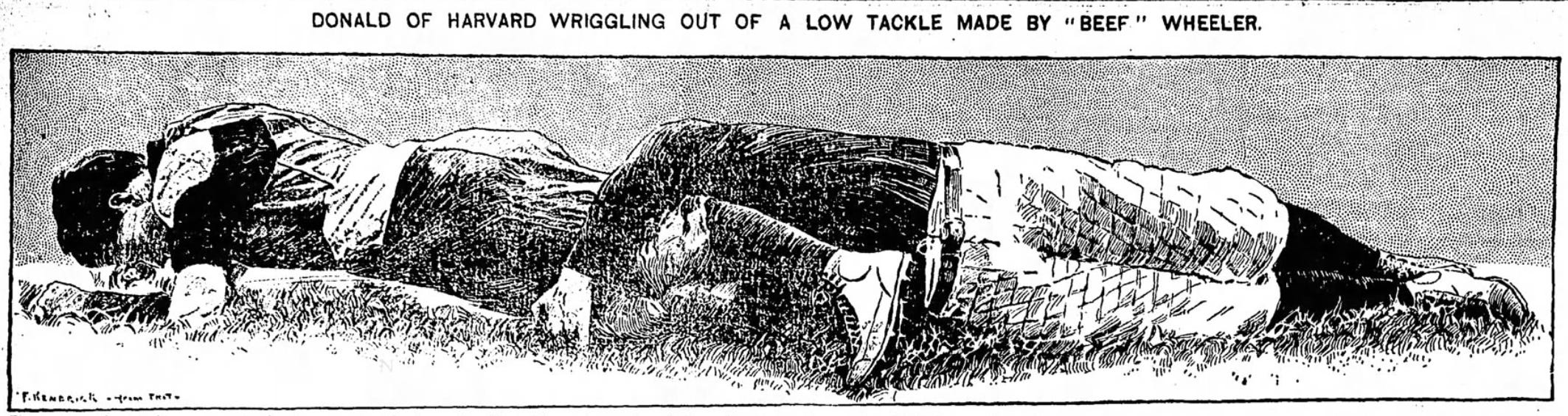 ('Donald Of Harvard Wriggling Out Of A Low Tackle Made By "Beef" Wheeler,' World (New York), October 11, 1897.)
Rule 10 of the IFA’s 1876 rules defined a tackle as a process rather than an outcome.
Rule 10: A tackle is made when the holder of the ball is held by one or more players of the opposite side.
Although Rule 10 and other 1876 rules did not go further than to say a tackle occurs when the ball holder is held, the rules of the time, as practiced, allowed the ball carrier to be grabbed only by...
December 22, 2022
Today's Tidbit... Charles Gill, 1889 All America
Football was still a relatively new game in 1889, new enough that major city newspapers still published articles explaining the fundamentals of the game to their audiences. A few club teams had formed for the post-college or no-college boys, but the colleges dominated the game, and the IFA, representing four or five schools, made football's rules, and everyone else followed them.
A November 1889 article in the Pittsburgh Dispatch, "Some Noted Kickers," is typical of such reports. In addition to p...
December 21, 2022
Today's Tidbit... Polio and NC State's Rapid Response
COVID-19 upended the 2020 college football season with teams canceling, delaying, or reducing their schedules. During and after that season, the aptest comparison was to the Spanish Flu pandemic of 1918, which also caused a reshuffling of college football schedules.
However, games were canceled in the late 1940s through the mid-1950s when polio reared its ugly head. Unlike the Spanish Flu or COVID-19, polio was less transmissible and appeared more sporadically. Still, more than five percent of po...
December 20, 2022
Today's Tidbit... The 1935 Version Of Instant Replay
We see and understand football based on how we consume it. Before stadiums had video scoreboards, watching a game in person meant there were no opportunities for instant replay or slow motion. Instead, you had to pay attention and have a reasonable understanding of football to analyze the events on the field. In contrast, today's fan watching games on television benefits from replays and circles or lines superimposed on the screen and the commentary from the folks in the booth.
Before television,...
December 19, 2022
Today's Tidbit... Marquette's Top Football Players
For all but a few, basketball is the sport that comes to mind when mentioning Marquette University. Marquette enjoyed quite a run under Al McGuire from 1964 to 1977, including winning the NCAA championship in his siren song season. Unfortunately, like many other schools, Marquette now appears in the NCAA tournament every other year without notable success, so let's forget about basketball and look back to the days when Marquette played big-time football.
Marquette played football for the first ti...
December 18, 2022
Today's Tidbit... Expand It and They Will Come
In the 1870s and most of the 1880s, Harvard and Yale played most games on campus before playing in New York City in 1883 and 1887 to handle large crowds. However, as they began making plans for the 1889 game, Harvard's faculty announced they could no longer play in New York City due to the commercialism inherent in playing in the city.
That meant the teams had to find a rail-friendly location with a stadium capable of handling 20,000 fans. Yale argued for Hartford, CT, between New Haven and Sprin...