Timothy P. Brown's Blog, page 90
January 27, 2023
Today’s Tidbit… IFA Rule #15 Run-In
This is #15 in a series covering football’s original 61 rules adopted by the Intercollegiate Football Association in 1876. We review one rule each Friday.
Rule 9 tells us, “A touchdown is when a player, putting his hand upon the ball on the ground in touch or in goal stops it so it remains dead or fairly so,” which replaced rugby’s try with football’s touchdown. While Rule 15 overlaps Rule 9, though the former confirmed that running with the ball was legal, while the latter tells us th process of...


January 26, 2023
Today's Tidbit... Battling For The President's Cup
Football developed mainly in academic settings, but the U.S. military also played a role in the game's spread, especially outside the U.S. For example, the first gridiron football game played in Europe occurred when the U.S.S. Minnesota and U.S.S. Kansas played in Nice, France, in 1909 (see here). Likewise, Army, Navy, and Marine teams first exposed China and other locations to the game played by crazy Americans.
It is not surprising that the military, with many healthy young men, played this rol...
January 25, 2023
Honoring Letter Sweaters and Jackets
This article previously appeared on Uni Watch on January 22, 2023.
Early football uniforms were often plain garments, with a wool or cotton sweater in the school's dominant color topped off by striped sleeves or a letter representing the school name on the chest. By the early 1890s, a tradition developed, allowing those playing in the big games at the season's end to keep their jerseys. Those jerseys became prized possessions because so few earned the right to wear them. Of course, athletes in ot...
Today's Tidbit... I-N-D-I-A-N-A and Letters on Back (LOB)
The Indiana Hoosiers are known more for their innovations on the basketball court than the football field, but no one can take away football coach Ewald Stiehm's big idea. In the days before anyone wore numbers on their backs, Coach Stiehm, aka The Stiehm Roller, had his linemen wear letters on their backs.
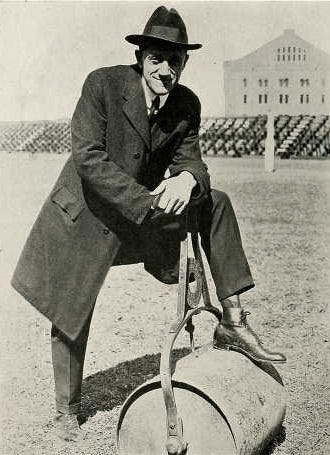 (1920 Indiana yearbook)
The left end wore an "I," the left tackle wore an "N," and so on until they spelled" I-N-D-I-A-N-A."
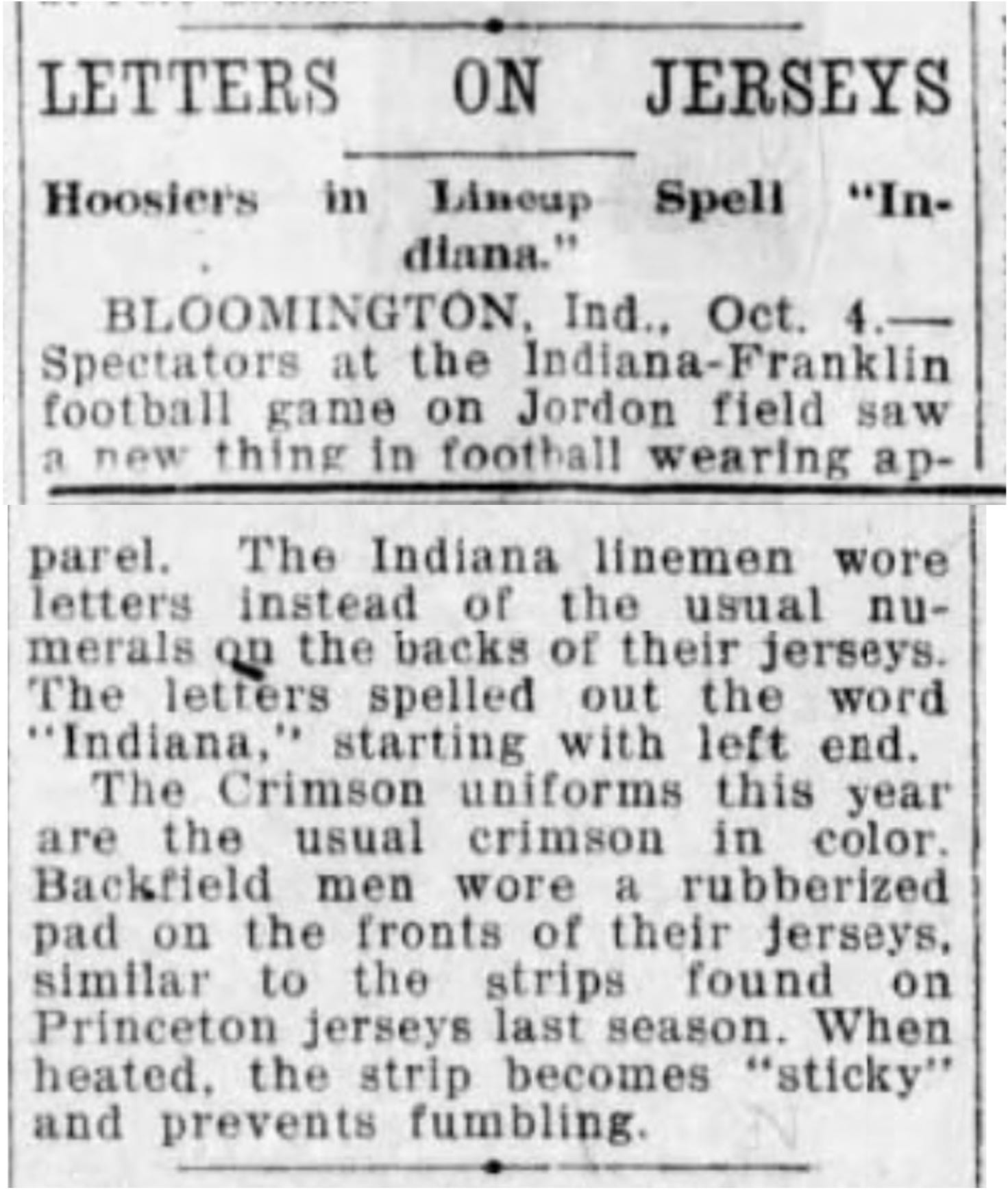 'Letters on Jerseys,' Des Moines Register, October 5, 1917.
Pictures o...
January 24, 2023
Today's Tidbit... Coaching One Player During Timeouts
American football originated as a college club sport controlled by the players. Initially, the game did not have coaches, especially professional ones, so it developed a tradition against coaches, players on the sidelines, or fans instructing players during the game. Prohibitions against coaching from the sideline made their way into the rulebook in 1892, accompanied by a 15-yard penalty.
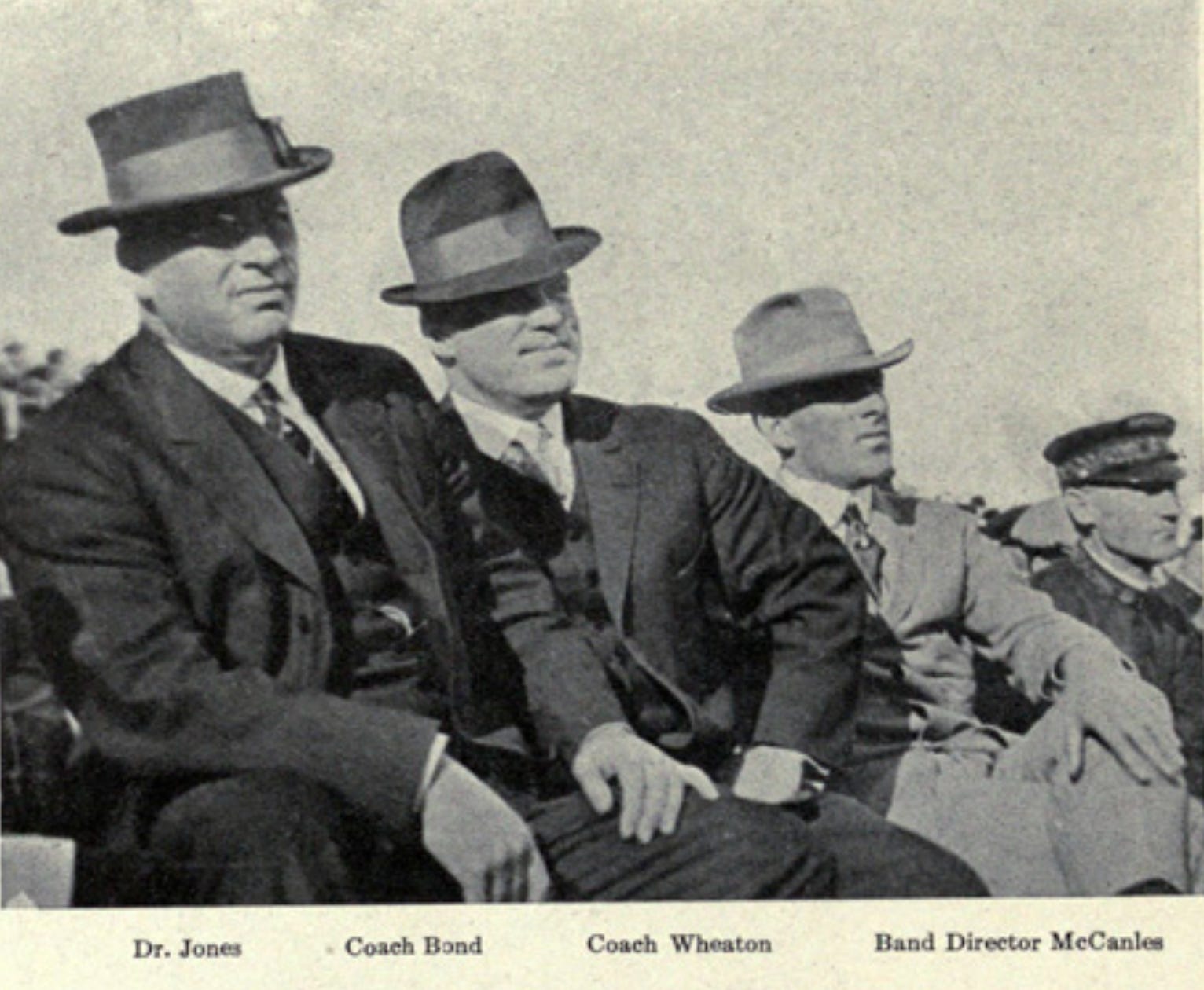 For many years, coaches and players had to remain seated along the sideline, or one or two coaches might roam...
Pigskin Dispatch Podcast: Punting on Early Downs
Pigskin Dispatch podcaster Darin Hayes and I discuss a recent TidBit about football’s previous emphasis on punting on early downs and the rationale for doing so. Click here to listen, or subscribe to Pigskin Dispatch wherever you get your podcasts.
Listen as we cover this story!
Subscribe for free and never miss a story. If you are a regular reader, consider a paid subscription to support my work.
January 23, 2023
Today's Tidbit... Bootleg Footballs and Changing Specifications
We are all familiar with "bootlegs" in football, which entered the game with Pop Warner's 1927 Stanford team when they ran what appeared to be a Statue of Liberty play to the left. Instead, the double-wing fullback faked the give, concealed the ball on his hip, and ran around the right end for a touchdown.
The late 1920s and early 1930 also saw the term 'bootleg' applied to footballs manufactured at variance from the NCAA's specifications during a time when several aspects of the ball changed. Th...
January 22, 2023
Today's Tidbit... The 1905 Big Game Before Photoshop
Cal and Stanford first met on the gridiron in March 1892. They played again in December of that year and then annually until 1905, a game represented in the RPPC below. The image, of course, is a fabrication created using scissors and glue in the pre-Photoshop days.
The fans in the background attended the game in 1904, not 1905, when designated men wrapped white shawls and turbans to form a giant S in the stands. To the right, another group supported their team by wearing cardinal and white strip...
Honoring Letter Sweaters and Jackets on Uni Watch
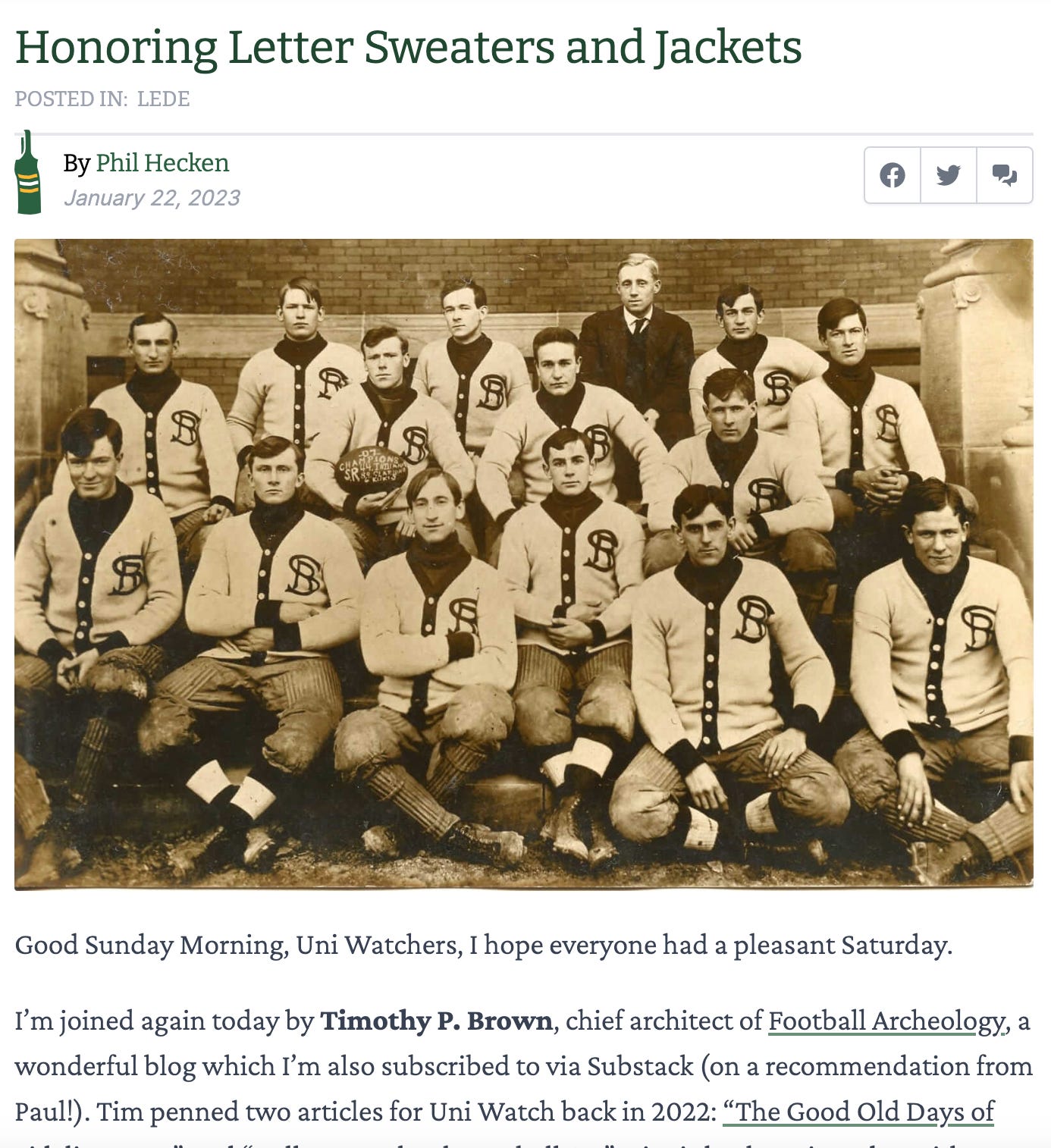
My story on the evolution of letter sweaters and jackets is the lead article on Uni Watch this morning. It includes fun images and catalog entries from the first decades of the 1900s to the late 1950s showing the sweaters and jackets of the time.
Click here for Honoring Letter Sweaters and Jackets
I’ll repost the article here in a few days.
Subscribe for free and never miss a story. If you are a regular reader, consider becoming a paying subscriber to support my work.
January 21, 2023
Today's Tidbit... Player Safety Via Homemade Headgear
Earlier this year, I posted images of early shoulder pads, which initially were leather or cloth pads sewn atop their jerseys. Players also sewed pads on the elbows, sternums, and other locations. Among the images was a 1910 Minnesota high school team whose shoulder pads were homemade rather than manufactured by a sporting goods supplier.
Today, we look at a similar situation but focus on homemade headgear.
As seen in the c. 1905-1910 RPPC of a high school team below, the center, left halfback and...