Timothy P. Brown's Blog, page 95
December 17, 2022
Today’s Tidbit… From The Bubbly To The Bulge
During WWII, American troops in Europe and the Pacific were periodically pulled out of action and moved behind the lines to rest, rehabilitate, and take on replacements. Besides their military duties, a portion of each unit received leave to visit designated entertainment locations or nearby cities.
Those remaining with the units had time available for various leisure activities, including sports. As a result, it was not uncommon for units to form football and other teams to compete with one anot...


December 16, 2022
Today's Tidbit… 1876 IFA Rule #9: Touchdown
This is #9 in a series covering football’s original 61 rules adopted by the Intercollegiate Football Association in 1876. We review one rule each Friday.
The American college boys making the rules in 1876 thought they had a few better ideas than their English counterparts, and one of those ideas involved the try versus the touchdown.
Rule 9: A touchdown is when a player, putting his hand upon the ball on the ground in touch or in goal stops it so it remains dead or fairly so.
Rugby Rule 6: A try is...
December 15, 2022
Today's Tidbit... Class Football Team Jerseys
Back when football players did not wear numbers on the front of their jerseys to identify themselves, they sometimes wore numbers on the front of their jerseys to identify their class.
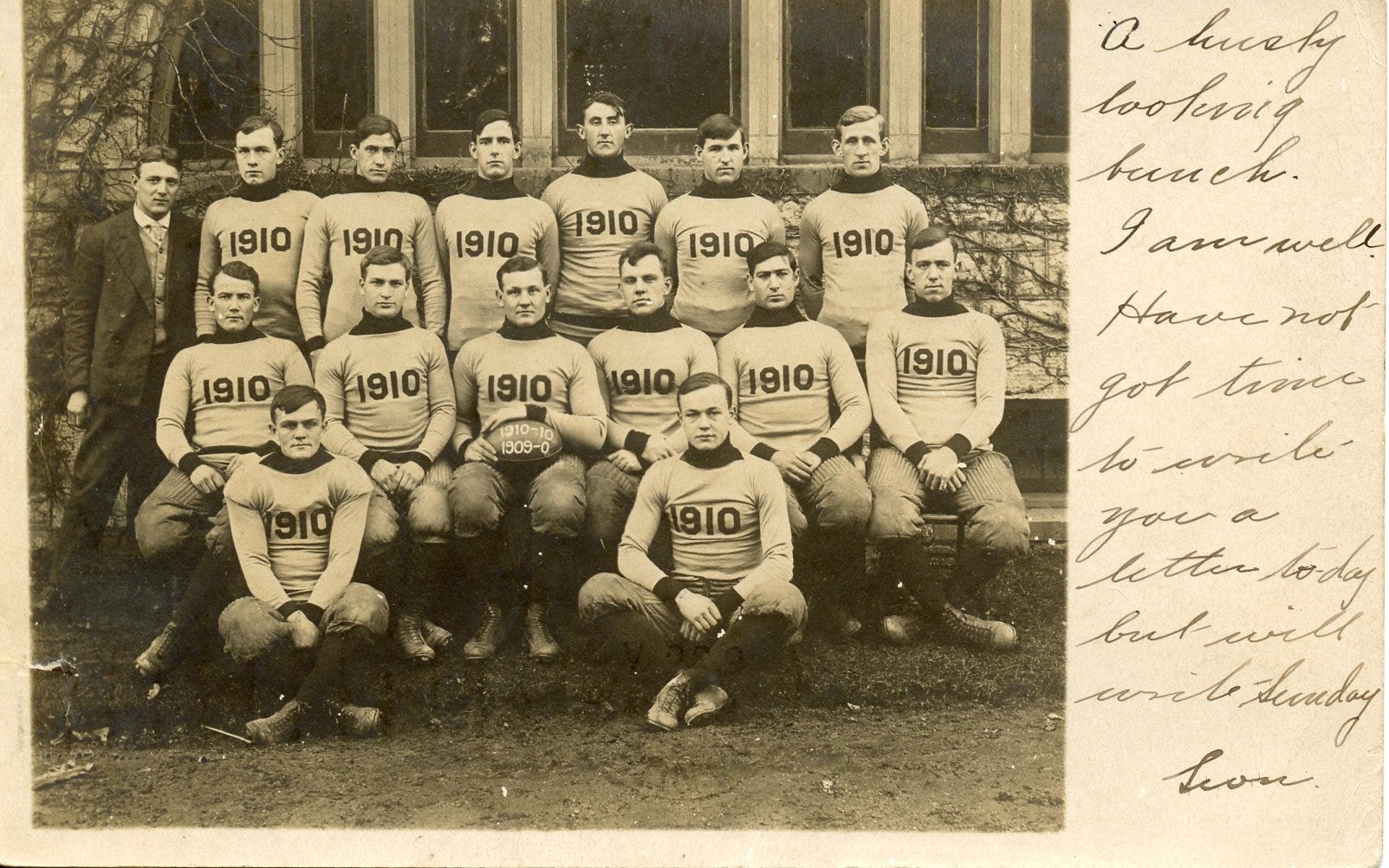 The freshmen team at an unidentified Pennsylvania college defeated the sophomore team 10-0. (RPPC)
It was not until the late 1920s that players wore numbers on the front of the jersey to distinguish themselves. (Players first wore numbers on the back of their jerseys in 1905, but they were few and far between until ...
December 14, 2022
Today's Tidbit... Getting A Head Of The Game
I feel comfortable claiming to be in the top one percent of goofballs who look at one-hundred-year-old yearbooks and sports pages for information and images on old football teams. That experience allows me to note that newspaper and publicity folks in the Teens and Twenties liked to create collages of teams comprised of the players’ faces. The layout allowed the squeezing of many faces in limited space. Here’s an example.
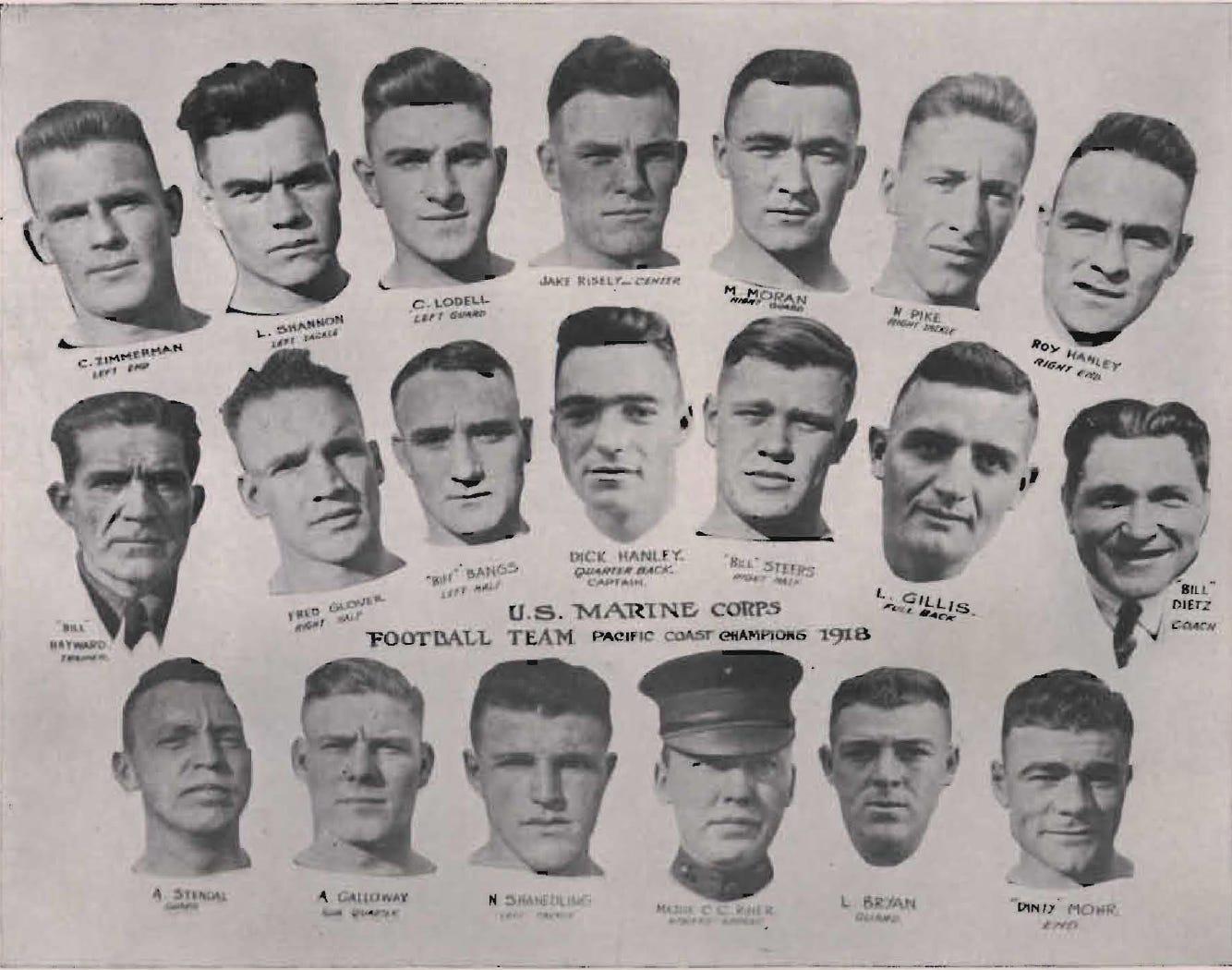 The 1918 Mare Island Marines lost to Great Lakes in the 1919 Rose Bowl.
Anot...
December 13, 2022
Today's Tidbit... Purdue's New Football Coacher
Purdue named Ryan Walters as their 37th head football coach today, replacing Jeff Brohm, who returned to his alma mater, Louisville. Clearly, the jury remains out of Walters' impact in West Lafayette, but we know how things worked out under D. M. Balliet, Purdue's fifth and ninth coach.
Balliet played football for two years at Lehigh before transferring to Princeton, where he started two years at center for the Tigers. Balliet then went to Auburn, coaching them in their first football game, a win...
December 12, 2022
Today's Tidbit... Losing Yards For First Downs
A critical period in football history came between 1880 and 1882 when Yale and Walter Camp's ideas redefined football by introducing the concept of possession. Camp and others considered the rugby scrum "unscientific" because both teams had the opportunity to gain possession of the ball. Instead, he preferred a game in which teams retained possession of the ball as they attempted to progress down the field. His thinking won out, and the 1880 rules allowed teams to retain possession of the ball.
T...
December 11, 2022
Today's Tidbit... 1889 Yale-Princeton @ Berkeley Oval
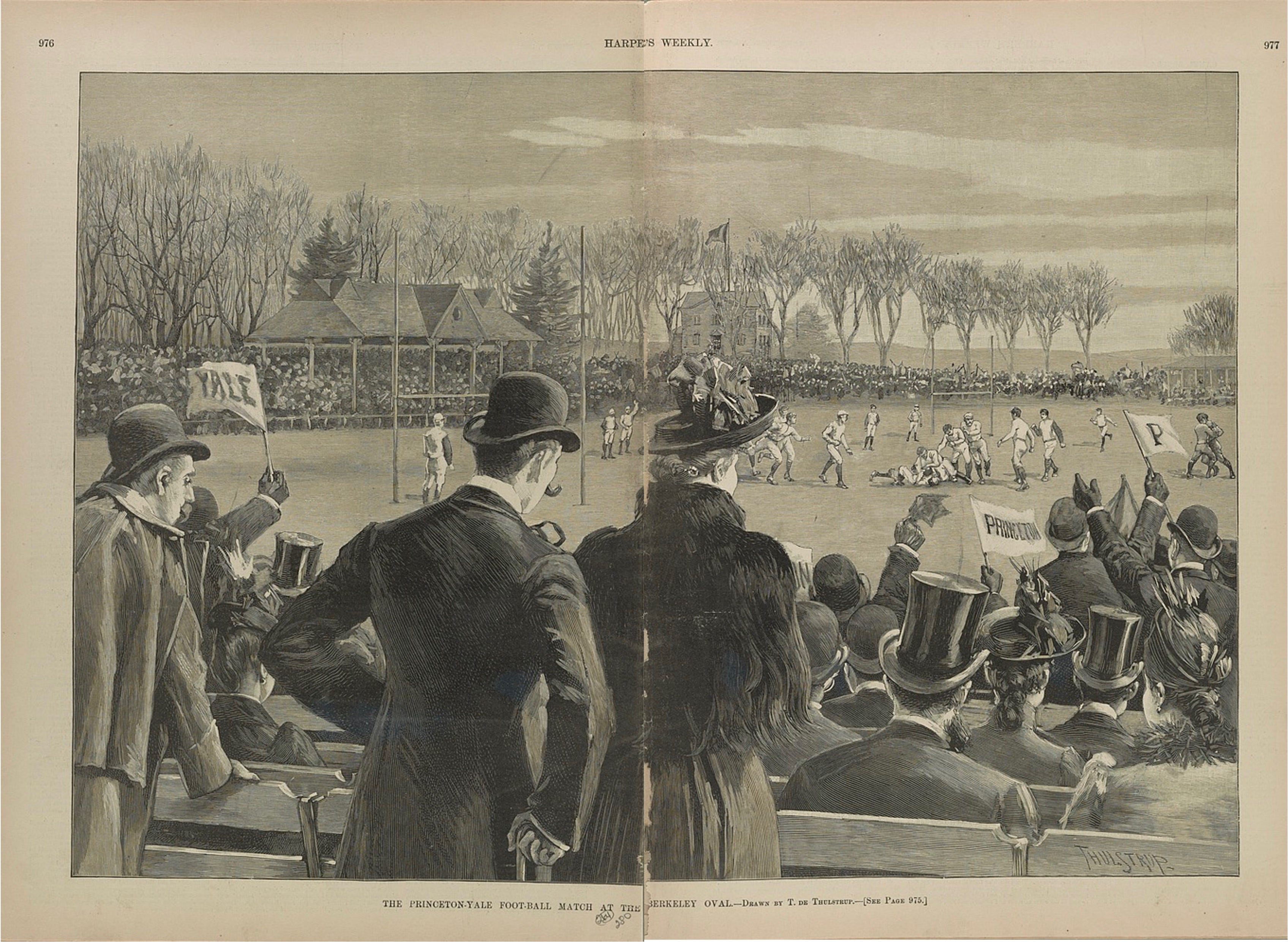 T. de Thulstrup., ‘Princeton-Yale foot-ball match at the Berkeley Oval,’ Harper's Weekly, December 7, 1889. (Library of Congress)
The Intercollegiate Football Association games on Thanksgiving Day in New York City involved the top two teams from the previous year, which often meant Yale and Princeton since they were the best programs of the era. The 1889 Yale-Princeton game attracted 30,000 fans to Berkeley Oval, with its muddy playing field and grandstand entryways after a wet autumn. They were ...
December 10, 2022
Today's Tidbit... Along the Sidelines
Normally I keep notes about where I came across information and images I use in my posts, but this is one of those times I cannot find the source of the image, which I believe to be from the 1945 Army-Navy game when many veterans watched the game from the sideline.
In the end, this image defines the symbolism behind the Army-Navy game.
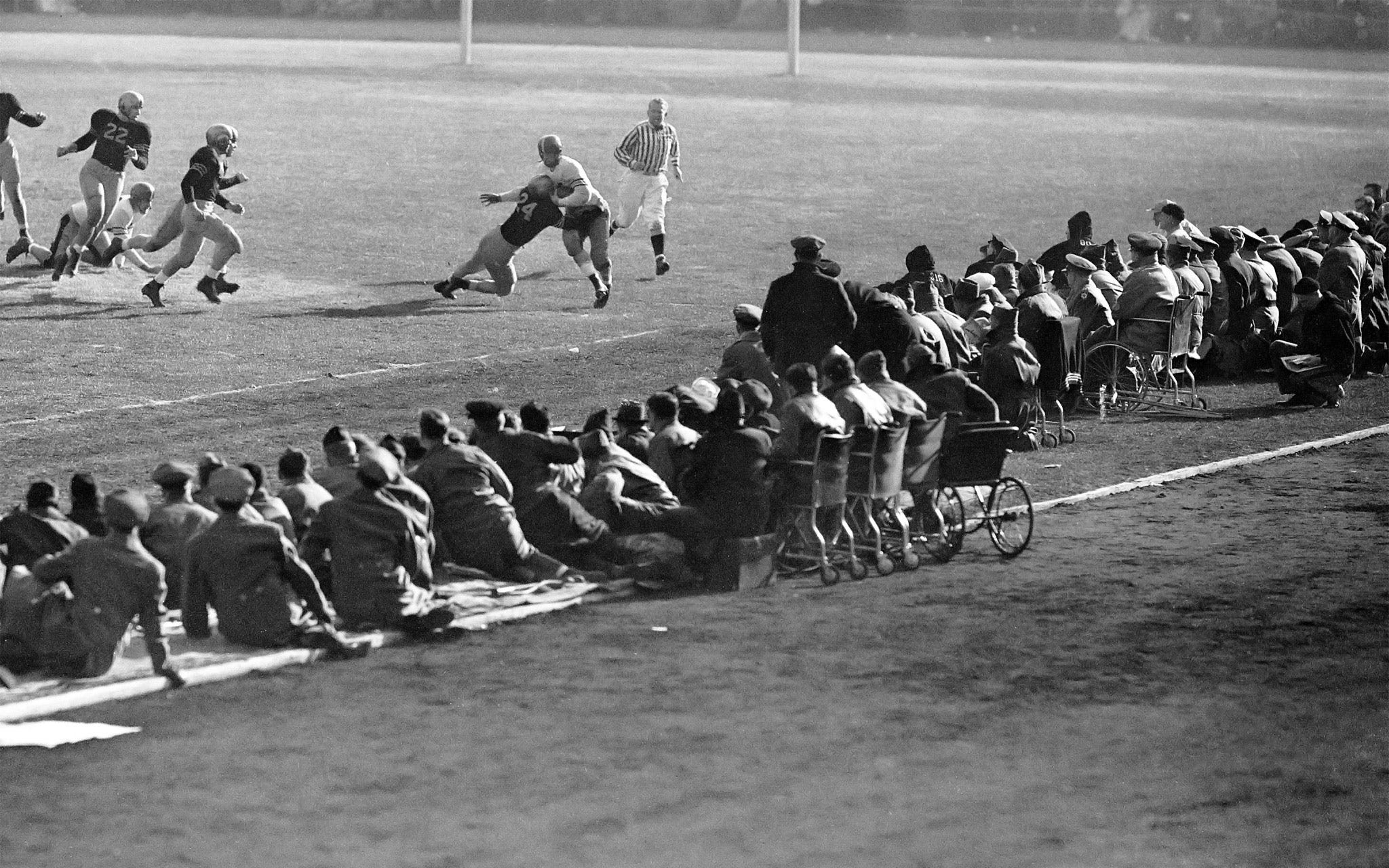
Let me know if you know the source of this image.
Celebrate seasons with one of my books. More here.
Subscribe for free and never miss a story. If you are a regular ...
December 9, 2022
Today's Tidbit… 1876 IFA Rule #8: Dead Ball
This is #7 in a series covering football’s original 61 rules adopted by the Intercollegiate Football Association in 1876. We review one rule each Friday.
 (1905 Army Yearbook)
Rule 8: The ball is dead when it rests absolutely motionless on the ground.
Although Rule #8 pertains to a kicked or dropped ball that comes to rest, its more important application comes in defining touchdowns and downs. As we will see in upcoming rules, a touchdown requires touching and holding the ball to the ground behind t...
December 8, 2022
Today's Tidbit...1957 Special Train to Philadelphia for Army-Navy
I own a few itineraries and brochures touting train travel to football games, one of which involved the 1957 Army-Navy game played in Philadelphia. Conveniently dropping its passengers at the Baltimore & Ohio station across the street from Philadelphia's Municipal Stadium, the trip had to be amazing.
The blue ink on yellow paper tells us the railroad considered Navy fans their primary audience, but it stopped in Washington and likely had a few ground pounders join them in traveling to the big gam...