Iris Ruth Pastor's Blog, page 6
December 6, 2024
I am Internally Emigrating
I am not proud to say this, but ever since the election I have stopped watching the news. I am concentrating on cleaning closets, rigidly following my to-do list and nesting with great intensity. While driving, I have switched from NPR to classical music. And at home, I rely on Pandora from my phone as background noise, not the 24hour news stations normally providing backdrop.
I know there is a danger in this break-up, but I need a pause. There is a term for this turning inward: internal emigration. Instead of dealing with political reality, I am directing my attention elsewhere – into such things as self-improvement and home enhancement. My Amazon orders of candles has increased exponentially, as has my visiting the nearby plant shop to purchase an overabundance of philodendron – the one plant I don’t seem to kill.
I feel guilty, about my withdrawal, of course, and suppose one day I will return to avidly following politics and presidential activities. And when I do, I have promised myself to be more aware of innate biases that can impact my judgments and interactions with the world.
There are many. Here are a few:
Confirmation bias is the tendency to search for, interpret and remember information in a way that confirms with one’s existing beliefs. In politics, a person who strongly supports a particular political party may predominantly watch news channels or follow social media accounts that align with their views, while regarding opposing viewpoints with skepticism, thus reinforcing their existing beliefs.
Bandwagon effect bias is the tendency for people to adopt a particular belief or behavior because they perceive that many others are doing the same – reflecting a desire to conform. In politics, when polling data shows a particular candidate leading significantly, many voters may begin to support that candidate simply because they perceive them as the likely winner and they want to align themselves with a successful campaign.
Ingroup bias is the tendency to favor the members of one’s own group over those in other groups. In politics, one would support policies that align with their own political party, even in the face of contradictory evidence, and to criticize the opposing party more harshly than their own.
Optimism bias is the tendency of individuals or groups to believe that future events will turn out better than they realistically might. An example would be a political candidate who promises significant economic growth and job creation, but who does not adequately address potential obstacles and challenges.
Anchoring effect bias is the tendency to rely heavily on the first piece of information encountered on a particular topic when making decisions even if that information is misleading or irrelevant.
These biases also play out socially too. So, if you are also doing a deep dive into isolation after the election, be aware of these too when you decide to re-surface.
Confirmation bias in a social context: An example would be a person looking to the news media or social media to support his belief that a vegan diet is the healthiest way to eat. That may result in that person ignoring or dismissing any research or personal accounts suggesting the potential downsides of a strict vegan diet.
Ingroup bias in a social context: Best observed in sports fandom. Fans exhibit strong loyalty and support for their team and readily accept negative comments about the opposing team. (OMG! In my family the OSU-Michigan rivalry fits the bill perfectly – GO BUCKS!!!!)
Bandwagon bias in a social context would be adopting a particular style or brand of an item based on perceived popularity rather than personal choice, reflecting a desire to confirm. Think of your choice of sneakers. I got hooked on Hoka that way.
Optimism bias in a social context may be the tendency to expect things like planning a wedding to turn out well – leading to less preparation and attention to detail and therefore not having as seamless as an outcome.
Anchoring effect bias in a social context can occur when a group of friends are discussing where to go out for dinner. One friend suggests a highend restaurant that has a reputation for being expensive. This initial suggestion serves as an anchor for the group’s thinking. If another friend proposes a more moderately priced restaurant, the group may perceive it as more reasonable even if the moderately priced restaurant is still above their usual budget.
Time to go listen to Bach and water my plethora of philodendron.
Keep Preserving Your Bloom,

PS This is my first rodeo with using AI (Artificial Intelligence) for definitions and examples. And I must say, IT’S AWESOME!


November 29, 2024
A Tsunami of Nostalgia
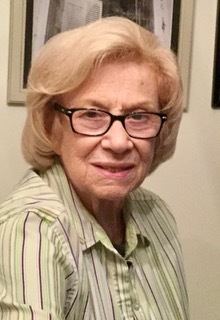
Little Joe
It was a difficult birth on this cold, wintery night
Prayers were answered when all went right
At last, a dark haired, beautiful baby boy
They named him Joseph, this long-awaited bundle of joy
Oh how complete their young lives seemed
Happier than they ever dreamed
His life span wasn’t long
Six days later he was gone
Not a day goes by that I don’t mourn
For my brother, who died before I was born.
(My mother always intensely hated being an only child. Perhaps this is why.)
Counting My Blessings
For us it was love at first sight
That long ago, cool summer night
The Second World War was raging on
Stars in the window for the boys who were gone
Ration stamps, shortages at home, being sent to our servicemen overseas
Telegraph boys – don’t stop at my house please!
After years of waiting for the war to cease
My Air Force hero returned to a world at peace
It was a struggle adjusting to domestic life
We were so young to be man and wife
I was 17 and he was 21and I counted my blessing every day
For the past 68 years we shared before he passed away.
90 Already
Unable to fly, so I gaze at the sky and the jets from afar,
Thankful I’ve got keys and can still drive my car.
Don’t hear as well as I’d like,
And my legs fold at the thought of a hike.
I remember things I’d sooner forget,
And forget to remember what I came to get.
More time with my kids, this they can’t give
Yet they’re the very reason I want to live.
It’s lonesome here without my mate
And I refuse to question the hands of fate.
When my time is up I’ll be ready to go,
but while I’m here I want you to know,
“The Greatest Generation” is where I played a part,
An interesting, exciting lifetime from the very start.
I’m told my experiences were unusual – I tend to agree,
But as a kid that didn’t dawn on me.
I earned every wrinkle and each gray hair,
And at 90 I really don’t care.
To my precious family and very dear friends I have this to say,
Thanks for the ride – it’s been a “trip” all the way.
(Yep, Mom, I get it NOW. I too long for more time with my kids.)
In Good Hands
A people watcher at heart am I,
Watching everyone hurrying by.
Here I am in this huge mall,
Remembering when it was very small.
The shops were few, but quite unique,
From modern and clever to old and antique.
It wasn’t as crowded as it is today,
A safe area for the children to play.
Nothing is as it used to be.
Well, neither am I, just look at me.
Sitting here like a lump on a log.
I can hardly walk, no less still jog.
Our next generation, in plain sight,
Energetic and so very bright.
Contented I’ll be when laid to rest,
That I leave the future to the very best.
In good hands, from what I see today,
To love and protect our U.S.A.
(My mother passed away on her 91st birthday on February 17, 2018, from pancreatic cancer. She was surrounded by her kids.)
Keep Preserving Your Bloom,
(I miss you, Mom.)
November 22, 2024
Advice for living
They probably won’t ask, but just in case this is what I would tell them:
Consciously “handcraft” your own life.
What does that even mean?
A hand-crafted life is a life that is consciously assembled from pieces that you yourself select and put together. It’s self-created. It’s not a life pulled off the rack having been put together by others or unduly influenced by our culture and society. It’s a reminder to chart our own course and then – as I so often say – “Control Your Own Remote.”
The bedrock of my “handcrafted” life is the three-word phrase PRESERVE YOUR BLOOM. What does it mean? It simply means using your talents and resources to be the best version of yourself. Not perfect – because that would be courting disaster, but certainly good enough.
Here are some things I would implore my grandkids to consider and that will help you do just that too:
· Approach problem solving creatively. I have a giant fear of disjointed thoughts and typos creeping into my weekly newsletter. After writing it, the more I re-read my column, the more likely my eye reads what is supposed to be there, not what is. I solved this problem by sending my ister, my brother or my husband a copy to look over carefully BEFORE publication.
· Adjust plans. Roll with the punches. If the way you have always done it doesn’t work, try a new way. If the time that you have always done it, doesn’t work, try a new time. We break down barriers; we don’t resist them.
· View an event as a situation to be managed, not a crisis that will derail you. In my grandchildren’s case, I advise them to break down complex issues into smaller doable steps. Some examples: Studying for your Bar or Bat Mitzvah, getting acclimated to a new situation such as sleep-away camp, and/or applying for college.
· Collaborate/ask for or accept help. I am good at collaborating and very deficient in asking for or accepting help. My stock reply: “No worries, I’ve got this covered.” Even if I don’t.
Unlike me, I implore you to start early in life to seek help if you need it and accept aid when offered.
· Find every opportunity to laugh with your family and friends. This one is self-explanatory.
And then I would remind them that because they have been given so much, certain things are expected of them. One of them is that they take care of themselves.That they do good things for themselves. That they treat themselves with the same kindness and consideration with which they treat their friends and, hopefully, their family members.
Each of us can consciously choose what to do with our own life.
We can achieve our dreams – construct the kind of life we want to lead – buck the system – blaze new trails and fulfill our potential.
It starts with celebrating our achievements, forgiving our mistakes and embracing our uniqueness.
It’s about being kind to ourselves in moments of struggle and cheering for ourselves in times of success.
We then can experience exhilaration, joy, and the peace that comes from knowing that we are living our life to the fullest. And in doing so, we will leave this world a little bit better than it was when we came into it and we will be a happy and satisfied person.
Keep Preserving Your Bloom,
PS Happy Turkey Day – May your heart be as full as your belly!
November 15, 2024
Things Change, But Also Remain The Same
In 11th grade, when our curriculum dictated we learn about the American Revolution and the Civil War, I was way too busy learning how to pluck my eyebrows, apply mascara and, most of all, attract boys.
It’s only in later years, having acquired knowledge of how to tweeze, having mastered the art of thickening my eye lashes AND how to attract males, did I finally settle down and start learning about the checkered history of our beloved United States of America.
Think this past election was contentious? Think again!
It’s 1828 and Andrew Jackson is running against incumbent John Quincy Adams, the son of past president John Adams.
It was a nasty presidential race marked by extreme personal attacks that highlighted their contrasting backgrounds and political ideologies. Mudslinging was rampant.
Jackson’s supporters emphasized his military exploits and his identification with the West and the frontier, characterizing him as the champion of the common man. His supporters accused Adams, a Harvard graduate, of being patrician, elitist, corrupt and too tied in with Eastern backers.
Jackson’s supporters attacked Adams for engaging in immoral behavior, including allegations about his past dealings and a supposed “prostitution” scandal related to a servant. Jackson’s campaign used the scandal to portray Adams as morally corrupt and unfit for the presidency.
Adams’ supporters attacked Jackson as an uncouth, unrefined, violent and dangerous frontier savage whose election would bring the reign of the mob.
Jackson’s personal life, including his marriage to Rachel Jackson, was marred by controversy. She had separated from her husband before she met Andrew Jackson. But the divorce was not finalized when she began her relationship with Jackson – leading to accusations that she had committed adultery and that their marriage was illegitimate.
The public scrutiny and personal attacks took a toll on Rachel and exacerbated her health issues. She died shortly before Jackson’s inauguration, leaving Jackson devastated by her passing at age 61.
Jackson forced relocation of Native American tribes to land further west – believing that it was essential for America expansion and progress – has had lasting reverberations. Thousands of Native Americans were forcibly removed from their homes. The Trail of Tears refers to one particular march where 15,000 Cherokees trudged 1000 miles under brutal conditions. Four thousand died. Jackson’s ideology underscored the tragic consequences of forced displacement.
Today, due to the above, controversy still reigns on why or why not 7thU.S. President Andrew Jackson should be the face on the U.S. $20 bill. Jackson has been featured on the $20 bill since the late 1920s. There have been discussions and proposals to replace his image with that of Harriet Tubman, an abolitionist and political activist, but as of now, Jackson remains on the bill.
Andrew Jackson died in 1845, surrounded by many of the household servants he had enslaved.
He told them: “I want all to prepare to meet me in heaven….Christ has no respect to color.”
This was very ironic because his patronage practices contributed greatly to a racially discriminatory enviroment within the federal workforce.
The Jackson- Adams nasty election was just one of many nasty occurrences in our presidential history – proving that our democracy is designed to be vastly resilient and able to handle falsehoods and rampant unproductive untruths.
Here are some examples:
The election of 1860 (Abraham Lincoln vs. Stephen A. Douglas, John C. Breckinridge, and John Bell) took place amid rising tensions over slavery.
The Election of 1884 (Grover Cleveland vs. James G. Blaine) was peppered with brutal personal attacks and vitriolic rhetoric.
The election of 1960 (John F. Kennedy vs. Richard Nixon) involved significant issues, such as religion and allegations of communism against both candidates.
Things change, but somehow they still seem to remain the same.
Keep Preserving Your Bloom,
November 8, 2024
History Repeats Itself
For now I’m writing an unrelated column.
My mother was an only child. When my parents married, my mom became very close to my dad’s only sister. Her name was Melva – at times dubiously called “Hurricane Melva” because she had a tendency to cause havoc wherever she landed.
Nevertheless, my mother adored her sister-in-law and when my beloved grandmother died when my mom was just 27, my mother took great comfort in the knowledge that my childless aunt and uncle could provide many things a grandparent normally would provide for their grandchildren. And she was right.
When my high school boyfriend broke-up with me our freshman year in college, I was bereft. My parents turned to my aunt and uncle for guidance. They suggested I apply to the University of Florida and assured my parents they would be close enough if I needed anything.
I applied. I was accepted and off I went to UF as a sophomore transfer student.
I met a frat boy from the Tampa Bay area and we started dating. Months later, we told our families that when he graduated we wanted to marry.
My mother assumed I’d come back to Ohio and get married there – as most brides in the 1960’s married in their hometowns. My aunt disagreed vehemently and insisted the wedding should be in Florida.
And that’s when it all went downhill. My mother and my aunt never resolved their differences over the wedding city and bitterness and jealousy reigned supreme between them for the rest of their lives.
I did end up marrying my husband in Ohio – but not with a lavish, joyous wedding, but a quick and simple ceremony in the rabbi’s study – leaving shortly thereafter to live in Tampa. My mother never forgave me for either of those events.
My marriage lasted seven years and produced my oldest two sons – Harry and Frank. After an amiable divorce and with my ex-husband’s okay, I then sold our family home, packed up my belongings and relocated back to my hometown. My mother was ecstatic.
My aunt, upon hearing news of my impending move from Tampa back to Cincinnati, played it low-key.
“I am sad for me,” she quietly stated, “but this is obviously something you want, so I am happy for you.”
I visited Tampa often in the years following. The first time I visited after relocating, I realized that my aunt’s family room area looked different, but I couldn’t quite figure out why.
I asked her.
“Oh,” she remarked both carefully and casually, “after you left, I took the table leaves out of the dining table and stored them in the garage. I don’t much need an expanded dining table – not really hosting big family get-togethers anymore.”
I didn’t pursue it.
Fast forward to 2021. My parents and my aunt and uncle have passed away. I have since remarried and have had three more sons and – ironically – moved back to the Tampa area.
Like my aunt, I have no daughters, but my sister does and one of them got married and moved to Tampa.
Within just a few weeks of her relocating here, I noticed that every other week or so, I was schlepping the leaves of my dining table in and out of the garage. I decided it was just easier to leave them in place to accommodate the frequent visits from my niece and her husband. It proved to be a very logical move because in no time they had a child.
Unlike my aunt, I am super sensitive to the fact that as much as I adore my niece, she has a mother and I always kept that in mind in my dealings with her.
At the same time, having my niece here opened-up a whole new world for me. We visited local street fairs and she introduced me to restaurants and events I never knew existed, even though I have lived in Tampa for almost 20 years.
2024: I begin to hear some rumblings. I hoped that was all they were. But the rumblings turned to reality when my niece one day told me that she and her family were moving back to the Washington DC area – closer to where she had been raised and closer to her parents.
My intense emotions mirrored my aunt’s.
I know now I won’t be seeing my niece’s child on a regular basis. I know now I can take down the crib in the guest room. I know now there will be less frequent visits to Tampa from my sister and brother-in-law. I know now there will be no new sites to explore or projects to work on for my niece and me.
In spite of all that, my words to my niece echoed the ones my aunt had so carefully chosen to say to me so many years ago: “I am sad for me, but this is obviously something you want, so I am happy for you.”
And just like my aunt did so long ago, in a few weeks -when another family occupies my niece’s house, when the final goodbyes are said and their heavily loaded car heads north – I, too, will pack away the leaves from my dining room table.
Keep Preserving Your Bloom,
PS If you need a break from post election craziness or just want to treat yourself to a heck of a good time, come to my friendship event for a little TLC!

To register:
https://www.jewishtampa.com/bloom
November 1, 2024
Resilience and Loss
And, of course, the election is just days away. And someone will win and someone will lose – even if the results are contested.
Loss is hard.
One of my all-time favorite authors, Judith Viorst, wrote extensively on this subject in her book Necessary Losses. She notes that the way we cope with loss defines the way we live because loss is inevitable and essential for us to grow personally and develop fully.
I embrace that.
Loss is a part of life – no one escapes it.
Coming to terms with loss is essential, Viorst points out, as is acknowledging the concurrent grief that accompanies loss and working through that emotional response. And then, though it may seem counter intuitive, loss, Viorst adamantly stresses, actually allows us to be more appreciative for the blessings we do have.
Resilience is the bedrock of our ability to recover and adapt in the face of this adverse condition.
Unsurprisingly, a good sense of humor helps – lightening the mood and providing a different perspective – when immersed in the grieving process of loss.
I can’t count how many times in the last couple of weeks I have repeated silly quips to my friends and relatives who have experienced the wrath of Florida’s back-to-back hurricanes. And every time, I witnessed a smile.
Here’s a few:
Why are resilient people like good coffee? Because they can stand the heat and still come out strong
What do you do when life gives you lemons? You make lemonade and then add vodka for good measure.
What’s the definition of resilience? Hitting the snooze button on life’s challenges and then getting up again like nothing has happened.
One of the primary reasons resilient people can adapt to changing situations and conditions is that they are flexible in their thinking and outlook and they embrace change. Doing so leads them to being open to new ways of thinking – especially in the face of loss.
Hillary Clinton, after losing the presidency in 2016 to Donald Trump, is a prime example of this approach – an approach which can lead to innovative solutions for recovery. However, before that sea change, she had a lot to deal with regarding her defeat.
In her book something lost, something gained, she admits to her great anger about how she lost the election.
At an event shortly after the election, a retired senior FBI official came up to her and apologized for how the FBI mishandled the investigation into her e mails and how sorry he was that he hadn‘t stopped Jim Comey, the FBI director, from trashing her in public just days before the election.
Hillary Clinton stared at him for a minute, trying to contain her anger.
Finally, she said, “I would have been a great president and walked away.
“It wasn’t easy,” she states, “to accept I would never serve as president. But I kept busy, trying new things, cultivating new dreams. I kept going and kept learning and stayed open to new experiences and new ideas.”
And one of her new experiences was becoming a major producer of a show now on Broadway called “Suffs” – a musical focusing on the women’s suffragist movement during the early 20th Century.
And, not surprisingly, the play echoes the importance of perseverance and resiliency as women from diverse backgrounds and experiences fought valiantly for the right to vote.
Here’s a bit of the opening song to give you a taste of how uplifting new directions can be:
https://www.youtube.com/watch?v=ImFUUwwAeKQ
What can we learn from Clinton’s experience?
We keep going in spite of the fact that “progress is possible, but not guaranteed.”
And that’s what it’s all about.
Keep Preserving Your Bloom,
October 25, 2024
No Good Deed Goes Unpunished
However, at checkout, I did take the time to compliment the cashier on her very cool, oversized lime green glasses.
I wheeled my bagged purchases out to my car, loaded up the back of my SUV and headed home.
When I unloaded my groceries and checked my receipt (something I hardly ever do), I realized that both items that had been at the bottom of my cart had not been seen by the cashier, noticed by the young man bagging my groceries or remembered by me.
There was a jumbo bag of Halloween candy for $11.99 and a six pack of Perrier.
“I can’t go back,” I wailed to myself. “I’m too exhausted and I have company coming in about 30 minutes,” I rationalized.
It nagged at me – this feeling of taking some things that simply were not mine. And maybe, I fantasized, if I went back, the good people of Publix would resist taking my check and instead donate it to a hurricane relief fund. And I would be a hometown hero!
Three days later, shortly before dinner, I headed back to Publix with a personal check in my purse.
I walked up to Customer Service and waited almost ten minutes while a line of eager customers purchased lottery tickets.
When my turn came, I explained the situation very clearly to the customer service rep who kinda seemed lost as how to handle this particular situation. While she was figuring stuff out, one impatient customer behind me left and another one – an elderly lady – even more elderly than me – lamented she was going to miss her bus if she couldn’t purchase some cigarettes right now.
The customer service rep – a young lady with beautifully manicured nails, complete with bright orange tips, I may add – kept looking up all kinds of things on her I phone in an effort to figure out how to proceed.
Finally, she accepted my check for $20.00 and then asked me for ID – the irony of that was not lost on me.
After our transaction, I walked back into the interior of the store, bought a few items and proceeded to checkout. For some reason, probably because my husband and I were soon leaving to go out of town, I only grabbed one avocado, not my usual three, and didn’t bother to bag the lone piece of fruit.
After checkout, I once again headed to my car, placing the bagged groceries into the back. And there, forgotten by me, and overlooked by the cashier and the bagger, was my one lone avocado rolling around at the bottom of the cart. I wish I could tell you I went right back into Publix to pay, but I didn’t.
Because…..just at that very moment, I was sidetracked by the same elderly woman who had recently tried to buy cigarettes at the customer service counter.
“Do you have a light?” she asked me. “I quit smoking, but I decided to buy a pack of cigs anyway.”
“I’m sorry,” I said, “but I don’t”.
“You know, I missed my bus because the lady at customer service was so slow. Could you possibly give me a lift?”
“I’m sorry,” I said once again. “But I can’t.”
I quicky drove off – with an unpaid avocado in my possession and an angry elderly lady glaring at me.
As my dad used to say, “No good deed goes unpunished.”
Keep Preserving Your Bloom,
October 20, 2024
Sometimes You Just Gotta Change It Up
Start with my newsletter – which has never come out on any other day but Friday, at 3pm. And today is NOT Friday at 3 pm.
BUT THIS COULDN’T WAIT!
When Helene and Milt paid us a visit, my first thought was to cancel the Nov 15th women’s friendship event and postpone to a more settled time.
But then stories started tumbling out of people’s mouths – of domiciles, businesses and neighborhoods decimated. I felt their yearning – not just for connection but for familiarity, routine and a sense of being oriented to one’s place.
That’s when I decided to go ahead with the third in the three-part series on women’s friendships.
I have since added a twist to the topic – it’s still The Art of Being Your Own Best Friend, but with a tag line: Especially After a Natural Disaster.
We won’t be just talking about self-care, but the importance of not minimizing personal loss and also about the fine art of cultivating self-determination. And, of course, I’ve sprinkled in a few humorous anecdotes during my presentation.
I hope you will once again join us for a mix of mingling, laughing and learning together. Our event also features a mini-market place filled with unique items great for holiday giving.
Here’s the ad:
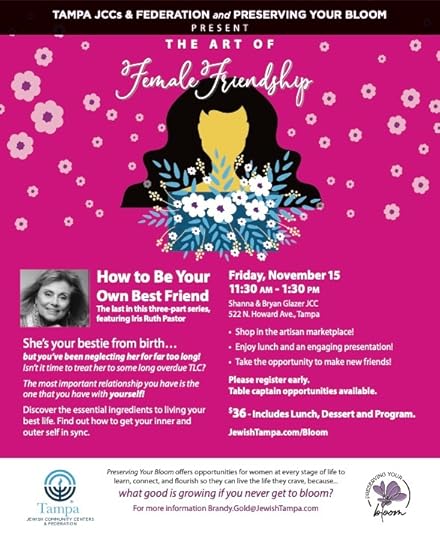
Here’s the link to register:
https://www.jewishtampa.com/bloom
And, as we say in PYB land:
What good is growing
if you never get to bloom?
October 18, 2024
The Saga of my Refrigerator
I didn’t realize how gross it was until I came home from the New York City area after bidding a very enthusiastic adieu to two very unwelcome guests hovering around: Helene and Milt.
My niece – so thoughtfully – had emptied out the contents of my entire refrigerator and freezer shortly after our house lost power. So my first morning home, I spent over two hours wiping, washing, rinsing and drying every shelf, bin and drawer in said appliance.
When I finished, it was startling clean and I was totally exhausted.
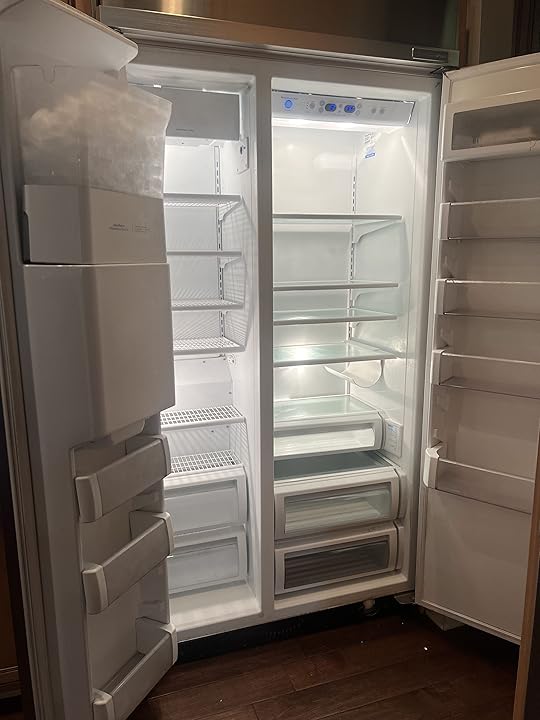
I had one thought only: how in the heck do people recover from devastating loss of their property when I could hardly deal with two hours of hard labor restoring my refrigerator to receive new supplies of food?
It’s not lost on me – that unlike many others – I have the strength, the energy, the time and the resources to right my house after our most recent two natural disasters just days apart. And that I have the means to replace my salad dressings, yogurt drinks and fruits and veggies as soon as I feel like venturing out.
It is and it was like the Wild West in Florida:
Continuing flooding
Power outrages
Stinking debris on the sides of roads
Non-working traffic lights
Closed and shuttered schools, post offices, gas stations and familiar businesses.
And we in Tampa did NOT get a direct hit – it veered at the very end to just south of us.
Tonight, I go to sleep with a sparkling clean, well-stocked refrigerator.
Tonight, I go to bed with my outdoor furniture generously placed back in place by caring relatives. Ditto for my photo albums and plants.
Tonight, I watch the news in my pajamas with my air conditioning cooling me and electricity lighting my family room.
Tonight, I gaze out at a placid back yard, attentively restored and cleared of debris by the fine young man who takes care of mowing and mulching our yard.
Tonight, I go to bed with a roof still attached to my house and no sign of water damage, though we only live two short blocks from Tampa Bay.
I am so lucky.
Way too many Florida residents are not.
Am I thankful? You bet.
And I will donate where appropriate
and help when and where I am needed.
I will keep the victims in my prayers – all those who lost livelihoods and domiciles – all those who are now and will be for many weeks and months beset with anxiety and frayed nerves.
And to those who lost their lives, all 268 of them, I end with this song by Warren Zevon: Keep Me In Your Heart For A While.
https://www.youtube.com/watch?v=RMTKb...
Shadows are fallin’ and I’m runnin’ out of breath
Keep me in your heart for a while
If I leave you it doesn’t mean I love you any less
Keep me in your heart for a while
When you get up in the mornin’ and you see that crazy sun
Keep me in your heart for a while
There’s a train leavin’ nightly called “When All is Said and Done”
Keep me in your heart for a while
Keep me in your heart for a while
Keep me in your heart for a while
Sometimes when you’re doin’ simple things around the house
Maybe you’ll think of me and smile
You know I’m tied to you like the buttons on your blouse
Keep me in your heart for a while
Hold me in your thoughts
Take me to your dreams
Touch me as I fall into view
When the winter comes
Keep the fires lit so that
And I will be right next to you
Engine driver’s headed north up to Pleasant Stream
Keep me in your heart for a while
These wheels keep turnin’ but they’re runnin’ out of steam
Keep me in your heart for a while
Keep me in your heart for a while
Keep me in your heart for a while
Keep me in your heart for a while
Warren Zevon intended the above song to be his final farewell. He was diagnosed with Mesothelioma in 2002. He told VH1 that “I don’t think anybody knows quite what to do when they get the diagnosis. I picked up the guitar and found myself writing this kind of farewell. Instantly I realized I’d found what to do with myself.”
Warren Zevon died in September, 2003 at age 56.
Keep Preserving Your Bloom,
PS Hurricane Milton devastated my friend Francine’s condo in Largo, Florida. She can’t live there.
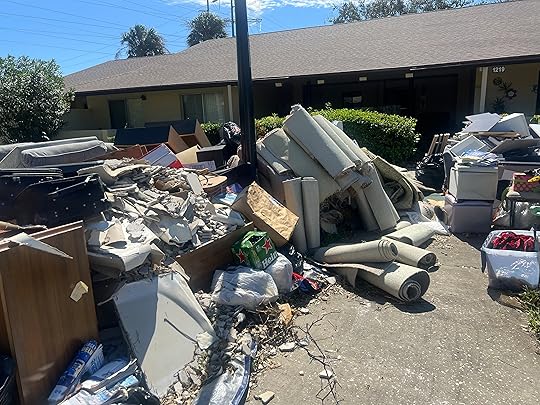
“I am a walking zombie,” she confesses. “My entire acting career is gone…papers, teaching materials, all photos…my eBay store inventory..all furniture…I still have to pay for my condo fees and utilities… I’m living a nightmare.”
Please donate to Francine’s GoFundMe and share it with your friends.
October 11, 2024
When the Unimaginable Happens
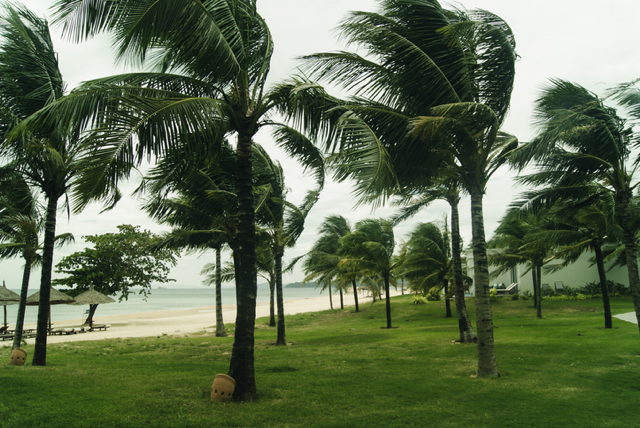
Anyone who resides in the state of Florida lives under the threat of a major hurricane occurring between June 1 and November 30 – EVERY YEAR!
And there are many of us certainly getting our fill of hurricanes in the last couple of weeks.
I started googling ways to comfort oneself after a hurricane and came up with this: Re-establish your daily routine for work, school, play, meals, and rest. That seems a little lame to me – especially if you don’t have power, an habitable home or resources to relocate temporarily while you rebuild.
Geez: it’s like telling somewhat who is depressed to go get a mani and pedi. Helpful, but only in the very short run – like a band aid for a gushing and heavily bleeding wound.
The next suggestion I found wasn’t quite as unrealistic: after the event, involve your children by giving them specific chores to help them feel they are helping to restore family and community life. Praise and recognize responsible behavior. And understand that your children will have a range of reactions to disasters.
But I still had this compulsion to dig deeper. I found the following useful to understanding our reactions to violent climatic catastrophies:
A disaster refers to a natural calamity.
The phases of Disaster are:
Peri-impact – before the disaster occurs
Impact – when it occurs
Recoil – immediately after
Post impact – days to weeks after recovery
Reconstruction – months and years after
Many times our first reactions after a natural disaster directly involving ourselves are shock, stupor and being dazed and stunned. This is a natural reaction to trauma when one’s life has been grossly threatened and from which a variety of biological, psychological and social wounds and scars result.
Psychic shock occurs in the Recoil stage and centers around being stunned upon recognizing the extent of the loss. This is seen as the first stage of the grieving process when confronting a natural disaster. One feels
overwhelmed, sinking into a dark hole, feeling immobile, unresponsive, extremely fatigued. This can be coupled with constricted attention and detachment.
Quite surprising to me is that many of these natural responses can be viewed as adaptive and helpful to one’s recovery.
For instance, immobility can manifest itself by people being less likely to take risks and put themselves in unknown jeopardy by venturing out and about too soon.
Unresponsiveness in victims can help as it may facilitate more cooperation with authority figures than in less hazardous times.
Conservation of energy can be useful in replenishing one’s reserves of liveliness and zest at a future date.
Physical and psychological warmth, comfort and support is a must, as is physical contact and connection with others, reassuring voices, explanations of what is happening and expressions of positivity and progress.
In the Post-Impact phase, survivors emerge from their silos – grateful to be alive. They are eager to help others and re-connect with family and friends and to help rebuild their communities. This often results in a temporary post -disaster euphoria.
However, at the same time, anger is often directed toward outsiders whose help is often seen as lacking in empathy.
What follows next is the Reconstruction phase, which can be a hard, prolonged time of rebuilding the physical environment and our internal lives and rebuilding community that has been temporarily lost.
(These observations and recommendations above are those of the author Paul Valent, as found on searchgate.net)
FEMA (Federal Emergency Management Agency) also has some very practical health and safety guidelines:
View recovery from a natural disaster as a gradual process.
Safety is the primary priority, as is mental and physical well-being.
It’s important to know how to access services and aid.
Don’t try to do too much at one time.
Set priorities and pace yourself.
Drink plenty of clean water and try and eat well.
Keep sturdy work boots and gloves handy.
After working with debris, wash your hands thoroughly with soap and clean water.
Be aware of local safety issues such as washed-out roads, contaminated buildings, gas leaks, broken glass and damaged electrical wiring. Try and stay off the streets, especially until debris is cleared away.
Keep a battery-operated radio and battery powered flash lights handy.
When you re-enter your home, if you smell natural gas or hear a hissing, leave immediately. Watch out for snakes and other animals lurking around. Beware of broken or frayed wires and roof, foundation or chimney cracks.
If your appliances are wet, turn off the electricity and the circuit breakers and unplug appliances. Get them checked by a professional before using again.
If pipes are damaged, turn off the main water valve.
Throw out damaged food.
Call your insurance agent if you are lucky enough to have insurance.
And pray:
Holy One, we ask you to calm the wind and the waves of the hurricane and spare those that were in its path from harm. Help those who were impacted to reach safety and regain their footing. And in the coming days, open our hearts in generosity to all in our community who need help and sustenance. And give us the strength, courage, and resolve to ride out this storm and its aftermath. Amen.
Keep Preserving Your Bloom,
Iris Ruth Pastor