Iris Ruth Pastor's Blog, page 41
June 5, 2017
Henna, Not Heroin
There is no chance I will ever become a heroin addict. I hate needles.
Even the THOUGHT of an IV makes me cringe. And the ACTUALITY of one sets my normally prominent and generously sized veins into a state of such constriction that the routine procedure of inserting an IV becomes an agonizing ordeal.
It was with this attitude and proclivity that I approached tattooing. You might say I was just “slightly” squeamish.
The sign on the front door of the tattoo parlor didn’t help much to allay my fears. “NO CRYBABIES.”
I gingerly pushed the door open and stepped inside. My friends were already preoccupied with the ceiling-hung display boards housing hundreds of patterns that can be permanently affixed to skin.
“Anywhere but the face,” was advised.
“0h gee,” I thought disappointedly. “I was so looking forward to getting a tattoo on the tip of my nose!” It wasn’t clear whether state law prohibits face tattooing or if it is just a “No-No” in the world of permanent body art.
And Art it is. The owner of the shop, Dana, has a master’s degree in Fine Arts from the University of Cincinnati. And all his independent contractors have apprenticed for years under tattoo artists. Their designs are unlimited: Indians, skulls, nude woman (with large breasts), butterflies, flowers, castles and even cartoon characters.
I look around. The place is clean, uncluttered, business-like and mellow. The technicians all have lots of tattoos, lots of holes in their ears filled with studs and hoops but otherwise appear quite mainstream.
None of the customers seem totally bizarre either. One guy is involved in traveling all over the world checking out “ruins.” He has long blond hair (I’d kill for his locks) and is getting a Mayan tattoo on his leg and an Egyptian mummy on his back. All in one sitting.
Another couple has lust walked in the door. Young. Good looking. Dressed like they are out shopping at the mall. Her only distinguishing feature is that she is carrying a huge framed picture of herself that she wants duplicated on her boyfriend’s back. Talking about confidence in everlasting love. Or possessiveness.
I notice certain things. The recliners are comfortable and clean and the clients seemed relaxed. Technicians wear gloves. And instruments are sterilized by high pressure and high temperatures in an intimidating machine. There is even a Norman Rockwell print of a tattoo artist on the wail.
“Maybe I should reconsider,” I think. “Just a small ‘Iris’ on my ankle….”
Then 1 notice the sign tacked up by the plastic paint containers: Jeffrey Dahmer says: “Tattoos Taste Great.”
I experience a sudden surge of gagging – my initial repulsion comes flooding back.
I watch carefully as my friend is prepped for her tattoo after picking out the design and color scheme she wants – and deciding just where on her body to place it.
Brenda, the technician, cleans the area with alcohol and shaves it. Then she applies the stencil outline of the design onto the skin. After that, she fiddles with the machine that houses “the needle.” My legs are starting to buckle and my skin feels clammy. I sit down heavily, wipe my brow and force myself to pay attention.
My friend, meanwhile, is chirpy and chatty and perfectly at ease. They begin.
“What does it feel like?” I demand instantly.
“Well,” says Susan, “a little weird and then sort of like scratching myself with my fingernail.”
Minutes later I ask again as the machine whirrs on and on.
“Well,” says Susan hesitantly, “it feels a little irritating but nothing I can’t tune out because the needle’s not in place constantly.”
At the end of a line, Brenda stops and then starts again. Finally, she finishes the outline and starts on the coloring. Susan is still resting comfortably.
I think of my Grandpa Harry with his famous forearm tattoo of a naked lady that for my benefit he would wiggle to make her body parts move.
“Maybe just one tiny, teeny little band of cascading daisies running down my forearm -in memory of Grandpa Harry….”
In 45 minutes the tattoo is done. On Susan’s ankle is a black outline of a delicate rose with red petals and lush green leaves.
The cost: about $80 bucks. The care: minimal. Just leave bandage on for 10 hours. Then wash with warm soap and water and moisturize two times per day. Within about 3 weeks, all the itchiness and scabbing will be gone and within 4 weeks, the surface is back to normal.
I take a deep breath. I have the cash. I have the time. And I always like to try new things….
I look once more at the needle. I watch as it comes in contact with the skin. Nah, I can’t do it.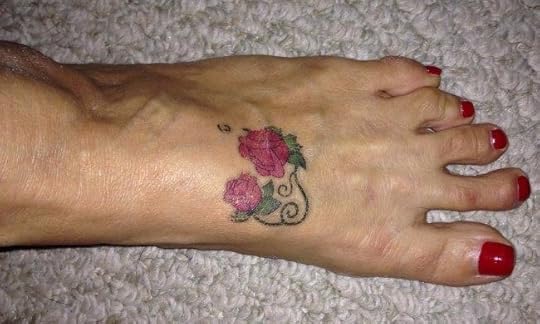
I’ll just have to stick with “Imposters” – those temporary tattoos you apply by pressing firmly on clean, dry skin, wetting with a sponge and after 20 seconds, peeling off the backing.You know, the kind my nine year-old granddaughter always has stashed away in her crayon box.
Or the henna tattoos I am beginning to be addicted to.
I always was and always will be a wimp when it comes to needles. And heroin.


We Plan. G-d Laughs.
My brother and sister-in-law, after living their entire lives in one city, retired to Arizona two months ago. They planned to enjoy the climate, mountains and people; vacation in San Diego; visit friends in Los Angeles; explore the West and experience our country’s wonderful national parks. In the end, only moving to Arizona would come to pass.
As they drove into their new neighborhood, just outside Tucson, my sister-in-law began complaining of terrible stomach pain. An emergency room visit ensued. Gall bladder issues were the culprit. A stint was put in. Two days later, the moving truck arrived and she got busy unpacking, unwrapping, and putting away. Her pain persisted.
Diagnosed with pancreatic cancer just a few weeks later, my sister-in-law started on chemo the very next morning following her initial appointment with the oncologist. There were no mountains of reasonable doubt to transverse. We all knew, but didn’t say, what was baked into the diagnosis: a death sentence.
We asked my brother the obvious question, “How long?”
My brother answered, “Six months without chemo. One year with.”
It was a toxic stew of circumstances any way you swiveled the rubric cube: New town. Thousands of miles from family. Devastating diagnosis.
Our family dug in. We called each other often, texted throughout the day and dialogued about how we could make her remaining time and my brother’s remaining time with her as pleasant and as least stressful as possible.
After the diagnosis, I had been in close contact with my brother daily, but kept putting off calling my sister-in-law. What do you say to someone who has just been delivered such bad news? One morning, consumed with guilt over my shameless procrastination, I decide to make the leap, figuring if I could just get over the initial call, subsequent ones would go more smoothly.
She answered the phone after a few rings. “Karen,” I said softly, “it’s Iris.”
“Hi, Iris,” she said calmly.
I took a deep breath and hoped that what I said next wouldn’t come across as totally crass, but would serve as an ice breaker – which is what I intended.
“Karen, you will just do anything to get attention!” I yelled out. “And this is a topper.”
There was silence.
And more silence.
Then I heard her familiar throaty laugh. “Oh Iris, only you could come up with that!”
And I knew it was going to be okay between us. How could it not? She was a well melded trifecta of brains, spunk and practicality. A staunch advocate for my brother and a loyal, non-judgmental family member to all of us.
I started immediately knitting a prayer shawl for her in purple and red. I finished it right before Thanksgiving and left it on my dining room table. I planned to mail it to her when I got back from my Thanksgiving travels.
My son, Sam, came up with the idea to send a Netflix gift card for a full year of TV watching to his aunt from him and his brothers. He planned to send it when he got back from his Thanksgiving travels too.
My sister-in-law went out shopping the day before Thanksgiving. And even though clumps of hair had begun to fall out when she was brushing, she was feeling fine. Thanksgiving was spent with some new friends. Friday, she tackled more unopened boxes in the morning and spent the afternoon reading out on their back patio – soaking in the sunshine and gazing at the panoramic view of the Santa Rita Mountains.
Saturday afternoon – following Thanksgiving – the first text came through from my brother: Today has not been good for Karen. Dizziness. Weakness. Jaundice back. We will be calling the doctor on Monday.
Saturday evening: In the hospital: Severe pain. She’s having an acute heart attack. Very serious.
Saturday night: Just spoke with the cardiologist. The good news is that it’s not the heart. It’s doing the best it can. The problem is blood. She has 30% of the blood she should have. In ICU. Getting a transfusion.
Sunday – 1am: Giving her another transfusion. It’s touch and go. She is very weak. Giving her a third transfusion. The doc thinks the blood loss is somewhere in the gastrointestinal area, but can’t give her another scope until she is stabilized.
Sunday – 4:21am: On full life support. Continues to bleed. Blood pressure is 60/22.
Sunday – 5:33am: Blood pressure is 45/14.
Sunday – 6:40am: She’s gone.
It just reinforces what we all know, but seldom acknowledge: We plan. G-d laughs.
Keep coping,
Iris Ruth Pastor
I Can Tell my Best Friend Anything, Right?

Jeannie was my very first “best friend.” She is in front of me in the wagon, which, as you will see, was her default position when it came to our relationship.
Tuesday, September 7, 1954: first day of school at Bond Hill Elementary.
Our principal, a towering and imposing figure, mandated that each school year begin with all students returning to their previous year’s classroom. Their teacher would then march them confidently down the hall and turn them over to their new schoolmarm. It was an exciting and improvisational way to launch the year.
As we all halted in a long line before our new classroom, my beloved first grade teacher leaned down and whispered to me to step out of line and wait for her to return. I then watched as Jeannie and the rest of my friends eagerly filed into their new environment.
Puzzled and unhappy, I waited – counting the number of tiles in the Rookwood drinking fountain beside me. I waited some more – counting the number of eye lace holes in my shiny, new black and while saddle shoes.
When my first grade teacher smilingly re-appeared, she walked me to a different second grade class – filled with a bunch of kids I didn’t know and – most importantly – without Jeannie.
I was despondent.
My despondency, interestingly enough, was short lived. It was a sweet twist: within days, I had made a whole new circle of friends.
Jeannie and I continued to play together daily. We were next door neighbors and had known each other since we were babies. We blew bubbles that burst all over our rosy cheeks, dressed up our dolls in fancy get-up, and wrote endless stories about prince and princesses in faraway lands.
In fifth grade, she moved away and my family bought her house. I eagerly claimed her bedroom for myself – and although my mom adored Jeannie, she was determined to stamp this space with her daughter’s own identity. My mom replaced the carpeting, repainted the walls a deeper color, and rearranged my furniture in a different configuration than Jeannie’s – amid much protest from me.
For a while, I visited frequently at Jeannie’s rambling Victorian residence in a different school district, but by junior high we had lost touch.
The decades rolled by but I learned little of Jeannie. I read of her parents’ deaths and a younger sibling’s engagement. And I often wondered what paths she had chosen and if life had been kind.
Thursday, August 30, 1989: I watch as my son boards the bus for second grade – sharply reminded of my harrowing elementary school separation. I call my mom to seek an explanation.
My mom pauses and I get the feeling she is choosing her words carefully. I hear an intake of her breath and she begins to talk. “Mrs. Norcross, your first grade teacher, observed firsthand that you and Jeannie were always competing. And guess who was consistently falling just a tad bit short? You. She felt giving you a fresh start with a new bunch of kids would force you to fend for yourself and develop the skills and the confidence that were being stifled.”
THANK GOODNESS FOR WISE FIRST-GRADE TEACHERS.
Thursday, March 8, 2001: My mother calls me early in the morning as I am scrambling to leave the house.
“Have you read today’s paper?” she pipes up brightly.
“Yeah, Mom,” I quip sarcastically, “in between my languid bath filled with scented bubbles and my leisurely romp through my (very small and very messy) walk-in closet looking for an article of clothing that is not wrinkled, filled with cat hair or too tight across the hips.”
She ignores my ill humor. “Top of Page 3,” she imparts excitedly. “And call me back.”
Disgruntled and frazzled, but curious too, I grab the paper and hurriedly turn to Page 3. My rush to get ready comes to a screeching halt.
Staring back at me is a face I know almost as well as my own – a face I looked at every day from age 6 months to 10 years – the face of my next door neighbor and my very first best friend: Jeannie.
I start to cry.
Jeannie will be in town promoting her newly released book, Shakespeare Behind Bars – The Power of Drama in a Women’s Prison..
Friday, March 9, 2001: Contact is made with Jeannie’s step-mom, who tells me she’s arriving tomorrow, but that I can call Jeannie at her home tonight if I wish.
I decline the suggestion – paralyzed with emotion – too afraid I’ll start off by sobbing uncontrollably. She’ll think I’m deranged.
Saturday, March 10, 2001: My mom digs up old pictures. One is of Jeannie and me at 23 months old, sitting in a Champion red wagon. I don’t miss the fact that she is in front and I am behind her.
Monday, March 12, 2001: We meet. We hug. We cry. We hug. We cry. We hug. We cry. Releasing each other, we play catch-up – capriciously skipping across and through decades, with emotions continually neutering facts.
In high school, she worked on plays. I worked on my school’s newspaper and perfected the art of applying eyeliner.
In college, she worked on becoming an actress in the east. I worked on getting my MRS., with a minor in sociology and communications, in the south.
Shortly after college graduation, I traced the trends and became a suburban wife and mother. She bucked the tide, abandoned acting, and became a free spirited wanderer – intent on cobbling a profession from her passion: redeeming lives through the power of theater.
We both married twice. She had no children and I had five. And we both became – among a myriad of things – authors and writers.
Seeing Jeannie was like getting one last present long after blowing out the birthday candles – all the more special, because it turns out to be the very best one.
Before we parted, she directed me to write down her name, address and E-mail so we can always be in touch.
She’s so bossy. Maybe one day I will work up the courage to tell her that.
Jews and Asians – A Workable Marriage Mix?
So I recently made a foray to Hong Kong for a week. For the record, I am not an ardent traveler/writer like Rick Steves nor an ardent eater/media darling like Anthony Bourdain. Aspiring to their level of admiration and success, however, has a prominent place on my bucket list. But that’s another blog post.
I went to Hong Kong for more personal reasons – to attend the 92nd birthday party of my future daughter-in-law’s maternal grandmother.
A week is a long time to be among “strangers” – people I had never met and whose culture, heritage, customs and, in some cases, language – I do not share.
The first inkling of how the trip would unfold started with the plane reservations. In retrospect, I should have heeded the emotional climate I would soon be enveloped in, but I am always a little obtuse in these matters. When Betty and Ed, my daughter-in-law’s parents, learned I would be traveling alone without my husband, they immediately offered me some of their airline points. Why? So I could switch to the flights my son and future daughter-in-law, Joia, were booked on. I was stunned by their generosity and thoughtfulness. And I was even more delighted that my future daughter-in-law didn’t mind spending 15 hours with me, beside her, on an airplane. In fairness, I didn’t realize that for most of the flight I would be in a Xanax-induced stupor, where conversation wasn’t possible anyway. But she didn’t know that when she accepted me so graciously as a seat mate.
Upon arrival at the imposing, bustling Hong Kong airport, we were met by Ed and Betty, swept into a taxi and whisked to our hotel, where we could unpack and rest. Just as the elevator doors were closing, Joia’s parents pulled me aside and handed me a green plastic card.
“What’s this?” I inquired, slightly puzzled.
“It’s like a debit card,” Ed explained. “With it, you can get coffee, subway access, etc. It will make things easier for you.” Again, I was stunned by their heightened sense of accommodation to a visitor/guest.
When I came to Hong Kong, I expected to have a nice time. I expected people to be polite and helpful. I even expected to be treated with a degree of respect, because in Asian eyes, I am an elder. And, as Joia has taught me, filial piety is held in high esteem.
But nothing, and I mean nothing, prepared me for what I was met with every single day. Special treatment. Deference to my wishes. Well-planned outings. Affection. Good will. And so many, many laughs and shared good times. It was a well-balanced blend of sightseeing, family time and down-time to relax and re-charge.
I didn’t get to experience Chinese Mah Jongg, but I did get a taste of authentic Hong Kong coffee – no sugar, but well blended with cream. I didn’t take high tea at the Sheraton, but I gambled at Macau and lost $1000 Hong Kong dollars in about 3 minutes, while attempting to figure out a complicated slot machine
I didn’t master the use of chopsticks, but I did embrace with gusto every type of Chinese noodle placed before me. I stayed away from anything squiggly or slimy, still moving or very undercooked, but I stuffed myself with turnip cakes at every opportunity.
I was enthralled with the big round tables we usually dined at, all topped with a swiveling round disc – a Lazy Susan. The conversation flowed continuously as waiters brought out each new course. And though there were many courses – usually about 15 – portions were small and the time between each serving ample. I left each meal comfortably full, but not stuffed. What was in excess was the tabletop banter and animated conversation. The latter reminded me of a Shabbat meal.
On our last Saturday night in Hong Kong, 45 of us gathered in a party room at the Four Seasons to toast, roast and celebrate Lou and Joia’s upcoming nuptials in May. As befitting my own love of Judaism, I incorporated Judaism’s classic phrase of a bestowal of blessings: “L’ Chaim.” To life. And I stated that I wished for all those present “good health, long life and the sharing of many more joyous moments.”
And then I paused. I lifted my glass once again. And I continued. “To Louie and Joia, not only do I wish for you both good health, ample wealth and an abundance of happiness. But, in the coming years, may you also be blessed with many little kiddos sitting around your Lazy Susan too.”
There was dead silence. Had I unknowingly committed an Asian faux pas? And then en masse, all 45 family members – aunts and uncles and cousins – stood. They smiled broadly. They lifted their glasses. Their voices rang out, strongly and with great gusto, echoing my toast. “L’ Chaim!” they roared.
No crystal ball sits on my kitchen counter. Who knows how my son and his bride will mesh their cultures, as they begin their lives as husband and wife next spring? Our first foray into the world of getting to know each other went smoothly. And that’s enough for now.
Big Deal – So my Dad was a Ball Turret Gunner During WW2
I wasn’t the brightest kid. I grew up believing the tale my father told me – that I had spent World War 2 being toted around on his back. It wasn’t until I was about nine-years-old that I realized the impossibility. I had been born in August of 1947, years after the war was over. And my father wasn’t traipsing around Europe on foot in the Infantry, anyway – he was a ball turret gunner in The 8thAir Force, operating in a confined space.
The ball turret gunner was one of the most dangerous assignments in World War 2. Ball Turret Gunners on B-17 bombers were protected only by a glass bubble jutting out from the bowels of the plane. Permanently fixed and unable to be retracted, there was no hiding from enemy attack. It was an enclosure that at any time could become an airman’s coffin. And often did.
Crews on a B17, fondly referred to as “The Flying Fortress,” flew enemy raids against Nazi Germany from 1942 to 1945. Originating from air bases in England, the B-17’s left to attack enemy targets in broad daylight because The Air Force believed in precision bombing – bombing to hit a specific target. This was only possible to accomplish in daylight. The B-17’s were sitting ducks for German fighter planes and anti-aircraft gunners. It wasn’t until 1944 that fighter escorts were deployed to accompany them on their missions. By that time, thousands of airmen had perished over the skies of Europe.
Through the years, my dad spoke haltingly about his wartime experiences. “I flew my first mission on a B-17 as a ball turret gunner with the 8th Air Force at the age of 21,” he tells me while driving me to school one morning. “We had a ten man crew and we were all terrified.”
Size mattered when it came to selecting ball turret gunners. Airman in the bubble were hunched over almost in a fetal position, knees up to chin, machine gun controls inches away.
I was 5’ 8” – a little tall for the turret, but I accepted the assignment, which some deemed as a suicide position,” my dad points out.
On days that missions were flown, the crew was up at 2 AM preparing their aircraft, cleaning their guns, grabbing a quick breakfast, getting briefed on the impending mission. After that: three hours of circling the airfield to get in formation – an absolute necessity to protect themselves against German counter attack. The formation would be maintained on the way over, during the raid, and on the entire way home.
By the first sign of daylight, the flying fortresses were on their way. Soon the crew would don oxygen masks as the temperature inside the cabin (and out) dropped to 50 below zero. Flight suits were heated and insulated but the crew often reported icicles on their eyebrows and frostbite around their mouths.
Pilots navigated. Gunners protected, constantly twisting and turning – checking for enemy fighter aircraft. The first gunner in any position to spot an enemy plane alerted the rest of the crew via the plane’s intercom system.
But sometimes things went wrong.
We learn details as time passes. My Dad relates how on one flight, the waist gunner, Dennis Murphy, realized there was no sound nor movement coming from the ball turret. Concerned, he investigates and finds my father’s oxygen tank has plugged up. “I was feeling pretty good by this time – like “three-martinis good” – from lack of oxygen,” my Dad reminisces. “So far gone was I that Murph had to instruct me on how to get out of the turret – I was not capable of remembering. He saved my life and up until his death, I kept in regular contact with him.”
About lunchtime, the B-17’s hit their targets.
In conjunction, enemy shells would be exploding at predetermined altitudes – blasts of flying flak raining down upon the ship. Deviating from the course and getting out of formation was sure suicide because German fighter planes were always lurking in the clouds, ready to pick off a random plane.
Another time, we glean a little more. My Dad relates, “I saw one of our planes – right next to me – shot down. It lost two engines and couldn’t keep up. Veering off course, heading for Sweden, I watched as it was blown up. It was a sickening site.”
Airmen badly wounded from flak would die without immediate medical attention at that altitude due to shock. So, many were tossed out in parachutes, in the hopes that German troops would give them emergency care before shipping them off to P.O.W. Camps. Injuries from flak accounted for more loss of life among the B-17 crews than any other factor.
After dropping their bombs, the B-17’s headed back to England. To warm beds. Hot meals. Poker games. And once very 30 days, a three or four day pass to London (and the British pubs).
The Brits however weren’t totally enamored with the boys from the U.S.A. As they said, “The Yanks were overpaid, oversexed and over here.”
But if the Brits were ambivalent, the Dutch more than made up for it. In 1945, towards the end of the war, a newspaper article told of planes flying over a tulip field in Holland on their way back from a mission. In the tulips were spelled out the words, “Thank you Yanks.”
My Dad says “I saw the tulips spelling out ‘Thank You, Yanks.’ It was the best sight in the world – second only to spotting the famous White Cliffs of Dover late in the afternoon after completing yet another harrowing mission.”
Over twelve thousand B-17’s were built by Boeing. Thirty-five hundred were shot down over Europe. All but a handful have been consigned to the wrecking yard. A few are still flying today.
Two hundred, ten thousand airmen flew over Europe. Twenty-six thousand never returned.
Only three ball turret gunners received the Medal of Honor.
Nothing my father had related to us over the years prepared us for the terrifying reality of his position.
“The first in/The last out
The most exposed/The least protected
. … The silent wing warriors.”
Thanks Dad.
June 2, 2017
A Sudden Death Leap-Frogs Me Into Action
Taxi Driver Stabbed to Death at Gas Station.
Gunman Causes Chaos in Casino Then Kills Self.
Motorcyclist Killed in Township Crash.
We become immune to the vagaries of fate until it hits close to home. I’m reminded of this as we head into June and I’m attending yet another funeral of a death not expected.
No one can prepare for the unexpected or gross accidental occurrence, but the older I get I’m beginning to see the wisdom of having cemetery plots, casket choice and funeral service details in place rather than leaving to happenstance. And, I think – most importantly – it’s essential to write your own obituary (before death is imminent) to express what you want to be remembered for and how you want to be remembered.
And the obit can even be humorous, as is the following:
“Faced with the prospect of voting for either Donald Trump or Hillary Clinton, Mary Anne Noland of Richmond chose, instead, to pass into the eternal love of God.”
Her husband of nearly forty-six years says the line wasn’t meant as a parting shot at either presidential candidate. Instead, Jim Noland said “it was a joke and a way for their children to carry on her sense of humor.”
Mrs. Noland, 68, of Richmond, Va., died Sunday, May 15, 2016 after a long battle with lung cancer, her husband said. The obituary was written by one of her three sons to capture Mrs. Noland’s spirit and celebrate her essence.
Being a Type A personality that likes to be in control, I don’t want to delegate the task of writing my obituary to anyone else, but me. So last week I sat down and pondered the question, “Who is Iris?”
Not as an exercise in self-absorption, but to craft an image of myself that represents what’s both important and essential to my well-being. And to be used as a starting point of an obituary I will be writing for myself – one that hopefully will lay untouched in a bureau drawer for many years to come. But one never knows.
So, this is ME:
A lover of
Double Bubble bubble gum
Black tights
Thunderstorms
New beginnings
Enduring friendships
An audacious warrior
A wrinkled visionary
A recovering good girl
An inveterate striver
A wisdom seeker
Whose rambling house is overstuffed with too many books and too much yarn and too many dusty house plants
Whose mind is fascinated by relatively unknown stories
And whose late night eating habit is still her bitch.
May 25, 2017
Three Stories That Will Change Your View on Memorial Day Forever
I feel like I’m back in fifth grade writing a report in Mrs. Norcross’s class. After school, I would lug my orange ceramic bowl full of Oreos and my plastic cup of apple juice into the living room to snuggle/struggle with the daunting set of Encyclopedia Britannica. I knew my mom would now let me wear my new white patent leather Mary Janes to school instead of my black ones and that we were having a picnic with cousin Sarah and her brood on Monday instead of dad going to work and me to school. And I knew my dad’s mad because he’s supplying steak for the grill and Uncle Bernie got away – once again – with just bringing hot dogs. But somewhere in my childish brain, it did register that this holiday probably meant more than grilling out, baseball games, going to the park and the official start of summer.
I’m older now. I “daringly” wear white jeans in April. I grill all year round and don’t wait for an extended holiday weekend to fill my days with fun and frolic. I’m also more appreciative of the thousands of men and women who have died in military service for the United States. And the many men and women who served in military service and were lucky enough to come home – my father and father-in-law among them. And I find that, though visiting their graves is not always an option on Memorial Day weekend, carving out the time to learn about feats of courage and war’s ravages is always an option.
Memorial Day is a day to discover an untold story: I learn about the story of the Ritchie Boys – boys who fled Nazi Germany in the 1930’s, came of age in America and returned to Europe as members of the U.S. Army. According to author Bruce Henderson, in 1942, 2000 German-born Jewish young men joined every major combat unit in Europe. They interrogated German POW’s and gathered crucial intelligence on enemy strength, movement and defensive positions – supplying more than sixty percent of the credible intelligence gathered in Europe and thus playing a key role in the Allied victory.
Memorial Day is a day to celebrate the uncelebrated soldier: I learn about a white soldier during World War 11 who was put in charge of an all African- American platoon in the segregated South – an experience that left him embittered and withdrawn and his family relationships laced with shadows and trauma. I learn how he spent his life seeking acknowledgement for his engineering feats – feats that saved the lives of those soliders test-piloting fighter planes. No medal was ever forthcoming – during or after he died – and his family was left baffled and scarred until a stranger at the solder’s funeral delivers the family an odd gift and an apology.
Memorial Day is a day to learn something new: I learn that soldiers at the front aren’t the only ones who can alter history and combat threats to democracy. Laura Rosenzweig brings to light a long hidden story of American Jewish resistance to Nazism during the 1930’s. Louis B. Mayer, Jack Warner and other Hollywood Jewish moguls paid private investigators to infiltrate the German-American Bund and its allies, reporting on seditious plots and collusion with the German government.
Along with the “beach” books spilling out of my canvas swim bag this summer, I’ll be toting the following too – all based on the above teasers:
Sons and Soldiers by Bruce Henderson
In the Shadow of Alabama by Judy Reene Singer
Hollywood’s Spies by Laura B. Rosenzweig
May 17, 2017
Amidst an Ending, Starting Anew
All around the country, words of wisdom have been spewing forth from high school and college podiums by an eclectic group of speakers. These bold-face dignitaries share nuggets of thoughts and observations designed to provoke and prod the graduate towards new levels of awareness as he makes the transition onto a new life path – without the breadbasket of community, neighborhood and family to cradle him.
Here’s some examples:
You will never see a U-haul behind a hearse, you can’t take it with you.
Denzel Washington
For the most important decisions in your life, trust your intuition, and then work with everything you have, to prove it right.
Tim Cook
I could tell you that when you have trouble making up your mind about something, tell yourself you’ll settle it by flipping a coin. But don’t go by how the coin flips; go by your emotional reaction to the coin flip. Are you happy or sad it came up heads or tails?
David Books
Don’t let your fears overwhelm your desire. Let the barriers you face – and there will be barriers – be external, not internal. Fortune does favor the bold, and I promise that you will never know what you’re capable of unless you try.
Sheryl Sandburg
Life is an improvisation. You have no idea what’s going to happen next and you are mostly just making things up as you go along.
Stephen Colbert
If you think you are too small to be effective, you have never been in bed with a mosquito.
Bêtte Reese
You will never have more energy or enthusiasm, hair, or brain calls than you have today.
Tom & Ray Magliozzi
There’s few things that get you over your own crap more than working hard.
Adam Savage
No one’s clamored for MY worlds or wisdom on graduation day, but here’s what I would have imparted to those eager, beaming young people had I been asked:
On November 18, 1995 Itzhak Perlman, the violinist, came on stage to give a concert at Lincoln Center in New York City. Getting on stage is no small achievement for him. Stricken with polio as a child, he has braces on both legs and walks with the aid of two crutches. The audience sits quietly as he painfully and slowly walks across the stage, sits down, puts his crutches on the floor, undoes the clasps on his legs, bends down, picks up the violin, nods to the conductor and proceeds to play.
Just as he finishes the first few bars, one of the strings on his violin breaks. Anyone knows that it is impossible to play symphonic work with just three strings. But that night, Itzhak Perlman refused to know that.
You could see him modulating, changing, re-composing the piece in his head – to get new sounds from the strings that they had never made before.
When he finished, he smiled, wiped the sweat from his brow, and then said in a quiet tone, “You know, sometimes it is the artist’s task to find out how much music you can still make with what you have left.”
For all those moms whose back seats will soon be empty, embrace life’s lessons and go out and conquer the world too.
May 11, 2017
A Mundane Day With My Mom, Or Is It?
It’s nice to be someone’s daughter – at age fifty-five.
While my friends may be turning to friends for advice on their middle-schooler who has just pierced her navel or a teen-age son who is hell bent on touring the volatile Middle East this summer, I’ve got my mom as my compass and anchor.
This is what I did last Friday: worked in the morning and knocked-off about 12:30 PM – met my mother for lunch at a neighborhood eatery, where a long time acquaintance stopped by the table and stayed for the duration of our lunch.
“Gee,” she remarked wistfully as we got up to leave, “how nice that you have your mother to do things with.”
While my friends may be turning to friends for advice on hormone replacement, graying hair, arthritic fingers, and the Visa bill that’s too high to show their husband, I’ve got my mom right down the street as my personal guru/trainer/confidant. She still has a wad of maternal currency in her wallet that she spends discriminatively, but generously. She’s bailed me out emotionally, financially, and physically more times than I like to admit.
After lunch, we head to the specialty bra shop my mother has been nagging me to visit. Who else but your mother would have the patience, much less the interest, to help you shop for bras? Then we traipse to the mall for jeans, shoes and a black scoop neck top – all for me. We fight over who should carry the heaviest bag. I prevail.
My mom is a wealth of minutiae – a woman who begins every story with “Do you remember so and so?”
“No, Mom.”
Well he was Henrietta’s brother-in-law’s neighbor, who moved to Boston in 1983, no, it must have been 1986…..”
My eye rolling, by this time, is in full swing, and yet, her meandering tales always have a point and a principle. And my sister and I find ourselves later quoting and re-quoting her endlessly.
At one popular women’s apparel shop, we are greeted with hugs and affection by one of my closest friends, who happens to work there. My mother advises me on which color camisole top to purchase. I petulantly ignore her suggestion and purposely choose the opposite color. Still, as we make our way out to the mall once more, my friend pulls me aside and whispers, “Do you know how envious I am that you’ve got your mother by your side?”
While my friends piece together family history from nameless, dateless, faded black and white photos, I’ve got my almanac of family facts, feuds, and foibles right at hand. And while my friends lack back-up, my mother’s always there to lend a hand. I volunteer her for good deeds that I don’t have time to do and she does them lovingly and with flair and creativity.
While many of my friends are yearning for mothers no longer here, I can pick up the phone and discuss ad nauseam the most recent antics of my five kids with the woman whose attention to this subject never flags – their grandmother.
Will Harry go into politics? Will Frank leave New York?
When will Max get engaged? Will Sam join an impov comedy group? When will Lou finally figure out a major?
Action wise, it wasn’t a blockbuster day. Pretty mundane. Ordinary. Run-of-the-mill. Two women shopping, lunching, chatting and exchanging confidences. And finishing off the afternoon with a visit to their local museum to check-out a traveling exhibit. But to me, it was magical. A day to be savored.
How lucky I am to still have my mother (and father) at age fifty-five? Pretty damn lucky.
I’m now sixty-nine and my mom is ninety. My dad passed away five years ago. And I moved away. Days like those above are few and far between, and savored all the more so.
May 5, 2017
When Someone You Love Leaves
 Photo Credit: transplanbuddies.org
Over the years I’ve written many columns on my life with my children.
A soccer mom’s Sunday
Is an awful lot like Monday
It’s prying and vying and sighing and trying
To get everything done
That needs to be done
I’ve written about running a household.
It’s loading the dishes
And containing the wishes
Of husband and children
And your own unfulfilled dreams
Of the importance of just being there.
It’s picking up clutter
As you hear them all mutter
“Ma, you’re blocking the TV
Please move
So that we can see.”
Of the struggle to maintain a home replete with calm and good spirits.
It’s bringing order to chaos
And chaos to order
In a never ending battle
With boredom and fatigue
Of the realization that it’s tempting to place your relationship with your partner on the back-burner when strife and trouble come-a-calling.
I laugh at life’s ironies
While fighting despair
I long for my husband
Even though he’s right there
And I acknowledge that at timers there’s a difference, a very large difference, between what’s printed and what’s felt.
I write to “Keep Coping”
Instead of just moping
When all I’d like to do
Is climb back in bed
With a good book
And a box of vanilla fudge
Over the years I’ve written many columns on the eve of my sons graduating and moving on – from pre-school to kindergarten, from grammar school to middle school, from junior high to high school and from high school to college.
The latter move is always the most wrenching for me. I’m not the one at graduations incessantly snapping pictures or craning to capture the perfect moment on video. I’m the one huddling in the corner, writing furiously on a napkin, in an effort to put in words what I’m experiencing as my youngest child walks down the aisle to the strains of Pomp & Circumstance.
And when the kids are so little
It’s wishing they’d grow up
And when they are older
It’s wishing they’d just show up
To shed some magic glow
On my endless routine
And I’m not the one making scrapbooks. I figure my published thoughts will be my legacy to my five grandchildren and one on the way.
I muse as I cry. And cry as I muse. And I know I’m not alone.
I know there are many mothers out there that can’t believe that beautiful little child they birthed 18 years ago is leaving the nest. And taking their heart. I was in that club too many years ago.
So, in closing, please note my heartfelt wish: May yours venture forth safely and return home often.