Iris Ruth Pastor's Blog, page 37
April 8, 2018
Embracing Your Family’s History
The Past
It’s 1913. The word “teen-ager” was not yet in use. The constitutional amendment granting American women the right to vote had not yet passed. Canned beer, modern supermarkets, and Barbie dolls had not yet been invented. The US did not have an official national anthem.
And many practicing doctors in those forty-eight states had been educated haphazardly since, according to the National Library of Medicine, “Medical schools had become mostly diploma mills.”
It was also the year Fanny Landman was born in Cincinnati, Ohio. Maybe in a hospital. Maybe not. Her parents named her Fanny, after her father’s mother, who he had left behind in Austria when he set sail for America.
The family settled in the basin of Cincinnati, surrounded by other immigrant Jews, Germans and Italians scrambling to make a living. Their modest quarters had no running water, electricity or indoor plumbing. But Harry had found a job which would provide for his wife and children at Cincinnati Milling Machine Company. Harry had enough money to get by, but little protection against disease.
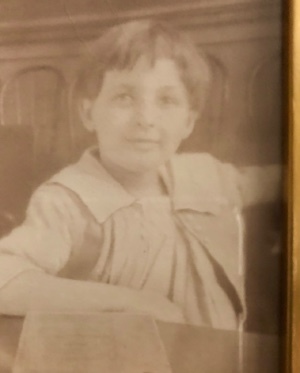
Little Fanny, at age seven, was stricken with both Diphtheria and Scarlett Fever – two common and serious childhood illnesses in the early 20th Century. She was buried in an unmarked grave. When her siblings reached adulthood, they tried to track down her burial plot; they failed in their efforts. This is the only photo we have of Fanny:
The Present
One evening, I went to see my ninety-two-year-old mother-in-law at her apartment in an assisted living facility. We talked of many things – and I learned more about Fanny than I had learned in the forty years I had been married to her son. When I got up to leave, my mother-in-law called out, “Wait one moment, Iris. I have something I want to give you. It’s not worth much, but I want you to have it.”
I watched her rummage through the tiny compartments of her jewelry box and finally she emitted a sigh of relief and pulled out a small velvet box. She turned to me and said, “I’m giving you this – the only thing left from my sister Fanny – who I never knew. I think you, of anyone else in the family, would appreciate it.”
Tears sprang to my eyes and stared to fall on my cheeks. “Don’t cry,” she whispered. “This is a good thing.”
I was touched beyond words and hugged her hard. And slipped the little girl’s ring on my pinky finger, where it has been ever since.
My mother-in-law was wrong. A family heirloom is priceless.
The Future
The ring will be a reminder of past tough times, the harshness of disease and poverty, and the fragility of life.
It will be a symbol of continuity – that even someone who we never knew could have such a profound effect on us
It will be a gentle reminder to be deeply grateful for the many advances, discoveries and inventions that have today given us a reasonable chance of good health and longevity
And it will be a prompt to recognize once again how important it is to delve into our family history. Ask for the stories. Listen to the reminisces. Record the observations and memories.
Why? Simply because it helps us live our own lives more fully.
What family heirloom do you prize? And why? How did knowing your roots and your ancestor’s stories enrich your life?
Keep Preserving Your Bloom,
Iris


March 30, 2018
Replacing Fear With Joy
It’s 11:15am and I’m squirming in my seat. Impatiently scraping my saddle shoes against the metal sidebars of my desk. I glance up at the big wall clock. Fifteen more minutes until lunch break. I can already taste the spicy hamburger loaded with fried onions and the iced cold Coke I will soon be guzzling. My best friend, Sharon, and I are heading straight for White Castle – four blocks away. Karen and Linda are trying the new pizza place by the library and Libby is heading home for lunch.
The recess bell pierces the silence of our classroom at exactly 11:30am. We hand-in our spelling tests and scramble for the door. Freedom. Ninety glorious minutes of unsupervised time to roam the streets surrounding our suburban elementary school.
It’s 1957. There are no locks on the portals of our schools. The red brick structure sports floor to ceiling windows that are open in both fall and spring to the outside world of fluttering leaves and newly mowed grass. Our school is a haven of safety, even though no armed guards march around the perimeter nor security cameras hang from the corners of our classrooms. The more responsible of the students are patrol boys – assigned to carefully cross the younger children at the intersections surrounding our three-story schoolhouse. It’s an oasis of learning – a building that fosters growth and both protects and shelters us.
In all the years my siblings and I attended that school, my parents never heard of one incidence of violence, threat or harm from a gun-wielding assailant – in the school, on the playground or in the surrounding neighborhoods we explored in – on our own – from 11:30am until 1pm each school day.
Our post-World War II schools periodically have fire drills, where we line-up and – in an orderly fashion – march outdoors. Periodically we have civil defense drills, where we are instructed to huddle under our desks for an allotted amount of time until the all-clear siren blasts from the speakers and we unscramble our little bodies and sit back down at our desks. We are told we do this as a precaution against invasion from that big scary country called Russia.
The civil defense drills themselves are benign, but the fact that a mean country so far away can possibly separate me from my mom, dad, brother and newly born little sister simply terrifies me. It is the first thing I think about when I wake up in the morning and the last thing I ponder every night as darkness descends and I am alone in my bed: “Will I see my parents again, once I am dropped off at school?”
Of course, not all is serene. Trouble is brewing. Trouble I know little about. South Vietnam is being attacked by Viet Cong Guerrillas. Federal troops are sent to Arkansas to enforce anti-segregation laws. Writers and playwrights are convicted by The House for Un-American Activities Committee (HUAC) for such things as Communist party membership. But to me, all that seems important is the burgeoning rage of Rock and Roll music, my hula hoop, pogo stick and Nancy Drew mystery books.
It’s now 2018. I’m no longer that scrawny, fearful ten-year-old, fifth grader. Now I’m a not-so- scrawny, but more fearful, seventy-year-old grandmother. And I don’t like what I see happening in our schools across the nation.
Many of us have a home to live in, a job to go to, a pantry stocked with food to eat, a car to ride in and a cell phone to communicate with. But our peace of mind has been eroded and our control of our kids’ safety is at great risk. We must no longer put our efforts into acquiring more of what we already have. We must direct our efforts toward getting what we don’t have: a safe environment for our children.
I realize that my grandchildren are not as lucky as my husband and I were. Their night terrors are based on reality, not like mine which were based on “What if’s”.
I realize that times have changed and violence flares up all around us. It certainly makes “Preserving Your Bloom” – my watchword – all the harder to do. It is easy to feel jaded. To shut down. To tune-out. But it is more imperative than ever to use our talents and resources to reflect on what we loved about the past and try to re-create that in the present.
Let’s take our children to visit our nation’s capital physically or acquaint them with the wonders of our nation’s seat of government through books, documentaries and the Internet.
Let’s visit Ellis Island and the Tenement Museum to show them how hard life was for the immigrants who flocked to our country’s shores seeking safe haven and how – through hard work and diligence – they succeeded.
Let’s seek out historical landmarks in our own cities.
Let’s tour our state and national parks to see the many natural wonders our United States has been blessed with.
Let’s educate our kids on both the power and privilege of voting.
Let’s expose our kids to our own family’s history – giving them the rich details of the sacrifices and triumphs they experienced firsthand.
Let’s use our libraries, support our historical societies, display our American flag proudly and sing our national anthem with joy and vigor.
In these consistently diligent ways, we can make a difference. We can lessen the chance that our precious grandchildren will fall asleep in fear and wake up the same way, wondering, “Will I see my parents again, once I am dropped off at school?”
To my Jewish family and friends, a very joyous Seder surrounded by your loved ones. And to my many friends and readers who celebrate Easter, may it be a joyous time as well.
Keep Preserving Your Bloom,
Iris
March 23, 2018
Losing My Mother
In my latest podcast I reflect on losing my mother. Click ‘play’ above or find the podcast on iTunes.
Giving Back
How important is it to give back? And how exactly can we? We have the power to brighten someone’s day and to make a difference in the world – in so many very simple ways.
We live in the physical world and can see the results of encouragement, kindness and empathy first hand.
It’s how we treat the people in our lives, beginning with our spouses, our kids, our parents. Our friends. Neighbors. Shop clerks. Employees. Strangers we bump into for a mere few seconds of our lives – and may not ever see again. Which happened to me recently at a book conference: the the guy standing in line in front of me calmly noted the slow-moving line of people – both waiting to buy coffee and trying to get to the next panel discussion on time. He paid for his cup of coffee and my cup of coffee to save me and the others standing behind me a little bit of time.
It’s listening. Paying attention. Taking note. Being proactive. Giving someone a compliment while picking up your dry cleaning. Remembering to call your friend to see how her dental surgery went. Acknowledging – with a hearty wave – the driver who lets you in the turn lane when you’ve forgotten to get over. Sending a message of encouragement when a colleague is experiencing a rough patch in her career. Writing a thank you note for a dinner party – mentioning one dish in particular that made it so special.
I thought a lot about giving back when I was writing my book – hoping that when it was published it would help other midlife and baby boomer women who were struggling with challenges that sapped their strength and marred their psyche. I wanted my book to inspire readers to gain the wisdom to live the life they craved – in fact, that is the subtitle of my book.
With the internet at our fingertips, we also have an opportunity to spread goodness and kindness. We have an opportunity to reach others – but it is an opportunity laced with ambiguity and ambivalence. We love the internet for its convenience, for all the information at our fingertips, for the instant connection to people both far and close, by blood and friendship. But we pay a price for this new way of living. It’s intrusive. It’s addictive. And, it’s quantitative.
I recognize this. If I write a newsletter that garners lots of comments, does that mean that that particular piece was more valuable than one that received fewer comments? If I paste on Instagram a picture that draws 300 likes, does that mean that picture was more meaningful than one that garnered forty-five likes? Not necessarily.
So I’ve learned to write what I feel in my heart. And write what I hope will inspire others to achieve, dream, and live their lives in full bloom. And guard against my emotions being neither unduly flattered nor overly impressed (or depressed) by the number of shares and likes.
Comments, however, are another matter altogether. Comments – when negative – provide me with food for thought. Comments – when positive – stoke the embers when my fuel tank is running near empty. And I heartily thank each one of you who have ever posted a comment on social media.
My recent book launch made me realize how powerful feedback can be and how important reviews on Amazon are from readers. My Amazon go-to guru, who lives in Portland, tells me that about half of potential buyers like to read reviews. And more weight is given – not to the professionals – but to what the average person writes, because – they’re like THEM.
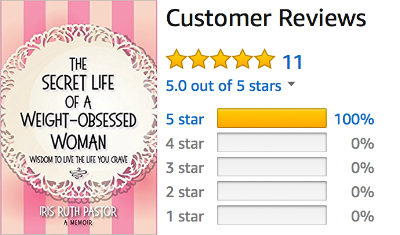
Reviews are important.
To the author – because they validate the book’s merit.
To the reader – because it shows how someone interested in the topic responded to the author’s experience and story.
So why don’t people leave more reviews on what they buy? I’m not talking just about books – though I’d certainly like to see you review mine! I’m talking about reviews on other books, products and services, too.
My guru, eager to supply me with suggestions to dismantle barriers to writing reviews, suggested the following:
People aren’t sure what to say.
She proposes a simple approach to writing reviews of any kind. Click the number of stars and then tell two little things:
What was one thing you can’t get out of your mind about the product – the one thing that lingers in your memory about the experience you had with it?
Why do you think someone else would enjoy it too? Or not?
Writing a review takes a little forethought and reflection, but sharing your experience connects you to someone else interested in the same book, product or service. And my guru and I both think we all need a little more connection in this world.
If you’ve read my book The Secret Life of a Weight-Obsessed Woman or will be reading it, please consider leaving a review.
Click here to go to the Amazon page for my book.
Scroll down to the little gray box that says “Write a customer review”
Sign in to your Amazon account
Rate and review the book!
Policies for reviews can be inconsistent. For instance, identifying yourself as a friend or relative of the author may cause Amazon to throw out the review. Sometimes even calling the author by her first name can be a red flag. And verified purchases get more consideration.
I’d be honored if you left an HONEST review of my book. And, as I’ve said before, very appreciative of the connection.
Keep Preserving Your Bloom,
Iris
March 16, 2018
Staying Close to Your Family
March 16, 1970 – forty-eight years ago today – was my due date for the birth of my first son, Harry. I would end up delivering him into this world three long weeks later. As I remember, those weeks were filled with anxiety over the mechanics of the actual birthing process and how much it would hurt. And I recall feeling quite relieved over having three more weeks to prepare for becoming a mom.
In reality, the hospital I delivered at was putting mothers to sleep so I missed the entire birthing experience and my husband, who was banished to the waiting room, was as clueless as me as to how Harry actually entered the world. And having three more weeks of preparation for being a mom? Joke time. Nothing prepares you for the monumental task of parenting.
I’m way past diapering, grade school playground skirmishes, teenage angst, college applications and graduations. My youngest child is almost thirty-four and I’m STILL grappling with parenting angst – now centered on how to be a happier parent of adult children.
I question my relevancy in my adult children’s lives – especially when I send out a group text and not one of them replies. And I don’t know any parent who doesn’t have at least one sticky situation they can’t seem to satisfactorily resolve.
That is why I was so excited to chat with Dr. Ruth Nemzoff – who sprouts mama-loshen – the Yiddish word for common sense. Our entire podcast was peppered through with her practical, straightforward advice on how to create close relationships with our adult children – even when popular wisdom advises us to fade quietly into the woodwork.
You can listen to the full episode here on my blog, or on iTunes.
Here are some of Dr. Ruth Nemzoff’s insights:
No one has all the answers when it comes to family dynamics; we just have our own experiences
We spend more time in relationships with our kids as adults then as kids
Times change – recognize the reality of what living is like today as opposed to when we were raising kids
Different things work and do not work with each particular child
Most relationships have blips, but that doesn’t mean you don’t love each other
Focus on what we have gained, not lost, with becoming empty nesters – less time pressure, greater freedom. Take joy from what you have now and what can you do with that time to bring you happiness
Here are some questions Dr Ruth Nemzoff and I both pondered and discussed:
How can we maintain ties with family members who have different political and religious beliefs?
How can we tell if we are really close to our children?
There are many ways for adult kids to show caring. Do sons and daughters help their parents in different ways as they age?
Can we be friends with our adult kids?
How honest can we be about our financial situations, end of life choices, expectations for their help as we age?
Weddings and engagements can bring out the worst in us all! How can we avoid the minefields that inevitably arise?
After the wedding, what are some guidelines for good relationships?
If you’d like to hear even more wise wisdom from Dr. Ruth Nemzoff, her book is available on Amazon: Don’t Bite Your Tongue: How to Foster Rewarding Relationships with your Adult Children.
You can subscribe to my podcast in iTunes here.
Keep Preserving Your Bloom,
Iris
March 9, 2018
Announcing My New Podcast!
I must admit after sending off last week’s newsletter about my mom, I was seriously considering taking a long break from writing.
My husband’s surgery, my mom’s passing away and the frenetic pace of publicizing my book,The Secret Life of a Weight Obsessed Woman, had literally drained me. I was yearning for a quiet mind – one that wasn’t always sniffing out the next idea and then finding just the right words and tone to express and convey it. I envisioned lazy days TV binge watching, going to gentle yoga classes on a regular basis and leisurely lunching with long-neglected friends.
But I’ve changed my mind.
Why?
Comments from readers on the passing of my mom made me realize the power of connection and the importance of telling and sharing our personal stories.
“Your Mom always had hugs for me, smiles that went from here to the ends of time, and always time to listen…the woman had chutzpah and never stopped being who she was. I’ll miss her spunk, ideas, and voice!”
“When I think of your mother, one word in particular comes to mind: creativity! Sleeping at your house when we were kids, reflections of her creativity permeated your house. What stands out most in my mind was her paintings on your bedroom walls, which conveyed feelings of beauty and positive energy, although I don’t have a clue what they really were!”
“Having been there (My mother died in 2003), I can tell you some things that might help: Set boundaries if needed. The death of a parent can at times bring out the not so good. She might be gone, but her memories will always remain as long as you speak of them. Never disparage the departed. We are human beings after all.”
“It will never be the same, but I (and my siblings) take comfort that our parents are back together and we get some good laughs about the good times and some of their distinct character traits that made them who they were and helped us to become the people we are today.”
“Iris, your post about your mother is a “four tissue” article.”
The outpouring of comments I got from my honest post about loss was so unexpected. And it reminded me why I started writing my slice-of-life column over thirty years ago and why my fingers will still keep pounding on the keyboard:
To connect
To tell my story so that you can also share your story
To make a difference when it’s dark and to celebrate when it’s light
Not only am I continuing with my newsletter uninterrupted, but I’m also going full speed forward with my newest venture – a podcast series called Preserving Your Bloom.
There are four podcasts to begin with – three centered on eating disorders. One is from a trend setting professional heading a premier eating disorder organization. One from an anorexic Australian woman who battled her disease for decades and one a therapist treating those in the trenches. And the fourth is from a wise woman from on getting along with your adult children. Below are the links and relevant information:
June Alexander suffered with anorexia until age 60 when she found a weapon to effectively fight back and help others in the process.
Elissa Myers is the head of the Academy of Eating Disorders and provides perspective on the growing field of Eating Disorder research and emerging trends in treatment and recovery.
Dr. Nina Savelle Rocklin is a Los Angeles based therapist who advocates for an anti-dieting stance when fighting the food monster within.
Ruth Nemzoff is the author of “Don’t Bite Your Tongue: How to Foster Rewarding Relationships with your Adult Children” and shares her wisdom on maintaining stable and loving family relationships.
Once again, I’m presenting you yet another way of taking care of yourself. It’s Preserving Your Bloom through connection and by sharing our personal stories as we journey through life.
You can subscribe to the podcast in iTunes here.
Keep Preserving Your Bloom,
Iris
March 7, 2018
Maintaining Stable and Loving Family Relationships, with Dr. Ruth Nemzoff
I don’t know anyone with adult kids who doesn’t question their relevancy in their kids lives – and everyone has at least one sticky situation they can’t seem to satisfactorily resolve. That’s why I was so excited to chat with Dr. Ruth Nemzoff – author of Don’t Bite Your Tongue: How to Foster Rewarding Relationships with your Adult Children.
Ruth gives practical, straight forward advice on how to create close relationships with your adult kids, even though popular wisdom advises parents to let go, disconnect, and bite their tongues.
Click ‘play’ above to listen the the podcast, or find it on iTunes.
March 2, 2018
I’m Tired, But Also Relieved
It’s two weeks since my mom passed away and I find myself struggling about what to write about her and her death. So many feelings are cascading over me constantly – like a tsunami – washing away what I felt just seconds before and sweeping in new ones.
I think my overriding feelings are twofold:
I’m feeling great fatigue. Bone tired fatigue. The kind that a good night’s sleep doesn’t relieve. I’m tired from the myriad details pressed upon all survivors. I’m tired from the ever-present uppermost thoughts in my mind to set a good example for my grandchildren – to show them that even through the death of our beloved matriarch, there are rituals and traditions to comfort our shattered heats, calm our fears, and guide us through the discomfort and unknown. And I’m tired from responding graciously and authentically to the many whose lives my mother touched and whose death leaves an immense void.
I’m also relieved. My mom was a free-spirited, decisive woman who had had a rough year. And I had spent many days tormenting myself over her living far from her children and grandchildren – though her choice – but having too much responsibility for advocating for her own care. As a wise friend counseled me, “When a parent dies, we all feel like what we’ve done is ‘never enough.’”
And I’m experiencing a lot of incremental losses. Saying goodbye to my mom’s friends who have known me – not only before braces and boobs – but before baby teeth and sippy cups. I’m saying goodbye to my mom’s hairdresser who always worked me in and knew exactly how to trim my bangs. I’m saying goodbye to the waitress at First Watch who knew without asking not only what my mom was ordering – a Cobb Salad without avocado and bacon – but also what I was ordering – a turkey burger with accompanying greens. To the maintenance man who changed my mom’s air filters at the drop of a hat and the apartment security card who my mom brought dinner to almost every time she went out to dinner too.
Sure I’ll still visit my hometown. I’ll still see my sister-in-law and brother-in-law and niece and nephews and mother-in-law. And I’ll still run into my high school cronies and lunch with irreplaceable confidants whose friendships span decades. I’ll even have her two bedroom apartment to return to for the next couple of months. But something has fundamentally changed when returning to the city of my birth and to the city I’ve lived most of my adult life. Quite simply, my parents are no longer there.
When I flew up to meet her and her caregiver at the hospital emergency room just days before she died, I snapped the picture below. It’s the escalator I ascended after deplaning. It’s been many years since I’ve gazed up at the top of those moving stairs to see my mom and dad eagerly scanning the approaching crowd – waiting with unbridled excitement to see me emerge from the crowd. And even when they could no longer make the relatively complicated drive to the airport, I knew they were eagerly awaiting my tap on their apartment door. Even when my dad passed away five years ago, I knew my mother would still be in that same apartment – fully dressed, hair perfectly coiffed – ready to zip out the door with me in tow – as soon as I deposited my suitcases in the spare bedroom. Off we would go for lunch and shopping.

I haven’t cried much. I haven’t gone though her closet with my younger brother and sister separating what we will keep and what we won’t. I haven’t even received her official death certificates or written one thank you note for the many who have reached out to express their sympathies and condolences. I know the long process – I’ve walked the walk with many friends and family members who have buried their last remaining parent – many of them at much younger ages than I have.
All I keep picturing is that long escalator inching me forward to baggage collection. I know for the rest of my life, it will never be the mom and dad – who welcomed me into the world and raised me – certainly not perfectly – but absolutely the very best way they could – who will eagerly be scanning the crowd of arriving passengers looking just for me. And I – who adored them, was immensely proud of them and loved them just as imperfectly – will now step off that moving sidewalk stoically, collect my bags without fanfare, call Lyft with my phone app and begin the visit to the city I called home for so much of my life – without them.
I know I am identified in many ways – wife, mother, nana, sister, friend, writer, speaker and author. But as long as my mom and/or my dad were alive, I was still somebody’s little girl.
The world may see in me a woman whose gray roots are peeking through, whose hands are sporting a few age spots, whose eyes are ringed with bags, whose balance is a tad compromised and whose knee caps jiggle as she walks. But to my mom – to the very end – I was always that little girl with the sparkling brown eyes, wildly swinging pony tail, and skinny legs – running home from the bus stop to show her my newest creation.
A friend and fellow writer said it up best, “I know as long as my mom is around someone is really reading what I write. Someone is really proud of how I’m stringing my words together. Someone is remembering weeks later a quote I used, a new word I embraced or a new slant I expressed.”
I’ll miss a lot of things, but I think that unrestrained love and devotion is what I’ll miss most.
Keep Preserving Your Bloom,
Iris
February 23, 2018
A Tribute to My Mother
My mother passed away this week. My time has been spent attending to her funeral, connecting with family, and of course, honoring who she was and all she has given.
If it is okay with you, I would like to share her life with you.
She was an only child and impressed on her children the importance of having more than one child. So I took her admonition seriously and gave birth to five.
My mom was raised by a mother who worked full time so she impressed on us the importance of a mother being there when the yellow bus dropped off her kids at 3 pm every afternoon from school. I followed her example so wholeheartedly that one of my kids in utter exasperation asked me why I had to be home EVERY day when he got home from school. Couldn’t I at least every once in a while find something ELSE to do?
My mom was instantly captivated by a brash young man when she was 16 and married him at 17 when he went AWOL from the Army Air Corp before being shipped off to England during World War 2. I followed her example in this too but my captivating young man came a little bit later in life than hers did. And he only had to give up a day of working out at the gym to marry me.
My mom wasn’t perfect – she always was late to pick me up from school, a friend’s house or a birthday party, but in most other ways she was pretty damn close to perfection.
She was always there for me. When I was devastated by a break-up with a boyfriend, I’d get from my dad some obnoxious remark like “there’s nothing deader than yesterday’s romance,” but my mom would comfort me – saying “Everything you are feeling has been felt before,” and “those awful feelings would not last forever.”
My mom was known for many things:
Her sliver cake – one sliver and you kept going back for more
Her bowls of Rice Chex cereal coated expertly in white chocolate
Her ability to balance her check book to the penny and complete the word jumble that appeared daily in the newspaper
Creativity was woven through her DNA – “La Bev” was her self-given nickname – not because she was a diva but because she truly regarded herself as a creator. Table decorations, invitations, and party planning all were her playground.
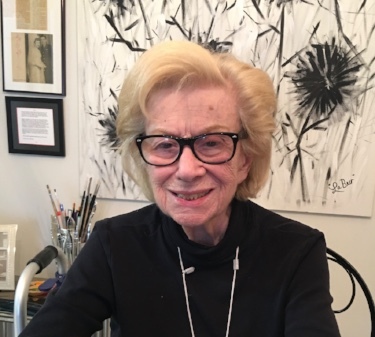
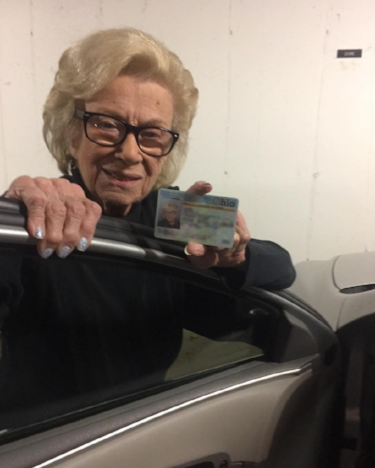
She was a trooper. She lost most of her hearing, so she learned to text. Her children moved away, but she refused to leave her hometown and doubled down on caretakers. She lovingly kept the friends she had and made more. Though she was driving less and less as her energy flowed away, she passed her driving test just a few weeks before it expired.
She was known for excellent memory, organizational skills, empty closets and exceptionally spotless premises. I can speak for my sister, brother and me when I also admit those genes eluded us.
In 2015, when Union Terminal – the majestic architectural gem of the City of Cincinnati – needed to pass a levy for essential maintenance and repair, there was only one commercial they ran continuously and only one person in that commercial: my mother.
On February 17, her 91st birthday – though she lay in a coma in hospice – my brother and sister and I – along with a group of friends and family – sang her Happy Birthday and cut her cake. About thirty minutes later, she slipped away. She died as she had wished – on the day she had been born and in the midst of a “party.”
The Cincinnati Reds lost a loyal fan.
The Cincinnati Museum Center at Union Terminal lost one of their strongest supporters.
Indian Creek Apartments lost a model resident.
A lot of people lost a loyal and caring friend.
Embers, Bob Evans, First Watch, Skyline Chili, the bagel shop, Graeters and Trios lost a good customer.
And our family lost our beloved and indomitable matriarch – “La Bev.”
But I must say, as sad as we are on her passing, I know there are four souls who are extremely joyous:
Her mother – Lily Diamond Friedman
Her father – Frank Friedman
Her husband – E. Pike Levine
And her older brother, Joseph, who died before she was born and who she grieved for throughout her life.
She’s now with them for eternity.
So farewell, Mom.
We will miss you greatly.
We will love you forever.
And we will live our life with zest and curiosity and passion in celebration of your passing.
Just as you lived yours.
– Iris
February 16, 2018
Energy, Awareness, Focus, and Wonder
Through circumstances not altogether pleasant I found myself in the waiting room of Mt. Sinai Hospital in New York City on Super Bowl weekend.
Trying to distract myself from the myriad of tests my husband was having on his spine, I started reading the weekend edition of the Wall Street Journal I had picked up at the airport just hours before. Page by page, I patiently perused the book section.
What a wealth of information I was treated too. And I’m eager to share.
ENERGY
Ever gritted your teeth in chest tightening pain as you attempted to endure your daily morning run? Author Alex Hutchinson says that “the feeling that you can go no further is just that – a feeling.” Hutchinson notes that if you change your perception of a task’s difficulty, you can change your actual results. Hutchinson demonstrates this by citing a 2006 analysis by South African scientist Ross Tucker, who analyzed the pacing patterns of sixty-six races dating back to the 1920’s. The last kilometer was either the fastest or second fastest pace in every case but one.
His conclusion: the sight of the finish line – and the knowledge that you can soon stop – automatically reframes your brain’s interpretation of your body’s signals. And you discover that you’re not quite out of juice after all.
I’ll remember that the next time the elliptical machine begins to beat me down three quarters of the way through.
AWARENESS
Ever thought when it comes to parenting, that MORE is always BETTER? You may want to re-think this assumption. Jennifer Wallace, a free lance writer in New York, wrote about the perils of over-discussing your child’s problems and that it often can do a child more harm than good.
Wallace notes that “when children routinely engage in what psychologists call ‘co-rumination’ excessively re-hashing and speculating about problems with a parent…it can amplify stress, impair judgment, and increase the risk of them developing anxiety and depression.”
Wallace cites a study by Dr. Amanda Rose, a psychology professor at the University of Missouri, who says one of the most effective ways for parents to break the co-ruminating habit is to be aware that they are doing it. And to share with their child that they want them to feel good and not get stuck thinking about the negative.
FOCUS
Ever since I’ve raised my five boys – a process that seemed to go on forever – I’ve puzzled over my frantic pace to write, tell stories, do public speaking and learn about as many new things as I can. It seemed so counter intuitive. I kept telling myself that now that my nest has emptied, I should be vacationing, reading more, lunching with my friends, shopping at the mall. Why was I pushing myself so hard, for so long, so relentlessly to create?
I think I have found the answer.
Melissa Schilling, professor at New York University Stern School of Business, notes that a single-minded life of invention is hard to combine with family obligations. She talks about rushing around her apartment one morning at 6am getting ready to fly to California to teach an innovation workshop. Her ten year-old son looks at her with sad eyes and asks, “Why are you always busy?” Her heart begins to pound and that familiar knife of guilt and pain twists in her stomach. She concludes that “the need to connect with our children does not prevent women from being successful…but it may get in the way of having the almost maniacal focus” that famous innovators exhibit.
Schilling concludes that mothers can be important innovators, but their years of intense focus might start later. Got it.
WONDER
So have you ever sat next to someone at a dinner party who knew just as much as you do about novels, but was also knowledgeable about opera, and had an encyclopedic knowledge of the English Civil War and French wines? And then did you feel an anxiety that nudged beyond the envious and begged the question: “How does she find the time?”
Essayist and author Zadie Smith had that exact experience. If she, who is so mightily accomplished, gives into this type of existential angst, then I truly know I am not alone. So I can write. Can I rattle off the Latin names for my wild array of houseplants? Certainly not. Can I pinpoint the exact years of Reconstruction after the Civil war? Hardly. Do I know how to play the piano and the flute and speak three languages? Tee hee.
CONCLUSION
I love newspapers. Not the online ones. The paper ones. The ones where the ink smears, articles get ripped out of and they don’t need batteries to charge in order to get the latest breaking stories. They inform. They instruct. They enlighten. And they make me feel better about myself.
Tell me what does that for you?
Keep Preserving Your Bloom,
– Iris