
Mary Jane Walker's Blog: Adventures at Snow Farm Part 1 – Skiing with a broken shoulder! , page 39
September 29, 2017
New Zealand: Easy for Solo Women Travellers
Travelling in New Zealand is easy for solo women travellers, whether you are an adventurer, hiker, mountaineer or photographer, or just an ordinary person.
You can find cheap places to stay everywhere, using campsite phone apps.
Whether you choose to buy a car or rent a car there are so many ways of travelling New Zealand, on good roads.
Here is my latest story.
I parked my car at Christchurch airport, where they charged $7 a day, while I was in Auckland on business.
When I arrived back at Christchurch I got picked up from the plane by the carpark operators and taken to the carpark, all part of the service.
I drove south to Queenstown with a friend named Diana, through the picturesque towns of Fairlie and Tekapo.
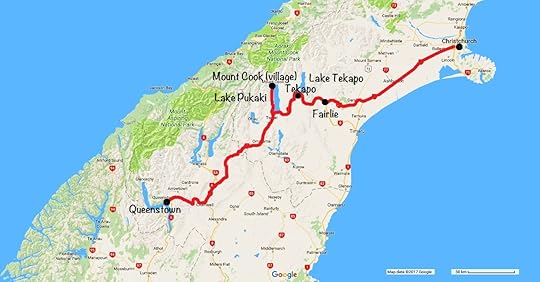
Journey from Christchurch to Queenstown, with places mentioned in the text, background map data copyright 2017 Google. The route taken was added in red for this post, five places visited were added similarly as black dots, and six conspicuous place names were added for this post in Noteworthy, a free font.
Here’s a link to a really excellent Youtube video of Tekapo, showing the picturesque Church of the Good Shepherd, which looks very old but was actually built in the 1930s.
.
We detoured west along the shore of Lake Pukaki and stayed at backpackers at Mt Cook, which is 3,800 metres high and the highest mountain in New Zealand.
There are lots of spectacular walks you can do in the Mount Cook area, such as the Hooker Glacier Walk and walks along the Tasman Valley. Here’s a Youtube video that Diana and I made at Mount Cook; Diana lives in the North Island, where it’s a bit warmer . . .
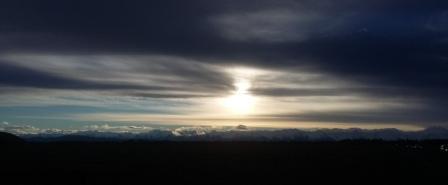
Variable weather made for a more interesting holiday, and more interesting photos, than if the weather had been totally fine!
You can read about more walks in my book A Maverick New Zealand Way, part of a series of illustrated travel books from the point of view of a woman and a solo traveller.
Here are some of the photos:
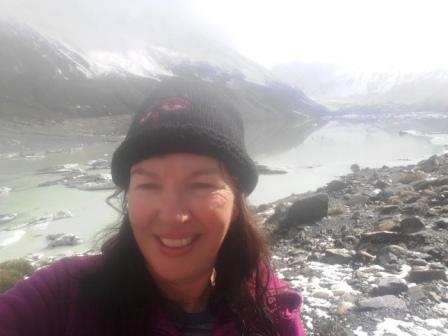
Myself at the Hooker Glacier, Mount Cook
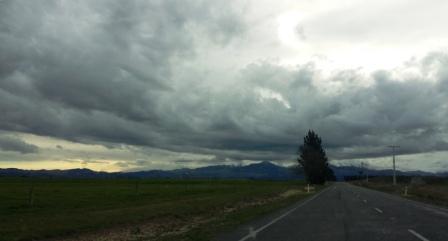
Dramatic Skies on the Road
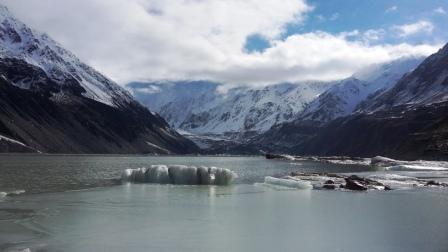
At Mount Cook
.
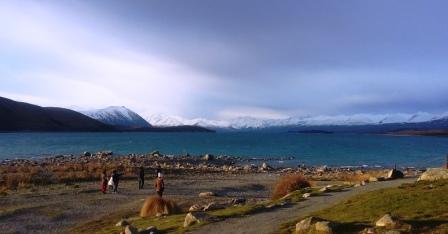
A view of Lake Tekapo from a spot beside the Church of the Good Shepherd
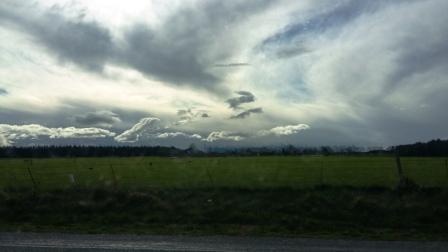
Yet more bad-weather skies
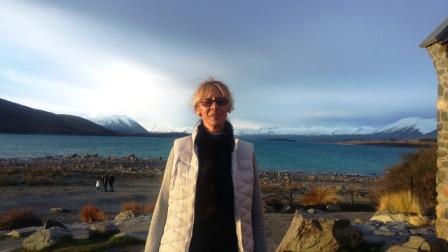
Lake Tekapo with my friend Diana, the Church of the Good Shepherd visible at the extreme right
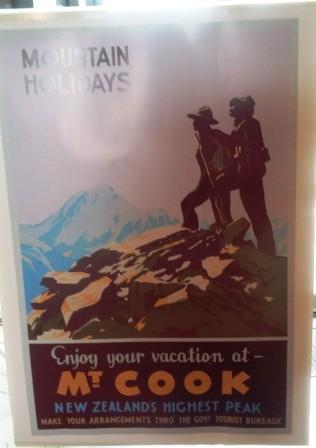
An old 1930s-type poster at Mount Cook, a reproduction I presume
The post New Zealand: Easy for Solo Women Travellers appeared first on A Maverick Traveller.


August 21, 2017
Adventures at Snow Farm: Nordic Skiing Downunder
This winter, I have been told that I cannot do Alpine skiing because of my broken shoulder. A collision or heavy fall would take my shoulder back to being broken.
So, I wondered about trying gentler pursuits such as Nordic skiing, or snowshoeing. I had a go snowshoeing once at Lake Alta, but I decided I would try Nordic skiing this year.
What is the difference? Well, one is on mostly steep slopes and the other is mostly on gentle slopes. Also, with Alpine skiing you are firmly clipped onto the ski both at the heel and at the toe, whereas with Nordic skiing you are only clipped on at the toe and can lift the heel.
Nordic skiing is the original kind of skiing, dating back thousands of years. It is 90% walking, or striding, and only 10% downhill. You can always tell a Nordic skier, they will be striding along with the heels rising and falling.
Alpine skiing, 100% downhill with the boot clipped on at both ends, only came into vogue in the 1930s once rope-tows became available. Early Alpine skiing was a bit of a daredevil sport. The early Alpine bindings often didn’t release in a fall, which resulted in sprains and fractures. It wasn’t until the 1960s that Alpine ski bindings became safe enough for the general public to be interested in the sport, with the old rope-tows upgraded to chair-lifts accordingly.
So, Nordic skiing was the only kind of skiing that existed for 99% of the history of the ski, right up to the 1930s, even though Alpine skiing is more familiar today.
I decided to give Nordic skiing a go at Snow Farm, a dedicated Nordic skiing facility not far from Queenstown and Arrowtown. Snow Farm is about 1,600 metres above sea level, in the mostly rather flat-topped and hummocky Pisa Range.
When the snow is absent, as in this photo, you can see the groomed landscape of Snow Farm. It is the biggest Nordic skiing facility in the Southern Hemisphere, bigger than many in Europe. It is also right next to a facility called the Southern Hemisphere Proving Ground, where cars can be tested for winter conditions in the northern summer, reducing development times.
(In the season, of course, it just looks like—well, snow.)
Snow Farm was developed by John Lee CNZM, a highly entrepreneurial sheep-farmer who also developed the Cardrona Ski Field and the Southern Hemisphere Proving Ground, as well as one or two other venues. Better than digging ewes out of snowdrifts, I suppose! A book about Lee and his family, called The Snow Farmer, was published in 2016 by Random House; he’s retired now, and the Snow Farm is under new management.
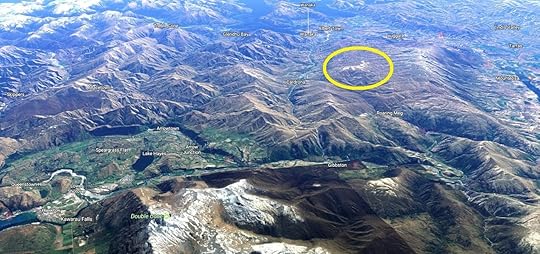
Oblique aerial view of Snow Farm (in yellow oval) in relation to Queenstown and Frankton at bottom left. North at top. Background image source: Google Earth. Imagery ©2017 Digital/Globe, CNES/Airbus, Landsat/Copernicus, DataSIQ, NOAA, TerraMetrica, U.S. Navy, NGA, GEBCO. Map data ©2017
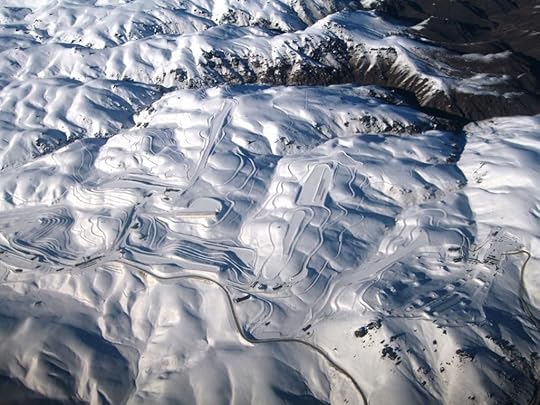 An aerial view of Snow Farm in Winter, with the Audi Southern Hemisphere Proving Grounds at the right. Wikimedia Commons, by Greg O’Beirne, 23 August 2008, CC-BY-SA 3.0.
Snow Farm has two back country huts, Meadow Hut and Bob Lee Hut. Meadow Hut is about 4 kms from the main Lodge, on a Beginners trail, and Bob Lee hut is about 3 kms after that, nothing too steep or arduous. Bob Lee Hut is close to the Southern Hemisphere Proving Ground. I rang, and to my delight the shoulder season was officially until July 20th, so I was able to get in straight away. Snow Farm is often full up at the height of the season, and you have to book in advance then. In August 2017, all the world’s cross-country teams were going to be at Snow Farm. But things were still pretty quiet in early July.
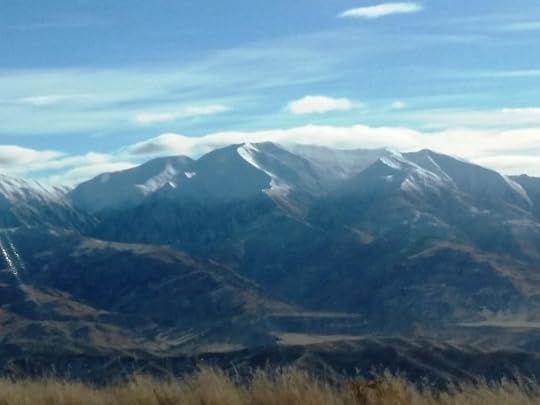 View of the terrain along the Crown Range Road, the main highway by which to access both Snow Farm and the Cardrona Skifield. The shortest route from Queenstown on the Crown Range Road involves a moderately high pass, and in icy weather it makes sense to take the long way around through Cromwell. That was the way I came back.
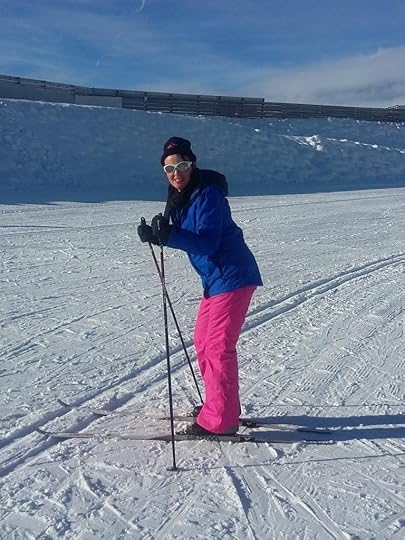
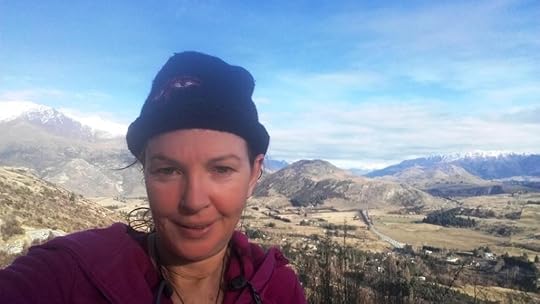 Me on the way up
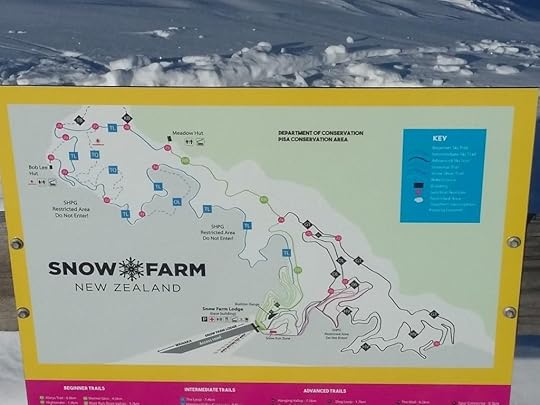
Photograph of Snow Farm sign, detailed content ©Snow Farm (see Snow Farm website http://snowfarmnz.com for more information and bookings)
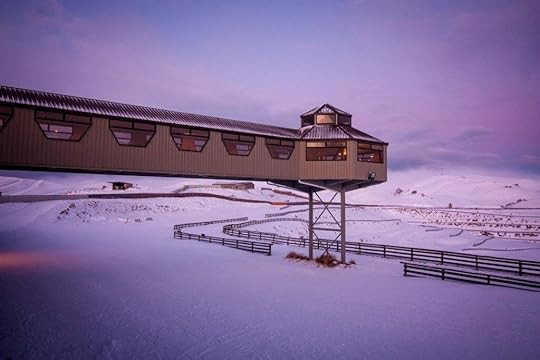 All photos by me in this group, except for the last one showing part of the Snow Farm Lodge, which is from Wikimedia Commons and is by André Richard Chalmers, dated 18 July 2015, CC-BY-SA 4.0.
I arrived at 1.30 p.m. and took ski lessons straight away. Both ski instructors, Sarah and Hannah, were from northern Sweden.
You had go 1.2.3, then slide without poles. I did not mention my shoulder. You had to learn to fall over without hurting yourself and how to how to get up. I would need that the next day when I fell over 22 times.
I was suffering from a frozen shoulder in addition to being at risk of re-breaking it, so a really did have to be careful. I soon found that if I kept my speed down I could fall over backwards rather than onto my shoulder, and that if I was going faster I could often spot a bit of soft snow to land in. The main thing was that I had control, because on the Alpine fields people kept crashing into me, often beginners on the intermediate slopes. Last season, I hired a French instructor at Coronet Peak, an Alpine skifield, and he stopped twelve people from colliding with me!
To get back up on the Nordic skis you put the skis at 45 degrees, get on your knees (which is possible with Nordic skis of course), and then stand up. That was simple really.
All the same, the overall technique took a while to learn. With Nordic skiing, you use the opposite arm to match the sliding on each ski, i.e. your opposite arm goes with it, presumably for better balance.
Going up a steep hill was not easy either. You had to use the herring bone technique with ski tips outward. Conversely when you go down-hill to stop you put your skis into the snowplough position with the tips together. Of course, this is stuff any Alpine skier should be familiar with as well. The only difference is that there is more uphill work with Nordic skis, since it is more cross-country and ski-lifts and tows aren’t generally employed.
I stayed at the Lodge on the first night and the food was very good. I watched the Rugby and met a teacher who was a coach, but I also wanted to get my pack ready for two nights in the huts.
To my surprise they could take your pack for you for a cost of $20 over two days; and the huts had gas cookers. This was amazing! I was getting ready to take big heavy packs that included gas cookers, gas and cooking implements, expecting to rough it in some kind of back-country hut both nights. But of course, as you can see from the appearance of the Lodge, Snow Farm wasn’t that sort of place.
So, I decided that they could very well take my packs (minus gas cookers and pots), as with a sore shoulder I wasn’t going to strain myself any more than necessary.
That night I watched the rugby, and met a coach from a team of Biathlon competitors, a classic Nordic-ski sport that combines shooting at targets with cross-country skiing to get to from one target to the next.
The next day, I was headed for my own Nordic / cross-country adventures. But first, let’s have a look at a bit more skiing history.
To be continued…
The post Adventures at Snow Farm: Nordic Skiing Downunder appeared first on A Maverick Traveller.
Adventures at Snow Farm Part 1 – Skiing with a broken shoulder!
This winter, I have been told that I cannot do Alpine skiing because of my broken shoulder. A collision or heavy fall would take my shoulder back to being broken.
So, I wondered about trying gentler pursuits such as Nordic skiing, or snowshoeing. I had a go snowshoeing once at Lake Alta, but I decided I would try Nordic skiing this year.
What is the difference? Well, one is on mostly steep slopes and the other is mostly on gentle slopes. Also, with Alpine skiing you are firmly clipped onto the ski both at the heel and at the toe, whereas with Nordic skiing you are only clipped on at the toe and can lift the heel.
Nordic skiing is the original kind of skiing, dating back thousands of years. It is 90% walking, or striding, and only 10% downhill. You can always tell a Nordic skier, they will be striding along with the heels rising and falling.
Alpine skiing, 100% downhill with the boot clipped on at both ends, only came into vogue in the 1930s once rope-tows became available. Early Alpine skiing was a bit of a daredevil sport. The early Alpine bindings often didn’t release in a fall, which resulted in sprains and fractures. It wasn’t until the 1960s that Alpine ski bindings became safe enough for the general public to be interested in the sport, with the old rope-tows upgraded to chair-lifts accordingly.
So, Nordic skiing was the only kind of skiing that existed for 99% of the history of the ski, right up to the 1930s, even though Alpine skiing is more familiar today.
I decided to give Nordic skiing a go at Snow Farm, a dedicated Nordic skiing facility not far from Queenstown and Arrowtown. Snow Farm is about 1,600 metres above sea level, in the mostly rather flat-topped and hummocky Pisa Range.
When the snow is absent, as in this photo, you can see the groomed landscape of Snow Farm. It is the biggest Nordic skiing facility in the Southern Hemisphere, bigger than many in Europe. It is also right next to a facility called the Southern Hemisphere Proving Ground, where cars can be tested for winter conditions in the northern summer, reducing development times.
(In the season, of course, it just looks like—well, snow.)
Snow Farm was developed by John Lee CNZM, a highly entrepreneurial sheep-farmer who also developed the Cardrona Ski Field and the Southern Hemisphere Proving Ground, as well as one or two other venues. Better than digging ewes out of snowdrifts, I suppose! A book about Lee and his family, called The Snow Farmer, was published in 2016 by Random House; he’s retired now, and the Snow Farm is under new management.
Oblique aerial view of Snow Farm (in yellow oval) in relation to Queenstown and Frankton at bottom left. North at top. Background image source: Google Earth. Imagery ©2017 Digital/Globe, CNES/Airbus, Landsat/Copernicus, DataSIQ, NOAA, TerraMetrica, U.S. Navy, NGA, GEBCO. Map data ©2017
An aerial view of Snow Farm in Winter, with the Audi Southern Hemisphere Proving Grounds at the right. Wikimedia Commons, by Greg O’Beirne, 23 August 2008, CC-BY-SA 3.0.
Snow Farm has two back country huts, Meadow Hut and Bob Lee Hut. Meadow Hut is about 4 kms from the main Lodge, on a Beginners trail, and Bob Lee hut is about 3 kms after that, nothing too steep or arduous. Bob Lee Hut is close to the Southern Hemisphere Proving Ground. I rang, and to my delight the shoulder season was officially until July 20th, so I was able to get in straight away. Snow Farm is often full up at the height of the season, and you have to book in advance then. In August 2017, all the world’s cross-country teams were going to be at Snow Farm. But things were still pretty quiet in early July.
View of the terrain along the Crown Range Road, the main highway by which to access both Snow Farm and the Cardrona Skifield. The shortest route from Queenstown on the Crown Range Road involves a moderately high pass, and in icy weather it makes sense to take the long way around through Cromwell. That was the way I came back.
Me on the way up
Photograph of Snow Farm sign, detailed content ©Snow Farm (see Snow Farm website http://snowfarmnz.com for more information and bookings)
All photos by me in this group, except for the last one showing part of the Snow Farm Lodge, which is from Wikimedia Commons and is by André Richard Chalmers, dated 18 July 2015, CC-BY-SA 4.0.
I arrived at 1.30 p.m. and took ski lessons straight away. Both ski instructors, Sarah and Hannah, were from northern Sweden.
You had go 1.2.3, then slide without poles. I did not mention my shoulder. You had to learn to fall over without hurting yourself and how to how to get up. I would need that the next day when I fell over 22 times.
I was suffering from a frozen shoulder in addition to being at risk of re-breaking it, so a really did have to be careful. I soon found that if I kept my speed down I could fall over backwards rather than onto my shoulder, and that if I was going faster I could often spot a bit of soft snow to land in. The main thing was that I had control, because on the Alpine fields people kept crashing into me, often beginners on the intermediate slopes. Last season, I hired a French instructor at Coronet Peak, an Alpine skifield, and he stopped twelve people from colliding with me!
To get back up on the Nordic skis you put the skis at 45 degrees, get on your knees (which is possible with Nordic skis of course), and then stand up. That was simple really.
All the same, the overall technique took a while to learn. With Nordic skiing, you use the opposite arm to match the sliding on each ski, i.e. your opposite arm goes with it, presumably for better balance.
Going up a steep hill was not easy either. You had to use the herring bone technique with ski tips outward. Conversely when you go down-hill to stop you put your skis into the snowplough position with the tips together. Of course, this is stuff any Alpine skier should be familiar with as well. The only difference is that there is more uphill work with Nordic skis, since it is more cross-country and ski-lifts and tows aren’t generally employed.
I stayed at the Lodge on the first night and the food was very good. I watched the Rugby and met a teacher who was a coach, but I also wanted to get my pack ready for two nights in the huts.
To my surprise they could take your pack for you for a cost of $20 over two days; and the huts had gas cookers. This was amazing! I was getting ready to take big heavy packs that included gas cookers, gas and cooking implements, expecting to rough it in some kind of back-country hut both nights. But of course, as you can see from the appearance of the Lodge, Snow Farm wasn’t that sort of place.
So, I decided that they could very well take my packs (minus gas cookers and pots), as with a sore shoulder I wasn’t going to strain myself any more than necessary.
That night I watched the rugby, and met a coach from a team of Biathlon competitors, a classic Nordic-ski sport that combines shooting at targets with cross-country skiing to get to from one target to the next.
The next day, I was headed for my own Nordic / cross-country adventures. But first, let’s have a look at a bit more skiing history.
To be continued…
The post Adventures at Snow Farm Part 1 – Skiing with a broken shoulder! appeared first on A Maverick Traveller.
July 21, 2017
Mostly Marvellous Melbourne
ONE place I never get tired of visiting is Melbourne, the southernmost of Australia’s big cities, a city that lies roughly on the latitude of Hamilton and the Waikato on the shores of Port Phillip Bay.
In many ways, Melbourne is the original ‘garden city’. In this 3D aerial image from Google Earth, you can see how true that is.

Central Melbourne, as it might be seen seen from an aircraft over Port Phillip Bay, north at top.
(Source: Google Earth. Imagery ©2017 Google, Map Data ©2017 Google.)
Here’s a closer look at the very heart of downtown:

Melbourne: Flinders Street Railway Station and St Paul’s Cathedral with Flinders Street (left to right) and tree-lined Swanston Street (at right angles in the middle) between them, as seen from over the Yarra River in the vicinity of Princes Bridge. (Imagery ©2017 Google, DigitalGlobe, Aerometrex, CNES/Airbus, Landsat/Copernicus, Map Data ©2017 Google)
Melbourne’s an intensely walkable city. The next couple of photos show the Rainbow Pedestrian Bridge over the Yarra River, with countless pedestrians crossing it at dusk. Underneath the bridge is one of the world’s smallest islands, Ponyfish Island. The island is entirely covered by an outdoor bistro bar, at which some of the pedestrians tarry!


Rainbow Pedestrian Bridge with Ponyfish Island beneath (two images)
I will be writing about my visit to Melbourne a little further on below. But first, let’s take a look at the city’s colourful history.
How Melbourne got its Name
Melbourne was founded by the Crown in 1836, following the dubious acquisition of its site by a private adventurer named John Batman in 1835. Batman hailed from Tasmania, then known as the penal colony of Van Diemen’s Land. According to a neighbour, the artist John Glover, Batman was a “a rogue, thief, cheat and liar, a murderer of blacks and the vilest man I have ever known.”
Intent on founding a colony of his very own, to be called Batmania—a possible clue as to the wider soundness of his judgement—Batman claimed for the rest of his days that he had obtained 600,000 acres of land from people on the mainland, called the Kulin. According to Batman, this estate was leased to him in return for an annual tribute of goods, including several dozen knives, shirts, blankets and hatchets.
Batman and his party could not find an interpreter and were thus reduced to conducting the negotiation in sign language. It most unlikely that the Kulin understood the transaction in the same, permanent, terms as Batman. But as one later historian noted, “No doubt the blankets, knives, tomahawks, etc., that he gave them were very welcome.”

‘Soon, you will all be citizens of Batmania’
A Victorian artist’s impression of the negotiation of Batman’s Treaty. Public domain work from Wikimedia Commons, attributed to A. Garren, ed., Picturesque Atlas of Australasia, Sydney, 1886, Vol. 1, p. 161.
Batman’s land claim was immediately annulled by the Governor of New South Wales, Richard Bourke. The Governor moved swiftly to establish an official settlement on the same site with the more sensible-sounding name of Melbourne. Bourke’s settlement was named after the British Prime Minister of the day, Lord Melbourne, whose party Bourke openly favoured. A few years after his attempt to found Batmania and the official founding of Melbourne, Batman died of syphilis; a disease that may have accounted for the grandiosity of his scheme.
As incredible as it might sound to a New Zealander, arrangement with the Kulin arrived at by the rogueish and quite possibly deranged John Batman—sometimes dignified with the name of Batman’s Treaty—is the only recorded instance in which European settlers actually negotiated with Australian aborigines for access to their land. Others, including Governor Bourke, didn’t even bother.
And so, the city that grew up in the former Kulin territory was called Melbourne, created by a high-handed stroke of the Governor’s pen in 1836, and not Batmania.
The Rise of ‘Marvellous Melbourne’
After the town was founded, as the capital of a new colony of Victoria hived off from New South Wales, it grew rapidly. Within a decade Melbourne was half the size of Sydney, founded much earlier in 1788. People took to calling the fast-growing Victorian city ‘Marvellous Melbourne’.
Here’s an 1861 painting of the solid city as it had become, only 25 years after its foundation in 1836. This picture, showing the original Princes Bridge, is painted from a viewpoint similar to the modern-day image of Flinders Street Railway Station and St Paul’s Cathedral above, through from ground level rather than the air.

Henry Burn, ‘Swanston Street from the Bridge’, 1861 (National Gallery of Victoria), public domain image on Wikimedia Commons.
In 1885, the most prominent church in this painting, St Paul’s Church, behind a house that is in shadow, was torn down to make way for St Paul’s Cathedral; but even St Paul’s Church was pretty impressive!
By the 1890s, Melbourne contained half a million people, a grand exhibition hall, a great network of railways and smoking Victorian factories churning out the iron and steel for more rails and the iron lace of Victorian townhouses; and yet there were still oldsters who remembered the site of the city as nothing more than a level plain.
After this initial period of fast growth, however, Melbourne’s growth tapered off, and it never succeeded in catching up with Sydney. During the twentieth century, Melbourne would always play second fiddle to its brash New South Wales cousin. Between 1901 and 1927 Melbourne did have the distinction of being the capital of the new Australian federation.
After Canberra became the capital in 1927, Melbourne became firmly stuck in second place, and even began to acquire a reputation as a city that was a bit slow, rather than fast-growing (though it was still the second-biggest city in Australia).
In compensation, Melbourne began to claim to that it was somehow a better place to live than most other parts of the country, its way of life a happy medium of town and country principles: a ‘garden city’
Whether people were speaking of a brash and Americanised Sydney or dusty regions of the Outback, Melbourne was held to be a cut above all those sorts of places.
Melbourne Today
So, what is Melbourne like today? Well, the short answer is that it is a real city. The central area is a delight to wander about in and be a tourist, with free trams since the beginning of 2015.

Free Tram Zone
And of course, Melbourne did retain its trams when other cities were tearing them out half a century ago, courtesy of an unorthodox head of the local board of works, Major-General Sir Robert Risson, who declared that “transportation is civilisation.”

Maj-Gen. Risson, secretly a nonconformist
(Source: Australian Army, Crown Copyright reserved.)
The usual rationale for getting rid of the trams was that they made it hard for cars to get into the central city. The trams hogged the middle of the road and were hard to overtake. Well, if by retaining the trams Melbourne succeeded in discouraging bogans in Holdens from cruising up and down Bourke Street, that was just fine as far Sir Robert was concerned!
Risson’s attitude was typically Melburnian. There is something old-fashioned and slow-paced about the city, a certain something which goes beyond the obvious fact of the retention of the trams. There is a massive area of beautiful parklands along the Yarra River and in the inner suburbs, which makes Melbourne a true ‘garden city’.
Thousands of people are moving to Melbourne each year from Sydney in the hope of finding a place where they can live, rather than exist.
Ironically, there are many people who fear that fast growth—once more a feature of Melbourne life—may imperil the values that attract immigrants to Melbourne in the first place.
At the same time, there is a lot that is modern and go-ahead. The urban train service has been progressively improved, with a circular City Loop rail tunnel excavated under the CBD in the 1980s, and a new Metro Tunnel about to be built between the suburbs northwest of the CBD and those to the southeast, near St Kilda.
And exciting modern architecture exists everywhere. One thing that is very noticeable is that the dull, grey, industrial-looking aluminium cladding that seems to sheathe every second building in downtown Auckland, including the Sky Tower, seems to have been banned in Melbourne.
Maybe they still use this kind of cladding. But if so, it clearly has to be some colour other than grey. That seems to be the planning rule in Melbourne: either that, or it’s a point of pride that the building owners uphold themselves.


Modern eco-building with plants growing up the side for shade
The Docklands and its new apartments (four images)
The only real negative for Melbourne, as for most of the rest of urban Australia and New Zealand, is the ridiculous cost of housing. This is a problem that could be solved if the political will was there, but obviously it isn’t.
In this respect Melbourne has become the kind of big city once described by the urbanist Hugh Stretton, in his book Ideas for Australian Cities, as “physical and psychological devices for quietly shifting resources from poorer to richer and excusing or concealing—with a baffled but complacent air—the increasing deprivation of the poor.”
My Impressions
I flew into Melbourne from Tasmania, where you could get houses for as little as A$20,000, but where the bottom had lately fallen out of the important local mining industry, as in many other parts of Australia.
I hadn’t been to Melbourne for a quite a while, so I was keen to see the city again. I was scheduled to stay for nine days. I stayed with some people at an Airbnb close to Southern Cross Station for A $60 a night; they took me out for breakfast and showed me the markets.
They had paid A $500K for a 2-br apartment; the cost of apartments in Australia is ridiculous and high construction costs seem to have something to do with it, the price is twice what you would pay in many American or Canadian cities. I met people who were renting one-bedroom apartments for A $350 a week. Even so, these housing costs are quite a bit cheaper than in Sydney, which is now held to be the second most unaffordable city in the world, after Hong Kong. About 500 people a week are moving to Melbourne from Sydney, and when immigrants from other places are added in as well, the population of Melbourne turns out to be increasing by about 100,000 people a year. It is currently 4.6 million, and it increased by one million in the space of only twelve years, according to a recent report. Official projections are for 8 million Melburnians by 2050 or so, if the city does not somehow burst at the seams before that.
The unexpected highlight of my tour was a visit to the Victoria State Library. It had an impressive, domed, reading room with leather-covered desks, and the staff gave free tours around a museum section.
Our tour started on the 1st floor and the tour showed the history of Melbourne, how Melbourne had waves of immigration, Greeks and Italians arriving in the central city after World War II. There were extracts from the diary of May Stewart, an ordinary young woman around 1906, which showed the everyday life of Melbourne in those days. There was a Ned Kelly section which showed why he had become desperate, it was to do with Irish politics and being harassed. They had a plaster death mask, which I will not show here as it is too macabre.

Victoria State Library Reading Room

Aboriginals living near Melbourne in the Ned Kelly era

Historical Photograph of Ned Kelly’s Armour

Ned Kelly’s armour today

Police officer in Kelly’s armour
There is also a separate Immigration Museum in Melbourne. This museum really brought out the misfortunates of current refugees and migrants, whose position makes me wonder if Australia is returning to the old White Australia policy in some ways. At any rate it is obvious that the refugees are somehow the scapegoats for wider community concerns about the rate of immigration to Australia and the population growth and general urban strain on infrastructure and housing that comes from it. The official rate of immigration to Australia is 190,000 a year, which is quite modest relative to an overall national population of a bit over 24 million.
However, just about all the immigrants come to the major cities, and on top of that, there are about two million people living in Australia on temporary visas, including more than half a million New Zealanders. Critics allege that Australian political class has used immigration to stoke the big-city housing markets where presumably they and all their friends have investment properties, and also to keep the country technically out of recession, since with high levels of immigration economic growth is unlikely to turn negative, no matter what. Meanwhile, genuine refugees have become the meat in the sandwich, victims of a symbolic crackdown against a particularly vulnerable class of immigrant who, of course, brings little money into the country.
On a more cheerful note, there is a lot of ornate old Victorian architecture still, such as the Royal Exhibition Building from 1880, the Melbourne Town Hall and the famous Flinders Street Railway Station.

Melbourne Town Hall, Swanston Street, just north of the main entrance

Royal Exhibition Building, 1880s, Fitzroy Gardens
In terms of some of the newer architecture, the South Bank of the Yarra, and the Docklands were both impressive. While on the South Bank, I went with some friends to Ponyfish Island, which I’ve mentioned above.

Me on the South Bank next to Princes Bridge

The Melbourne Arts Centre, on the South Bank south of Princes Bridge, by night
Also way-out is Federation Square, on the north side of the Yarra and close to the Princes Bridge, across which many of the trams go across, including the trams that run to Melbourne’s famous St Kilda Beach and several other seaside destinations. You can see a bit of Federation square in the second image right at the start of this blog.


Federation Square (two images)
I never made it to St Kilda beach, but I still want to go there. And another thing I need to do is to go for a ride in the Colonial Tramcar Restaurant, which trundles around the streets of Melbourne in a tram fitted out as a dining car.
But all that’s for next time!
The post Mostly Marvellous Melbourne appeared first on A Maverick Traveller.
July 4, 2017
Hello, Tasmania: My trip to Australia’s Convict Island State
Hobart, Tasmania, Australia
Hobart is the most populous city on the southern island of Tasmania with a population of 221,000 founded in 1803 as a British Colony, penal colony (prisoners). It is the second oldest capital city in Australia after Sydney. Tasmania is only 68,401 kms sqm and 150 miles south of state of Victoria separated by the Bass Strait. The entire population of Tasmania is 500,000 roughly.
It was discovered by Abel Tasman in 1642 and named Van Diemen’s land until 1856.
I stayed in North Hobart in Airbnb with a lovely woman. The first day I was there I spent familiarizing myself with the city and went to Battery point. It had some of the older homes and old markets called Salamanca Markets held every Saturday.
When I was there they had what’s known as dark mofo, it is a festival that runs over 10 days and HObart has lights and plays. On wednesday night they had pussy riot, I didn’t get to see them but I thought wow. They had international acts and people from all over Australia coming over for that. I was only in Hobart for 5 nights from Sunday to Friday then I would fly to Melbourne.
I wanted to get out of Hobart and see rest of island. I certainly appreciated what I saw. It is interesting that in a book written by Robert Hughes called the fatal shore, it was a poem
“The very day we landed upon the fatal shore, the planters stood around us, full twenty score or more; they ranked us like horses and sold us out of hand, they chained us up to pull the plough, upon Van Diemen’s land”, a convict ballad from 1825-1830.
Robert Hughes published the fatal shore in 1987 and it was the first australian history about convicts, there was 160,000 of them. The approved euphemism for these convicts was government man. In the 1840’s he talked about how the Australian identity did not occur until the first world war in Gallipoli.
Its called a mythic event of Gallipoli our Copylam, the history of great deeds. It talks about the history of transportation of convicts to Australia from 1787-1868, that is relatively quite late.
The penal colonies were in the Norfolk Island which was quite harsh and Port Arthur. There are many islands in the Bass Strait Bruny Island, King or Flinders islands and the Macquarie island which is a sub-Antarctic Island that lies 1450 kms to the south east of Tasmania.
I decided to visit Port Arthur, which was a 45 minutes drive from Hobart. Port Arthur was a remote and harsh area with no chance of escape for the convicts who were held there. It was a key part of the colonial system of convict discipline. It was the destination for hardened criminals and repeat offenders.
Port Arthur is the best preserved convict site in all of Australia and had quite a lot of interesting history there about the convicts sent from the UK to serve out their sentences. It was between 1830-1877 that Port Arthur operated as a Penal settlement and the prison was industrialized. I saw the prison and where they were locked up and there was plenty of stories, some were sent there just for stealing bread. There was a lot of buildings and cells you can visit there, I thought it was well worth going to.
I drove back to Hobart but not before seeing the beautiful sunset at Port Arthur, the drive between the two was pretty amazing and stunning scenery.
[image error] [image error] [image error] [image error] [image error] [image error] [image error] [image error] [image error] [image error] [image error] [image error] [image error] [image error] [image error] [image error] [image error] [image error] [image error] [image error] [image error] [image error] [image error] [image error] [image error] [image error] [image error] [image error] [image error] [image error] [image error] [image error] [image error] [image error] [image error] [image error] [image error] [image error] [image error] [image error] [image error] [image error] [image error] [image error] [image error] [image error] [image error] [image error] [image error] [image error] [image error] [image error] [image error]
I then decided to do a tour of the whole island. I went to a place unzoo after I was at Port Arthur, I saw two Tasmanian devils fighting, a little joey that was cute and a Tawny Frogmouth owl.
http://marymav.com/wp-content/uploads/2017/06/19031086_319814658453962_1796292581752045568_n-1.mp4
I only had 5 days so I spent 3 days in Hobart. I was told to go to Mount Wellington, it was about 1300-1400 metres high so I drove up some of the way and then walked the rest to see the sunrise. I was amazed at the similarity between New Zealand flora and fauna, they had similar ferns.
I went to information centre in Hobart and they were very helpful, they sent me to Cradle Mountain which is the highest in Hobart and see Dove Lake.
So I drove up the East Coast and had a look at the beautiful beaches there, I went to Swansea and then I ended up in Bicheno, then through Saint Mary’s and Launceston. Launceston was a University town and I stayed somewhere for $20 a night, I stayed there for 2 nights and I went to Deloraine.
Cradle Mountain was in Lake St Clair National Park, 42% of Tasmania is National Park. When you go for a walk in the National parks you have to fill in a register and pay a small fee.
Launceston was lovely and small, I walked around and brought food. I come from Queenstown in NZ and there was a Queenstown in Tasmania which was funny. I wondered why they didn’t use any indigenous Aboriginal names.
What was known as the Black War in Tasmania, it was the attempted extermination of Aborigines that began over land then became over food. The Black War was violent conflict between the British and indigenous Aborigines between 1820-1832. Lieutenant General George Arthur declared Marshall law, legal immunity for killing Aboriginal people and bounties were offered for the killing of them. In 1930 he order the black line a military movement, 2200 civilians and soldiers created cordones to drive aboriginal people out of town districts to an area of confinement. The black line was prompted by the rapid spread of british soldiers and agricultural livestock. The woman and girls suffered sexual abuse.
The Black War has never been described as a genocide, just as in World War 2 it was a planned genocide. There were 20,000 Aborigines living in Tasmania. I visited an Aboriginal organisation and that was interesting.
Tasmania has a good museum known as MONA Museum of old and new art, that is worth going to. There was one artist, that is in vogue at the moment her name is Hilms al Klimt and she was part of the exhibition. She conducted seances with other female artists and she saw herself as a healer and artist.
The exhibition coincided with the festival dark mofo and hundreds of people visited it. The building itself was impressive and I was amazed at what they had, all different cultural art. There was a lot of interesting things going on anyway.
Five days wasn’t enough time to spend there, I had a good time.
I flew from Hobart to Melbourne after that.
The post Hello, Tasmania: My trip to Australia’s Convict Island State appeared first on A Maverick Traveller.
Hello Tasmania, Australia
Hobart, Tasmania, Australia
Hobart is the most populous city on the southern island of Tasmania with a population of 221,000 founded in 1803 as a British Colony, penal colony (prisoners). It is the second oldest capital city in Australia after Sydney. Tasmania is only 68,401 kms sqm and 150 miles south of state of Victoria separated by the Bass Strait. The entire population of Tasmania is 500,000 roughly.
It was discovered by Abel Tasman in 1642 and named Van Diemen’s land until 1856.
I stayed in North Hobart in Airbnb with a lovely woman. The first day I was there I spent familiarizing myself with the city and went to Battery point. It had some of the older homes and old markets called Salamanca Markets held every Saturday.
When I was there they had what’s known as dark mofo, it is a festival that runs over 10 days and HObart has lights and plays. On wednesday night they had pussy riot, I didn’t get to see them but I thought wow. They had international acts and people from all over Australia coming over for that. I was only in Hobart for 5 nights from Sunday to Friday then I would fly to Melbourne.
I wanted to get out of Hobart and see rest of island. I certainly appreciated what I saw. It is interesting that in a book written by Robert Hughes called the fatal shore, it was a poem
“The very day we landed upon the fatal shore, the planters stood around us, full twenty score or more; they ranked us like horses and sold us out of hand, they chained us up to pull the plough, upon Van Diemen’s land”, a convict ballad from 1825-1830.
Robert Hughes published the fatal shore in 1987 and it was the first australian history about convicts, there was 160,000 of them. The approved euphemism for these convicts was government man. In the 1840’s he talked about how the Australian identity did not occur until the first world war in Gallipoli.
Its called a mythic event of Gallipoli our Copylam, the history of great deeds. It talks about the history of transportation of convicts to Australia from 1787-1868, that is relatively quite late.
The penal colonies were in the Norfolk Island which was quite harsh and Port Arthur. There are many islands in the Bass Strait Bruny Island, King or Flinders islands and the Macquarie island which is a sub-Antarctic Island that lies 1450 kms to the south east of Tasmania.
I decided to visit Port Arthur, which was a 45 minutes drive from Hobart. Port Arthur was a remote and harsh area with no chance of escape for the convicts who were held there. It was a key part of the colonial system of convict discipline. It was the destination for hardened criminals and repeat offenders.
Port Arthur is the best preserved convict site in all of Australia and had quite a lot of interesting history there about the convicts sent from the UK to serve out their sentences. It was between 1830-1877 that Port Arthur operated as a Penal settlement and the prison was industrialized. I saw the prison and where they were locked up and there was plenty of stories, some were sent there just for stealing bread. There was a lot of buildings and cells you can visit there, I thought it was well worth going to.
I drove back to Hobart but not before seeing the beautiful sunset at Port Arthur, the drive between the two was pretty amazing and stunning scenery.


I then decided to do a tour of the whole island. I went to a place unzoo after I was at Port Arthur, I saw two Tasmanian devils fighting, a little joey that was cute and a Tawny Frogmouth owl.
http://marymav.com/wp-content/uploads/2017/06/19031086_319814658453962_1796292581752045568_n-1.mp4
I only had 5 days so I spent 3 days in Hobart. I was told to go to Mount Wellington, it was about 1300-1400 metres high so I drove up some of the way and then walked the rest to see the sunrise. I was amazed at the similarity between New Zealand flora and fauna, they had similar ferns.
I went to information centre in Hobart and they were very helpful, they sent me to Cradle Mountain which is the highest in Hobart and see Dove Lake.
So I drove up the East Coast and had a look at the beautiful beaches there, I went to Swansea and then I ended up in Bicheno, then through Saint Mary’s and Launceston. Launceston was a University town and I stayed somewhere for $20 a night, I stayed there for 2 nights and I went to Deloraine.
Cradle Mountain was in Lake St Clair National Park, 42% of Tasmania is National Park. When you go for a walk in the National parks you have to fill in a register and pay a small fee.
Launceston was lovely and small, I walked around and brought food. I come from Queenstown in NZ and there was a Queenstown in Tasmania which was funny. I wondered why they didn’t use any indigenous Aboriginal names.
What was known as the Black War in Tasmania, it was the attempted extermination of Aborigines that began over land then became over food. The Black War was violent conflict between the British and indigenous Aborigines between 1820-1832. Lieutenant General George Arthur declared Marshall law, legal immunity for killing Aboriginal people and bounties were offered for the killing of them. In 1930 he order the black line a military movement, 2200 civilians and soldiers created cordones to drive aboriginal people out of town districts to an area of confinement. The black line was prompted by the rapid spread of british soldiers and agricultural livestock. The woman and girls suffered sexual abuse.
The Black War has never been described as a genocide, just as in World War 2 it was a planned genocide. There were 20,000 Aborigines living in Tasmania. I visited an Aboriginal organisation and that was interesting.
Tasmania has a good museum known as MONA Museum of old and new art, that is worth going to. There was one artist, that is in vogue at the moment her name is Hilms al Klimt and she was part of the exhibition. She conducted seances with other female artists and she saw herself as a healer and artist.
The exhibition coincided with the festival dark mofo and hundreds of people visited it. The building itself was impressive and I was amazed at what they had, all different cultural art. There was a lot of interesting things going on anyway.
Five days wasn’t enough time to spend there, I had a good time.
I flew from Hobart to Melbourne after that.
The post Hello Tasmania, Australia appeared first on A Maverick Traveller.
June 19, 2017
My first time in Perth Western Australia
Perth Western Australia
I arrived in Perth City and there had been very little rain in the Western most state of Australia. It was winter and it was still a warm 22 degrees celsius. The reason why I wanted to go to Perth was I had never been before and I wanted to have a look at the Western State. I was staying at an Airbnb in Northbridge which was quite an arty district. There were a lot of older homes there and it was easy to walk into the city, there were trains and public transport that was well organised and easy to access.
The waterfront was right there too and there were playgrounds and walkways. I was there during Western Australia day that had a lot of free outdoor events.
My friend Nader lived there and I had met him in Auckland at a hiking meet up group. He had lived in Perth for several years and it was good to meet up with him again as we both had similar interests.
I went out to dinner with some of his hiking friends and that was a lot of fun. I went out on a couple of short one hour walks with his hiking group and they were so friendly and hospitable.
Perth was quite a well planned city with a lot of parks. The population of Perth is 2.14 million people. There was a lot of building going on and high rise apartments being built. I heard there was one of the parks that was going to be developed into a water park, which a lot of the locals had opposed.
Perth city really boomed along with the mining industry there, with the a lot of iron ore mining sites set up around the state of Western Australia. But with the slow down of the mining activities the city had slowed down a bit too. The rents had gone down, where at one point people would bid on houses – so who ever was willing to pay the most rent would get the house. There were a lot of empty rooms and accommodation around the city, which surprised me. Everyone was hoping for mining to make a come back. Perth is also the head quarters for Rio Tinto, a major mining company worldwide as well as within Australia.


I enjoyed the inner city district of Northbridge, had a good movie theatre. I visited Fremantle and saw the old prison there, in fact there was a lot to do in Perth when the weather was nice. I was in Perth for a total of 8 days and I got out and about with my friend acting as my tour guide Nader.
I went to the Western Australian Museum that had an exhibition that looked at the Aboriginals and the protests going on since 1973. Basically it was the history of the protests of the Aboriginal people. They had met in Uluru and discussed how to get recognition as the first people of Australia.
I read a book called Stan Grant “Talking to my country”, about arsenic poisoning in New South Wales at water holes going back to 1830-50’s. He was a well known CNN reporter, he suffered depression in his 40s not feeling part of the Australian nation as an aboriginal person. They almost had to prove that they existed. The British had claimed when they landed in Australia there was no existing people there, which was a lie.
It was very interesting of 30-40 years of protests, was good to see that exhibition.

National Parks around WA
Next on my list was to see the National Parks around Perth. I didn’t know whether to go North or South. There was a lot of information online, and I was told to go to Pinnacles which was 60,000 year old rocks and it was a two hour drive North of Perth City and it was along the Indian Ocean Highway.
There were a lot of watch out for wildlife signs around too. I was driving along and saw some kangaroos along the side of the road that was cool.
I headed North to the Pinnacles and someone had been killed so the roads were all blocked. The roads were pretty narrow and you do have to be careful when you are driving over there.
When I got to the Pinnacles, I was amazed! They are thousand of pillars made of limestone in a desert in the area known as Nambung National Park and they are also known as the Cervantes Pinnacles. Experts are still at a loss to explain exactly how they were formed, one such suggestion is that shells were broken down into lime rich sand and they were blown inland to form high mobile dunes, however the manner which they developed has been subject of much debate. There are 3 different theories of formation to them another one is that, they were born in sand dunes when acidic rainwater leaked down cementing the lime rich sand and binding into clumps and vegetation on top of the dunes helped things along by holding them together.They are formed in WA and other locations and suggest they have been exposed for 6,000 years roughly.
There were a lot of aboriginal artefacts found around the area too so it was quite rich with Aboriginal cultural history, with evidence dating back over 60,000 years of Aboriginal occupation.


I went back down to Perth and thought about driving all over the State, I wanted to go to Esperance and I wanted to see the birdlife there but the time of year was autumn and winter and wasn’t the best time to see them, plus ti was a very long drive.I borrowed Nader’s tent, sleeping bag and cooking stove, hired an rental car for $25 AUD a day and brought some food and off I went.
Then I decided to head to the South to a popular tourist spot called Margaret River. Its great for wine tasting tours, caves and hiking. I didn’t know a lot about it and I didn’t know where to stay. I visited Yallingup and then carried on down to Margaret River. I stayed at Contos Campground in the Leeuwin-Naturaliste National Park, the weather was 20 degrees during the day and at night dropped as low as 5 degrees, which wasn’t that bad. It only cost $10 AUD a night to stay at the campground which was pretty cheap! I stayed for three nights and found I had plenty to do.
http://marymav.com/wp-content/uploads/2017/06/19010489_1094008780731832_2653227518961647616_n.mp4
I met a guy working for the department of wildlife and service as a ranger and he told me why they have some of these fires is to help the forest regenerate and they don’t need to be put out a lot of the time, they just monitor them.
There was beautiful places to see like the Boranup Karri Forest, which was filled with native eucalyptus trees which were 500-600 years old.
I went to two different caves, for about $50 AUD which was amazing. I went to the Lake Caves not far from Contos Campground about 2kms away. There was a suspended table formation which weighed several tonnes and hovers above clear lake water, and beautiful crystal straws and staginites with drops of water on the tips. The pure crystal was mind blowing! I went to the Mammoth cave with over 10,000 fossils there. There were sites of excavations showing 50,000 year old jaw bones of a creature called zygomaturus. The Mammoth Cave was different there wasn’t running water and a lot of old bone!
I enjoyed Margaret River and then I ended up going to one other National Park was Wellington National Park. That was beautiful, one doesn’t expect WA to be so green! I stayed at the Honeymoon pools camping and there were walkways everywhere and several overnight trekking trips I went upriver and saw the rapids and was amazed at the beauty there. I saw a bush fire that was burning out, I didn’t want to get caught in a bush fire which are really common there especially because there had been no rain.
It says if you get caught you are meant to lie low in your car, and your better to surround yourself with rocks.
Along the Indian Ocean there was a coast to coast trail I could have walked from in fact there were a lot of long distance trails around WA. I was amazed at all the walks and trails there were around.
http://marymav.com/wp-content/uploads/2017/06/18988206_440348642987927_1460060603128217600_n.mp4
http://www.westernaustralia-traveller...#
I went back to Perth, looking at the map it is massive, I didn’t even get to make a dent! I would like to come back again and go further north and south.
The post My first time in Perth Western Australia appeared first on A Maverick Traveller.
May 30, 2017
Sydney Writers Festival and The Blue Mountains
My First Writers Festival: The Sydney Writers Festival 2017
Sydney Australia is one of those places I usually stop at via on my way somewhere else, for me travelling from New Zealand is a hop skip and a jump across the Pacific Ocean, a total of three hours plane travel.
I was heading to Sydney for the Sydney Writers Festival 2017, something I was excited about. A world of resources in the shape of publishers, vibrant speakers and conferences. I arrived to the warm Aussie autumn air and tickets to a few conferences with notable speakers. I had order books from Amazon’s Createspace which were due to arrive that same week, I was hoping to hand some of them out at these conferences and events.
I was staying right in the city centre in Ultimo and the trains were going to be my way of getting to and from the various events. That’s one thing that is great about Sydney is the trains, they go everywhere and the transport in general is well organised. You can get a train, costly though, from the airport into the city. Although there were plenty of options sometimes it was easier to just walk where I needed to go.
My First Writers Festival as an author
The Sydney Writers Festival was amazing, it was held in Walsh Bay in warehouses and restaurants. There were some interesting topics of discussion and in the presentations. One discussion that I found really interesting was called, “Fighting Hislam and beyond veiled cliches”. It was based around to Muslim woman writers, and looked into the themes surrounding women’s roles in Islam. Link here This was an inspiring debate I have ever been apart of. A Palestinian woman who took the veil off who saw it as tribalism and lack of expression. An Aussie woman who wears it freely, yet both fighting sexism. We need to talk more.
I was surprised at the lack of representation of Aboriginal writers in general at the festival, while there was a lot of refugees there. I know there are different awards in place and grants to encourage Aboriginal writers, but I was hoping to meet a lot more than I did. There was one guy Micheal Mohammed Ahmad who said he represented Aboriginal people and people of colour, he had just scored a big book deal and had trained many successful writers in his business called, “Sweat Shop” in the Western suburbs.
 While I thoroughly enjoyed my time, the discussions and the resources it really made me realise people weren’t joking when they describe the publishing industry as “cut-throat”. One incident springs to mind to serve as an example, one speaker an author who had recently scored himself a contract with a major publishing company said in one meeting, “self-publishing is for losers” and that sent one woman in the audience to tears. I was taken aback at his narrow mindedness, that comment would certainly not win him any fans – so good luck to him and his books. In response to that fact, I have actually turned down a literary agent because it was too “controlling”. I found his comment quite offensive and would refute that people who self publish are not losers! In fact I’ll bet there are many who make more money then those who get publishing contracts!
Outside of the Sydney Writers Festival I enjoyed Vivid, which was a light show event, illuminating the various sculptures around the city centre. I went and saw an English opera show called “Two Weddings One Bride” at the iconic Sydney Opera House a UNESCO site. I have seen opera’s else where but they were usually in French and Italian.


Heading out of Sydney to the Blue Mountains
I hired a car and drove out to Katoomba where I stayed for three nights to visit the Blue Mountains. The weather couldn’t have been better and the scenery was stunning. I saw the sunrise at Echo Point and saw the “Three Sisters” which are three rock formations seeped in Aboriginal mythology.


The local Aboriginal people in the area were known as Gundungurra Dreaming. There were three beautiful sisters Meehni, Wlinah, Gunnedoo who once lived with the Gundungurra people in the Jamison Valley. The three sisters were in love with three brothers from the neighbouring Dharruk people but marriage was prohibited between the tribes. The brothers who were warriors and took the three sisters by force, which created a war between the two tribes. The war forced the Gundungurra people to turn the sisters into stone and since then no one has been able to break the spell and so the sisters remain rocks.
I decided to walk up Mount Solitary from a place called Narrow head, all on the whim of seeing a picture of the mountain. The walk up was beautiful, a whole lot of rock climbing and steep climb but the chorus of the birds in the background was beautiful and made it enjoyable.
I also met a girl from Denmark called Hanne, she’s in the photo with blue hair and she also took the stunning photo of opera house under the moonlight!
Sydney is the first city in Australia to reach a population of 5 million, the largest in the country and history. I was amazed at the number of homeless people I saw around the city and areas like Circular Quay. Australia is also the only Western country in the world that does not allow gay marriage. In the last ten years not one prime minister has seen out there full term, amazing and this was discussed as on of the topics at the writers festival!
The cost of living in Sydney is on the horrific side, close to San Francisco in the US with an average studio room costing around $500 AU a week!

Source: http://www.cityofsydney.nsw.gov.au/co...
Overall I enjoyed my time, had interesting experiences at my very first writers festival and learned a lot. Now I am catching a midnight flight 5 and a half hours to the other side of the country to Perth, Western Australia.
The post Sydney Writers Festival and The Blue Mountains appeared first on A Maverick Traveller.
May 15, 2017
Autumn Impressions, South Island New Zealand
Travelling around New Zealand’s South Island during Autumn
Autumn Impressions: A Journey in the South Island
By Mary Jane Walker, with Chris Harris
I’ve just been travelling in the South Island, from the Nelson area to Invercargill. I thought I’d share some of my ‘impressions’ with you.
First off, here’s a picture of the Abel Tasman National Monument, on top of a hill between Pohara Beach and Ligar Bay. It looks simple but it is stunningly effective, like the black slab in 2001: A Space Odyssey, except that it’s a white slab that catches the sun and can be seen from a great distance. It was re-dedicated by Queen Beatrix of the Netherlands in 1992 and is one of thirteen New Zealand National Monuments.
While I was in the nearby Abel Tasman National Park, I checked out the Tōtaranui campsite to see how the local wildlife was coming back. Years ago, there was nothing but the introduced Australian brushtail possum to be seen. Now the possums are in retreat and the flightless weka (mostly brown) and semi-flightless pūkeko (mostly blue) are numerous once again, running around in mixed flocks on the ground. Dogs are strictly banned, as they would make short work of such ground-dwelling birds, the cheeky and fearless weka in particular.


The Tōtaranui campsite is on the beach and you can watch the sun come up over the water.
Another place we visited in the Nelson region was the Waikoropupū springs, formerly known as the Pupu springs. The great pool of the springs is one of the clearest lakes in the world, constantly refreshed by an upwelling of absolutely pure groundwater which is enough to fill more than forty bathtubs a second.
After Nelson, we went on to Christchurch to see how the rebuilding of one my favourite cities was coming along, more than six years after the great quake of February 2011. The short answer is that it is still coming along.
Here is an old bronze war-memorial monument of an angel breaking a sword, set very aptly amid assorted devastation and rebuilding, even in 2017. Not sure if you can see the slogan below, but it reads (in neon), “EVERYTHING IS GOING TO BE ALRIGHT,” which is presumably the Christchurch version of Keep Calm and Carry On.
“Christchurch the Garden City on the Avon” reads the little structure below, still in the course of being patched up.
People aren’t too sure what to do with the iconic Anglican Cathedral, which now looks decidedly post-apocalyptic. This photo includes another angle on the angel monument. This was once a busy square in the very heart of the city!
To keep things in perspective, the other half of the square is back in service, though it’s pretty obvious that a lot of the buildings have gone, and not yet been replaced.
There are lots of old buildings that have survived in this famously most ‘English’ of New Zealand cities, though, and the tramway is back in service.
We travelled on to Timaru, where there is a spectacular old Roman Catholic basilica, and then on through Waimate with its rather Russian-looking 1870s wooden church, and inland Otago and its picturesque pubs, where the leaves were falling from the trees and where the car sped past wild bushes covered in red berries at that time of year.


The Lindis Pass looked like Nevada . . .


And so on to Queenstown on Lake Wakatipu, where it seemed that winter had already arrived.
The Queenstown Gardens are often overlooked. Established in 1869 by far-sighted pioneers, they occupy a peninsula sticking out into the lake between Queenstown’s cove and the nearby Frankton Arm.
Lake Wakatipu is almost as clear as Waikoropupū Springs. From a plane, you can see the bottom of the Frankton Arm quite clearly, and you can see that it is strewn with rocks.
The Queenstown Gardens consist of a terminal moraine, an area where a glacier melted and deposited rocks embedded in the ice. At the end of the ice age the level of the lake was also somewhat higher than today, and rocks embedded in glacial icebergs ultimately dropped onto the bottom. Both causes have led to a rock-strewn landscape, which was once a rocky lake bed itself.


The TSS (twin-screw steamer) Earnslaw plies its course up and down the lake, as it has done for more than a hundred years. By the way, the photo below, in which the Earnslaw appears as a white speck, gives you some idea of just how big Lake Wakatipu and the surrounding country really is. People compare Wakatipu to Loch Ness in Scotland, but it is far larger, and so are the hills of the surrounding ‘highlands’.
.

And so, to Invercargill. Everything in the South Island often seems to be a bit old fashioned to anyone from Auckland, and this is just as true of Invercargill: a city where the traffic stops if it looks like you want to cross the street, and where the motto on the Invercargill Town Hall (and Theatre) reads ‘For the Common Good’, a very old-fashioned idea by Auckland standards.


In the old-fashioned Queen’s Park there is a café with old-fashioned silver service. Even the court house bears an old-fashioned coat of arms.
And that’s really as far as you can go, apart from Stewart Island!
The post Autumn Impressions, South Island New Zealand appeared first on A Maverick Traveller.
May 10, 2017
Did you know the average New Zealand author earns $13,500 a year.
WHY NEW ZEALAND AUTHOR MARY JANE WALKER HAS GIVEN UP ON THE NEW ZEALAND MARKET
May 2017
Let’s get real here for a moment..
Being an author in New Zealand is freaking hard!
*****************************************

SO WHY HAS NEW ZEALAND AUTHOR MARY JANE WALKER HAS GIVEN UP ON THE NEW ZEALAND MARKET
Did you know the average New Zealand writer earns $13,500 a year.
“It is disheartening to think that people don’t place value on writing as art anymore” Mary Jane says. “I mean people in New Zealand are only making $13,500 a year – its treated as a hobby and not a career anymore”
Mary Jane Walker, author of 8 different travel books has decided that the New Zealand market for writers is so bad she is looking overseas. In fact she is heading to Australia at the end of the month to attend the Sydney Writer’s Festival.
Mary Jane has had numerous troubles with so called publishers, printers and bookstores all over New Zealand and overseas. Sadly, she is not alone.
Her troubles first began with a printing company in Nelson. Mary Jane paid for their services in creating book covers and the layout of her books. The book covers and editing services were of such a poor standard and filled with mistakes. She tried another publishing company in Auckland, who sent her the wrong format for kindle publishing. The list of issues is very long, so much so that one has resulted in a court case.
Finding a printer in New Zealand has become another mammoth task the average quote came back at $50 a book, while in China it can cost as little as $1.50 to print. Then you run into the problem of the print quality.
“What my experience has told me, is that people do not take writing seriously anymore. Nobody has any clue what they are doing and I have had to learn it all for myself and wasted my time and money in the process” Mary Jane says.
She was also told by the Auckland Writers Festival that she could not participate in the book festival and offered her a writing course instead on “how to be an author” and she was told by a committee her book was not literary enough and to do an article in a little known magazine. “It is a rude joke really” Says Mary Jane who has had a number of overseas publishers and distributors interested in her books.
The New Zealand Herald even published an article about the struggle New Zealand writers have.
http://m.nzherald.co.nz/nz/news/article.cfm?c_id=1&objectid=11812921
Mary Jane is not alone in her struggles with the Herald article citing many authors in New Zealand struggle to find publishers. Writers in New Zealand do need more support.
People do want to make money from this, I love New Zealand but I just can’t see it working.
Please see contact information to find out more or to get in touch with Mary Jane about her experiences.
Contact
www.facebook.com/amavericktraveller
Thank Amazon for Kindle!

Information about Mary Jane Walker
Mary Jane Walker is a New Zealand author based in both Queenstown and Auckland.
Her passion in life is travel and adventure, and she has found herself in plenty of them.
Mary Jane sat down last winter to write about her travels in a novel, but found she had so many it wouldn’t fit into just one so then what was one book has now turned into seven follow on books!
Born in Hastings she used to attend mass with flowers in her hair and string around her feet. She started travelling as soon as her feet could carry her, at first just down the street to the local park and then on to bigger and better things such as travelling across oceans in a hand built Chinese Junk, while naked.
She has spent time walking, trekking and cycling through her own country, discovering the beauty of its landscapes and getting up close and personal with the native animals.
Beyond her home land she has travelled the world extensively, throughout the continent of Europe, North and South America, the Middle East, across Asia to the ice covered glaciers of the Arctic and to the southernmost tip of Africa.
Her travels have been laden with adventures and experiences that she would like to share! Her exploration has seen her follow ancient trails and summit some of the highest peaks in Europe including, Mont Blanc Carrauntoohil and Ben Nevis. Mary Jane also made it to Basecamp on Mount Everest, hugging cliff faces and dodging yak poo high up in the magnificent Himalayas.
The reason for her dedication to travelling, exploration and adventure? Simple – it’s science. The DRD-4 gene is something quite a few of us carry – even though we may not know it! It is known as the wanderlust gene – the love of exploration, discoveries and a natural curiosity in everything. It’s also why she feels that ‘a Maverick’ is the best way to describe herself.
Information about books
A Maverick Traveller Published January 2017
A Maverick New Zealand Way Published February 2017
A Maverick Cuban Way Published May 2017
A Maverick USA Way Published June 2017
A Maverick Pilgrims Way Published June 2017
A Maverick Himalayan Way Published July 2017
A Maverick Inuit and Viking Way Published August 2017
A Maverick Australian Way Published September 2017
The post Did you know the average New Zealand author earns $13,500 a year. appeared first on A Maverick Traveller.
Adventures at Snow Farm Part 1 – Skiing with a broken shoulder!

So, I wondered about trying gentler pu ...more
- Mary Jane Walker's profile
- 29 followers

