
Mary Jane Walker's Blog: Adventures at Snow Farm Part 1 – Skiing with a broken shoulder! , page 36
July 31, 2018
Lebanon, Explored


July 21, 2018
Landing in Lebanon
July 8, 2018
Hatay, Explored Further
June 30, 2018
Homestay in Hatay
June 21, 2018
Istanbul Revisited
Location Map of Istanbul by OpenStreetMap, from Wikimedia Commons, CC-BY-2.0
The Old City and its Accommodations
I stayed at the Bahaus Hostel, which was recommended by Lonely Planet as the best place to stay, whether in a female dorm or in my own room, in the old city. There was a lovely terrace overlooking the town. I loved walking around the old city, for the food and the atmosphere.
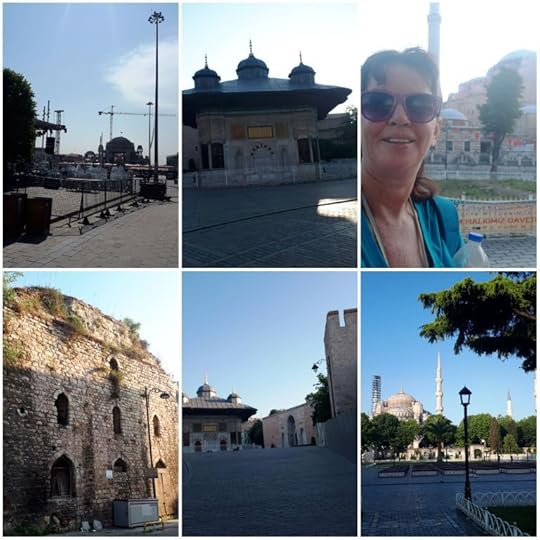
However, a recent employee was selling drugs — heroin, cocaine, or anything you wanted. I said I did not do drugs, as it was illegal. Later on, at ten pm in fact, he barged into my room saying he was cleaning the toilets; however, they had been done at two o’clock that afternoon.
I upped sticks to a hostel owned by a Polish woman called Anna — the Green Hostel, not far from Taksim Square — and had made friends with them and a Syrian refugee called Michael.
I mostly took photos at seven in the morning, as it was in the middle of Ramazan (or Ramadan), and very busy during the day.
Election Fever
I had visited Istanbul a long time ago and then again in October of last year. It was interesting to see how things were changing even over the short time since my last visit.
This time, I noticed that there was a lot of construction in and around Taksim Square. I found out that there was to be a gigantic Sunni mosque installed in Taksim Square, a mosque sponsored by the government of current President Recep Tayyip Erdoğan, together with many others that were also being built across Turkey. The Square was a place of trees and peaceful occupation by protestors, now to be occupied by a mosque instead.
My belief is that governments should not sponsor any particular religion but support all religions and remain secular. The founder of the modern Turkish republic, Mustafa Kemal Atatürk, abolished the ancient religious office of Caliph held by the Turkish sultans and generally secularised the State apparatus. But it seems that this did not resolve the sectarian differences at all: it just buried the differences.
Critics say that mosque-building and the glorification of war by supporting the Syrian rebels is President Erdoğan’s idea of a new Caliphate.
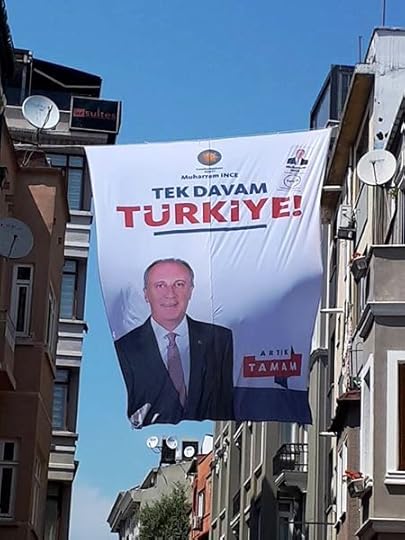
The elections being held currently have not seen a live national debate on TV. Muharrem İnce is seen by many as the main rival for beating Erdoğan, whom İnce taunts with the slogan Artik Tamam meaning ‘Enough Now’, or in other words that it’s time for Erdoğan to go. İnce also wants to get rid of all US military bases; supporters of Erdoğan brand him as weak
On June 5, a Turkish court ordered the conditional release of cartoonist Nuri Kurtcebe, one of Turkey’s most prominent, a day after he was jailed to serve a 14-month sentence for insulting President Erdoğan. This is a fate that has befallen a lot of journalists lately.
Around and About
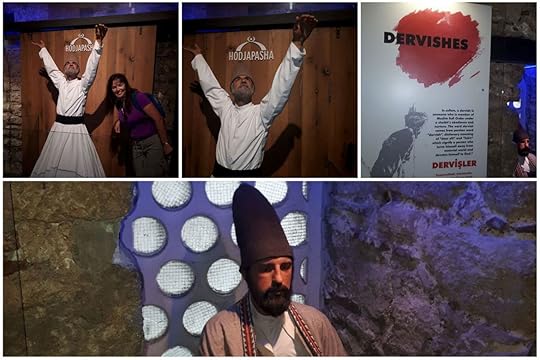
I took myself along to see a Sufi Islamic spiritual dance by a Dervish group at the Hodjapasha Dance Theatre. This expressed a mystical dimension of Islam. Sufism is defined as a means by which a person makes his personality free from bad habits and excessive egotism, expressed by the metaphor ‘the ocean and a jug of water’, in which the water in the jug is the same as the ocean. The dance I was to see was by the Mevlevi order institutionalised under the Ottoman Empire. No clapping no speaking were allowed.
The name of the Dervish hat is called a Sikke. The Hirka or coat can represent the world, and is cast off during the Sema, a very old spiritual ceremony from the 12th century CE. The main part of the Sema is the famous whirling dance of the Dervishes, which symbolises the ecstasy of the poet and Sufi founder Rumi in the city of Konya in the 1300s CE and, at the same time, unity with God — Allah — by getting rid of the ego. Flutes drums and instruments accompany this dance.
The Tennure or white dress-like garment that becomes more visible after the Hirka is cast off represents a shroud.
This was very different. I should add that the Sema is recognised as part of the world’s intangible cultural heritage by UNESCO.
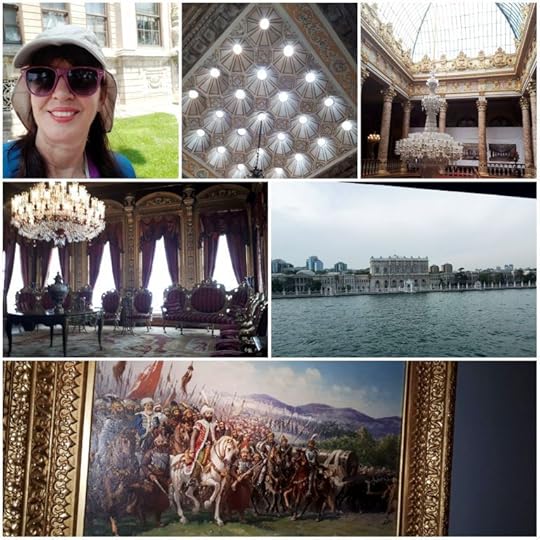
I also visited Dolmabahçe Palace, the home to the Sultans from 1856 until 1924 and of Mustafa Kemal Atatürk, founder of the Turkish Republic, from 1924 until he died here on November 10, 1938
According to the tourism literature, Dolmabahçe is the largest palace in Turkey. It has an area of 45,000 m2 (11.1 acres), and contains 285 rooms, 46 halls, 6 Turkish baths and 68 toilets, apparently.
The design has elements of the Baroque, Rococo and Neoclassical styles, as well as traditional Ottoman architecture.
The palace has features of traditional Turkish homes. These include the Southern Wing, the quarters reserved for the men, which contains the public representation rooms, and a Northern Wing which included the Harem, in reality the private residential area for the Sultan and his family.
What is though to be the world’s largest Bohemian-glass chandelier was received by the Sultan as a gift from Queen Victoria. It has 750 lamps and weighs 4.5 tonnes. The famous Crystal Staircase has the shape of a double horseshoe, and is made of Baccarat crystal, glass, and mahogany.
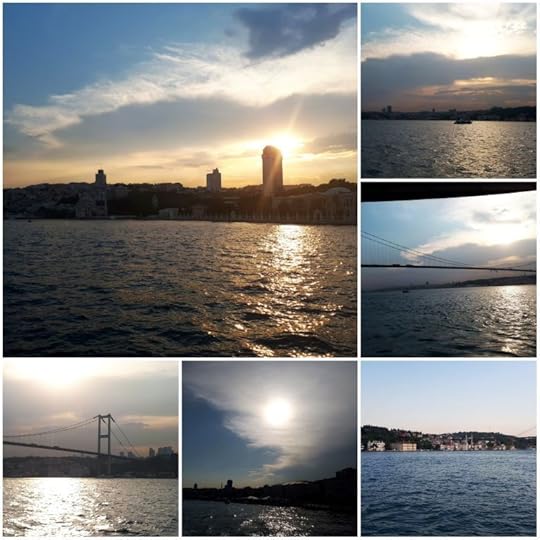
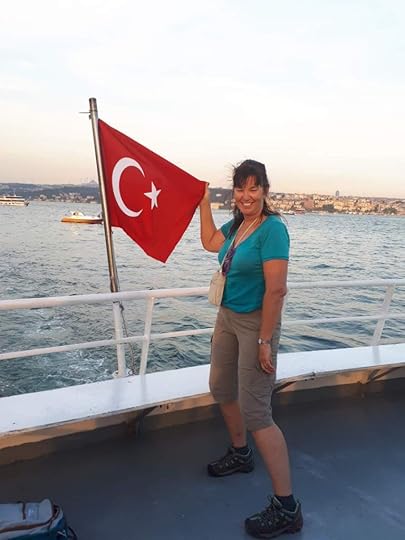
And then I discovered Istanbul’s abundance of ferry services. I could take a ferry across to the other side of the Bosphorus, or as far afield as Odessa in the Ukraine or the famous battlefield of Gallipoli. I took a three-hour cruise that went past the Dolmabahçe Palace on the European side of the Bosphorus and back down the Asian side, which was more suburban and had way more parks and greenery. Hmm … I would like to stay there next time.
The post Istanbul Revisited appeared first on A Maverick Traveller.
June 20, 2018
Istanbul Revisited (with another me-too moment in my accommodation)
May 26, 2018
Batons for the Beasts? A Nepalese Safari in Chitwan National Park (Part Two)
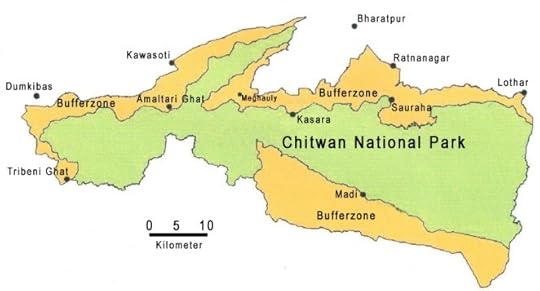
Chitwan National Park and buffer zones. Source: BhagyaMani, Wikimedia Commons, CC-BY-3.0 (2010)
CHITWAN National park was established in 1973, partly at the expense of the Tharu people who lived there. The Tharu displaced by the park’s creation number ten to thirty thousand.
I was to witness clashes over different types of survival — conflicts between locals and the army, animals versus humans — and to ask: do they have to be mutually exclusive?
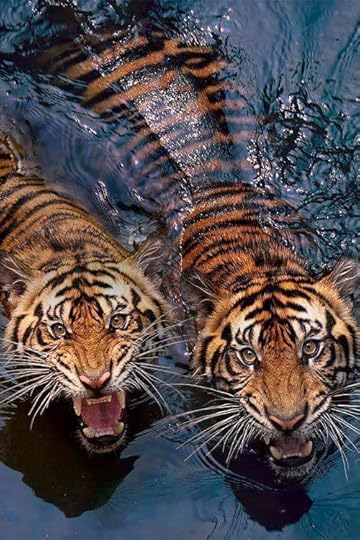
In Chitwan, there are currently 650 rhinos, 250 tigers, and a number of leopards that I didn’t catch.
They’d had zero poaching for the last few years, probably because there was now a battalion of Nepalese soldiers stationed in the park to protect the wildlife. There had been shoot-outs with poachers four years before, but nothing lately.
Before the king was assassinated in 2008, and a republic proclaimed, the remaining locals had policed the park. Where I went next, to the town of Madi, I found that the local people were still nostalgic for the idea of their own force.
Homestay in Madi
Madi was on the southern edge of the park, very close to the Indian border, outside the park but inside an administrative buffer zone. Before 1973, Madi had apparently been a prosperous base for hunters and safari expeditions. But eight resorts had closed down since.
When I encountered it in 2018, the town struck me as the poorest I had been to apart from Manaslu in the Himalayas. I really did wonder about the quality of the accommodation. I was worried about my health and decided I was not going to over do things, and be careful where I stayed.
So, we got a bus eventually and found ourselves going on a rocky road via Bharatpur, past two army checkpoints, to Madi where I had a homestay booked.
The bus ride was a nightmare, with three people attempting to squeeze onto two seats. Kamal prevented a woman from sitting between us; she was younger than me and no way was I was going to let her share.
I was really worried as to whether I could handle this homestay situation. I had never chosen to do this before; but then it could not be as bad as the crappy hotel rooms various guides had put me in on the Everest trail.
Anyhow the accommodation was very clean, and the woman running the homestay, named Sarita, turned out to be nice. Her husband had left her to start another family seven years earlier, and her parents had bought the place. She had two married sons on the property, her sister, two nieces, her parents, and two grandchildren. And me.
Sarita’s house was in a village that was part of the wider Madi conurbation, itself really a collection of villages. Sarita’s village was made up of houses that all had thatched roofs. There were young children and buffalos in the streets, and dogs running around.
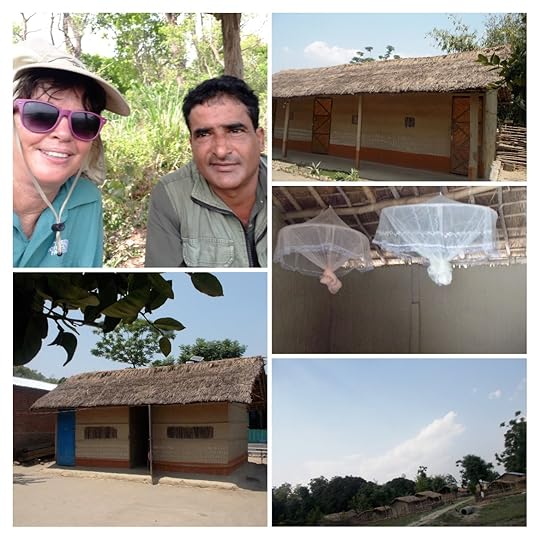
I had a cute hut made out of mud, with interesting windows, spaces between the sticks, and a mosquito net. That was just as well. Quite apart from the mosquitos it kept out, I was grateful that it would probably keep animals at bay as well. A small mouse was nibbling on the thatched roof. I figured it wouldn’t be able to get through the mosquito nets and run across my face in the middle of the night, which was the important thing .
We arrived at 11am, and walked to the old temple of Shiva, where two woman from Pokhara had built a house. They had sold their land in Pokhara, all in the name of karma and wanting a better life. It was so hot and I was drinking water like there was no tomorrow: six litres in one day, all carefully treated with pills. How would I survive tomorrow’s trek?
Kamal was very knowledgeable. He had been a guide since 1995, after being in the police before that. We also engaged a local guide called Oppo, who was in fact Sarita’s son. He was 27 and just married, very shy, but knew where the Tigers were.
The whole village had moved to a new location about five years before, as another wild elephant, not the same as Ronaldo but another one, had killed about half a dozen villagers. I wasn’t sure whether this had been required, or whether because the old place was now thought to be unlucky.
The villagers also had to house their buffalo at night, as the tigers came for them otherwise. The buffaloes seemed to have better accommodation than the people. The local people slept outside as it was way too hot to sleep inside, other than in an airy hut.
Some of the local villagers caught fish in the river. The army tried to convince them not to. I saw the people fishing on my first night in Madi, till the army caught them at it.
That night, Sarita’s mother and other women from the village were also out gathering ferns, to extract the edible insides of the stems. They did this weekly. It was a tasty vegetable and supplemented a very limited diet. The locals would also graze their buffalo near the park in the dry season, as the river ran low. This often led to conflict with the army, too.
At night the children played until 9 pm around the different homestay cottages and the households of Sarita’s family group. Sarita or another woman would cook and serve the guests. More people would go into the homestay kitchen to cook the meals. Each household had its own kitchen; each was separate from the homestay cottages.
Two young women had been raped by the army. Sarita had a meeting with the village women about this. But the guilty guy was only transferred.
On the Tiger Trek
The next day was going to be a tough one, a twelve-hour trek from 6:30 am till dusk, to Tiger Point and back. Tiger Point was the area where tigers could most easily be seen, even if a sighting wasn’t absolutely guaranteed. Most of our route was along the river.
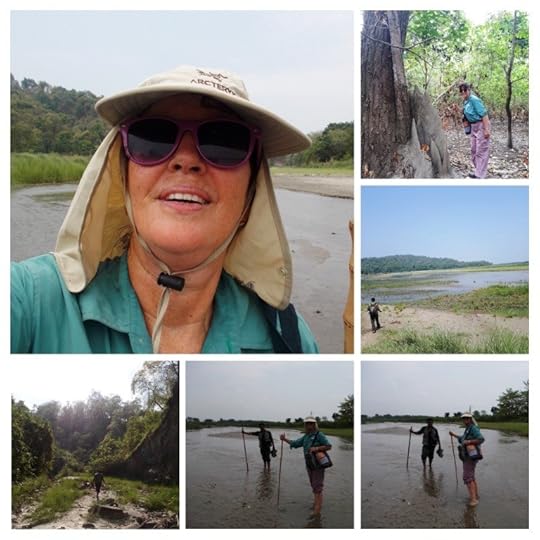
We were given some sticks which I thought were walking sticks at first; but it turned out that they were batons to fend off enraged wild animals. I was told an injured or sick tiger could attack you at any time, though they were normally wary of humans otherwise. You could also be caught in the middle between fighting rhinos. I couldn’t help wondering what use a baton would be in a situation like that.
With Kamal, looking for tigers
We saw a tiger after only two hours on the trail, at 8.30 am. We had stopped to talk to some other guides and their two guests. Kamal saw the tiger first, then me too. Wow, I could not believe it: an actual Bengal tiger in the wild. The rest of the day we followed the river and Oppo let me wear his open jandals. I was going from mud, to water, to sand, and this repeated itself about thirty times through the course of the day. I had flat feet and bunions but it seemed my feet were up for it. Oppo must have spent about five hours up a tree looking for tigers during the course of that day, by the way.
There were about eight people in the park at that stage looking for tigers. It was close to 50 degrees centigrade and the river water was really hot where it formed stagnant pools, actually too hot for anyone to swim in it! Kamal came across about ten different tiger foot prints, but no other visitors in the park had seen tigers that day. I was so lucky.
Occasionally there would be wind to cool us down. But mud, sand and river water, and up banks, is what we did for twelve hours.
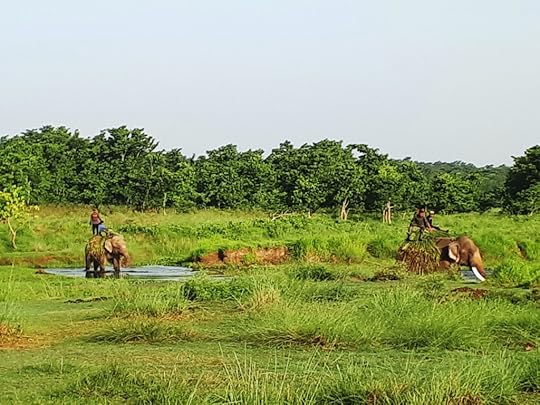
The army came through with elephants, enroute to their outpost in the jungle. Unlike private elephants, the army elephants were allowed to eat foliage on their way through. I snuck into a cooler part of the river for a swim and the army nearly saw me. Kamal said he did not want them to become jealous. It was funny lying in the river knowing a tiger or a leopard could come down for a drink. It was only later on that I thought about crocodiles, too.
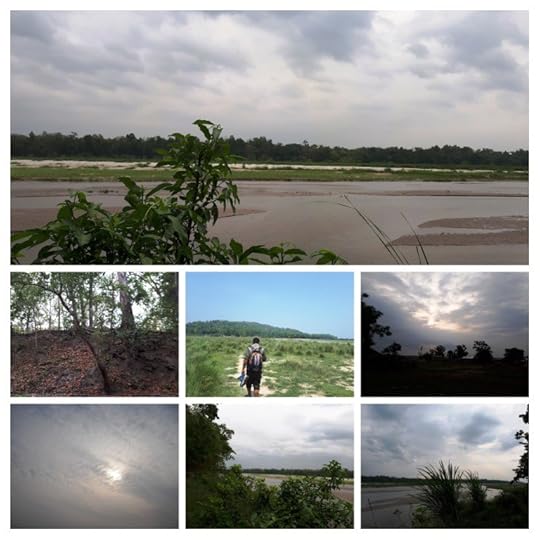
Eventually we stopped for lunch by a cool watering hole, this is where the rhinos fight each other. I heard one snoring and I was told they could run at any time and to get out of their way if that happened. This watering hole realy was uncannilly cold: it must have been fed by an underground spring or a cave-stream.
The day was very hot and I needed to rest in the shade every two hours.
The other tourist staying at Sarita’s establishment when I was there, a Belgian guy named Leo, saw nothing. But Kamal’s last two clients came within a metre of a tiger!
I loved the fact we walked along the river both ways. Another guide joined us, saying that he would do this and that if he were in charge of the park: restore the lookouts, and cut the grass so that the tigers can be seen more easily. Kamal said this guy was head of his guides’ association, that he took fees and did nothing with the money in spite of all the talk. He wanted it back.
I got another restless night’s sleep with the heat.
Back to Sauraha by ambulance and jeep, then Kathmandu
The next morning there was no traffic on the road. Kamal joked that there was a bus strike. Actually, a bomb had gone off in the small hours of the morning at a supermarket in Bharatpur.
To revive a Victorian expression, the infernal device had been tossed from a motorbike by left-wing rebels, who had presumably put themselves at risk to make sure the bomb didn’t hurt anyone else. As terrorist incidents go, this was at the old-fashioned end of the scale. But the scare put the bus services out of action for the day, all the same.
So, the Belgian’s guides got a safari jeep to come all the way from Sauraha to give us a ride back. But the army would not allow the jeep through as they did not allow jeep safaris in that part of the park. It was all a bit of a Catch-22.
So instead, believe it or not, we got a ride with an NGO-sponsored ambulance to meet the jeep at the checkpoint beyond which it had not been allowed to come. That was a cool ride back.
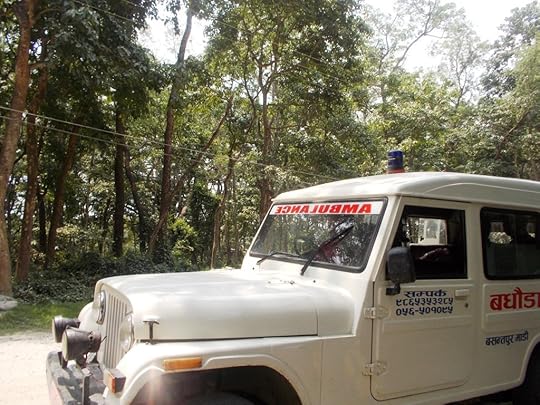
The jeep journey to Sauraha
I got back to Sauraha, stayed the night, and got the bus to Kathmandu at 7am. This time around it was a 10-hour ride. Still, I was feeling better. I only had a sore throat now, one that could be sorted by aspirin. Then I would be right to return to New Zealand.
The post Batons for the Beasts? A Nepalese Safari in Chitwan National Park (Part Two) appeared first on A Maverick Traveller.
Batons for the Beasts? A Nepalese Safari in Chitwan National Park (Part Two)
May 23, 2018
Batons for the Beasts? A Nepalese Safari in Chitwan National Park (Part One)
THE ride to Chitwan from Kathmandu, only eight kilometres (fifty miles), took five and a half hours along almost-impassable roads, mainly used by slow-moving fuel tankers.
At the risk of sounding controversial, the sooner the Chinese build some more railways in Nepal — and maybe some pipelines too — the better.
The current plan is to build a railway across the Himalayas from Lhasa to Kathmandu, thereby spreading Chinese domination southwards to another capital city in true nineteenth-century fashion, and to extend it further to join up with the Indian railways.
Frankly, this can’t happen soon enough
There are still almost no railways on the ground in Nepal, only a lot of bad roads. The fact that getting a proper railway line from Tibet through to India seems like such a great leap forwards shows just how underdeveloped Nepal still is.
So, hurry there to sample the rustic charm, bad roads and all, before Nepal, too, feels the full force of the Industrial Revolution!
Why go to Chitwan?
I’d gone online and booked several nights’ accommodation in the Chitwan National Park, a renowned wildlife area full of elephants, Indian rhinoceroses (yes there are such creatures!) and even tigers.
When I got there I was glad I’d booked accommodation inside Chitwan National Park, as the town of Sauraha, the northern gateway to the park (where I did stay on my first night) was a bit rough, though it had scenic sunsets over the river. The first morning I was in Sauraha, I saw elephants being ridden along the street as well.
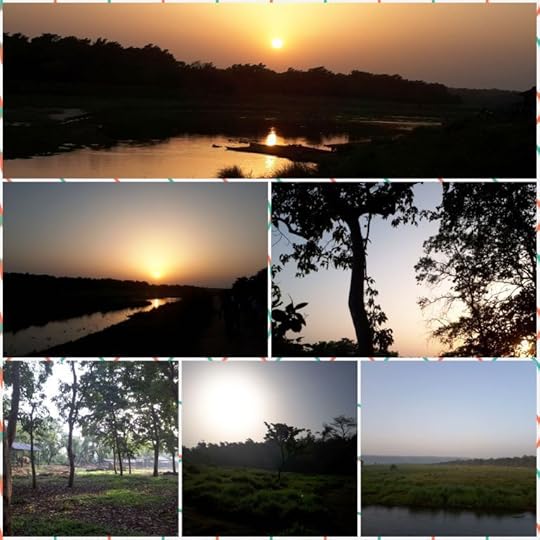
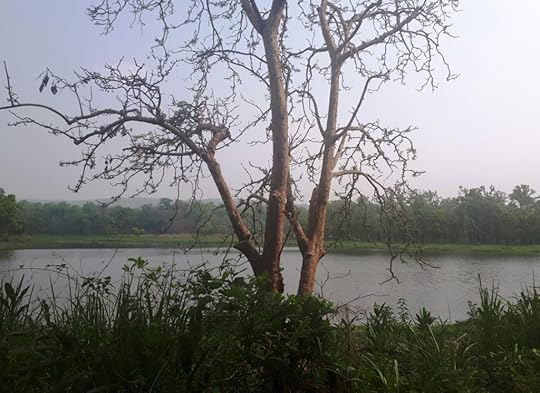
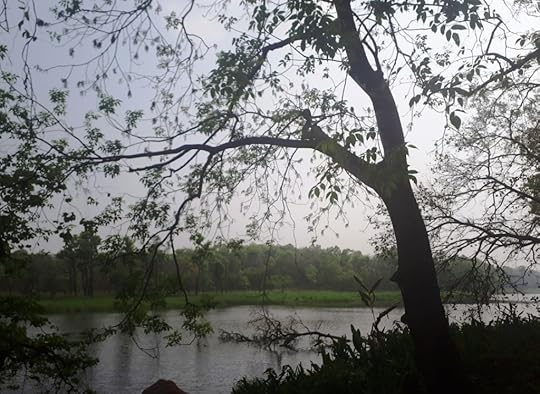
Elephants being ridden in the morning at Sauraha, next to Chitwan National Park
As the sun climbed higher, the temperature ranged from the mid-30s to mid-40s Celsius, and was unbearably hot at times. This part of Nepal is Not the Himalayas!
Shopping for a Guide
I shopped around several guiding agencies seeking a guide, as for obvious reasons I am extremely suspicious about guides right now. Most people I met were annoyed that they were paying $100 US a day and being made to stay in places that cost no more than $2.50 US. On the other hand, it you book through a company, the guides themselves can be left with essentially nothing.
Sometimes you do not know until the last minute who will be your guide: bad move if you are by yourself.
Basically you want to be able to interact with whoever it is that is going to be your guide, before you take them on.
A bad choice of guides also happened to me in New Zealand. I had someone referred to me who did not have his guide qualifications; someone who wanted to take hallucinogenic drugs on the way up a mountain. I think I have had it all.
In Chitwan, I was referred to one agency by a friendly café owner. The guy selling me the package was different from the guides. Another selling the packages was not so friendly and that put me off his agency. He wanted to charge me US $22 to take a 30 minute walk, plus a two night stay in a homestay in the village of Madi and a trip to the Tiger Point lookout costing US $180. Oh, and they could not assure me of seeing a tiger. Hmm. That did not sound great.
A Nepalese Safari
The hotel I’d booked to stay within the park was called the Jungle Safari Resort. The guide offered by the hotel was really nice, costing $US 300, though even they could not assure me of seeing a tiger. I loved the hotel’s garden and staff and the older gentleman who owned the place. It was quaint, and my room was large and amazing, with air conditioning to keep me cool.
I did a half day jungle safari ride on a jeep, which felt rather cramped. On this trip we took a very slim long canoe to get over the river that runs through the park. We saw a rhino mother and its offspring, along with three other adult rhinos and two sloth bears, a creature I’d never heard of before.
Unlike African rhinoceroses that have two horns, the Indian rhinoceros, the type found in Chitwan, has only one horn. Its scientific name is rhinoceros unicornis: though I think if this species of rhino ever contributed to the legend of the fair unicorn, the legend must have been embellished.
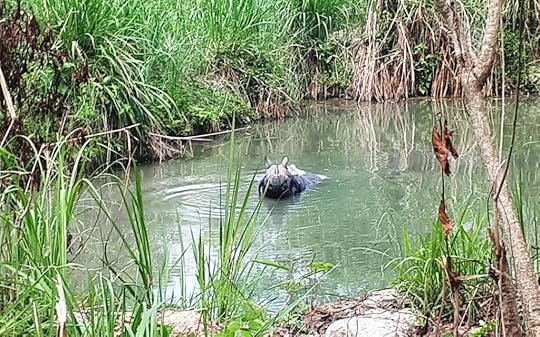
A baby rhino
Everybody thinks of Africa as the place where remarkable wildlife is to be found. A lot people don’t realise that many ‘African’ animals such as elephants and even rhinoceroses also live in India and the adjoining countries such as Nepal. Or, that the Indian region has some distinctive creatures of its own, such as the tiger (of course) and the sloth bear, which I’m going to talk about a little further on.
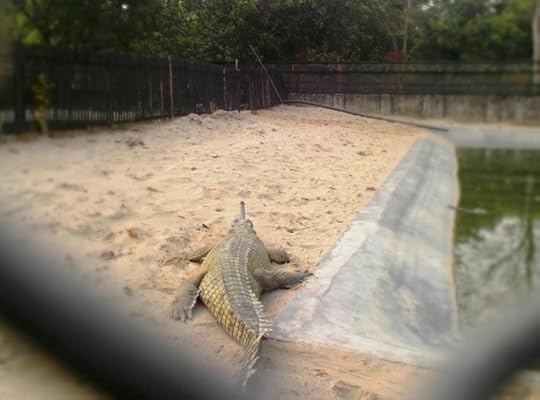
There are also freshwater ‘mugger’ crocodiles in the local rivers, and gharials as well. The gharial is a species of crocodile with a weirdly narrow snout that lives on fish. Sadly, it is almost extinct in the wild. Chitwan National Park has a Gharial Breeding Centre, whose staff are doing their best to restore the numbers.
Anyhow, what’s this sloth bear thing, then?
Well, it’s a kind of bear that wound up being named after another animal, because the European naturalists who first came into contact with them, around the year 1800, mistakenly thought that they were relatives of the South American sloth, perhaps even of the giant prehistoric ground sloths lately discovered in American fossil beds.
The naturalists were wrong, but on the other hand, the sloth bear is indeed not your average bear.
They were bears: but at the same time fairly unusual and sloth-like, with missing teeth and a diet that mostly consisted of termites. Sloth bears have large claws and fangs, but aren’t really adapted to eating meat as such.
The sloth bear also has some other peculiar traits (for a bear). Its babies ride around on its back as though it were a possum — or a sloth. The babies of all other species of bear trot along beside mama bear (I’m sure you’ve heard how you aren’t supposed to get between them).
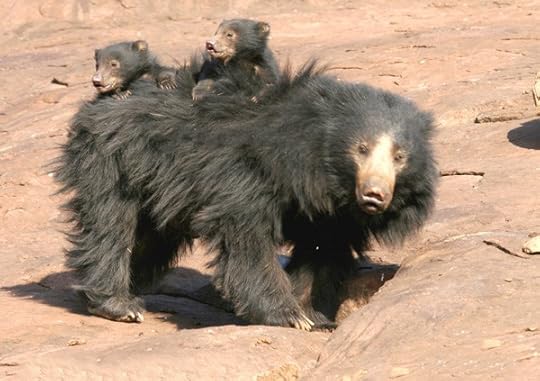
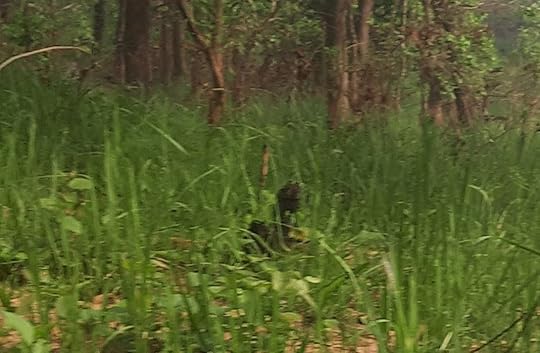
Though it mostly lives on insects, the sloth bear can be ferocious. Horrible tales are told of people who have somehow annoyed one and been slashed to bits by its claws Revenant-style, or even — this is worse — been kept alive while the sloth bear, ill-adapted for devouring large prey in the usual fashion, chews on their limbs and sucks out the juices instead.
Why is the sloth bear so much more awful than it needs to be in order to subdue its usual prey, the termite?
The reason is that the sloth bear actually needs to subdue the tiger.
In spite of their defensive armament, sloth bears are among the favourite prey of the tiger. A tiger can kill a sloth bear if it succeeds in taking it entirely by surprise. But if the sloth bear gets wise at the last moment, the tables are turned.
(Fear of the tiger also explains why sloth bears keep their babies close.)
What else did I see? I saw the amazing colours of kingfishers, fly-catchers and giant hornbills (wow, the bird life!), two monkeys, and a crocodile farm.
It was a pity that I also felt half-dead physically, with my burnt lips from strong sunshine in the Himalayas where I’d just been, and a chest infection which was also down to my recent hardships at altitude.
The next day I got antibiotics to deal to the chest infection. I’d nearly lost my voice. I had to get better.
Down at the river, after my canoe-ride, I spoke to cigarette-smoking and drunken guides, who said I should hire them as they would be used anyway; as other companies used them on contract. That didn’t really suit me.
I had read some disturbing stuff on Trip Advisor I always check this out when I arrive at a place: what to do, where to go. But I am a bit tired of it now.
The elephant breeding centre was privately owned. It did rides with up to four people on the top of the elephant on a square ringed seat. The elephants were trained up; but wild and domesticated elephants sometimes went crazy.
A male elephant had killed a woman, and a tourist saw it all. She said Ronaldo (the elephant) was going for her. My guide later told me Ronaldo was a wild male elephant who had broken down all the electric fences in the breeding centre. The elephants there, which were mostly female, had to be chained up. He had mated with them and produced several calves.
Ronaldo had killed several people in fact, and broken into fruit shops and eaten the fruit twice.
The people from Sauraha are very resilient as in addition to rogue elephants, the area is visited by floods in each monsoon season. Recently, the restaurants, a baby rhino and a mother elephant were washed away. The mother took a month to die a very painful death. The mother’s baby was adopted by another elephant and the baby rhino, which survived, was adopted by the people of the village, who let it eat some of their crops.
It suddenly rained, and at 5 am that morning off I went to the river mouth to see what I could see. I thought ‘I am not paying $22 for a 30 minute walk, up the riverside’.
I bumped into a guide who was staring through binoculars. He said he preferred this to sitting in his office, and all the gambling with cards that happens around town. He would walk seven times a day to see what was going on.
A thoughtful guide, and more about the elephants
Ultimately I met a guide named Kamal, whose laid-back, honest nature appealed to me. We walked and talked for about two hours and I gave him a 50% deposit on the spot to do the tiger-watching tour (though I would pay for my own food).
Kamal said he almost got attacked by Ronaldo while with an elderly couple. He made them hide behind at tree while he lit a cigarette. He reckons anything to do with fire makes elephants run away.
So, that’s how Kamal got rid of Ronaldo. Kamal also told me that in some places elephants are only fed 100 kilos of food a day and they should be fed more. Instead of living until eighty, they die much younger.
Local private elephants were brought from India. Kamal said that having four people on their backs and the steel seat was cruel. He didn’t mention the breaking in process which meant they are kept in a pen for two years, and broken in by their master.
Some of the other elephants were government elephants, used by the Nepalese army. These elephants were not used for giving rides to members of the public: just transporting army personnel. They seemed to be more well-fed and better looked-after.
I mostly ate out at local restaurants and the food was only two dollars US or thereabouts. I said I would depart for the town of Madi in three days’ time, when I felt better. Kamal and I continued to meet at certain times to walk along the river.
A local food stand
I went to the elephant bath, and refused to take a ride or scrub them with a pot scrub which made them white and pale, unnaturally so I think. At first I thought all the elephants were very well looked after, but finding out more from Kamal made me realise that their care could be improved.
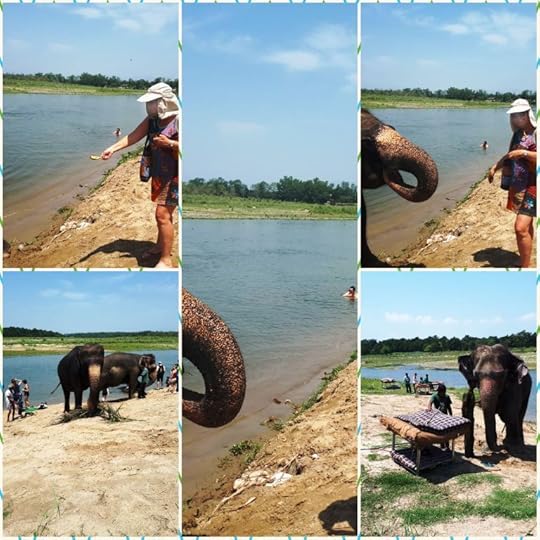
So I decided to feed the elephants instead of riding on them; especially the one that arrived with the steel seating. It looked tired and two old, overweight men were riding on it.
The stables at the elephant breeding centre
Elephants bathing
Afterwards, the people fed the elephants bunches of bananas, which was great to see. Some people were putting water on the elephants, which were relaxing, and not scrubbing them at all. Some people now pay to walk with the elephants and not to ride on them. I had wanted to ride them, but was made aware by my Facebook friends about the cruel practices that went on.
The elephant I fed had an open wound on its head. Apparently the trainer struck it to make the elephant submit to his directions. I never saw a woman on an elephant, interestingly enough.
Another thing I noticed was that only the government elephants had tusks.
If through education people like me can feed and not ride the elephants, hopefully other people will do so also.
I could have stayed by the river for longer. But it seemed like party central and I was in no mood for that, as I was ill. Next time I will stay by the river. I liked eating at the places next to Kamal’s office. The people were genuine and really wanted to talk to you. The Everest Region, where I had been, just seemed a bit more commercial, and I was glad to be here in Chitwan, to get well and feel better.
[This is the first part of a two-part essay.]
The post Batons for the Beasts? A Nepalese Safari in Chitwan National Park (Part One) appeared first on A Maverick Traveller.
Batons for the Beasts? A Nepalese Safari in Chitwan National Park (Part One)
Adventures at Snow Farm Part 1 – Skiing with a broken shoulder!

So, I wondered about trying gentler pu ...more
- Mary Jane Walker's profile
- 29 followers


