Elizabeth Rusch's Blog, page 5
April 4, 2015
The Attack of the Brain Snatchers
 Here it is, folks, in black and white, like this sign I saw in a store window a block from my writer’s garret. I confess to you that my dream as a writer is to control your mind. While you are reading my book, I want you to forget about eating. I want you to forget about going to the gym or checking your e-mail. I want you to silence your cell phone. I want to get inside your head and not let go even after you’ve finished reading my book. In short, I want you 24-7. And then I want you to want more.
Oh, yeah……


April 1, 2015
Good Notes
 On this blog about critique (as well as very much about the writing process), I offer a plug for Creativity, Inc.: Overcoming the Unseen Forces that Stand in the Way of True Inspiration, by Ed Catmull. A graphic artist friend recommended the book, and indeed people of all stripes will find plenty to mine within. Animators, writers, managers, artists, moviemakers, CEOs… and members of critique groups!
There’s plenty about effective critiquing interspersed throughout. (The book has a good index: I recommend tracking “Braintrust” if you can’t take on reading the whole book.) But here’s a lovely summary by Catmull, the President of Pixar and Disney Animation, about the “good notes” that Pixar leaders offered each other from the beginning:
“A good note says what is wrong, what is missing, what isn’t clear, what makes no sense. A good note is offered at a timely moment, not too late to fix the problem. A good note doesn’t make demands; it doesn’t even have to include a proposed fix. But if it does, that fix is offered only to illustrate a potential solution, not to prescribe an answer. Most of all, though, a good note is specific. “I’m writhing with boredom,” is not a good note.” (p. 103).
May we all give, and receive, the best of good notes.
-Sabina I. Rascol
March 20, 2015
The Time of Day
I’m not a morning person and I am committed to getting some exercise (walk, run, or yoga) almost every day. As a result my basic schedule for MANY YEARS has been: wake up, get kids off to school, workout, shower, eat breakfast, and then get to work.
Oftentimes this means I don’t get to my desk until 10 or 10:30 in the morning. After a couple of hours of work, I’m hungry, so I have lunch. By then, it’s 1 p.m. and my daughter gets out of school at 2:15, so I cram to get some work done. Work time per day: Two hours and then one hour — so three total.
But recently, I have made a tweak in my schedule that has changed everything. I don’t have any more time, and yet, I have more time!
Instead of working out when my kids leave, I get right to work at 8 am. At 12:30 or 1:00, if I’ve worked intensely, I am so ready for a walk/run/yoga break. I eat breakfast with my kids in the morning and then eat with them again when they are gorging on their snacks, so eating takes less of my work time and I gain nice mealtimes with my kids. But best of all I get FOUR TO FIVE HOURS of uninterrupted writing time each day!
Is that INSANE?! What took me so long to figure this out? I mean at least a DECADE!
The moral of this story is: Take a hard and creative look at your schedule. Forget your old habits and assumptions and try something new. You may have more writing time than you think.
March 12, 2015
Do I have to blog? The curse of the writer’s platform
 One piece of advice that many, many pre-published writers hear is that they need to develop their online presence. They need a platform.
Ugh.
Most of us hate that.
But we love books, right? The logical first stab at blogging is often to review books that we read. Before you jump on this bandwagon, I offer a few words of caution.
First, this weird, wild world of interwebs that we inhabit has dissolved the traditional boundaries of publishing. There used to be a clear demarcation between readers and writers and reviewers, between editors and agents, between publishers and the rest of us. These lines have blurred. Many agents are “editorial.” Many editors also write. Some agencies have set up their own in-house publishing wings.
And this brings me to book reviews.
I don’t write them. Ever. I will tell you when I love a book. I will beg you to run out a buy a book that I adore (like OKAY FOR NOW by Gary Schmidt). But I don’t give stars and I don’t review. Let me tell you why.
Writing useful, constructive, intelligent reviews that analyze the craft within the pages is HARD. It takes skill, experience, and time. The reviewers who do this well are GOLDEN. If I were going to review, I would be compelled to be that kind of reviewer. But that would take immense time and energy away from writing my actual books.
Many reviews that you will stumble upon are of a different sort. They are a reader’s opinion, based not so much on analysis but on feelings and impressions and person connections. This is cool too. I love it when a reader connects with something I’ve written, but it’s different from a literary review. And there are so many of these blogs out there, that you will find it hard to make your voice heard among them. If you are doing this as a writer trying to build a platform, it probably won’t get you very far.
The other reason I don’t review books is that the book community is small and these people are my friends. I want to support them as artists more than I want to publicly critique their work.
But back to platform… do you have to blog?
No.
I blog very infrequently on my main website, usually about experiences or thoughts that get lodged in my brain and require a little noodling on my part. I don’t have the illusion that this will win me millions of followers, but it will give the interested few a peek into my weird head.
We blog here because we saw a need. So many people over the years have asked us if we had room in our group (Sadly, we don’t) that we decided to lift the veil on our process so that other writers could look inside. This isn’t a platform for any of us. It’s a service. We’re trying to meet a need that we observed.
As you are thinking about building your base as as writer, think about what you have share, what need you could fill, and what would be fun for you to explore. Being online as a writer is about building relationships. There’s no need to force it.
And find me — on Twitter, on Goodreads, or on my author FB page! I love to connect with other story-tellers and other readers!
March 5, 2015
Taking a Bubble Break
 I captured this shot a few days ago, during one of the gloriously (and weirdly) warm days of non-winter. In lieu of snowflakes or raindrops in Jamison Square Park, we had bubbles. Really big bubbles, floating up into the sky.
The rational side of me knows where bubbles come from and how to make them. Here’s a whole list of links to recipes from bubbleblowers.com. Still, the kid in me was entranced by the magic. Like the child in the photo, I wanted to chase after a bubble and touch it.
The writer in me wants to create a scene that engenders this much intense attention in the reader. I want to write a scene that pulls the reader into the action on the page (or the screen), and keeps the reader there. I want to meld craft and creativity, until I can write such a scene. And then of course the challenge is to write another scene after that until there’s a whole narrative arc of scenes. It’s easier to make bubbles, believe me. But it’s the scene I’m after, so the bubble break is over. I’d better stop blathering and get back to work.
February 27, 2015
Reading Bad Books

Best-selling bad book threatens the very foundation of feminism or provides a titillating escape, depending on who you ask.
Should you or shouldn’t you? Or maybe the better question is: Do you or don’t you? Read bad books, by which I mean formulaic, cliched, stiff, tawdry, populist, immature, or otherwise embarrassing books. There is a belief that “real” authors don’t and shouldn’t read trash. That reading a bad book is the equivalent of feeding your brain junk food, and even worse, that the junk food might start clogging your arterial thoughts and make your writing stupider. Bad writing is catching.
I’ve never quite bought it.
Like most writers, I suspect, I want to write a literary masterpiece, the book that could win me a Printz, a National Book Award, even a Pulitzer. Huzzah! While I’ve read many prize-worthy books, I’ve put plenty of them back on the shelf too. On a given night, I reach for books more pedestrian. Books I might meet at a vacation beach house or an outdated doctor’s office. Young adult thrillers. Old school romance novels. I rarely stop reading them, even when the stilted prose makes me cringe.
Stephen King says, “Almost everyone can remember losing his or her virginity, and most writers can remember the first book he/she put down thinking: I can do better than this. Hell, I am doing better than this! What could be more encouraging to the struggling writer than to realize his/her work is unquestionably better than that of someone who actually got paid for his/her stuff?” (from his excellent On Writing)
So true! Though I don’t read bad books for that reason either. Not to make myself a better writer or feel a little righteous snobbery. I read bad books for the same reason I read good books: to escape reality. I am willing to extend almost any courtesty to a book that will pull me into another place and time. I can hate the character, scorn the dialogue, disdain the whole premise, and still I will read on. If the plot fails, I will read on in the eternal hope that it will improve. That might make me easy as a reader; some might even say sloppy. But I am an adult now, and I haven’t met a bad book I couldn’t read.
“One learns most clearly what not to do by reading bad prose,” from the Master King again. I would add that you sometimes learn what to do right as well. But you don’t have to read to save the world. You can read just to read. And you can eat Cheetos while you do it.
February 20, 2015
Bullet Journal Your Way Into Writing
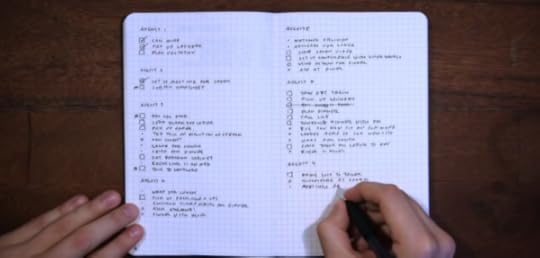 Do you find it hard to find time to write? When you do have time to write, do you waste time wondering what to do? Inspired by a blog post by the wonderful children’s book author Kate Messner, I have started bullet journaling.
Instead of reading my lame description of how to do this, watch the video here.
Take the time to think out your month, think out your days and week, and break down your writing projects into distinct steps, and you might find, like me, that you have more time to write when you make it a priority and when you know just what to do when you sit down.
Hope you find it as helpful as I have!
ScrivaLiz
February 12, 2015
The Wonder Cupboard of Amy Baskin, an occasional series
We’ve launched this occasional series to give you a peek into our secret stash of inspiration–our Wonder Cupboards. May I present to you Amy Baskin:
The Wonder Cupboard of Amy Baskin
 Amy Baskin’s Wonder Cupboard includes a rickety fire escape balcony, the view from inside of a cave, moss, heart-shaped rocks, Tuck Everlasting, Gilead, The Snow Child, mustard seeds, sock monkeys, and a quote from Lyle Lovett: “Well God does, but I don’t. God will, but I won’t. And that’s the difference between God and me.”
Amy reads to escape or help interpret reality. She writes for the same reasons. Her limited concept of home decorating involves stacks of books- in corners, on tables, where the TV used to be. Her work has appeared in various publications including Stories for Children Magazine and Reading Local: Portland. In September, she won the Pacific Northwest Plein Air Writers People’s Choice award for her poem, Snowbound: Day 6, Imagined. She enjoys collaborating, particularly with Jason Baskin, her husband and in-house illustrator.
February 4, 2015
Plagiarize, Plagiarize, Plagiarize!

With credit to Johannes Vermeer (1632-1675)
PLAGIARIZE!
Now that I have I caught your attention, let’s clarify. I do not want you to take someone else’s work and pass it off as your own. Nope. Not good. A definite no-no.
Still, I offer you this ironic line from an old song by Tom Lehrer about a Russian mathematician. “Plagiarize, plagiarize, plagiarize. Only be sure to call it please research.”
Research is exactly what I’m talking about, research into how the best authors craft a sentence, paragraph, or scene. Here’s what Ursula K. Le Guin, writer extraordinaire, says in her “how to” book, Steering the Craft:
A rational fear of plagiarizing, and an individualistic valuation of originality, have stopped many prose writers from using deliberate imitation as a learning tool…. I think conscious, deliberate imitation of a piece of prose one admires can be good training, a means towards finding one’s own voice as a writer…. What is essential is the consciousness. When imitating, it’s necessary to remember the work, however successful, is practice, not an end in itself, but a means towards the end of writing with skill and freedom in one’s own voice.
Thank you, Ursula. Enough said.
January 29, 2015
Talking Money
There has been an interesting discussing on the interwebs lately about how much authors make and especially, what it means when a writer says that he or she “writes full time.” This implies that all of us who “write full time” are also making enough money to support our families on writing money. In fact, many of us (like me) can write full time because our awesome spouses have jobs that include health insurance and 401k and reliable income all that good stuff. (See the Salon article that spawned the talk here.) This is the first year I have made a non-negligable income, but it is not yet enough to support us. Many working writers–i.e. those making money–say that it takes between five and ten years of steady sales plus the slowly accumulating royalty stream to either justify quitting their day jobs or getting their spouse off the hook.
There has been a call for transparency and honesty among writers about money. Many an innocent soul has been sucked into the allure of becoming an overnight millionaire a la Fifty Shades. Everyone’s Great Aunt Hilda thinks that as soon as we sell a book it means we are rich, rich, rich. And many more of us are thinking, “What’s wrong with me? Am I the only one with multi-book deals who is still eating ramen noodles every night?”
So what do the economics of writing really look like? The 2015 Author Survey by Digital Book World sheds some fascinating light on the money issue.

For traditional book deals, 65% of all authors are making less than $10,000 a year. For indie authors (supposedly the holy grail of money printing), 75% are making less than $10,000. In general, authors who can work both sides–indie and trad–the so-called hybrid authors are doing the best. 50% of them are making more than $10,000 a year. (I’ll argue that this is because well-known, traditionally published authors move to indie publishing where they can make more profit and take their fan base with them.)
As for what to tell Great Aunt Hilda, reaching the $100,000+ mark is accomplished by very few authors–about 7% of traditional authors, 6% of indie authors, and about 84% of hybrid authors (see above).
So thems the stats… Does knowing them change anything for you?