S.D. Falchetti's Blog, page 16
September 25, 2017
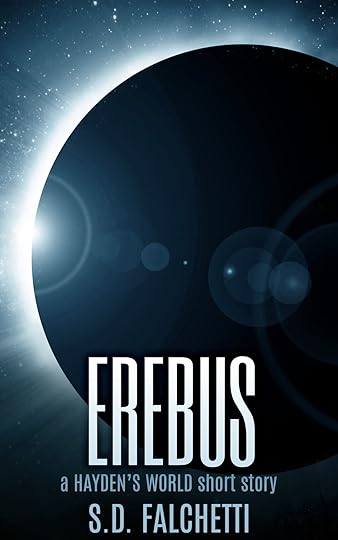
NEW RELEASE: Erebus - now available on Amazon
All of your favorite characters are back - James, Ananke, William, and Hitoshi - with a few new ones in this exciting follow-up to 43 Seconds and Silver-Side Up. Bernard's Beauty flies again, but so does the newest Riggs ship, Gossamer Goose. Get the new Hayden's World novelette, Erebus, on Amazon now for 99 cents.


September 12, 2017
Sneak Peek - Erebus
In "Silver-Side Up", James gives us a sneak peek at the next Riggs ship, Gossamer Goose, and mentions Sarah is slated to be Gossamer's pilot. You'll recall Sarah appears at the end of "43 Seconds" as the pilot on stand-by near Mars if anything went wrong.
I've been writing Sarah's story, and thought I'd share a few snippets from it. Let me know your thoughts:
Sarah pushes the Pintail’s flight stick forward and the aquamarine sky rolls away. Below, the cloud deck is an impossible swirl of cinnamon and gold with pockets of flickering lightning. Thunder rumbles in bursts, its audio out of sync with the light show. Through the cockpit windows great banded rings fade into the horizon and the scale of it is almost too much to take in at once. Motion catches her eye as a silver glimmer carves a vapor trail across the sky, alternating red and green strobes pulsing from its wings. It changes course, the vapor trail bending behind it, then corkscrews a white spiral before matching her altitude. Saturn’s moons are an audience of bright stars behind it.
“Well, now you’re just showing off,” Sarah says to her helmet mic.
The stars behind Bernard’s Beauty swirl to an invisible periphery as if pushed by a great unseen force. Each brightens and blues. In the blink of an eye the ship collapses into the nothingness of space, the stars rotating back into place in its wake.
Transmission Four: +9 days/+21 hours
Sarah’s having lunch with her mother. Gaige sits beside her, happy to be reunited after her two-week trip. Sarah’s mother has been a saint taking care of him each time she’s been away.
In James’s video the cabin lights are dimmed and he’s weightless in a wall-mounted sleeping bag, his arms floating in front of him. There’s just not enough room in Bernard’s for a separate sleeping area. He gives a salute before turning off the light.
William pilots the Sandpiper on final approach to Hayden-Pratt’s MEO2 construction dock. It’s a twin to the Cassini One shipyard, a great wheel in space filled with brilliant blue Earthshine and sharp shadow. Mounted perpendicular to the wheel is a sixty-two meter wedge with gold light spilling from its cockpit windows. It’s sunlit-side is blinding white, washed out, but its shadow side is illuminated with pockets of running lights and strobes. Black registry letters read HP-G01 Gossamer Goose. Below it the Earth is a sun-washed ocean swirled with powder.
Hitoshi drums his fingers against his thumb.
“You okay?” Sarah asks.
“Okay to design the ships. Not so much for the flying, I’m an engineer, not a test pilot,” he says.
“Well, you’re more of a test passenger, if that makes you feel any better.”
“No. Not really.”
Sneak Peek - Gossamer Goose
In "Silver-Side Up", James gives us a sneak peek at the next Riggs ship, Gossamer Goose, and mentions Sarah is slated to be Gossamer's pilot. You'll recall Sarah appears at the end of "43 Seconds" as the pilot on stand-by near Mars if anything went wrong.
I've been writing Sarah's story, and thought I'd share a few snippets from it. Let me know your thoughts:
Sarah pushes the Pintail’s flight stick forward and the aquamarine sky rolls away. Below, the cloud deck is an impossible swirl of cinnamon and gold with pockets of flickering lightning. Thunder rumbles in bursts, its audio out of sync with the light show. Through the cockpit windows great banded rings fade into the horizon and the scale of it is almost too much to take in at once. Motion catches her eye as a silver glimmer carves a vapor trail across the sky, alternating red and green strobes pulsing from its wings. It changes course, the vapor trail bending behind it, then corkscrews a white spiral before matching her altitude. Saturn’s moons are an audience of bright stars behind it.
“Well, now you’re just showing off,” Sarah says to her helmet mic.
The stars behind Bernard’s Beauty swirl to an invisible periphery as if pushed by a great unseen force. Each brightens and blues. In the blink of an eye the ship collapses into the nothingness of space, the stars rotating back into place in its wake.
Transmission Four: +9 days/+21 hours
Sarah’s having lunch with her mother. Gaige sits beside her, happy to be reunited after her two-week trip. Sarah’s mother has been a saint taking care of him each time she’s been away.
In James’s video the cabin lights are dimmed and he’s weightless in a wall-mounted sleeping bag, his arms floating in front of him. There’s just not enough room in Bernard’s for a separate sleeping area. He gives a salute before turning off the light.
William pilots the Sandpiper on final approach to Hayden-Pratt’s MEO2 construction dock. It’s a twin to the Cassini One shipyard, a great wheel in space filled with brilliant blue Earthshine and sharp shadow. Mounted perpendicular to the wheel is a sixty-two meter wedge with gold light spilling from its cockpit windows. It’s sunlit-side is blinding white, washed out, but its shadow side is illuminated with pockets of running lights and strobes. Black registry letters read HP-G01 Gossamer Goose. Below it the Earth is a sun-washed ocean swirled with powder.
Hitoshi drums his fingers against his thumb.
“You okay?” Sarah asks.
“Okay to design the ships. Not so much for the flying, I’m an engineer, not a test pilot,” he says.
“Well, you’re more of a test passenger, if that makes you feel any better.”
“No. Not really.”
August 26, 2017
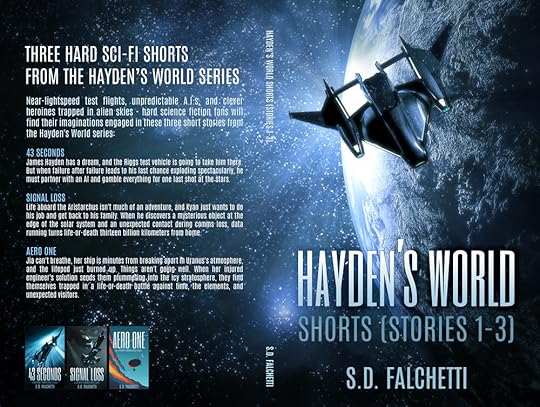
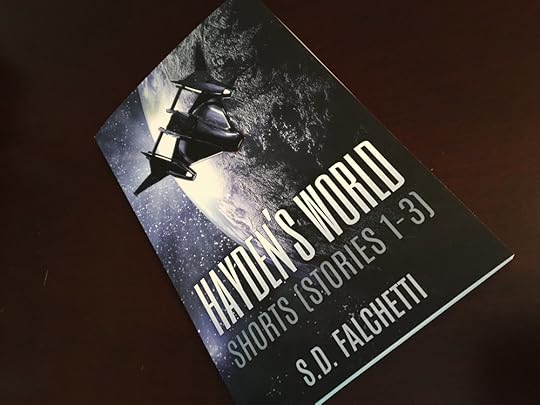
Hayden's World Shorts - Paperback Artwork
One of the bits of trivia about me is that I majored in mechanical engineering but minored in graphic design. As I began self-publishing, it's been fun to dust off the graphic design skills and create my own book covers.
After a few requests for a print edition of Hayden's World Shorts, I decided to release the paperback. This required designing wrap-around artwork for the front and back covers.
Here's the final art. You can get the print edition here.
August 7, 2017
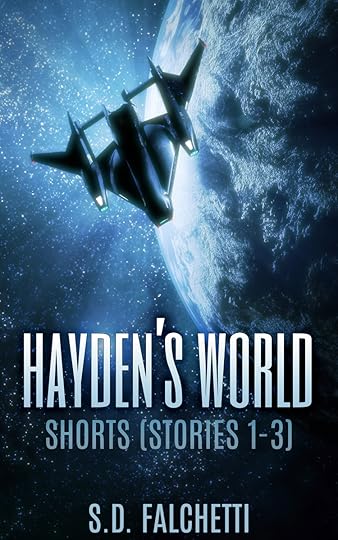
Hayden's World Bundle (43 Seconds, Signal Loss, Aero One)
Get all three short stories for the price of two! Grab the Hayden's World Shorts (Stories 1-3) bundle and get 43 Seconds, Signal Loss and Aero One, plus the two vignettes Silver-Side Up and Last Stand.
July 29, 2017
Signal Loss - Free Today
Get Signal Loss for free Saturday July 29th - Monday July 31st: http://bit.ly/sigloss
July 2, 2017
Aero One: FREE July 2 - July 4
Get the Kindle edition of Aero One for free Sunday July 2- Tuesday July 4. It's a 9000 word scifi survival short story which takes you on an adventure soaring through Uranus's clouds. Find it here on Amazon: http://bit.ly/aero_1
May 21, 2017
Space Problems: A Science of the Story Extra
Space is ridiculously big. If you make a scale model of the solar system the outer planets will be miles away.
Now here's what will really bake your noodle: the Earth and Moon are so far apart that you can fit every planet in our solar system between them. If that's a bit hard to imagine, just line up Earths end-to-end. You can fit thirty Earths between the Earth and the Moon. Don't believe me? Here's the math:
Diameter of the Earth: 7917.5 milesDistance from the Earth to the Moon: 238,900 miles238,900 / 7917.5 = 30.17 EarthsIt's really far.
If you fly at half-a-million miles per hour, it'll still take you half-an-hour to get there.
So, this is the problem I keep running into when I write science-fiction. Even with super-speedy reactionless RF drives, it still takes a while to get from point A to point B.
With current technology the maximum attainable speed is determined by the rocket equation. Put simply, if you throw mass out the back of your ship to accelerate, sooner or later you're going to run out of mass. Given the starting mass of the ship and fuel you can do the math and figure out what the final velocity will be when you use your last drop of fuel. The kicker is that increasing the fuel tank doesn't help because that additional mass offsets itself by decreasing the velocity change each bit of ejected mass imparts. Ultimately the only variable you can really change is the speed you eject the mass, and this is usually determined by the reaction properties.
There are some clever within-current-technology work-arounds for this. Stephen Hawking has proposed laser sails and postage-stamp sized probes. Because the probes don't carry their own propellant, they are not limited by the rocket equation and can potentially hit twenty percent light speed. There's quite a few barriers to Project Starshot, including not vaporizing the postage stamps with the lasers or shredding them with the 51,000 g acceleration.
With the Hayden's World stories RF drives exist and generate acceleration without ejecting mass. This sets the new speed limit at light speed. Great! But, humans can only tolerate high gee for so long (unless someone invents Star Trek's inertial dampeners). If people want a comfortable one gee acceleration it's going to take a year to accelerate near light speed.
James Hayden's ship sidesteps this by not moving his ship at all. Instead, space expands and contracts around the ship. He's able to go from zero to ninety-seven percent light speed in eight seconds because, from his reference frame, he's stationary.
For everyone else the quickest way to get anyplace is to accelerate halfway and decelerate the remainder. Relatively short distances can be problematic.
Consider the scene in Aero One where the Prosperity is in a lower orbit than Ward's ship. Let's say this is Earth and I put Ward's ship in geostationary orbit (35,786 km above Earth) with the Prosperity in low Earth orbit (200 km):
Problem A: Ward's orbital period is 24 hours and Jia's is 90 minutes, so Prosperity will slip over the horizon fairly quickly. If Ward steps on the gas pedal he'll increase his tangental speed relative to Earth and move into an even higher orbit. If Ward wants to catch her he has to decelerate, causing him to fall towards Earth into a lower orbit. While he's doing that she's still going to get away, at least until she orbits around again.
Problem B: Even if I completely ignore the orbital mechanics and have Ward accelerate at 1 g straight towards Jia (followed by deceleration to match position), it will still take him an hour to travel 36,568 km.
Problem C: Ward thinks this is taking too long and fires off his railgun-accelerated seeker slugs. Let's say the railgun accelerates the slugs to 100 kps (223,694 mph!). It still takes them six minutes to get there. They're guided, so they can still hit the Prosperity, but it's a long time (at least from a narrative standpoint).
So, these are the space problems I need to work out for each story. I decided to put Ward and the Prosperity fairly close to each other so the slugs can reach her in thirty seconds.
Fortunately as you travel greater distances the cumulative effect of the acceleration begins to greatly decrease the transit times. Here's a few 1 g travel times (at half accel/half decel):
Earth to Moon: 3.5 hoursEarth to Lagrange Two: 7 hoursEarth to Mars: 1.8 daysEarth to Sun: 2.9 daysEarth to Saturn: 8.3 daysEarth to Pluto: 20.2 daysEarth to heliopause: 1 monthEarth to beginning of Oort Cloud: half a yearThese are with 1 g continuous accelerations, which is something we can't currently do. For reference, the real-life Pluto New Horizons probe took 9 years to travel from Earth to Pluto.
Well, hope you enjoyed a little bit of space-geekery. Back to writing!
May 13, 2017
Everything's Free!
This weekend all of my stories are free on Amazon. You can get them all from this handy Amazon series link: http://bit.ly/haydensworld
80s Problems That Never Happened
There’s a popular meme which states “When I was a kid, I thought quicksand was going to be a much bigger problem than it really is.”
I grew up in the 80s. I had a Members Only jacket, one pair of parachute pants, an assortment of skinny ties, and some rocking velcro black Reeboks. I lived and breathed cheesy sci-fi, drank coke from my McDonald’s Star Wars glass collection, and went to bed under a sky-blue Empire Strikes Back blanket. I can still see Luke with his blaster drawn, Bespin behind him. I remember watching countless flicks where the hero sank into quicksand and I always made a mental note to heed his advice. Don’t struggle, it only makes you sink faster.
Thinking back, there’s a whole host of things which always happened in my favorite 80s shows that never materialized into problems in my future adult life:
Getting sucked into a comic book and needing to fight my way back outJealous computersNeeding to dive at just the right time to outrun an explosionKnowing how to pick a lock with a bobby pin borrowed from a woman’s hairOutsmarting a killer computer in a dazzling display of logicSwitchbladesAnyone from the futureFights on ledges over lavaGetting frozen by liquid nitrogen (or carbonite)Escaping by crawling through HVAC ductsFalling through the ceiling while crawling through HVAC ductsMeteor strikesKnowing how to close a demonic portalNinjasUsing proper form when swinging across chasms (kiss the girl, first!)Identifying cursed talismansDealing with bounty huntersCrashing my car through a fruit cartBeing recruited to fight in an alien warGetting trapped in the pastWell, okay, I suppose #20 did actually happen.