S.D. Falchetti's Blog, page 15
December 17, 2017
Pulp Fiction
If you've read 43 Seconds or Erebus, you'll know James has nostalgia for the golden days. His dreams are an extension of my own. Instead of the golden days of aviation, however, I dream about the pulpy days of science fiction. Book covers painted in gauche with paint-streaked rocket ships bisecting star fields, like these:
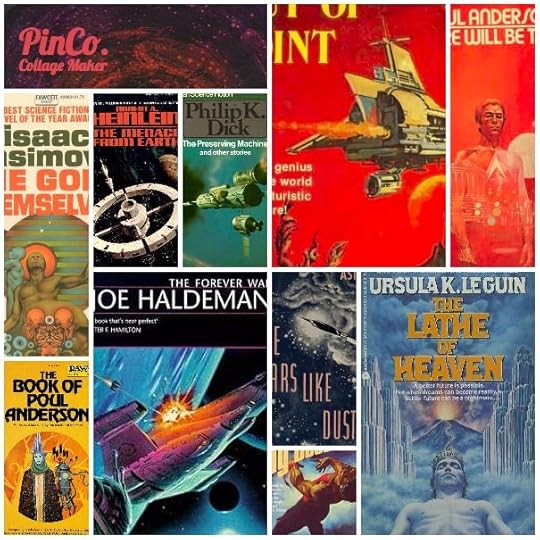
Like 'em? Check out my collection on Pinterest.
I also love the concept of the serial, tuning in next week or getting the next issue to see what befalls our hero. It's really the structure for most modern sci-fi television, whether you're watching Dr. Who or Star Trek. Bite-sized stories consumed sequentially, starring the same characters, focusing sometimes on the star, sometimes on the co-stars.
When I conceived Hayden's World, it was a full-fledged book. I thought the voyage to get to that point, however, was its own exciting story. I'd been searching for Kindle short reads to consume each night in bed - ninety-nine cent stories I could read in under an hour. To my surprise, there was a shortage of them. It was an itch which needed to be scratched, and I decided to tackle it with my keyboard.
Publishing sci-fi shorts on Kindle is surprisingly difficult. I think people are more likely to try a novel from an unknown author than a short story. It's nearly impossible to advertise ninety-nine cent fiction without losing money. I've found the most effective paid promotion is simply to buy the books from Amazon and give them away (via Amazon's Giveaway program). Kindle Select allows me to set the price to free for up to five days every three months. and this moves two hundred copies if I pay for basic advertising. Recently I had a friend ask if there was good money in my Kindle sales. I told him I could buy one nice dinner-for-two yearly from them.
This quote from author Palessa on Nicolas C. Rossis blog sums it up perfectly:
On the author side, I decided to go more for brand awareness than book sales, because if I’ve learned anything in this whole independent author journey, it’s that obscurity is the force we are all fighting against.
The main challenge hasn't been one star reviews. It's publishing to the abyss. It takes money and effort to keep your needle in the haystack from sifting to the bottom of the pile. And, you've got company there. You can deduce this fairly quickly from your Kindle stats. When your book bottoms out in sales, it moves to a sales rank of around three million (meaning, there are three million books in the pool, and you are at the bottom). When you sell just one copy, your rank jumps to one hundred thousand. This means those 2.9 million other souls are selling no copies.
I'll admit, it's daunting. I was an artist before I was a writer. Both are creative endeavors. Art is easier, though. It's visual. When you post a newly completed piece online, you immediately get feedback. People can assess its merit in the few seconds it takes to glance at it, and respond. They can share the image socially. Writing, though, is different. There's a commitment to read a story, and then it takes more than a Facebook like to give feedback.
I'm four stories deep now in the Hayden's World series and excited about the subplots developing. There's plenty to explore, especially with James's discovery in Erebus, or the lack of closure with the pirates in Aero One. Looking forward to seeing what happens next with our heroes.
As always, you can help with your feedback. Leaving a rating on Amazon or Goodreads really helps, or just a comment on this blog if you like a story or have questions about what's next. I love to hear from readers, so drop me a line.
Thanks!


December 10, 2017
If it's free it's for me
43 Seconds is FREE on most major vendor's sites. You can get it on Apple iBooks, Barnes & Noble, Kobo, Scribd, and several others. On Amazon Kindle it's still 99 cents, but hopefully Amazon will price match it in the near future. Click here to get your copy: https://www.books2read.com/43seconds
December 8, 2017
Grammar Police
I admit, the math section of the SATs was easier for me than the reading section, which is probably why I became an engineer. Despite that, I still really enjoy Weird Al's Word Crimes:
In keeping in theme with my recent post discussing what I've learned in my first year of self-publishing, I thought I'd mention a few grammar confusions I needed to work through:
SinceApparently I've been using the word "since" incorrectly my entire life. Case in point:
Since I'm here, I may as well have some french fries.
I should be using it like Kelly Clarkson:
Since you been gone, I can breathe for the first time.
Granted, "since you been gone" isn't the best grammatical example, but hey.
"Since" references a period of time. I've been waiting here since nine o'clock. Or, Since learning that I use "since" incorrectly, I need to sing that Kelly Clarkson song to remember how to use it.
Which/ThatAaargh. Quick quiz - which is correct:
Cut the wire which is red
Cut the wire that is red
There's a better explanation detailing restrictive clauses, but I find it's easiest to replace the word "which" with "which happens to be". If the sentence still makes sense and has the same meaning, you're good.
Cut the wire, which happens to be red. It doesn't really matter that it's red. Just pointing that out for people who like the color red. Pretty!
Cut the wire that is red. There's also a black wire. Please don't cut the black...oh my God, you're not even listening to me! Give me those wire cutters!
Feeling PossessiveSure, it's been several hundred years since I went to elementary school and my memory may be a little foggy, but I distinctly remember the rule to use an apostrophe s unless the word already ended in s, in which case just use an apostrophe. Granted, that was back in Arthurian days when we spelled town with an e.
It seems I'm supposed to use an apostrophe s for singular nouns (regardless of their ending letter) and apostrophe for plural nouns that end in s. Actually, if you Google it you'll find the Internet's definitive opinion on the matter is:
Apostrophe s for singular nouns; apostrophe for plurals ending in sApostrophe s for nouns that don't end in s; apostrophe for words that doApostrophe s if you speak the s; apostrophe if you don'tThese can't all be true, but it doesn't matter, just be consistentWhy do we even have language at all. Let's just grunt and point.Hey, there's a new Cinemasins videos. Wait, what was I Googling again?Anyway, in my stories you'll see:
James's
and not
James'
That is, unless a Riggs malfunction creates an army of duplicate James, and they all collectively own something.
As an aside, why English has chosen the possessive form of "it" to be "its" is mind boggling. More accurately, it's mind boggling. I realize that "it's" has been claimed as the contraction for "it is", but there's no reason you can't contract "to be" onto any noun, as in "Hey, Bob, cat's gone missing again" or "That grammar rule's silly."
Okay, that's enough pearls for today. Back to writing.
November 13, 2017
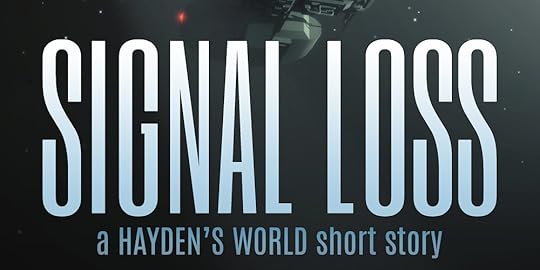
Signal Loss - Free Nov 13 - Nov 17
Grab Signal Loss while it's free on Amazon Kindle, Monday Nov 13th - Friday Nov 17th. http://bit.ly/sigloss
November 8, 2017
Erebus Needs Your Help
You've gone interstellar with Sarah and James. Now, can you lend them a hand? Will you leave a rating on Amazon: https://www.amazon.com/review/create-review?asin=B075WVJGWQ ?
New books have a tough time getting reviews, and an even tougher time selling without any. I appreciate it!
October 30, 2017
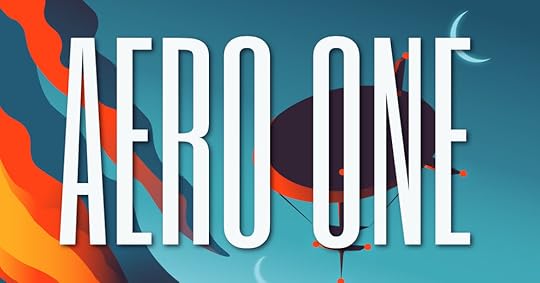
Get Aero One for FREE Oct 31 - Nov 4
It's Halloween, so why not get stranded on a blimp on Uranus? Okay, those two have nothing to do with each other...except that you can get Aero One for free five consecutive days starting on Halloween (Tuesday Oct 31). Get it here: http://bit.ly/aero_1
If you do read it, would you leave a review on Amazon? It would greatly help. Reviews turn the cogs of the Amazon machinery.
Enjoy!
October 19, 2017
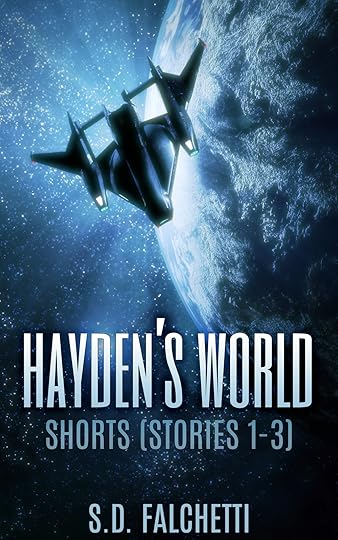
Get all four Hayden's World stories for FREE on Friday Oct 19th
One day only - get Hayden's World Shorts (Stories 1-3) and the new release, Erebus (Story 4) for free on Friday Oct 19th on Amazon Kindle. Pick your stories from my Amazon author's page.
October 7, 2017
What I've Learned in One Year of Self-Publishing
June 12th, 2016, I uploaded 43 Seconds to Kindle Direct Publishing and clicked the submit button. One hour later it was live. Since then, I've published Signal Loss, Aero One, Hayden's World Shorts, and Erebus. When I started, I recall reading many self-publisher's blog posts about how their journey unfurled. I thought I'd share mine after the first year.
Writing CraftThere are endless books on story structure, plot, characters, grammar, and dialogue. I devoured them. James Scott Bell's and Marcy Kennedy's series are very helpful. By far, Self Editing for Fiction Writers is essential and probably should be required reading for self-publishers. It addresses many of the common problems newer writers face.
Here’s a few things I've needed to focus on as a newer writer:
Passive Voice (the bane of newer writers):Long ago I wrote a story titled "Wraith's Dance" and submitted it to Weird Tales. I received a refusal letter, but was pleasantly surprised that it included a constructive critique from the editor. He liked the story, but the deal breaker was its passive voice. Keep writing, he encouraged.
When we speak, we're used to telling a story using the word "was" to indicate a transient action:
He was running down the hall when the bell rang.
Ditching the word 'was' and just using the actual verbs ran or rang changes the sentence from a state (was running) to an active verb (he ran, the bell rang):
He ran down the hall as the bell rang.
The bell rang as he ran down the hall.
Both are more engaging than "he was running down the hall".
I recommend using your word processor's Find/Replace to locate every use of "was" and determine if it's needed. I found this was littered throughout my writing.
A little less common, but even worse, is using was to put the recipient of the action first:
The martini was splashed in his face by Jane.
Much better to write:
Jane splashed the martini in his face.
I can't recall which writing book listed the acronym R.U.E, but it definitely applied to my early work. R.U.E. is "resist the urge to explain". The biggest offender for me was "to", as in:
He opened the door to search for the axe murderer.
Better to let the reader figure it out based on the character's actions:
His pulse raced as he reached for the door knob. He had to find Eugene before he killed again.
Seriously, it was everywhere in my writing. To do this, to do that. Readers like watching a character and trying to deduce what they're up to.
Tight Writing and PacingAs you'd guess, don't use a hundred words to say something best described with a dozen. I found my biggest offender was the word "of":
Pools of radiant light filled the room.
Flowery, but better to say:
Radiant pools filled the room.
Right? Radiant is a stronger word to start the sentence and doesn't require mental gymnastics to extract the modifier between the object and verb.
Pacing's a little harder to pin down. It's easy when writing sci-fi to get swept away in descriptions, but endless description is boring and endless action is tiresome. You need to constantly mix-up description, actions and dialogue to keep things moving. The other thing I'll say is that it's often better to suggest descriptions with a few well-chosen words. For instance, the waves bled with fading sunlight conjures a complete mental image in six words, plus it even has an ominous tone and perhaps a bit of foreshadowing. You can imagine some night time battle at sea.
When I wrote Aero One, the opening paragraphs were very focused on Jia's senses and confusion. The high level or detail didn't match the urgency of her situation, though. I self-edited it down to:
Thoughts spark and fizzle in an overlapping jumble of competing primal urges. Air. She needs air.
Head HoppingPhew! This one's tough. We've grown up watching television and movies which constantly cut between different character's perspectives. Some are better than others at keeping you in the main character's head.
For example, the camera frames a close-up of Bob's expression as he looks down at a letter. Next, it cuts to what Bob reads in the letter. Off-screen, we hear the clinking glasses as Sandy opens the kitchen's liquor cabinet. Great!
More typically we see Bob reading a letter followed by a camera cut to Sandy in the kitchen. Bob can't see Sandy from where he's standing in the study, but we get to see her pouring the poison into his brandy.
When I started writing I mimicked this cinematic approach. There's no rule that says you can't do that, just keep in mind that in this case you're writing as a detached omniscient viewer and your reader will have the same experience. This weighed on my mind as I wrote my recent story Erebus. Staying with Sarah's perspective meant the reader didn't know what happened to James. If this were a tv episode, it would have cut simply to what James was doing while Sarah searched for him.
Note this doesn't mean that you can't change character point-of-views using line or chapter breaks. Just keep in mind there are pros and cons to POV changes.
DialogueThe simplest rule is "he said/she said".
"Yup, we're all going to die," Hitoshi said.
I remember getting confused and sometimes typing it backwards:
"Yup, we're all going to die," said Hitoshi.
But that puts the verb before the object.
Even better, eliminate the dialogue tag with stage direction:
Hitoshi facepalmed and shook his head. "Yup, we're all going to die."
Formatting Your Book/Creating Cover ArtScrivener is invaluable for organizing and writing your story. It's project management software for writers. If you have enough patience, you can produce well-formatted books directly out of Scrivener. I did not, so I purchased Vellum. Vellum's expensive, but produces beautiful books.
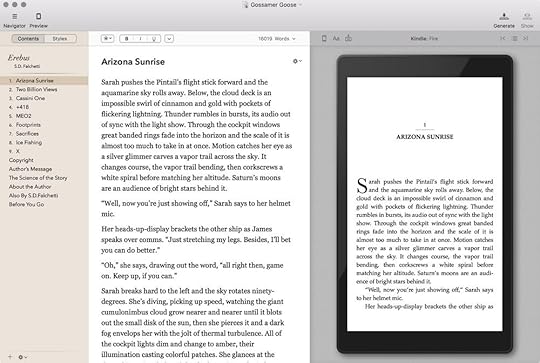
Vellum file for Erebus. Very easy to create a professional ebook or paperback.
Canva is the easiest way to create a quick book cover online, and it's cheap. Alternately, if you have some design skills you can purchase stock photos (make sure you select the right license) and assemble your own cover in Photoshop. If you have artistic skills, you can use Adobe Illustrator or Photoshop to create custom artwork. Lastly, you can also outsource it to a designer via a site like 99 designs.
Here's how I created the cover for 43 Seconds:
The background's warp effect is a licensed Adobe stock photoThe spaceship is a 3D model created in the free modeling software, BlenderThe foreground text is a layer in Photoshop.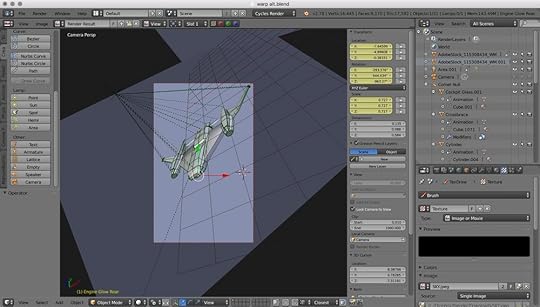
Blender 3d model of Bernard's Beauty for 43 Seconds
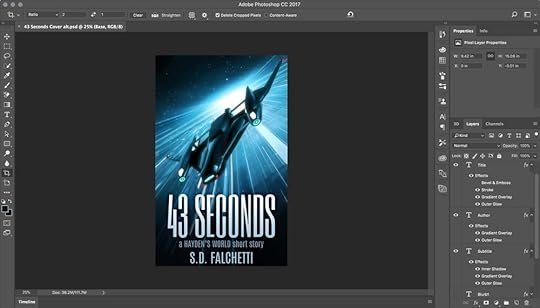
Photoshop composite of background art (generated in Blender) with foreground text
Reviews and Sales
And now the bad news. When I started I feared I would post my book and get peppered with one-star reviews. The reality is that next-to-no-one will see your book, and out of those that do, one-in-a-thousand will leave a review. Getting peppered with negative reviews is an upgrade to where you actually start. I've had my best luck getting reviews with Amazon Giveaways. I do use KDP free days, but they never generate reviews.
Regarding sales, my annual book sales can probably buy me a single, nice dinner. If you're looking to make money, I suggest trying to sell to magazines. If you get 6 cents per word for a 6000 word story like 43 Seconds, you'll make $360. Maybe I'll try writing some non-Hayden's World stories and submit those to magazines.
AdvertisingAmazon ads do work, but they are not cost effective for 99 cent books (unless you can upsell a series). I typically land in the 40 to 50 cents-per-click range and need ten clicks to get one sale. Four to five dollars to sell a 99 cent book isn't a sound business model. Giveaways work better because four to five dollars gets you four to five sales. Without ads or giveaways, however, my books fall into obscurity. When using ads, Product Ads work much better than Keyword Ads in generating actual sales, probably because they are better targeted.
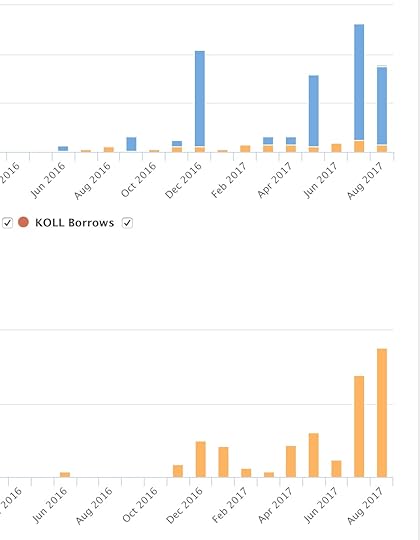
In the top chart, the blue bars represent free books purchased and the orange bars are paid books sold. The bottom chart shows pages read via Kindle Unlimited book borrows. In December 2016, I learned how to promote my Kindle free days more effectively and started using Amazon ads.
Spamming buy-my-book on twitter is counter-productive and will cost you followers. Twitter is for sharing content. I do recommend posting snippets of your good writing, especially if they fit the day's theme (SciFiFri for example), or if they're works-in-progress and fit the #amwriting tag.
Wrap-upI feel like I've learned a lot this first year. I've taught myself Scrivener, Photoshop, Illustrator, Blender, Vellum, and KDP. Getting an occasional review from an excited reader makes my day. Writing in series for the Hayden's World stories has been challenging because each story needs to be independent, and each time I finish a work I have this self-doubt phase of wondering how I'll come up with something new. But, the stories keep churning out, and they're getting longer and more complex:
43 Seconds - 6000 wordsSignal Loss - 9000 wordsAero One - 9300 wordsErebus - 17,000 wordsSo, marching on into year two and seeing where my keyboard takes me.
October 6, 2017
Erebus - Writing and Story Tidbits
SPOILERS ALERT! If you haven't read Erebus, grab a copy first. It's only 99 cents. Seriously, you can't even get someone to read a 17,000 word story to you for 99 cents.
Erebus is the inverse of my original story idea. In my first draft, Sarah was the one who got trapped in interstellar space and James rescued her in Bernard's Beauty. I still have the draft of chapter one, titled "Gamma 222". Here's a clip:
Sarah breathes fast, her words muffled by the mask. “Collapse the wave.” She spins the damage control graphic with his fingers. Red flagged systems follow a diagonal line bisecting Gossamer Goose. Ballistics calculations plot the trajectory of the impactor.
But I really didn't want Sarah to be a damsel-in-distress. So, I flipped it.
One of the issues I immediately ran into is "one too many heroes" and I needed to think a bit about using story structure to address this. One thought was to use parallel stories, like "The Martian", with some chapters following Watney while others followed the NASA rescue efforts. You can see how James's scenes - crashing Bernard's, scouting the snowy landscape - would be compelling as their own chapters, and toggling between his and Sarah's story would be interesting. But, ultimately the story is Sarah's. It's about her voyage there, what she's feeling, how it changes her, and what she does when she gets back. As interesting as James's adventures are, they're the background events. It's a bit like how the movie Titanic wasn't really about the Titanic.
As an aside, I notice that James, who was the clear hero in 43 Seconds, takes the role of catalyst in the subsequent stories. When I write him, it's very easy for him to overshadow the lead characters, so I always need to use some restraint. I also like how his strength (taking risks) is also his weakness.
Handling time was one of the consistent narrative challenges. During James's voyage to Erebus, he and Sarah are in different timeframes. I decided to give a sentence or two for each of them during Jame's six transmissions. It's similar to the approach I used with Jia's video journal in Aero One. William's slightly convoluted whiteboard diagram for the rescue was another visual tool to help with time. Pepper in some flashbacks via James's two video logs and you've got a narrative moving on multiple time axis.
In a way, this story was a bit of an all-star reunion for many characters. A few thoughts:
I'll bet James and Will's offices are just like you imagined. Letting Sarah sit in both gave a chance to see what each man valued.My beta reader commented that she always liked any scene where Hitoshi appeared. In 43 Seconds, he was Q to James's Bond. In Erebus, he's a little like Galaxy Quest's Guy, having read far too much sci-fi to think it's a good idea to be on an away team. I relate with him the most.Ananke could've used more air time, but she does get to ask a very important question near the story's end.I broke a bit of a story rule by introducing two new characters midway through the narrative. Isaac gets a decent share of talk time, but you don't get to learn too much about his or Julian's personality. I'm sure they'll appear in future stories. On the plus side, it was fun having an actual crew, and I liked how they each had their own area of expertise for the mission.And a couple of plot tidbits:
Cassini Station was developed for a new story called Titan's Shadow. It seems like a fascinating place, and I'm looking forward to exploring it. Here's a clip:Rolin shrugs.
“Why didn’t facial recognition pick him up?”
“Cassini Station doesn’t have an open security agreement with EarthSec.”
“Well, that’s idiotic.”
He gestures towards the shops. “Everyone who comes here has some reason to get away from Earth.” He appraises Jia a second. “If Cassini had an open sec agreement, probably a quarter of its shops would be gone.”
James tucking himself weightless into a wall-mounted sleeping bag was inspired by Chris Hadfield's video of sleeping on the International Space Station.When I wrote 43 Seconds, it occurred to me that if a ship could maintain greater than one gee acceleration for days at a time, then it could maintain a one gee deceleration long enough to land on a planet. The reason real-life spaceships can't do this is because they are rockets and are bound by the rocket equation. This means they can't possibly take enough fuel with them to both accelerate and decelerate the full way (because the fuel has mass and needs to be accelerated itself, requiring even more fuel). So, real spaceships need to fall from the sky at orbital speeds.At the end of the story Riggs switches from a threat to a defense. In the 1960s, fear that Russia would develop space superiority and deploy orbital weapons fueled the Apollo program.The idea of a ninth planet (or tenth, prior to Pluto's demotion), has been around for a while. Dubbed Nemesis, some thought it was a distant object perturbing the Oort Cloud, raining comets down upon us. More recently, the theoretical planet was given a working name of Xena based on the Xena Warrior Princess tv series. When it is discovered, it will be given an official name. This will be challenging because the majority of roman and greek gods have already been assigned to dwarf planets, asteroids, or moons.As an aside, there was an actual distant orbit which grazed the Oort Cloud not very long ago (from a cosmological perspective). Scholtz's Star passed through our Oort Cloud 70,000 years ago. It kept on going, and it now 17-23 light years away. When it passed through, it was 52,000 AU away. In Erebus, Gossamer Goose travels 1200 AU. Scholtz's Star may have perturbed comets, but it will be two million years before any make it to Earth.In mythology, Erebus was the primordial god of darkness and consort of Nyx (Night). Janus is the god of beginnings, gates, transitions, time, duality, doorways, passages, and endings. You can see why I chose Janus for Sarah and James's adventure.September 26, 2017
Erebus (First Chapter, 1200 words)
Sarah pushes the Pintail’s flight stick forward and the aquamarine sky rolls away. Below, the cloud deck is an impossible swirl of cinnamon and gold with pockets of flickering lightning. Thunder rumbles in bursts, its audio out of sync with the light show. Through the cockpit windows great banded rings fade into the horizon and the scale of it is almost too much to take in at once. Motion catches her eye as a silver glimmer carves a vapor trail across the sky. It changes course, the vapor trail bending, then corkscrews a white spiral before matching her altitude. Saturn’s moons are an audience of bright stars behind it.
“Well, now you’re just showing off,” Sarah says to her helmet mic.
Her heads-up-display brackets the other ship as James speaks over comms. “Just stretching my legs. Besides, I’ll bet you can do better.”
“Oh,” she says, drawing out the word, “all right then, game on. Keep up, if you can.”
Sarah breaks hard to the left and the sky rotates ninety-degrees. She’s diving, picking up speed, watching the giant cumulonimbus cloud grow nearer and nearer until it blots out the small disk of the sun, then she pierces it and a dark fog envelops her with the jolt of thermal turbulence. All of the cockpit lights dim and change to amber, their illumination casting colorful patches. She glances at the three-dimensional plot of cloud schematics and wind vectors showing James’s relative position. A push of the stick and she’s diving again, down through the base of the cloud with distant lightning flashes momentarily breaking up the fog, then she bursts through the bottom and pulls up to level out. The Pintail throttles back and Sarah takes a moment to breathe and just watch the sights. Overhead, the cloud stack is a roof the size of the Grand Canyon, flattened, stretching off into an infinite dappled orange ceiling. Sunlight shafts create drifting havens in the twilight.
James emerges from the cloud bottom and accelerates to her starboard. His Pintail is white with silver wings adorned by the two-tone Hayden-Pratt logo. Its strobes paint her cabin like a blinking neon sign outside a city window.
“Well that was fun,” James says. Sarah can see him in his cockpit, his helmet turned toward her. He lifts a gloved hand and gives a thumbs up.
She smiles. A thumbs up from James means something to her, and, for just a moment, she can’t believe that she’s really here, flying one of the first two production Pintails over Saturn’s ammonia clouds, looking over her shoulder and seeing the only person to fly near light speed tucked into her wingman position. “Hey,” she says, “what’d you think of the view?”
“It’s like an Arizona sunrise,” James says. “Smile, I’ll take your picture.”
Sarah gives a thumbs up as he snags the image from his wing cam.
* * *
Cassini Station is an azure jewel dangling from the golden necklace of Saturn’s F Ring. Strobes blink from space traffic gliding in and out of the station. It’s a work-in-progress, great swathes of framework exposed to vacuum, modules partially in place, and a building-block-like matrix of alloyed plates hinting at the future bends and curves of the structure. Sky blue interior lighting transmits through the habitat’s translucent domes, and, even from this distance, Sarah can see movement. People. In front of it all, taupe-and-twine-hued rings span back towards her.
Sarah lands her Pintail at Cassini’s lower dock, gets cleaned up and changes out of her flight gear. A shuttle connects her with the commercial decks. Microgravity appears when she enters the station’s rotation, growing in strength until she’s under a full gee. When the shuttle door opens, she steps into Cassini’s shop-filled Promenade.
James sits at their favorite table in front of the Panorama. Saturn emerges behind him like a full moon rising, sideways, its rings bisecting the view top to bottom. Smoothly it glides up with stars trailing in its wake. Two glasses of amber beer wait on the table.
“Hey,” Sarah says, sitting. She motions to the beer. “You know they brew that stuff from Titan’s lakes, turn the ethane into ethanol.”
James smiles. “Sippin’ the universe. You want something else?”
She grabs the glass, lifts it, and clinks it against his. “Here’s mud in your eye.”
It’s cool and bubbly, tasting like a mixture of wheat beer and rubbing alcohol. Sarah grimaces and scrunches her eyebrows, forcing herself to swallow.
James laughs and wipes his lips with the back of his hand. “Holy hell.” He coughs and slides the beer away.
She smacks her lips. “I know I was one-upping you back there a bit, but I didn’t think you’d try and kill me.”
“We should bring back a liter for Will.”
Sarah points. “Now that’s an idea.”
James chuckles and glances at the slate. Her eyes follow. “There’s something I want to show you,” he says, pushing the slate over.
Sarah leans in. A standard engineering schematic glows blue on the slate. The top view outlines a flattened wedge-shaped ship, an arrow of cockpit windows at its front. Sixty-two meters nose-to-nail. She’s never seen this configuration before.
“What’s this?” Sarah asks, engrossed.
James waits and smiles.
She pinches and zooms the screen. Her mouth opens. “Three terawatt reactor! Damn, James, what’re you going to do with that?” And then she sees it, the halo of emitters configured in a sphere of interlocking rings tucked behind the reactor. Riggs wave generators. This ship has a Riggs drive.
James reads her expression and says, “The best Bernard’s Beauty will ever do is ninety-eight percent light speed, but this…” He points to the blue print. “This will reach ninety-nine point nine. Full hab deck, max crew of six, enough fuel for three months.”
“Woah.” She does some quick math in her head. “So, her range will be almost three light-months? You could get to the Oort Cloud.”
“Ah, see, I did the same thing on my first Bernard’s flight. Three months ship’s time is sixty-six actual months. At ninety-nine cee, that’s five-and-a-half light-years.”
She processes that a moment, searching his eyes. “You can get to Proxima Centauri. Hell, the entire Centauri system.” Now she’s excited, indexing star charts from memory. “You could almost reach Barnard’s Star.”
“Yup, but it’d be one way. Realistic range for there-and-back is half that.”
“That’s incredible! Are you going to build it?”
James nods. “MEO2 shipyard is setting up as we speak. Construction starts end of this month.”
Her eyebrows raise and she laughs, nearly a giggle. She feels like a kid who’s gotten a sneak peek at the world’s coolest toy. Her fingers brush over the screen. Without looking up, she asks, “What are you going to call it?”
James turns up an open palm. “That’s up to you.”
Sarah meets his eyes. “Really?”
“She’s yours, Sarah,” he says, leaning in. Butterflies cascade through her stomach. “You’re the best pilot I have. I want you to fly her.”
* * * *