
Jeffrey Zeldman's Blog, page 71
June 7, 2011
Responsive Web Design – The Book
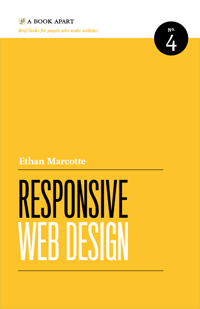
SOME IDEAS SEEM inevitable once they arrive. It's impossible for me to conceive of the universe before rock and roll or to envision Christmas without Mr Dickens's Carol, and it's as tough for my kid to picture life before iPads. So too will the internet users and designers who come after us find it hard to believe we once served web content in boxy little hardwired layouts left over from the magical but inflexible world of print.
I remember when the change came. We were putting on An Event Apart, our design conference for people who make websites, and half the speakers at our 2009 Seattle show had tumbled to the magic of media queries. One after another, CSS wizards including Eric Meyer and Dan Cederholm presented the beginnings of an approach to designing content for a world where people were just as likely to be using smart, small-screen devices like iPhone and Android as they were traditional desktop browsers.
Toward the end of the second day, Ethan Marcotte took what the other speakers had shared and amped it to 11. Suddenly, we had moved from maybe to for sure, from possible to inevitable. Ethan even gave us a name for his new approach to web design.
That name appears on the cover of this book, and this book represents the culmination of two years of design research and application by Ethan and leading-edge design practitioners around the world. Armed with this brief book, you will have everything you need to re-imagine your web design universe and boldly go where none have gone before. Happy reading and designing!
Jeffrey Zeldman,
Publisher,
Responsive Web Design

[image error][image error][image error][image error][image error][image error][image error][image error][image error]


June 6, 2011


June 3, 2011
16 years online

Deliberately off-center Daily Report layout of 2003.
ON MAY 31, 2011, this website turned sixteen years old. Thank you for indulging me. (And thanks to Sean M. Hall for reminding me.)
Here is a reflection written when the site turned 13.
And here, from 2007, is a mini-retrospective of The Daily Report beginning with 31 August 1997 (entries from 1995–1996 are gone due to overwriting), and continuing through years of constant writing and strange design such as daily/0303a.shtml, daily/0103a.shtml, and daily/0902b.html. (Of course to really see these pages as the world saw them then, you'd need a non-antialiased operating system, a non-standards-compliant browser, and a dingy TV tube monitor. But I digress.)
More of this site's juicy Web 1.0 goodness may be unearthed on this page.
If you like, you can also peruse a small gallery of my article header images from the early days of A List Apart Magazine.
Here's to plenty more years ahead, inventing the web and modern design together.

[image error][image error][image error][image error][image error][image error][image error][image error][image error]
One blog post is worth a thousand portfolio pieces.

I HIRED JASON SANTA MARIA after reading this post on his site.
The year was 2004. Douglas Bowman, one of my partners on a major project, had just injured himself and was unable to work. I needed someone talented and disciplined enough to jump into Doug's shoes and brain—to finish Doug's part of the project as Doug would have finished it.
I lack the ability to emulate other designers (especially classy ones like Douglas Bowman) and I was a Photoshop guy whereas Doug worked in Illustrator, so I knew I needed a freelancer. But who?
A Google search on Illustrator and web design led me to a post by a guy I'd never heard of. The post was enjoyably written and reflected a mature and coherent attitude not simply toward the technique it described, but to the practice of design itself. Yes, the blog itself was intriguingly and skillfully designed, and that certainly didn't hurt. But what made me hire Jason was not the artistry of his website's design nor the demonstration that he possessed the technical skill I sought, but the fact that he had an evolved point of view about web design.
Anyone can write a how-to. Not everyone thinks to write a why.
Jason had.
I offered him the thankless task of aping another designer's style for not a ton of money under extreme time pressure, and to my pleased surprise, he accepted. He did so well, and performed so selflessly, that I hired him for another project, this time one with full creative freedom. I have never regretted those decisions.
Just about everyone I know and work with I first met online. And, although well-done portfolio services have their place, neither I nor anyone at Happy Cog has ever hired someone purely (or even largely) on the basis of their portfolio. It's all about how you present yourself online. Before I even meet you, do I feel like I know you—or like I wish I knew you?
Have you got a point of view? Are you sharing it?

[image error] [image error] [image error] [image error] [image error] [image error] [image error] [image error] [image error]
June 2, 2011
Progressive enhancement: all you need to know is here
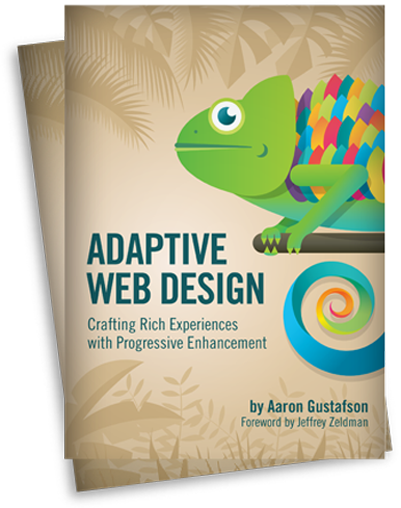
ONE GLORIOUS AFTERNOON in March, 2006, as a friend and I hurried past Austin's Downtown Hilton Hotel to catch the next session of the SXSW Interactive Festival, a young stranger arrested our progress. With no introduction or preliminaries, he announced that he was available to speak at An Event Apart, a conference for web designers that Eric Meyer and I had launched three months previously. Turning to my companion with my best impression (which is none too good) of Mr Burns of "The Simpsons," I asked, "Who is this brash young upstart, Smithers?"
The brash young upstart quickly became an essential colleague. In the months and years that followed, Aaron Gustafson created dazzling front- and back-end code for some of my agency's most demanding clients. Just as importantly, he brilliantly tech-edited the second and third editions of Designing With Web Standards. The job largely consists of alerting Ethan Marcotte and me to the stuff we don't know about web standards. I'll let you think about that one. For five years now, Aaron has also been a tough but fair technical editor for A List Apart magazine, where he helps authors succeed while ensuring that they are truly innovative, that their methods are accessible and semantic, and (thanks to his near-encyclopedic knowledge) that they give all prior art its due. Moreover, Aaron has written seminal pieces for the magazine, and, yes, he has lectured at An Event Apart.
Given my experiences with the man and my admiration for his knowledge and abilities, I was thrilled when Aaron told me the premise of this book and began letting me look at chapters. This isn't just another web design book. It's an essential and missing piece of the canon. Our industry has long needed a compendium of best practices in adaptive, standards-based design. And with the rise of mobile, the recent significant improvements in desktop and phone browsers, and the new capabilities that come with HTML5, CSS3, and gestural interfaces, it is even more vital that we who make websites have a reliable resource that tells us how to take advantage of these new capabilities while creating content that works in browsers and devices of all sizes and widely differing capabilities. This book is that resource.
The convergence of these new elements and opportunities is encouraging web professionals to finally design for the web as it always should have been done. Adaptive design is the way, and nobody has a wider command than Aaron of the thinking and techniques required to do it well. In these pages you will find all that thinking and those methods. Never again will you lose a day debating how to do great web design (and create great code) that works for everyone. I plan to give this book to all my students, and to everyone I work with. I encourage you to do likewise. And now, enough preliminaries. Dive in, and enjoy!
Adaptive Web Design: Crafting Rich Experiences with Progressive Enhancement
by Aaron Gustafson
Foreword by Jeffrey Zeldman

[image error][image error][image error][image error][image error][image error][image error][image error][image error]
June 1, 2011
Big Web Show No. 50: Jenville

O'REILLY AUTHOR, INTERVIEWER OF ROCK STARS, and longtime web and UX designer Jen Robbins (jenville.com, @jenville) is our guest in Episode No. 50 of The Big Web Show, to be recorded in front of a live internet audience on Thursday, June 2, at 12:30 PM Eastern via 5by5.tv/live.
Jen began designing for the web in May 1993 as the designer of O'Reilly Media's "Global Network Navigator." Since then, she's written several books about web design, including Web Design in a Nutshell and Learning Web Design. She recently made the switch to mobile as the Senior Designer for O'Reilly Media's new mobile publishing department. Her first app, "HTML 4 & 5 Complete Reference," an adaptation of her HTML Pocket Reference book, is available in the App Store now.
The Big Web Show ("Everything Web That Matters") records live every Thursday. Edited episodes can be watched afterwards, often within hours of recording, via iTunes and the web. Subscribe and enjoy!
Note that, for the time being, the shows are audio only. If you subscribed to the video feed in iTunes, you'll need to switch to audio. Sorry about that!

[image error] [image error] [image error] [image error] [image error] [image error] [image error] [image error] [image error]
May 28, 2011
Big Web Show No. 49: Popularity

"GUT-PUNCHING HONESTY."- @Boyd Waters
"One of the best BWS episodes yet." – @Piers Rippey
Dan Benjamin and I discuss the intersection of community and popularity on the web and in terms of podcasts and social media. The Big Web Show Episode No. 49: Popularity.

[image error][image error][image error][image error][image error][image error][image error][image error][image error]
May 27, 2011
An interview with Jeffrey Zeldman

WALT DISNEY AND ME, a typical day, running Happy Cog, building An Event Apart, what's next for A Book Apart, and more: DIBI, the design/build conference, presents An interview with Jeffrey Zeldman for your pleasure.
(I swear it's a coincidence the last two posts have begun with inset photos of yours truly.)

[image error][image error][image error][image error][image error][image error][image error][image error][image error]
May 26, 2011
On Creative Direction

IN MY APPRENTICE DAYS, I worked for Marvin Honig, a Hall of Fame copywriter who created indelible commercials for Alka-Seltzer, Cracker Jack, and Volkswagen during the 1960s and 1970s, and who assumed creative leadership of Doyle Dane Bernbach upon legendary founder Bill Bernbach's death. It was not one of those bloody successions that stain the pages of history and advertising. Bill chose Marvin to carry on in his place.
By the time I met Marvin, he and I were toiling at Campbell-Mithun-Esty. He had been brought in to radically upgrade the financially successful but talent-challenged agency's creative product. I was there because it was the first job I could get in New York.
Marvin was gentle. He never told you how stale your ideas were or how disappointed he was in you for not working harder. He made you believe you were the future, not only of the place, but of the profession.
Besides his warmth, what I remember most is a piece of advice he gave me: "If you're not a creative director by the time you're 40, get out of the business."
Continue reading But What I Really Want to Do is Direct at Cognition, the blog of Happy Cog.

[image error][image error][image error][image error][image error][image error][image error][image error][image error]
May 19, 2011
Letter of the Month
Hi Jeffrey,
Back in 2004 we had been running Headscape for three years. Things were going well but personally I was a little dissatisfied with my career. I just wasn't as excited about the web as I had been and was lacking a new challenge and direction.
Anyway, we won a new client that was particularly concerned about accessibility and so I realised I had to brush up my skills in this area. I decided to see if I could find a book on the subject. Bizarrely I ended up buying Designing With Web Standards. I am not sure why I thought it was going to be about accessibility but for some reason I did. Anyway when it arrived from Amazon I quickly discovered that although it did touch on accessibility it was about so much more.
I remember what I now refer to as a pivotal moment in my web career. I was sitting in bed reading your book. I knew nothing really about CSS (other than for setting fonts/colours and I couldn't see what was wrong with the old way of doing things). However as I read, it was like a slow realisation. I remember vividly turning to my wife and saying "This book is amazing. I am going to have to relearn everything I know about building websites". I didn't know whether to laugh or cry. On one hand the enormity of what you were suggesting was overwhelming but on the other hand it was just the injection I needed in my own career.
I reached the end of the book and made a decision. I was going to move the whole of Headscape across to standards based design. Not only that was I was going to do it as soon as possible. By 2005 we had made the transition and have never looked back.
So far this is probably not dissimilar to other stories you have heard. However, it doesn't stop there. I obviously started to follow your blog and you mentioned you were coming to speak in the UK at @Media 2005. For me this was too good an opportunity to miss. I wanted to see this guy who had turned our business upside down. Myself and my cofounders at Headscape booked on the conference.
I had never attended a conference before. In fact I had never spoken to another web designer outside of those I had worked alongside. It is therefore hardly a surprise that @Media blew me away. Yourself and the other speakers were so inspirational. In particular I remember Jeremy Keith's amazing talk on Javascript.
However, the moment that changed everything for me (yes again) was right at the beginning of the conference. Patrick asked various bloggers in the audience to stand up as he mentioned each of their sites. I was overwhelmed by the sense of community and the knowledge in the room. It left me desperate to be apart of that. I left the conference and started building boagworld.com the very next day.
I guess my point is this. If I hadn't bought your book by accident we would never have attended @Media and if I had never done that I would never have founded boagworld.com. Boagworld has transformed Headscape and brings in approximately 90% of our new business. You have helped our business grow, reinvigorated my own passion for the web and allowed me personally to do things (such as travel the world) that I would have only dreamed of.
That deserves my thanks.
Thank you.
Paul Boag [Web Strategist, Broadcaster, Author & Rabble Rouser]

[image error] [image error] [image error] [image error] [image error] [image error] [image error] [image error] [image error]


