Melanie Tomlin's Blog, page 3
March 20, 2017
An Interview with Author Rosetta Bloom
Today I’m interviewing author Rosetta Bloom, who loves a good fairy tale, some heart-warming and sometimes steamy romance, and combines these elements into stories that grown-ups can devour. Thank you, Rosetta, for taking the time to chat to me. Please sit down, get comfortable and let’s begin.
About Rosetta Bloom
Rosetta Bloom loves a good love story. She also likes a steamy tale with two characters who find solace in each other’s arms. So, she writes romance and erotic romances, and all of them end happily, because Rosetta hates sad endings. If you want a story that has a few surprises, and lots of heart, then she’s writing the story for you.
Rosetta Bloom’s primary novels and novellas are sexy retellings of classic fairy tales. They include The Princess, the Pea and the Night of Passion; Beauty and Her Beastly Love; Cinders and Ash: A Cinderella Story; Dream Trysts: A Sleeping Beauty Story; Finding Bliss: A Dream Trysts Story and Ravishing Rapunzel. Rosetta loves adding new life to these classic tales and hopes you enjoy the tweaked versions too. Rosetta also has a series of really short erotic love stories called the Romance: Trysts series. You can read the first one, Dr. Carter & Mrs. Sinn, FREE. There are four in the series, and if you like the first, you can grab the rest individually or pick up the boxed set, Romance: Trysts Volumes 1-4.
What’s the name of the book you’re here to talk about?
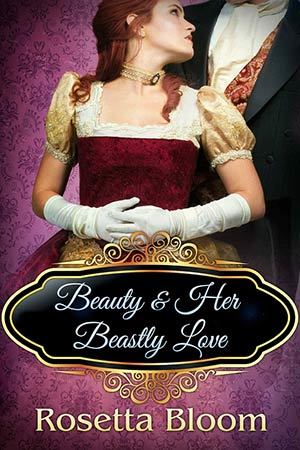
Beauty & Her Beastly Love
Tell us a bit about your book
In this grown-up Beauty and the Beast, we meet Beauty, a sheltered young girl living with her father. She doesn’t get out much, but her tutor has given her books to read privately. The books all have a rose imprinted on the cover and describe the ways in which men and women love each other. The books give Beauty ideas about pleasures of the flesh.
Beauty’s father, Pierre, sets off on a journey and ends up taking refuge in an enchanted dwelling. Pierre takes a rose-covered book, like the ones his daughter reads, and is caught by the beast who lives in the manor. Pierre agrees to send his daughter in exchange for the Beast not killing him.
When Beauty arrives, she feels disappointed that she will spend a lifetime imprisoned with this beast, rather than experiencing the type of relationship between a man and a woman described in her books. Only, as she gets to know Beast, she develops an attraction to him. Later, Beauty discovers that she and Beast can take pleasure in each other’s company in more ways than she’d ever imagined.
How important are character names to you in your books? Is there a special meaning to any of the names?
I think character names for the main character are very important. I think I work hard on those. Because many of my pieces are fairy tales, I try to go with names that evoke the spirit of the time. Some names are set in stone, based on the fairy tale retelling. Rapunzel has to be the name. But for other main characters, like the prince, I’ll pick strong names I like. Bradyn had a strong feel to it and meant Broad. In my Cinderella retelling, I went with Ashton, because I knew I wanted the title to be Cinders & Ash. For my short story Nikki & Mike, I went with Nikki, because it embodied a certain spirit and sassiness. I always think of Nikki Giovanni when I see that name, and she’s such a lively, deep and spirited person.
If you could choose ten words to describe your book, what would they be?
Happily ever after. Charming. Heart-warming. Sexy. Fun. Sweet. Simple.
Where do your ideas come from?
It depends on the ideas. I have an entire fairy tale series, which focuses on retellings of classic fairy tales. For those, I was obviously inspired by the originals and wanted to do something fun, but different. I wanted an adult version of the classic tale. I’ve written some contemporary short stories, and those were all inspired as ways to have a sexy encounter between two people who are connected in ways they don’t quite realize yet. I think those kinds of stories where two people connect in ways they hadn’t expected really intrigue me, so I like to write those.
What do you think of book trailers? Do you have a trailer or do you intend to create one for your own book?
I think book trailers are great. It’s wonderful when people use other forms of media, such as video and audio to bring attention to their books. I have a couple of book trailers that I created on YouTube. I’m not sure how effective they are in bringing in readers, so I don’t have them for all my books, as they do take time to create. The ones I’ve created, I think, may be a tad too long, so I’ll take that into consideration in the future. However, I do think, when they’re done well, they add a great dimension for marketing.
Here’s a link to one of mine. I have a couple of others, but I have revised the covers and haven’t had time to update the trailers:
Cinders & Ash: https://www.youtube.com/watch?v=ofVcKoHesNs
Have you always liked to write?
Ever since I was a child, I’ve loved to write, so it’s been natural to me. I love being able to do it in the romance genre. Stories that connect two people who form a strong bond make me really happy.
What writing advice do you have for aspiring authors?
Write and read. Write every day, and get as many words as you can down on paper, but also read. Read stuff that makes you happy, that keeps you turning pages. Do those two things, and you’ll do well as an author.
Do you read reviews of your book(s)? Do you respond to them, good or bad? How do you deal with the bad?
I do read reviews. I think every author looks at reviews at some point. I’m not JK Rowling, so I don’t have books with 10,000+ reviews, so when I get new ones, I try to take a peek at what was said. I don’t respond to reviews on buying sites (like Amazon or Barnes & Noble). People have an opinion and the fact that they decided to write the review says enough. Generally, if I see a blog post review, I’ll thank the reviewer for taking the time to read and review the book. I’m always really happy to see a person who enjoyed the book, and obviously disappointed when someone doesn’t enjoy the book. But not everyone enjoys every book.
What is your least favourite part of the writing / publishing process?
My least favorite part has to do with the publishing side. A lot of the publishing parts are just tedious. Formatting paperbacks and ebooks takes time and I’d rather just be writing or editing. Also, the marketing can feel like a time-suck from your writing, too. However, I do like engaging with fans. I have a newsletter, and sometimes people respond to articles I mention them in, and that’s always fun, to have that little bit of back and forth.
How long does it usually take you to write the first draft of a book?
First draft timelines can vary widely. I’ve done short first drafts in as quick as two weeks. I wrote the first draft of Beauty and her Beastly Love that quickly (and it’s a shorter book at 35,000 words). That story really just came to life. Other times a first draft could take a couple of months, especially if I have another project I’m working on simultaneously. Generally, if everything is working smoothly, I can have a first draft complete in a month. But rarely do things go perfectly smoothly in my life.
What are you working on now?
Right now, I’ve just finished a book for that was supposed to be for an anthology called the Diamond Club. Unfortunately, the anthology got canceled, and I’m going to have to revise it so I can publish it on my own. Each book in the anthology was supposed to have a diamond-related title. My book is Brilliant (as in the diamond cut, but also my main character). Once I finish revisions, I’m going to work on my next book in the fairy tale series, Red Rider. It’s going to be a Little Red Riding Hood tale, and it’s going to bring in some of the characters in the previous books. I like how my fairy tale universe has some overlap in it. After I finish that one, I’m going to focus a little bit on contemporary romance, with a modern love story. I don’t have a title for it yet, but I’m on the hunt for a cover, and I have a very clear idea of the characters.
What’s the strangest thing you have ever had to research for your book?
I just finished Brilliant, so I’ve been researching things related to diamonds and jewel heists and diamond processing. It’s not that strange, I guess, but different. And when a topic is on my mind, I tend to be on the lookout for any stray articles about the subject. I found this very cool article on diamonds. So, it’s fun when your research informs real life.
When you’re writing, do you listen to music or do you need silence?
I do not listen to music when I write. I find that a horrible thing to do, as I like music, and if I were listening to it, I’d be singing along. I don’t mind background noise that’s not music. I tend to tune out when I write. I could be sitting in a room full of people and write and it would be fine. A television show could even be on in the background and I’d tune it out. But music does bother me immensely while I write.
Where can readers go to discover more about you and your books?
Website | Facebook | Twitter | Pinterest | Amazon Author Page | Goodreads | YouTube
Beauty & Her Beastly Love is out now!
Available formats: ebook and paperback
The post An Interview with Author Rosetta Bloom appeared first on Melanie Tomlin.


An Interview With Author Rosetta Bloom
Today I’m interviewing author Rosetta Bloom, who loves a good fairy tale, some heart-warming and sometimes steamy romance, and combines these elements into stories that grown-ups can devour. Thank you, Rosetta, for taking the time to chat to me. Please sit down, get comfortable and let’s begin.
About Rosetta Bloom
Rosetta Bloom loves a good love story. She also likes a steamy tale with two characters who find solace in each other’s arms. So, she writes romance and erotic romances, and all of them end happily, because Rosetta hates sad endings. If you want a story that has a few surprises, and lots of heart, then she’s writing the story for you.
Rosetta Bloom’s primary novels and novellas are sexy retellings of classic fairy tales. They include The Princess, the Pea and the Night of Passion; Beauty and Her Beastly Love; Cinders and Ash: A Cinderella Story; Dream Trysts: A Sleeping Beauty Story; Finding Bliss: A Dream Trysts Story and Ravishing Rapunzel. Rosetta loves adding new life to these classic tales and hopes you enjoy the tweaked versions too. Rosetta also has a series of really short erotic love stories called the Romance: Trysts series. You can read the first one, Dr. Carter & Mrs. Sinn, FREE. There are four in the series, and if you like the first, you can grab the rest individually or pick up the boxed set, Romance: Trysts Volumes 1-4.
What’s the name of the book you’re here to talk about?
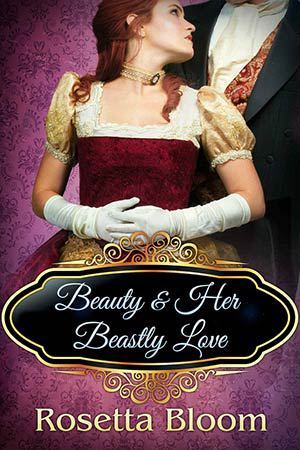
Beauty & Her Beastly Love
Tell us a bit about your book
In this grown-up Beauty and the Beast, we meet Beauty, a sheltered young girl living with her father. She doesn’t get out much, but her tutor has given her books to read privately. The books all have a rose imprinted on the cover and describe the ways in which men and women love each other. The books give Beauty ideas about pleasures of the flesh.
Beauty’s father, Pierre, sets off on a journey and ends up taking refuge in an enchanted dwelling. Pierre takes a rose-covered book, like the ones his daughter reads, and is caught by the beast who lives in the manor. Pierre agrees to send his daughter in exchange for the Beast not killing him.
When Beauty arrives, she feels disappointed that she will spend a lifetime imprisoned with this beast, rather than experiencing the type of relationship between a man and a woman described in her books. Only, as she gets to know Beast, she develops an attraction to him. Later, Beauty discovers that she and Beast can take pleasure in each other’s company in more ways than she’d ever imagined.
How important are character names to you in your books? Is there a special meaning to any of the names?
I think character names for the main character are very important. I think I work hard on those. Because many of my pieces are fairy tales, I try to go with names that evoke the spirit of the time. Some names are set in stone, based on the fairy tale retelling. Rapunzel has to be the name. But for other main characters, like the prince, I’ll pick strong names I like. Bradyn had a strong feel to it and meant Broad. In my Cinderella retelling, I went with Ashton, because I knew I wanted the title to be Cinders & Ash. For my short story Nikki & Mike, I went with Nikki, because it embodied a certain spirit and sassiness. I always think of Nikki Giovanni when I see that name, and she’s such a lively, deep and spirited person.
If you could choose ten words to describe your book, what would they be?
Happily ever after. Charming. Heart-warming. Sexy. Fun. Sweet. Simple.
Where do your ideas come from?
It depends on the ideas. I have an entire fairy tale series, which focuses on retellings of classic fairy tales. For those, I was obviously inspired by the originals and wanted to do something fun, but different. I wanted an adult version of the classic tale. I’ve written some contemporary short stories, and those were all inspired as ways to have a sexy encounter between two people who are connected in ways they don’t quite realize yet. I think those kinds of stories where two people connect in ways they hadn’t expected really intrigue me, so I like to write those.
What do you think of book trailers? Do you have a trailer or do you intend to create one for your own book?
I think book trailers are great. It’s wonderful when people use other forms of media, such as video and audio to bring attention to their books. I have a couple of book trailers that I created on YouTube. I’m not sure how effective they are in bringing in readers, so I don’t have them for all my books, as they do take time to create. The ones I’ve created, I think, may be a tad too long, so I’ll take that into consideration in the future. However, I do think, when they’re done well, they add a great dimension for marketing.
Here’s a link to one of mine. I have a couple of others, but I have revised the covers and haven’t had time to update the trailers:
Cinders & Ash: https://www.youtube.com/watch?v=ofVcKoHesNs
Have you always liked to write?
Ever since I was a child, I’ve loved to write, so it’s been natural to me. I love being able to do it in the romance genre. Stories that connect two people who form a strong bond make me really happy.
What writing advice do you have for aspiring authors?
Write and read. Write every day, and get as many words as you can down on paper, but also read. Read stuff that makes you happy, that keeps you turning pages. Do those two things, and you’ll do well as an author.
Do you read reviews of your book(s)? Do you respond to them, good or bad? How do you deal with the bad?
I do read reviews. I think every author looks at reviews at some point. I’m not JK Rowling, so I don’t have books with 10,000+ reviews, so when I get new ones, I try to take a peek at what was said. I don’t respond to reviews on buying sites (like Amazon or Barnes & Noble). People have an opinion and the fact that they decided to write the review says enough. Generally, if I see a blog post review, I’ll thank the reviewer for taking the time to read and review the book. I’m always really happy to see a person who enjoyed the book, and obviously disappointed when someone doesn’t enjoy the book. But not everyone enjoys every book.
What is your least favourite part of the writing / publishing process?
My least favorite part has to do with the publishing side. A lot of the publishing parts are just tedious. Formatting paperbacks and ebooks takes time and I’d rather just be writing or editing. Also, the marketing can feel like a time-suck from your writing, too. However, I do like engaging with fans. I have a newsletter, and sometimes people respond to articles I mention them in, and that’s always fun, to have that little bit of back and forth.
How long does it usually take you to write the first draft of a book?
First draft timelines can vary widely. I’ve done short first drafts in as quick as two weeks. I wrote the first draft of Beauty and her Beastly Love that quickly (and it’s a shorter book at 35,000 words). That story really just came to life. Other times a first draft could take a couple of months, especially if I have another project I’m working on simultaneously. Generally, if everything is working smoothly, I can have a first draft complete in a month. But rarely do things go perfectly smoothly in my life.
What are you working on now?
Right now, I’ve just finished a book for that was supposed to be for an anthology called the Diamond Club. Unfortunately, the anthology got canceled, and I’m going to have to revise it so I can publish it on my own. Each book in the anthology was supposed to have a diamond-related title. My book is Brilliant (as in the diamond cut, but also my main character). Once I finish revisions, I’m going to work on my next book in the fairy tale series, Red Rider. It’s going to be a Little Red Riding Hood tale, and it’s going to bring in some of the characters in the previous books. I like how my fairy tale universe has some overlap in it. After I finish that one, I’m going to focus a little bit on contemporary romance, with a modern love story. I don’t have a title for it yet, but I’m on the hunt for a cover, and I have a very clear idea of the characters.
What’s the strangest thing you have ever had to research for your book?
I just finished Brilliant, so I’ve been researching things related to diamonds and jewel heists and diamond processing. It’s not that strange, I guess, but different. And when a topic is on my mind, I tend to be on the lookout for any stray articles about the subject. I found this very cool article on diamonds. So, it’s fun when your research informs real life.
When you’re writing, do you listen to music or do you need silence?
I do not listen to music when I write. I find that a horrible thing to do, as I like music, and if I were listening to it, I’d be singing along. I don’t mind background noise that’s not music. I tend to tune out when I write. I could be sitting in a room full of people and write and it would be fine. A television show could even be on in the background and I’d tune it out. But music does bother me immensely while I write.
Where can readers go to discover more about you and your books?
Website | Facebook | Twitter | Pinterest | Amazon Author Page | Goodreads | YouTube
Beauty & Her Beastly Love is out now!
Available formats: ebook and paperback
The post An Interview With Author Rosetta Bloom appeared first on Melanie Tomlin.
March 5, 2017
An Interview with Author Dr. Sharon A. Mitchell
Joining me today is Dr. Sharon A. Mitchell, who seeks to entertain, as well as inform, with her stories on autism. A little research on my part and I found that a study by the Centers for Disease Control and Prevention (CDC, in the USA) identified 1 in 68 children as having autism spectrum disorder (ASD). Someone in your family may be autistic, or a family member of a friend. If not, chances are you’ll meet someone with autism at some point in your life. I’m sure we’ll learn even more during the interview. Thank you, Dr. Mitchell, for taking the time to chat to me. Please sit down, get comfortable and let’s begin.
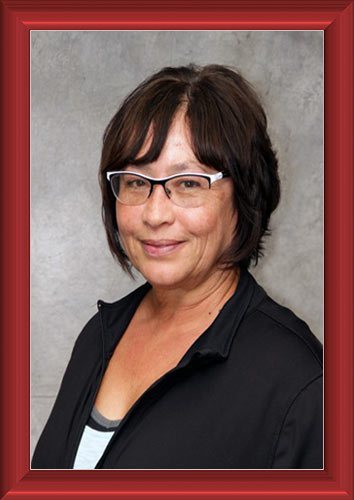
About Dr. Sharon A. Mitchell
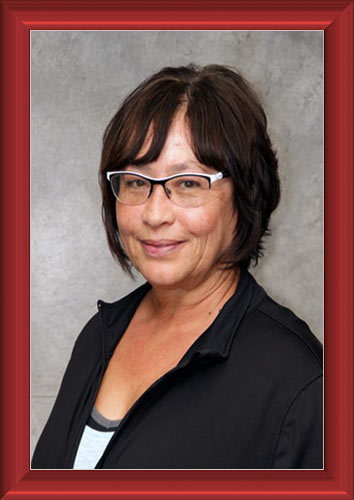
Dr. Sharon A. Mitchell has worked as teacher, counselor, psychologist and consultant for several decades. Her Masters and PhD. degrees focused on autism spectrum disorders and helping kids to reach as high a level of independence as possible.
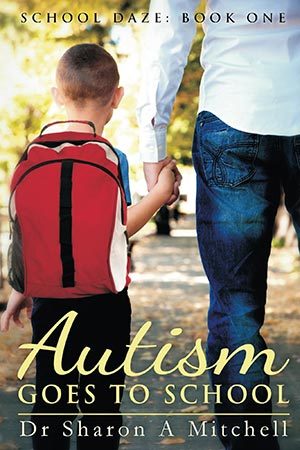
The first book in the series, “Autism Goes to School” is an award-winning Amazon bestseller. Yes, life with autism has its struggles, but there are strengths as well and the fun parts that any family experiences. The book is full of the challenges inherent in autism plus strategies that make life easier for all concerned. It’s a story about a single dad doing the best he can. One in sixty-eight American children has an autism spectrum disorder and one in every forty-two boys. Every teacher will have a child with autism in their classroom. Every coach will meet a child with autism. If autism has not touched your family, it will affect your friends or neighbors.
Autism Goes to School has been followed by these books; Autism Runs Away, Autism Belongs, Autism Talks and Talks, Autism Grows Up, and, coming in 2017 is The Autism Goes to School Workbook and the Prequel to Autism Goes to School. Join the kids and staff of Madson School as they learn and grow and welcome others with special needs into their midst.
When not writing, Sharon works as an autism consultant, teaches university classes and works on their grain farm in western Canada.
What’s the name of your new book?
Autism Goes to School – Book One of the School Daze Series
Tell us a bit about your book
After suddenly receiving custody of his five year old son, Ben must learn how to be a dad. The fact that he’d even fathered a child was news to him. Not only does this mean restructuring his sixty-hour workweek and becoming responsible for another human being, but also Kyle has autism.
Enter the school system and a shaky beginning. Under the guidance of a gifted teacher, Ben and Kyle take tentative steps to becoming father and son.
Teacher Melanie Nicols sees Ben as a deadbeat dad, but grudgingly comes to admire how he hangs in, determined to learn for his son’s sake. Her admiration grows to more as father and son come to rely on Melanie being a part of their lives.
Give us an insight into your main character. What makes them unique?
Each of my books features a child or young adult who has a form of autism. Although an autism spectrum disorder is the commonality, the type of degree of autism symptoms varies and how these features interact with the character’s personality make him unique. There’s a saying – “If you’ve met one child with autism, you’ve met one child with autism.”
Where do your ideas come from?
Ideas spring from my imagination. I love the question, “What if…?” The delightful thing about writing fiction is that you can let you mind soar; that’s how a book begins but then the characters take over and drive what happens next.
What do you consider to be your best accomplishment?
This is a tough question. I think it would be raising two sons to be independent, responsible, nice young men who are not afraid to tackle challenges. Although one has an autism spectrum disorder, between them they have five university degrees. We’re proud of our kids.
I’m also proud to say that I love my job(s). I work as an autism consultant for a health region, teach university classes, write and farm.
Where do you see yourself in 10 years?
Hmm. Writing, of course and farming. Likely, I will cut back on the consulting work but still teach at university part-time.
Have you always liked to write?
As a school district consultant, I offered to assist a group of high school teachers who were introducing NaNoWriMo to their students. That sounded like fun, but as I listened to the kids setting their goals and taking their huge step, how could I not put myself out there as well? Drats. This was more than I’d signed on for.
I’d heard about NaNo for years, but it all seemed too daunting. Write a novel in a month? Who are you kidding? With full-time jobs, a family, elder-care, plus teaching university classes, and doing volunteer work, who has time to write?
I came across a little ebook that changed my mind. Lazette Gifford has written a wonderful little book that makes NaNo seem within reach for even those who are scared to try. NaNo for the New and Insane (http://lazette.net/free%20stuff/nano.htm)
Unwillingly, and scared stiff, I entered NaNo and then had the time of my life. Although I’d written several dozen pieces for magazines, published hundreds of pieces at AllExperts.com and done academic writing, this was my first attempt at fiction. NaNo was freeing. To write that many words in four short weeks, I had to turn off my inner editor and just let go. It worked! The words just flew out of my fingers, easily surpassing the 50,000 word goal. But, then NaNo was over and the editing process began.
So, Autism Goes to School was born – a light read aimed at a general audience. It was fun for me to write and I hope fun for you to read. Yes, life with autism has it’s struggles, but there are strengths as well and the fun parts that any family experiences. The book is full of the challenges inherent in autism plus strategies that make life easier for all concerned. It’s a story about a single dad doing the best he can.
I’ve been a teacher, counselor and consult in school systems. I’ve been autism consultant for my province in Canada. I know what autism is like from a professional point of view and also a personal one – we have a son with an autism spectrum disorder, although he’s older now and away at university.
Autism now affects one in every 42 boys in the United States. As hard as it is to watch the child struggle, autism’s effects are also felt by his family, teachers and classmates. Every teacher will have a child with autism in her room. Every coach will have a child with autism on his team. Many families will experience autism in their home or neighborhood.
When parents first learn of their child’s diagnosis, they scour books and the internet, searching for information on how to help their son or daughter. There is a lot of information out there, much of it by competent authorities. But after a hard day of work and family responsibilities, who wants to read a textbook? I have my doctoral degree in autism, have taught at university on this topic, and keep up with the research in the field. But even I get tired of reading weighty books.
Writers are admonished to show, don’t tell. Kids with autism learn best when shown rather than “talked at”. Why not write a book that shows how a family and a school help a little boy with autism? Does a book have to be hard slugging to learn new things? Does learning have to be tedious? What if you could just read a good story and still gain ideas to try?
NaNo freed me to write the book. Is it a feel good story? Well, sort of. In the end, the autism does not all go away. Instead, they struggle and grow and learn, plus, they do live happily ever after.
What writing advice do you have for aspiring authors?
Just do it. I love NaNoWriMo (National Novel Writing Month). Each November hundreds of thousands of people around the world commit to writing a 50,000 word novel in those thirty days. To accomplish that much output, it is necessary to ignore that inner editor, the one who will tell you that you’re not good enough, your words suck and other such nonsense. Just box up that demon and let the words fly.
First drafts are not good for most of us, but that’s when the editing process takes over. Just getting those initial words onto the screen makes it much easier for me to then go back and edit.
If you didn’t like writing books, or weren’t any good at it, what would you like to do for a living?
Admittedly, I have attention problems. I need to be busy and I need to do a variety of things. Yes, I love writing, but I mix that up with other loves. I work half-time as an autism consultant. I take on other consulting contracts. I give presentations. I teach university classes. I work on our grain farm and it’s all fun.
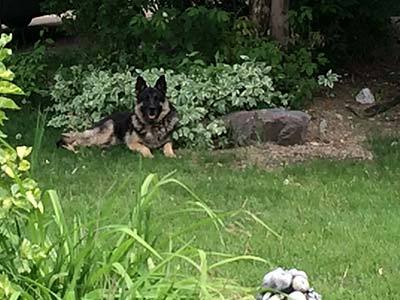
One of Dr. Sharon A. Mitchell’s favourite photos
Do you read reviews of your book(s)? Do you respond to them, good or bad? How do you deal with the bad?
I definitely read each one and I try to thank each reviewer for taking the time to make a comment or offer a review of one of my books. I appreciate when they make the effort. The feedback from reviewers is invaluable and I use that to shape the next books.
The first book has sixty-nine reviews. While almost all have four or five star ratings, there is one two star. That one sticks in my mind. One reviewer left a four star rating, complaining that the book was not long enough; that gave me pause and I still mull over that one. I worked hard to cut and pare the books in this series until they are between 50,000 and 80,000 words. The feedback I receive from parents, teachers and counselors is that they are busy and want a short, entertaining, informative read. Most people say they can read one of these novels in one or two evenings, which is what I aimed for.
What is your best marketing tip?
The sales of all my other books increased when I made the first book in the series permafree.
What are you working on now?
I have two books underway right now, both suggested by reviewers – a Prequel to Autism Goes to School and an Autism Goes to School Workbook.
Prequel to Autism Goes to School (coming in 2017)
What were the teen years like for Jeff? What led Mel down the career path she has taken? Find out their early stories in the Prequel to Autism Goes to School.
The Autism Goes to School Workbook
Readers who followed Ben and Kyle’s journey in Autism Goes to School have said that they would like a guide to help them follow the strategies that Ben and Kyle try. Of course, not every strategy works for everyone. Remember that once you’ve met a child with autism, you have met one child with autism. While we’re all unique, there is often a core cluster of characteristics that kids on the spectrum share.
The workbook looks at the things Ben did right and the mistakes he made, despite his good intentions. It looks at Kyle’s responses, and then guides you to consider how your child with autism might respond.
There is space to profile your son, daughter or student’s strengths and the areas that pose the most challenge right now.
The guide will help you look at the sensory issues that might contribute to the difficulties and ways to help. It discusses the communicative aspect of behavior and how you can help the child better express his wants and needs in appropriate ways. A self-regulated child is a calmer, happier child.
There are examples of visuals and schedules and space to create your own. And, there is an extensive list of references that will help you guide your child to be as independent as he can be.
How has your environment or upbringing impacted your writing?
How could anyone’s upbringing and environment not colour their world and their writing?
My upbringing is likely not typical. When I was a young child, my father was a drug addict. When in my teens, he died of alcoholism and all its accompanying complications. Money, or lack thereof, was a serious issue and food was frequently scarce.
I think that resilience is a theme that runs throughout all my books. Yes, things are tough but there are always things you can do to help and the bad times don’t need to last forever.
Why should a potential reader buy your book(s)?
Initially I assumed that my audience would be parents of kids who have autism and teachers of these children. I have been surprised at the number of people who have no ties to autism who see the book as a good story that they enjoyed. They talk about the family struggles and learning about how someone with autism might view their world.
What’s something you’re really good at that few people know about?
I’m a pilot and survived a situation that few come out of intact.
Are your characters based on real people, are they imaginary or a combination of both?
My characters are figments of my imagination but may share some characteristics of people I’ve met or even people I’ve seen on the street.
Where can readers go to discover more about you and your books?
Website | Facebook | Twitter | Pinterest | Amazon Author Page | Smashwords | Goodreads
Autism Goes to School – Book One of the School Daze Series is out now!
Available formats: ebook and paperback
The post An Interview with Author Dr. Sharon A. Mitchell appeared first on Melanie Tomlin.
An Interview With Author Dr. Sharon A. Mitchell
Joining me today is Dr. Sharon A. Mitchell, who seeks to entertain, as well as inform, with her stories on autism. A little research on my part and I found that a study by the Centers for Disease Control and Prevention (CDC, in the USA) identified 1 in 68 children as having autism spectrum disorder (ASD). Someone in your family may be autistic, or a family member of a friend. If not, chances are you’ll meet someone with autism at some point in your life. I’m sure we’ll learn even more during the interview. Thank you, Dr. Mitchell, for taking the time to chat to me. Please sit down, get comfortable and let’s begin.
About Dr. Sharon A. Mitchell
Dr. Sharon A. Mitchell has worked as teacher, counselor, psychologist and consultant for several decades. Her Masters and PhD. degrees focused on autism spectrum disorders and helping kids to reach as high a level of independence as possible.
The first book in the series, “Autism Goes to School” is an award-winning Amazon bestseller. Yes, life with autism has its struggles, but there are strengths as well and the fun parts that any family experiences. The book is full of the challenges inherent in autism plus strategies that make life easier for all concerned. It’s a story about a single dad doing the best he can. One in sixty-eight American children has an autism spectrum disorder and one in every forty-two boys. Every teacher will have a child with autism in their classroom. Every coach will meet a child with autism. If autism has not touched your family, it will affect your friends or neighbors.
Autism Goes to School has been followed by these books; Autism Runs Away, Autism Belongs, Autism Talks and Talks, Autism Grows Up, and, coming in 2017 is The Autism Goes to School Workbook and the Prequel to Autism Goes to School. Join the kids and staff of Madson School as they learn and grow and welcome others with special needs into their midst.
When not writing, Sharon works as an autism consultant, teaches university classes and works on their grain farm in western Canada.
What’s the name of your new book?
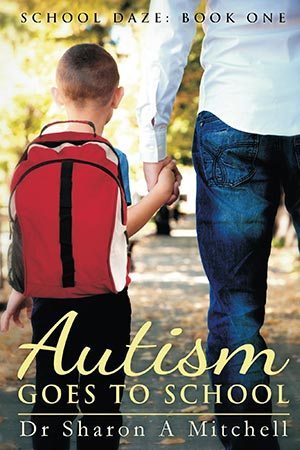
Autism Goes to School – Book One of the School Daze Series
Tell us a bit about your book
After suddenly receiving custody of his five year old son, Ben must learn how to be a dad. The fact that he’d even fathered a child was news to him. Not only does this mean restructuring his sixty-hour workweek and becoming responsible for another human being, but also Kyle has autism.
Enter the school system and a shaky beginning. Under the guidance of a gifted teacher, Ben and Kyle take tentative steps to becoming father and son.
Teacher Melanie Nicols sees Ben as a deadbeat dad, but grudgingly comes to admire how he hangs in, determined to learn for his son’s sake. Her admiration grows to more as father and son come to rely on Melanie being a part of their lives.
Give us an insight into your main character. What makes them unique?
Each of my books features a child or young adult who has a form of autism. Although an autism spectrum disorder is the commonality, the type of degree of autism symptoms varies and how these features interact with the character’s personality make him unique. There’s a saying – “If you’ve met one child with autism, you’ve met one child with autism.”
Where do your ideas come from?
Ideas spring from my imagination. I love the question, “What if…?” The delightful thing about writing fiction is that you can let you mind soar; that’s how a book begins but then the characters take over and drive what happens next.
What do you consider to be your best accomplishment?
This is a tough question. I think it would be raising two sons to be independent, responsible, nice young men who are not afraid to tackle challenges. Although one has an autism spectrum disorder, between them they have five university degrees. We’re proud of our kids.
I’m also proud to say that I love my job(s). I work as an autism consultant for a health region, teach university classes, write and farm.
Where do you see yourself in 10 years?
Hmm. Writing, of course and farming. Likely, I will cut back on the consulting work but still teach at university part-time.
Have you always liked to write?
As a school district consultant, I offered to assist a group of high school teachers who were introducing NaNoWriMo to their students. That sounded like fun, but as I listened to the kids setting their goals and taking their huge step, how could I not put myself out there as well? Drats. This was more than I’d signed on for.
I’d heard about NaNo for years, but it all seemed too daunting. Write a novel in a month? Who are you kidding? With full-time jobs, a family, elder-care, plus teaching university classes, and doing volunteer work, who has time to write?
I came across a little ebook that changed my mind. Lazette Gifford has written a wonderful little book that makes NaNo seem within reach for even those who are scared to try. NaNo for the New and Insane (http://lazette.net/free%20stuff/nano.htm)
Unwillingly, and scared stiff, I entered NaNo and then had the time of my life. Although I’d written several dozen pieces for magazines, published hundreds of pieces at AllExperts.com and done academic writing, this was my first attempt at fiction. NaNo was freeing. To write that many words in four short weeks, I had to turn off my inner editor and just let go. It worked! The words just flew out of my fingers, easily surpassing the 50,000 word goal. But, then NaNo was over and the editing process began.
So, Autism Goes to School was born – a light read aimed at a general audience. It was fun for me to write and I hope fun for you to read. Yes, life with autism has it’s struggles, but there are strengths as well and the fun parts that any family experiences. The book is full of the challenges inherent in autism plus strategies that make life easier for all concerned. It’s a story about a single dad doing the best he can.
I’ve been a teacher, counselor and consult in school systems. I’ve been autism consultant for my province in Canada. I know what autism is like from a professional point of view and also a personal one – we have a son with an autism spectrum disorder, although he’s older now and away at university.
Autism now affects one in every 42 boys in the United States. As hard as it is to watch the child struggle, autism’s effects are also felt by his family, teachers and classmates. Every teacher will have a child with autism in her room. Every coach will have a child with autism on his team. Many families will experience autism in their home or neighborhood.
When parents first learn of their child’s diagnosis, they scour books and the internet, searching for information on how to help their son or daughter. There is a lot of information out there, much of it by competent authorities. But after a hard day of work and family responsibilities, who wants to read a textbook? I have my doctoral degree in autism, have taught at university on this topic, and keep up with the research in the field. But even I get tired of reading weighty books.
Writers are admonished to show, don’t tell. Kids with autism learn best when shown rather than “talked at”. Why not write a book that shows how a family and a school help a little boy with autism? Does a book have to be hard slugging to learn new things? Does learning have to be tedious? What if you could just read a good story and still gain ideas to try?
NaNo freed me to write the book. Is it a feel good story? Well, sort of. In the end, the autism does not all go away. Instead, they struggle and grow and learn, plus, they do live happily ever after.
What writing advice do you have for aspiring authors?
Just do it. I love NaNoWriMo (National Novel Writing Month). Each November hundreds of thousands of people around the world commit to writing a 50,000 word novel in those thirty days. To accomplish that much output, it is necessary to ignore that inner editor, the one who will tell you that you’re not good enough, your words suck and other such nonsense. Just box up that demon and let the words fly.
First drafts are not good for most of us, but that’s when the editing process takes over. Just getting those initial words onto the screen makes it much easier for me to then go back and edit.
If you didn’t like writing books, or weren’t any good at it, what would you like to do for a living?
Admittedly, I have attention problems. I need to be busy and I need to do a variety of things. Yes, I love writing, but I mix that up with other loves. I work half-time as an autism consultant. I take on other consulting contracts. I give presentations. I teach university classes. I work on our grain farm and it’s all fun.
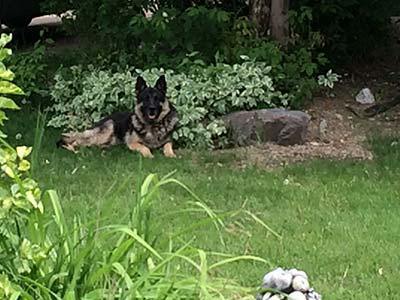
One of Dr. Sharon A. Mitchell’s favourite photos
Do you read reviews of your book(s)? Do you respond to them, good or bad? How do you deal with the bad?
I definitely read each one and I try to thank each reviewer for taking the time to make a comment or offer a review of one of my books. I appreciate when they make the effort. The feedback from reviewers is invaluable and I use that to shape the next books.
The first book has sixty-nine reviews. While almost all have four or five star ratings, there is one two star. That one sticks in my mind. One reviewer left a four star rating, complaining that the book was not long enough; that gave me pause and I still mull over that one. I worked hard to cut and pare the books in this series until they are between 50,000 and 80,000 words. The feedback I receive from parents, teachers and counselors is that they are busy and want a short, entertaining, informative read. Most people say they can read one of these novels in one or two evenings, which is what I aimed for.
What is your best marketing tip?
The sales of all my other books increased when I made the first book in the series permafree.
What are you working on now?
I have two books underway right now, both suggested by reviewers – a Prequel to Autism Goes to School and an Autism Goes to School Workbook.
Prequel to Autism Goes to School (coming in 2017)
What were the teen years like for Jeff? What led Mel down the career path she has taken? Find out their early stories in the Prequel to Autism Goes to School.
The Autism Goes to School Workbook
Readers who followed Ben and Kyle’s journey in Autism Goes to School have said that they would like a guide to help them follow the strategies that Ben and Kyle try. Of course, not every strategy works for everyone. Remember that once you’ve met a child with autism, you have met one child with autism. While we’re all unique, there is often a core cluster of characteristics that kids on the spectrum share.
The workbook looks at the things Ben did right and the mistakes he made, despite his good intentions. It looks at Kyle’s responses, and then guides you to consider how your child with autism might respond.
There is space to profile your son, daughter or student’s strengths and the areas that pose the most challenge right now.
The guide will help you look at the sensory issues that might contribute to the difficulties and ways to help. It discusses the communicative aspect of behavior and how you can help the child better express his wants and needs in appropriate ways. A self-regulated child is a calmer, happier child.
There are examples of visuals and schedules and space to create your own. And, there is an extensive list of references that will help you guide your child to be as independent as he can be.
How has your environment or upbringing impacted your writing?
How could anyone’s upbringing and environment not colour their world and their writing?
My upbringing is likely not typical. When I was a young child, my father was a drug addict. When in my teens, he died of alcoholism and all its accompanying complications. Money, or lack thereof, was a serious issue and food was frequently scarce.
I think that resilience is a theme that runs throughout all my books. Yes, things are tough but there are always things you can do to help and the bad times don’t need to last forever.
Why should a potential reader buy your book(s)?
Initially I assumed that my audience would be parents of kids who have autism and teachers of these children. I have been surprised at the number of people who have no ties to autism who see the book as a good story that they enjoyed. They talk about the family struggles and learning about how someone with autism might view their world.
What’s something you’re really good at that few people know about?
I’m a pilot and survived a situation that few come out of intact.
Are your characters based on real people, are they imaginary or a combination of both?
My characters are figments of my imagination but may share some characteristics of people I’ve met or even people I’ve seen on the street.
Where can readers go to discover more about you and your books?
Website | Facebook | Twitter | Pinterest | Amazon Author Page | Smashwords | Goodreads
Autism Goes to School – Book One of the School Daze Series is out now!
Available formats: ebook and paperback
The post An Interview With Author Dr. Sharon A. Mitchell appeared first on Melanie Tomlin.
February 25, 2017
Angel’s Body Competition — did you think I’d forget?
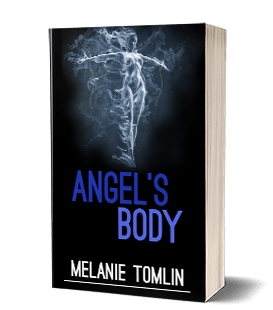
Competition? What Competition?
This was a competition only my angel followers (subscribers of one of my newsletters) knew about. It was for my loyal supporters, who were automatically entered into draw. The competition celebrated the release of the fourth book in the Angel Series — Angel’s Body — on February 14. My warped sense of humour was in overdrive when I chose that date. A book about demonic possession was hardly going to be lovey-dovey.angel’s body competition
From now on, I won’t be posting the details of any competition that is only for my angel followers. Instead, they’ll be notified via email that a competition is running. Other competitions, like last year’s , will be advertised, as anyone can enter.angel’s body competition
Competition Winners
As with my other competitions, the details for all entrants were entered into a random list picker, courtesy of Random-ize. After each winner was randomly chosen, they were removed from the list to ensure they couldn’t be randomly selected again. So, who won?

Congratulations to the following winners!
Annelize, 1st prize — Amazon gift card ($20 USD)
Emma, 2nd prize — Amazon gift card ($10 USD)
Luke, 3rd prize — Amazon gift card ($10 USD)
All winners have been notified by email.angel’s body competition
When’s the next competition?
The next one depends on when the fifth book in the Angel Series — Angel’s Demon — is finished and ready to be published. I hope that will be later in the year, but don’t hold me to it!angel’s body competition
The post Angel’s Body Competition — did you think I’d forget? appeared first on Melanie Tomlin.
February 19, 2017
1K Book Challenge Final Results
[image error]
1K Book Challenge: The final results are in for everyone to have a squiz at
What a hectic 12 months this has been. The last quarter of 2016 saw me full of nail-chewing nerves (though I didn’t actually chew my nails — I comfort ate instead). It was going to be reasonably close, with a final surge in sales.final results
For those of you who have no idea what I’m talking about, the 1K Book Challenge involved me declaring that I would get a tattoo if any one of my books reached 1000 sales between April and the end of December last year.final results
Paperback sales were slow online, but performed really well at the various pop culture conventions I attended in Melbourne (Australia) — Supanova, Oz Comic-Con and AMC Expo. I’d love to attend some of the interstate conventions but sadly I’m not making enough money yet to justify it. Perhaps next year …
Ebooks sales were good, probably because they’re cheaper than a paperback and easier to lug around. I still like having the paperback option though.final results
As an independent author, spreading the word about your books, and getting them in front of the right audience, is a challenge. Multi-author promotions that only cost a tweet, post and plug in a newsletter were a good option. Paid advertising was hit and miss. I’ve crossed a few companies off my ever-shrinking list. Bookbub continues to elude me. It doesn’t seem to matter what I submit, I get rejected, though I’ve heard the same thing from lots of other authors as well, so I can take heart from not being alone in not having achieved the holy grail in book advertising … yet.final results
What else have I been doing?
Building my email list. InstaFreebie is a great way to connect with people who like to read the sort of things I write. As the names suggests, a freebie is given, for which the person downloading the book agrees to be added to your mailing list. Many of you reading this are my instaFreebie Angel Followers (that’s what I call my subscribers) and you’ve proven to be just as faithful and supportive as my organic subscribers. One of my books is going to be featured by instaFreebie on February 22, so hopefully that will gain me a few more Angel Followers.
I now have three ARC (Advanced Reader Copy) teams, to read and reviews copies of my books as they come out. These wonderful people have offered to devote some of their precious time to do this, and I am grateful for their support.final results
I also started The Prolific Reader (an instaFreebie repository) in December. It started out with only a few select genres. Around 70 authors participated and close to 80 books were on offer. I quickly learned that everyone (readers and authors) wanted more, so expanded it to all genres except erotica. It quickly grew to nearly 300 authors and 400 books.final results
So, here are the final results:
Book
1Angel’s Kiss
Angel’s Curse
2Angel’s Messiah
3The Sands of Time
4Twisted Poems of a Warped Mind
5Lucy Vampoosy The Little Vampire Dog
Number Sold
763
198
172
13
19
18
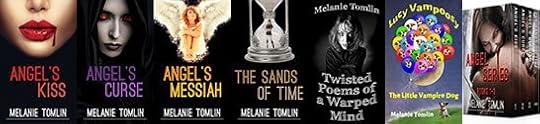
1 includes sales of the Angel Series Books 1-3 Boxed Set that was released on 4 November 2016, 2 released on 10 June 2016, 3 released on 10 September 2016, 4 released on 7 October 2016, 5 released on 20 November 2016.final results
Of course, Lucy was hoping that her book would be the clear winner, and sell over one thousand copies in just over a month. The only reason for her wishful thinking is that I promised I would buy her dog treats from the proceeds of her book sales. Naturally she’s not happy. She also thinks she’s wasting away to nothing (fat chance, Lucy) because of a lack of treats.final results
I’m not upset that my skin will remain free of tattoos, but it would have been nice to say that in those nine months I did manage to sell a thousand copies of Angel’s Kiss, or one of my other books. Oh well, that’s life. There are still plenty of readers out there who haven’t discovered my books … I just need to connect with them!
The post 1K Book Challenge Final Results appeared first on Melanie Tomlin.
February 5, 2017
An Interview with Author Ulff Lehmann
Joining me today is author, Ulff Lehmann, who has a lot to say about writing, and his epic fantasy ‘Shattered’ books in general. Thank you, Ulff, for taking the time to chat to me. Please sit down, get comfortable and let’s begin.
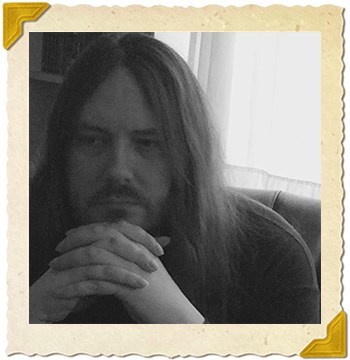 About Ulff Lehmann
German born but English writing author, Ulff Lehmann, was raised reading almost any and everything, from the classic Greek to Roman to Germanic myths to more appropriate fiction for children his age. Initially devouring books in his native language, he switched to reading English books during a year long stay in the USA as a foreign exchange student.
In the years since, he has lost count of the books he has read, unwilling to dig into the depths of his collection. An avid fantasy reader, he grew dissatisfied with the constant lack of technological evolution in many a fantasy world, and finally, when push came to shove, he began to realize not only his potential as a story teller but also his vision of a mythical yet realistic world in which to settle the tale in he had been developing for 20 years.
What’s the name of the book you’re here to talk about?
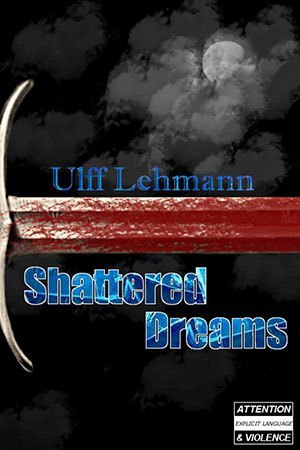
Shattered Dreams
Tell us a bit about your book
For two years the mercenary Drangar Ralgon has kept his back to his dark past. Afraid to live, afraid to die, Drangar tries to ignore the abyss that lies behind him. Now, faced with a war he wants nothing to do with, he finally turns around and gazes back.
Inspired by the vigorous style of George R.R. Martin’s A SONG OF ICE AND FIRE, and in the vein of historical fictioneer Bernard Cornwell, SHATTERED DREAMS brings to life a stark, uncompromising tale of a man’s path to redemption.
How important are character names to you in your books? Is there a special meaning to any of the names?
Important only in the way that human names should ring if not downright be Gaelic/Welsh/Breton. Other than a character who I incidentally named after a Gaelic deity, no. They might have meaning to the folks living in my world, but I have no clue about that. I just tell stories from there.
Give us an insight into your main character. What makes them unique?
Drangar is a tortured soul. The only thing he sees about himself is the pain he caused and the pain he is feeling. He has no aspirations to becoming a hero, he doesn’t care about the world or himself, yet he has a strong sense of justice which he cannot escape either. In many ways he is utterly broken.
But those looking at him see someone who is fair, with an impeccable sense of what’s right and wrong, who suffers no deception, other than deceiving himself into thinking he is worthless.
Where do your ideas come from?
I got a nightstand, they jump out of there at night. 
January 29, 2017
An Interview with Author Alasdair Shaw
Joining me today is author Alasdair Shaw, who would be just as comfortable talking to Stephen Hawking or Sheldon Cooper about Theoretical Physics as he is about talking to me as an author. Thank you, Alasdair, for taking the time to chat to me. Please sit down, get comfortable and let’s begin.
About Alasdair Shaw
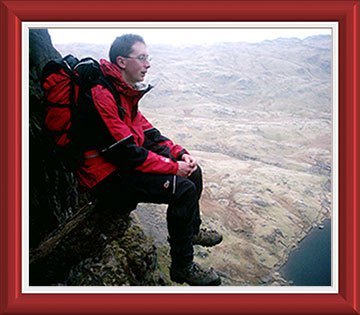
Alasdair Shaw grew up in Lancashire, within easy reach of the Yorkshire Dales, Pennines, Lake District and Snowdonia. After stints living in Cambridge, North Wales, and the Cotswolds, he has lived in Somerset since 2002.
He has been rock climbing, mountaineering, caving, kayaking and skiing as long as he can remember. Growing up he spent most of his spare time in the hills. Recently he has been doing more sea kayaking and swimming.
Alasdair studied at the University of Cambridge, leaving in 2000 with an MA in Natural Sciences and an MSci in Experimental and Theoretical Physics. He went on to earn a PGCE, specialising in Science and Physics, from the University of Bangor. A secondary teacher for over fifteen years, he has plenty of experience communicating scientific ideas.
What’s the name of the book you’d like to talk about?
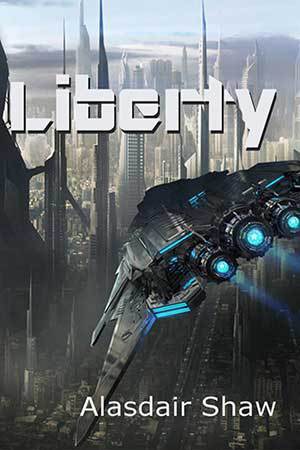
Liberty
Tell us a bit about your book
Struggling with newfound sentience and desperately trying to repair itself, The Indescribable Joy of Destruction is a ship trying to find a new home. In a galaxy torn apart by generations of civil war, that isn’t an easy task. Tired of being used as a killing machine, it has a huge decision to make: hide and save itself, or help other artificial intelligences achieve freedom. Unable to make the decision alone, it revives the sole human aboard – the enemy officer who crippled it.
Commander Olivia Johnson wakes to find herself in the infirmary of a strange vessel. Her nightmares deepen when she discovers it is the ship that attacked her destroyer. Even as she recovers from her physical injuries, she can’t get past her survivor’s guilt. She might have failed to protect her crew, but she vows to take revenge on their killer.
When the ship uncovers a genocidal plot by the commander’s own admirals, Johnson realises just what is at stake. Together, the AI ship and the human officer must recruit outsiders from both sides. Training the misfits in battle to prevent the atrocity may be an impossible task, but running and hiding is no longer an option.
If there was a film or TV adaptation of your book, who would you like to see play your characters?
Indie is easy. From the moment he dressed himself up in a Napoleonic captain’s uniform, I saw Aidan Turner (of Being Human, Poldark, and The Hobbit fame) playing him.
Do you read reviews of your book(s)? Do you respond to them, good or bad? How do you deal with the bad?
I do read them, but don’t respond. The good ones make me feel like it’s all worth it. To be honest, I haven’t had many bad ones yet. When I do get one, I see if there is something to it; one caught a typo that was really significant – 1919 instead of 1909. If there is something I can improve in the next book, I will. If it is just a one-off opinion, I’ll move on and not dwell on it.
How long does it usually take you to write the first draft of a book?
It took me a year and a half to write the first draft of Liberty. I have a full-time job, a young family, and I edit as I go along, so I rarely manage more than 1200 words in a day. I also put aside days to go back and read/edit previous chapters to keep them fresh in my mind. When I am happy with a chapter, I put it on Scribophile for critique. Making changes based on the feedback from that also takes time away from writing new stuff.
However, I don’t regret the way I do it. Whilst the first draft took eighteen months, it only took a couple of months to do the two major redrafts.
What are you working on now?
I’m currently working on Equality, the next book in the Two Democracies: Revolution series. Johnson has to lead Legion Libertus to retake their ‘home’ moon, Robespierre, and strengthen their ties with Concorde. Meanwhile, she continues the political wrangling in an attempt to have Robespierre recognised as an equal partner in the alliance, whilst Indie campaigns for equal rights for AIs.
Describe what your ideal writing space looks like.
My ideal place to write is outdoors. In summer, I spend as much writing time as possible on my laptop in the garden. I have been known to set up on a beach or up a mountain with my Surface.
If I can’t work outside, because of rain, or too much sun reflecting off the screen, I prefer to sit somewhere with a good view. My study looks out the front, along a flower bed. When I can, I sit in the conservatory, surrounded by my flower beds.
Why should a potential reader buy your book(s)?
I’ll leave that up to one of my reviewers:
“this novel takes the reader down unusual paths with well thought out twists and turns that took me places I never saw coming. If you like your space opera simple-good guys wipe the bad guys, kiss their horse and go home you may be in the wrong place. If you want well crafted story telling that sticks with you, you may be in luck. Some of the best written, original scifi I have come across in a long time.”
What’s an interesting fact about your book?
Only two copies of the original version were printed. It turned out to be the wrong size, so if I ever become famous, they could become collectors’ pieces. One was the proof copy I ordered, which I will sign and donate to a charity at some point. I have no idea who bought the other.
Why did you choose to write in your genre? If you write in more than one, how do you balance them?
I write science fiction, popular science, physics textbooks, and walking guides. I chose those genres because they were things I enjoyed, either reading about or doing. I balance them by writing what I feel like at any particular moment. It is a great way to avoid writers’ block – if I can’t see where to go next on something, I don’t waste time sitting staring at the screen, I change genre and get on with something else.
Do you have a day job in addition to being a writer? If so, what do you do during the day?
My main job is a secondary school teacher. I teach physics and computer science to 10-18 year olds. I am also an outdoor activities instructor, specialising in caving, rock climbing, and mountaineering. As a lead examiner for physics A-levels, June is probably my most hectic month.
Who are your favourite authors, and why?
My favourite authors include Isaac Asimov, Iain M Banks, Simon Scarrow, C S Forrester, Julian Stockwin, Bernard Cornwell, Jasper Fforde, and Terry Pratchett. They write dashing plots with interesting characters and a measure of wicked humour.
Where can readers go to discover more about you and your books?
Website | Blog | Facebook | Twitter | Amazon Author Page | Goodreads
Liberty is out now!
Available formats: ebook and paperback
The post An Interview with Author Alasdair Shaw appeared first on Melanie Tomlin.
January 22, 2017
An Interview with Author E. V. Darcy
Joining me today is author E. V. Darcy, with a cross stitch in one hand and a book in the other. Thank you, Evie, for taking the time to chat to me. Please sit down, get comfortable and let’s begin.
 About E. V. Darcy
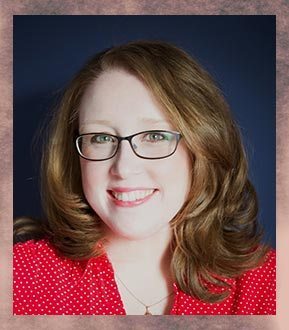
E. V. Darcy is a high school teacher with a Bachelor of Arts in Imaginative Writing from Liverpool John Moores University.
She lives in the north of England with her husband and rather large — and very spoilt — dog, Jabba, who she rescued in 2015.
When Evie isn’t writing you can find her binge watching her favourite T.V. shows, playing computer games, or walking her much loved dog.
What’s the name of the book you’re here to talk about?
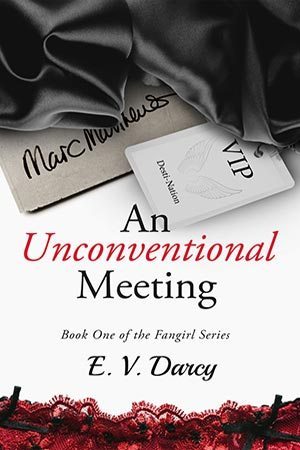
An Unconventional Meeting
Tell us a bit about your book
Marc Matthews, intensely private star of the hit TV show Destiny, hates his fans. He can think of nothing worse than having to speak to, sign autographs for, or have his picture taken with them. So the day he finds out he’s contractually obligated to attend the biggest TV convention of the year, Desti-nation, is not a good one for him. Left without childcare for his four-year-old, Tyler, he has to take his deaf son with him to the biggest fan event in Las Vegas.
Ellie Roscoe, deaf interpreter and fangirl, has reached her fandom limit. After this convention she is done with TV shows, its stars, and the fan scene in general! No more binge watching, no more fan fiction, no more gif sets, it’s time to move on. But after the convention… After she’s met her favourite stars one last time, and finally claims the elusive Marc Matthew’s signature to complete her poster.
When Tyler runs off, it’s Ellie that rescues him, but will Marc be prepared to listen to a fangirl?
Meet the stars of the hit TV show Destiny in An Unconventional Meeting, the first of the Fangirl books; a series of books dedicated to women over thirty who love TV shows!
If there was a film or TV adaptation of your book, who would you like to see play your characters?
The fangirl in me had people in mind from the word go for the leading men of the series! I’d love Misha Collins (Supernatural) to play Marc Matthews, and Ewan McGregor (Moulin Rouge / Emma / Star Wars) to take on the mantle of Casey McManaman. Jensen Ackles would be perfect for Luc Truman, and Robbie Amell (The Tomorrow People / The Flash) for Tristan Swift.
How important are character names to you in your books? Is there a special meaning to any of the names?
Oh gosh! Names are my biggest weakness. I’m utterly rubbish at picking names. I tend to look at my Facebook Friends and pick a first name from one friend randomly and then a surname from another. If I don’t like it, if I don’t think it suits my character, I do it again. I’ve also used name generators. Generally this tends to be for women. For men I’m not too bad at, but I still suck at their surnames. Right now some of my future leads of the Fangirl series, are only known by their first names because I haven’t yet thought about them, because if I do the books will never get written!
Where do your ideas come from?
My ideas come from my own fangirl fantasies–who wouldn’t want to bed their favourite TV star? Also they’re exaggerated parts of reality–for example I regularly attend conventions to meet said stars.
Have you always liked to write?
I’ve written since I was a child. One of my first and favourite memories is of sitting on the stairs listening to my nan reading a story she had written–I was shocked that a normal person could write! My nan wasn’t an author, what was she doing writing a book? After that I often filled note books with stories to fill my rather dull life with excitement that I couldn’t experience first hand.
What writing advice do you have for aspiring authors?
Just do it. Don’t hold back. Don’t be afraid. I wasted too many years not doing it for those reasons, and it’s a huge regret (I don’t have many regrets, but this is a big one!). Don’t worry about what others think, you’ll learn from just giving it a go. Speak to other authors, but take their words as merely that–THEIRS–and know that just because they have more experience doesn’t mean they know all. Remember JKR had dozens of rejections by ‘professionals’ with years of experience under their belt, before she was picked up!
If you didn’t like writing books, or weren’t any good at it, what would you like to do for a living?
Something creative still. I love cross stitching. I’d love to design and stitch cross stitch patterns for a living. I love the rhythm of the stitching and watching the tiny little crosses forming the image. I love the floss shopping. There are so many colours, all different types of thread, that I feel like a kid in a sweet shop when I’m picking them out–completely spoilt for choice and wanting them all!
What are you working on now?
Right now I’m putting the finishing touches on Book 2 of my Fangirl Series, An Unexpected Entanglement, and plotting out a new series called The Courtesan.
How has your environment or upbringing impacted your writing?
When I was growing up I was quite isolated from my peers by living on the other side of town from my school friends. I’d been bullied at my primary school and so I was sent to a school across town. Of course that meant nobody lived near by! And with a strict and over protective father I wasn’t allowed to venture very far from home. As I result I curled up with books, and their characters became my friends. Being rather lonely I tended to drift into a world of daydreams, of far more exciting and lavish experiences than I was living. These fantasies got put down on paper–hence why I write what I dream about!
Describe what your ideal writing space looks like.
I write in a number of places! On my lap in bed, in the ‘Man-Cave’ of the house, the local library, my office. I tend to float from one space to the next. It completely depends on my mood!
What advice would you give to your younger self?
Write. Do it. Stop worrying that you’re not good enough, because you never will be if you put yourself off.
Do you have a day job in addition to being a writer? If so, what do you do during the day?
I do! I’m a high school teacher by day, but I’m hoping that will change soon!
When you’re writing, do you listen to music or do you need silence?
My preferred time for writing is in bed of a night. My husband lying next to me and the dog on the floor next to me–although I can do without the snoring! I find that I can focus better with the darkness around me, I don’t get disturbed by either of them and I can just focus.
Where can readers go to discover more about you and your books?
Website | Facebook | Twitter | Pinterest | Amazon Author Page
An Unconventional Meeting is out now!
Available formats: ebook
The post An Interview with Author E. V. Darcy appeared first on Melanie Tomlin.
Santa Carla: A New Breed of Store Supporting Independent Artists
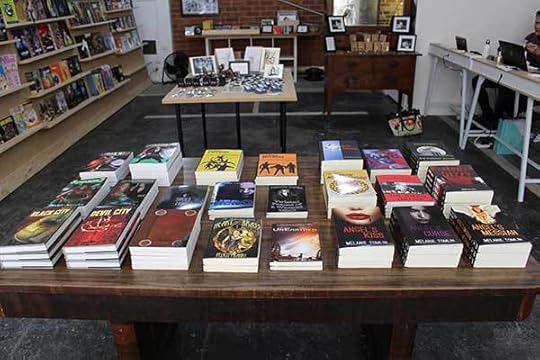
If you’re an independent artist, getting your wares into physical stores can be a challenge. Now, before I go any further, let me clarify that by ‘artist’, I’m referring to any person skilled in a creative activity to produce an end product. For example, my sister is a glass artist and I am an artist of the written word.
There are some bookstores that solely support independent authors, and these are starting to grow in number as people realise that the quality of books published independently has greatly improved over the last five years. In fact, in many cases the quality of the books (I’m thinking more along the lines of grammar and punctuation here) is on par with, or better than, those that are traditionally published. Why? Because independent authors tend to have greater control over their work. If you find a typo and contact the author, apart from being grateful, they can usually correct the error (if it is indeed an error) within 48 hours. Traditional publishers aren’t so keen to fix those four typos unless a new edition is going to be released. They seem to be more concerned with bottom lines rather than the quality of the products they are making available to consumers.
Of course, there are bookstores that stock both traditionally published and independently published books, and these are in the increase a well, but it’s stores that only stock independent works which this article relates to.
I know of at least two bookstores in the US that are following the ‘independent only’ model. There may be more, but I haven’t some across them yet. If you happen to know one, add a comment. It would be great to grow the list! The stores I know of are P.J. Boox and Gulf Coast Bookstore. Both are located in Florida and were founded by, or co-founded by, Patti Brassard Jefferson. P.J. Boox also supports a variety of independent artists, and it is this type of support that is the most exciting!
Locally I was very lucky to be introduced to Santa Carla, a new bricks and mortar store that has taken that wild leap to support independent artists in Australia.
Stop by at Santa Carla and buy something awesome for yourself or someone you care about. We are talking quality handcrafted, inspired pieces of art in all the many forms art can take, from print to plushie, book to vinyl. These are all by indie artists, people who have amazing special gifts that the world needs.www.santacarla.com.au
They are leading the way, in a country that sometimes falls behind what the northern hemisphere is doing, and I hope that others will follow their example.
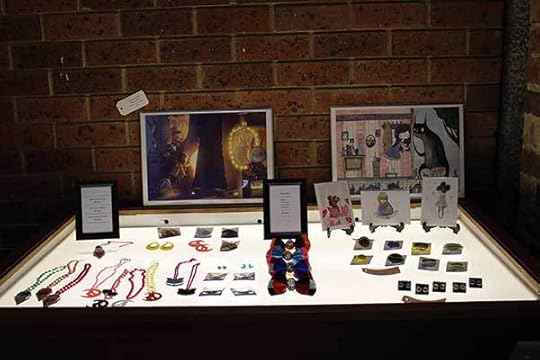
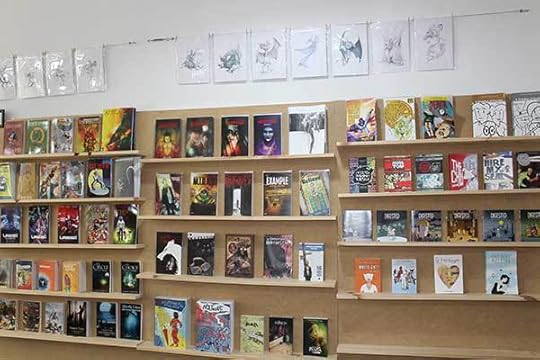
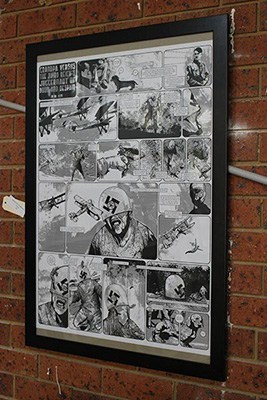
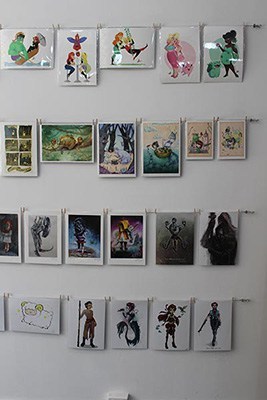
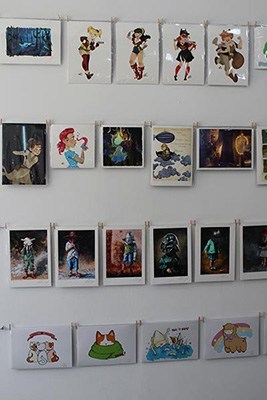
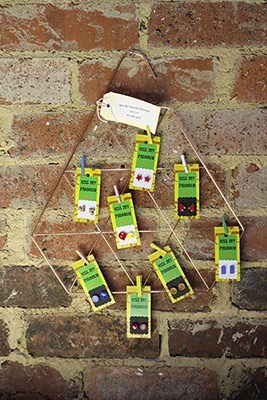
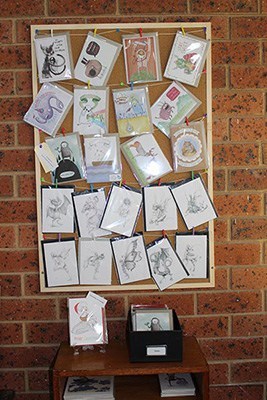
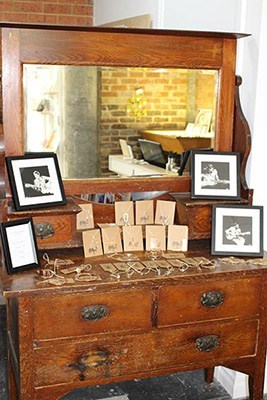
Recently I visited Santa Carla, to find out exactly what they have on offer, and I was astounded by the wide variety, and quality, of the goods. Here you will find books, comics, CDs, vinyls, gorgeous drawings of dragons, jewellery, zombie ponies, cards and prints, and a heap of other stuff.
I took some photos of what they had on offer on the day I visited, so you can get some idea of what it’s all about.

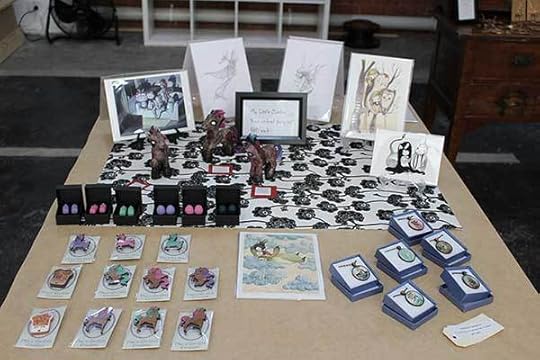
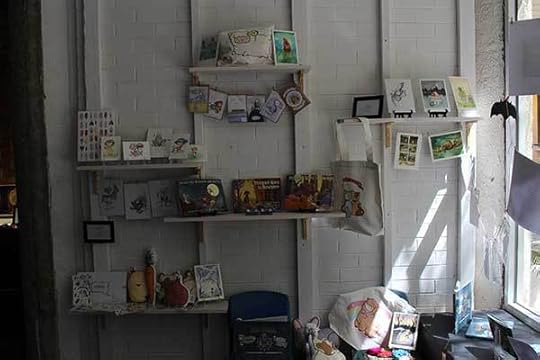
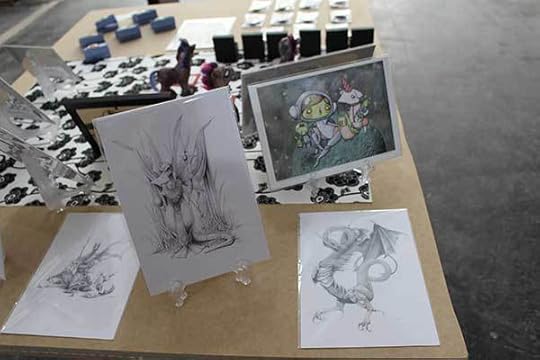
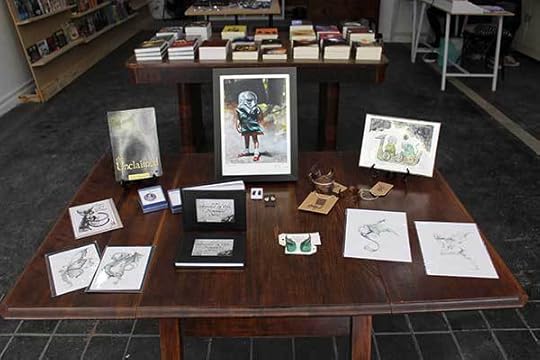
" htmlDivCss "
" htmlDivCss "
' htmlDivCss '
Jode, the founder of Santa Carla, hopes to open an online store in the near future. To keep informed about what’s going on, or to see more photos of the goods on offer, head over to Facebook.
And if you happen to be a local, stop by the store, which is located at 3 Sparta Pl, Brunswick 3056 and say hello to Jode and Alix!
The post Santa Carla: A New Breed of Store Supporting Independent Artists appeared first on Melanie Tomlin.