
Emily B. Martin's Blog, page 8
January 14, 2016
Pine Beetles, Gifford Pinchot, and the Women's Timber Corps
“What are you doing?”
I glanced down. Arlen was at the foot of the tree, looking up at me.
“Nothing. Checking the pines. Habit.” I continued down to the ground. “Did you need something?”
“What are you checking for?”
I rubbed my sticky hand. “Sickness. Die-off. But they’re producing pitch, and all their needles are green. That’s good. That means they can fight off beetles.”
“What does that matter?”
“What do you mean, what does that matter? If a tree gets infested with beetles, they’ll spread to other trees. Sick trees have to be cut down before they get infested. Why are you looking at me like that?”
“You can’t possibly check every tree in the wood?”
I raised my eyebrows. “Well, we don’t go tree to tree or anything. Each Woodwalker heads a scouting party assigned to a certain range. Weak pines are just one of the things they look for.”
“Seriously?”
“What did you think we did?” I asked hotly, stalking past him.
“I’ve never been entirely sure, to be honest.” He pattered after me. “Birdwatching?”
I huffed and settled down a few feet from Mona, who was stitching up a rip in her cloak. “We’re stewards of the forest. We keep an eye on all kinds of things. That’s why we’re called scouts. What?” He was staring at me with a look of amused disbelief.
“I mean, it’s a forest.” He waved around him as he sat down against a pine trunk. “Doesn’t it sort of take care of itself?”
“If it was just a forest, yes, it would take care of itself.” I unlaced my boot. “But there are a couple thousand people living up and down the mountain range, and we cause a lot of damage. Landslides, spoiled streams, overhunting—and that’s not counting the impacts of the silver mine. If we put stress on a stand of timber, the trees will die, the mountainside will wash out, and folk will get killed. If we muck up a stream, the insects and plants will disappear, and then bam, we’ll have no fish. The Wood Guard—and the Woodwalkers—were created to keep track of those things.”
-WOODWALKER
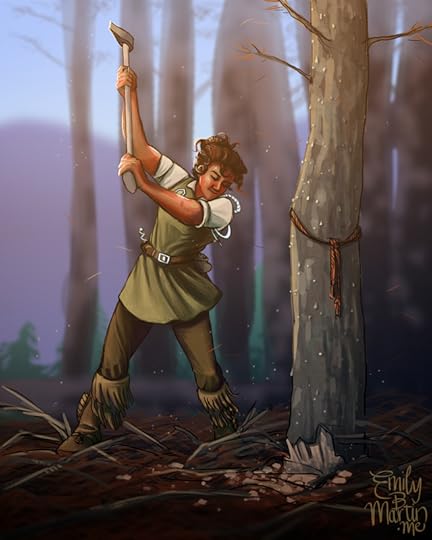 I’m a park ranger, traipsing along in the footsteps of John Muir and Stephen Mather and the like. And a lot of people, most notably my family, have accused me of casting myself as Mae. This irks me, because it means I’ve committed the most rookie of all mistakes—just writing oneself as the protagonist, rather than creating a unique character. I thought I had left those days behind in middle school.
But beyond this, it irks me because Mae’s job is different from mine. She is, at heart, a conservationist rather than a preservationist. Responsible use of resources over preservation for the sake of preservation. In fact, this is why I chose October 4th as her birthday—the death date of oft-maligned Gifford Pinchot, father of modern forestry, with the thought that she’s continuing his work. Granted, Mae has a heart for the inherent worth of wilderness that Pinchot is often accused of lacking (she probably would have been on John Muir’s side over the damming of Hetch Hetchy valley), but her job as a Woodwalker is ultimately to oversee responsible use of the Silverwood’s resources. This is a society not merely passing through a stand of wildland as visitors, but living intimately in it and relying on it for their survival. As such, preservation probably isn’t even a concept the folk of the Silverwood are concerned about.
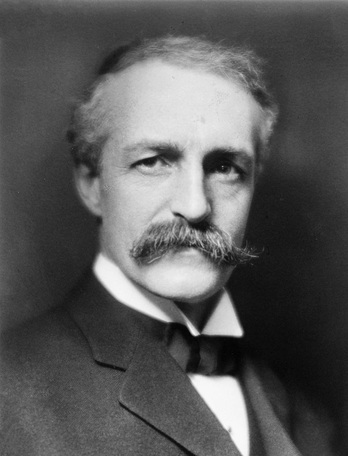 And let's face it, Gifford Pinchot was a babe. Now, the Silverwood will have been practicing silviculture and forestry much longer than post-European United States, and as such, they’ll have graduated out of some of Pinchot’s more outdated ideas (such as restricting wildfires at all costs). The Wood Guard would oversee strategic timbering to reduce the spread of blight or infestation and would monitor wildfires to facilitate forest regeneration. So that’s what Mae is doing in the illustration above—felling a pine that has fallen prey to pine beetles.
And this is where we hop to another, less famous chapter in the history of forestry and land use—the Women’s Land Army and the Women’s Timber Corps. These two organizations, like many others involving women in unusual workplaces, emerged during the First and Second World Wars. The two mentioned were in Britain, but there was also a Women’s Land Army of America and an Australian Women’s Land Army. Their work was closely related to entities like the US Forest Service, but I bring up these lesser-known organizations because the illustration above is referenced directly from a photo of a lumberjill in the Women’s Timber Corps.
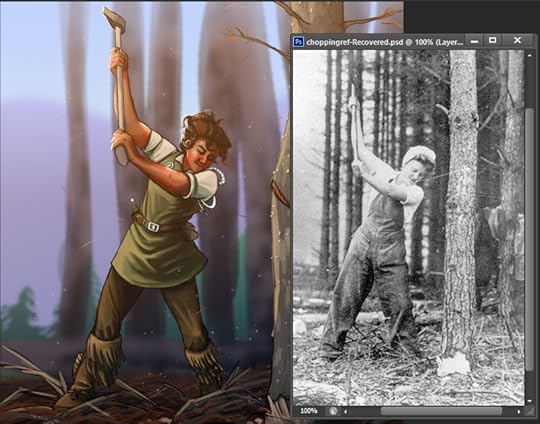 Image from http://histomil.com As famine loomed in Britain in World War I, women were hurriedly recruited to fill agriculture and forestry jobs the soldiers had left behind. They were recruited again during World War II. Once each war was over and the men returned home, the organizations were disbanded—yet another instance of women being ushered into a workforce to compensate for a lack of men, only to be kicked out when the need was gone (or, in the case of the National Park Service, when word got round to Washington that women were working as rangers). And despite the amount of timber the Women's Timber Corps provided for the war effort, they were given no recognition for their work until 2007, when a memorial was erected in Scotland.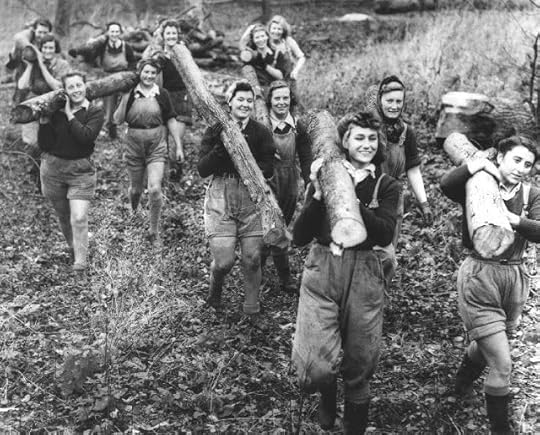
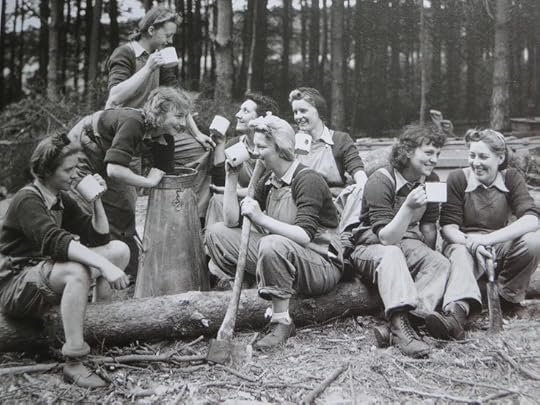 Images from http://long-may-she-rain.blogspot.com... The Wood Guard is decidedly coed, as with any other profession and industry in the world of Woodwalker. Women serving as foresters or soldiers or politicians is so normal as to be beyond comment. This is perhaps the biggest fantasy element in Mae’s world. But I hope Mae serves as a little homage to these women, continuing their work for the good of her people and her love for her home.
I realize few people care about the differences between a park ranger and a forester, or a preservationist and a conservationist, but Mae is unquestionably more akin to the latter. With some exceptions, her convictions align more closely with Pinchot’s than Muir’s, and her work aligns more closely with that of the women of the Timber Corps and modern foresters than park rangers. In this sense, Mae resembles my conservationist friends building trail at Philmont Scout Ranch or the vegetation crews working to control hemlock woolly adelgids in Great Smoky Mountains National Park.
Which apparently means I've written fanfiction about my friends, rather than myself.
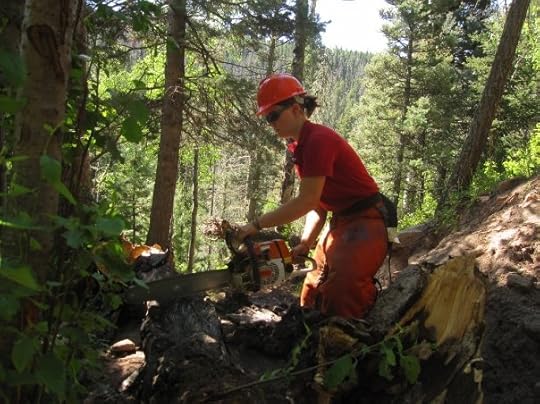 Write what you know, right? (Pictured: Katie Fyhrie, Philmont conservationist, who did all the hard work while I took pictures.)


January 12, 2016
Woodwalker Sketchdump
Boy, these past few weeks have been a whirlwind. Official edits to Woodwalker manuscript, redrawing the world map for the interior pages, a fourth draft of the cover art, and then feedback on my second manuscript... I'm pretty ragged. I thought I'd take a few days and work on some art to just calm my nerves a little, but I'm kind of sucking that up, too. I just don't have the stamina to finish anything. So here's a good old-fashioned sketchdump of concept work and doodlery. 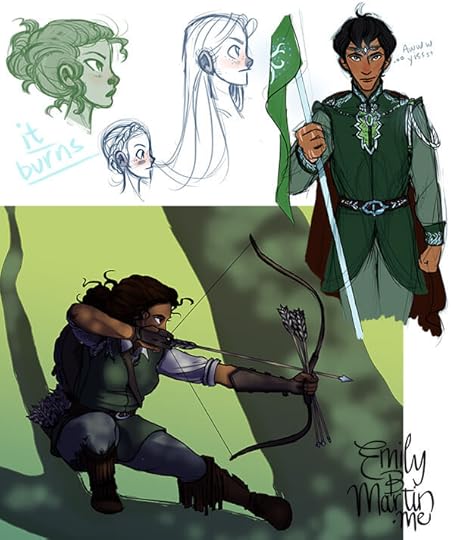
 Top left are a few inane doodles of Mae and Mona in a Pixar style, which I usually shy away from because all Disney-Pixar's female leads look the same, with the doe eyes and button noses. This gave me a complex as a kid because I knew with my big hawk nose I could never be cast as a Disney princess. But several of my favorite artists draw in this style and I can never resist trying to mimic my idols. (For the record, I'm over my childhood complex now--- turns out hooked noses were a sign of aristocracy in ancient Rome, and as my heritage is largely Italian...)
To the right of that is a junky sketch of Valien on his coronation day looking all smirky (and a bit like a mashup of Loki and Kylo Ren, which in all honesty, is pretty accurate). To his left is an unfinished concept of Mae with her archery gear. I've since changed the weaponry of the Royal Guard from recurved bows to flatbows, so this isn't quite right anymore, but she'd still have the hip quiver and spare arrows in her bow hand. I prefer hip quivers over back quivers because I've always found them easier and quicker to access, and they leave room for a backpack, which the Royal Guard would certainly need on days-long scouts in the forest. I also know highly accomplished archers would sometimes keep their spare arrows in their draw hands, but Mae isn't necessarily supposed to be the pinnacle of archery. She's good because she has to be, but she's not a prodigy, so I imagine she would be perfectly satisfied with keeping her spares in her bow hand.
Below that are two concepts for Lumen Lake, both of which led me to swear at my screen as I created them. In fact, one of them is actually saved under the name "arrgHATE.jpg." I'm just not that good at large-scale environments despite my love for them, and these didn't turn out how I wanted them to. But they gave me good practice, and they helped me with my worldbuilding. Tiny Colm is in the foreground of both.
Hopefully I'll be able to pull myself out of this funk before I have to write any more self-deprecating posts. Woodwalker is with the copy editor now, and my editor has a synopsis of manuscript 2. So things are still trucking along!
Top left are a few inane doodles of Mae and Mona in a Pixar style, which I usually shy away from because all Disney-Pixar's female leads look the same, with the doe eyes and button noses. This gave me a complex as a kid because I knew with my big hawk nose I could never be cast as a Disney princess. But several of my favorite artists draw in this style and I can never resist trying to mimic my idols. (For the record, I'm over my childhood complex now--- turns out hooked noses were a sign of aristocracy in ancient Rome, and as my heritage is largely Italian...)To the right of that is a junky sketch of Valien on his coronation day looking all smirky (and a bit like a mashup of Loki and Kylo Ren, which in all honesty, is pretty accurate). To his left is an unfinished concept of Mae with her archery gear. I've since changed the weaponry of the Royal Guard from recurved bows to flatbows, so this isn't quite right anymore, but she'd still have the hip quiver and spare arrows in her bow hand. I prefer hip quivers over back quivers because I've always found them easier and quicker to access, and they leave room for a backpack, which the Royal Guard would certainly need on days-long scouts in the forest. I also know highly accomplished archers would sometimes keep their spare arrows in their draw hands, but Mae isn't necessarily supposed to be the pinnacle of archery. She's good because she has to be, but she's not a prodigy, so I imagine she would be perfectly satisfied with keeping her spares in her bow hand.
Below that are two concepts for Lumen Lake, both of which led me to swear at my screen as I created them. In fact, one of them is actually saved under the name "arrgHATE.jpg." I'm just not that good at large-scale environments despite my love for them, and these didn't turn out how I wanted them to. But they gave me good practice, and they helped me with my worldbuilding. Tiny Colm is in the foreground of both.
Hopefully I'll be able to pull myself out of this funk before I have to write any more self-deprecating posts. Woodwalker is with the copy editor now, and my editor has a synopsis of manuscript 2. So things are still trucking along!
December 24, 2015
Happy Holidays!
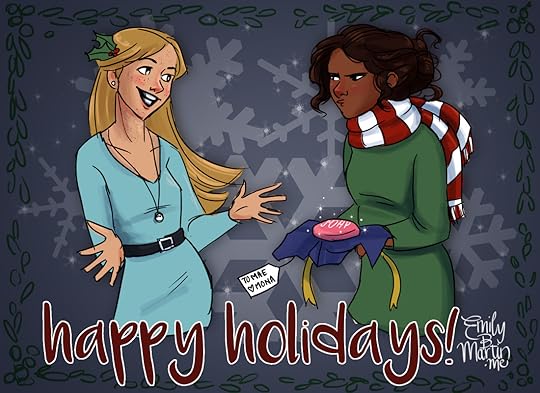 Mona's always looking out for Mae. Merry Christmas and happy holidays to everyone! Here's to a big 2016!
December 20, 2015
The Sound of Silence
Man, December hit like a freight train this year. Here are the things that happened in the span of three days:
My editor sent me revisions for Woodwalker.The art department asked for second drafts of the cover illustration and world map.The application window opened for the national park job I’m hoping for next summer.We closed on a new house.We moved into said house.I realized I hadn’t bought any Christmas presents yet.My 3-year old spent most of the morning vomiting while my 18-month old studied the process with fascination and continuous commentary.
Needless to say, I have no shortage of things to keep me awake at night. But one thing has overridden everything else, buoying me through the season. Okay, two things. One is whisky shots. But the other is my brand-spanking-new workspace.
Our old house was 900 square-feet, two-bed, one-bath—a good size for a newly-married couple. But five years later, as a family of four, we were bursting at the seams. My desk, such as it was, was wedged beside the chest freezer in the utility room, but I couldn’t always work there. With no other alternative, it often served as a landing pad for laundry and cooking. But besides that, it was loud. There was no quiet place in the house—nowhere I could sit where I couldn’t hear everything else that was going on, whether it was Daniel Tiger teaching my kids about the potty or Kai Ryssdal serenading my husband with the marketplace reports. I often wound up writing in bed with my earbuds blasting Pandora’s Ambient radio station.
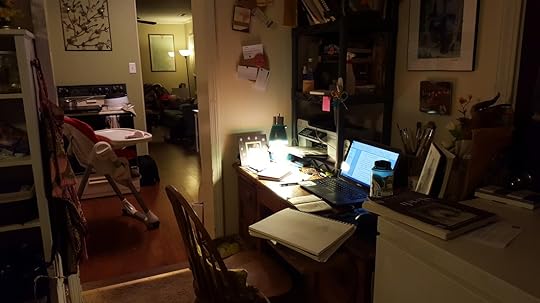 High chairs do not peaceful company make.
 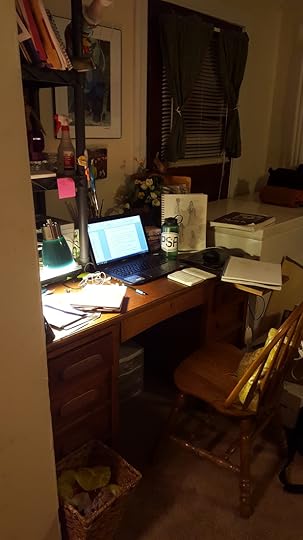 Chest freezer doubled as secondary workspace until I had to access the frozen peas. Now, I don’t mean to whine. Our house was small, but it was safe, and it was ours. We had a great little yard for our vegetables and flowers. My girls learned quickly how to share space and belongings. Power bills were absurdly low. I could vacuum four out of the five rooms from the same electrical outlet. But I can’t deny that trying to create a productive workspace was a nearly impossible task.
My most vivid memory of this crusade came during the first draft of Woodwalker. It was in the evening, and the girls were in bed. At that early stage, my youngest daughter was sleeping in a bassinet in our bedroom. My oldest was asleep in the adjoining room. My husband was working on some project in the utility room, listening as usual to NPR podcasts. That meant I was on the couch in the living room. But it was also vacuuming day. We have a second-hand Roomba we inherited, and it was busy trundling across the living room floor. As such, the coffee table and toddler chair were stacked on the couch beside me to give the Roomba a clear path. I was hunched over my laptop on half a cushion, doing my best to move my characters through a thrilling plot of danger and intrigue while the Roomba crabbed along the couch and Kai updated us on the S&P 500.
I’m pretty sure I ended up re-writing that particular scene.
You can imagine how thrilled I am, then, that in our new house, we’ve dedicated an entire room to being a home office. It comfortably holds both my desk and my husband’s (he's promised to listen to his podcasts on headphones). It gets lovely sunlight through two windows. It easily fits a large bookshelf, big enough to hold not just my books, but twelve years’ worth of sketchbooks as well. But best of all?
It has a door.
A door that closes.
I don’t even know what Daniel Tiger sang about today. I didn’t hear Kai Ryssdal do the numbers. I couldn’t hear a single word. I heard the click of my keyboard as I worked on edits, the tap of my stylus as I redrew my cover, and the little ding Photoshop makes when I try to use too many hotkeys at once.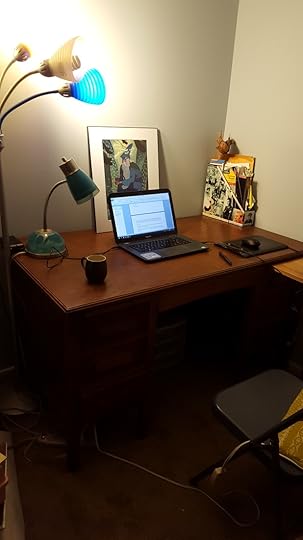 You can SEE the silence (though that may be because I haven’t unpacked all my boxes yet). It was bliss. I'm enjoying my editor's revisions immensely, and I'm really excited about the direction the book cover is heading. I'm looking forward to many long hours in this little room, where the only sounds are the cacophony of character dialogue in my head (and that Photoshop error ding--but at least I can mute that).
If you’re waiting until you’ve built the perfect workspace to start your novel, don’t. If you’re waiting until you have more time, don’t. You’ll never have a better place or time than right now. Carve out your space. Make the time. Let it happen.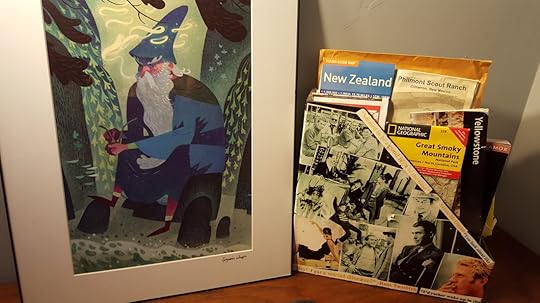 Though I do recommend having Gandalf and the Marx Brothers present whenever possible.
My editor sent me revisions for Woodwalker.The art department asked for second drafts of the cover illustration and world map.The application window opened for the national park job I’m hoping for next summer.We closed on a new house.We moved into said house.I realized I hadn’t bought any Christmas presents yet.My 3-year old spent most of the morning vomiting while my 18-month old studied the process with fascination and continuous commentary.
Needless to say, I have no shortage of things to keep me awake at night. But one thing has overridden everything else, buoying me through the season. Okay, two things. One is whisky shots. But the other is my brand-spanking-new workspace.
Our old house was 900 square-feet, two-bed, one-bath—a good size for a newly-married couple. But five years later, as a family of four, we were bursting at the seams. My desk, such as it was, was wedged beside the chest freezer in the utility room, but I couldn’t always work there. With no other alternative, it often served as a landing pad for laundry and cooking. But besides that, it was loud. There was no quiet place in the house—nowhere I could sit where I couldn’t hear everything else that was going on, whether it was Daniel Tiger teaching my kids about the potty or Kai Ryssdal serenading my husband with the marketplace reports. I often wound up writing in bed with my earbuds blasting Pandora’s Ambient radio station.
High chairs do not peaceful company make. Chest freezer doubled as secondary workspace until I had to access the frozen peas. Now, I don’t mean to whine. Our house was small, but it was safe, and it was ours. We had a great little yard for our vegetables and flowers. My girls learned quickly how to share space and belongings. Power bills were absurdly low. I could vacuum four out of the five rooms from the same electrical outlet. But I can’t deny that trying to create a productive workspace was a nearly impossible task.My most vivid memory of this crusade came during the first draft of Woodwalker. It was in the evening, and the girls were in bed. At that early stage, my youngest daughter was sleeping in a bassinet in our bedroom. My oldest was asleep in the adjoining room. My husband was working on some project in the utility room, listening as usual to NPR podcasts. That meant I was on the couch in the living room. But it was also vacuuming day. We have a second-hand Roomba we inherited, and it was busy trundling across the living room floor. As such, the coffee table and toddler chair were stacked on the couch beside me to give the Roomba a clear path. I was hunched over my laptop on half a cushion, doing my best to move my characters through a thrilling plot of danger and intrigue while the Roomba crabbed along the couch and Kai updated us on the S&P 500.
I’m pretty sure I ended up re-writing that particular scene.
You can imagine how thrilled I am, then, that in our new house, we’ve dedicated an entire room to being a home office. It comfortably holds both my desk and my husband’s (he's promised to listen to his podcasts on headphones). It gets lovely sunlight through two windows. It easily fits a large bookshelf, big enough to hold not just my books, but twelve years’ worth of sketchbooks as well. But best of all?
It has a door.
A door that closes.
I don’t even know what Daniel Tiger sang about today. I didn’t hear Kai Ryssdal do the numbers. I couldn’t hear a single word. I heard the click of my keyboard as I worked on edits, the tap of my stylus as I redrew my cover, and the little ding Photoshop makes when I try to use too many hotkeys at once.
You can SEE the silence (though that may be because I haven’t unpacked all my boxes yet). It was bliss. I'm enjoying my editor's revisions immensely, and I'm really excited about the direction the book cover is heading. I'm looking forward to many long hours in this little room, where the only sounds are the cacophony of character dialogue in my head (and that Photoshop error ding--but at least I can mute that).
If you’re waiting until you’ve built the perfect workspace to start your novel, don’t. If you’re waiting until you have more time, don’t. You’ll never have a better place or time than right now. Carve out your space. Make the time. Let it happen.
Though I do recommend having Gandalf and the Marx Brothers present whenever possible.
December 7, 2015
Inspiration Spotlight: The Thief
Of all the many books that have stuck with me since childhood, none have influenced my actual writer’s voice as much as The Thief. After the works of J.R.R. Tolkien, and arguably J.K. Rowling, Megan Whalen Turner’s little book-turned-series has been the biggest player in my writing life.
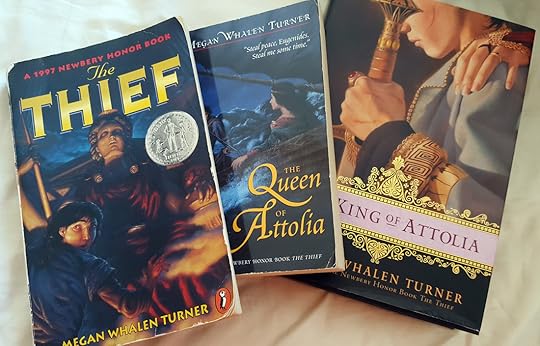 Ah, the Newberry Honor Book of '97. Good year.
Like The Hobbit , I used to reread The Thief almost every year, right up until I went to college. I read the sequels, too, but since they came later, I never developed the same kind of religious devotion to them. The Queen of Attolia, The King of Attolia, A Conspiracy of Kings and whatever else Turner’s got up her sleeve are undeniably better books, with more fluid prose and better character development, but The Thief has always been number one in my heart.
But over the last few years, I’ve felt myself undergo a transition in my preferred reading material. Plot holes and tropes I used to gloss over or miss entirely now stand out glaringly to me, and books I once adored now seem paltry in some cases and downright offensive in others. For this reason, I think, I was afraid to reread The Thief. I loved the protagonist Eugenides and his witty narration so much I worried about going back and finding out my adulation was just a product of naiveté and too much fangirling. Until this week, I hadn’t touched the book in the last eight years or so.
But, despite my avoidance, as I plotted and wrote Woodwalker, it became undeniably clear what a tremendous impact Megan Whalen Turner has had on my writing and on my concept of a captivating story and a clever protagonist. Turner’s unreliable first-person narrator was my first experience with such a character, and I relished going back and rereading her first book over and over again, picking up on all of Gen’s hints and slips. My copy of the book is riddled with little handwritten “ha!”s and “that’s what YOU think!”s anytime this twist is particularly clear.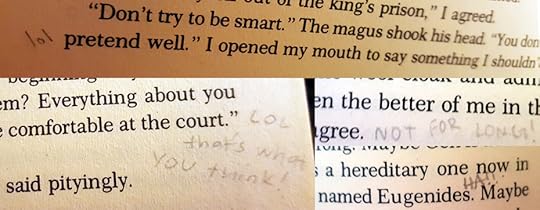 I'm dating myself by revealing that "lol" was already a thing during my childhood. Partway through my first draft of Woodwalker, I realized with trepidation that there were so many unintentional similarities, I was afraid someone would immediately slam me for copyright infringement. This was coming at the tail-end of grad school, where it was imperative to only write work that was entirely my own, and to maniacally cite any work that had even a whisper of another author. It scared me so much I actually stopped writing Woodwalker for a while, but I was too nervous to pick The Thief back up. I was afraid that if I read it again, it would confirm all my suspicions, and I’d have no choice but to throw my now-beloved manuscript out on the street.
Fortunately, this break in writing forced me to read more. I started a “YA Reconnaissance” bookshelf on Goodreads and began to work my way through many of that year’s top Young Adult fantasies. And you know what? I came to the delightful, liberating realization that nothing I write is original. Everything in Woodwalker has been done before, from the plot to the setting to the characters’ names and personalities. I can’t even describe how refreshing this was. I wasn’t going to get charged with plagiarism and kicked out of grad school for having the same story arc as another book. I have the same story arc as a thousand other books (likely more). Freed from this burden, I picked my manuscript back up and forged ahead, buoyed by my new discernment between imitation and inspiration.
Now, with Woodwalker on the verge of publication and its sequel in its final rounds of editing, I felt it was time to revisit Eugenides and face my fears that I’ve grown into a cranky and cynical literary snob. And I came away relieved. Yes, I pick up on more inconsistencies. The plot twist has become rather obvious, and there are several awkward turns of phrase. Characters say and do things that conflict with their personalities. I grate on the ingrained gender segregation that I didn’t care about before. Fully two-thirds of the book is taken up by eventless travel, something I just griped about in my latest Goodreads review on Rachel Hartman’s novel Shadow Scale.
But Gen still has a hold on my heart. I still laugh at his wit; I still admire his skills. I love his expert concealment of his true motivation and his willingness to sacrifice himself for his companions and his queen. I love Helen, my earliest heroine who is blatantly described as ugly. I love Pol’s perceptiveness and Sophos’ awkwardness. I love the Grecian setting and political intrigue. Call it stubbornness or retrograde admiration—I’m just happy that, after shaking my cane at dozens of YA novels and shouting at them to get off my lawn, I haven’t totally transformed into a ruined old crone.
Thanks, Megan Whalen Turner, for this enduring piece of my childhood, and for laying such a solid foundation for my own writing.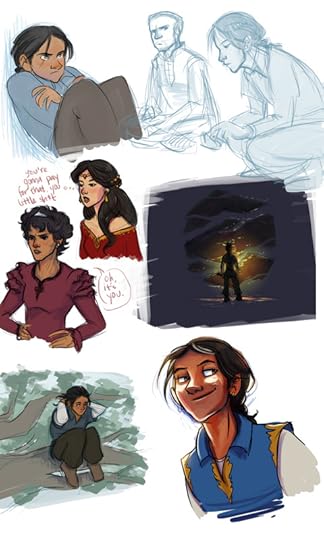 Never change, Gen. Oh wait, you do.
Ah, the Newberry Honor Book of '97. Good year. Like The Hobbit , I used to reread The Thief almost every year, right up until I went to college. I read the sequels, too, but since they came later, I never developed the same kind of religious devotion to them. The Queen of Attolia, The King of Attolia, A Conspiracy of Kings and whatever else Turner’s got up her sleeve are undeniably better books, with more fluid prose and better character development, but The Thief has always been number one in my heart.
But over the last few years, I’ve felt myself undergo a transition in my preferred reading material. Plot holes and tropes I used to gloss over or miss entirely now stand out glaringly to me, and books I once adored now seem paltry in some cases and downright offensive in others. For this reason, I think, I was afraid to reread The Thief. I loved the protagonist Eugenides and his witty narration so much I worried about going back and finding out my adulation was just a product of naiveté and too much fangirling. Until this week, I hadn’t touched the book in the last eight years or so.
But, despite my avoidance, as I plotted and wrote Woodwalker, it became undeniably clear what a tremendous impact Megan Whalen Turner has had on my writing and on my concept of a captivating story and a clever protagonist. Turner’s unreliable first-person narrator was my first experience with such a character, and I relished going back and rereading her first book over and over again, picking up on all of Gen’s hints and slips. My copy of the book is riddled with little handwritten “ha!”s and “that’s what YOU think!”s anytime this twist is particularly clear.
I'm dating myself by revealing that "lol" was already a thing during my childhood. Partway through my first draft of Woodwalker, I realized with trepidation that there were so many unintentional similarities, I was afraid someone would immediately slam me for copyright infringement. This was coming at the tail-end of grad school, where it was imperative to only write work that was entirely my own, and to maniacally cite any work that had even a whisper of another author. It scared me so much I actually stopped writing Woodwalker for a while, but I was too nervous to pick The Thief back up. I was afraid that if I read it again, it would confirm all my suspicions, and I’d have no choice but to throw my now-beloved manuscript out on the street.Fortunately, this break in writing forced me to read more. I started a “YA Reconnaissance” bookshelf on Goodreads and began to work my way through many of that year’s top Young Adult fantasies. And you know what? I came to the delightful, liberating realization that nothing I write is original. Everything in Woodwalker has been done before, from the plot to the setting to the characters’ names and personalities. I can’t even describe how refreshing this was. I wasn’t going to get charged with plagiarism and kicked out of grad school for having the same story arc as another book. I have the same story arc as a thousand other books (likely more). Freed from this burden, I picked my manuscript back up and forged ahead, buoyed by my new discernment between imitation and inspiration.
Now, with Woodwalker on the verge of publication and its sequel in its final rounds of editing, I felt it was time to revisit Eugenides and face my fears that I’ve grown into a cranky and cynical literary snob. And I came away relieved. Yes, I pick up on more inconsistencies. The plot twist has become rather obvious, and there are several awkward turns of phrase. Characters say and do things that conflict with their personalities. I grate on the ingrained gender segregation that I didn’t care about before. Fully two-thirds of the book is taken up by eventless travel, something I just griped about in my latest Goodreads review on Rachel Hartman’s novel Shadow Scale.
But Gen still has a hold on my heart. I still laugh at his wit; I still admire his skills. I love his expert concealment of his true motivation and his willingness to sacrifice himself for his companions and his queen. I love Helen, my earliest heroine who is blatantly described as ugly. I love Pol’s perceptiveness and Sophos’ awkwardness. I love the Grecian setting and political intrigue. Call it stubbornness or retrograde admiration—I’m just happy that, after shaking my cane at dozens of YA novels and shouting at them to get off my lawn, I haven’t totally transformed into a ruined old crone.
Thanks, Megan Whalen Turner, for this enduring piece of my childhood, and for laying such a solid foundation for my own writing.
Never change, Gen. Oh wait, you do.
December 2, 2015
Official Release Date and Pre-Order
It's official! Despite not having a cover (or a final round of edits, for that matter), Woodwalker is up for pre-order with HarperCollins! Pre-orders help publishers gauge interest and generate buzz in a book, so I would be thrilled if you chose to pre-order a digital copy (right now only $2.99!).
Official release date for the e-book is May 17, 2016! It's early yet, and this date might fluctuate (but I hope it doesn't--- that's my mom's birthday. Happy birthday, Mom, I'm not a total failure!). Hopefully soon we'll see a release date for the paperback version and a cover reveal!
Pre-order a digital copy at HarperCollins.com
Official release date for the e-book is May 17, 2016! It's early yet, and this date might fluctuate (but I hope it doesn't--- that's my mom's birthday. Happy birthday, Mom, I'm not a total failure!). Hopefully soon we'll see a release date for the paperback version and a cover reveal!
Pre-order a digital copy at HarperCollins.com
Emily B. Martin's Blog

- Emily B. Martin's profile
- 145 followers
Emily B. Martin isn't a Goodreads Author
(yet),
but they
do have a blog,
so here are some recent posts imported from
their feed.

