
Emily B. Martin's Blog, page 2
August 1, 2019
My Strategic Author Shoebox
 There’s a lot of advice out there for writers at every step of the game, from concept to drafting to publishing. Different things work for different people—I know authors who edit heavily as they draft, not moving on until a scene is close to perfect, while others take whole chapters that are giving them problems and—get this—delete them. Not move them to another document—DELETE like a freaking CYBERMAN.
Everybody goes about this nutty process of book-writing in a different way, which is w...


June 3, 2019
My Plein Air Process
 En plein air is just a fancy French way of saying painting outside. I never really considered myself capable of plein air painting until my first season as a ranger in Yellowstone in 2015. While in the park, I had the opportunity to learn from Suzie Garner, a fantastic watercolorist and plein air painter. She opened the door to landscape painting for me and gave me so much confidence! Now watercolors are some of my favorite ways to document my trips and ranger seasons.
Now that I’m back i...
April 30, 2019
Jump-Starting Your Protagonists
 It’s not going to be a long blog post this month, because I have precisely five days before I need to be in a car with my husband and all my worldly possessions and heading cross-country to Yellowstone. But being in the thick of several manuscripts at all different stages—one in plotting, one in drafting, and one in editing—I wanted to share some great tips I’ve gathered over the years on jump-starting protagonists. Think of them as icebreakers for authors, only less horrible than real social icebreakers because your characters can't judge you.
 So many of my protagonists start out as little more than a suggestion—a role to fill (Mae), a foil to another character (Rou), a catalyst (Celeno). Often, it’s not until I reach the end of the first draft that I understand exactly who that character is and how to achieve their full potential. Sometimes that makes drafting hard, especially when I need a character to make a big decision—by the time I was writing Creatures of Light, I knew, for example, how Mona would react in any given situation. But as I was drafting book 1 of The Outlaw Road, with new characters, I had to do a lot more puzzling. What choices would this character make? How do they handle their problems? How do they react when they fail?
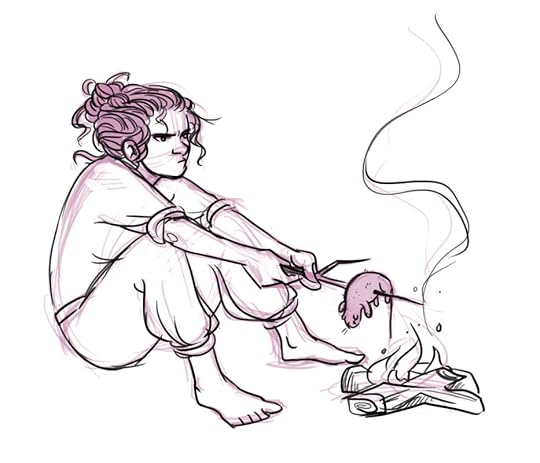 Sulking, mainly. There are lots of great character-building exercises and activities available online and in writers' workshops to help you get to know your protagonist, but I have a few go-to aids that I use when I realize I need to know more about them. Check them out below the jump! 1. The Basic Traits: Save the Cat! Writes a Novel
 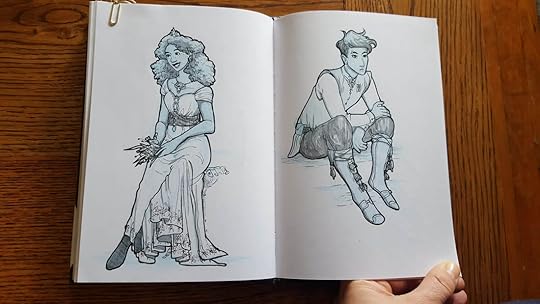 Characters Eloise Alastaire and Veran Greenbrier from The Outlaw Road. I picked up a copy of Jessica Brody’s Save the Cat! Writes a Novel after hearing Jessica Khoury recommend it on a panel we were on together. And boy howdy, has it streamlined my plotting. I won’t go into the really golden stuff in the book—it’s better read with all the details and sample beat sheets. But I will share a tidbit from the first chapter on knowing your hero. Brody explains that for a character to be protagonist-worthy, they need three things:A problemA wantA needWithout these things, a protagonist runs the risk of lacking direction and agency, and a plot runs the risk of having no personal stakes. She explains that in the first two acts of your story, your character is focused on their want—or fixing their problem the wrong way—until finally in the last act, they figure out what it is they actually need. She breaks down this magical transformation throughout Save the Cat, along with vital components of a compelling plot. If you’re stuck in the middle of a vague plot, like I was, or if you’re just beginning to plan your novel, or if you have a finished draft and are ready to polish, be sure to check out this book! 2. The Basic Traits, 2.0
 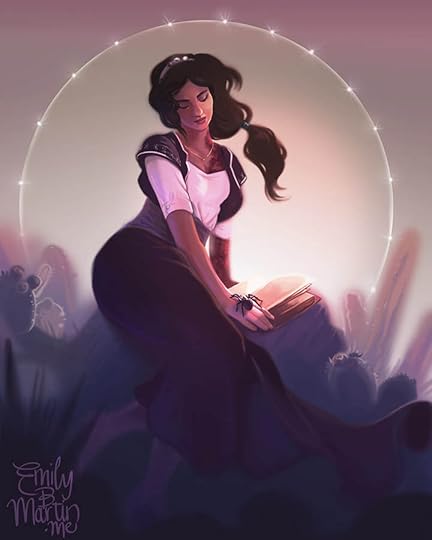 Gemma, Creatures of Light This is another similar approach to character building, much like the basic traits above. I regret that I can’t remember where I picked this up—I think I saw it several years ago on Twitter and pinned it to my office cork board along with other good writing tips, but I didn’t write down who originally tweeted (if you know, tell me in the comments!). This tweet suggested that for a character to be interesting, they need:An internal struggleAn external struggleA unique traitThis is a great starting place for your characters, a way to get them sprouted, if you will, before growing them into a more complete person. I used these to guide the basics of several characters, including Gemma, Rou, and Celeno. At her very beginning, for example, I knew Gemma would struggle with her lack of self-confidence (internal struggle), and the looming threat of war (external struggle), while navigating the expectations around her highly visible wine stain (a unique trait). As she developed, she gained more depth beyond these three things, like her skills as a scientist and artist (unique traits), the journey she must undertake (external struggle), and the haunting of her past (internal struggle). 3. Character Questionnaire
  Mae, Woodwalker I’m not sure where this particular set of questions originated, because it pops up on lots of different writing workshop blogs, such as
Gotham Writers
. This was the earliest character-building tool I used, using it to get to know characters like Mae, Mona, and Valien. This helped me hone in on some of the lingering effects exile had on Mae—such as a tendency to hoard things beyond their intended usefulness—and dig into the details of Mona’s relationship with her mother. It’s also where I developed individual tics and habits for different characters—Val’s constant drumming of his fingers, Mona’s clenched palms, and Colm’s, uh… crippling depression.
Mae, Woodwalker I’m not sure where this particular set of questions originated, because it pops up on lots of different writing workshop blogs, such as
Gotham Writers
. This was the earliest character-building tool I used, using it to get to know characters like Mae, Mona, and Valien. This helped me hone in on some of the lingering effects exile had on Mae—such as a tendency to hoard things beyond their intended usefulness—and dig into the details of Mona’s relationship with her mother. It’s also where I developed individual tics and habits for different characters—Val’s constant drumming of his fingers, Mona’s clenched palms, and Colm’s, uh… crippling depression.
There are around eighteen prompts in all, depending on which version you use, and they work best when written down, not just thought about internally. I added “nervous habits” and “handwriting style” to mine because they were relevant. Some of my favorites on the list include:
Where does your character go when he’s angry?What makes your character laugh out loud?What is on her bedroom floor? On her nightstand? In her garbage can?Your character is doing intense spring cleaning. What is easy for her to throw out? What is difficult for her to part with? Why? 4. Spy on Your Character: Deb Norton
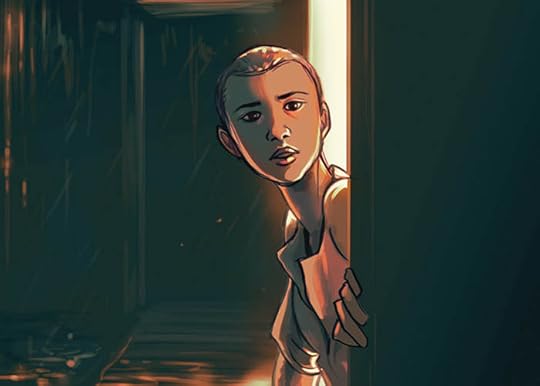 An early rough concept of Tamsin in The Outlaw Road. This is a more recent one that I’ve used to get to know Tamsin, a character in The Outlaw Road. I had edits back from my agent that this character needed to be more tangibly connected to the main body of the story, so I dug a little deeper than the questionnaire above and looked for prompts to use for some freewriting. I landed on a fun article on Writer’s Digest by Deb Norton,
10 Sly Character Development Techniques
. Like the questionnaire above, these prompts work best as freewriting exercises—you’ll be amazed what starts to flow out when you begin writing that you hadn’t even considered when it was all stuck in your head. Not only did this give rise to some great symbolism and grounding characteristics in The Outlaw Road, it also created a few small side plots that solved some problems in book 2. Plus, spying on your characters is just fun.
An early rough concept of Tamsin in The Outlaw Road. This is a more recent one that I’ve used to get to know Tamsin, a character in The Outlaw Road. I had edits back from my agent that this character needed to be more tangibly connected to the main body of the story, so I dug a little deeper than the questionnaire above and looked for prompts to use for some freewriting. I landed on a fun article on Writer’s Digest by Deb Norton,
10 Sly Character Development Techniques
. Like the questionnaire above, these prompts work best as freewriting exercises—you’ll be amazed what starts to flow out when you begin writing that you hadn’t even considered when it was all stuck in your head. Not only did this give rise to some great symbolism and grounding characteristics in The Outlaw Road, it also created a few small side plots that solved some problems in book 2. Plus, spying on your characters is just fun.
Some of my favorite prompts are:What does she try to get away with when no one is looking?Zoom in on details on his clothes/accessories.What’s hidden on the top shelf of her wardrobe?Two characters are talking about what she’s like when she’s mad.
Do you have favorite character-building tools or techniques? Share them below! April Art Roundup It was Queen's Thief Appreciation Week this month! So most of my artwork was celebrating my favorite book series, plus a plein air from my watercolor sketchbook and a bookmark I made for a contest at my local library. What I'm Reading:
Where the Crawdads Sing, Delia OwensDumplin', Julia Murphy
Woodwalker, out loud to my kids (their request)
Just like, so many tourism websites as I prep for driving cross-country. I'll be in Yellowstone for the next several months, and my WiFi will be sporadic! If you want to keep up with my sketches and park ranger adventures, follow me on Instagram!
March 31, 2019
Real-Life Places from Creatures of Light
 Woodwalker was born on a hike.
The trail itself was really nothing special—just a short, easy walk from the Stumphouse Tunnel parking area, away from the locally famous half-finished railroad tunnel. In a past life, we’d have gravitated toward something longer and more remote. But I had just had my second baby two months previously, and having finally healed and gotten some stamina back, it was our first hike as a family of four, and the first time I’d gotten beyond our backyard in months.
I grew up in the Appalachian foothills, so the landscape was nothing new, but after the confines of a winter pregnancy and new motherhood, being in the woods again was almost overwhelming. My brain fired up, and the little germ of an idea that had begun in a Lord of the Rings fanfiction started sprouting into something completely new. And even though Mae had her roots in Middle Earth, on that hike through a classic southern mixed-hardwood forest, there was no question in my mind what kind of environment she came from.
 The places in my books are always heavily drawn from real landscapes I’ve worked in or traveled through. Mae’s country of the Silverwood Mountains draws its environment directly from Great Smoky Mountains National Park and the surrounding national forests, where I’ve been a park ranger for three seasons. Alcoro draws from my time in the desert southwest, and Cyprien from the old-growth swamps in my home state. But several locations throughout the trilogy get even more specific than just an American region—in some cases, I can even list hiking trails or mountain peaks that have directly inspired the journeys of my protagonists. Explore some of these below—maybe one of the campsites or castles in Creatures of Light isn’t that far from you!
All photos belong to me unless otherwise noted. Header photo was taken near Newfound Gap, Great Smoky Mountains National Park. Header fonts are Valeria Bold Grunge and Amarillo from dafont.com.
See them all after the jump! Woodwalker Book location: Drink-Your-Tea Creek
Real location: Forney Creek, Great Smoky Mountains National Park
 Located on the North Carolina side of the Smokies, in some of the most rugged land in the park, is a classic Appalachian mountain river, at times clear as crystal and other times foaming over rocky currents. Like in the book, this area is thick with songbirds, including the Eastern Towhee that Mae points out to the others with it’s recognizable drink-your-tea call. I hiked Forney Creek with a friend in college, and memories of the lush, cool river stuck with me vividly since then, appearing as one of the first areas Mae leads the others through in the Silverwood Mountains. Book location: The Pine Campsite
Real location: Panthertown Valley, Nantahala National Forest
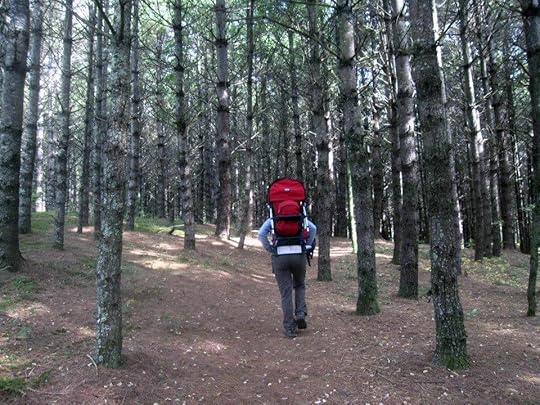 The soft give underfoot, the sound of muffled footsteps, the permeating scent of pine… the campsite Mae chooses for the others in the pine grove is hard to beat. It’s drawn from a lovely grove my mom and I hiked through on a backpack we brought my then 8-month-old daughter on. It’s located several miles into Panthertown Valley, North Carolina, in one of the national forests that flanks Great Smoky Mountains. The silence of our footsteps on the carpet of needles created a soothing, hushed atmosphere, just right after a long day of hiking. Of course, readers of Woodwalker know that night in camp didn’t stay calm for long… but fortunately my time in Panthertown was devoid of any such adventures. Book location: The Ridgeline
Real location: Clingman’s Dome, Great Smoky Mountains National Park
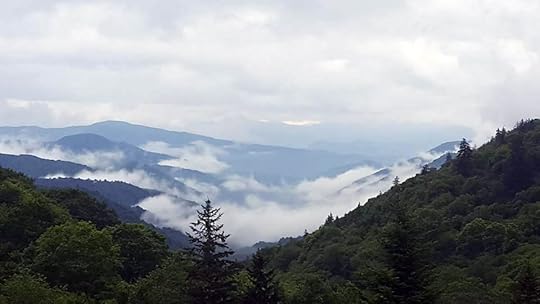 When Mae was a Woodwalker, she was assigned to the ridgeline of the mountains, a crucial artery for the Silverwood mining industry and a demanding environment. After an emergency in the group, she finds herself traversing it again, this time hunting for a hidden cache of scout supplies. This is one of my favorite environments in the book, drawn directly from my time roving the paths around Clingman’s Dome, the highest point in Great Smokies, as well as on the Appalachian Trail. This area is always cool and threaded with the scent of fir. The woods ring with the otherworldly downward-spiral call of veeries, and frequent mist creates an ethereal atmosphere. Clingman’s Dome is an easy 15-minute drive from the main road in the Smokies, and then a tough 15-minute walk up to the tower. It’s one of the most popular places in the Smokies to visit, thanks to its stunning 360 degree views of the park, so if you’re planning a jaunt, consider getting there as early in the morning as you can.
 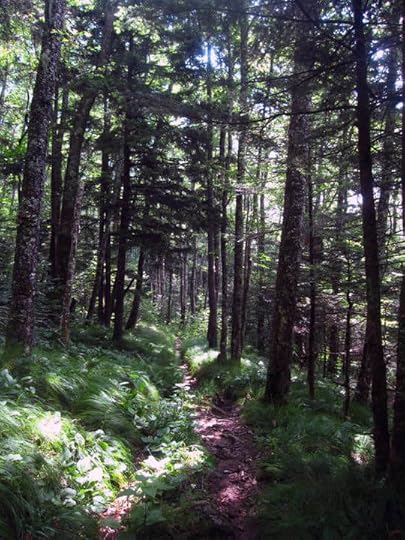 Near Laurel Gap. Book location: The Palisades
Real location: Table Rock, Table Rock State Park
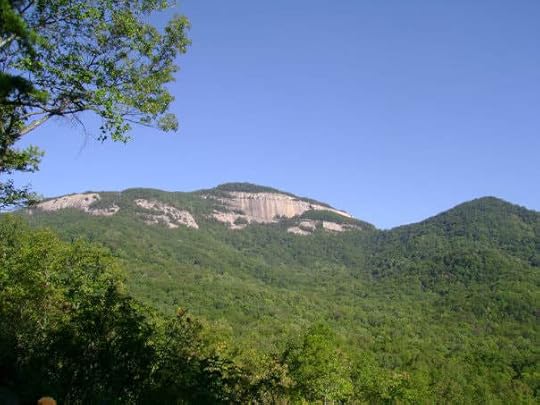 While I borrowed the name and the scope of the Palisades from an escarpment of the same name in Cimarron State Park in northern New Mexico, I fitted them into my Appalachian environment by drawing on a landmark closer to home—Table Rock. Recognizable for miles around, this exposed rock face towers over the lake below. When I needed a good environmental barrier between the Silverwood and Lumen Lake, I expanded the scale of this mountain and dropped it along the border.
Ashes to Fire Book location: The Lower Draws
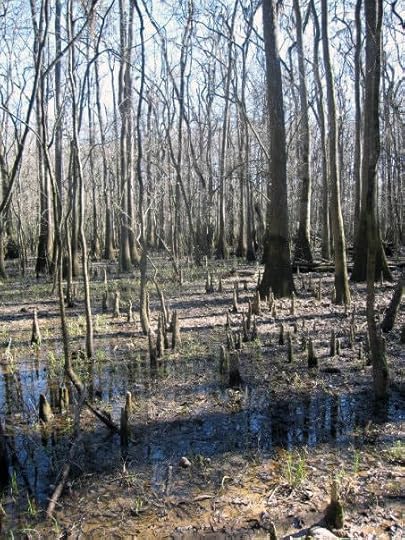
Real location: The Boardwalk Trail and Cedar Creek, Congaree National Park
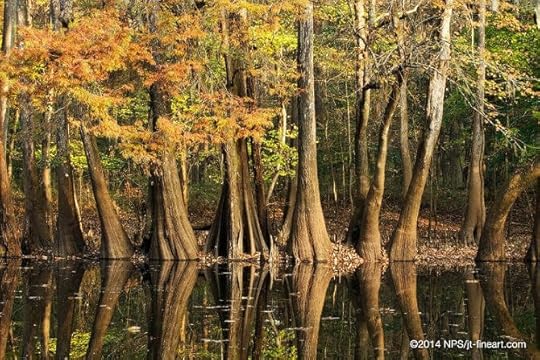 Photo courtesy of the National Park Service. Cypress knees, trailing moss, buttressed trunks rising from coppery water… Rou’s home province of the Lower Draws in Cyprien is directly pulled from the floodplain forests of Congaree National Park in South Carolina. I’ve spent many a hike here on the boardwalks that wind through the swamp, and while I’m a mountain girl at heart, there’s something magical and mysterious about these forests. I use the word bayou in Ashes to Fire because of the brackish water from the sea, and some of flora and fauna are more commonly found in places like the Atchafalaya River Basin in Louisiana, but the feel of the Draws came from Congaree.
 Book location: The channel
Real location: The Congaree River, Congaree National Park
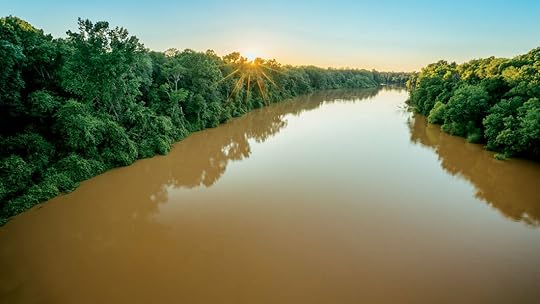 Photo courtesy of the National Parks Conservation Association The channel that the Swamp Rabbit comes to on the journey through Cyprien is inspired by the Congaree River, magnified to Mississippi-sized proportions. The Congaree winds along the border of the national park, slow-moving and silty, and even though it’s not big enough for the scene that occurs in Ashes to Fire, it’s the mental image I wrote with.
 Creatures of Light Book location: Whiptail Hob
Real location: Betatakin and Keet Seel, Navajo National Monument
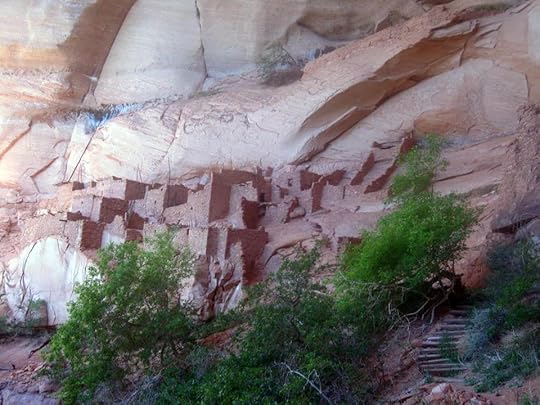 There are many preserved cliff dwellings throughout the US, but I wanted to make sure I was writing these types of homes with integrity. Instead of drawing inspiration from a broad swath of sites, which might have given me too generic an interpretation, I chose Betatakin and Keet Seel, two Ancestral Puebloan cliff dwellings in Navajo National Monument. I spent three days in Navajo while conducting my thesis research, and I loved the miles-long hikes into Tsegi Canyon with our guide to reach the soaring alcoves housing the villages. Betatakin in particular resonated with me—ordinary visitors like me aren’t allowed in the alcove, so we had to view it from outside. And I found it actually gave me more space to think about life in the canyon and under the alcove roof. Several years later, I drew on those memories to inform Rana’s cozy home in Whiptail Hob. Book location: The Stone Wall Campsite
Real location: Box Canyon Cave, New Mexico
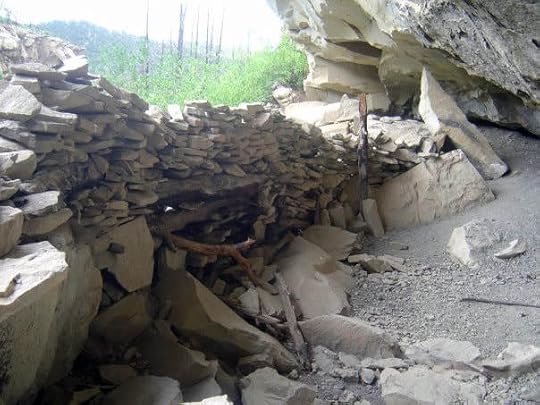 My first summer at Philmont Scout Ranch, I worked at a camp called Indian Writings in the North Ponil Canyon. In a small side canyon was an alcove similar to the one the hobs occupy, with a teetering stone wall built along the edge. The wall was reconstructed based on archaeological evidence, and like many other places in the North Ponil, there were Ancestral Puebloan petroglyphs carved into the walls. Ten years later, when I was writing Creatures of Light and needed a good campsite for Gemma, I sheltered her in a similar cave partway up the Stellarange Mountains. Book location: The Stellarange Caves
Real location: Whorley Cave, Tennessee
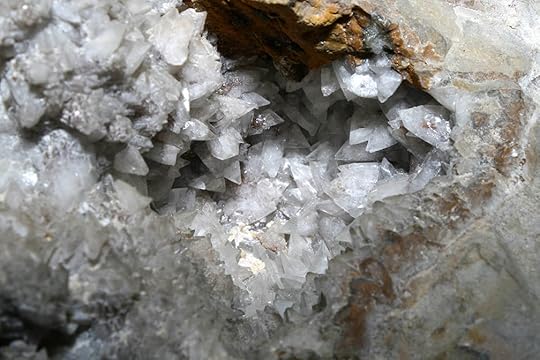 Dogtooth spar in Jewel Cave National Monument; photo courtesy of the National Park Service I wish I could tell you about the beautiful jewel-bright glowworms in Waitomo Caves, New Zealand, or the fantastic speleothems in Carlsbad Caverns. But even though I spent months in New Zealand, I never actually visited Waitomo, and all the Carlsbad insight came from several friends who’ve worked there as rangers. I did spend some time researching in Wind Cave and Jewel Cave, South Dakota, where I saw things like the cave bacon, columns, and other speleothems Gemma makes note of on their journey. But my most vivid cave experience that crept into Creatures of Light was a squeeze I was coaxed into much closer to home, while tagging along on a Boy Scout trip guided by my then-fiancé. It was a slide under a low stone bulge for about six feet—not nearly as dire as the one Gemma and Celeno face—but I realized when I was halfway through it that I 9000% Absolutely Hated It with Every Fiber of my Being. Yes, I did still go on to marry my fiancé, but I funneled that visceral fear of being squeezed under tons of rock directly into Gemma as she journeyed through the dark.
 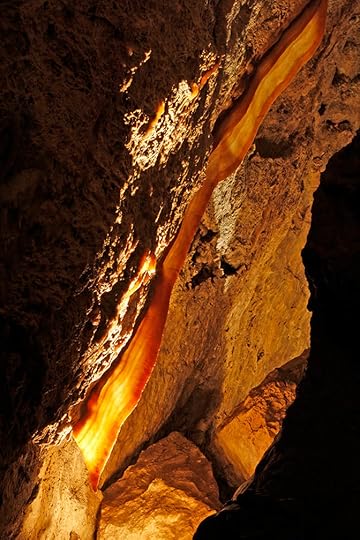 Cave bacon in Jewel Cave National Monument; photo courtesy of the National Park Service “It was character-building,” my husband said when I told him about this blog post.
“I’ll say it was,” I replied. March Art Roundup Only ONE IMAGE for you this month, for several reasons---one was lots of writing on my current manuscript, another was a big illustration project that I can't share yet, and yet another was the tumult of interviewing and making hard decisions with the National Park Service for this summer. Read more about that news below!
 Announcements:
My next duology, The Outlaw Road, has been officially announced! See more details on my Books page!
After some tough decisions, I will be heading back to Yellowstone National Park this summer as a ranger, based out of the Grant Village Visitor Center! See a video update about this summer and The Outlaw Road on my Facebook Page ! What I'm Reading: The Lost Pilots, Corey MeadThe Queen of Sorrow, Sarah Beth DurstAmelia Lost, Candace Fleming (out loud to my kids)Yellowstone Summer Guide for Interpreters
February 28, 2019
Improving Your Art: On Setting Goals
 I’ll start by saying that I tried really, really hard to have a progress video, or at least an illustrated tutorial for February’s “for artists” blog post, but as you may have seen on social media, the universe was against me this month. I’d set up a screencap video for the piece of Remus Lupin below, but it failed thirteen minutes in. So I tried to capture a different illustration on my phone, but I kept running out of memory, and then half the clips were eaten by Internet goblins when I tried to transfer them to the cloud. So I set about doing a simple face and shading tutorial, when I realized that with the frustration of everything else, I apparently no longer could draw a face, at which point I nearly gave up on February entirely.
 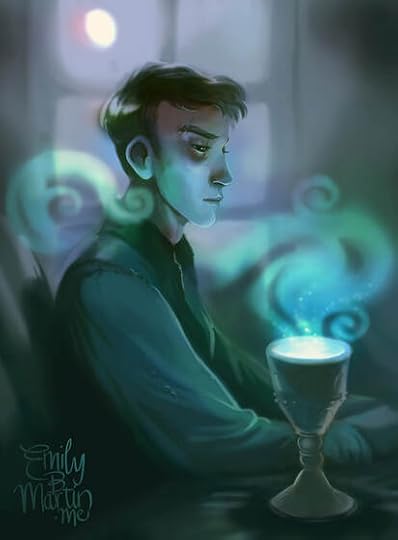 My boggart is this blog post. So finally, as I came down the wire, I decided to give you something that didn’t require me to draw anything new at all, and that’s to share my method of setting long-term goals to progress my art. I started doing this several years ago—setting specific objectives, usually at the beginning of the calendar year, of what skills and concepts I wanted to practice next.
Most of these goals were easy to come by—they were often concepts I was struggling with or felt like my pieces were lacking. But sometimes our weak points aren’t easy to pinpoint—these are great reasons to have artist friends or crit groups that will give you honest, supportive feedback. I’ll share a few of these resources at the end of the post.
So! It seems I’ve saved February’s art blog at the eleventh hour, despite the best efforts of a vengeful universe/crippling professional anxiety. Here are the stylistic roads I’ve journeyed on the past five years, the resources that helped me slowly progress, and where I hope to head this year. Includes Ye Olde Arte and some pieces I’d really rather bury but am posting for your amusement. See it all below the jump! 2015: Achieving Depth
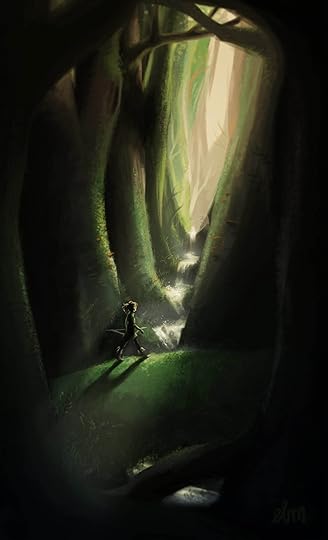 2015 was a big turning point in my life. My second daughter had been born the previous year, and I was finally emerging from four years of being either pregnant or nursing. While I would continue being a stay-at-home mom for another four years, I finally had some space to start thinking (albeit exhaustedly and distractedly) about something other than motherhood. 2015 was the year I got my first uniformed summer job with the National Park Service. It was the year I illustrated my first children’s book. And it was the year I took a giant, risky leap and started querying agents for Woodwalker.
I began that particular journey in January 2015, after having spent the previous eight months drafting and editing the manuscript. I connected with my agent in July, taking the all-important Call while in uniform at the Old Faithful Visitor Center (I did wait until I was off-duty). We signed together and went on submission that fall, and Woodwalker found its home with Harper Voyager with a shiny publication date for the following spring. This leap into the professional world, along with talk of building an author “brand” and a robust online presence, made me start thinking a lot more about my art and the direction I wanted it to take. My art during the New Mom Years had been sporadic and directionless, and I’d progressed very little since college. Now I wanted it to grow and be something I could use in tandem with my books. So I settled on something I thought was lacking in my work: depth.
In the beginning, the only way I really knew how to achieve depth was through blurring—making the foreground sharp and the background blurry. I knew light, value, and color had something to do with it, but I only had the barest grasp on how that worked. (Spoiler: I still don’t understand how those things work, but I’m better at making them do my bidding regardless.)
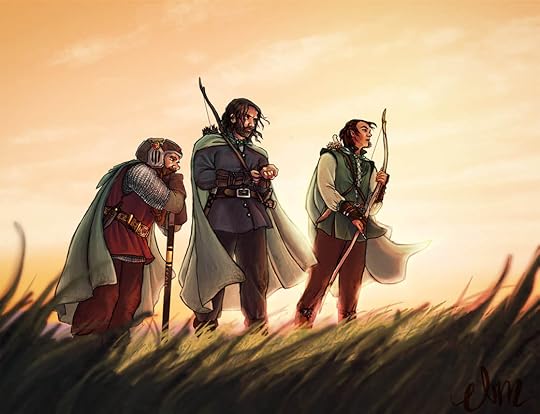 I made some breakthrough with this piece above, forcing myself to merely hint at the foreground and background rather than detail it. I missed the mark on the piece below, the very first digital concept I did of Mae, where I regressed into finessing the piece into oblivion, relying at the last minute on a pre-fab Photoshop lens filter to add focus.
 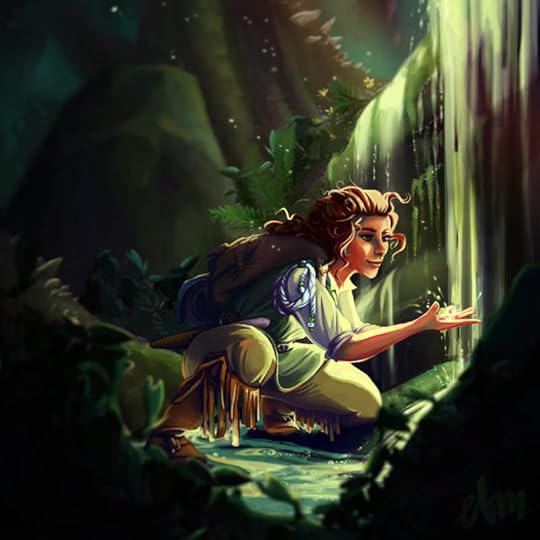 But slowly I started getting the knack of simply suggesting my background, even though I was still painting in the same saturated colors as my foregrounds.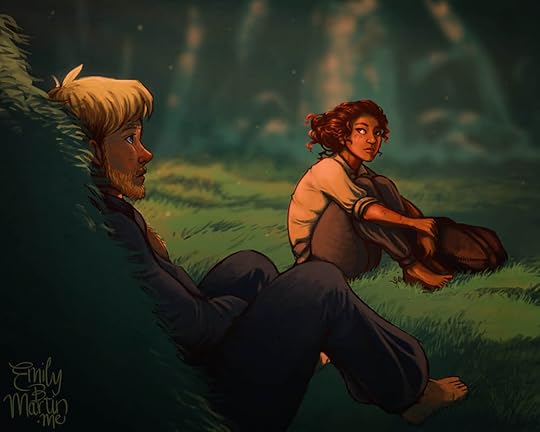
 By the end of 2015, I was doing a better job of envisioning distance and creating a piece that had some atmosphere to it. But man, something had to be done about my tendency to work a piece into the ground… 2016: Quicker and Broader
 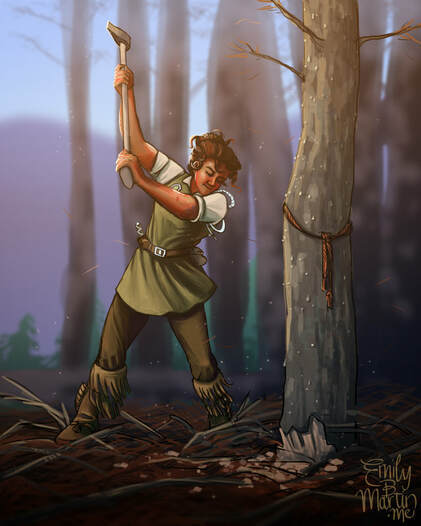 January of 2016, I painted this piece, referenced from a photo of a WWII lumberjill. I liked the energy of my initial sketch, and I put my work the previous year to use in distancing the background, but the thing that kept me from loving the piece was how stiff and motionless it felt. I mooned over other artists who managed to capture their subjects in rough, fast brush strokes, bringing energy and richness to their work without bogging it down in details. So I set a new goal for myself:
Speedpainting!
And I learned a very fast lesson.
Speedpainting is f*#king hard!
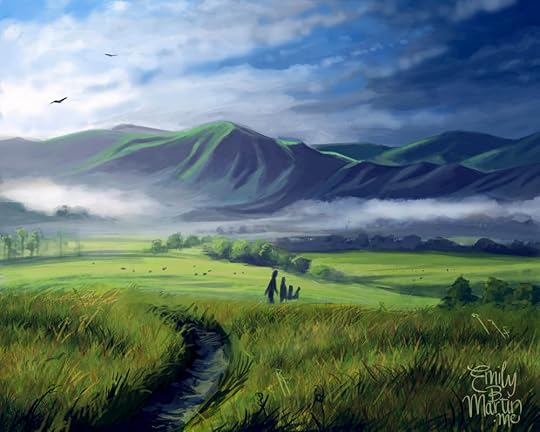 It looks like it should be easy. Zoom out, throw fast strokes down, and don’t fret over the details. But just like distilling a 70,000-word novel into a 200-word query letter, speedpainting requires a precise knowledge of exactly what needs to be on the page. It requires a robust understanding of composition and value, and often, prep work beforehand. Those were skills I was and still am a long way from mastering, and so my early attempts at speedpainting were immensely frustrating.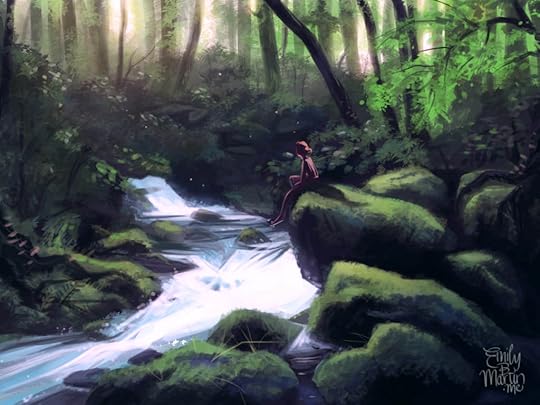
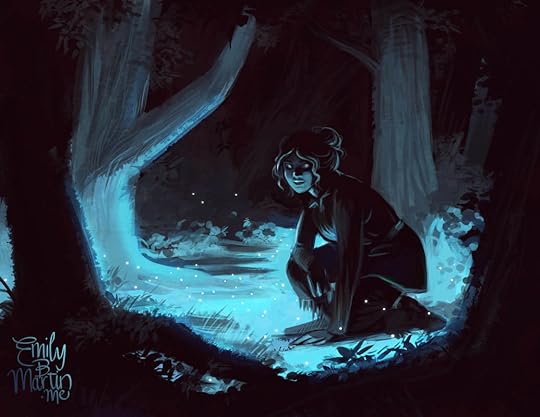 But--like my work on depth--repetition and practice helped me relax my work and move a little faster. It helped train my eye to identify the important parts of a piece and made me more comfortable with working at a macro, zoomed-out level. I want to be clear—I’m still not a very strong speedpainter, and it’s something I still practice a lot. That’s the key here—just because I have a new goal from year to year doesn’t mean I’ve completely mastered the previous year’s goal. But by the end of 2016, the focus on moving faster and broader did help me retain more energy in my work.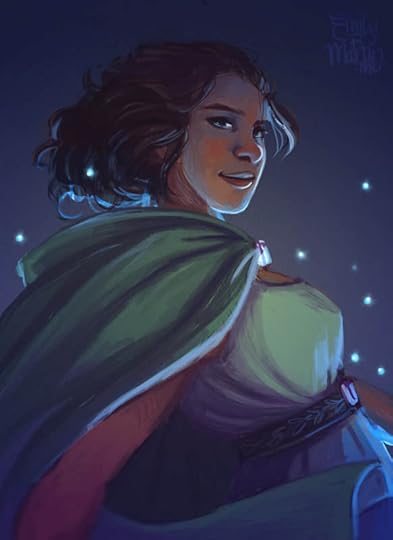
 As the next year dawned, though I found I had new problems…
2017: Maturing and Quieting 2017! Woodwalker had been out in the world for almost a year and the publication date for its sequel, Ashes to Fire, was approaching. I was slowly but steadily building a readership and online following. I was producing art a breakneck pace to celebrate and promote my books, filling more sketchbooks in a single year than I had during grad school and new motherhood combined. But this new world as a published author and illustrator handed me a dramatic realization.
People were drawn in by my art, for sure. But they were drawn in with the wrong assumptions. My books are classified Epic Fantasy, with protagonists in their 20s and adult themes like marriage, war, and execution. But the majority of people hooked by my cartoonish, brightly-colored art automatically assumed my series was middle grade fiction. I was introduced at events as a middle-grade or even children’s author, and asked to do events with young kids at bookstores and libraries, rather than teens or adults.
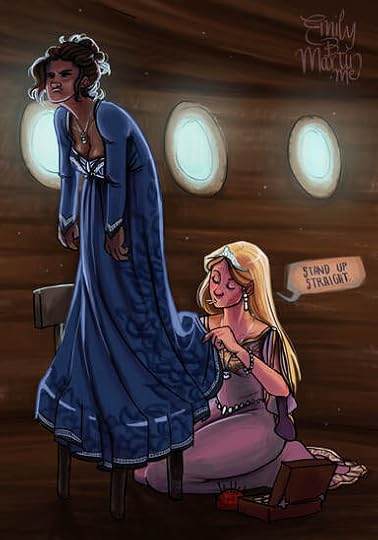
 WHY DOES NO ONE TAKE ME SERIOUSLY? So I leaped into 2017 in almost a panic—what do I do? How could I rectify the fact that my novels were for young adults, but my art looked like it was for a fifth-grade book fair? My art style had changed very little since I first studied the cartoony Harry Potter fan art of artists like Tealin and Makani circa 2002. Could I prune it into something that better channeled the older audience of my books? Was that wrong, to force my art to be something it wasn’t? Was it something it wasn’t, or something it just hadn’t become yet? (Things got existential.)
 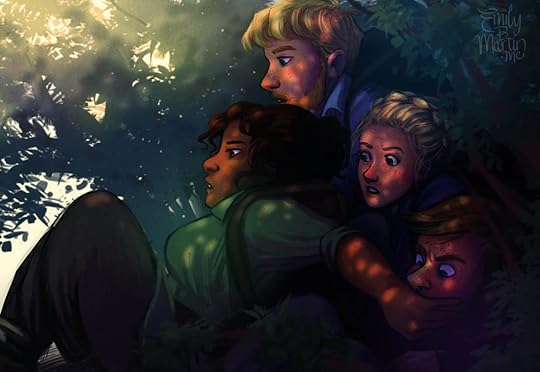 Color, I decided. Color was a major factor, along with my roots in mimicking Disney character design. To mature my style, I first needed to quiet the unicorn riot happening in my palettes, as well as find a more realistic shorthand for faces. I settled into a spate of illustrations with a very limited palette, laying down one primary color and adding only minimal accents.
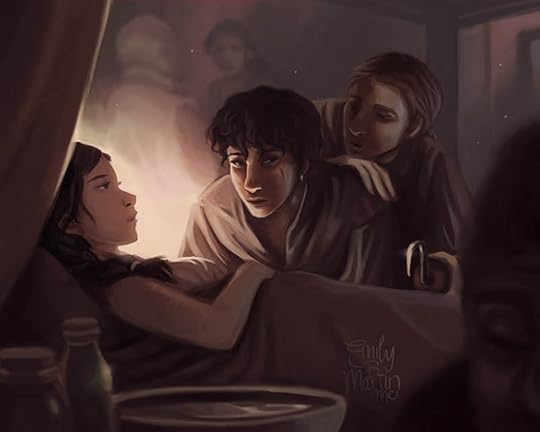
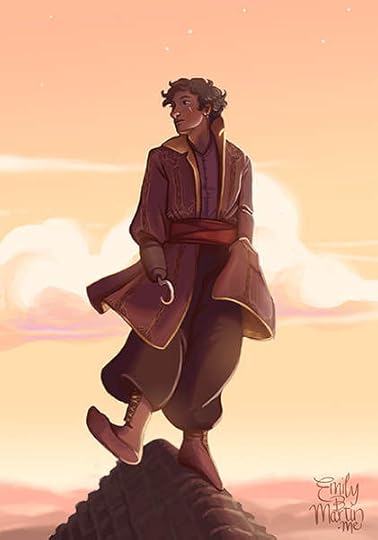 One thing this forced me to do was focus on value more than color. Value, in a crude explanation, is essentially looking at a piece in grayscale. It makes sure the piece translates by virtue of light and dark, rather than hue. I actually did a few experimental pieces where I painted the image first in grayscale and then added color. I liked the value painting but never liked the colorization—they always looked muddy. But it was great practice.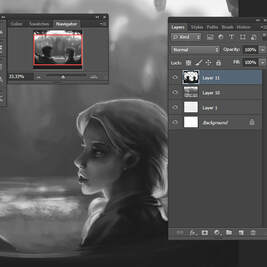
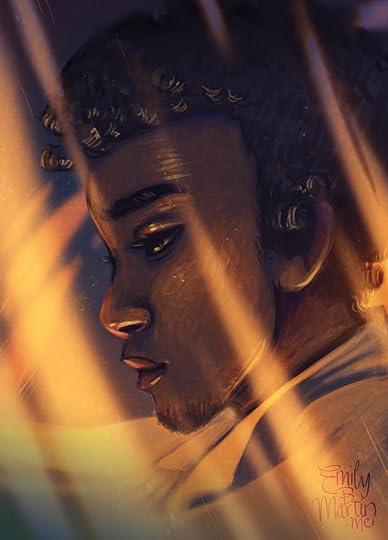
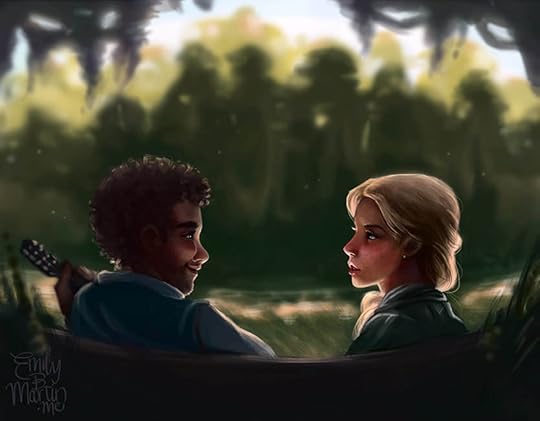 To internalize a more realistic facial construction, I did a series of character portraits based off photographs. These helped me pinpoint some of my issues—much of it rested in how I drew eyes. I forced myself to make eyes smaller and less shiny, and to add an appreciable amount of grunge and pigment to the corners and lids. Small blemishes and five o’clock shadows helped add some complexity and realism not present in my earlier cartoony pieces.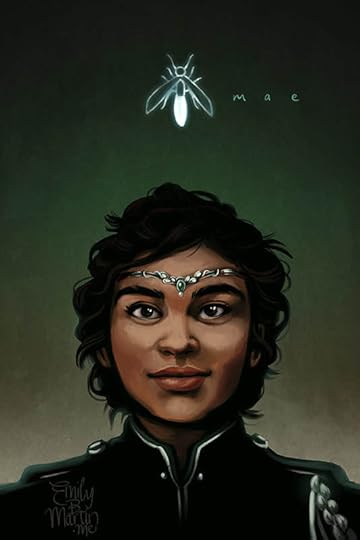
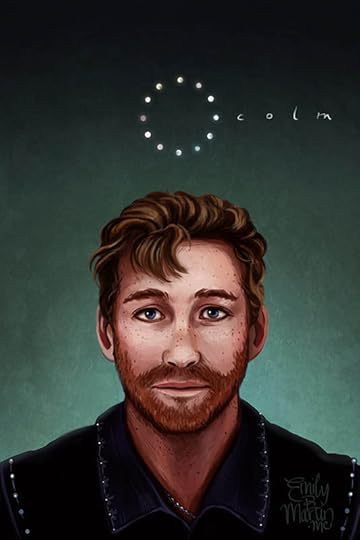
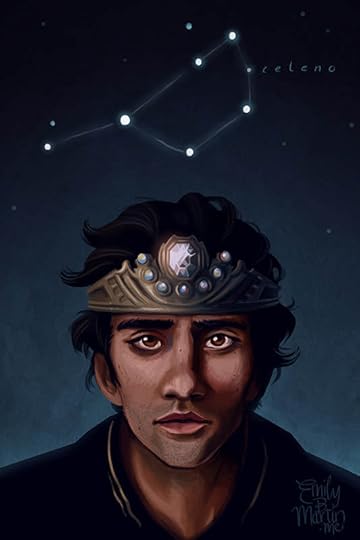 Face models: Kawennáhere Devery Jacobs, Dean O'Gorman, Oscar Isaac. You can find a progress video for the image of Mae in my Videos tab. My work toward the end of 2017 leans toward the stoic and realistic, with subtle palettes and subdued mood.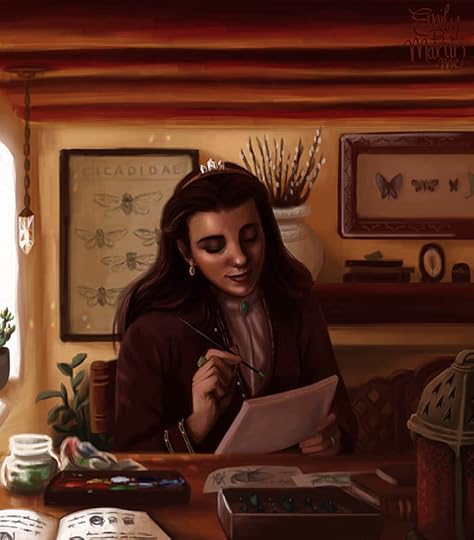
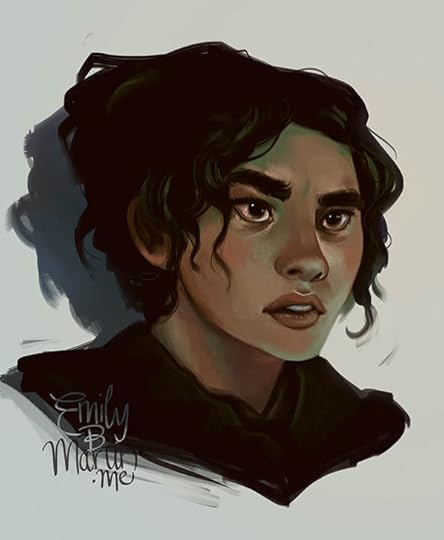
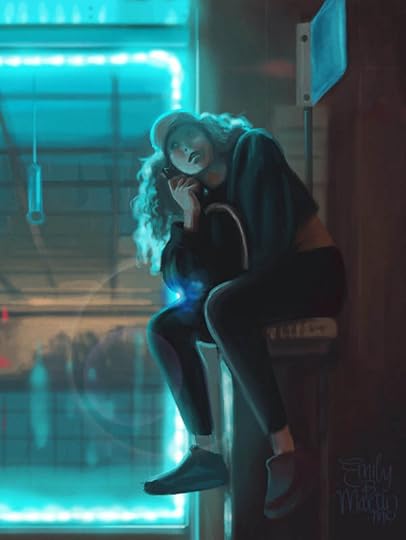 These pieces were some of the best work, technically, that I’ve achieved before or since. And they did reflect the new turn of my mood, a downward trend toward anxiety and introspection. But while I was proud of these pieces and still display them as some of the highlights of my portfolio, I also wondered if I’d sacrificed some of the whimsy and levity of my earlier work.
Then, suddenly, a wild 2018 appeared! 2018: Finding the Art
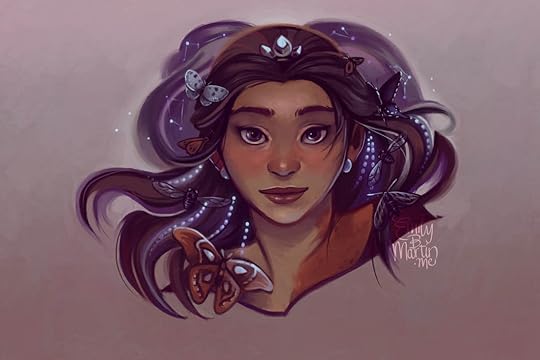 For Christmas 2017, one of the gifts I asked for was an artbook from one of my favorite artists, Lois van Baarle. I received it all shiny and beautiful and dived into it. And in the same way that Megan Whalen Turner’s work reminds me why I love writing, Loish’s artbook suddenly reminded me why I love not just art, but illustrative work in particular. She does such an amazing job at incorporating rich color, whimsy, and sheer artistry into her pieces… and they don’t feel juvenile or amateurish at all. I realized that the past few years had helped me achieve great things in my art—arguably the biggest strides I’d made since middle school. Now it was time to synthesize all that I’d learned back into my natural style.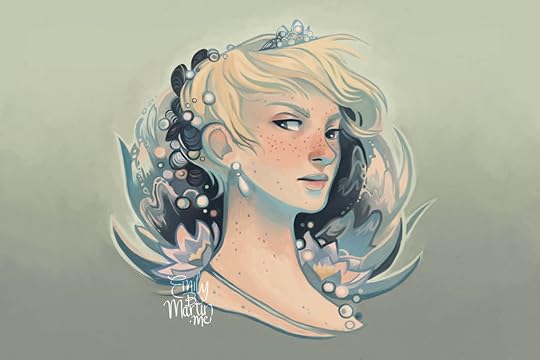
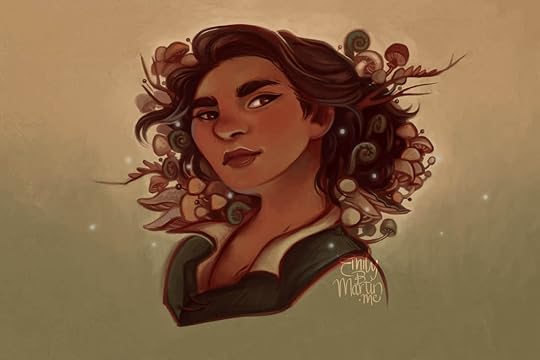 I decided to make 2018 about boosting my pieces from just “pretty picture” to “actual art,” focusing on elements that complemented and enhanced the image. In some cases, like the very Loish-esque character portraits above, I relied on the incorporation of whimsical details. In others, I explored dramatic lighting.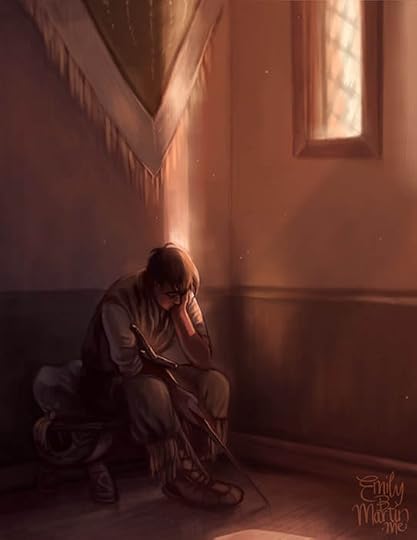
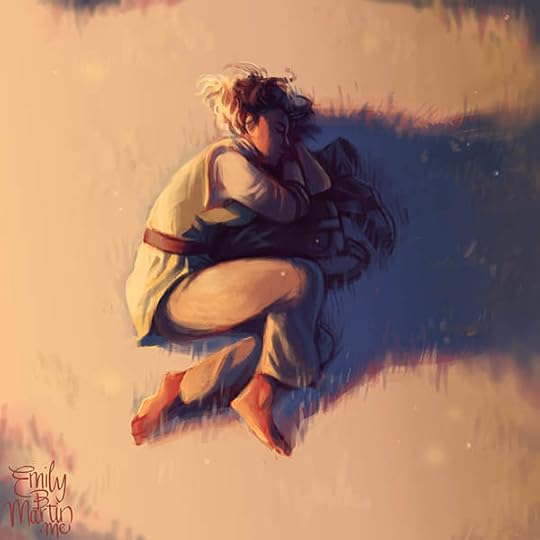 I played mix-and-match in 2018, leaping from one stylistic sandbox to another, pushing and pulling all the concepts I’d learned over the past few years to see how far they'd stretch. My work from 2018 is some of the most varied I’ve ever produced, but while in the past that might have suggested inconsistency, here it was a veritable playground of figuring out what the hell “Art” can actually mean.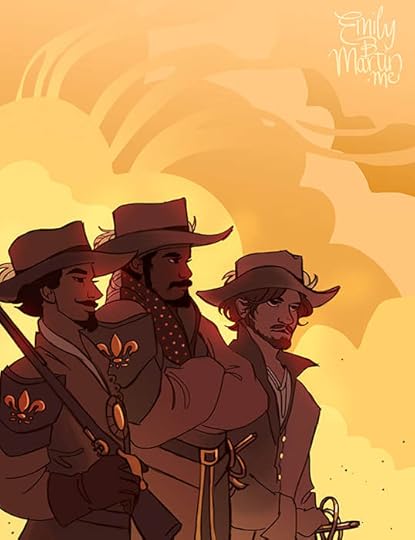
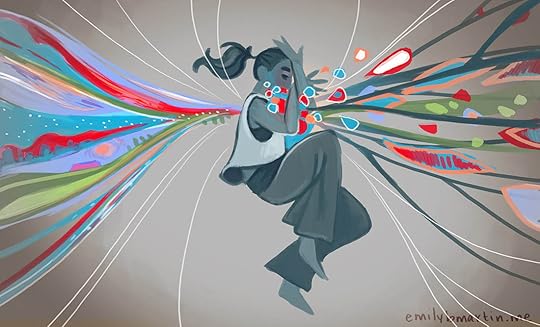

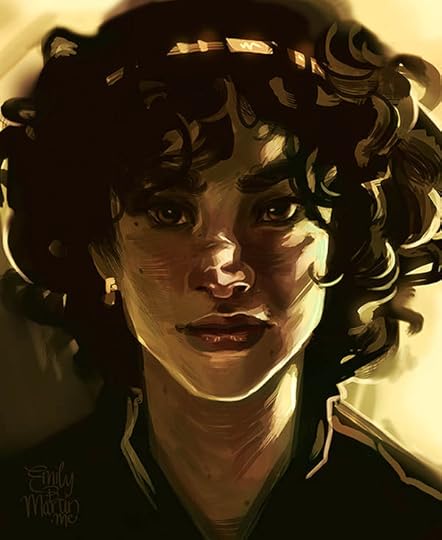 2018 was also the year that saw Creatures of Light published, the final installment in my trilogy. While I still did a lot of continued promotion for my series, my art started to draw more from other books and media. I produced a lot of fan art that year.
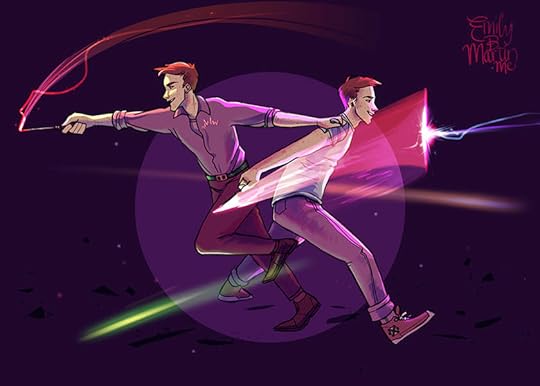 And so 2019 arrived…
2019: Purposeful Emotion …and fell flat on its face.
In the first two months of this year, I’ve produced very little quality content. Some of that is for good reasons, like throwing down some record-high wordcounts on my current manuscript and working on a big, exciting project I can’t share yet. Some reasons have been less good, like my angst over the government shutdown and some personal struggles that have me feeling like I’m just spinning my wheels.
But that’s okay. I’ve decided to make this year about being more purposeful in how I approach a piece, taking more time beforehand to envision, draft, and research it. Thanks to my years practicing foundation elements like depth, value, and color, I want to go a step further. I want to wring more emotion from my pieces. I want a viewer to look at a piece and feel it.
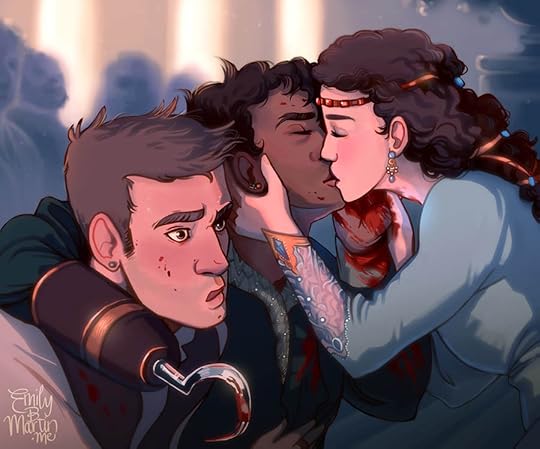
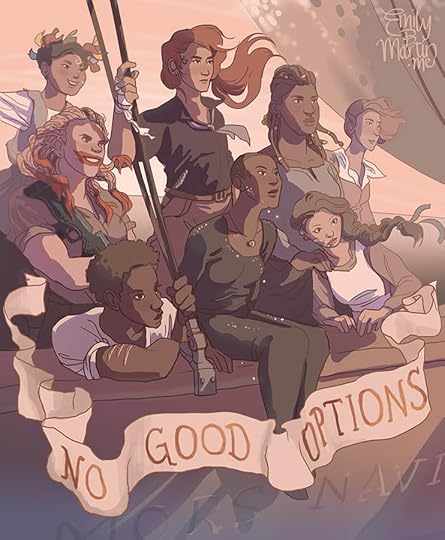
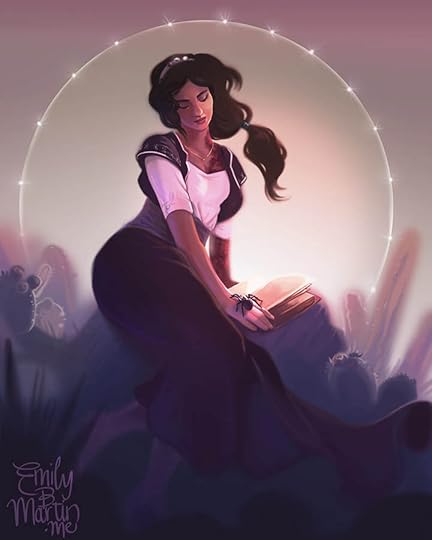 I’ll always have weak spots. My composition needs big time work, and I could benefit from revisiting basics like hands, feet, and noses. But the good news is, now I have the framework, and just as important, now I have the confidence. Setting these concrete, long-term goals has shown me that with focus and effort, I can make tangible, intentional strides in my art. This kind of approach might not work for everyone. That’s fine! I enjoy prepping, planning, and setting objectives, but it might very well stress you or another artist out. If art is your way to relax, this might all seem like overkill. If you try setting these kinds of goals and it leeches the enjoyment out of your work, try something else! While struggle is the way we grow, I believe overall there should be joy and a sense of achievement in the process. There’s no right way to create art. This is simply a way that has helped me.
What are some of your art goals for 2019? How are you going about achieving them? Let me know below! Resources Because I didn’t have the benefit of taking art classes after high school, much of my progress has come from studying others online. Some of my favorite resources include:
Loish’s Digital Art Group
This is a great Facebook group for digital artists of all skill levels, moderated by the aforementioned Lois van Baarle. People post all kinds of work asking for feedback from other users, and despite having thousands of members in the group, all the interactions I’ve experienced are friendly and helpful, not nasty.
One Fantastic Week
Another Facebook group, based on a weekly web show for self-employed fantasy artists. It was recommended to me by artist and friend Justin Donaldson, who is himself offering some online tutorial courses.
SenshiStock on Patreon
I’ve been following SenshiStock for years and have done several pieces based off her excellent reference photoshoots. I like to collect interesting poses she posts and pull them out as warmup sketches.
Griz and Norm on Instagram
These two are feature animation artists at Disney and frequently post tips on everything from costume design to storyboarding, plus concept sketches and bonus material from your favorite Disney films. What I'm Reading: The Reluctant Queen, Sarah Beth DurstMegg's History of Graphic Design, Philip B. MeggsA is for Arsenic: The Poisons of Agatha Christie, Kathryn HarkupAnd Then There Were None, Agatha ChristieHarry Potter and the Prisoner of Azkaban, J.K. Rowling (out loud to my kids)
January 30, 2019
A Park Ranger Vignette
JANUARY 2019  I wrote myself into a conundrum.
It was a good conundrum to have, but one I had to fix quickly. As many of you know, I rotate my blog post topics for writers, artists, and readers of my books. January's was slated to be for writers. In 2018, my writing posts were some of my favorites, documenting things like how to write next-level heroines and how to equip your characters for a trek through the wilderness.
But try as I might, as 2019 got underway, I couldn't get excited about a post for writers. My mind, instead, was focused on the ongoing government shutdown. I was watching my friends in the National Park Service apply for unemployment and hastily hunt for part-time work. I was watching rangers who have spent decades in service to the NPS network for food pantries. One mentor of mine, who hired me for my first internship, was furloughed just days before her retirement date.
I did what I could. I angrily called my senators. I sent angry cookies to my friends on furlough. I put angry words on one of my nature-nerd manuscripts. I did angry yoga. I vented to my also-angry mom. But there reached a point where it seemed like none of it was doing anything, for me or anybody else. So I turned, finally, to my monthly blog.
I had a good post written--"Five Low/No-Cost Ways You Can Help National Parks Survive the Shutdown." I interviewed my affected friends and combed articles from the National Park Foundation and National Parks Conservation Association. I looped another author in for a book giveaway. I curated a sweet national parks reading list. I made a flashy graphic.
Then, on Friday, the government re-opened. Federal employees and contractors went back to work. The engine sputtered to life again. I was happier that day than I'd been all of 2019. 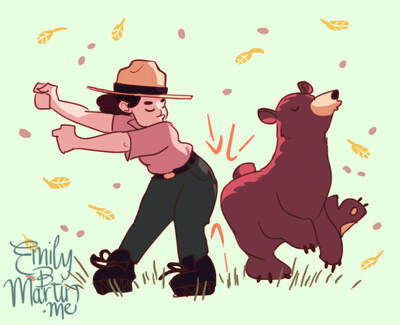 Disclaimer: Do Not Attempt to Bump Dance with Bears But some of my other friends were more wary. They knew the deal the government agreed upon was only supposed to last three weeks. If Congress and the president can't come to an agreement, things could very well shut back down on February 15.
So I'm shelving the post I wrote... for now. The points in it are valid even when not under a shutdown, but I'm going to save it until after February 15. Hopefully, I won't have to share it at all, and we can go back to our regularly scheduled programming of art blogs and writing tips. But if things go under again, expect to see it posted shortly afterward, fancy graphic and book giveaway and all.
Because I didn't have another post written for January, I'm sharing A Park Ranger Vignette, a short story I wrote for HarperCollins a few years ago. It features a Yellowstone ranger struggling through a rough morning in the park, and the people and phenomena that remind her just why she chose to be a ranger in the first place.
As an added bonus, I've included the national park reading list I curated from my original post. It features some of my favorite books written by park rangers and set in national parks. I hope it gives you some great additions to your TBR pile!
Thanks for sharing this time with me---check out A Park Ranger Vignette after the jump! Castle Geyser in the early morning. Margie Feng stormed up the visitor center staircase, her heavy government-issue boots filling the stairwell with resounding echoes. Her anger hung around her head in a cloud, her tight gray collar hot. She flung open the door on the landing—and collided with a body in full forward momentum.
“Woah!” A hand jumped out to grab her arm. “Where’s the fire, Ranger?”
A modicum of her anger eased, but not entirely. It was David, looking sharp in his formal uniform, the National Park Service badge gleaming golden on his chest, not buffed and scratched as hers was. Still, she was in a rush, and she hurried to move past him for the row of ranger lockers.
“Sometimes I wish there was a fire, dammit,” she said. “A nice, thousand-acre wildfire to clear this place out and give us an hour or two without someone howling about traffic or entrance fees or the rain in their tent.”
She flung her locker open and shoved her bicycle helmet inside, drawing out her flat hat. David leaned against the locker next to hers. “What’s up with you?”
“I can’t talk right now, David, I’m way, way late.” Margie jammed her flat hat on her head, disrupting her long, shiny black ponytail. “I’m on geyser predict, and I should have gotten the read off Castle fifteen minutes ago. Who’s on desk this morning?”
“I am,” he said, flashing that inimitable white grin. “Four full hours, baby—on the fourth of July.”
“Oh God, it is the fourth, isn’t it?” Yellowstone would be packed today. No wonder her morning had started off so badly. She snatched her radio from her locker and went to buckle it on her belt. Instead, she snagged the casing, and the whole thing fell out, dropping with an expensive smack on the linoleum. She balled her fists and drew in a sharp breath.
“Hey,” David said, his voice a bit softer. “Talk to me, Margie. What’s wrong?”
She let out her breath and covered her face with her hands. “Just… a bunch of little things. Stupid things.”
“Like?”
“David, I need to be out in the basin right now—people are going to be looking for today’s geyser predictions.”
“Listen, Castle Geyser erupted an hour ago—the guys at the Lower General Store told me. She’s got hours before she goes again. I can handle a few angry visitors—I’ll tell them there’s a bison wallowing out by Morning Glory Pool.”
“Don’t talk to me about bison.” Margie took another deep breath and retrieved her radio from the floor. “There was a bison jam at the crosswalk. The big cranky bull—the one that gored those Australian tourists the other week—he was standing right in the road like an asshole. Folks were stopping their cars. A mom and her toddler were barely ten feet away, trying to get a selfie.”
“So you had to be Mean Ranger first thing,” he said in understanding.
“Right. Nearly blew a fuse trying to get everybody away, and then made a fool of myself shooing the damned animal into the grass. I got cussed at.”
“Oh yeah? I’ll fight him.”
“It was the mother.”
“Ah,” he said in disappointment. A typical bison jam, with a "red dog" (calf). “Anyway,” she continued, “then I blew my bike tire on a gin bottle somebody tossed, and while I was stopped, a guy pulled up to yell at me for not having signs for the big trees.”
David’s brow creased in confusion. “The big trees?”
“Yeah.” Margie mimicked the angry visitor’s voice. “Why should I pay good tax money if you don’t even tell people where to see the most famous trees in the country?”
“The most famous trees…” David’s face split with shock. “You don’t mean…”
“Yes,” Margie confirmed, pointing to the gold redwood cones on her flat hat.
“Redwood trees?”
“Correct.”
“In California."
“Those are the ones.” Margie closed her locker. “Granted, he’s right—we don’t have signs for them. Not a single one. Sequoia National Park, 1,000 miles ahead on right.”
David groaned in commiseration and held out his arms, folding her in a hug. He was warm and reassuring, and his gray long-sleeved uniform shirt smelled of fresh detergent, not tangy with sweat as Margie’s was.
“Poor Mean Ranger,” he said. He removed her flat hat and kissed the top of her head.
She exhaled the last of her breath. David had a way of anchoring her, of shooing away some of the stress that came from working in such a major hub of such a major park. Where she got frazzled, he managed to stay cool. She could even smell starch in his uniform. Starch. She leaned back and took him in a little more closely. The dark stubble that often covered his chin was gone, and he was wearing his formal felt hat, not the usual summer straw hat.
“You look nice today,” Margie said suspiciously. “Why so nice?”
“Are you insinuating I don’t look nice all the other days?”
“If you’re going to make jokes, I’m twenty minutes late for geyser predict.”
He straightened his dark green tie where she’d mussed it. “I’m giving a special program to that group from the historic society today.”
“Oh.” The barely-perceptible trace of disappointment in his voice told her exactly what program he’d been asked to give. “I see. The Buffalo Soldiers?”
“Yep.” David’s great-grandfather had been a Buffalo Soldier, one of the African-American cavalrymen who had served as some of the very first park rangers, well before there was ever a National Park Service. David had an old photo of his great-grandfather taped in his locker, and the family resemblance was clear—the same deep brown skin and upturned lips that always looked like a little smile. He was proud of his great-grandfather, and proud of his connection to the national parks, a connection that for a long time had been smothered in the volumes of history.
But history wasn’t David’s first love. It wasn’t even really his strong point. He was a geology nut, drawn to Yellowstone for the outrageous landscape and phenomena found nowhere else in the world. Margie had met him the previous year when he accompanied a survey team doing a radar study on the cone of Old Faithful. She’d been asked to act as a Mandarin translator for one of the other team members. She often got trotted out for jobs like that—sometimes she wondered if the brass who had hired her in the past skipped over her two degrees in park management and six years in the North Cascades and Olympic and just honed right in on that one credential. Fluent in Mandarin. It was certainly a useful skill, but she disliked how often it became her primary identity. Just as David was often called on to give an authentic history program on the Buffalo Soldiers. Such was the nature of the Park Service—grasping at what little diversity they managed to attract with their shrinking budgets and history of exclusion. History that, granted, was slowly being righted—so long as the administration in DC thought it worth their time.
Which was never a given.
Margie sensed the seconds ticking away against her wrist, but suddenly she didn’t want to leave David’s arms. She could almost hear the hum of incoming crowds outside—she could feel the world pressing in through the visitor center windows. She leaned into him again, tucking her nose under his smoothly-shaved jaw.
Her phone buzzed in her pocket. Reluctantly, she slid it out halfway to glance at the text. It was from one of the law enforcement rangers. She groaned.
“What?” David asked.
“Bix wants to know how to say no parking in Mandarin.”
“Tell him how to say park anywhere.”
The intercom on the wall crackled. “Hey, uh, is anybody else up there? I’m alone at the desk—and where are our geyser predictions?”
They both let out a similar sigh and let go of one another.
“I’d better go rescue Mike,” David said. He tilted her chin and kissed her warmly. “And you have a date with Castle Geyser.”
She nabbed a second kiss, for fortitude. “I’ll radio in when I’ve got a reading. Good luck at the desk.”
He set her flat hat back on her head. “Later, Ranger.”
They parted ways—he heading down the staircase for the public area of the visitor center below, she taking the opposite one to head outside.
It was a cool morning, her favorite time of day to be in the Upper Geyser Basin. In the middle of the afternoon, the white sinter around the boardwalks would blaze with heat, but now the basin was crisp and quiet, wreathed in columns of steam as far as the eye could see. Old Faithful boiled quietly in its cone, sending white clouds billowing against the dark backdrop of lodgepole pines. Despite her earlier encounters, and the promise of a full parking lot later in the day, not many people were out this early. Soon the ambient buzz of cars and buses was lost to the bubbling and frothing of the geysers and hot springs. The air was thick with the smell of sulfur, a scent she’d come to love with an almost absurd devotion. Upper Geyser Basin. Old Faithful is erupting on the right. She walked down the paved trail toward Castle Geyser, the jagged cone thrusting up like a turret against the bright blue morning. Thankfully, there were no bison plodding along the path. Instead, she saw a family heading her way, the parents flanking a little girl in a wide-brimmed bucket hat. As Margie drew closer, she could see the telltale booklet clutched to the girl’s chest. She was working on her Junior Ranger badge.
The parents’ eyes lit up as they saw Margie approaching. The mother shook her little girl’s hand.
“Sasha, honey, look—it’s a park ranger!”
Sasha stopped in her tracks, her two brown pigtails frizzed by the geyser steam. She looked shyly up at Margie.
“Good morning,” Margie said, trying to inject enthusiasm into her voice. “It looks like you’re going to be a Junior Ranger soon!”
“Just one more activity,” the mother said excitedly, nudging her daughter again. “She has to interview a park ranger.”
Ah, yes. That page. Margie mentally filed through the standard answers she usually gave to the kids who came to her throughout the day.
“Go on, Sasha,” said the mother. “Look at your book, and then ask the park ranger the questions.”
But Sasha was suddenly shy, hiding her face behind her booklet. At Margie’s hip, her radio crackled. She was aware of her wristwatch again. Tick, tick, tick. She was probably well over a half an hour late with the geyser predictions—the hotel staff would be righteously pissed by this point.
Hurry up, kid, she thought. This ranger is hella late.
Then Sasha pointed into the basin and said, “What’s that?”
Margie looked over her shoulder.
Her jaw dropped.
“Oh!” Instinctively, she held out her hand to Sasha, all her anxiety dissolving. “Come with me, hurry! You don’t want to miss this!”
Together she and the little girl rushed up the boardwalks toward the river, her parents hurrying behind. As they went, Margie fumbled for her radio and held it to her face.
“David, it’s Margie. We’ve got water in Beehive’s Indicator!”
“Wooo, Beehive!” came the staticky response.
They reached a viewing platform overlooking the river, where just a few feet in front of them, a short jet of water was issuing at an angle near the base of a squat cone. Margie hefted Sasha onto one of the benches.
“Have you seen Old Faithful erupt yet, Sasha?” she asked.
“Yes,” Sasha said.
“I have news for you—you’re about to meet Beehive Geyser. That little jet of water tells us it’s about to erupt, and when it does, it goes taller than Old Faithful, and it lasts longer than Old Faithful, and coolest of all…”
With the roar of a jet engine coming to life, water shot from the little cone like a firehose, rocketing two hundred feet into the air, filling the early morning tranquility with steam and spray. Sasha’s little head flung backwards to watch it climb, her eyes wide. Behind them, Margie could hear the rapid click click click click of Sasha’s mother’s camera.
“Best of all, Sasha, nobody knows when it’s going to erupt,” Margie said, squeezing the little girl’s hand. “You just have to be lucky.”
“Beehive!” Margie heard David’s voice break through her radio, announcing the eruption to the others in the basin. “We’ve got Beehive at zero-eight-three-six, Beehive at eight thirty-six AM.”
“It sounds like a train,” Sasha said quietly, her face still turned up to the distant crown of water.
Margie watched it quietly with her for a moment. The water misted down, the early morning sun throwing rainbows through its spray. The radio crackled at her waist. She heard Mike’s voice. “This is the Visitor Center, does anyone have the geyser predictions?”
Margie turned her radio off.
“I believe the question in your booklet is about why I became a park ranger?” she asked the little girl.
“Yes,” Sasha whispered.
“Sometimes, Sasha, I don’t know. This job is hard. There aren’t enough of us to do all the work that needs doing, and sometimes it’s hard to take care of the park and the people. I live in a little run-down trailer with mice in the walls, and the money is terrible.” She squeezed the girl’s hand again. “But this place is pretty amazing, don’t you think?”
“Yes. I like the blue-colored hot springs the best.”
“Those are some of my favorites, too. Our national parks are so special, whether they’re geysers here in Yellowstone, or giant redwoods out in California, or historic houses, or battlefields, or ancient cities of the people who came before us. All these places tell the story of this country, long before there were park rangers, before this place was ever called America, even before there were ever people here at all. And these places will be here long after we’re gone—if you and I protect them. I think it’s pretty special to be part of that—just a little, tiny speck in the story of our national parks. How would you like to help me with that?”
Normally when she asked kids that question, they responded with, “That sounds like fun.”
Sasha didn’t. Her face turned up to Beehive’s jet, she said thoughtfully, “That sounds important.”
Oh my God, Margie thought. Finally, someone gets it.
She squeezed the girl’s hand again. “Yes. More than anything, it’s important.”
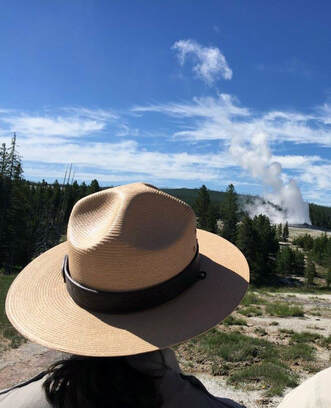 Special thanks to Danielle Tom and Ben Hoppe for their input. All photos belong to me unless otherwise noted. National Park Reading List National parks are all about the story of this country and the people in it. And the main way we honor and preserve that story is by knowing it. We can’t sustain or cherish what we don’t know. Here’s a list of some of my favorite books either written by park rangers, or related to national park units around the country.
All links go to NPS partner bookstores. If you can't purchase them, request them through your local library!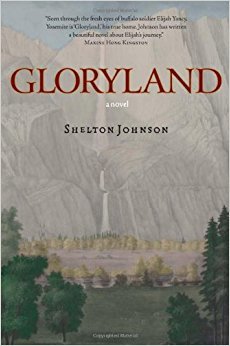 Top Favorite:
Gloryland, Shelton Johnson
This evocative historical fiction follows the journey of Elijah Yancey, a Buffalo Soldier posted to the distant and newly-created Yosemite National Park in 1903.
(Photo credit: Wikipedia.org)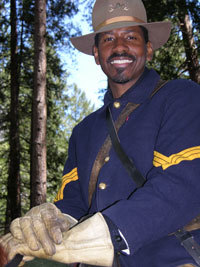 Ranger Shelton Johnson, dressed in the uniform of the 9th Cavalry Regiment. Historical Fiction:
Letters from Yellowstone, Diane Smith
A young woman joins an 1898 expedition to Yellowstone as a botanist, chronicling her challenges, victories, and eccentric fellow naturalists.
YA:
Valley Girls, Sarah Nicole Lemon
When Rilla hits rock-bottom, she joins her park ranger sister in Yosemite and discovers a bold new world of climbing.
Mystery:
The Anna Pigeon Mysteries, Nevada Barr
Perhaps the most well-known of any national park fiction, I always turn to Ranger Anna Pigeon when I’m missing my summer job and need a great heroine to adventure with.
(Pictured: fan art of Anna Pigeon, done for Inktober 2018.) Fantasy:
Nine of Stars, Laura Bickle
When a strange, deadly creature begins stalking the Yellowstone backcountry, it’s up to Petra and her coyote sidekick to unravel the paranormal happenings.
Humorous:
Hey, Ranger! Jim Burnett
Funny stories and misadventures from one ranger’s career.
Nonfiction:
National Parks and the Woman’s Voice, Polly Welts Kaufman
A look at the sometimes quiet, sometimes loud history of women in the male-defined National Park Service.
Mountain Spirit: the Sheep Eater Indians of Yellowstone, Lawrence Loendorf and Nancy Medaris Stone
I love this book for its illustrations, stunning work by Davíd Joaquin depicting traditional Sheep Eater lifeways.
(Pictured: One of Joaquin's paintings, depicting a Sheep Eater man and his dogs pulling travois.)
 Nonfiction Thriller:
Death in Yellowstone, Lee H. Whittlesey
A grimly fascinating look at all the ways people have died in Yellowstone National Park.

Children’s:
So Far from the Sea, Eve Bunting
A child visits the site of Manzanar War Relocation Camp, where his father was imprisoned for three years as a boy.
(Pictured: A photo of a family incarcerated in Manzanar, taken by Ansel Adams.) Children's (continued):
The Three Little Javelinas, Susan Lowell
A southwestern retelling of the classic Three Little Pigs.
Honorable Mentions:
The Big Burn, Timothy Egan
This nonfiction book is about the early US Forest Service, not the National Park Service, and gives a thrilling look at the mismanagement that shaped the agency’s mission. There’s also a PBS documentary by the same name based on the events in the book.
In the Heart of the Sea, Nathaniel Philbrick
While most of this book takes place on the ocean and off the coast of South America, it gives a compelling, often grisly look at the whaling industry that’s memorialized in many New England maritime parks, like Nantucket NHL District and New Bedford Whaling NHP.
These Truths, Jill Lepore
A comprehensive book on American history, from 1492 to 2016. It doesn’t touch on national parks much, but it gives a desperately-needed look at the arcs and cycles of American government. January Art Roundup Aside from some client work, only a few pieces (see the aforementioned shutdown anxiety; it's a soul-sucker). Pieces include a painting of Gemma, a sketch inspired by These Truths by Jill Lepore, and a thank-you cartoon for Megan Whalen Turner, author of the Queen's Thief series. What I'm Reading: Seafire, Natalie C. ParkerGive Me Some Truth, Eric GansworthThese Truths, Jill LeporeSave the Cat! Writes a Novel, Jessica BrodyHarry Potter and the Sorcerer's Stone, J.K. Rowling (out loud to my kids)
I wrote myself into a conundrum.It was a good conundrum to have, but one I had to fix quickly. As many of you know, I rotate my blog post topics for writers, artists, and readers of my books. January's was slated to be for writers. In 2018, my writing posts were some of my favorites, documenting things like how to write next-level heroines and how to equip your characters for a trek through the wilderness.
But try as I might, as 2019 got underway, I couldn't get excited about a post for writers. My mind, instead, was focused on the ongoing government shutdown. I was watching my friends in the National Park Service apply for unemployment and hastily hunt for part-time work. I was watching rangers who have spent decades in service to the NPS network for food pantries. One mentor of mine, who hired me for my first internship, was furloughed just days before her retirement date.
I did what I could. I angrily called my senators. I sent angry cookies to my friends on furlough. I put angry words on one of my nature-nerd manuscripts. I did angry yoga. I vented to my also-angry mom. But there reached a point where it seemed like none of it was doing anything, for me or anybody else. So I turned, finally, to my monthly blog.
I had a good post written--"Five Low/No-Cost Ways You Can Help National Parks Survive the Shutdown." I interviewed my affected friends and combed articles from the National Park Foundation and National Parks Conservation Association. I looped another author in for a book giveaway. I curated a sweet national parks reading list. I made a flashy graphic.
Then, on Friday, the government re-opened. Federal employees and contractors went back to work. The engine sputtered to life again. I was happier that day than I'd been all of 2019.
Disclaimer: Do Not Attempt to Bump Dance with Bears But some of my other friends were more wary. They knew the deal the government agreed upon was only supposed to last three weeks. If Congress and the president can't come to an agreement, things could very well shut back down on February 15.So I'm shelving the post I wrote... for now. The points in it are valid even when not under a shutdown, but I'm going to save it until after February 15. Hopefully, I won't have to share it at all, and we can go back to our regularly scheduled programming of art blogs and writing tips. But if things go under again, expect to see it posted shortly afterward, fancy graphic and book giveaway and all.
Because I didn't have another post written for January, I'm sharing A Park Ranger Vignette, a short story I wrote for HarperCollins a few years ago. It features a Yellowstone ranger struggling through a rough morning in the park, and the people and phenomena that remind her just why she chose to be a ranger in the first place.
As an added bonus, I've included the national park reading list I curated from my original post. It features some of my favorite books written by park rangers and set in national parks. I hope it gives you some great additions to your TBR pile!
Thanks for sharing this time with me---check out A Park Ranger Vignette after the jump!
Castle Geyser in the early morning. Margie Feng stormed up the visitor center staircase, her heavy government-issue boots filling the stairwell with resounding echoes. Her anger hung around her head in a cloud, her tight gray collar hot. She flung open the door on the landing—and collided with a body in full forward momentum.“Woah!” A hand jumped out to grab her arm. “Where’s the fire, Ranger?”
A modicum of her anger eased, but not entirely. It was David, looking sharp in his formal uniform, the National Park Service badge gleaming golden on his chest, not buffed and scratched as hers was. Still, she was in a rush, and she hurried to move past him for the row of ranger lockers.
“Sometimes I wish there was a fire, dammit,” she said. “A nice, thousand-acre wildfire to clear this place out and give us an hour or two without someone howling about traffic or entrance fees or the rain in their tent.”
She flung her locker open and shoved her bicycle helmet inside, drawing out her flat hat. David leaned against the locker next to hers. “What’s up with you?”
“I can’t talk right now, David, I’m way, way late.” Margie jammed her flat hat on her head, disrupting her long, shiny black ponytail. “I’m on geyser predict, and I should have gotten the read off Castle fifteen minutes ago. Who’s on desk this morning?”
“I am,” he said, flashing that inimitable white grin. “Four full hours, baby—on the fourth of July.”
“Oh God, it is the fourth, isn’t it?” Yellowstone would be packed today. No wonder her morning had started off so badly. She snatched her radio from her locker and went to buckle it on her belt. Instead, she snagged the casing, and the whole thing fell out, dropping with an expensive smack on the linoleum. She balled her fists and drew in a sharp breath.
“Hey,” David said, his voice a bit softer. “Talk to me, Margie. What’s wrong?”
She let out her breath and covered her face with her hands. “Just… a bunch of little things. Stupid things.”
“Like?”
“David, I need to be out in the basin right now—people are going to be looking for today’s geyser predictions.”
“Listen, Castle Geyser erupted an hour ago—the guys at the Lower General Store told me. She’s got hours before she goes again. I can handle a few angry visitors—I’ll tell them there’s a bison wallowing out by Morning Glory Pool.”
“Don’t talk to me about bison.” Margie took another deep breath and retrieved her radio from the floor. “There was a bison jam at the crosswalk. The big cranky bull—the one that gored those Australian tourists the other week—he was standing right in the road like an asshole. Folks were stopping their cars. A mom and her toddler were barely ten feet away, trying to get a selfie.”
“So you had to be Mean Ranger first thing,” he said in understanding.
“Right. Nearly blew a fuse trying to get everybody away, and then made a fool of myself shooing the damned animal into the grass. I got cussed at.”
“Oh yeah? I’ll fight him.”
“It was the mother.”
“Ah,” he said in disappointment.
A typical bison jam, with a "red dog" (calf). “Anyway,” she continued, “then I blew my bike tire on a gin bottle somebody tossed, and while I was stopped, a guy pulled up to yell at me for not having signs for the big trees.”David’s brow creased in confusion. “The big trees?”
“Yeah.” Margie mimicked the angry visitor’s voice. “Why should I pay good tax money if you don’t even tell people where to see the most famous trees in the country?”
“The most famous trees…” David’s face split with shock. “You don’t mean…”
“Yes,” Margie confirmed, pointing to the gold redwood cones on her flat hat.
“Redwood trees?”
“Correct.”
“In California."
“Those are the ones.” Margie closed her locker. “Granted, he’s right—we don’t have signs for them. Not a single one. Sequoia National Park, 1,000 miles ahead on right.”
David groaned in commiseration and held out his arms, folding her in a hug. He was warm and reassuring, and his gray long-sleeved uniform shirt smelled of fresh detergent, not tangy with sweat as Margie’s was.
“Poor Mean Ranger,” he said. He removed her flat hat and kissed the top of her head.
She exhaled the last of her breath. David had a way of anchoring her, of shooing away some of the stress that came from working in such a major hub of such a major park. Where she got frazzled, he managed to stay cool. She could even smell starch in his uniform. Starch. She leaned back and took him in a little more closely. The dark stubble that often covered his chin was gone, and he was wearing his formal felt hat, not the usual summer straw hat.
“You look nice today,” Margie said suspiciously. “Why so nice?”
“Are you insinuating I don’t look nice all the other days?”
“If you’re going to make jokes, I’m twenty minutes late for geyser predict.”
He straightened his dark green tie where she’d mussed it. “I’m giving a special program to that group from the historic society today.”
“Oh.” The barely-perceptible trace of disappointment in his voice told her exactly what program he’d been asked to give. “I see. The Buffalo Soldiers?”
“Yep.” David’s great-grandfather had been a Buffalo Soldier, one of the African-American cavalrymen who had served as some of the very first park rangers, well before there was ever a National Park Service. David had an old photo of his great-grandfather taped in his locker, and the family resemblance was clear—the same deep brown skin and upturned lips that always looked like a little smile. He was proud of his great-grandfather, and proud of his connection to the national parks, a connection that for a long time had been smothered in the volumes of history.
But history wasn’t David’s first love. It wasn’t even really his strong point. He was a geology nut, drawn to Yellowstone for the outrageous landscape and phenomena found nowhere else in the world. Margie had met him the previous year when he accompanied a survey team doing a radar study on the cone of Old Faithful. She’d been asked to act as a Mandarin translator for one of the other team members. She often got trotted out for jobs like that—sometimes she wondered if the brass who had hired her in the past skipped over her two degrees in park management and six years in the North Cascades and Olympic and just honed right in on that one credential. Fluent in Mandarin. It was certainly a useful skill, but she disliked how often it became her primary identity. Just as David was often called on to give an authentic history program on the Buffalo Soldiers. Such was the nature of the Park Service—grasping at what little diversity they managed to attract with their shrinking budgets and history of exclusion. History that, granted, was slowly being righted—so long as the administration in DC thought it worth their time.
Which was never a given.
Margie sensed the seconds ticking away against her wrist, but suddenly she didn’t want to leave David’s arms. She could almost hear the hum of incoming crowds outside—she could feel the world pressing in through the visitor center windows. She leaned into him again, tucking her nose under his smoothly-shaved jaw.
Her phone buzzed in her pocket. Reluctantly, she slid it out halfway to glance at the text. It was from one of the law enforcement rangers. She groaned.
“What?” David asked.
“Bix wants to know how to say no parking in Mandarin.”
“Tell him how to say park anywhere.”
The intercom on the wall crackled. “Hey, uh, is anybody else up there? I’m alone at the desk—and where are our geyser predictions?”
They both let out a similar sigh and let go of one another.
“I’d better go rescue Mike,” David said. He tilted her chin and kissed her warmly. “And you have a date with Castle Geyser.”
She nabbed a second kiss, for fortitude. “I’ll radio in when I’ve got a reading. Good luck at the desk.”
He set her flat hat back on her head. “Later, Ranger.”
They parted ways—he heading down the staircase for the public area of the visitor center below, she taking the opposite one to head outside.
It was a cool morning, her favorite time of day to be in the Upper Geyser Basin. In the middle of the afternoon, the white sinter around the boardwalks would blaze with heat, but now the basin was crisp and quiet, wreathed in columns of steam as far as the eye could see. Old Faithful boiled quietly in its cone, sending white clouds billowing against the dark backdrop of lodgepole pines. Despite her earlier encounters, and the promise of a full parking lot later in the day, not many people were out this early. Soon the ambient buzz of cars and buses was lost to the bubbling and frothing of the geysers and hot springs. The air was thick with the smell of sulfur, a scent she’d come to love with an almost absurd devotion.
Upper Geyser Basin. Old Faithful is erupting on the right. She walked down the paved trail toward Castle Geyser, the jagged cone thrusting up like a turret against the bright blue morning. Thankfully, there were no bison plodding along the path. Instead, she saw a family heading her way, the parents flanking a little girl in a wide-brimmed bucket hat. As Margie drew closer, she could see the telltale booklet clutched to the girl’s chest. She was working on her Junior Ranger badge.The parents’ eyes lit up as they saw Margie approaching. The mother shook her little girl’s hand.
“Sasha, honey, look—it’s a park ranger!”
Sasha stopped in her tracks, her two brown pigtails frizzed by the geyser steam. She looked shyly up at Margie.
“Good morning,” Margie said, trying to inject enthusiasm into her voice. “It looks like you’re going to be a Junior Ranger soon!”
“Just one more activity,” the mother said excitedly, nudging her daughter again. “She has to interview a park ranger.”
Ah, yes. That page. Margie mentally filed through the standard answers she usually gave to the kids who came to her throughout the day.
“Go on, Sasha,” said the mother. “Look at your book, and then ask the park ranger the questions.”
But Sasha was suddenly shy, hiding her face behind her booklet. At Margie’s hip, her radio crackled. She was aware of her wristwatch again. Tick, tick, tick. She was probably well over a half an hour late with the geyser predictions—the hotel staff would be righteously pissed by this point.
Hurry up, kid, she thought. This ranger is hella late.
Then Sasha pointed into the basin and said, “What’s that?”
Margie looked over her shoulder.
Her jaw dropped.
“Oh!” Instinctively, she held out her hand to Sasha, all her anxiety dissolving. “Come with me, hurry! You don’t want to miss this!”
Together she and the little girl rushed up the boardwalks toward the river, her parents hurrying behind. As they went, Margie fumbled for her radio and held it to her face.
“David, it’s Margie. We’ve got water in Beehive’s Indicator!”
“Wooo, Beehive!” came the staticky response.
They reached a viewing platform overlooking the river, where just a few feet in front of them, a short jet of water was issuing at an angle near the base of a squat cone. Margie hefted Sasha onto one of the benches.
“Have you seen Old Faithful erupt yet, Sasha?” she asked.
“Yes,” Sasha said.
“I have news for you—you’re about to meet Beehive Geyser. That little jet of water tells us it’s about to erupt, and when it does, it goes taller than Old Faithful, and it lasts longer than Old Faithful, and coolest of all…”
With the roar of a jet engine coming to life, water shot from the little cone like a firehose, rocketing two hundred feet into the air, filling the early morning tranquility with steam and spray. Sasha’s little head flung backwards to watch it climb, her eyes wide. Behind them, Margie could hear the rapid click click click click of Sasha’s mother’s camera.
“Best of all, Sasha, nobody knows when it’s going to erupt,” Margie said, squeezing the little girl’s hand. “You just have to be lucky.”
“Beehive!” Margie heard David’s voice break through her radio, announcing the eruption to the others in the basin. “We’ve got Beehive at zero-eight-three-six, Beehive at eight thirty-six AM.”
“It sounds like a train,” Sasha said quietly, her face still turned up to the distant crown of water.
Margie watched it quietly with her for a moment. The water misted down, the early morning sun throwing rainbows through its spray. The radio crackled at her waist. She heard Mike’s voice. “This is the Visitor Center, does anyone have the geyser predictions?”
Margie turned her radio off.
“I believe the question in your booklet is about why I became a park ranger?” she asked the little girl.
“Yes,” Sasha whispered.
“Sometimes, Sasha, I don’t know. This job is hard. There aren’t enough of us to do all the work that needs doing, and sometimes it’s hard to take care of the park and the people. I live in a little run-down trailer with mice in the walls, and the money is terrible.” She squeezed the girl’s hand again. “But this place is pretty amazing, don’t you think?”
“Yes. I like the blue-colored hot springs the best.”
“Those are some of my favorites, too. Our national parks are so special, whether they’re geysers here in Yellowstone, or giant redwoods out in California, or historic houses, or battlefields, or ancient cities of the people who came before us. All these places tell the story of this country, long before there were park rangers, before this place was ever called America, even before there were ever people here at all. And these places will be here long after we’re gone—if you and I protect them. I think it’s pretty special to be part of that—just a little, tiny speck in the story of our national parks. How would you like to help me with that?”
Normally when she asked kids that question, they responded with, “That sounds like fun.”
Sasha didn’t. Her face turned up to Beehive’s jet, she said thoughtfully, “That sounds important.”
Oh my God, Margie thought. Finally, someone gets it.
She squeezed the girl’s hand again. “Yes. More than anything, it’s important.”
Special thanks to Danielle Tom and Ben Hoppe for their input. All photos belong to me unless otherwise noted. National Park Reading List National parks are all about the story of this country and the people in it. And the main way we honor and preserve that story is by knowing it. We can’t sustain or cherish what we don’t know. Here’s a list of some of my favorite books either written by park rangers, or related to national park units around the country.All links go to NPS partner bookstores. If you can't purchase them, request them through your local library!
Top Favorite:Gloryland, Shelton Johnson
This evocative historical fiction follows the journey of Elijah Yancey, a Buffalo Soldier posted to the distant and newly-created Yosemite National Park in 1903.
(Photo credit: Wikipedia.org)
Ranger Shelton Johnson, dressed in the uniform of the 9th Cavalry Regiment. Historical Fiction:Letters from Yellowstone, Diane Smith
A young woman joins an 1898 expedition to Yellowstone as a botanist, chronicling her challenges, victories, and eccentric fellow naturalists.
YA:
Valley Girls, Sarah Nicole Lemon
When Rilla hits rock-bottom, she joins her park ranger sister in Yosemite and discovers a bold new world of climbing.
Mystery:
The Anna Pigeon Mysteries, Nevada Barr
Perhaps the most well-known of any national park fiction, I always turn to Ranger Anna Pigeon when I’m missing my summer job and need a great heroine to adventure with.
(Pictured: fan art of Anna Pigeon, done for Inktober 2018.)
Fantasy:Nine of Stars, Laura Bickle
When a strange, deadly creature begins stalking the Yellowstone backcountry, it’s up to Petra and her coyote sidekick to unravel the paranormal happenings.
Humorous:
Hey, Ranger! Jim Burnett
Funny stories and misadventures from one ranger’s career.
Nonfiction:
National Parks and the Woman’s Voice, Polly Welts Kaufman
A look at the sometimes quiet, sometimes loud history of women in the male-defined National Park Service.
Mountain Spirit: the Sheep Eater Indians of Yellowstone, Lawrence Loendorf and Nancy Medaris Stone
I love this book for its illustrations, stunning work by Davíd Joaquin depicting traditional Sheep Eater lifeways.
(Pictured: One of Joaquin's paintings, depicting a Sheep Eater man and his dogs pulling travois.)
Nonfiction Thriller:Death in Yellowstone, Lee H. Whittlesey
A grimly fascinating look at all the ways people have died in Yellowstone National Park.
Children’s:
So Far from the Sea, Eve Bunting
A child visits the site of Manzanar War Relocation Camp, where his father was imprisoned for three years as a boy.
(Pictured: A photo of a family incarcerated in Manzanar, taken by Ansel Adams.) Children's (continued):
The Three Little Javelinas, Susan Lowell
A southwestern retelling of the classic Three Little Pigs.
Honorable Mentions:
The Big Burn, Timothy Egan
This nonfiction book is about the early US Forest Service, not the National Park Service, and gives a thrilling look at the mismanagement that shaped the agency’s mission. There’s also a PBS documentary by the same name based on the events in the book.
In the Heart of the Sea, Nathaniel Philbrick
While most of this book takes place on the ocean and off the coast of South America, it gives a compelling, often grisly look at the whaling industry that’s memorialized in many New England maritime parks, like Nantucket NHL District and New Bedford Whaling NHP.
These Truths, Jill Lepore
A comprehensive book on American history, from 1492 to 2016. It doesn’t touch on national parks much, but it gives a desperately-needed look at the arcs and cycles of American government. January Art Roundup Aside from some client work, only a few pieces (see the aforementioned shutdown anxiety; it's a soul-sucker). Pieces include a painting of Gemma, a sketch inspired by These Truths by Jill Lepore, and a thank-you cartoon for Megan Whalen Turner, author of the Queen's Thief series. What I'm Reading: Seafire, Natalie C. ParkerGive Me Some Truth, Eric GansworthThese Truths, Jill LeporeSave the Cat! Writes a Novel, Jessica BrodyHarry Potter and the Sorcerer's Stone, J.K. Rowling (out loud to my kids)
December 15, 2018
"Songbird and Shadow": A Woodwalker Short Story
DECEMBER 2018  December! We've made it. 2018 was a roller-coaster year for me, with some very bright highlights, including the release of the final book in the Creatures of Light trilogy and big progress on my other manuscripts. At times this year felt like it detached from linear time altogether, and it was possibly the most stressed I've ever been by large-scale events outside my control, but here we are at the end. In celebration, and as a holiday thank-you to my readers and followers, this month features an illustrated short story set prior to the events of Woodwalker.
It's no secret that Mae, the protagonist and narrator of Woodwalker, is exiled from her home--that much is given away on the back cover of the book. But what did things look like on the night of her arrest? What furtive things were swirling around the palace, and who was slinking through the shadows before Mae was led away from the Silverwood? Take a glimpse into that fateful night through the eyes of a character readers might remember from the firefly slopes of Lampyrinae.
If you haven't read Woodwalker, not to worry--there are only a few spoilers included in this story, and none are major to the plot. Consider this a peek into the events leading up to chapter one. For those of you who have read the book, keep your eyes open for nods to some of the twists and turns you know and love...
Read it all after the jump! SONGBIRD AND SHADOW “Jenë. Jenë. Wake up--Jenë, you have to wake up.”
Jenë shifted on her bunk, wrapped in the warm cocoon of a dream. “Rrgg… go away, Senna.”
Jenë’s bunkmate grabbed the coverlet and stripped it away, letting in a wash of cold air. She swore and curled up, groping for the blanket. “Senna! Go away! It’s not wake up call yet!”
“No,” Senna said urgently. “It’s the middle of the night. But you have to get up—it’s your cousin.”
Jenë groaned. “It’s the day after midsummer. I’m not taking off on some clandestine mission—last time I did she had me felling pines for nine hours…”
“No.” Senna cut her off, and through the haze of sleep Jenë detected more than just mere irritation—Senna was frightened. “It’s not a mission. Something’s happened. I think… I think she’s in trouble.”
Jenë opened her eyes. The idea of Ellamae in trouble was nearly laughable—in every crisis she came across, she generally emerged victorious enough to win a medal. That is, if the king had ever thought her worthy of a medal. Jenë couldn’t fathom an outcome other than her cousin bolstering her already legendary status as the anarchic champion of the Silverwood.
Unless…
Jenë sat up. “What’s happened?” “Get up, put your boots on. Hurry, I don’t know how much time we have.” Senna threw her a pair of trousers to put on under her nightshirt and then tossed her a pair of civilian boots.
“Senna,” Jenë said, belting her trousers. “Tell me what’s going on.”
“I don’t know!” she said, anguished. She was in Ellamae’s squad, one of the scouts who served under her as Woodwalker. “But she’s in prison.”
Jenë’s fingers froze on her boots. “Prison?”
“They locked her up last night. I don’t think word was supposed to get out, but my brother’s a Palace Guard—he told me they brought her in.”
“Why is she there?”
“I don’t know. Something about the king. Something about treason. The prison guards won’t let anybody in, but they might make an exception for family.” She hauled on Jenë’s arm to set her upright, and then pushed her to the door. “Go on!”
Jenë stumbled into the barracks corridor. Still foggy with sleep, she gathered her wits and jogged toward the colonnade connecting the Guard Wing to the main palace. The hallways were dark and silent, but it wasn’t the serene silence that should have accompanied deep night. It was a tense silence, almost tangible, like the palace was holding it’s breath. As Jenë ran from the Guard Wing and into the adjoining foyer, she noticed lamps lit haphazardly, clustered particularly around the dispatch office, where all the scout records were kept. Doors were open where they shouldn’t be; murmuring came from behind others when the rooms beyond should have been empty.
In the greater palace, guards weren’t standing rigidly at their assigned posts—many were leaning around corners or bent over bannisters to whisper to others. She rushed by them. If they’d heard the news about Ellamae, and if they recognized her, they must have guessed where she was going. Jenë’s heart tightened in worry. The Wood Guard would riot for Ellamae, but she wasn’t sure about the Armed Guard, and the Palace Guard was another thing entirely—they were farther from the doings in the country and closer to the king’s inner circle. Jenë couldn’t be sure they would be sympathetic to her or her cousin. The prison landing was going to be the hardest. If the guards there wouldn’t let her in—and technically they shouldn’t— Jenë wasn’t sure what she was going to do.
But to her utter shock, there was no one on the landing. The two corners where the Palace Guards usually stood were empty, and the heavy door was cracked open, leading into the darkness of the prison stairwell. Where had they gone? Were they just inside? Had someone else come to investigate? Jenë was Ellamae’s only family in the palace.
She didn’t wait to think on it. She threw open the door and ran down the stairs, the way lit by guttering cast-iron lanterns. She reached the bottom of the staircase, expecting to find another guard on patrol—but there was no one.
Had Ellamae escaped and dispatched the prison guards? As soon as the idea entered Jenë's head, she flicked it away. The thought of her cousin attacking a fellow Guard was absurd.
Jenë slowed her pace as she headed into the first cell block, steeling herself to peer through the barred doors. Some were empty, but many were not—poor, shivering fools who’d fallen behind on taxes, or mishandled classified information, or given a whisper of being disloyal to the king. Most were asleep, but a few were up, pacing or muttering, or simply staring into the corridor. Jenë swallowed and pressed forward, forcing herself to look in every cell.
Ellamae wasn’t in the first block, or the second. The third was the most remote, reserved for only the most egregious of criminals—murderers and traitors.
“Great Light, you all move louder than an elk caught in the courtyards.”
And her cousin.
She was lying on her back on the flagstones with her feet propped up against the wall. Her dark, curly hair was splayed out behind her, worked loose from its usual unruly knot. She was in uniform, the dark green fabric made black in the dim light, with only a few glints from the silver florets and Woodwalker pin.
She didn’t look at Jenë. Her gaze was fixed on the ceiling. “Mae,” Jenë said, dropping to the floor by the bars.
“Excuse you, I’m in uniform—you address me by my office, Junco.”
“What happened?” Jenë asked, unwilling to let her cousin snark her into distraction. “What’s going on? Why are you here?”
“Because the damned nancy Palace Guards dragged me down here. Palace Guards, Jenë! The Guard of Last Resort, muscling a Woodwalker into a cell! It was probably the proudest day of their lives.” There was another flash of silver. Ellamae was turning something in her fingers—a scout compass. No, a fancier compass—one with an engraved lid. Jenë was surprised the guards hadn’t taken it from her upon her arrest, but she wasn’t going to waste time wondering about it.
She curled her fingers around the bars. “Mae, please—if you answer me, maybe I can help you.”
Ellamae gave a hollow laugh. “No, Jenë. You can’t help me. But, I do know how fast gossip spreads through the Guard, and I’d like to make sure the story’s the truth. So here it is: I shouted myself hoarse at the king and his council.”
The bottom dropped out of Jenë’s stomach. “You did what?”
“Accusations, insults, obscenities—good ones, too, I should probably write some of them down.”
“Why?” she whispered. The other prisoners she’d passed had been given life sentences for less. “Why would you do that?”
“The same reason I do anything, Jenë. Because our king is a raging, inflamed boil on this country.”
Jenë whipped her head to the side, terrified her words would carry. “Ellamae…”
“He’s just making stuff up now,” she continued evenly, as if holding a breakfast conversation and not spouting flagrant treason. “He’s dismantling the Guard, the office of Woodwalker—we, who are meant to protect the Silverwood—he’s destroying us because we’re in the way of his agenda. Lifting mining restrictions, easing pollution thresholds, keeping us busy with stupid stuff like border patrols… it’s all crap, Jenë. It’s always been crap. And I finally went too far for his liking.”
“What’s he going to do?” she asked. “What's your sentence?”
Ellamae was silent, her gaze on the ceiling and her fingers unmoving on the compass. Jenë mentally ticked through all the sentences she’d heard of—life in prison, servitude in the silver mines, even execution in the not-so-distant past, though it wasn’t a common practice for citizens anymore.
“Mae,” she pleaded.
“He’s kicking me out,” she said.
“Kicking you out of the Guard?” Jenë asked. She’d expected at least that, but if that was her only sentence…
“No,” she said. “He’s kicking me out of the Silverwood.”
Jenë’s blood went cold. “Exile?”
“Lifelong exile,” she confirmed. “Hey, I’ll get to see the ocean. Maybe I’ll become a sailor.”
For the first time, her bluster didn’t hit home. Jenë’s fingers shook on the bars as comprehension sunk in—the sentence was the most devastating one she could think of. Wood-folk didn’t travel beyond their own borders. It wasn’t done—it hadn’t been done in generations, not since diplomacy collapsed with Lumen Lake and the monarchy began trading with Alcoro. Wood-folk didn’t need outside trade to supplement their resources in the forest. And Ellamae was a Woodwalker—the youngest in decades, and the fiercest one in history, at least, to the younger scouts. Jenë had a feeling that if someone were to cut her cousin open, soil and leaf litter would spill out instead of blood.
After another heartbeat, Jenë jumped to her feet. “I’ll be right back.”
“Where are you going?”
“To find a prison guard. To find a key. I’ll get you out of here.”
“Oh, please.” At the last second, Ellamae realized her cousin was serious, and she lashed her hand through the bars to snatch a handful of fringe on her boot. “Jenë, stop. Cut it out. You can’t do that.”
“Watch me.”
“Don’t be stupid. I know you’ve got more sense. Do you think a prison guard will just give you their key?”
“I’ll… I’ll bribe one of them, or…”
“Or what? Knock one out? You haven’t even got your target stripes yet, let alone hand-to-hand combat.”
Jenë flushed in the darkness. “I’ll steal a key.”
“And wind up in the next cell over. Jenë, listen. If you break me out, what happens? Do you think I’ll go free? Do you think I can head on back to our family on Beegum Bald and live quietly? No—Vandalen will set the Guard after me as soon as he conjures up the capacity to string two words together. There will be nowhere I can hide in the Silverwood.”
“But…” Jenë searched for rationale. “But our family… your ma and pa, your brothers… Sera, Mae, Sera’s baby is due…”
“I know,” she said, her voice quieter. “I know. Don’t think I haven’t thought about it. But it’s too late, Jenë. It’s too late for me.” Jenë stood silently next to her door, her cousin’s fingers still tangled in her boot fringe. Her eyes began to prickle. Earth and sky. She didn’t want to cry in front of Ellamae—she’d never once seen her cousin shed a tear. But Jenë’s sniffle gave her away, magnified by the cold stone walls.
“I’m going to get you out,” she said, dashing her hand over her eyes.
“No, you’re not. You can’t, and I won’t let you. If you get a key and unlock my door, I’m just going to sit here.”
“How can you say that?” she asked, her voice rising in the darkness, her fists balled by her sides. “How can you just give up? How can you let him win? How can you be okay with leaving us?”
Ellamae’s grip grew tighter on Jenë’s boot. “Sit down.”
She didn’t.
“Jenë Junco, I am in uniform and you are under my command—sit down!”
Her knees buckled of their own accord, and she dropped to the cold stone. This despite the fact that with Jenë in civilian clothes and Ellamae in prison, the hierarchy of command seemed a bit scrambled.
Ellamae’s fingers went from Jenë’s boot to her knee, her eyes piercing through the darkness. “Jenë, listen. I screwed up. I know I did. If I’d kept my temper, maybe I wouldn’t be here. But for how much longer? Vandalen was going to make an example out of one of us sooner or later, and I’m sure my name was first on his list. And here’s the thing—he’ll think he’s won. You understand that? By getting rid of me, he’ll think he’s cowed the other Woodwalkers, and the rest of the Wood Guard, into submission. He’ll think the whispers and the accusations of corruption will shrivel up. You want that to happen? Do you want my defeat to be the Guard’s defeat?”
“No,” Jenë whispered.
“No,” Ellamae agreed. “If you care about me at all, if you care about the Guard, if you care about the Silverwood—then you keep fighting. Got that? Whether I’m here or not, you keep doing what’s right.”
“We’ll never be able to manage it without you.”
“That’s crap. Do you know what a hawkmoth is?” she asked, referencing her epithet.
Jenë ran her sleeve over her nose. “It’s a moth,” she said. “A moth that’s yellow like a bee, and flies like a hummingbird.”
“Right. Sneaky little creature, able to pretend to be something it’s not. But you know what? It’s still just a moth. Not a bee. Not a bird. If an animal sees through it’s disguise, it’s nothing but a snack. Now.” She shook her cousin’s knee. “What’s a junco?”
“A bird,” Jenë said dully. “A little gray bird.” She’d picked it as her epithet because she liked how they flocked around her childhood window, stormy gray, energetic, chittering. But if they were looking for deep personal meaning, Jenë considered it a stretch. Juncos were birds of no importance. No flashy plumage, no sweet song. A background bird. “And what’s the king?” Ellamae asked.
Jenë gave another involuntary glance down the corridor. “Warbird. An eagle.”
“Right. And you know what a junco will do to an eagle?”
“Probably get eaten.”
“Probably. You know what a flock of juncos will do to an eagle? They’ll tear the bastard apart.”
Jenë was silent.
“I’m not a flock, though,” she whispered.
“So raise one,” Ellamae said. “Raise a flock of songbirds. Sparrows and towhees and chickadees. Raise a damned maelstrom of little gray birds, and fight back.”
Jenë pressed her palms to either side of her face, as if she could block out her cousin’s words. She heaved a thick sigh, her nose stuffy. “It won’t help, though. It won’t help you. Even if… the king…” Jenë couldn’t bring herself to say the words aloud, so dangerously treasonous. She drew in a breath. “Prince Valien is next in line. And for all we know, he’ll be even worse.”
It was hard to imagine the prince being a worse king than Vandalen. He’d joined the Guard a few years before, training as diligently as any of the new recruits, but making few friends. If stories from the older scouts could be believed, most were wary of him at best. He was quiet and calculating, always watching, rarely speaking, frequently turning up in places he hadn’t been expected, sometimes with odd bruises or scrapes that couldn’t be explained. If he needed to use Guard materials or gear, he always came at night or the early morning and melted away soon after. Awkward silences persisted around him—many speculated that he was studying the inner workings of the Guard so he could continue the king’s crusade to dismantle it. But he didn’t have his father’s obsession with power—at least, not yet. Where the king was brash and iron-fisted, the prince was a shadow.
He was a mystery. It took Jenë a moment to realize Ellamae had been silent. Her cousin turned the silver compass slowly in her fingers.
“Jenë,” she said, and then she stopped herself. She pursed her mouth, as if she was thinking.
“What?” she asked.
“I think you can trust the prince,” she finally said.
Jenë lifted her head. “You do?”
“At least, I don’t think you need to worry about him. Not right now, anyway. Vandalen isn’t going anywhere any time soon. The main thing is to stick together, and keep upholding the purpose of the Wood Guard. Listen to Reuel, and the other Woodwalkers. They’re just as angry as me, and twice as smart. Don’t let Vandalen divide you. Keep each other strong.”
In the adjoining cell block, something banged against a bar, and Jenë jumped at the echo. Distantly, she heard the creaking of heavy metal hinges from the prison landing. Dread flooded Jenë’s stomach.
“Go,” Ellamae said. “Don’t get caught here.”
“I don’t want to go.” Jenë gripped the bars separating her from her cousin. “What if he sends you away soon? What if he sends you away before we can do anything about it?”
“Jenë, I don’t think there’s any doubt of that.” Her voice was low and sad, and it startled Jenë to hear her so resigned, so devoid of the snarly fire she usually carried inside her. Ellamae snaked her hand through the bars and squeezed Jenë’s wrist gently, and then she started prying her cousin’s fingers off the bars. “Explain things to my ma and pa, all right? And Sera and the others. Watch out for them—don’t let them get in trouble with the king.”
“But—” Jenë protested. Another tap filtered down the corridor. Ellamae pushed her again, waving for her to stand up. Slowly, automatically, Jenë rose to her feet, but she couldn’t make herself leave yet. Her cousin had been a presence in her life from her first breath— Jenë had never stopped wishing she could be like her. Tough like her, brave like her, smart like her. Ellamae wasn’t supposed to leave the Silverwood.
Ellamae wasn’t supposed to leave her.
“But,” Jenë tried again, and her eyes burned with tears she couldn’t keep back anymore. “What if… what if I don’t see you again?”
Ellamae sighed and settled back on the cold floor, resting her hands on her chest with the silver compass underneath.
“Unfortunately,” she said wearily, “I think you probably will.” Jenë could hear the grimace in her voice. “You’d better go get your class A’s on. The king... he's going to want to make this a show.”
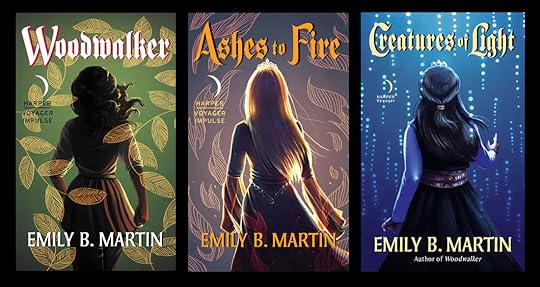 You can purchase Woodwalker, Ashes to Fire, and Creatures of Light from any book retailer, including:
Amazon
Harper Voyager Books
Independent bookseller
Fiction Addiction
(ask for a signed copy)
You can purchase Woodwalker, Ashes to Fire, and Creatures of Light from any book retailer, including:
Amazon
Harper Voyager Books
Independent bookseller
Fiction Addiction
(ask for a signed copy)
Thanks for reading, and for all your love and support this year and always. I hope this holiday season is full of warmth and peace for all of you, and that we all roll into 2019 with fresh intention and passion.
What blog topics would you like to see from me this coming year? Leave your ideas in the comments!
December Art Roundup I finally did a colored piece for The Lady's Guide to Petticoats and Piracy by Mackenzi Lee, plus a personal piece and a slew of Queen's Thief art for totally legitimate Reasons. What I'm Reading: Sorry not sorry.
(Pictured: 4/5 of the Queen's Thief series audiobooks by Megan Whalen Turner) Upcoming Events: Greenville Author Expo, Saturday, January 26th, 12:30-5:30. I'll be on the Writing YA panel at 2:30 PM. Hughes Main Library, Greenville, SC.
December! We've made it. 2018 was a roller-coaster year for me, with some very bright highlights, including the release of the final book in the Creatures of Light trilogy and big progress on my other manuscripts. At times this year felt like it detached from linear time altogether, and it was possibly the most stressed I've ever been by large-scale events outside my control, but here we are at the end. In celebration, and as a holiday thank-you to my readers and followers, this month features an illustrated short story set prior to the events of Woodwalker.It's no secret that Mae, the protagonist and narrator of Woodwalker, is exiled from her home--that much is given away on the back cover of the book. But what did things look like on the night of her arrest? What furtive things were swirling around the palace, and who was slinking through the shadows before Mae was led away from the Silverwood? Take a glimpse into that fateful night through the eyes of a character readers might remember from the firefly slopes of Lampyrinae.
If you haven't read Woodwalker, not to worry--there are only a few spoilers included in this story, and none are major to the plot. Consider this a peek into the events leading up to chapter one. For those of you who have read the book, keep your eyes open for nods to some of the twists and turns you know and love...
Read it all after the jump! SONGBIRD AND SHADOW “Jenë. Jenë. Wake up--Jenë, you have to wake up.”
Jenë shifted on her bunk, wrapped in the warm cocoon of a dream. “Rrgg… go away, Senna.”
Jenë’s bunkmate grabbed the coverlet and stripped it away, letting in a wash of cold air. She swore and curled up, groping for the blanket. “Senna! Go away! It’s not wake up call yet!”
“No,” Senna said urgently. “It’s the middle of the night. But you have to get up—it’s your cousin.”
Jenë groaned. “It’s the day after midsummer. I’m not taking off on some clandestine mission—last time I did she had me felling pines for nine hours…”
“No.” Senna cut her off, and through the haze of sleep Jenë detected more than just mere irritation—Senna was frightened. “It’s not a mission. Something’s happened. I think… I think she’s in trouble.”
Jenë opened her eyes. The idea of Ellamae in trouble was nearly laughable—in every crisis she came across, she generally emerged victorious enough to win a medal. That is, if the king had ever thought her worthy of a medal. Jenë couldn’t fathom an outcome other than her cousin bolstering her already legendary status as the anarchic champion of the Silverwood.
Unless…
Jenë sat up. “What’s happened?”
“Get up, put your boots on. Hurry, I don’t know how much time we have.” Senna threw her a pair of trousers to put on under her nightshirt and then tossed her a pair of civilian boots.“Senna,” Jenë said, belting her trousers. “Tell me what’s going on.”
“I don’t know!” she said, anguished. She was in Ellamae’s squad, one of the scouts who served under her as Woodwalker. “But she’s in prison.”
Jenë’s fingers froze on her boots. “Prison?”
“They locked her up last night. I don’t think word was supposed to get out, but my brother’s a Palace Guard—he told me they brought her in.”
“Why is she there?”
“I don’t know. Something about the king. Something about treason. The prison guards won’t let anybody in, but they might make an exception for family.” She hauled on Jenë’s arm to set her upright, and then pushed her to the door. “Go on!”
Jenë stumbled into the barracks corridor. Still foggy with sleep, she gathered her wits and jogged toward the colonnade connecting the Guard Wing to the main palace. The hallways were dark and silent, but it wasn’t the serene silence that should have accompanied deep night. It was a tense silence, almost tangible, like the palace was holding it’s breath. As Jenë ran from the Guard Wing and into the adjoining foyer, she noticed lamps lit haphazardly, clustered particularly around the dispatch office, where all the scout records were kept. Doors were open where they shouldn’t be; murmuring came from behind others when the rooms beyond should have been empty.
In the greater palace, guards weren’t standing rigidly at their assigned posts—many were leaning around corners or bent over bannisters to whisper to others. She rushed by them. If they’d heard the news about Ellamae, and if they recognized her, they must have guessed where she was going. Jenë’s heart tightened in worry. The Wood Guard would riot for Ellamae, but she wasn’t sure about the Armed Guard, and the Palace Guard was another thing entirely—they were farther from the doings in the country and closer to the king’s inner circle. Jenë couldn’t be sure they would be sympathetic to her or her cousin. The prison landing was going to be the hardest. If the guards there wouldn’t let her in—and technically they shouldn’t— Jenë wasn’t sure what she was going to do.
But to her utter shock, there was no one on the landing. The two corners where the Palace Guards usually stood were empty, and the heavy door was cracked open, leading into the darkness of the prison stairwell. Where had they gone? Were they just inside? Had someone else come to investigate? Jenë was Ellamae’s only family in the palace.
She didn’t wait to think on it. She threw open the door and ran down the stairs, the way lit by guttering cast-iron lanterns. She reached the bottom of the staircase, expecting to find another guard on patrol—but there was no one.
Had Ellamae escaped and dispatched the prison guards? As soon as the idea entered Jenë's head, she flicked it away. The thought of her cousin attacking a fellow Guard was absurd.
Jenë slowed her pace as she headed into the first cell block, steeling herself to peer through the barred doors. Some were empty, but many were not—poor, shivering fools who’d fallen behind on taxes, or mishandled classified information, or given a whisper of being disloyal to the king. Most were asleep, but a few were up, pacing or muttering, or simply staring into the corridor. Jenë swallowed and pressed forward, forcing herself to look in every cell.
Ellamae wasn’t in the first block, or the second. The third was the most remote, reserved for only the most egregious of criminals—murderers and traitors.
“Great Light, you all move louder than an elk caught in the courtyards.”
And her cousin.
She was lying on her back on the flagstones with her feet propped up against the wall. Her dark, curly hair was splayed out behind her, worked loose from its usual unruly knot. She was in uniform, the dark green fabric made black in the dim light, with only a few glints from the silver florets and Woodwalker pin.
She didn’t look at Jenë. Her gaze was fixed on the ceiling.
“Mae,” Jenë said, dropping to the floor by the bars.“Excuse you, I’m in uniform—you address me by my office, Junco.”
“What happened?” Jenë asked, unwilling to let her cousin snark her into distraction. “What’s going on? Why are you here?”
“Because the damned nancy Palace Guards dragged me down here. Palace Guards, Jenë! The Guard of Last Resort, muscling a Woodwalker into a cell! It was probably the proudest day of their lives.” There was another flash of silver. Ellamae was turning something in her fingers—a scout compass. No, a fancier compass—one with an engraved lid. Jenë was surprised the guards hadn’t taken it from her upon her arrest, but she wasn’t going to waste time wondering about it.
She curled her fingers around the bars. “Mae, please—if you answer me, maybe I can help you.”
Ellamae gave a hollow laugh. “No, Jenë. You can’t help me. But, I do know how fast gossip spreads through the Guard, and I’d like to make sure the story’s the truth. So here it is: I shouted myself hoarse at the king and his council.”
The bottom dropped out of Jenë’s stomach. “You did what?”
“Accusations, insults, obscenities—good ones, too, I should probably write some of them down.”
“Why?” she whispered. The other prisoners she’d passed had been given life sentences for less. “Why would you do that?”
“The same reason I do anything, Jenë. Because our king is a raging, inflamed boil on this country.”
Jenë whipped her head to the side, terrified her words would carry. “Ellamae…”
“He’s just making stuff up now,” she continued evenly, as if holding a breakfast conversation and not spouting flagrant treason. “He’s dismantling the Guard, the office of Woodwalker—we, who are meant to protect the Silverwood—he’s destroying us because we’re in the way of his agenda. Lifting mining restrictions, easing pollution thresholds, keeping us busy with stupid stuff like border patrols… it’s all crap, Jenë. It’s always been crap. And I finally went too far for his liking.”
“What’s he going to do?” she asked. “What's your sentence?”
Ellamae was silent, her gaze on the ceiling and her fingers unmoving on the compass. Jenë mentally ticked through all the sentences she’d heard of—life in prison, servitude in the silver mines, even execution in the not-so-distant past, though it wasn’t a common practice for citizens anymore.
“Mae,” she pleaded.
“He’s kicking me out,” she said.
“Kicking you out of the Guard?” Jenë asked. She’d expected at least that, but if that was her only sentence…
“No,” she said. “He’s kicking me out of the Silverwood.”
Jenë’s blood went cold. “Exile?”
“Lifelong exile,” she confirmed. “Hey, I’ll get to see the ocean. Maybe I’ll become a sailor.”
For the first time, her bluster didn’t hit home. Jenë’s fingers shook on the bars as comprehension sunk in—the sentence was the most devastating one she could think of. Wood-folk didn’t travel beyond their own borders. It wasn’t done—it hadn’t been done in generations, not since diplomacy collapsed with Lumen Lake and the monarchy began trading with Alcoro. Wood-folk didn’t need outside trade to supplement their resources in the forest. And Ellamae was a Woodwalker—the youngest in decades, and the fiercest one in history, at least, to the younger scouts. Jenë had a feeling that if someone were to cut her cousin open, soil and leaf litter would spill out instead of blood.
After another heartbeat, Jenë jumped to her feet. “I’ll be right back.”
“Where are you going?”
“To find a prison guard. To find a key. I’ll get you out of here.”
“Oh, please.” At the last second, Ellamae realized her cousin was serious, and she lashed her hand through the bars to snatch a handful of fringe on her boot. “Jenë, stop. Cut it out. You can’t do that.”
“Watch me.”
“Don’t be stupid. I know you’ve got more sense. Do you think a prison guard will just give you their key?”
“I’ll… I’ll bribe one of them, or…”
“Or what? Knock one out? You haven’t even got your target stripes yet, let alone hand-to-hand combat.”
Jenë flushed in the darkness. “I’ll steal a key.”
“And wind up in the next cell over. Jenë, listen. If you break me out, what happens? Do you think I’ll go free? Do you think I can head on back to our family on Beegum Bald and live quietly? No—Vandalen will set the Guard after me as soon as he conjures up the capacity to string two words together. There will be nowhere I can hide in the Silverwood.”
“But…” Jenë searched for rationale. “But our family… your ma and pa, your brothers… Sera, Mae, Sera’s baby is due…”
“I know,” she said, her voice quieter. “I know. Don’t think I haven’t thought about it. But it’s too late, Jenë. It’s too late for me.”
Jenë stood silently next to her door, her cousin’s fingers still tangled in her boot fringe. Her eyes began to prickle. Earth and sky. She didn’t want to cry in front of Ellamae—she’d never once seen her cousin shed a tear. But Jenë’s sniffle gave her away, magnified by the cold stone walls.“I’m going to get you out,” she said, dashing her hand over her eyes.
“No, you’re not. You can’t, and I won’t let you. If you get a key and unlock my door, I’m just going to sit here.”
“How can you say that?” she asked, her voice rising in the darkness, her fists balled by her sides. “How can you just give up? How can you let him win? How can you be okay with leaving us?”
Ellamae’s grip grew tighter on Jenë’s boot. “Sit down.”
She didn’t.
“Jenë Junco, I am in uniform and you are under my command—sit down!”
Her knees buckled of their own accord, and she dropped to the cold stone. This despite the fact that with Jenë in civilian clothes and Ellamae in prison, the hierarchy of command seemed a bit scrambled.
Ellamae’s fingers went from Jenë’s boot to her knee, her eyes piercing through the darkness. “Jenë, listen. I screwed up. I know I did. If I’d kept my temper, maybe I wouldn’t be here. But for how much longer? Vandalen was going to make an example out of one of us sooner or later, and I’m sure my name was first on his list. And here’s the thing—he’ll think he’s won. You understand that? By getting rid of me, he’ll think he’s cowed the other Woodwalkers, and the rest of the Wood Guard, into submission. He’ll think the whispers and the accusations of corruption will shrivel up. You want that to happen? Do you want my defeat to be the Guard’s defeat?”
“No,” Jenë whispered.
“No,” Ellamae agreed. “If you care about me at all, if you care about the Guard, if you care about the Silverwood—then you keep fighting. Got that? Whether I’m here or not, you keep doing what’s right.”
“We’ll never be able to manage it without you.”
“That’s crap. Do you know what a hawkmoth is?” she asked, referencing her epithet.
Jenë ran her sleeve over her nose. “It’s a moth,” she said. “A moth that’s yellow like a bee, and flies like a hummingbird.”
“Right. Sneaky little creature, able to pretend to be something it’s not. But you know what? It’s still just a moth. Not a bee. Not a bird. If an animal sees through it’s disguise, it’s nothing but a snack. Now.” She shook her cousin’s knee. “What’s a junco?”
“A bird,” Jenë said dully. “A little gray bird.” She’d picked it as her epithet because she liked how they flocked around her childhood window, stormy gray, energetic, chittering. But if they were looking for deep personal meaning, Jenë considered it a stretch. Juncos were birds of no importance. No flashy plumage, no sweet song. A background bird.
“And what’s the king?” Ellamae asked.Jenë gave another involuntary glance down the corridor. “Warbird. An eagle.”
“Right. And you know what a junco will do to an eagle?”
“Probably get eaten.”
“Probably. You know what a flock of juncos will do to an eagle? They’ll tear the bastard apart.”
Jenë was silent.
“I’m not a flock, though,” she whispered.
“So raise one,” Ellamae said. “Raise a flock of songbirds. Sparrows and towhees and chickadees. Raise a damned maelstrom of little gray birds, and fight back.”
Jenë pressed her palms to either side of her face, as if she could block out her cousin’s words. She heaved a thick sigh, her nose stuffy. “It won’t help, though. It won’t help you. Even if… the king…” Jenë couldn’t bring herself to say the words aloud, so dangerously treasonous. She drew in a breath. “Prince Valien is next in line. And for all we know, he’ll be even worse.”
It was hard to imagine the prince being a worse king than Vandalen. He’d joined the Guard a few years before, training as diligently as any of the new recruits, but making few friends. If stories from the older scouts could be believed, most were wary of him at best. He was quiet and calculating, always watching, rarely speaking, frequently turning up in places he hadn’t been expected, sometimes with odd bruises or scrapes that couldn’t be explained. If he needed to use Guard materials or gear, he always came at night or the early morning and melted away soon after. Awkward silences persisted around him—many speculated that he was studying the inner workings of the Guard so he could continue the king’s crusade to dismantle it. But he didn’t have his father’s obsession with power—at least, not yet. Where the king was brash and iron-fisted, the prince was a shadow.
He was a mystery.
It took Jenë a moment to realize Ellamae had been silent. Her cousin turned the silver compass slowly in her fingers.“Jenë,” she said, and then she stopped herself. She pursed her mouth, as if she was thinking.
“What?” she asked.
“I think you can trust the prince,” she finally said.
Jenë lifted her head. “You do?”
“At least, I don’t think you need to worry about him. Not right now, anyway. Vandalen isn’t going anywhere any time soon. The main thing is to stick together, and keep upholding the purpose of the Wood Guard. Listen to Reuel, and the other Woodwalkers. They’re just as angry as me, and twice as smart. Don’t let Vandalen divide you. Keep each other strong.”
In the adjoining cell block, something banged against a bar, and Jenë jumped at the echo. Distantly, she heard the creaking of heavy metal hinges from the prison landing. Dread flooded Jenë’s stomach.
“Go,” Ellamae said. “Don’t get caught here.”
“I don’t want to go.” Jenë gripped the bars separating her from her cousin. “What if he sends you away soon? What if he sends you away before we can do anything about it?”
“Jenë, I don’t think there’s any doubt of that.” Her voice was low and sad, and it startled Jenë to hear her so resigned, so devoid of the snarly fire she usually carried inside her. Ellamae snaked her hand through the bars and squeezed Jenë’s wrist gently, and then she started prying her cousin’s fingers off the bars. “Explain things to my ma and pa, all right? And Sera and the others. Watch out for them—don’t let them get in trouble with the king.”
“But—” Jenë protested. Another tap filtered down the corridor. Ellamae pushed her again, waving for her to stand up. Slowly, automatically, Jenë rose to her feet, but she couldn’t make herself leave yet. Her cousin had been a presence in her life from her first breath— Jenë had never stopped wishing she could be like her. Tough like her, brave like her, smart like her. Ellamae wasn’t supposed to leave the Silverwood.
Ellamae wasn’t supposed to leave her.
“But,” Jenë tried again, and her eyes burned with tears she couldn’t keep back anymore. “What if… what if I don’t see you again?”
Ellamae sighed and settled back on the cold floor, resting her hands on her chest with the silver compass underneath.
“Unfortunately,” she said wearily, “I think you probably will.” Jenë could hear the grimace in her voice. “You’d better go get your class A’s on. The king... he's going to want to make this a show.”
You can purchase Woodwalker, Ashes to Fire, and Creatures of Light from any book retailer, including:
Amazon
Harper Voyager Books
Independent bookseller
Fiction Addiction
(ask for a signed copy)Thanks for reading, and for all your love and support this year and always. I hope this holiday season is full of warmth and peace for all of you, and that we all roll into 2019 with fresh intention and passion.
What blog topics would you like to see from me this coming year? Leave your ideas in the comments!
December Art Roundup I finally did a colored piece for The Lady's Guide to Petticoats and Piracy by Mackenzi Lee, plus a personal piece and a slew of Queen's Thief art for totally legitimate Reasons. What I'm Reading:
Sorry not sorry.(Pictured: 4/5 of the Queen's Thief series audiobooks by Megan Whalen Turner) Upcoming Events: Greenville Author Expo, Saturday, January 26th, 12:30-5:30. I'll be on the Writing YA panel at 2:30 PM. Hughes Main Library, Greenville, SC.
November 28, 2018
How to Create a Pretty Picture (Without Really Trying)
NOVEMBER 2018 It’s the same every year—shortly after Halloween, when Pumpkin Spice gets the boot in favor of Peppermint Mocha, my anxiety shoots through the roof. It’s November 3rd! It’s practically Christmas Eve! My love language is gifts, and my husband is gift-challenged, so the majority of holiday gift brainstorming, researching, purchasing, wrapping, and giving ultimately falls on me. I like it when I can come up with the perfect gift (like the 7-Eleven Tour de France bike jersey I got for my husband a few years ago), and I get stressed when I fall short (my brother’s wish list ranges from ‘airplane’ to ‘ski trip in Vermont,’ so I invariably end up getting him gift cards, which always makes me feel stupid).
Anyway, this year, I had a great gift idea for my youngest daughter. Before she was born, I wrote and illustrated a picture book for her sister called “Fairy for a Day.” It featured my eldest rescuing a fairy and being gifted wings and a fantastic floral wardrobe, replete with sparkles and friendly woodland creatures. Both my girls love reading it, and I figured it was high time my youngest had a picture book of her own.
The catch is, of course, that picture books take time. A lot of time. There’s a reason hiring an illustrator is so expensive, and it’s because nothing kills the look of a project more than it being rushed. Here’s a secret: I actually don’t like reading the Fairy for a Day book I wrote for my eldest. The writing is bad and the illustrations are bad, and it’s because I did it too fast, trying to whip it off with enough time to send to the printer before her birthday. Oh, that book. Uh, wouldn't you rather read... literally anything else?I’ve grown a lot as an illustrator since then. I dedicated most of 2016 to honing my ability to work efficiently. I’d set timers for digital paintings and make myself consider the piece done when the time was up. I participated in Inktober for the first time, which forced me to move on to a new piece each day. It’s not easy working like this—it’s a skill that has to be practiced. And of course, nothing tops the quality gained by a generous deadline. But sometimes we simply don’t have the time. I’m still not as efficient as I’d like to be, but I’m a lot better than I was when I created Fairy for a Day. So it was with more confidence that I set about creating my youngest’s Christmas present--Mermaid for a Day.
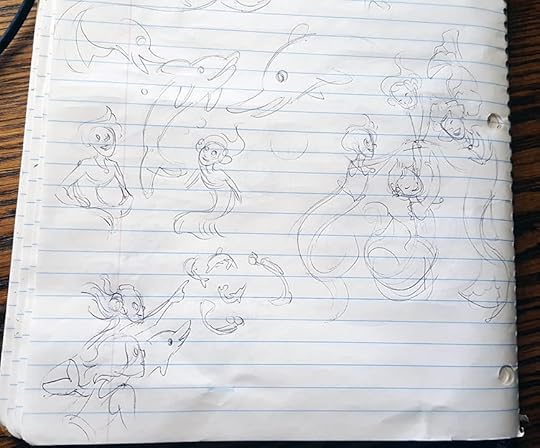 In this month’s blog post, I’m sharing some suggestions for how to create an appealing, dynamic piece while on a tight deadline. See them all below the jump!1. Plan AheadMermaid for a Day, like its predecessor, features my youngest helping a mermaid rescue her dolphin and earning a sparkly tail in gratitude. I use Shutterfly to print one-off books like this, so I knew I wanted it to be 8x8 and around 24 pages. That meant twelve square digital paintings. Right off the bat, I planned to make a few illustrations vignettes, and to keep the style cartoony to avoid complex shading.
Before I wrote the text, I thumbnailed the main characters and each illustration. I used them to direct the structure of the story, which kept things simple and visual. Thumbnailing is great for capturing the energy and basic composition of the piece before diving in to the full-sized canvas. Doing this ahead of time, as well as knowing the size and scope of your project, can save laborious revisions later on. Gotta make lists of ocean-inspired character names, too. BabyNames.com must think I'm having a new kid every other month.2. Keep Things SimpleI knew it was in my best interest to keep things from getting too complex. In the illustrations on the shore, I did this by using a soft brush and low-contrast colors to merely suggest a background. This let me keep the sometimes-tedious task of outlining to just the foreground characters.
 Fortunately, the underwater environments were even simpler. To keep things from getting boring, I used gradients to suggest light and highlight certain characters.
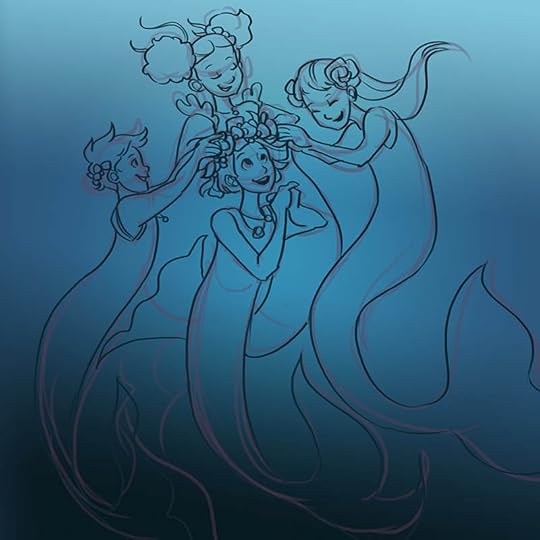 3. Have a Palette ReadyDuring the thumbnailing stage, I thought about the color palette I wanted—classic mermaid jewel tones in a complementary green-blue-purple scheme, with my daughter in pink to make her stand out. I went ahead and defined the flat colors I’d use as a base on my two main characters for their skin, hair, fins, and accessories.
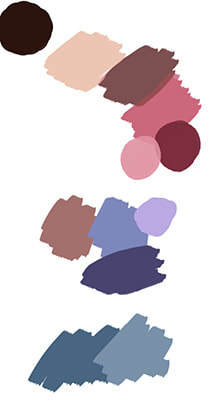 Since the other two mermaids only appear twice, I let their palettes complement the other two, using my Hue/Saturation tool to find the right shade. Hue/Saturation and Color Balance Tools are great because they let you tweak color quickly. If your pre-planned palette looks differently that it did in your mind, which often happens for me, the H/S and CB tools can right a lot of wrongs along the way.
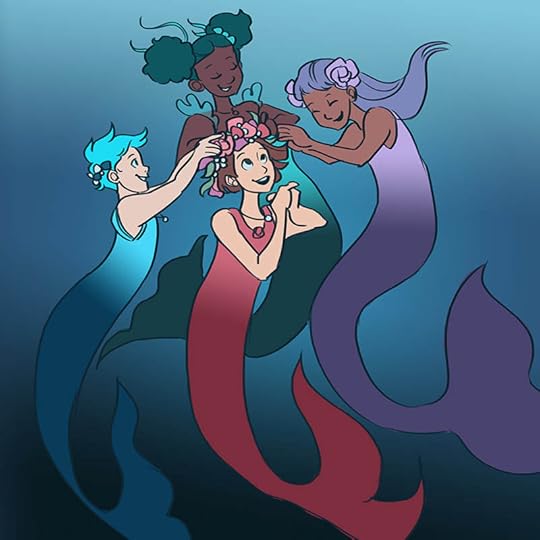 4. Be Deliberate with DetailsOne thing I love about painting mermaids is taking inspiration from real fish and underwater environments. Fish have such a beautiful array of patterns, shapes, and fins, and underwater lighting is so complex.
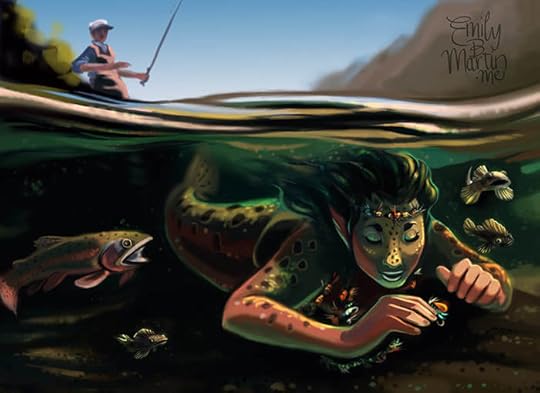
 Buuuut, those kinds of illustrations take a lot of time and effort. In the Rocky Mountain Mermaid picture above, I spent a long time researching native fish populations in Rocky Mountain National Park and then plotting how their coloring might translate to human skin. For the green eco-mermaid, I studied lots of images of kelp forests, working to get the beautiful, ethereal light just right.
Those approaches were too labor-intensive for this project, which is why I decided to go with a cartoon style from the outset. But working quickly doesn’t mean forgoing details altogether. You just have to be deliberate about them. This often means focusing on the things that highlight the narrative of the piece. For this project, that meant, in particular, highlighting the mermaid tails and underwater environment. So I added suggestions of scales and texture on their tails, some highlight to their fins, and some reflecting light.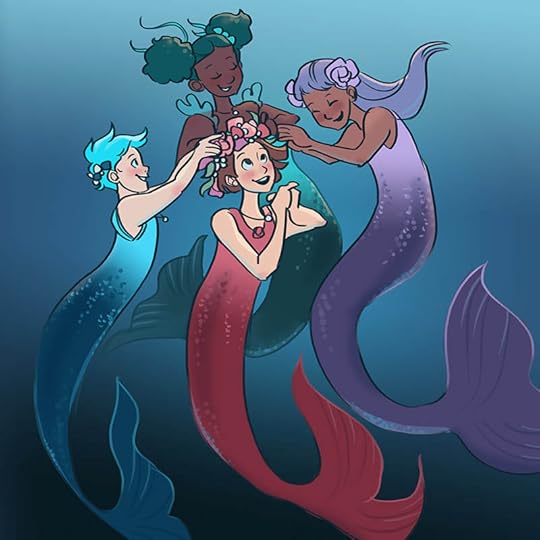 4. Create Atmosphere Technically, I could consider the piece more or less done at this stage. The characters are defined, there are some details, and there’s a suggestion of a background. If I only had 45 minutes to complete a piece, this is where I’d probably stop. But there are some easy things I could do to really make it pop and make it look like I spent a lot longer on it than I did, and it all has to do with atmosphere.
If 2016 was about working quickly, 2017 was about creating depth. I felt like my pieces were getting too flat and one-dimensional, so I set about learning how to inject a sense of space into my pieces. This meant studying how colors change as they get farther away, and how objects visually interact with each other.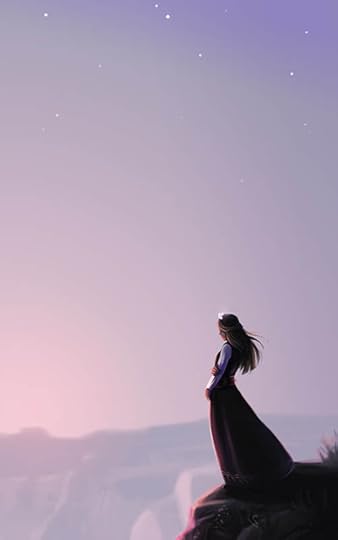 In this picture of Gemma, the far canyon wall is little more than a suggestion, but it gives a sense of immense space.
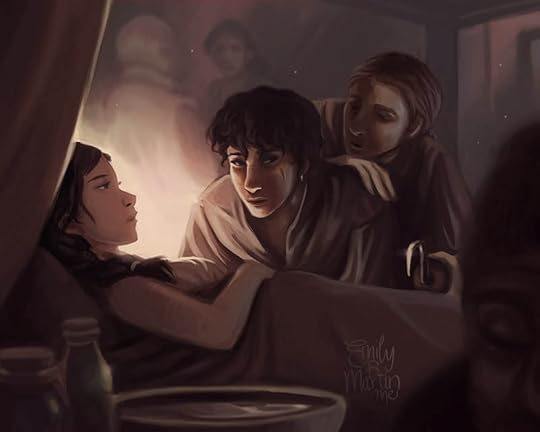 My goal for this Queen's Thief piece was keeping an intimate focus on Gen and Irene while suggesting a tense room crowded with people and objects.Underwater environments are very atmospheric by nature—it would be easy to get carried away with shadowy kelp fading into the blue and ribbons of reflecting light. But I wanted something quick that could be replicated throughout the book. A great shortcut is to consider your characters not in the foreground of your piece, but the mid-ground. With a soft brush and darker shade, add suggestions of objects to your foreground. With a more muted shade, do the same to the background. Even in small quantities, this places your characters in a tangible space, like Legolas below.
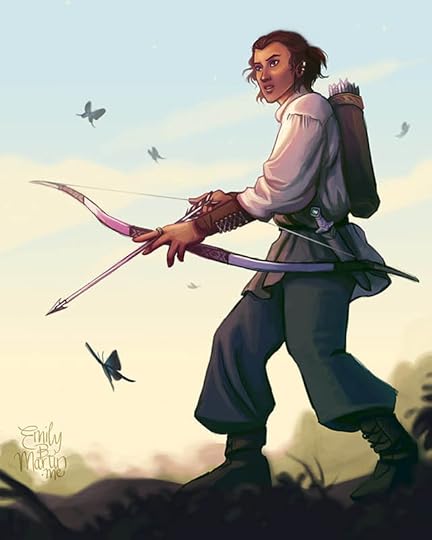 For my mermaids, that meant adding some filtering light above them in a Screen layer, some hard-brush bubbles around them, suggestions of fish behind them, and colored shines coming off their tails and dispersing in the water around them.
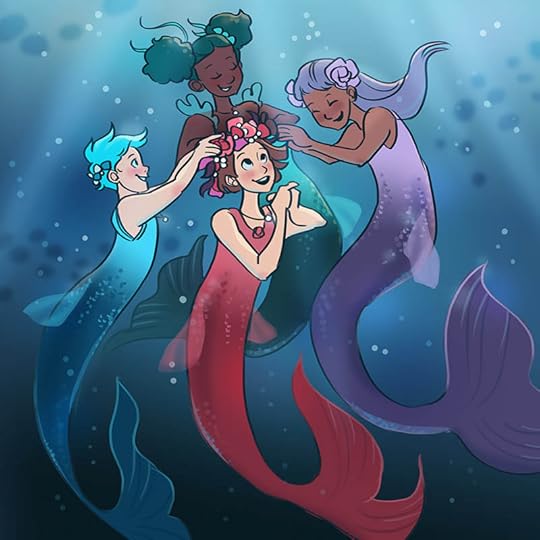 My favorite illustration that really achieved good atmosphere is the one below—I used dispersed color amid the angelfish and jellyfish to suggest large groups without having to define each animal. I also used reflecting light behind the mermaids to suggest an ocean floor. This is the piece I ultimately used for the cover illustration.
 6. Be Okay with Calling it Done
 This is not the greatest group of mermaids I’ve ever painted. It’s not even my favorite illustration in the book. But it conveys the story, and it’s enjoyable to look at. It communicates the details I need it to communicate, and most of all, it’s something my 4-year-old is going to lose her mind over. Her mermaid friends are giving her a pearly flower crown! Honestly, what else matters?
All twelve illustrations were done quickly, each one under two hours. I took all kinds of shortcuts, duplicating backgrounds from picture to picture and taking every opportunity to merely suggest the action rather than paint it outright. None of them are anything I’d want to showcase or sell as a single print. But set alongside each other, they accomplish their part in the story and create a dynamic, cohesive body of work.
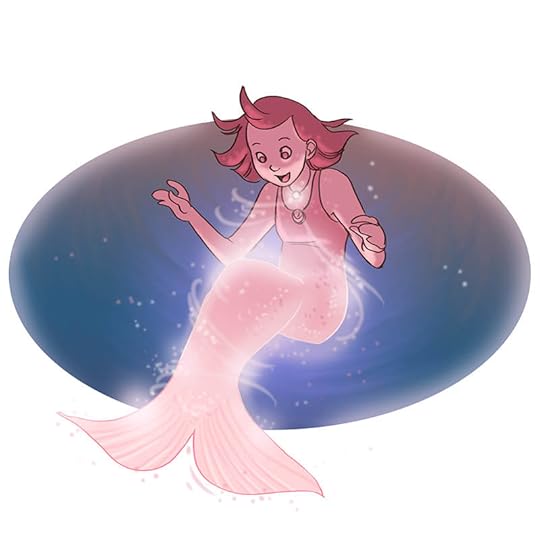
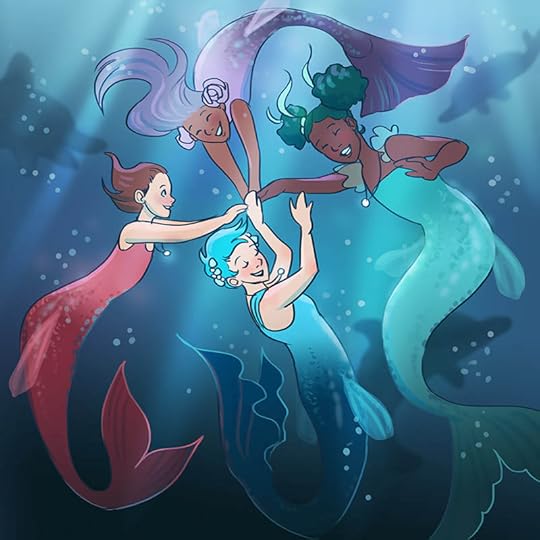 And I can pat myself on the back for a Christmas present checked off my list. This one is going to be a hit. My youngest loves mermaids. She loves books. And she loves adventures starring herself. Creative kids are a blast to think up presents for. Husbands and brothers are another thing entirely.
Maybe I’ll just make them mermaid books too.
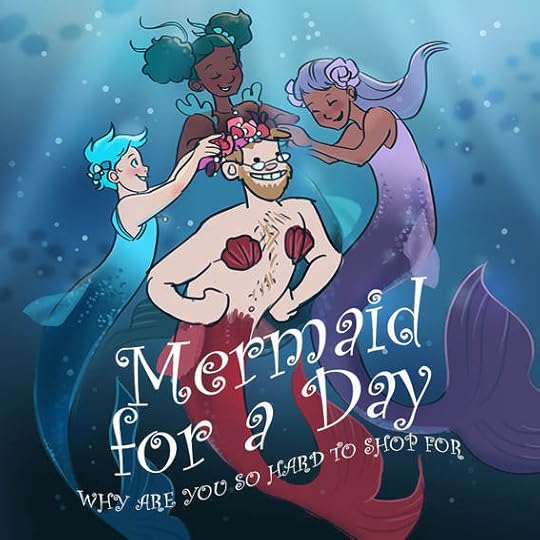 November Art RoundupSome Queen's Thief pieces because I'm weak, several double-page pen and ink illustrations in my sketchbook, a few character speedpaints, and a design for a client.What I'm ReadingMarkswoman, Rati MehrotraNot the Girls You're Looking For, Aminah Mae SafiThe Queen of Attolia, Megan Whalen Turner
Matilda, Roald Dahl (out loud to my kids)
Did you get some value out of this post? If so, please consider buying me a coffee by donating $3 to my Ko-fi account:Upcoming EventsStory Lines Author Fair: Saturday, December 1, 1-4 PM. Anderson Main Library, Anderson SC. Tons of regional authors will be selling their books, and there will be three panels on the writing and publishing process. I'll be on the Writing Craft panel at 1:30!
Get all the info on the Anderson Library website.
Creatures of Light is still a Kindle Monthly Deal, but only until DECEMBER 3rd! Get it fast before the promotion expires!>
It’s the same every year—shortly after Halloween, when Pumpkin Spice gets the boot in favor of Peppermint Mocha, my anxiety shoots through the roof. It’s November 3rd! It’s practically Christmas Eve! My love language is gifts, and my husband is gift-challenged, so the majority of holiday gift brainstorming, researching, purchasing, wrapping, and giving ultimately falls on me. I like it when I can come up with the perfect gift (like the 7-Eleven Tour de France bike jersey I got for my husband a few years ago), and I get stressed when I fall short (my brother’s wish list ranges from ‘airplane’ to ‘ski trip in Vermont,’ so I invariably end up getting him gift cards, which always makes me feel stupid).
Anyway, this year, I had a great gift idea for my youngest daughter. Before she was born, I wrote and illustrated a picture book for her sister called “Fairy for a Day.” It featured my eldest rescuing a fairy and being gifted wings and a fantastic floral wardrobe, replete with sparkles and friendly woodland creatures. Both my girls love reading it, and I figured it was high time my youngest had a picture book of her own.
The catch is, of course, that picture books take time. A lot of time. There’s a reason hiring an illustrator is so expensive, and it’s because nothing kills the look of a project more than it being rushed. Here’s a secret: I actually don’t like reading the Fairy for a Day book I wrote for my eldest. The writing is bad and the illustrations are bad, and it’s because I did it too fast, trying to whip it off with enough time to send to the printer before her birthday.
Oh, that book. Uh, wouldn't you rather read... literally anything else?I’ve grown a lot as an illustrator since then. I dedicated most of 2016 to honing my ability to work efficiently. I’d set timers for digital paintings and make myself consider the piece done when the time was up. I participated in Inktober for the first time, which forced me to move on to a new piece each day. It’s not easy working like this—it’s a skill that has to be practiced. And of course, nothing tops the quality gained by a generous deadline. But sometimes we simply don’t have the time. I’m still not as efficient as I’d like to be, but I’m a lot better than I was when I created Fairy for a Day. So it was with more confidence that I set about creating my youngest’s Christmas present--Mermaid for a Day.
In this month’s blog post, I’m sharing some suggestions for how to create an appealing, dynamic piece while on a tight deadline. See them all below the jump!1. Plan AheadMermaid for a Day, like its predecessor, features my youngest helping a mermaid rescue her dolphin and earning a sparkly tail in gratitude. I use Shutterfly to print one-off books like this, so I knew I wanted it to be 8x8 and around 24 pages. That meant twelve square digital paintings. Right off the bat, I planned to make a few illustrations vignettes, and to keep the style cartoony to avoid complex shading.Before I wrote the text, I thumbnailed the main characters and each illustration. I used them to direct the structure of the story, which kept things simple and visual. Thumbnailing is great for capturing the energy and basic composition of the piece before diving in to the full-sized canvas. Doing this ahead of time, as well as knowing the size and scope of your project, can save laborious revisions later on.
Gotta make lists of ocean-inspired character names, too. BabyNames.com must think I'm having a new kid every other month.2. Keep Things SimpleI knew it was in my best interest to keep things from getting too complex. In the illustrations on the shore, I did this by using a soft brush and low-contrast colors to merely suggest a background. This let me keep the sometimes-tedious task of outlining to just the foreground characters.
Fortunately, the underwater environments were even simpler. To keep things from getting boring, I used gradients to suggest light and highlight certain characters.
3. Have a Palette ReadyDuring the thumbnailing stage, I thought about the color palette I wanted—classic mermaid jewel tones in a complementary green-blue-purple scheme, with my daughter in pink to make her stand out. I went ahead and defined the flat colors I’d use as a base on my two main characters for their skin, hair, fins, and accessories.
Since the other two mermaids only appear twice, I let their palettes complement the other two, using my Hue/Saturation tool to find the right shade. Hue/Saturation and Color Balance Tools are great because they let you tweak color quickly. If your pre-planned palette looks differently that it did in your mind, which often happens for me, the H/S and CB tools can right a lot of wrongs along the way.
4. Be Deliberate with DetailsOne thing I love about painting mermaids is taking inspiration from real fish and underwater environments. Fish have such a beautiful array of patterns, shapes, and fins, and underwater lighting is so complex.
Buuuut, those kinds of illustrations take a lot of time and effort. In the Rocky Mountain Mermaid picture above, I spent a long time researching native fish populations in Rocky Mountain National Park and then plotting how their coloring might translate to human skin. For the green eco-mermaid, I studied lots of images of kelp forests, working to get the beautiful, ethereal light just right.Those approaches were too labor-intensive for this project, which is why I decided to go with a cartoon style from the outset. But working quickly doesn’t mean forgoing details altogether. You just have to be deliberate about them. This often means focusing on the things that highlight the narrative of the piece. For this project, that meant, in particular, highlighting the mermaid tails and underwater environment. So I added suggestions of scales and texture on their tails, some highlight to their fins, and some reflecting light.
4. Create Atmosphere Technically, I could consider the piece more or less done at this stage. The characters are defined, there are some details, and there’s a suggestion of a background. If I only had 45 minutes to complete a piece, this is where I’d probably stop. But there are some easy things I could do to really make it pop and make it look like I spent a lot longer on it than I did, and it all has to do with atmosphere.If 2016 was about working quickly, 2017 was about creating depth. I felt like my pieces were getting too flat and one-dimensional, so I set about learning how to inject a sense of space into my pieces. This meant studying how colors change as they get farther away, and how objects visually interact with each other.
In this picture of Gemma, the far canyon wall is little more than a suggestion, but it gives a sense of immense space.
My goal for this Queen's Thief piece was keeping an intimate focus on Gen and Irene while suggesting a tense room crowded with people and objects.Underwater environments are very atmospheric by nature—it would be easy to get carried away with shadowy kelp fading into the blue and ribbons of reflecting light. But I wanted something quick that could be replicated throughout the book. A great shortcut is to consider your characters not in the foreground of your piece, but the mid-ground. With a soft brush and darker shade, add suggestions of objects to your foreground. With a more muted shade, do the same to the background. Even in small quantities, this places your characters in a tangible space, like Legolas below.
For my mermaids, that meant adding some filtering light above them in a Screen layer, some hard-brush bubbles around them, suggestions of fish behind them, and colored shines coming off their tails and dispersing in the water around them.
My favorite illustration that really achieved good atmosphere is the one below—I used dispersed color amid the angelfish and jellyfish to suggest large groups without having to define each animal. I also used reflecting light behind the mermaids to suggest an ocean floor. This is the piece I ultimately used for the cover illustration.
6. Be Okay with Calling it Done
This is not the greatest group of mermaids I’ve ever painted. It’s not even my favorite illustration in the book. But it conveys the story, and it’s enjoyable to look at. It communicates the details I need it to communicate, and most of all, it’s something my 4-year-old is going to lose her mind over. Her mermaid friends are giving her a pearly flower crown! Honestly, what else matters?
All twelve illustrations were done quickly, each one under two hours. I took all kinds of shortcuts, duplicating backgrounds from picture to picture and taking every opportunity to merely suggest the action rather than paint it outright. None of them are anything I’d want to showcase or sell as a single print. But set alongside each other, they accomplish their part in the story and create a dynamic, cohesive body of work.
And I can pat myself on the back for a Christmas present checked off my list. This one is going to be a hit. My youngest loves mermaids. She loves books. And she loves adventures starring herself. Creative kids are a blast to think up presents for. Husbands and brothers are another thing entirely.
Maybe I’ll just make them mermaid books too.
November Art RoundupSome Queen's Thief pieces because I'm weak, several double-page pen and ink illustrations in my sketchbook, a few character speedpaints, and a design for a client.What I'm ReadingMarkswoman, Rati MehrotraNot the Girls You're Looking For, Aminah Mae SafiThe Queen of Attolia, Megan Whalen TurnerMatilda, Roald Dahl (out loud to my kids)
Did you get some value out of this post? If so, please consider buying me a coffee by donating $3 to my Ko-fi account:Upcoming EventsStory Lines Author Fair: Saturday, December 1, 1-4 PM. Anderson Main Library, Anderson SC. Tons of regional authors will be selling their books, and there will be three panels on the writing and publishing process. I'll be on the Writing Craft panel at 1:30!
Get all the info on the Anderson Library website.
Creatures of Light is still a Kindle Monthly Deal, but only until DECEMBER 3rd! Get it fast before the promotion expires!>
October 30, 2018
Six Tips for Writing Next-Level Heroines
OCTOBER 2018
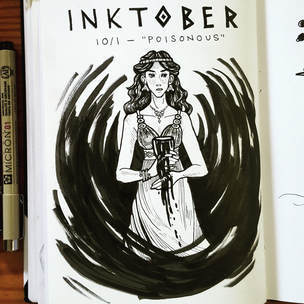 Queen Irene Attolia: The Queen's Thief series, Megan Whalen TurnerI’ve been thinking a lot about heroines this month.
It started with Inktober, the month-long challenge where artists post a pen and ink drawing every day. Back at the end of September, when the news cycle was especially ugly, I wasn’t sure I was going to have the emotional stamina to see Inktober through this year. I’ve come to love it—it’s made ink one of my favorite mediums besides digital art. But 31 days of illustrations seemed like such a tall order in a world where political and climate disasters are so big and my voice and efforts seem so small. Normally I like to plot out my posts ahead of time, but as September wound down with little to no inspiration for the official prompts, it seemed more and more pointless.
Two things saved me. One was my current re-read of the Queen’s Thief series in preparation for the release of Return of the Thief early next year (this marks the 897th time Megan Whalen Turner’s work has rescued me emotionally). The other was the official prompt for Inktober day 1: “poisonous.” Being deep into the Queen’s Thief automatically made me think of the character of Irene, who poisons the man trying to steal her throne. This led me to wonder what other fictional heroines could fit with the other prompts, and all of a sudden I had a sub-theme. I would draw a different heroine every day, hoping to wrap myself up in women who make things happen, whether that means toppling regimes or loving their families. So began #31DaysofHeroines.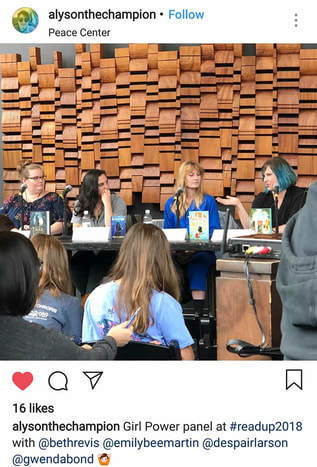 Girl Power Panel, ReadUp Greenville 2018. Photo: Alyson R. ChampionI also had the great experience of being on an awesome Girl Power panel at the ReadUp Book Festival in Greenville, SC. For one hour, Gwenda Bond (Lois Lane: Fallout), Beth Revis (Give the Dark My Love), Hope Larson (All Summer Long), and I talked about our favorite heroines, writing wonderful women, and navigating our current social and political climate. I also got to sit in on other panels with some of my favorite YA authors, like Dhonielle Clayton (The Belles), Nic Stone (Odd One Out), and Becky Albertalli (Leah on the Offbeat) as they talked about identity, gender, and writing honest, powerful characters.
All this has led to a solid month of recalling all my favorite heroines from literature and movies and analyzing what I love about them. If you had asked me on September 30th, I would have wondered if I could see this sub-theme through to the end. Now I wish I had another three months of prompts to fill in. There are so many amazing girl characters that I wasn't able to incorporate. And simply surrounding myself with some of my favorite fictional women, both from my childhood and from recent reads, has revitalized me more than I ever would have expected a month ago.
It’s also highlighted some common threads among this spectrum of characters. Whether it’s a fairy tale a few centuries old or a fresh, progressive story from this year, I found that a handful of the same themes kept jumping out at me. So this month, for writers plotting out their mighty heroines, I’ve put together a list of six ways to elevate your heroines to the next level. Read them all after the jump!The caveat to all this, of course, is that these are my opinions and observations. They’re not hard and fast rules, and just because a female character doesn’t adhere to these doesn’t mean she’s not well-written or well-rounded. The best heroine is one that’s three-dimensional, genuine, and speaks to an infinite number of truths. It’s a broad brush with endless possibilities. So take these tidbits and make them work for you and the heroine of your heart.1. Avoid Tokenism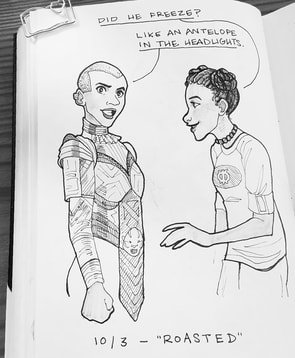 Black Panther does an amazing job at avoiding gender tokenism, even with several male protagonists and antagonists.You’ve seen it before: a group of protagonists that consists of a bunch of dudes and one lady. Harry Potter, Jurassic Park, Timeline, Wizard of Oz, Justice League, The Avengers, The Smurfs… it tends to be the most common makeup for groups of three or more main characters. What this does, consciously or not, is put all the onus of representation on the single female character, in many cases relying on her to be the emotional caretaker, love interest, or someone to rescue. (All of this is also relevant to other forms of minority tokenism, especially racial tokenism, where single characters of color are burdened with representing not just their particular race, but in many cases all non-white races).
In last month’s blog post , I talked about one of my many Lord of the Rings fanfictions and how it led to the creation of Woodwalker. I briefly mentioned that this fic was also where I learned the importance of giving a heroine a robust group of female friends. In the first draft, I wrote elf ranger Eirien as something of an outcast, the old “not like other girls” tar pit. But when it came time to exile her from her home, I realized—so what? If she’s such a misfit, with no friends or family, why should she care so much about leaving her home? I scrapped her original backstory and rewrote her with a tight-knit group of female friends and peers. Not only did this make exile suddenly agonizing, but it gave me the chance to write a diverse array of women—hot-tempered ones and cool-headed ones, fashionable ones and casual ones, sweet ones and salty ones. It took the responsibility off Eirien to be the sole female representative. Fast forward to the Creatures of Light trilogy, and the ultimate trio of Mae, Mona, and Gemma helped me accomplish the same thing.
Great books that do this: The Lady’s Guide to Petticoats and Piracy (Mackenzi Lee), The Belles (Dhonielle Clayton), Geekerella (Ashley Poston), The Queen of Blood (Sarah Beth Durst), Lumberjanes (Noelle Stevenson), Shadowshaper (Daniel José Older)2. Embrace Traditionally “Feminine” Roles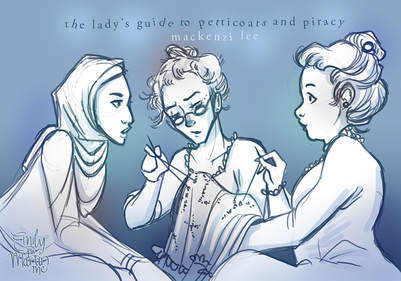 The Lady's Guide to Petticoats and Piracy, Mackenzi Lee. This book did so much for my weary soul.You know me—I love a good rugged heroine. A girl with mud on her knees and scrapes on her elbows. A girl in boots and armor, with practical hair and comfortable clothes.
But you know what I love even more? A girl who can do and be all those things, and still be allowed to like dresses, and jewelry, and masquerade balls. One of the things wash-and-wear ranger Mae misses most in Woodwalker is dancing—putting on her fancy boots and twirly skirt and spending a night dancing with her friends.
The tendency to gravitate toward warrior women came about as a kickback to the coiffed damsels-in-distress so popular in everything from fairy tales to literature to movies to video games. Girls got tired of only being cast as Princess Peach or Rapunzel, locked away and waiting to be saved, that in many cases media made a hard pivot toward only valuing physically strong female fighters, maligning and snubbing any woman who dared to enjoy anything considered “feminine” (of course, these warrior women are still often elegantly styled and scantily clad… but that’s a topic for another day). But while this gave us some great heroines, it didn’t do anything to bring value or respect to traditionally feminine roles and interests.
A recent book that purposefully addresses this trope is Mackenzi Lee’s The Lady’s Guide to Petticoats and Piracy, companion to 2017’s historical romp The Gentleman’s Guide to Vice and Virtue. In Lady’s Guide, the protagonist, Felicity, prides herself on being practical and progressive, fighting to be accepted to the male-dominated medical field. She berates her friend Johanna for her interest in pretty dresses and jewelry, telling her that men will never take her seriously. Johanna calls her out, saying Felicity is the one who doesn’t take her seriously—rather, Felicity operates under the narrow-minded view that being serious about science is mutually exclusive with enjoying traditionally feminine interests.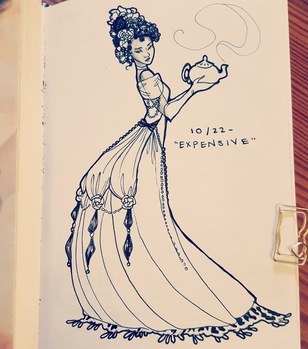 Camille: The Belles, Dhonielle ClaytonOne of my favorite ways to overcome this trope is to write a story where a woman achieves success through traditionally feminine outlets. Show me a heroine who is politically valued for her knowledge of society and the art of conversation—oh look, you have Mercedes from Isle of Blood and Stone (Makiia Lucier). Show me a heroine who uses her understanding of beauty and fashion to fight for justice and equality—make way for Camille from The Belles (Dhonielle Clayton). Show me a heroine who doesn’t let the limits of a male-dominated society rule her life or her decisions, instead using every ounce of leverage she has to gain herself agency—high five to Irene from, yes, the Queen’s Thief (Megan Whalen Turner). Show me a heroine who embraces and longs for romantic love, and is still portrayed as someone to be valued and respected—hugs to Molly from The Upside of Unrequited (Becky Albertalli). (Bonus: Lee's Lady's Guide hits all of these targets.)
Listen, I work with a lot of grungy female rangers, and yes, there are one or two who have to be physically pried out of their work boots for a black-tie affair. But the vast majority of them enjoy the chance to put on some makeup and earrings. The vast majority of them enjoy scented candles and wildflowers, eyeliner and nail polish (even if we can’t keep it from chipping for more than a few hours). Let your characters do both. Let them be both. Loft your sweet, stylish girls as heroes in their own right, and allow your rough, rugged warriors to enjoy a gown without burying them in shock, sexism, or snide remarks from their peers. Write women ruling countries and fighting for justice using traditionally feminine outlets—motherhood and emotional fluency and social gatherings and all the pretty trappings. Fight the false dichotomy of masculine = strong and feminine = weak. Bury it. Burn it. It’s a lie.
Great books that do this: Isle of Blood and Stone (Makiia Lucier), The Queen’s Thief series (Megan Whalen Turner), The Lady’s Guide to Petticoats and Piracy (Mackenzi Lee), The Belles (Dhonielle Clayton)3. Allow Her to Get Hurt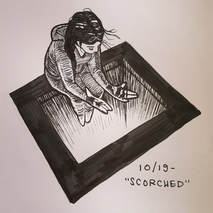 Inej: Six of Crows, Leigh BardugoI realized this on day 19 of Inktober, when I was drawing Inej from Leigh Bardugo’s Six of Crows after she scorches her hands while climbing up the hot furnace shaft. I love seeing girls get hurt. Not because I’m a masochist, but because it challenges the enduring notion that girls are more delicate and less resilient than boys. It’s also a nice counterpoint to the tendency to cast women in roles of healers and caretakers—my characters included. Mae is an herbalist and Gemma is caring by nature. They also both hurt themselves a lot—neither of them come through the Creatures of Light trilogy unscathed.
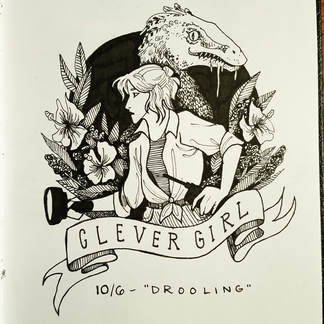 Dr. Ellie Sattler: Jurassic Park, Michael CrichtonThis doesn’t mean you have to de-feminize your women or make them unrealistically masculine. One thing I love about Laura Dern’s portrayal of Dr. Ellie Sattler in Jurassic Park is how she chokes up or cries under stress. When she’s running from the raptors on a busted ankle and finally reaches safety, she collapses and straight-out sobs. Girl, I would too! Crying is just a form of stress language, like getting angry or anxious. I’m a crier. Gemma’s a crier. That’s a powerful tool we as writers have—to show crying not as a form of weakness, but as some people’s natural response to stress or injury… and then allowing them to continue on.
Dr. Sattler is great because she’s allowed to get hurt, cry, and power through it. Unfortunately, Crichton wrote another fantastic heroine who didn’t get the same respect in her jump from book to screen. In The Lost World, Dr. Sarah Harding is a go-getter, a field biologist who studies African megafauna. When the tyrannosaurs push the trailers over the cliffs, it’s she who rescues Dr. Malcom, climbing painfully down the interior of the dangling RV with him over her back. She’s injured! It hurts! It’s hard! They’re about to die! But she’s allowed that powerful moment of agency and grit. But in the movie, she’s turned into a damsel in distress, lying against the splintering windshield, panicky and helpless, until Malcom rescues her. Why do that? Why make that change? (That’s rhetorical, I know why.) It would have been just as easy and truer to the book to let Sarah keep that heroic element to her character.
Let your heroine get hurt. Let her struggle through pain and come away with scars. If it meets the needs of your story, give her the chance to show her physical merit, as well as her emotional and mental merit.
Great books that do this: Jurassic Park (Michael Crichton), the Anna Pigeon mysteries (Nevada Barr), Six of Crows (Leigh Bardugo), Children of Blood and Bone (Tomi Adeyemi), Invasive (Chuck Wendig), Nimona (Noelle Stevenson), Isle of Blood and Stone (Makiia Lucier), The Lady's Guide to Petticoats and Piracy (Mackenzi Lee)4. Elevate Her Skills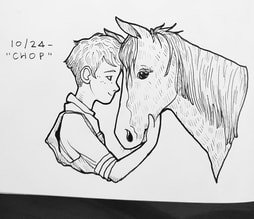 Charlotte Parkhurst: Riding Freedom, Pam Muñoz RyanIf you attended ReadUp and came to the Girl Power panel, you heard me say the phrase “girl in a man’s world” at least four times. My context for that comes from a lot of the books I read as a kid—Tamora Pierce’s Song of the Lioness quartet and Protector of the Small, Riding Freedom (Pam Muñoz Ryan)—they all feature girls doing exceptional things… except that those things are only exceptional because they're girls doing them. Learning to be a knight, a mage, a stagecoach driver… while they’re all accomplishments, in each book there are scads of boys doing the same things. The girls are only the protagonists because they’re girls in a man’s world, trying the same things the boys are.
Don’t get me wrong—I love stories like that. The books I just mentioned had huge roles in my childhood, and their influence still creeps into my writing. And the girls they feature generally have to work harder and achieve more to be considered equal to their male counterparts. But now that I’m writing my own books, I crave heroines that have more going for them than just doing what boys do, only as a girl. I want the heroines I write and read to be the protagonists of their stories because their skills and goals meet the needs of the plot… the same way boys are cast as the protagonists of their stories.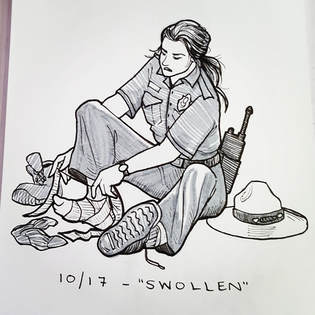 Ranger Anna Pigeon: the Anna Pigeon mysteries, Nevada Barr. Also see: heroines who get hurt a lot. Some of my favorite heroines that accomplish this are written in contemporary mysteries and thrillers. The aforementioned Dr. Ellie Sattler is drawn into the adventure because she’s the paleobotanist on Dr. Grant’s dig team. Ranger Anna Pigeon (Nevada Barr’s national park mysteries) is called on in her capacity as a park ranger, using her training in conservation and law enforcement to hone in on clues and details that don’t make sense. Hannah Stander (Chuck Wendig’s Invasive) is brought in as an FBI agent, and ultimately succeeds because she has skills as a survivalist. All of them are drawn into their stories not because they’re women, but because they have a skillset that’s important to the plot.
This doesn’t mean you have to make your heroines superwomen (unless you’re writing superwomen). Some of my favorite stories show women with realistic limitations, whether in their physical capacity or the way that people view and treat them. The Lady’s Guide to Petticoats and Piracy does both—Felicity and her companions are frequently hindered by their period-accurate clothes, their mild physical fitness, and the attitudes and actions of the men around them… and yet they still manage to succeed in their journey.
Even Ranger Anna Pigeon has anxiety that sometimes cripples her, and is written off by some colleagues as just a middle-aged meddling lady, particularly when she’s not in uniform. My favorite heroines weather these perceptions and simply press on despite them. As someone who’s been called “sweetheart” just after the guy standing next to me, wearing the same badge and uniform, was addressed as “ranger,” I connect with that on a deep level. Being undervalued and infantilized is just part of daily life for most women. If you’re writing a world with a similar patriarchal structure as ours, allow your heroine to have confidence in her skills despite the naysayers.
Great books that do this: Jurassic Park (Michael Crichton), the Anna Pigeon mysteries (Nevada Barr), Six of Crows (Leigh Bardugo), Children of Blood and Bone (Tomi Adeyemi), Invasive (Chuck Wendig), Nimona (Noelle Stevenson)5. Allow People to Take her Seriously Galadriel and the Destruction of Dol Guldur: The Return of the King, J.R.R. TolkienOn that note, allow the characters around your heroine to have confidence in her skills, too. The first four tips here are ways to write women with agency in a world stacked against them, but writing a next-level heroine can be just as much about writing a next-level world and supporting cast. One thing I love seeing is when characters take heroines seriously, respecting their skills and opinions without second-guessing or making sexist remarks. This can be hard to pinpoint in books and movies because it’s much easier to see instances where it’s done poorly than when it’s done well—when it’s done well, it can be nearly unnoticeable.
Disney has done okay with this recently—in Frozen, Elsa is crowned queen without caveat or question. She doesn’t need a husband or regent to be considered a competent ruler, she just needed to come of age. Everyone from the townspeople to her fellow politicians accept that she’s capable to rule, until she freezes everything (which makes her unfitness about her actions, not her gender). It would have been nice to see other women among the diplomats she interacts with, but it’s a good first step. In Moana, things are similar—while all the chiefs mentioned before Moana are men, nobody questions that she is capable enough to be the next chief. Maui does make some derogatory comments toward her, but they’re all about her age (“I’m not going to Te Fiti with some kid!”), not her gender, save for one or two snide princess remarks.
Unfortunately, it’s more common for books and movies to fall short. One of the reasons The Hobbit movies made me so mad was because every female character had to be saved by a man. Go on, watch The Battle of Five Armies again—every speaking-part woman, from Galadriel to Tauriel to Bard’s daughters, had to be rescued by male characters. That’s how their story arcs culminated. That was their endpoint. Being rescued. Galadriel, an ancient and powerful being with the might of Nenya on her finger, barely got started in Dol Guldur before the rest of the White Council had to come save her, whereas Gandalf is allowed to fight a Balrog and level up in The Two Towers with no assistance. Tauriel, who is given all kinds of lip-service about how great a fighter she is, didn’t even get to kill any of her enemies in battle—she had to be saved twice, first by Hot Dwarf Kili and then old Laser-Eyes Legolas. And Bard’s daughters were saved by their younger brother, who gave us no indication that he had any fighting skills whatsoever. To me, that’s frustrating and degrading. I’m tired of writers hyping up their “strong” women, only for them to end up as glorified rescue items. Rescue stories have their place, but if you’re going to write a warrior woman, take her seriously. Let her do what she or other characters say she can do.
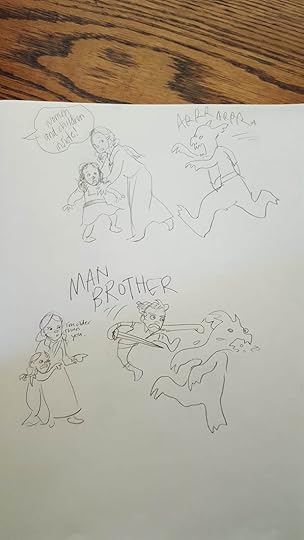
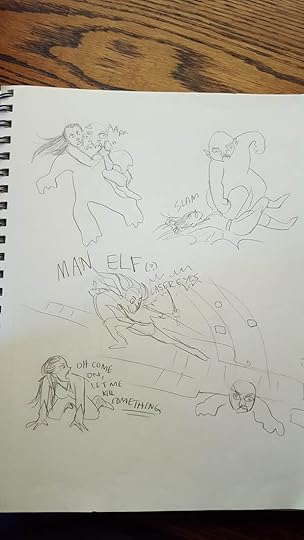 Comics I rage-drew in 2014.And if you’re not writing a warrior woman, allow the characters around her to respect her regardless. Is your female narrator judgy when she sees a coiffed and manicured woman? Why? Is your male narrator constantly making subjective assessments of the women around him? Why? How do other characters treat your heroine? Do they dismiss her, snark at her, disbelieve her? Why? Does your heroine live up to the hype about her? Why or why not? If all of the above has something to do with her actions or skills, then it can be an avenue for character development. But if it’s only because she’s a woman, consider rewriting the interaction or adding more layers to your protagonists.
Great books that do this: Jurassic Park (Michael Crichton), the Anna Pigeon mysteries (Nevada Barr), Six of Crows (Leigh Bardugo), Nimona (Noelle Stevenson), The Hate U Give (Angie Thomas)6. Build a Society that Lets Her Thrive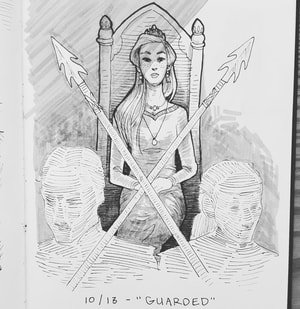 Mona: Ashes to FireHere’s the thing… we’re writers, right? We can write fiction. We can write fantasy. We can write anything. So what if we did this thing where instead of writing worlds and hierarchies where women are always inferior, we imagine worlds where women can just, like… exist. As equals. With men. Without needing extra qualifiers or protection or skills to be worthy of it.
Some people have a really hard time with this. When I was researching Woodwalker, I came across a forum where people were discussing how to write fantasy where there was no sexism or sexual assault. All the suggestions were variations on magical powers to give women—super strength or lightning bolts or invisibility or flight or presumably the power to transform into inanimate objects least likely to be considered sexual.
Are we serious?
We can imagine fantasy realms with dragons and vampires and talking raccoon pilots with machine guns, but writing a world without sexual assault is too unrealistic?
I hate that. I hate it. I will never not hate it. I don’t have many hills I’m willing to die on (I am very passive about my hills), but this is one of them. No. If I’m creating a new world, you can be damn sure I’m creating a place where I can exist without being considered a sexual object or opportunity.
I understand this isn’t every writer’s cup of tea—many authors I know deal with sexual or physical trauma in their lives by weaving it into their writing, whether it’s creating a character who overcomes what they endured, or highlighting a particular form of abuse or inequality. That’s valid and worthy and I respect it wholeheartedly. But for me, personally, I want it out of my worlds.
I say this having written one of my characters with sexual trauma in her past. That part of Mona’s backstory came about late in the draft of Ashes to Fire. For most of the draft, she was only politically manipulated, not sexually assaulted. Near the end, it didn’t feel like it had enough impact, so I amended it. It’s never sat quite right with me since then. I won’t say I wish I hadn’t written it, because it’s written, and part of me is projected into her struggle. But I can say relatively safely that I’m not going to write something like it again. It doesn’t make sense in the world of Creatures of Light--I was so careful to scrub out other suggestions that women are inherently inferior to men that it stands out, at least to me. And I also think it was lazy—falling back on a reliable standby for a tragic past, the same way I walked into branding Rou and Lyle with the harmful Absent Black Father trope (that one I do wish I could change; I regret that far more than Mona’s backstory).
Some of my favorite books that go about reimagining the power structures in our world are the Queens of Renthia series by Sarah Beth Durst and The Belles by Dhonielle Clayton. Both of these revolve around a magic system that’s controlled and manifested by women. I like reading stories like that, imagining what things would look like if power rested in feminine magic, rather than masculine might. What might we value instead of physical strength and the ability to kill? What would our currency be? Our priorities? The opportunities for worldbuilding are endless.
Ultimately, though, my favorite kind of story is one where there’s simply no imbalance. Where women don’t need magic to be considered untouchable, valued, or respected. My favorite world is a quiet one, an understated one, where equality just is.
Weird, right?
Great books that do this: the Queens of Renthia series (Sarah Beth Durst), The Belles (Dhonielle Clayton)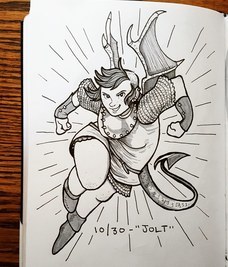 Nimona: Nimona, Noelle StevensonIn summary.....Let your girls be girls without ridicule. Let them be taken seriously. Let them have skills they’re confident in. Let them get hurt and show pain and stress. Give them great girl friends, girl colleagues, girl mentors, girl enemies. And celebrate the heroines who have made a difference in your life, both fictional and real. Maybe if we write the world we want to see, ours will slowly creep toward something more just and peaceful.
Who are your favorite fictional women? Exciting news--Creatures of Light is a Kindle Monthly Deal! For just a few weeks, you can grab the last book in the Creatures of Light trilogy for 99 cents!
Get it on Amazon October Art RoundupInktober was the bulk of my work this month, aside from some client work. Below are a few illustrations not featured in the blog above; for all 31 drawings, see my Inktober album on Facebook or my Instagram feed. See full portfolio What I'm ReadingLois Lane: Fallout, Gwenda BondThe Lady's Guide to Petticoats and Piracy, Mackenzi LeeThe Poppy War, R. F. KuangThe Queen of Attolia, Megan Whalen TurnerPippi Longstocking, Astrid Lindgren (out loud to my kids)Did you get some value out of this post? If so, please consider buying me a coffee by donating $3 to my Ko-fi account:Upcoming EventsSocial Media Strategies for Artists - Part of the Brush Tips art group at the Pendleton Branch Library. Thursday, November 15, 6:30 PM. Pendleton, SC. Get all the details on my Events page.Creatures of Light is a Kindle Deal all month! Get the e-book for just 99 cents!
Queen Irene Attolia: The Queen's Thief series, Megan Whalen TurnerI’ve been thinking a lot about heroines this month.It started with Inktober, the month-long challenge where artists post a pen and ink drawing every day. Back at the end of September, when the news cycle was especially ugly, I wasn’t sure I was going to have the emotional stamina to see Inktober through this year. I’ve come to love it—it’s made ink one of my favorite mediums besides digital art. But 31 days of illustrations seemed like such a tall order in a world where political and climate disasters are so big and my voice and efforts seem so small. Normally I like to plot out my posts ahead of time, but as September wound down with little to no inspiration for the official prompts, it seemed more and more pointless.
Two things saved me. One was my current re-read of the Queen’s Thief series in preparation for the release of Return of the Thief early next year (this marks the 897th time Megan Whalen Turner’s work has rescued me emotionally). The other was the official prompt for Inktober day 1: “poisonous.” Being deep into the Queen’s Thief automatically made me think of the character of Irene, who poisons the man trying to steal her throne. This led me to wonder what other fictional heroines could fit with the other prompts, and all of a sudden I had a sub-theme. I would draw a different heroine every day, hoping to wrap myself up in women who make things happen, whether that means toppling regimes or loving their families. So began #31DaysofHeroines.
Girl Power Panel, ReadUp Greenville 2018. Photo: Alyson R. ChampionI also had the great experience of being on an awesome Girl Power panel at the ReadUp Book Festival in Greenville, SC. For one hour, Gwenda Bond (Lois Lane: Fallout), Beth Revis (Give the Dark My Love), Hope Larson (All Summer Long), and I talked about our favorite heroines, writing wonderful women, and navigating our current social and political climate. I also got to sit in on other panels with some of my favorite YA authors, like Dhonielle Clayton (The Belles), Nic Stone (Odd One Out), and Becky Albertalli (Leah on the Offbeat) as they talked about identity, gender, and writing honest, powerful characters.All this has led to a solid month of recalling all my favorite heroines from literature and movies and analyzing what I love about them. If you had asked me on September 30th, I would have wondered if I could see this sub-theme through to the end. Now I wish I had another three months of prompts to fill in. There are so many amazing girl characters that I wasn't able to incorporate. And simply surrounding myself with some of my favorite fictional women, both from my childhood and from recent reads, has revitalized me more than I ever would have expected a month ago.
It’s also highlighted some common threads among this spectrum of characters. Whether it’s a fairy tale a few centuries old or a fresh, progressive story from this year, I found that a handful of the same themes kept jumping out at me. So this month, for writers plotting out their mighty heroines, I’ve put together a list of six ways to elevate your heroines to the next level. Read them all after the jump!The caveat to all this, of course, is that these are my opinions and observations. They’re not hard and fast rules, and just because a female character doesn’t adhere to these doesn’t mean she’s not well-written or well-rounded. The best heroine is one that’s three-dimensional, genuine, and speaks to an infinite number of truths. It’s a broad brush with endless possibilities. So take these tidbits and make them work for you and the heroine of your heart.1. Avoid Tokenism
Black Panther does an amazing job at avoiding gender tokenism, even with several male protagonists and antagonists.You’ve seen it before: a group of protagonists that consists of a bunch of dudes and one lady. Harry Potter, Jurassic Park, Timeline, Wizard of Oz, Justice League, The Avengers, The Smurfs… it tends to be the most common makeup for groups of three or more main characters. What this does, consciously or not, is put all the onus of representation on the single female character, in many cases relying on her to be the emotional caretaker, love interest, or someone to rescue. (All of this is also relevant to other forms of minority tokenism, especially racial tokenism, where single characters of color are burdened with representing not just their particular race, but in many cases all non-white races).In last month’s blog post , I talked about one of my many Lord of the Rings fanfictions and how it led to the creation of Woodwalker. I briefly mentioned that this fic was also where I learned the importance of giving a heroine a robust group of female friends. In the first draft, I wrote elf ranger Eirien as something of an outcast, the old “not like other girls” tar pit. But when it came time to exile her from her home, I realized—so what? If she’s such a misfit, with no friends or family, why should she care so much about leaving her home? I scrapped her original backstory and rewrote her with a tight-knit group of female friends and peers. Not only did this make exile suddenly agonizing, but it gave me the chance to write a diverse array of women—hot-tempered ones and cool-headed ones, fashionable ones and casual ones, sweet ones and salty ones. It took the responsibility off Eirien to be the sole female representative. Fast forward to the Creatures of Light trilogy, and the ultimate trio of Mae, Mona, and Gemma helped me accomplish the same thing.
Great books that do this: The Lady’s Guide to Petticoats and Piracy (Mackenzi Lee), The Belles (Dhonielle Clayton), Geekerella (Ashley Poston), The Queen of Blood (Sarah Beth Durst), Lumberjanes (Noelle Stevenson), Shadowshaper (Daniel José Older)2. Embrace Traditionally “Feminine” Roles
The Lady's Guide to Petticoats and Piracy, Mackenzi Lee. This book did so much for my weary soul.You know me—I love a good rugged heroine. A girl with mud on her knees and scrapes on her elbows. A girl in boots and armor, with practical hair and comfortable clothes.But you know what I love even more? A girl who can do and be all those things, and still be allowed to like dresses, and jewelry, and masquerade balls. One of the things wash-and-wear ranger Mae misses most in Woodwalker is dancing—putting on her fancy boots and twirly skirt and spending a night dancing with her friends.
The tendency to gravitate toward warrior women came about as a kickback to the coiffed damsels-in-distress so popular in everything from fairy tales to literature to movies to video games. Girls got tired of only being cast as Princess Peach or Rapunzel, locked away and waiting to be saved, that in many cases media made a hard pivot toward only valuing physically strong female fighters, maligning and snubbing any woman who dared to enjoy anything considered “feminine” (of course, these warrior women are still often elegantly styled and scantily clad… but that’s a topic for another day). But while this gave us some great heroines, it didn’t do anything to bring value or respect to traditionally feminine roles and interests.
A recent book that purposefully addresses this trope is Mackenzi Lee’s The Lady’s Guide to Petticoats and Piracy, companion to 2017’s historical romp The Gentleman’s Guide to Vice and Virtue. In Lady’s Guide, the protagonist, Felicity, prides herself on being practical and progressive, fighting to be accepted to the male-dominated medical field. She berates her friend Johanna for her interest in pretty dresses and jewelry, telling her that men will never take her seriously. Johanna calls her out, saying Felicity is the one who doesn’t take her seriously—rather, Felicity operates under the narrow-minded view that being serious about science is mutually exclusive with enjoying traditionally feminine interests.
Camille: The Belles, Dhonielle ClaytonOne of my favorite ways to overcome this trope is to write a story where a woman achieves success through traditionally feminine outlets. Show me a heroine who is politically valued for her knowledge of society and the art of conversation—oh look, you have Mercedes from Isle of Blood and Stone (Makiia Lucier). Show me a heroine who uses her understanding of beauty and fashion to fight for justice and equality—make way for Camille from The Belles (Dhonielle Clayton). Show me a heroine who doesn’t let the limits of a male-dominated society rule her life or her decisions, instead using every ounce of leverage she has to gain herself agency—high five to Irene from, yes, the Queen’s Thief (Megan Whalen Turner). Show me a heroine who embraces and longs for romantic love, and is still portrayed as someone to be valued and respected—hugs to Molly from The Upside of Unrequited (Becky Albertalli). (Bonus: Lee's Lady's Guide hits all of these targets.)Listen, I work with a lot of grungy female rangers, and yes, there are one or two who have to be physically pried out of their work boots for a black-tie affair. But the vast majority of them enjoy the chance to put on some makeup and earrings. The vast majority of them enjoy scented candles and wildflowers, eyeliner and nail polish (even if we can’t keep it from chipping for more than a few hours). Let your characters do both. Let them be both. Loft your sweet, stylish girls as heroes in their own right, and allow your rough, rugged warriors to enjoy a gown without burying them in shock, sexism, or snide remarks from their peers. Write women ruling countries and fighting for justice using traditionally feminine outlets—motherhood and emotional fluency and social gatherings and all the pretty trappings. Fight the false dichotomy of masculine = strong and feminine = weak. Bury it. Burn it. It’s a lie.
Great books that do this: Isle of Blood and Stone (Makiia Lucier), The Queen’s Thief series (Megan Whalen Turner), The Lady’s Guide to Petticoats and Piracy (Mackenzi Lee), The Belles (Dhonielle Clayton)3. Allow Her to Get Hurt
Inej: Six of Crows, Leigh BardugoI realized this on day 19 of Inktober, when I was drawing Inej from Leigh Bardugo’s Six of Crows after she scorches her hands while climbing up the hot furnace shaft. I love seeing girls get hurt. Not because I’m a masochist, but because it challenges the enduring notion that girls are more delicate and less resilient than boys. It’s also a nice counterpoint to the tendency to cast women in roles of healers and caretakers—my characters included. Mae is an herbalist and Gemma is caring by nature. They also both hurt themselves a lot—neither of them come through the Creatures of Light trilogy unscathed.
Dr. Ellie Sattler: Jurassic Park, Michael CrichtonThis doesn’t mean you have to de-feminize your women or make them unrealistically masculine. One thing I love about Laura Dern’s portrayal of Dr. Ellie Sattler in Jurassic Park is how she chokes up or cries under stress. When she’s running from the raptors on a busted ankle and finally reaches safety, she collapses and straight-out sobs. Girl, I would too! Crying is just a form of stress language, like getting angry or anxious. I’m a crier. Gemma’s a crier. That’s a powerful tool we as writers have—to show crying not as a form of weakness, but as some people’s natural response to stress or injury… and then allowing them to continue on.Dr. Sattler is great because she’s allowed to get hurt, cry, and power through it. Unfortunately, Crichton wrote another fantastic heroine who didn’t get the same respect in her jump from book to screen. In The Lost World, Dr. Sarah Harding is a go-getter, a field biologist who studies African megafauna. When the tyrannosaurs push the trailers over the cliffs, it’s she who rescues Dr. Malcom, climbing painfully down the interior of the dangling RV with him over her back. She’s injured! It hurts! It’s hard! They’re about to die! But she’s allowed that powerful moment of agency and grit. But in the movie, she’s turned into a damsel in distress, lying against the splintering windshield, panicky and helpless, until Malcom rescues her. Why do that? Why make that change? (That’s rhetorical, I know why.) It would have been just as easy and truer to the book to let Sarah keep that heroic element to her character.
Let your heroine get hurt. Let her struggle through pain and come away with scars. If it meets the needs of your story, give her the chance to show her physical merit, as well as her emotional and mental merit.
Great books that do this: Jurassic Park (Michael Crichton), the Anna Pigeon mysteries (Nevada Barr), Six of Crows (Leigh Bardugo), Children of Blood and Bone (Tomi Adeyemi), Invasive (Chuck Wendig), Nimona (Noelle Stevenson), Isle of Blood and Stone (Makiia Lucier), The Lady's Guide to Petticoats and Piracy (Mackenzi Lee)4. Elevate Her Skills
Charlotte Parkhurst: Riding Freedom, Pam Muñoz RyanIf you attended ReadUp and came to the Girl Power panel, you heard me say the phrase “girl in a man’s world” at least four times. My context for that comes from a lot of the books I read as a kid—Tamora Pierce’s Song of the Lioness quartet and Protector of the Small, Riding Freedom (Pam Muñoz Ryan)—they all feature girls doing exceptional things… except that those things are only exceptional because they're girls doing them. Learning to be a knight, a mage, a stagecoach driver… while they’re all accomplishments, in each book there are scads of boys doing the same things. The girls are only the protagonists because they’re girls in a man’s world, trying the same things the boys are.Don’t get me wrong—I love stories like that. The books I just mentioned had huge roles in my childhood, and their influence still creeps into my writing. And the girls they feature generally have to work harder and achieve more to be considered equal to their male counterparts. But now that I’m writing my own books, I crave heroines that have more going for them than just doing what boys do, only as a girl. I want the heroines I write and read to be the protagonists of their stories because their skills and goals meet the needs of the plot… the same way boys are cast as the protagonists of their stories.
Ranger Anna Pigeon: the Anna Pigeon mysteries, Nevada Barr. Also see: heroines who get hurt a lot. Some of my favorite heroines that accomplish this are written in contemporary mysteries and thrillers. The aforementioned Dr. Ellie Sattler is drawn into the adventure because she’s the paleobotanist on Dr. Grant’s dig team. Ranger Anna Pigeon (Nevada Barr’s national park mysteries) is called on in her capacity as a park ranger, using her training in conservation and law enforcement to hone in on clues and details that don’t make sense. Hannah Stander (Chuck Wendig’s Invasive) is brought in as an FBI agent, and ultimately succeeds because she has skills as a survivalist. All of them are drawn into their stories not because they’re women, but because they have a skillset that’s important to the plot.This doesn’t mean you have to make your heroines superwomen (unless you’re writing superwomen). Some of my favorite stories show women with realistic limitations, whether in their physical capacity or the way that people view and treat them. The Lady’s Guide to Petticoats and Piracy does both—Felicity and her companions are frequently hindered by their period-accurate clothes, their mild physical fitness, and the attitudes and actions of the men around them… and yet they still manage to succeed in their journey.
Even Ranger Anna Pigeon has anxiety that sometimes cripples her, and is written off by some colleagues as just a middle-aged meddling lady, particularly when she’s not in uniform. My favorite heroines weather these perceptions and simply press on despite them. As someone who’s been called “sweetheart” just after the guy standing next to me, wearing the same badge and uniform, was addressed as “ranger,” I connect with that on a deep level. Being undervalued and infantilized is just part of daily life for most women. If you’re writing a world with a similar patriarchal structure as ours, allow your heroine to have confidence in her skills despite the naysayers.
Great books that do this: Jurassic Park (Michael Crichton), the Anna Pigeon mysteries (Nevada Barr), Six of Crows (Leigh Bardugo), Children of Blood and Bone (Tomi Adeyemi), Invasive (Chuck Wendig), Nimona (Noelle Stevenson)5. Allow People to Take her Seriously
Galadriel and the Destruction of Dol Guldur: The Return of the King, J.R.R. TolkienOn that note, allow the characters around your heroine to have confidence in her skills, too. The first four tips here are ways to write women with agency in a world stacked against them, but writing a next-level heroine can be just as much about writing a next-level world and supporting cast. One thing I love seeing is when characters take heroines seriously, respecting their skills and opinions without second-guessing or making sexist remarks. This can be hard to pinpoint in books and movies because it’s much easier to see instances where it’s done poorly than when it’s done well—when it’s done well, it can be nearly unnoticeable.
Disney has done okay with this recently—in Frozen, Elsa is crowned queen without caveat or question. She doesn’t need a husband or regent to be considered a competent ruler, she just needed to come of age. Everyone from the townspeople to her fellow politicians accept that she’s capable to rule, until she freezes everything (which makes her unfitness about her actions, not her gender). It would have been nice to see other women among the diplomats she interacts with, but it’s a good first step. In Moana, things are similar—while all the chiefs mentioned before Moana are men, nobody questions that she is capable enough to be the next chief. Maui does make some derogatory comments toward her, but they’re all about her age (“I’m not going to Te Fiti with some kid!”), not her gender, save for one or two snide princess remarks.
Unfortunately, it’s more common for books and movies to fall short. One of the reasons The Hobbit movies made me so mad was because every female character had to be saved by a man. Go on, watch The Battle of Five Armies again—every speaking-part woman, from Galadriel to Tauriel to Bard’s daughters, had to be rescued by male characters. That’s how their story arcs culminated. That was their endpoint. Being rescued. Galadriel, an ancient and powerful being with the might of Nenya on her finger, barely got started in Dol Guldur before the rest of the White Council had to come save her, whereas Gandalf is allowed to fight a Balrog and level up in The Two Towers with no assistance. Tauriel, who is given all kinds of lip-service about how great a fighter she is, didn’t even get to kill any of her enemies in battle—she had to be saved twice, first by Hot Dwarf Kili and then old Laser-Eyes Legolas. And Bard’s daughters were saved by their younger brother, who gave us no indication that he had any fighting skills whatsoever. To me, that’s frustrating and degrading. I’m tired of writers hyping up their “strong” women, only for them to end up as glorified rescue items. Rescue stories have their place, but if you’re going to write a warrior woman, take her seriously. Let her do what she or other characters say she can do.
Comics I rage-drew in 2014.And if you’re not writing a warrior woman, allow the characters around her to respect her regardless. Is your female narrator judgy when she sees a coiffed and manicured woman? Why? Is your male narrator constantly making subjective assessments of the women around him? Why? How do other characters treat your heroine? Do they dismiss her, snark at her, disbelieve her? Why? Does your heroine live up to the hype about her? Why or why not? If all of the above has something to do with her actions or skills, then it can be an avenue for character development. But if it’s only because she’s a woman, consider rewriting the interaction or adding more layers to your protagonists.Great books that do this: Jurassic Park (Michael Crichton), the Anna Pigeon mysteries (Nevada Barr), Six of Crows (Leigh Bardugo), Nimona (Noelle Stevenson), The Hate U Give (Angie Thomas)6. Build a Society that Lets Her Thrive
Mona: Ashes to FireHere’s the thing… we’re writers, right? We can write fiction. We can write fantasy. We can write anything. So what if we did this thing where instead of writing worlds and hierarchies where women are always inferior, we imagine worlds where women can just, like… exist. As equals. With men. Without needing extra qualifiers or protection or skills to be worthy of it.Some people have a really hard time with this. When I was researching Woodwalker, I came across a forum where people were discussing how to write fantasy where there was no sexism or sexual assault. All the suggestions were variations on magical powers to give women—super strength or lightning bolts or invisibility or flight or presumably the power to transform into inanimate objects least likely to be considered sexual.
Are we serious?
We can imagine fantasy realms with dragons and vampires and talking raccoon pilots with machine guns, but writing a world without sexual assault is too unrealistic?
I hate that. I hate it. I will never not hate it. I don’t have many hills I’m willing to die on (I am very passive about my hills), but this is one of them. No. If I’m creating a new world, you can be damn sure I’m creating a place where I can exist without being considered a sexual object or opportunity.
I understand this isn’t every writer’s cup of tea—many authors I know deal with sexual or physical trauma in their lives by weaving it into their writing, whether it’s creating a character who overcomes what they endured, or highlighting a particular form of abuse or inequality. That’s valid and worthy and I respect it wholeheartedly. But for me, personally, I want it out of my worlds.
I say this having written one of my characters with sexual trauma in her past. That part of Mona’s backstory came about late in the draft of Ashes to Fire. For most of the draft, she was only politically manipulated, not sexually assaulted. Near the end, it didn’t feel like it had enough impact, so I amended it. It’s never sat quite right with me since then. I won’t say I wish I hadn’t written it, because it’s written, and part of me is projected into her struggle. But I can say relatively safely that I’m not going to write something like it again. It doesn’t make sense in the world of Creatures of Light--I was so careful to scrub out other suggestions that women are inherently inferior to men that it stands out, at least to me. And I also think it was lazy—falling back on a reliable standby for a tragic past, the same way I walked into branding Rou and Lyle with the harmful Absent Black Father trope (that one I do wish I could change; I regret that far more than Mona’s backstory).
Some of my favorite books that go about reimagining the power structures in our world are the Queens of Renthia series by Sarah Beth Durst and The Belles by Dhonielle Clayton. Both of these revolve around a magic system that’s controlled and manifested by women. I like reading stories like that, imagining what things would look like if power rested in feminine magic, rather than masculine might. What might we value instead of physical strength and the ability to kill? What would our currency be? Our priorities? The opportunities for worldbuilding are endless.
Ultimately, though, my favorite kind of story is one where there’s simply no imbalance. Where women don’t need magic to be considered untouchable, valued, or respected. My favorite world is a quiet one, an understated one, where equality just is.
Weird, right?
Great books that do this: the Queens of Renthia series (Sarah Beth Durst), The Belles (Dhonielle Clayton)
Nimona: Nimona, Noelle StevensonIn summary.....Let your girls be girls without ridicule. Let them be taken seriously. Let them have skills they’re confident in. Let them get hurt and show pain and stress. Give them great girl friends, girl colleagues, girl mentors, girl enemies. And celebrate the heroines who have made a difference in your life, both fictional and real. Maybe if we write the world we want to see, ours will slowly creep toward something more just and peaceful.Who are your favorite fictional women?
Exciting news--Creatures of Light is a Kindle Monthly Deal! For just a few weeks, you can grab the last book in the Creatures of Light trilogy for 99 cents! Get it on Amazon October Art RoundupInktober was the bulk of my work this month, aside from some client work. Below are a few illustrations not featured in the blog above; for all 31 drawings, see my Inktober album on Facebook or my Instagram feed. See full portfolio What I'm ReadingLois Lane: Fallout, Gwenda BondThe Lady's Guide to Petticoats and Piracy, Mackenzi LeeThe Poppy War, R. F. KuangThe Queen of Attolia, Megan Whalen TurnerPippi Longstocking, Astrid Lindgren (out loud to my kids)Did you get some value out of this post? If so, please consider buying me a coffee by donating $3 to my Ko-fi account:Upcoming EventsSocial Media Strategies for Artists - Part of the Brush Tips art group at the Pendleton Branch Library. Thursday, November 15, 6:30 PM. Pendleton, SC. Get all the details on my Events page.Creatures of Light is a Kindle Deal all month! Get the e-book for just 99 cents!
September 27, 2018
Mae in Middle Earth
SEPTEMBER 2018 Recently I’ve given several programs on the power of fan art, and during these programs, I always make sure to stress that the same value applies to fanfiction as well. There’s a good reason for that—most of my completed manuscripts prior to Woodwalker’s publication were fanfiction. The most significant of these, at least in relationship to my published work, is a 67,000 word fic set in the world and events of The Hobbit (in comparison, Woodwalker is 72k words). I wrote it after the first Hobbit movie came out and made me mad with how little it held to the spirit of the book, keeping me awake at night with all the potential that had been lost. It ended up becoming the first of a duology, with the second installment set during The Lord of the Rings.
Nobody has read these fics, not even my best friend and beta reader, who’s read almost everything else I’ve ever written. And they’re not my only LotR fics—I wrote one in undergrad that topped 115k words and encompassed about 500 years of Middle Earth history. But the one set during The Hobbit is the most special to me for several reasons—first, because The Hobbit defined my childhood and ignited my love of fantasy, quests, and worldbuilding. Second, because it was the fic I was writing when my husband finally found out, after four years of marriage, that all the typing I was doing on my computer wasn’t just social media, but fiction writing. And third, because without it, I wouldn’t have conceived of the character of Mae and the plot of Woodwalker.
Warning: Big plot spoilers for Woodwalker below (but none for books 2 and 3). Read them all after the jump!Meet Eirien.
 Look like someone you know?
 Eirien is an Avari Elf of Mirkwood, descended from the Elves that never traveled to Valinor, and part of the Royal Guard protecting the stronghold of King Thranduil. Her weapons of choice are two bone-handled knives, and she favors a long braid.
She has copper skin and dark brown hair…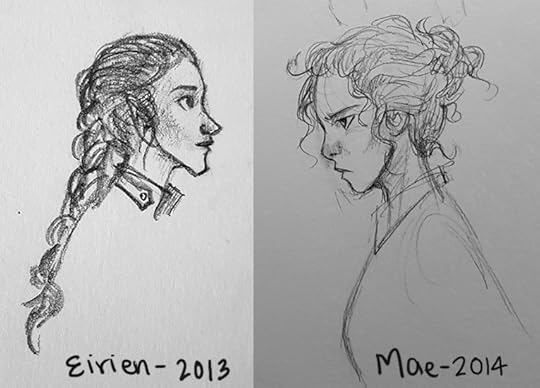 Likes to dance…
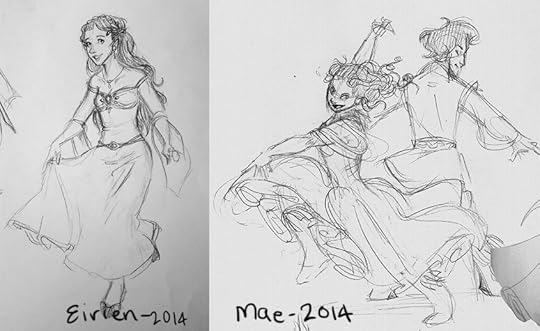 And is exiled from her home for something she didn’t do.
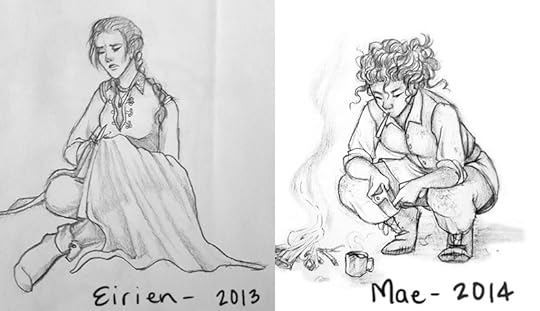 Now, I’ve already shared how my design for Valien is highly reminiscent of my design for Legolas, and this fic is the reason. What I haven’t shared is how Woodwalker Mae Hawkmoth has even more in common with Guardsman Eirien Sarndûriel.
The gist of the fanfic was this: After being banished from Mirkwood for a crime she didn’t commit, Eirien meets Gandalf, who recruits her to guide Thorin and Company through the forest without rousing suspicion from Thranduil’s guards.
Sound familiar? As I started adapting the story for an original novel, the party of Dwarves became Mona and her brothers, the Lonely Mountain became Lumen Lake, and Smaug became the nation of Alcoro. They're basically the same person.(For more on this stunning cosplay of Queen Mona, see Sadie by Design's guest post from August 2018!)But the similarities go even deeper—take a look at the plot outline below.A forest ranger is exiled for something she didn’t do.She agrees to lead a party of foreigners through the forest to drive away an enemy and reclaim their fallen kingdom.The foreigners hate the forest. At one point, one falls ill. Unconscious, he must be carried by his comrades.The ranger leaves to find help for her unconscious travel companion, leading to the party’s capture by her old friends in the Guard.The ranger is questioned about her quest; she lies to protect her companions.A desperate palace escape is made, helped by a mysterious benefactor.The ranger and her companions reach the foreigners’ country and proceed to reclaim the throne by forming a hasty and unlikely alliance.A battle ensues and the ranger is wounded.
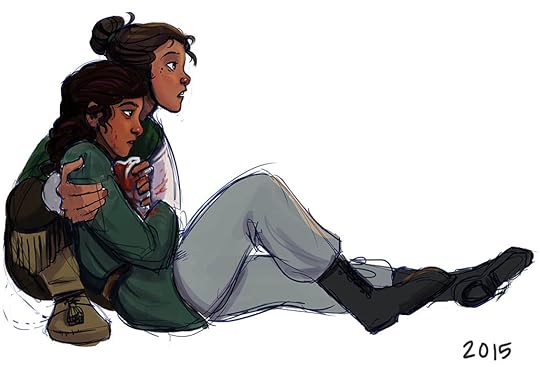 Is that a #*@%ing dragon??Yikes, right? The Sparknotes read like the exact same story. The big difference was in the endings. While Mae’s story ends with the promise of her returning home, Eirien is sent to Valinor before she can die from her wounds. I later altered the ending to have her recover in order to write the sequel fic, which chronicled her fight to protect the besieged Mirkwood while the Ring traveled south.
Several other facets of Woodwalker got their start in this fic, too. One was the name Woodwalker itself, a casual epithet Gandalf gives to Eirien (in the style of Wingfoot or Barrel-Rider). Another was the common exclamation, “Great Light!” This started out as the longer phrase, “Great Light of the Trees!” based on the Two Trees of Valinor that lit the Undying Lands. Out of habit I carried it over into the worldbuilding of Woodwalker, leading to the development of the spiritual force and ultimate factor driving the conflict in the trilogy.
At this zoomed-out level, it’s pretty stark how similar the two stories are. But moving in a little closer, the similarities start to disappear. The storytelling voice and the twist at the end are influenced much more heavily by Megan Whalen Turner’s Queen’s Thief series. The story took on strong environmental themes and moved from Middle Earth to southern Appalachia, and what little magic I had shoehorned into the plot dried up to nothing. And while my two protagonists share some things in common, Mae’s character ended up going in a different direction than Eirien’s. Mae isn’t the warrior Eirien is. Eirien is a soldier through and through, devoted to protecting the Greenwood from marauding Orcs and spiders, while Mae fights back against the attempts to turn the Wood Guard into an armed border patrol. Eirien has little to no skill with herbs and medicines, while they’re Mae’s specialty. And while Eirien gets wrapped up in the Dwarves’ quest without really meaning to, Mae is the one to engineer the attempt to restore Queen Mona to the throne of Lumen Lake.
Still, the similarities are certainly there, and that’s okay. I’ve grown less cagey about talking about my fanfiction, because I’ve reached a point where I can appreciate all it’s done for my career. This fic was important to me for more than just sketching out Woodwalker’s plot. It was where I first learned the value of giving my female protagonist a robust group of supportive female friends—not only did it take much of the emphasis off the romantic subplot, but it made exile all the more painful for Eirien. It was also great practice at writing woodcraft and long-distance travel in a way that’s actually fun to read. And perhaps most importantly, it boosted my confidence that despite my life being commandeered by my toddler and nursing infant, I could reliably commit to writing a full-length novel. Not fast, of course, but I did it, and I enjoyed it. It helped me connect back to the person I was before I became a mom. Without that success, I don’t know that I would have been brave enough to attempt writing Woodwalker, or seeking publication for it.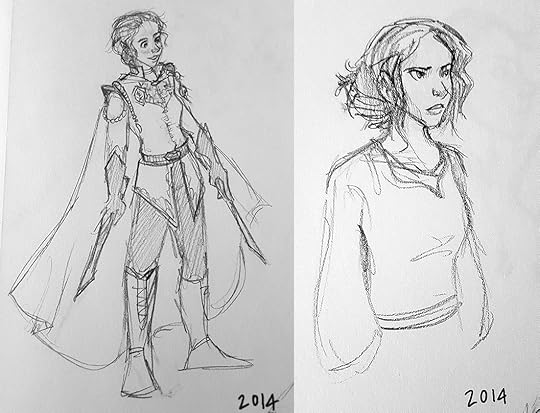 These images are two pages apart in my 2014 sketchbook—Eirien on the left and my very first sketch of Mae on the right.Woodwalker is my only published book that bears this kind of similarity to a fanwork. Ashes to Fire and Creatures of Light took off on their own trajectories, and my two in-progress manuscripts mostly have roots in my work as a park ranger. But I think that’s kind of neat—fanfiction served as a bridge, first to help me develop my writing skills and confidence, and then to build a story that launched my career as an author. It was a springboard, an incubator, and a treasure map.
Write your fanfiction. Value your fanfiction—from your terrible, indulgent Mary Sue oneshots to your sweeping epic sagas that could put George RR Martin to shame. They are the seeds that so much can sprout from. I recently found out that my aforementioned favorite author Megan Whalen Turner grew up writing Star Wars fanfiction. I love that! I love that there are swaths of authors who happily point to fanwork as a driving force in their careers. I love that we’re seeing fresh new voices telling in-universe stories (I just picked up Lois Lane: Fallout by Gwenda Bond, and my husband reads Star Wars novels like they’re his religion). I love that fanfiction, like fan art, is an outlet for building community and inspiring creators of all ages to make and consume and imagine new possibilities.
Oh, and a note to the Tolkien estate—if you ever open up Middle Earth for franchise fiction, ala Star Wars… let me know. I am, as they say, at your service.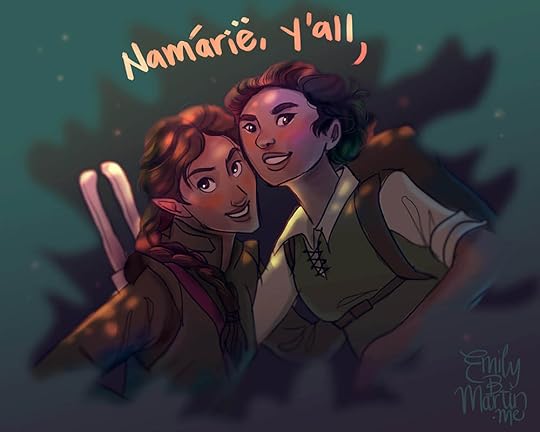 September Art RoundupAn assortment of character sketches--Mae and Toph were done as live-drawing demonstrations.
See full portfolio
What I'm ReadingUpcoming EventsHistory is All You Left Me, Adam Silvera
September Art RoundupAn assortment of character sketches--Mae and Toph were done as live-drawing demonstrations.
See full portfolio
What I'm ReadingUpcoming EventsHistory is All You Left Me, Adam Silvera
Isle of Blood and Stone, Makiia Lucier
Monday's Not Coming, Tiffany D. Jackson
The Madman's Daughter, Megan Shepherd
The Thief, Megan Whalen Turner
The Hobbit, JRR Tolkien (out loud to my kids)
Did you get some value out of this post? If so, please consider buying me a coffee by donating $3 to my Ko-fi account:Pendleton Fall Festival: October 6, 10:30-12:30, Pendleton, SC. I'll be at the public library table with books and giveaways. Everyone who buys or brings a copy of Woodwalker for me to sign gets a special new freebie!YA ReadUp: October 20, Greenville SC. I've been excited for this event all year. Come to the Peace Center for a day of panels and booksignings from your favorite Young Adult authors! Keynotes this year are Marissa Meyer, Ally Condie, and Brendan Reichs. Find my panel schedule and other details on my Events page.
Recently I’ve given several programs on the power of fan art, and during these programs, I always make sure to stress that the same value applies to fanfiction as well. There’s a good reason for that—most of my completed manuscripts prior to Woodwalker’s publication were fanfiction. The most significant of these, at least in relationship to my published work, is a 67,000 word fic set in the world and events of The Hobbit (in comparison, Woodwalker is 72k words). I wrote it after the first Hobbit movie came out and made me mad with how little it held to the spirit of the book, keeping me awake at night with all the potential that had been lost. It ended up becoming the first of a duology, with the second installment set during The Lord of the Rings.Nobody has read these fics, not even my best friend and beta reader, who’s read almost everything else I’ve ever written. And they’re not my only LotR fics—I wrote one in undergrad that topped 115k words and encompassed about 500 years of Middle Earth history. But the one set during The Hobbit is the most special to me for several reasons—first, because The Hobbit defined my childhood and ignited my love of fantasy, quests, and worldbuilding. Second, because it was the fic I was writing when my husband finally found out, after four years of marriage, that all the typing I was doing on my computer wasn’t just social media, but fiction writing. And third, because without it, I wouldn’t have conceived of the character of Mae and the plot of Woodwalker.
Warning: Big plot spoilers for Woodwalker below (but none for books 2 and 3). Read them all after the jump!Meet Eirien.
Look like someone you know?
Eirien is an Avari Elf of Mirkwood, descended from the Elves that never traveled to Valinor, and part of the Royal Guard protecting the stronghold of King Thranduil. Her weapons of choice are two bone-handled knives, and she favors a long braid.
She has copper skin and dark brown hair…
Likes to dance…
And is exiled from her home for something she didn’t do.
Now, I’ve already shared how my design for Valien is highly reminiscent of my design for Legolas, and this fic is the reason. What I haven’t shared is how Woodwalker Mae Hawkmoth has even more in common with Guardsman Eirien Sarndûriel.The gist of the fanfic was this: After being banished from Mirkwood for a crime she didn’t commit, Eirien meets Gandalf, who recruits her to guide Thorin and Company through the forest without rousing suspicion from Thranduil’s guards.
Sound familiar? As I started adapting the story for an original novel, the party of Dwarves became Mona and her brothers, the Lonely Mountain became Lumen Lake, and Smaug became the nation of Alcoro.
They're basically the same person.(For more on this stunning cosplay of Queen Mona, see Sadie by Design's guest post from August 2018!)But the similarities go even deeper—take a look at the plot outline below.A forest ranger is exiled for something she didn’t do.She agrees to lead a party of foreigners through the forest to drive away an enemy and reclaim their fallen kingdom.The foreigners hate the forest. At one point, one falls ill. Unconscious, he must be carried by his comrades.The ranger leaves to find help for her unconscious travel companion, leading to the party’s capture by her old friends in the Guard.The ranger is questioned about her quest; she lies to protect her companions.A desperate palace escape is made, helped by a mysterious benefactor.The ranger and her companions reach the foreigners’ country and proceed to reclaim the throne by forming a hasty and unlikely alliance.A battle ensues and the ranger is wounded.
Is that a #*@%ing dragon??Yikes, right? The Sparknotes read like the exact same story. The big difference was in the endings. While Mae’s story ends with the promise of her returning home, Eirien is sent to Valinor before she can die from her wounds. I later altered the ending to have her recover in order to write the sequel fic, which chronicled her fight to protect the besieged Mirkwood while the Ring traveled south.Several other facets of Woodwalker got their start in this fic, too. One was the name Woodwalker itself, a casual epithet Gandalf gives to Eirien (in the style of Wingfoot or Barrel-Rider). Another was the common exclamation, “Great Light!” This started out as the longer phrase, “Great Light of the Trees!” based on the Two Trees of Valinor that lit the Undying Lands. Out of habit I carried it over into the worldbuilding of Woodwalker, leading to the development of the spiritual force and ultimate factor driving the conflict in the trilogy.
At this zoomed-out level, it’s pretty stark how similar the two stories are. But moving in a little closer, the similarities start to disappear. The storytelling voice and the twist at the end are influenced much more heavily by Megan Whalen Turner’s Queen’s Thief series. The story took on strong environmental themes and moved from Middle Earth to southern Appalachia, and what little magic I had shoehorned into the plot dried up to nothing. And while my two protagonists share some things in common, Mae’s character ended up going in a different direction than Eirien’s. Mae isn’t the warrior Eirien is. Eirien is a soldier through and through, devoted to protecting the Greenwood from marauding Orcs and spiders, while Mae fights back against the attempts to turn the Wood Guard into an armed border patrol. Eirien has little to no skill with herbs and medicines, while they’re Mae’s specialty. And while Eirien gets wrapped up in the Dwarves’ quest without really meaning to, Mae is the one to engineer the attempt to restore Queen Mona to the throne of Lumen Lake.
Still, the similarities are certainly there, and that’s okay. I’ve grown less cagey about talking about my fanfiction, because I’ve reached a point where I can appreciate all it’s done for my career. This fic was important to me for more than just sketching out Woodwalker’s plot. It was where I first learned the value of giving my female protagonist a robust group of supportive female friends—not only did it take much of the emphasis off the romantic subplot, but it made exile all the more painful for Eirien. It was also great practice at writing woodcraft and long-distance travel in a way that’s actually fun to read. And perhaps most importantly, it boosted my confidence that despite my life being commandeered by my toddler and nursing infant, I could reliably commit to writing a full-length novel. Not fast, of course, but I did it, and I enjoyed it. It helped me connect back to the person I was before I became a mom. Without that success, I don’t know that I would have been brave enough to attempt writing Woodwalker, or seeking publication for it.
These images are two pages apart in my 2014 sketchbook—Eirien on the left and my very first sketch of Mae on the right.Woodwalker is my only published book that bears this kind of similarity to a fanwork. Ashes to Fire and Creatures of Light took off on their own trajectories, and my two in-progress manuscripts mostly have roots in my work as a park ranger. But I think that’s kind of neat—fanfiction served as a bridge, first to help me develop my writing skills and confidence, and then to build a story that launched my career as an author. It was a springboard, an incubator, and a treasure map.Write your fanfiction. Value your fanfiction—from your terrible, indulgent Mary Sue oneshots to your sweeping epic sagas that could put George RR Martin to shame. They are the seeds that so much can sprout from. I recently found out that my aforementioned favorite author Megan Whalen Turner grew up writing Star Wars fanfiction. I love that! I love that there are swaths of authors who happily point to fanwork as a driving force in their careers. I love that we’re seeing fresh new voices telling in-universe stories (I just picked up Lois Lane: Fallout by Gwenda Bond, and my husband reads Star Wars novels like they’re his religion). I love that fanfiction, like fan art, is an outlet for building community and inspiring creators of all ages to make and consume and imagine new possibilities.
Oh, and a note to the Tolkien estate—if you ever open up Middle Earth for franchise fiction, ala Star Wars… let me know. I am, as they say, at your service.
September Art RoundupAn assortment of character sketches--Mae and Toph were done as live-drawing demonstrations.
See full portfolio
What I'm ReadingUpcoming EventsHistory is All You Left Me, Adam SilveraIsle of Blood and Stone, Makiia Lucier
Monday's Not Coming, Tiffany D. Jackson
The Madman's Daughter, Megan Shepherd
The Thief, Megan Whalen Turner
The Hobbit, JRR Tolkien (out loud to my kids)
Did you get some value out of this post? If so, please consider buying me a coffee by donating $3 to my Ko-fi account:Pendleton Fall Festival: October 6, 10:30-12:30, Pendleton, SC. I'll be at the public library table with books and giveaways. Everyone who buys or brings a copy of Woodwalker for me to sign gets a special new freebie!YA ReadUp: October 20, Greenville SC. I've been excited for this event all year. Come to the Peace Center for a day of panels and booksignings from your favorite Young Adult authors! Keynotes this year are Marissa Meyer, Ally Condie, and Brendan Reichs. Find my panel schedule and other details on my Events page.
Emily B. Martin's Blog

- Emily B. Martin's profile
- 145 followers
Emily B. Martin isn't a Goodreads Author
(yet),
but they
do have a blog,
so here are some recent posts imported from
their feed.

