
Ellen Booraem's Blog, page 8
July 19, 2011
Sum-sum-summertime
Normally, Summer officially ends when our friends Linda and Michael pack up their dogs and toys and leave for Providence, RI, after a pandemonious week in a seaside cottage down the street. This year, L&M came up a month early, so we've had our climatic week and there's still a month and a half until Labor Day.
Normally, summer reaches its midpoint when I trek to Portland for lunch with my college roommates. That happened Monday, the day after Linda and Michael packed up the dogs and left. So the summer's midpoint came after its end, which is extremely confusing to the well-regulated mind.
I have reacted to this by spending today puttering. Peace of mind dictates that I get to work pronto. Time being in an upheaval, pronto apparently will not take place until tomorrow.
Highlights of the L&M week included a garden tour for Linda and me--of which she took pictures and I, being time-addled, did not--and matchstick sailboats, kits for which Michael assembled and sent up ahead so Rob and our friend Eric could make them in time for Michael's arrival. Rob was grateful that this year's boat wasn't as complicated and time-consuming as last year's, a miniature catboat with radio controls.
Also, we went to the Stonington Opera House for their annual Shakespeare in Stonington production, which this year consisted of two plays rather than one. With the usual mixed crew of Equity actors and local folk, the Opera House staged Much Ado About Nothing (with men playing Beatrice and Hero, as they would have in Shakespeare's time) and Elizabeth Rex, Timothy Findley's modern play set in Queen Elizabeth's barn the night before she caused Essex to be beheaded. Eager for distraction, she spends the night with Shakespeare's troupe of actors, who have just performed--yup--Much Ado About Nothing.
The Opera House production was in repertory, so the actor who played Beatrice in Much Ado scuttled across town to the Elizabeth Rex stage in the Historical Society's barn, where he portrayed the actor who played Beatrice. All the other parts matched, too. It was very, very cool. And since S in S loves to switch genders around (for example, the friar this year was played by the same woman who played the Duke/Friar in Measure for Measure last year) Findley's play fit like a lady's glove, men's size nine. Elizabeth, who rules England by playing a man's role, confronts Ned/Beatrice, who survives by playing women. Elizabeth is about to kill her lover. Ned's has killed him by giving him syphilis. Shakespeare's purported lover is about to die with Essex. Makes for an interesting conversation.
Usually, S in S takes place in August, but they switched it with the Jazz Festival this year. More time confusion. Tomorrow may be Thanksgiving for all I know.
Anyway, here are some pictures by Linda of the great matchstick sailboat regatta.
[image error] The gentlemen launched their boats at low tide, with Linda and me in kayaks to round up any craft that made a break for freedom. Here, I am pursuing one of Michael's two boats (the little sail in the center distance), while Rob's matchstick boat (right) makes for Linda, who's taking the picture. In the center foreground with the red sail is Rob's radio-controlled boat from last year, launched just to make things more interesting.
[image error] Ah, summertime in shallow water. Dudley and Mollie, L&M's dogs, wander around pondering mayhem while I lounge in decidedly unapproved kayak technique. My kayak is a Loon, the elastic waistband of the maritime world--very beamy and stable, with a huge cockpit that lets me free my legs for lounging and makes me less claustrophobic than a regular kayak.
[image error] The gentlemen , admired by Mollie. And, just to humiliate them, here are my college roommates plus one. Claudia (known to all right-thinking people as Dane) and Laura and I met at Wheaton College in 1971 (actually, I met Laura in 1970, I guess) and shared a house off campus with six other women in 1972-73. Dane and her partner Juanita live in DC, but come to Maine for a week or two every summer. About four years ago, we started meeting for lunch in Portland, which is about equidistant from Brooklin and Laura's New Hampshire home. The amazing thing is that we hardly communicate for a year, and then pick right up where we left off...the nature of old friends.
[image error] Juanita, me, Dane, and Laura after an extremely long and loud Monday lunch.
The knitting report: There is none. The secretary wishes to point out that this is not her fault, as there has been no activity since the last report. Oh wait, maybe I started a new sock. I'll have to check.
The writing report: Again none, and the secretary refuses to take responsibility. Except I did get the rough draft of CONOR'S BANSHEE spiral bound so I can give it to some kids to read. Oh, and I'm reading A BRIEF HISTORY OF TIME for undisclosed research purposes having nothing to do all the other time-related aspects of the day.

Normally, summer reaches its midpoint when I trek to Portland for lunch with my college roommates. That happened Monday, the day after Linda and Michael packed up the dogs and left. So the summer's midpoint came after its end, which is extremely confusing to the well-regulated mind.
I have reacted to this by spending today puttering. Peace of mind dictates that I get to work pronto. Time being in an upheaval, pronto apparently will not take place until tomorrow.
Highlights of the L&M week included a garden tour for Linda and me--of which she took pictures and I, being time-addled, did not--and matchstick sailboats, kits for which Michael assembled and sent up ahead so Rob and our friend Eric could make them in time for Michael's arrival. Rob was grateful that this year's boat wasn't as complicated and time-consuming as last year's, a miniature catboat with radio controls.
Also, we went to the Stonington Opera House for their annual Shakespeare in Stonington production, which this year consisted of two plays rather than one. With the usual mixed crew of Equity actors and local folk, the Opera House staged Much Ado About Nothing (with men playing Beatrice and Hero, as they would have in Shakespeare's time) and Elizabeth Rex, Timothy Findley's modern play set in Queen Elizabeth's barn the night before she caused Essex to be beheaded. Eager for distraction, she spends the night with Shakespeare's troupe of actors, who have just performed--yup--Much Ado About Nothing.
The Opera House production was in repertory, so the actor who played Beatrice in Much Ado scuttled across town to the Elizabeth Rex stage in the Historical Society's barn, where he portrayed the actor who played Beatrice. All the other parts matched, too. It was very, very cool. And since S in S loves to switch genders around (for example, the friar this year was played by the same woman who played the Duke/Friar in Measure for Measure last year) Findley's play fit like a lady's glove, men's size nine. Elizabeth, who rules England by playing a man's role, confronts Ned/Beatrice, who survives by playing women. Elizabeth is about to kill her lover. Ned's has killed him by giving him syphilis. Shakespeare's purported lover is about to die with Essex. Makes for an interesting conversation.
Usually, S in S takes place in August, but they switched it with the Jazz Festival this year. More time confusion. Tomorrow may be Thanksgiving for all I know.
Anyway, here are some pictures by Linda of the great matchstick sailboat regatta.
[image error] The gentlemen launched their boats at low tide, with Linda and me in kayaks to round up any craft that made a break for freedom. Here, I am pursuing one of Michael's two boats (the little sail in the center distance), while Rob's matchstick boat (right) makes for Linda, who's taking the picture. In the center foreground with the red sail is Rob's radio-controlled boat from last year, launched just to make things more interesting.
[image error] Ah, summertime in shallow water. Dudley and Mollie, L&M's dogs, wander around pondering mayhem while I lounge in decidedly unapproved kayak technique. My kayak is a Loon, the elastic waistband of the maritime world--very beamy and stable, with a huge cockpit that lets me free my legs for lounging and makes me less claustrophobic than a regular kayak.
[image error] The gentlemen , admired by Mollie. And, just to humiliate them, here are my college roommates plus one. Claudia (known to all right-thinking people as Dane) and Laura and I met at Wheaton College in 1971 (actually, I met Laura in 1970, I guess) and shared a house off campus with six other women in 1972-73. Dane and her partner Juanita live in DC, but come to Maine for a week or two every summer. About four years ago, we started meeting for lunch in Portland, which is about equidistant from Brooklin and Laura's New Hampshire home. The amazing thing is that we hardly communicate for a year, and then pick right up where we left off...the nature of old friends.
[image error] Juanita, me, Dane, and Laura after an extremely long and loud Monday lunch.
The knitting report: There is none. The secretary wishes to point out that this is not her fault, as there has been no activity since the last report. Oh wait, maybe I started a new sock. I'll have to check.
The writing report: Again none, and the secretary refuses to take responsibility. Except I did get the rough draft of CONOR'S BANSHEE spiral bound so I can give it to some kids to read. Oh, and I'm reading A BRIEF HISTORY OF TIME for undisclosed research purposes having nothing to do all the other time-related aspects of the day.


July 6, 2011
Book Review Club: July
 Click icon for more
book review blogs
@Barrie Summy
I suppose I should suggest beach reading, something light and frothy. This book is far from that, although it is FUN so doesn't that qualify?
Don't forget to click the icon for more reviews!
[image error] Monsters of Men
By Patrick Ness
Candlewick, 2010
Young Adult
A month or so ago, away from home and requiring an immediate book, I bought THE KNIFE OF NEVER LETTING GO, the first book of Patrick Ness's CHAOS WALKING trilogy. I'd heard about it over the past couple of years and had always kinda figured I'd read it sometime.
What. Was. I waiting for.
I finished the first book in 40 seconds flat, and casually mentioned it to our town librarian. She went online, liked what she saw, and before I could get my head together to buy the second book, THE ASK AND THE ANSWER, the whole flippin' trilogy appeared on the YA shelf beside the circulation desk. (I love our library.)
MONSTERS OF MEN, the third and final book, just won its author the Carnegie Medal, the UK's version of the Newbery Medal and a big, huge deal. (The first two books were short-listed.) While I have a minor bone to pick with this final book, I'm deeply happy that Ness has been honored for it.
The books are set on a planet that humans are beginning to colonize, despite the fact that it's already home to the gentle, humanoid Spackle. (Avatarish, yes. More on that later.) The first group of humans finds immediately that something about the planet allows everyone to "hear" the thoughts in a man's head, resulting in a cacophony quickly dubbed "Noise."
Human women can hear the men's Noise, but generate none of their own—a man's thoughts and intentions are visible to everyone, and a woman's to no one. (A friend of mine said: "And this differs from reality…how?")
All Spackle have Noise, regardless of sex. It's how they communicate.
Animals can communicate that way, too, although at an elementary level. Here's how the first book begins:
The first thing you find out when yer dog learns to talk is that dogs don't got nothing much to say. About anything.Ness has a wonderful time exploring the implications of Noise. Some human men become resentful and suspicious of the women, some women a tad contemptuous of the men. The lack of privacy drives some men nuts but inspires others to use Noise for personal power. Young people—who've known no other planet—accept Noise as the air they breathe.
"Need a poo, Todd."
"Shut up, Manchee."
"Poo. Poo, Todd."
The "Todd" whose dog needs a poo is just such a young person, our narrator for all of the first book and large parts of the other two. The first book follows him as he escapes his home village, called Prentisstown after its despotic Mayor, under a threat he doesn't understand. As he flees through the woods, he meets Viola, the first female he's ever known because Prentisstown's women died mysteriously in his infancy. Viola is the vanguard of another wave of human settlers—she and her parents took off from the fleet on a scouting mission, and her parents were killed when their ship crash-landed. She's already been threatened by Prentisstown's madman minister, so she and Todd join forces, mutually suspicious.
The first book is a picaresque adventure, as Todd and Viola make their way to what they hope will be a safe haven, pursued for enigmatic reasons by the minister and, eventually, an entire army from Prentisstown. It's also about the growing trust between Todd and Viola, and eventually their love for one another. In the second book, they are separated but still bonded, managing to survive the rival forces in yet another dictatorship.
In the third book, MONSTERS OF MEN, the humans are at war with the Spackle, who have had about enough of being subjugated and enslaved. Two factions battle within the human camp. Noise is explained, as well as the Spackle's Zen-like relationship to it and their planet. It turns out Noise can be manipulated if a man gets it under control. We see the politics of the human factions but also among the Spackle, as narration flips from Todd to Viola to the freed Spackle slave 1017.
In this final book and as a whole, CHAOS WALKING is one boy's coming-of age story but also a fascinating look at larger issues: why societies fester, why dictators thrive, why we conform, why we kill, why we go to war, and what will stop us. It sets up a series of almost unsolvable conundrums, in which everyone on every side has an unarguable reason to fight, and yet fighting will probably kill them all. There's a cliffhanger about every ten pages. Don't plan to sleep much until you finish it.
This last book does come perilously close to being just another Clueless European Colonist vs Noble Savage story, particularly because the Spackle are so psychically entwined with their planet. (They call themselves The Land.) It mostly escapes the yech factor because Noise is such an oddball concept and because the characters are so wonderfully complex and involving. Even the biggest, baddest villain has achingly sympathetic moments.
For me, the one problem with this book is the relationship between Todd and Viola. We keep being told that they will do anything to save each other, even if it means violating core ethics, and yet the bond between them is never as deeply felt as it is in the first book. This reads as an oversight rather than a deliberate plot point.
Fortunately, there's so much going on and it's all so much fun that the reader—this one, anyway—accepts what she's told and gets on with it.

July 5, 2011
Grueling Grilling
Every season has its tortured pleasures: Freezing the tomatoes in the fall, putting the lights on the maple tree for winter, the tax ordeal to usher in spring. For me, summer's annual Dreaded Good Time occurred yesterday, when the Brooklin Youth Corps (the summer work/self-esteem program of which I'm president) barbecued chicken for at least 350 of its neighbors and friends. This was our fifteenth attempt.
The Fourth of July barbecue has been a tradition for decades. When we moved here 27 years ago, the event was handled by the Grand Masters of public cooking: Louise and Rocky Rockwell, George and Georgene Allen, and a host of others. Not sure if there was an organization involved--they were an organization unto themselves. Many of them have moved on to the Bigger Supper now, or anyway have passed their aprons and charcoal briquettes to another generation.
When the BYC started up in 1997, the elementary school's PTF had been doing the honors but had requested relief for some reason. So we took the barbecue on--gulping, because it's such a tradition--and survived to grill another day. It's particularly harrowing in that the BYC season is but a week or two old at this point, so we're not quite the well-oiled machine we'll be in a couple more weeks.
Every year has its little jaw-clencher, usually related to the supplies order. Last year, the order came in with skinless, boneless chicken--it turned out scrumptious anyway because we have Paul Brayton the Master Griller on our team, but he almost had apoplexy worrying about it. This year, the order came in without plastic forks, and we didn't notice until a half-hour before the hoards arrived. This necessitated a frantic run down the street to the Brooklin General Store, which donated every plastic fork on the premises, including the ones they had in a drawer for their own customers.
The chief peculiarity of the event is its timing. The parade starts on the other end of town at 10 a.m., and the color guard makes it to the town green at 10:30, followed for the next half-hour by a succession of floats and antique cars and horses and bicycles and whatnot. The first year we did the barbecue, we figured nobody in their right minds would want barbecued chicken, corn, potato salad, cole slaw and watermelon before 11 a.m. Wrong. The minute people's feet hit the grass of the town green, their noses get a whiff and their mouths start watering. They walk right past the sponge toss and other kiddie games to get in line. Go figure.
We start selling at 10:30. We're sold out at noon.
Herewith, a few snapshots. Sorry I didn't get any of the parade or the other festivities. I was up to my elbows in cole slaw at the time.
[image error] The rush begins, and the brave BYCers begin an intense hour of slinging cole slaw. (The red t-shirts have "BYC--Brooklin Youth Corps" on the back, so they're advertising their services even when hunched over and weeding.)
[image error] BYC Steering Committee members Judith Fuller (foreground) and Sherry Streeter sell tickets to...
[image error] ... This crowd. This is probably 10:45. Note that some people are already eating.
[image error] Steering Committee member Ann Brayton, whose husband, Paul, is our grilling genius, cuts up watermelon. Ann's kids were in the BYC years ago, and now she's serving a life sentence on the steering committee.
[image error] Our coordinator, Doug Mangels (in red, naturally) gives Paul a break at the grill. This was fairly late in the game--at the start, the entire grill is covered with chicken. I actually don't know the guy in blue who's helping Doug, but I think he was the Braytons' house-guest. That's what happens to the unwary visitor so come here at your peril. (This message brought to you by the Greater Blue Hill Chamber of Commerce.) [image error] My one non-chicken-related photo. It's the sponge-throwing booth run by the school. I love the reaction of the girl in the left background.
After the clean-up, we went to our own neighborhood barbecue. I drank three (light) beers and ate, I think, four desserts. Fueling up for next year.

The Fourth of July barbecue has been a tradition for decades. When we moved here 27 years ago, the event was handled by the Grand Masters of public cooking: Louise and Rocky Rockwell, George and Georgene Allen, and a host of others. Not sure if there was an organization involved--they were an organization unto themselves. Many of them have moved on to the Bigger Supper now, or anyway have passed their aprons and charcoal briquettes to another generation.
When the BYC started up in 1997, the elementary school's PTF had been doing the honors but had requested relief for some reason. So we took the barbecue on--gulping, because it's such a tradition--and survived to grill another day. It's particularly harrowing in that the BYC season is but a week or two old at this point, so we're not quite the well-oiled machine we'll be in a couple more weeks.
Every year has its little jaw-clencher, usually related to the supplies order. Last year, the order came in with skinless, boneless chicken--it turned out scrumptious anyway because we have Paul Brayton the Master Griller on our team, but he almost had apoplexy worrying about it. This year, the order came in without plastic forks, and we didn't notice until a half-hour before the hoards arrived. This necessitated a frantic run down the street to the Brooklin General Store, which donated every plastic fork on the premises, including the ones they had in a drawer for their own customers.
The chief peculiarity of the event is its timing. The parade starts on the other end of town at 10 a.m., and the color guard makes it to the town green at 10:30, followed for the next half-hour by a succession of floats and antique cars and horses and bicycles and whatnot. The first year we did the barbecue, we figured nobody in their right minds would want barbecued chicken, corn, potato salad, cole slaw and watermelon before 11 a.m. Wrong. The minute people's feet hit the grass of the town green, their noses get a whiff and their mouths start watering. They walk right past the sponge toss and other kiddie games to get in line. Go figure.
We start selling at 10:30. We're sold out at noon.
Herewith, a few snapshots. Sorry I didn't get any of the parade or the other festivities. I was up to my elbows in cole slaw at the time.
[image error] The rush begins, and the brave BYCers begin an intense hour of slinging cole slaw. (The red t-shirts have "BYC--Brooklin Youth Corps" on the back, so they're advertising their services even when hunched over and weeding.)
[image error] BYC Steering Committee members Judith Fuller (foreground) and Sherry Streeter sell tickets to...
[image error] ... This crowd. This is probably 10:45. Note that some people are already eating.
[image error] Steering Committee member Ann Brayton, whose husband, Paul, is our grilling genius, cuts up watermelon. Ann's kids were in the BYC years ago, and now she's serving a life sentence on the steering committee.
[image error] Our coordinator, Doug Mangels (in red, naturally) gives Paul a break at the grill. This was fairly late in the game--at the start, the entire grill is covered with chicken. I actually don't know the guy in blue who's helping Doug, but I think he was the Braytons' house-guest. That's what happens to the unwary visitor so come here at your peril. (This message brought to you by the Greater Blue Hill Chamber of Commerce.) [image error] My one non-chicken-related photo. It's the sponge-throwing booth run by the school. I love the reaction of the girl in the left background.
After the clean-up, we went to our own neighborhood barbecue. I drank three (light) beers and ate, I think, four desserts. Fueling up for next year.
July 1, 2011
A Gardener's Moan
One of these things gave rise to the other:
[image error] [image error]
I took these photos in early May, when I got out the dahlia tubers that had overwintered in luxury (paper bags in Rob's studio). Last summer's perfect growing season had given the plants, and therefore the tubers, a burst of energy the likes of which I can only vaguely remember from my teen years. I ended up with 27 potted tubers, which would inevitably result in 27 potted plants, which would all require homes in the perennial garden.
Which had room for about twelve.
I've pretty much exhausted the willing recipients of dahlia plants. (My friend Kim took two or three this year, but only because she was already hooked before I admitted that her husband had previously refused them.) So, even though I had a book to finish and Places to Go later in the month, I decided, naturally, to expand the back flowerbed by roughly two-thirds. (I like to think I wouldn't have done it if I'd known I was going to be felled by the Cold that Wouldn't Die two weeks later. But we'll never know for sure, will we?)
If this had just been a matter of digging up some sod, adding compost and lime, and sticking in some dahlias, it wouldn't have been so bad. But the complication is that I've run out of sunny spots for flowerbeds, so this new bed was half-shade and unsuitable for dahlias. I had shade plants that now were in the sun because of massive tree-cutting the winter before last, plus I had newish apprentice perennials that had proved unmanageable and had been sentenced to exile in the wilderness.
So, while I finished the first round of CONOR'S BANSHEE (emailed to agent and editor yesterday, thank you very much), I also was playing perennial pinball in the garden. Dug up euphorbia and campanula, put in dahlias. Transplanted blue-flag iris, put in dahlias. Also put dahlias in their usual place, except more crowded than usual. Bought some new astilbe and astrantia (shade-lovers) and stuck them partly in the new bed but partly in the old bed. From which I transplanted violets and some other thing whose name I can't remember.
Here (below) is where it stands at the moment. The new bed is in the back, definitely a work in progress because I'm leaving lots of space for growth and the crap soil needs several more applications of compost and seaweed. The new astilbes etc (plus some old astilbes which I...er...transplanted) are in the lower left.
[image error]
Hmm. This isn't sounding like as much of a horror show as it was. Did I mention that we've had a weird late bloom of black flies, coinciding with the regular bloom of mosquitoes? Ah...now I have your attention. One of the little suckers found its way under my shirt and bit me just above the naval. The rest were content to swarm around waiting for my organic bug-repellent to wear off, which it does about once an hour.
There are other seasonal miracles. A leopard's bane, which flowers in late April, burst into life today and emitted one more perfect bloom, which we hadn't even seen coming. Maybe the rapture is due after all.
[image error]
Not a miracle (except in the broadest possible sense) but the peony's looking good, too. Kinda makes it all worthwhile, doesn't it?
[image error]
The knitting report: We don't get television once the trees leaf out, so I'm a little less productive. But I'm on the second sock of another cotton pair, which will make FIVE total since I started. And yet I am not bored.
The writing report: Bye-bye Conor, at least for the moment. A day off, maybe two. Then I'm either starting something new or refurbishing something old. Not sure which.

[image error] [image error]
I took these photos in early May, when I got out the dahlia tubers that had overwintered in luxury (paper bags in Rob's studio). Last summer's perfect growing season had given the plants, and therefore the tubers, a burst of energy the likes of which I can only vaguely remember from my teen years. I ended up with 27 potted tubers, which would inevitably result in 27 potted plants, which would all require homes in the perennial garden.
Which had room for about twelve.
I've pretty much exhausted the willing recipients of dahlia plants. (My friend Kim took two or three this year, but only because she was already hooked before I admitted that her husband had previously refused them.) So, even though I had a book to finish and Places to Go later in the month, I decided, naturally, to expand the back flowerbed by roughly two-thirds. (I like to think I wouldn't have done it if I'd known I was going to be felled by the Cold that Wouldn't Die two weeks later. But we'll never know for sure, will we?)
If this had just been a matter of digging up some sod, adding compost and lime, and sticking in some dahlias, it wouldn't have been so bad. But the complication is that I've run out of sunny spots for flowerbeds, so this new bed was half-shade and unsuitable for dahlias. I had shade plants that now were in the sun because of massive tree-cutting the winter before last, plus I had newish apprentice perennials that had proved unmanageable and had been sentenced to exile in the wilderness.
So, while I finished the first round of CONOR'S BANSHEE (emailed to agent and editor yesterday, thank you very much), I also was playing perennial pinball in the garden. Dug up euphorbia and campanula, put in dahlias. Transplanted blue-flag iris, put in dahlias. Also put dahlias in their usual place, except more crowded than usual. Bought some new astilbe and astrantia (shade-lovers) and stuck them partly in the new bed but partly in the old bed. From which I transplanted violets and some other thing whose name I can't remember.
Here (below) is where it stands at the moment. The new bed is in the back, definitely a work in progress because I'm leaving lots of space for growth and the crap soil needs several more applications of compost and seaweed. The new astilbes etc (plus some old astilbes which I...er...transplanted) are in the lower left.
[image error]
Hmm. This isn't sounding like as much of a horror show as it was. Did I mention that we've had a weird late bloom of black flies, coinciding with the regular bloom of mosquitoes? Ah...now I have your attention. One of the little suckers found its way under my shirt and bit me just above the naval. The rest were content to swarm around waiting for my organic bug-repellent to wear off, which it does about once an hour.
There are other seasonal miracles. A leopard's bane, which flowers in late April, burst into life today and emitted one more perfect bloom, which we hadn't even seen coming. Maybe the rapture is due after all.
[image error]
Not a miracle (except in the broadest possible sense) but the peony's looking good, too. Kinda makes it all worthwhile, doesn't it?
[image error]
The knitting report: We don't get television once the trees leaf out, so I'm a little less productive. But I'm on the second sock of another cotton pair, which will make FIVE total since I started. And yet I am not bored.
The writing report: Bye-bye Conor, at least for the moment. A day off, maybe two. Then I'm either starting something new or refurbishing something old. Not sure which.
June 23, 2011
The Creature Stirs and Blinks Its Bleary Eyes
Yes, well. See. I've been sick. And in Chicago. And revising.
The dreaded Brooklin Cold turned out to be a real horror. Two weeks in, I had stopped sneezing and snorting but had a totally blocked ear and felt like hell. A month in, I'm finally feeling like myself, have almost stopped coughing and my blocked ear is crackling, which seems like a good sign.
[image error] I mean, Futureland or what?
A plane flight probably wasn't what the doctor ordered for the ol' ear drum, but other than that I had a great time at the Printers Row Lit Fest. Penguin's travel arrangements were perfection, the hotel was great, and Chicago, in case you've never been there, is GORGEOUS. Also very, very hot, but right now--sitting in Brooklin, Maine, in four layers plus a fleece vest--hot seems like a good thing.
In addition to skylines and the comparatively cool lakefront and Millennium Park, there were human beings. First, my fellow panelists Ilene Cooper, Brenda Ferber, Kristina Springer, and C. Alexander London, and our fearless moderator, Amy Alessio. And our audience, who stayed with us even though it was a million degrees in our tent and the fan was directed only at the panel. I love meeting fellow kidlit writers--makes me proud to be one. They are funny, sharp, heartfelt, and great at words, and their ethics are in the right place. Did I say funny? (I'm talking about you, C. Alexander London.)
After the panel, I got to hang out with some of the Marauders, , my online friends who are funny, sharp, heartfelt, and great at words. They're quite ethical, too. Meg, Sandi, and Sue came to the panel discussion with a couple of friends and Sandi's daughter, Kathryn. Sandy and Kathryn had flown in from Nashville to spend the weekend with Meg, who lives in Wisconsin, and Sue took the train from Detroit. After the panel we wandered down to the waterfront then over to Millennium Park, ducking into the art museum and a coffee shop when the clouds opened. I'd only met Meg online, and as usual it seemed as if we'd known each other for years. Which we have. It's just that we'd never met in person.
Here we are cooling off in genteel fashion at Crown Fountain (from left, Sandi, Meg, me, Sue).
[image error]
Here's the correct behavior at Crown Fountain:
[image error]
Since I got home I've been revising, revising, and revising. Also, Brooklin Youth Corps starts Monday and the garden needed attention. Also, I've been revising. Two days ago I plugged a massive plot hole, and was feeling very cocky about it until yesterday morning, when I discovered that filling the plot hole had created a plot chasm. Today I wiped out three days of theorizing and started over. I think I've got it this time. Or, anyway, I think that until tomorrow morning.
I told my editor I'd have this to her "the end of June." What month is this again?
The dreaded Brooklin Cold turned out to be a real horror. Two weeks in, I had stopped sneezing and snorting but had a totally blocked ear and felt like hell. A month in, I'm finally feeling like myself, have almost stopped coughing and my blocked ear is crackling, which seems like a good sign.
[image error] I mean, Futureland or what?
A plane flight probably wasn't what the doctor ordered for the ol' ear drum, but other than that I had a great time at the Printers Row Lit Fest. Penguin's travel arrangements were perfection, the hotel was great, and Chicago, in case you've never been there, is GORGEOUS. Also very, very hot, but right now--sitting in Brooklin, Maine, in four layers plus a fleece vest--hot seems like a good thing.
In addition to skylines and the comparatively cool lakefront and Millennium Park, there were human beings. First, my fellow panelists Ilene Cooper, Brenda Ferber, Kristina Springer, and C. Alexander London, and our fearless moderator, Amy Alessio. And our audience, who stayed with us even though it was a million degrees in our tent and the fan was directed only at the panel. I love meeting fellow kidlit writers--makes me proud to be one. They are funny, sharp, heartfelt, and great at words, and their ethics are in the right place. Did I say funny? (I'm talking about you, C. Alexander London.)
After the panel, I got to hang out with some of the Marauders, , my online friends who are funny, sharp, heartfelt, and great at words. They're quite ethical, too. Meg, Sandi, and Sue came to the panel discussion with a couple of friends and Sandi's daughter, Kathryn. Sandy and Kathryn had flown in from Nashville to spend the weekend with Meg, who lives in Wisconsin, and Sue took the train from Detroit. After the panel we wandered down to the waterfront then over to Millennium Park, ducking into the art museum and a coffee shop when the clouds opened. I'd only met Meg online, and as usual it seemed as if we'd known each other for years. Which we have. It's just that we'd never met in person.
Here we are cooling off in genteel fashion at Crown Fountain (from left, Sandi, Meg, me, Sue).
[image error]
Here's the correct behavior at Crown Fountain:
[image error]
Since I got home I've been revising, revising, and revising. Also, Brooklin Youth Corps starts Monday and the garden needed attention. Also, I've been revising. Two days ago I plugged a massive plot hole, and was feeling very cocky about it until yesterday morning, when I discovered that filling the plot hole had created a plot chasm. Today I wiped out three days of theorizing and started over. I think I've got it this time. Or, anyway, I think that until tomorrow morning.
I told my editor I'd have this to her "the end of June." What month is this again?
June 1, 2011
Book Review Club: June
Click icon for morebook review blogs
@Barrie Summy
I've been sick as three dogs for the past week and a half, a last tail-lashing by The Brooklin Cold (or plague) before it leaves town for the summer. On the plus side, I've finally made a dent in my To Be Read pile--in this case, that meant revisiting my childhood, also a good thing.
Don't forget to click the icon for more reviews!
 The Good Master
By Kate Seredy
Doubleday, 1935
Scholastic paperback, 1991
To enjoy The Good Master is to question everything you think you know about what makes a good novel for children.
For example, it's a given these days that we keep the reader with us by increasing the dramatic tension any way we can. Make Harry Potter an orphan and set a murderous wizard after him, then kill off every father figure he's got. Make Harry feel the deaths are at least partly his fault. Violate the reader's trust so many times that finally the reader really, truly believes that Harry might get killed off, too.
Another given: Characters must have faults.
So here's this book, a Newbery honoree in 1936. Its author, Kate Seredy, was born and educated in Hungary, served as a nurse in World War I, then emigrated to the U.S. in 1922 to seek work as an illustrator. She wrote The Good Master after an editor at Doubleday suggested that children might be interested in tales set in the Hungary of her childhood. It won the Newbery honor; her next book, The White Stag, won the Newbery medal in 1938. The Singing Tree, a sequel to The Good Master, won another Newbery honor in 1940. Seredy wrote nine other books and illustrated countless others before her death in 1975.
 One of the author's illustrations for The Good Master
I can attest that children were interested in Seredy's Hungarian tales, because I enjoyed them myself when I was 8 or 9. I had only vague memories of them, however, and when somebody handed me The Good Master a week or so ago, I wasn't even sure this was the same book I'd loved as a kid. Until I googled her, I had no idea that Seredy was the author of The Chestry Oak, which I must have taken out of the library sixteen times in fourth grade.
So I re-read The Good Master as an adult—an adult who is in the middle of revising a novel, pumping up the dramatic tension every chance I get.
I became reacquainted with Jancsi, the young son of a prosperous rancher on the Hungarian plains, and his madcap city cousin, Kate, who comes to live with his family. I revisited Jancsi's perfect parents and their salt-of-the-earth shepherds, horsemen, and farmhands, riding out on the plains with them and listening to folk tales by the fire. We celebrated Easter. We went to a country fair.
Kate is the only major character with real flaws, and they are attractive ones: "She's the most impossible, incredible, disobedient, headstrong little imp," her father writes, pleading with his brother to give her some fresh air and discipline. Minutes after we meet her, she's running off with a wagon and a team of horses.
Kate quickly settles into farm life, however. She and Jansci have a couple of adventures with rampaging horses and river currents. Kate exposes a charlatan at the fair. The major incident, a potentially stirring one, is Kate's kidnapping by a band of stereotypically swarthy, good-for-nothing gypsies.
 The original cover We hear most of that tale from Kate herself, after the fact when she's already been rescued. It's a bit of a wet firecracker, causing me to spend several fruitless minutes imagining what might have been. An hour later, the book ended with a couple of cloyingly sentimental "surprises" that had been telegraphed for pages. I set it down, sighed … and realized to my surprise that I was a completely satisfied, blissful reader.
 Huh? How on earth did Seredy do that?
Heart, that's how. Seredy didn't just write this book, she felt it. So Jansci's father—the "good master" of the title—has no faults. That's how Seredy remembers men of his type. She's not cynical about it, she's not giving us what she thinks we want and will pay for. She's giving us everything she's got in her heart.
It's interesting that the one vision that stuck with me all these years—a moment when Jansci's father stands there getting soaked in a drought-ending rain, arm outstretched, face to heaven—is a minor incident in the book. The drought and attendant fears take up about four pages of text. But it struck me hard as a kid—I was so involved with these people that Seredy didn't need to go on for pages to tell me how fragile their lives could be.
I was in Hungary at that moment, transported out of my eight-year-old self. That's the power of a good book, and I'll trade it for dramatic tension any day.

May 25, 2011
An Urban Sojourn
Hooray for mind over matter. Rob had a terrible cold last week, and I ran around obsessively washing my hands in hopes of getting through the weekend without hacking and snorting and snuffling. I made it--the cold felled me the instant I got home Monday night. I spent yesterday in bed feeling sorry for myself, but thrilled that I hadn't sneezed all over Tatnuck Booksellers, various South Bostonians (Southies?) and my friend Larry, who gamely put me up in Cambridge even though he's madly preparing for graduation. (He administers Quincy House at Harvard.)
Health issues aside, I had a wonderful weekend. The highlight was Monday's visit to the Oliver Hazard Perry School in South Boston, where I sat in on seventh-grade classes (researching my dear Conor and his banshee) and then led workshops with some of the most delightful fourth and fifth graders I've ever met.
We did the Character Chase, an exercise in which we ask and answer 20 questions about a character, then chart his/her life so far, looking for a story. It gets very noisy, but it's a total hoot. The fourth graders' character was born in Spain and came to Boston in a shipment of garbage --who knew Spain was dumping its refuse here? He ended up being adopted and becoming a ballet dancer, so it all ended well.
The fifth graders' character almost shot his father and came down with AIDS, but they had pity on him in the end. He did jack a car, but he didn't get caught.
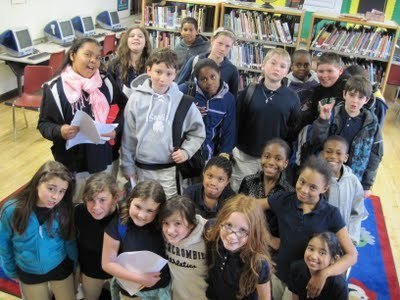
Here are the fourth graders:
And here are the fifth graders:
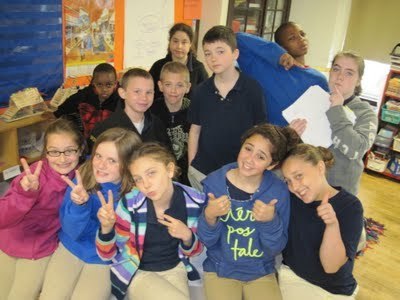
The young woman at right is holding the edited manuscript for THE UNNAMEABLES, exhibit A when talking about the importance of revision.
Speaking of which, I spent Friday and Sunday evenings chatting with South Boston natives to make sure I'm not misrepresenting Southie too badly in Conor's tale. I was suprised at the number of things I have right, but I do have some alterations to make. My major mistake is that I forgot all about busing and the school lottery (amazing for someone who lived in Boston when Louise Day Hicks was in the headlines). Everyone was very generous with time and insights, and I'm tremendously grateful to them and to Kim Simonian for organizing it all.
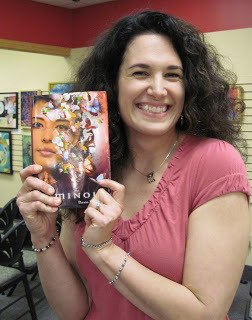
The original idea for the weekend, of course, was the Five Fantasy Authors appearance at Tatnuck Booksellers in Westborough. The sun came out Saturday for one friggin' day in a long stretch of clouds and rain, so we spoke to a select group. But we had a great time anyway, and got to be on hand when Dawn Metcalf caught her first sight of LUMINOUS, her debut novel. It publishes June 30, so she hadn't expected any copies to be there and in fact hadn't received any herself.
Here she is, in the first flush of romance:
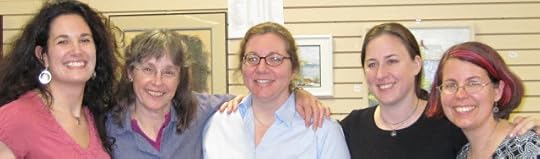
And here we all are (from left: Dawn, me, Marissa Doyle, Kate Metcalf, Deva Fagan).
Good times, good times.
Now I just have to get over this cold before I go to Chicago the weekend after next. Nothing like a panel discussion when you're deaf as a post from cold-ridden plane flight. I now know what my Printers Row Lit Fest gig will be, by the way: I'll be in a panel discussion called "Elementary, My Dear Watson" with fellow teen-lit authors Ilene Cooper, Brenda Ferber, Kristina Springer, and C. Alexander London. We'll be at The Mash Stage (the venue devoted to teenagers) at 12:30 p.m. Saturday, June 4.If you're in the Chicago area we'd love to see you!
The Revision Report: I know what I have to do. Now it's just a matter of doing it.
The Knitting Report: You're kidding, right? But I did wear my newest cotton socks (purple!) to Boston. I felt very glamorous. (Not really. I mean, they are purple cotton and I was wearing them with sandals.)

Health issues aside, I had a wonderful weekend. The highlight was Monday's visit to the Oliver Hazard Perry School in South Boston, where I sat in on seventh-grade classes (researching my dear Conor and his banshee) and then led workshops with some of the most delightful fourth and fifth graders I've ever met.
We did the Character Chase, an exercise in which we ask and answer 20 questions about a character, then chart his/her life so far, looking for a story. It gets very noisy, but it's a total hoot. The fourth graders' character was born in Spain and came to Boston in a shipment of garbage --who knew Spain was dumping its refuse here? He ended up being adopted and becoming a ballet dancer, so it all ended well.
The fifth graders' character almost shot his father and came down with AIDS, but they had pity on him in the end. He did jack a car, but he didn't get caught.
Here are the fourth graders:

And here are the fifth graders:
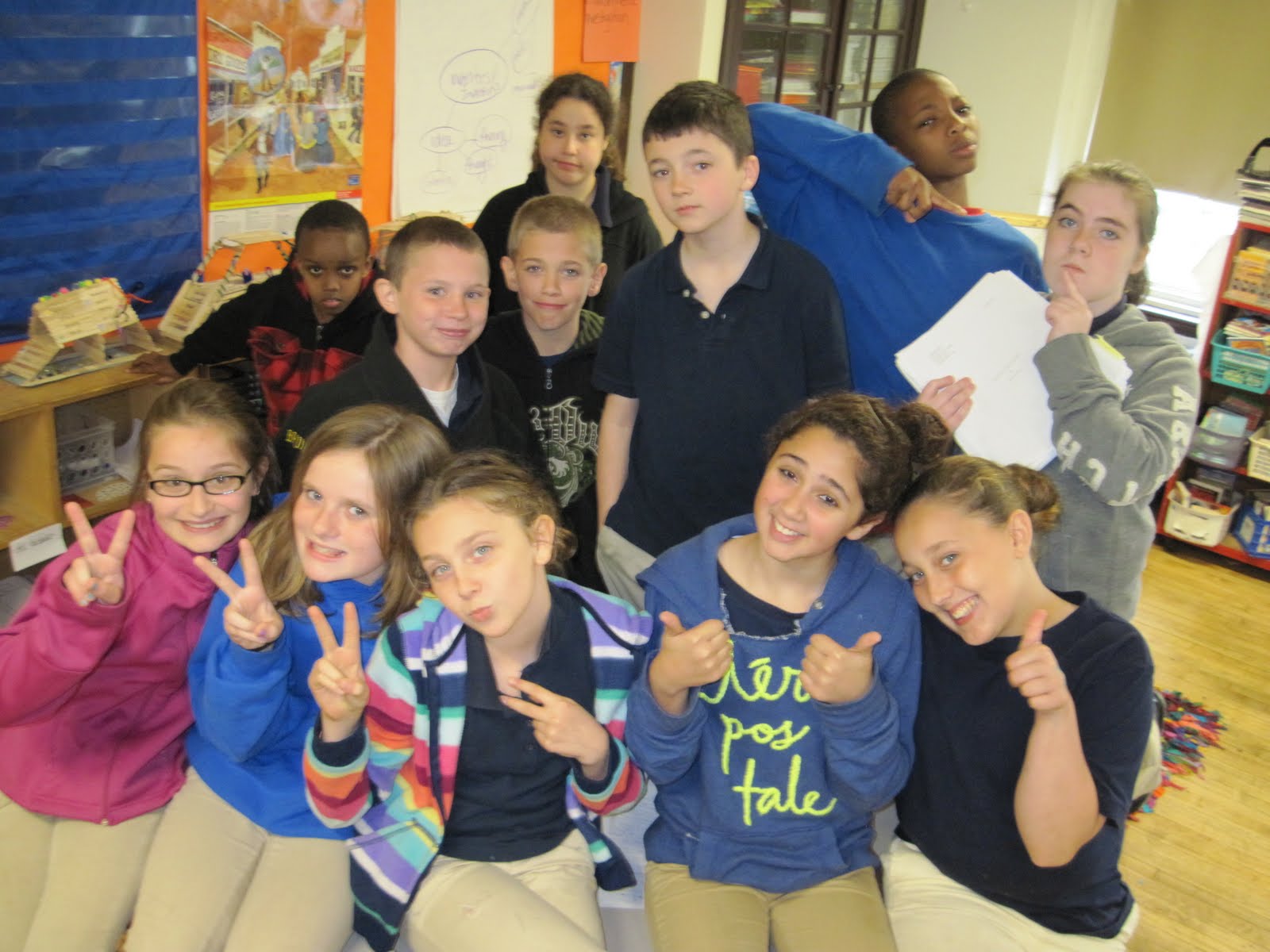
The young woman at right is holding the edited manuscript for THE UNNAMEABLES, exhibit A when talking about the importance of revision.
Speaking of which, I spent Friday and Sunday evenings chatting with South Boston natives to make sure I'm not misrepresenting Southie too badly in Conor's tale. I was suprised at the number of things I have right, but I do have some alterations to make. My major mistake is that I forgot all about busing and the school lottery (amazing for someone who lived in Boston when Louise Day Hicks was in the headlines). Everyone was very generous with time and insights, and I'm tremendously grateful to them and to Kim Simonian for organizing it all.
The original idea for the weekend, of course, was the Five Fantasy Authors appearance at Tatnuck Booksellers in Westborough. The sun came out Saturday for one friggin' day in a long stretch of clouds and rain, so we spoke to a select group. But we had a great time anyway, and got to be on hand when Dawn Metcalf caught her first sight of LUMINOUS, her debut novel. It publishes June 30, so she hadn't expected any copies to be there and in fact hadn't received any herself.
Here she is, in the first flush of romance:
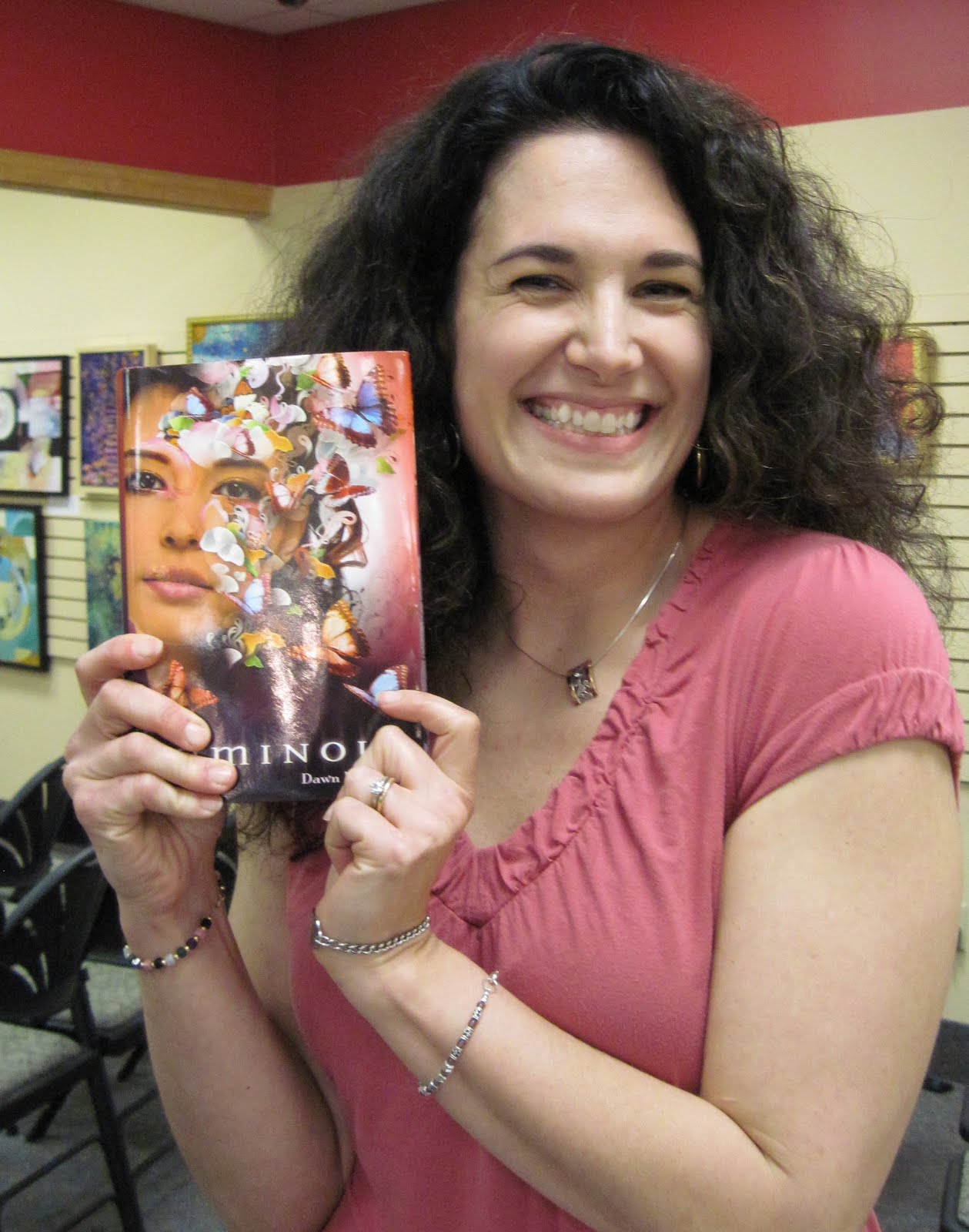
And here we all are (from left: Dawn, me, Marissa Doyle, Kate Metcalf, Deva Fagan).
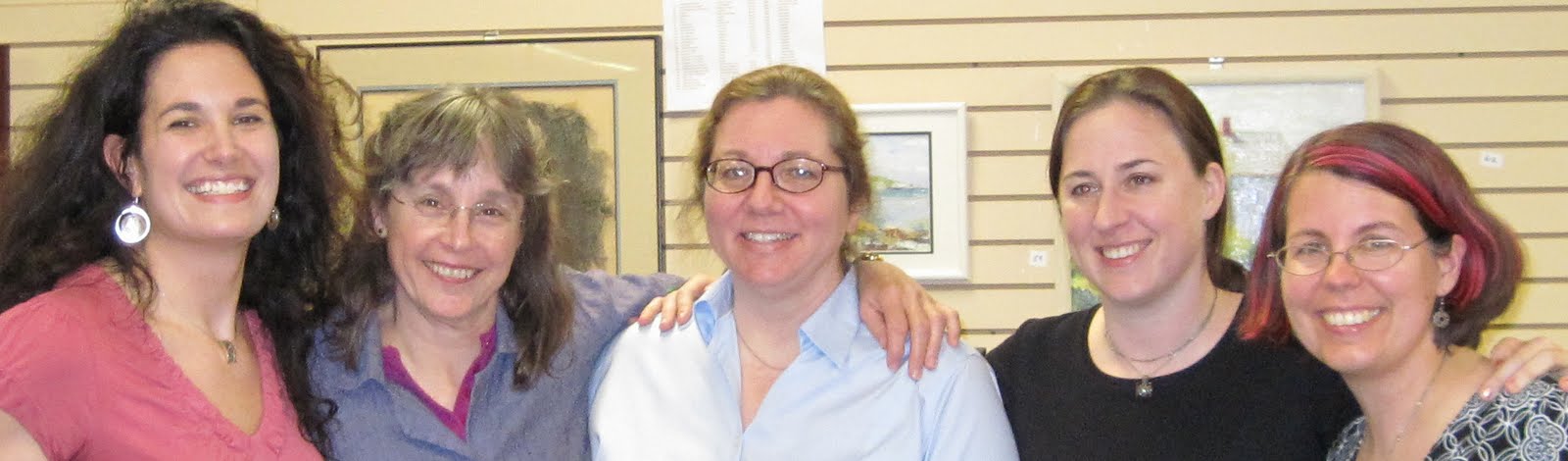
Good times, good times.
Now I just have to get over this cold before I go to Chicago the weekend after next. Nothing like a panel discussion when you're deaf as a post from cold-ridden plane flight. I now know what my Printers Row Lit Fest gig will be, by the way: I'll be in a panel discussion called "Elementary, My Dear Watson" with fellow teen-lit authors Ilene Cooper, Brenda Ferber, Kristina Springer, and C. Alexander London. We'll be at The Mash Stage (the venue devoted to teenagers) at 12:30 p.m. Saturday, June 4.If you're in the Chicago area we'd love to see you!
The Revision Report: I know what I have to do. Now it's just a matter of doing it.
The Knitting Report: You're kidding, right? But I did wear my newest cotton socks (purple!) to Boston. I felt very glamorous. (Not really. I mean, they are purple cotton and I was wearing them with sandals.)
May 15, 2011
The Sound of One Mouth Flapping
I'm going to be hearing the sound of my own voice a fair amount over the next two or three weeks, not always a good thing. Fortunately, the first Sound of Ellen's Voice Event (SOEVE?) was one town over at Blue Hill Consolidated School, where the readers are brilliant.
Here they are:
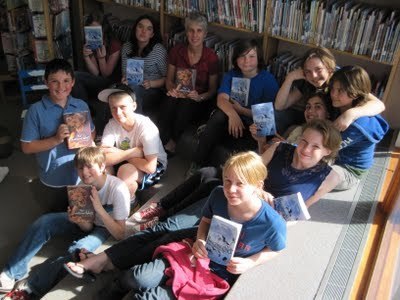
They even look smart, don't they? Librarian Beth Jackson and teacher Marianne Lewandowski host an after-school book group every spring, and this year they read THE UNNAMEABLES, mostly in its shiny new paperback edition although some had the hardcover. (That's Beth in the photo above, wearing red. Her husband used to be my dentist, until he retired. Such is life on the Blue Hill Peninsula.)
These kids were fantastic--lots and lots of varied and intelligent questions, ranging from "why a Goatman" (answer: chaos and humor) to "do you have anything to do with the cover" (answer: no, but I've been lucky with the ones I've gotten).
Marianne even made nutcakes! (That's Goatman food.) And they served Red Keeping Fruit (apple) pie and tea, Medford's drink of choice. The mother of one of the kids made nutcakes, too. Here's Marianne (right) dispensing the goodies:
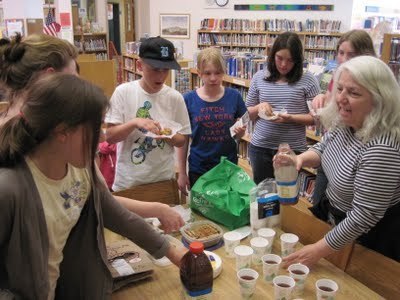
Thanks for the good time, BHCS!
Next stop, also in Blue Hill, is the George Stevens Academy arts week. GSA is a private school that functions as a public high school for area towns, mine among them. Arts Week is a venerable and AMAZING institution--an entire week devoted to workshops taught by local artists and craftspeople. I'll be doing a writing workshop Wednesday morning: "Lightning Round for Writers," focusing on five or ten-minute exercises to get your ideas flowing and introduce you to your characters.
On Saturday (meaning May 21) I'm joining four other Inkies (fantasy authors involved in The Enchanted Inkpot blog) at Tatnuck Bookseller in Westborough, MA, to discuss "How to Build a Fantasy." Marissa Doyle, Deva Fagan, Dawn Metcalf, and Kate Milford will join me in discussing the various components of a fantasy as well as our experiences in publishing. ETA: forgot to say, it starts at 2:30 p.m. And--duh--I've added a link for the bookstore so you can get directions.
Also next weekend, I'll be hanging around South Boston doing research for CONNOR'S BANSHEE, The amazing Kim Simonian, who lives in Dorchester, has arranged drinks Friday night and Sunday dinner with various South Bostonians. Kim's the niece of Ann Logan, who's in my writers group, and obviously is a formidible organizer.
I'll spend Monday at Oliver Hazard Perry Elementary School in South Boston, sitting in on classes and eating lunch with any kids who will let me ask searching questions such as "What's your favorite candy? Do you ride a bike?" Then I'll do a couple of workshops with fourth and fifth graders.
Then I'll drive home for six hours. Then I suspect I'll crash. But not forever, because the first weekend in June I'll be doing some unspecified something at the Printers Row Lit Fest in Chicago. No word yet on when or what, but I'll post it as soon as I know.
The Knitting Report: I'm one toe away from another pair of cotton socks. This one I knitted on circular needles so the cuff looks MUCH neater. I'm going to go down a needle size for the next pair and see what happens. Life on the edge.
The Revision Report: I may be able to finish this round before I go to Boston, which would be great because that means I'll have a few built-in days off before I print it out, read it, and fine tune. At least I hope fine-tuning will be all it'll need. *shivers*
Here they are:
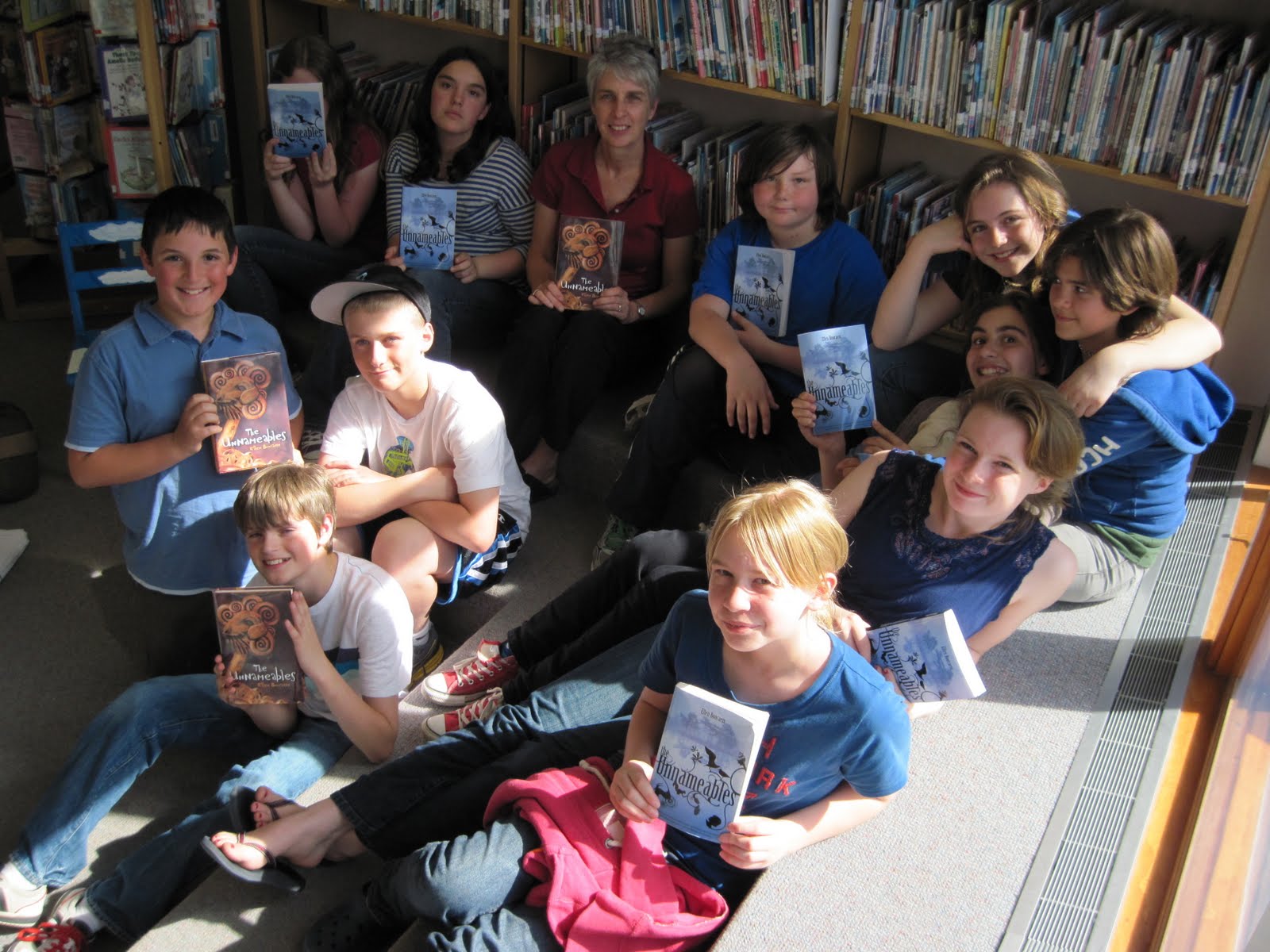
They even look smart, don't they? Librarian Beth Jackson and teacher Marianne Lewandowski host an after-school book group every spring, and this year they read THE UNNAMEABLES, mostly in its shiny new paperback edition although some had the hardcover. (That's Beth in the photo above, wearing red. Her husband used to be my dentist, until he retired. Such is life on the Blue Hill Peninsula.)
These kids were fantastic--lots and lots of varied and intelligent questions, ranging from "why a Goatman" (answer: chaos and humor) to "do you have anything to do with the cover" (answer: no, but I've been lucky with the ones I've gotten).
Marianne even made nutcakes! (That's Goatman food.) And they served Red Keeping Fruit (apple) pie and tea, Medford's drink of choice. The mother of one of the kids made nutcakes, too. Here's Marianne (right) dispensing the goodies:
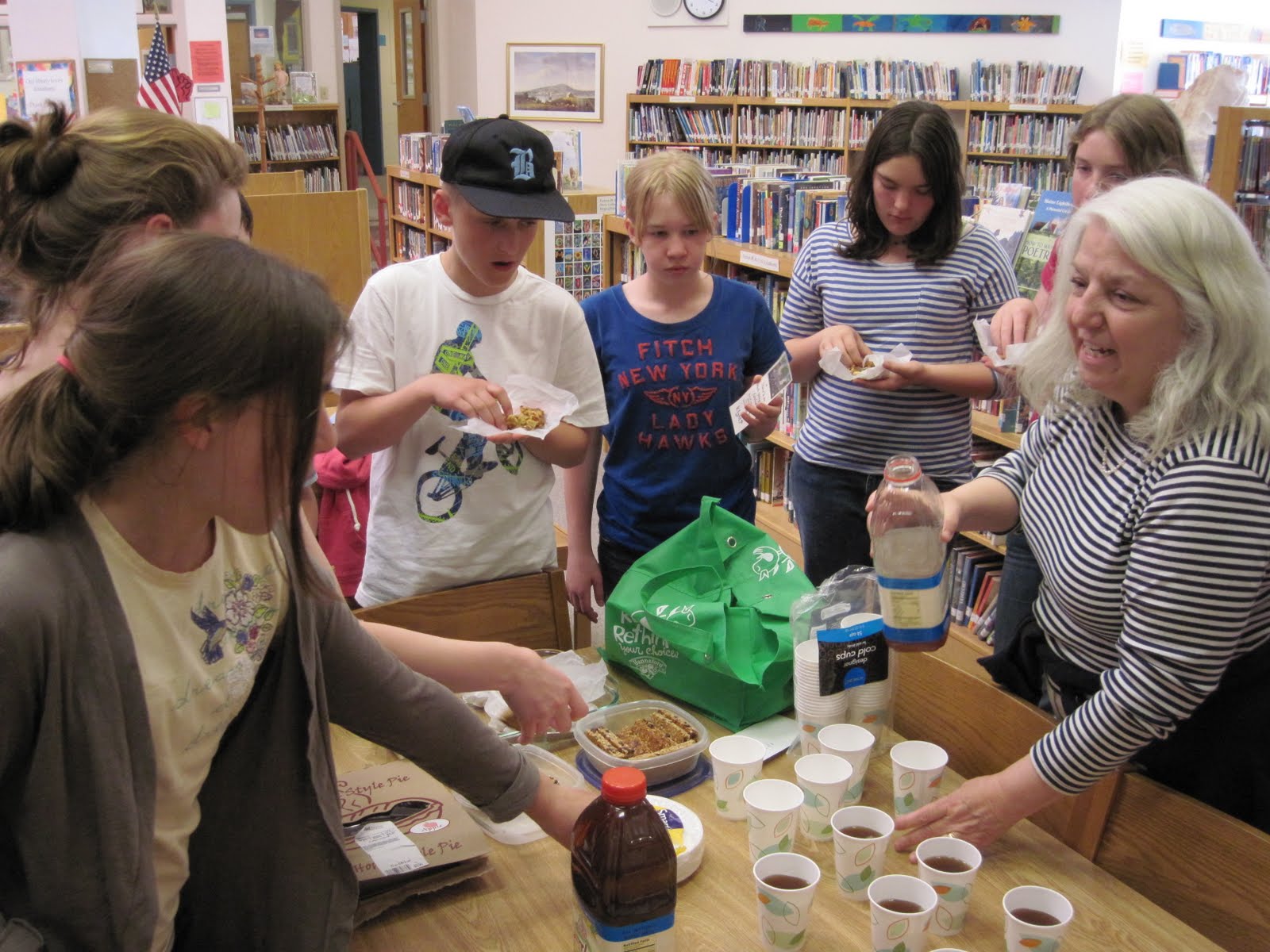
Thanks for the good time, BHCS!
Next stop, also in Blue Hill, is the George Stevens Academy arts week. GSA is a private school that functions as a public high school for area towns, mine among them. Arts Week is a venerable and AMAZING institution--an entire week devoted to workshops taught by local artists and craftspeople. I'll be doing a writing workshop Wednesday morning: "Lightning Round for Writers," focusing on five or ten-minute exercises to get your ideas flowing and introduce you to your characters.
On Saturday (meaning May 21) I'm joining four other Inkies (fantasy authors involved in The Enchanted Inkpot blog) at Tatnuck Bookseller in Westborough, MA, to discuss "How to Build a Fantasy." Marissa Doyle, Deva Fagan, Dawn Metcalf, and Kate Milford will join me in discussing the various components of a fantasy as well as our experiences in publishing. ETA: forgot to say, it starts at 2:30 p.m. And--duh--I've added a link for the bookstore so you can get directions.
Also next weekend, I'll be hanging around South Boston doing research for CONNOR'S BANSHEE, The amazing Kim Simonian, who lives in Dorchester, has arranged drinks Friday night and Sunday dinner with various South Bostonians. Kim's the niece of Ann Logan, who's in my writers group, and obviously is a formidible organizer.
I'll spend Monday at Oliver Hazard Perry Elementary School in South Boston, sitting in on classes and eating lunch with any kids who will let me ask searching questions such as "What's your favorite candy? Do you ride a bike?" Then I'll do a couple of workshops with fourth and fifth graders.
Then I'll drive home for six hours. Then I suspect I'll crash. But not forever, because the first weekend in June I'll be doing some unspecified something at the Printers Row Lit Fest in Chicago. No word yet on when or what, but I'll post it as soon as I know.
The Knitting Report: I'm one toe away from another pair of cotton socks. This one I knitted on circular needles so the cuff looks MUCH neater. I'm going to go down a needle size for the next pair and see what happens. Life on the edge.
The Revision Report: I may be able to finish this round before I go to Boston, which would be great because that means I'll have a few built-in days off before I print it out, read it, and fine tune. At least I hope fine-tuning will be all it'll need. *shivers*
May 10, 2011
We Visit the Sunrise County
 On Monday, my friend Alice hijacked me for a trip Downeast to Lubec, which is as far east as you can go in the U.S. Lubec does not let you forget this fact: There are signs everywhere telling you that this is the easternmost place where you can do whatever it is that you're doing and still remain on U.S. soil. I was expecting a sign like that in the outhouse at West Quoddy Head Light, but was disappointed.
Alice pulled off a particularly skillful hijacking, since I drove. I like driving. I especially like driving Downeast, where there is practically no traffic and therefore no one to mind if you slow down and gawk. (Not the case around here, especially at Blue Hill Falls, where we regularly shake our fists at summertime visitors who slow down to 5 mph just when we are late for the dentist.) (I hasten to add that I did try to speed up or get out of the way if someone came up behind me.)
Washington County, where Lubec is located, is a large and relatively empty place, often billed as the Maine county most in need of jobs and economic development. It includes two Passamoquoddy reservations, at Pleasant Point and Indian Island, plus a University of Maine campus in Machias.
It's called the Sunrise County, but it's gorgeous even in the rain. Good thing, because yesterday couldn't decide whether to rain or rain like hell.
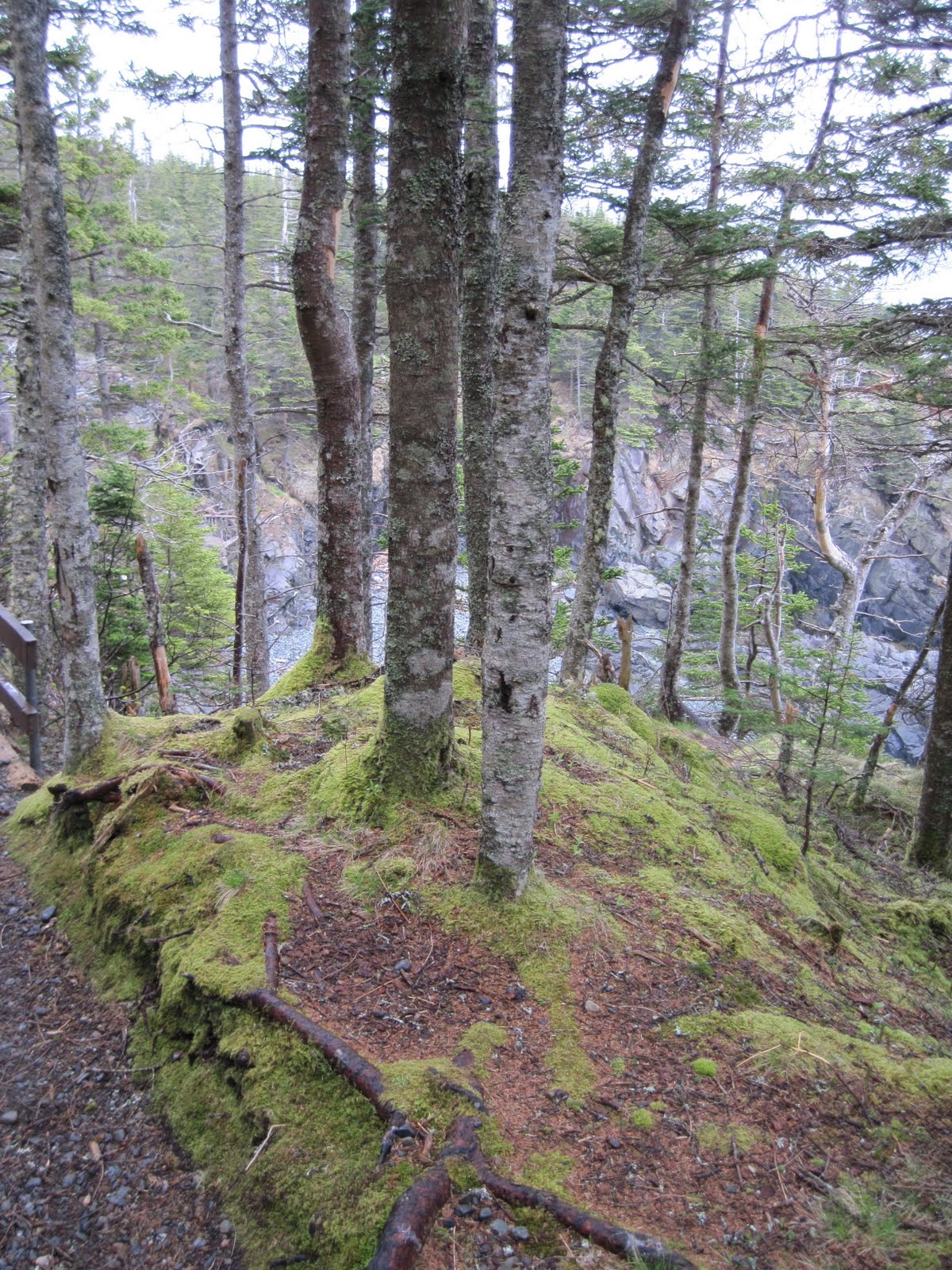
I'd seen tons of pictures of West Quoddy Head--many of them exactly like the one I took at right--but had never been there. It is spectacular, and I plan to return, possibly in better weather. There's an amazing trail from the lighthouse along the cliffs:
And another that takes you to a lovely little boardwalk over a bog full of pitcher plants. (Easternmost open bog in the U.S., the sign says.)
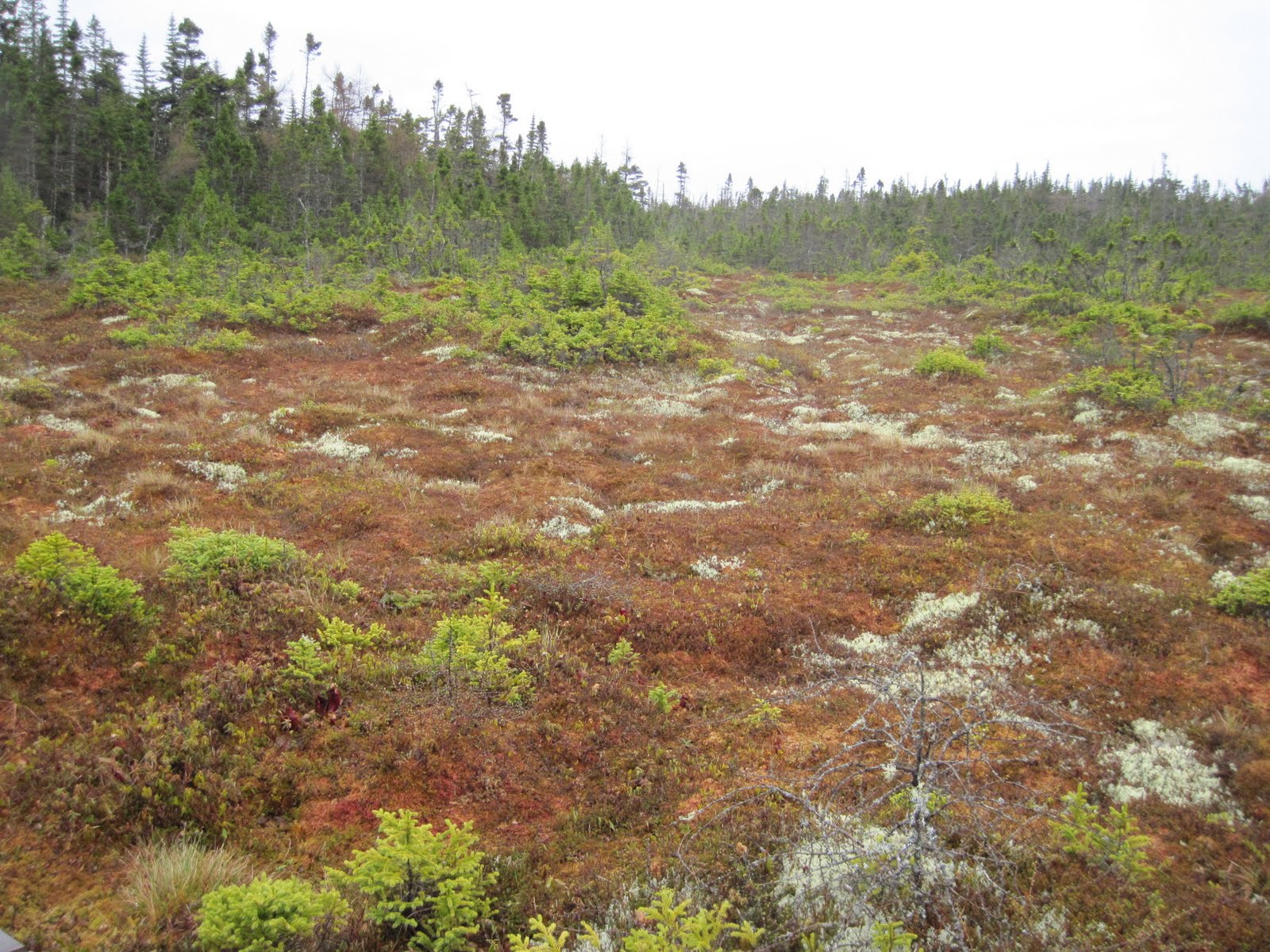
I've never seen so many pitcher plants in one place. (Click on the photo to appreciate close-up)

Eager for foreign travel, we crossed the bridge to Campobello Island, Canada. We drove past the Roosevelt homestead, but our main goal -- Alice being a foodie AND an anglophile -- was a grocery store so we could gape at all the British stuff labeled in French. Alice bought candy bars, and the guy at the register said she had to have a Coffee Crisp, which Nestle makes only in Canada. Apparently they're much in demand, because when we drove back into the U.S. and told the customs guy we'd bought candy bars but didn't open the bag, he said knowledgeably, "Oh. Coffee Crisp."
Frankly, they were a bit sweet for my taste. But they were satisfyingly crisp, so one out of two ain't bad.
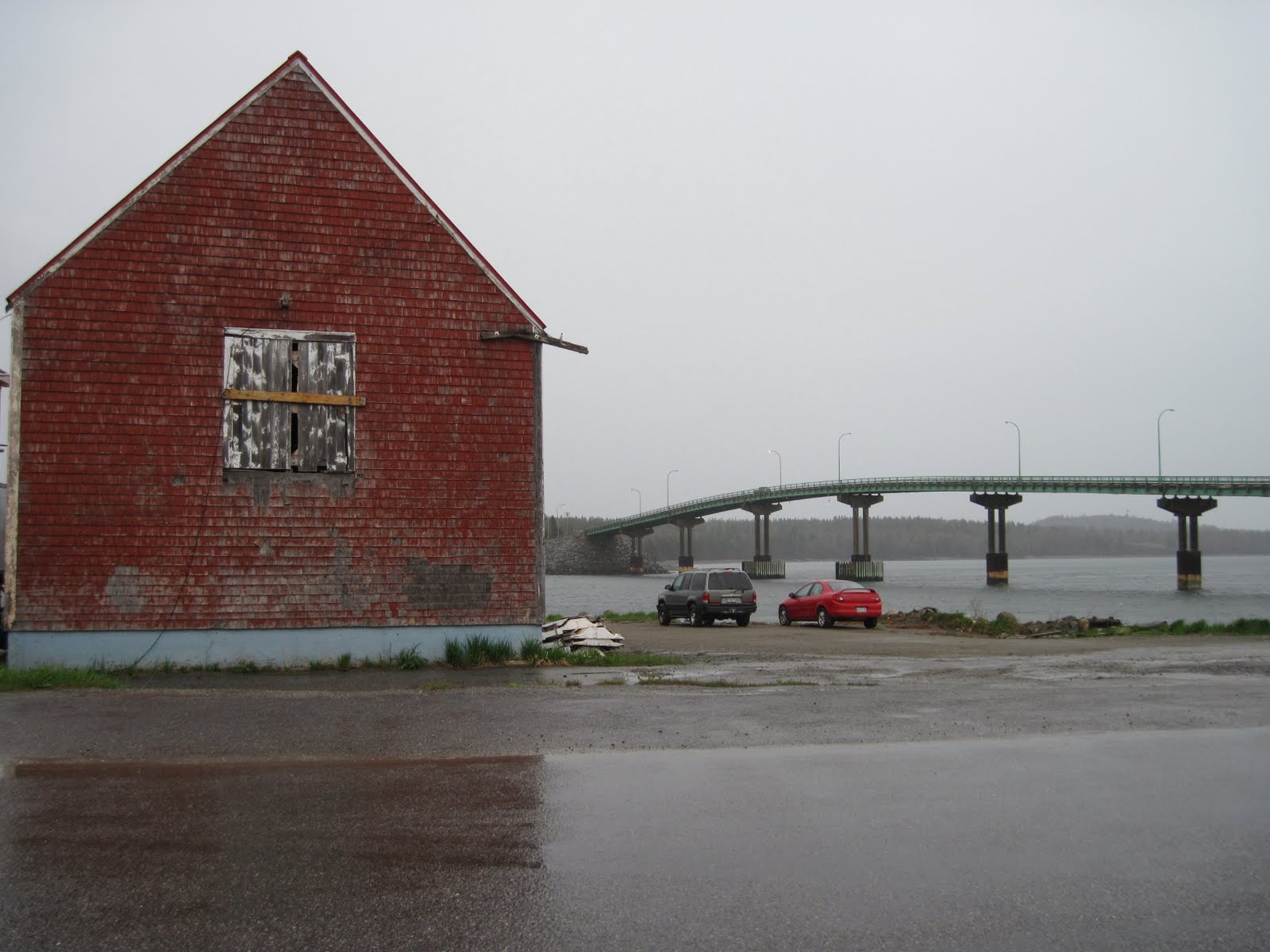
Here's the bridge, with a little bit of typical Lubec next to it. (Lubec really is not thriving.)
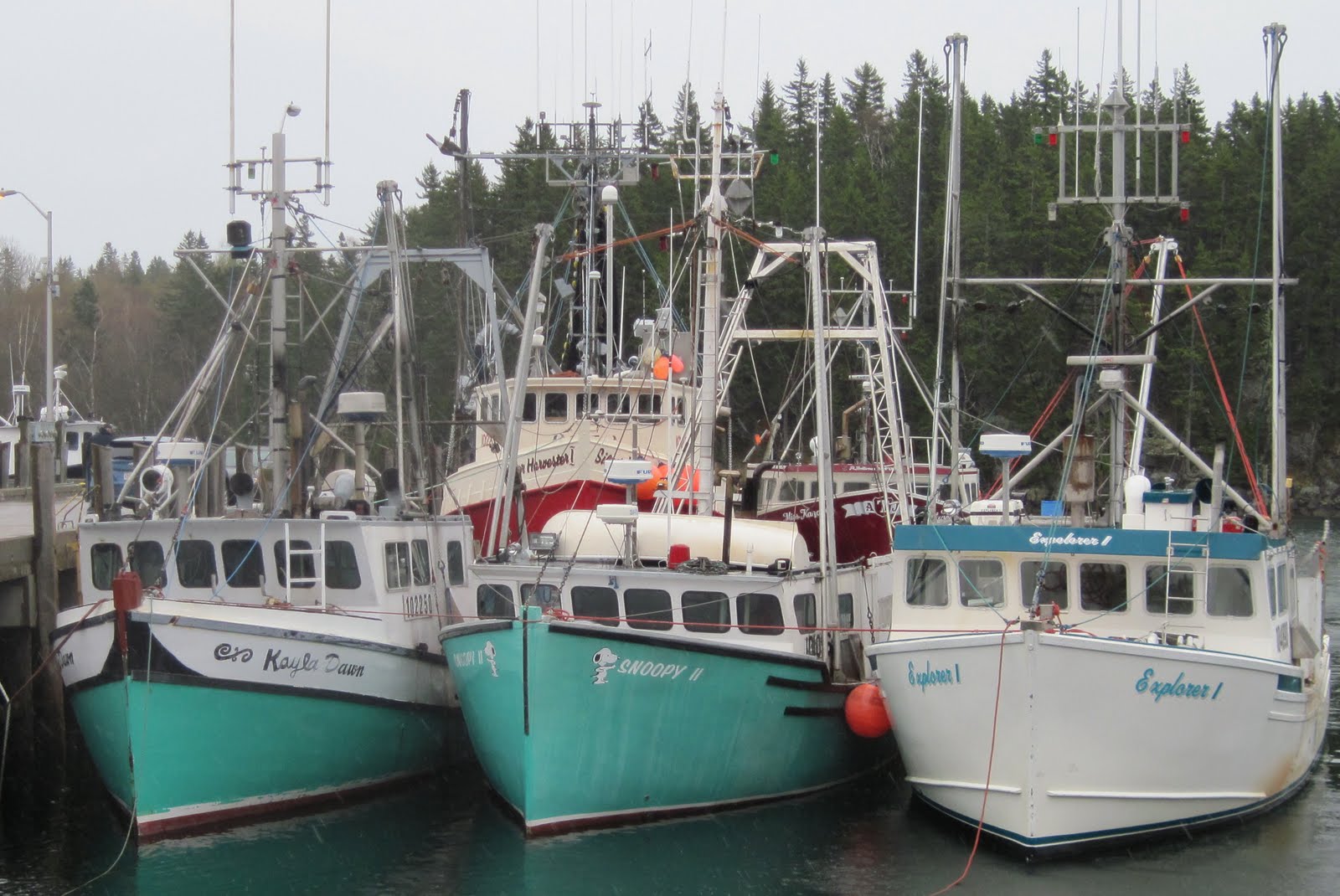
Here's the place on Campobello which thrilled us most, discovered by mistake after we got lost heading out of the grocery store. (Well, not exactly lost. We were exploring and got turned around funny, not having a map and not understanding how the coastline worked.) Anyway, this is Head Harbor, a busy fishing port, which means the island economy doesn't rely on tourists and retirees, which is all to the good.
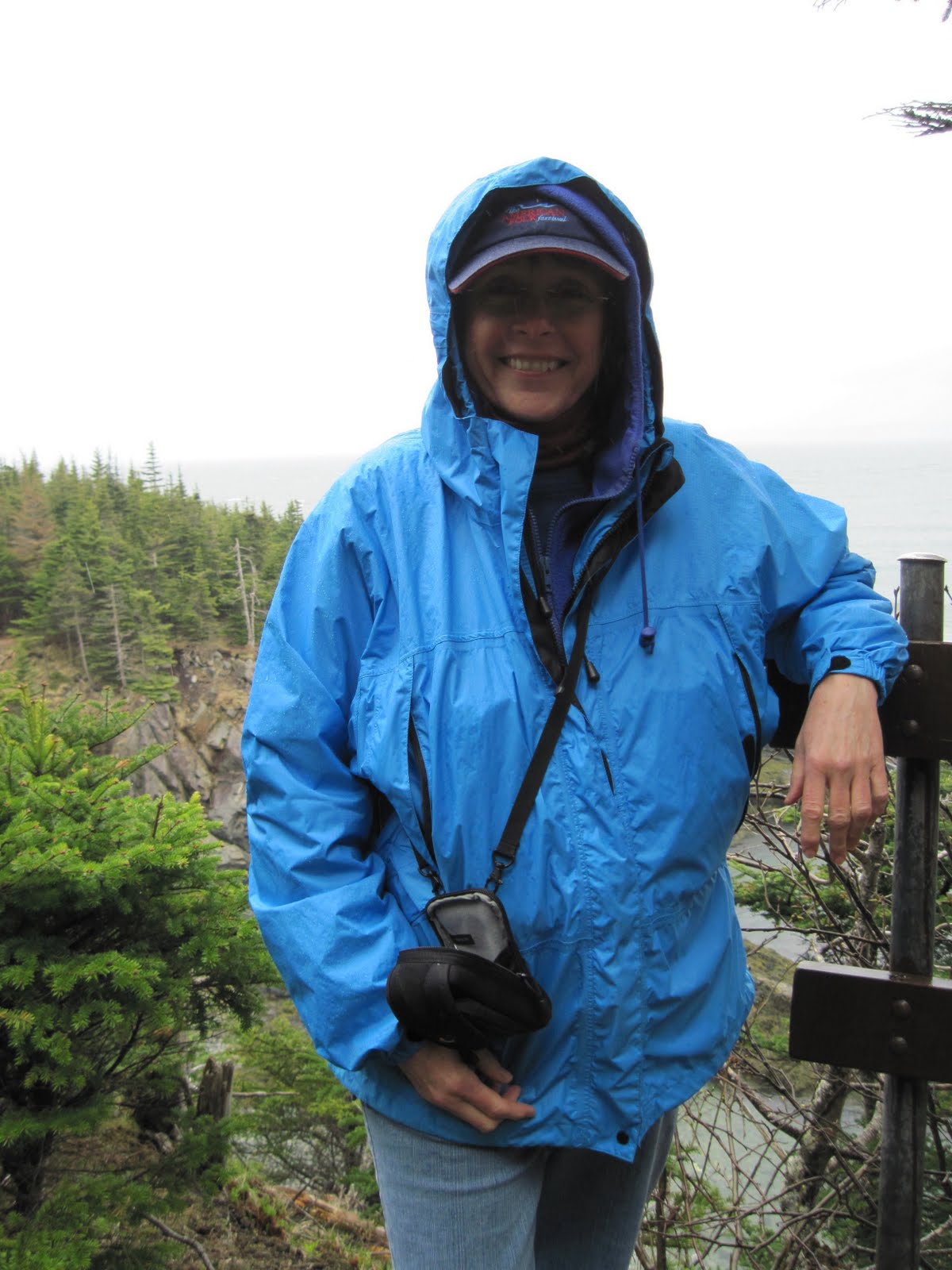
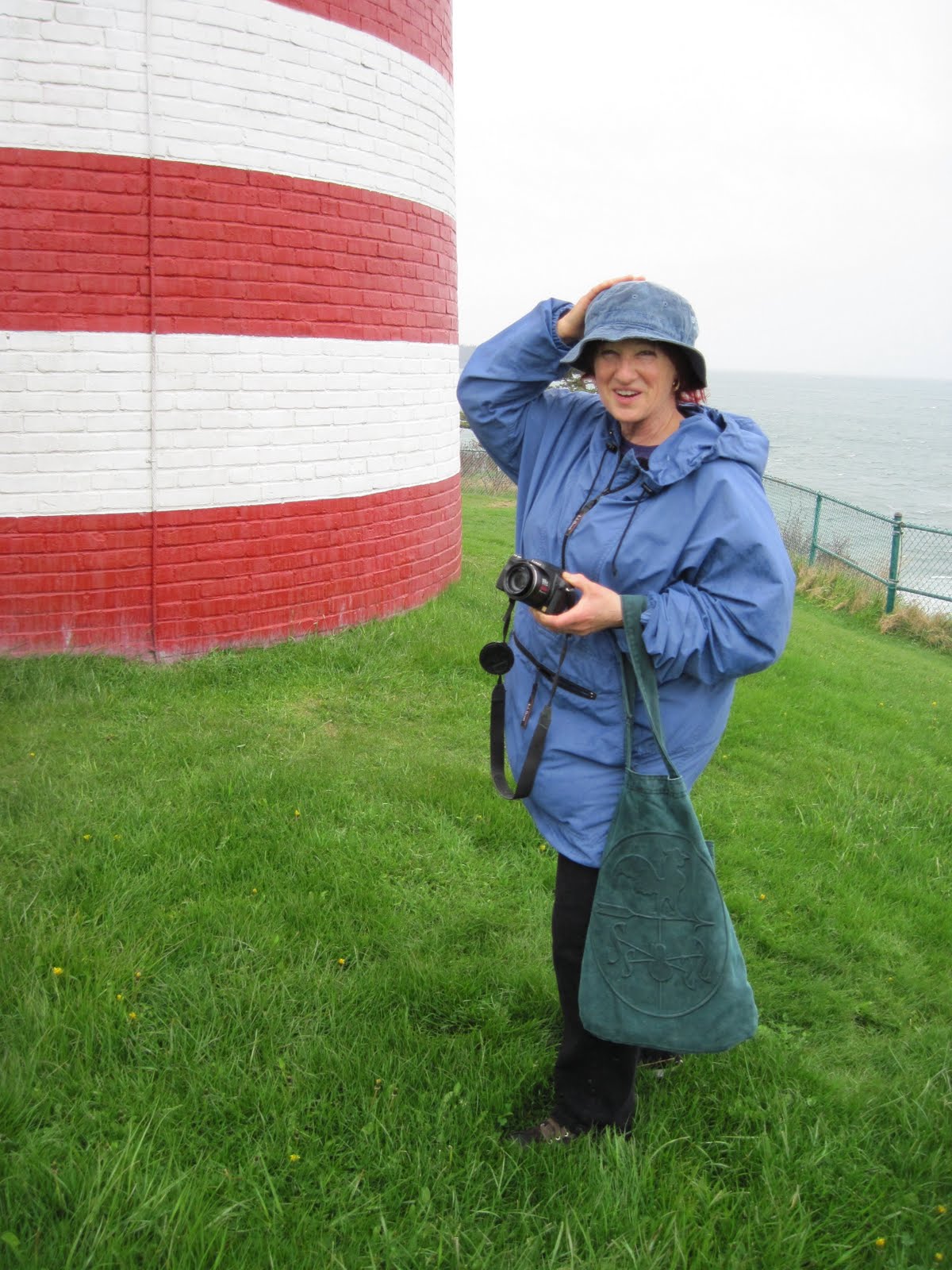
And here are the intrepid travelers. I'm on the West Quoddy Head trail, Alice at the lighthouse with its distinctive red stripes.

May 4, 2011
May Book Review Club
Click icon for morebook review blogs@Barrie SummyIt's spring! My eyes are itching like crazy and yesterday I met a black fly. I'm revising my first draft, alternately singing and sighing. And yet, I read. It's a sickness.
Don't forget to click the icon to find the rest of the May reviews!
 Chime
ChimeBy Franny Billingsley
Penguin/Dial Books for Young Readers
2011
I had no intention of ever reviewing this book, nor do I have any business reviewing it now. Franny Billingsley and I have the same editor, the miraculous Kathy Dawson at Dial Books for Young Readers. Kathy's assistant, Claire Evans, sent CHIME to me out of the blue when I innocently (really! I swear!) said I was looking forward to reading it.
I can't help myself. This book is marvelous. So sue me, FCC.
YA fantasy is choked with stories of girls coming to grips with their powers and fighting off evil. The one big difference here is the narrator's voice—well, everyone's voice. Oh, and the utterly original collection of supernatural elements. And the characters, who are quirky yet achingly human, plus the setting, which is eerie and gorgeous.
"Rich" was the word that kept coming to mind as I read. Also "sepia." Atmosphere is everything in this book. If you don't count voice and characters and story and setting and supernatural elements.
Okay, let's just say it's the writing.
"The wind smacked at everything. It smacked the river into froth. It smacked the willow branches into whips. It smacked the villagers into streamers of hair and shawls and shirttails. The wind didn't smack us up, though, not the Larkin family. We were buttoned and braided and buckled and still."
The narrator is Briony, one of the lovely twin daughters of a village clergyman when railroads are laying claim to the English countryside. She's funny, depressed, smart, self-deprecating, searingly honest and utterly deluded.
"Adults tend to view me as being mature beyond my years. I think it has partly to do with being a clergyman's daughter, partly to do with looking after Rose, and partly to do with being rather clever. But I can't take any credit; I'm stuck with all of it."
Briony hates herself. She believes she is a witch, evil enough to have damaged her beloved twin's brain and enabled her beloved stepmother's death. At seventeen, she has sentenced herself to a lifetime of taking care of Rose, her gently addled sister, and never, ever being happy.
"Rose hates any bit of clothing that constricts, but I say, Chin up and bear it. Life is just one big constriction."
Briony lives in the town of Swampsea, next to a swamp governed by the Old Ones: spirits who, like nature itself, can kill you if you cross them. There are Horrors and Reed Spirits and the Dead Hand, all intent on dragging the foolish wanderer under the muck. There are Dark Muses, who feed on a man's talents until he's drained to death. There's the Boggy Mun, whose anger at the railroad's plans to drain his swamp has inflicted the town with "swamp cough."
Into this dank life comes Eldric, a failed college student whose father plants him at the parsonage to settle him down. Eldric is lively, funny, and fashionable, not the irascible Briony's type at all. And yet she is drawn to him, and apparently he to her. Their relationship, with its humor and shocks and life-changing effects, is a bright thread in the darkness.
"If I could love anything, I'd love the swamp," Briony says. She stays away from it because she alone can hear the Old Ones, and letting anyone know about that gift could get her hanged as the witch she knows she is. But she's compelled to return when Rose contracts the swamp cough, making a perilous bargain with the Boggy Mun that could end up at the gallows.
The plot twists off from there, and by the end it's the characters and the reader who are drained, not the swamp. I don't have time to read it again but I'm going to. I'd suggest you read it, too.
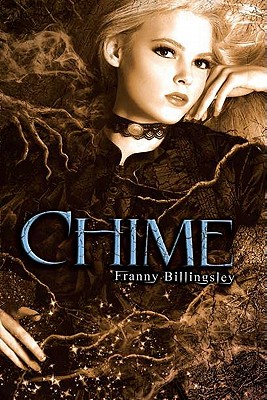
A word on the cover: Gorgeous design, perfect model. Too much make-up and hair product, though. Briony spent her childhood tramping the swamp, earning the nickname "wolfgirl." She would not wear eye-liner. And I can tell you from personal experience: Hair product is murder in a buggy swamp.


![[image error]](http://3.bp.blogspot.com/-YkwIfDnVbh4/TiXMPk2dd9I/AAAAAAAAAuA/19oG8O5xE_Y/s1600/IMG_0001.jpg)
![[image error]](http://3.bp.blogspot.com/-HDXuui7FXOA/TiXMSD3pzSI/AAAAAAAAAuE/9K_LDotmfUY/s1600/IMG_0002.jpg)
![[image error]](http://4.bp.blogspot.com/-BM2yxK8BYEw/TiXMU9BxKXI/AAAAAAAAAuI/69FU_K_isrg/s1600/IMG_0003.jpg)
![[image error]](http://4.bp.blogspot.com/-50KNa1J1fhw/TiXOToBaqjI/AAAAAAAAAuQ/tKtndwX9iYs/s1600/IMG_0001_1.jpg)
![[image error]](http://3.bp.blogspot.com/-ZgD6RGcXAHs/ThSE7HwscUI/AAAAAAAAAt4/wSNAIiyLR3k/s1600/monsters+of+men.jpg)
![[image error]](http://4.bp.blogspot.com/-0-qitTtbbaE/ThNVkZLIraI/AAAAAAAAAtw/PP45dF2ugN0/s1600/fourth+serving.jpg)
![[image error]](http://2.bp.blogspot.com/-h_ZSmjJaKHY/ThNVJqPOpVI/AAAAAAAAAtk/5JER8mTLnac/s1600/fourth+cash.jpg)
![[image error]](http://1.bp.blogspot.com/-gKYi0BCg3_k/ThNVQBZB4II/AAAAAAAAAto/fAIUA1vTCGM/s1600/fourth+crowd.jpg)
![[image error]](http://3.bp.blogspot.com/-0R1tsCW8ZdI/ThNVaplj2GI/AAAAAAAAAts/-Ajue4B_wD4/s1600/fourth+melon.jpg)
![[image error]](http://3.bp.blogspot.com/-29JemO5yAPE/ThNVBwvNc5I/AAAAAAAAAtg/I5CUgWKOwYU/s1600/fourth+bbq.jpg)
![[image error]](http://3.bp.blogspot.com/-W0TqWwyORiU/ThNVpZJqPbI/AAAAAAAAAt0/5UH4DOgU4zQ/s1600/fourth+sponge.jpg)
![[image error]](http://3.bp.blogspot.com/-bHTRruZcruo/Tg4lr2IjnHI/AAAAAAAAAtU/ePJJ4YO6pgY/s1600/garden--dahlia+potting.jpg)
![[image error]](http://3.bp.blogspot.com/-wmaEVDoy95o/Tg4lUUKD3kI/AAAAAAAAAtM/E4xmESGW-IA/s1600/garden+digging.jpg)
![[image error]](http://3.bp.blogspot.com/-nnunwDa0d4I/Tg4lhhzqcnI/AAAAAAAAAtQ/Q55Me-ofz3I/s1600/garden+expanded.jpg)
![[image error]](http://1.bp.blogspot.com/-Hxiqpne1i8A/Tg4x6HvS5GI/AAAAAAAAAtY/H5mYy3isjFM/s1600/garden--leopard%2527s+bane.jpg)
![[image error]](http://1.bp.blogspot.com/-0-a00a7rdX0/Tg4yQLTrlJI/AAAAAAAAAtc/uJ4iuk4w5ls/s1600/garden--peony.jpg)
![[image error]](http://2.bp.blogspot.com/-W8q5d-Y1laY/TgN15nWoxII/AAAAAAAAAtA/ynXgUqjIM48/s1600/chicago+006.jpg)
![[image error]](http://3.bp.blogspot.com/-mLukrTASaKY/TgOB2Ai5akI/AAAAAAAAAtE/syy4GuzYhC0/s1600/chicago+maraudersn.jpg)
![[image error]](http://1.bp.blogspot.com/-5Qmj-LbtOe8/TgOCkeY5EgI/AAAAAAAAAtI/l9FDAhn5InE/s1600/chicago+kids.jpg)