
Ellen Booraem's Blog, page 2
November 2, 2016
November Book Review Club: THE DREAMHUNTER DUET
 Click icon for more
book review blogs
@Barrie Summy
If ever we needed to escape into a good book, now's the time. I'm seriously considering spending the next week under the covers with a flashlight. Hey, it worked when I was ten, why not now?
Anyway, here's a possibility. Don't forget to click the link above for more reviews!
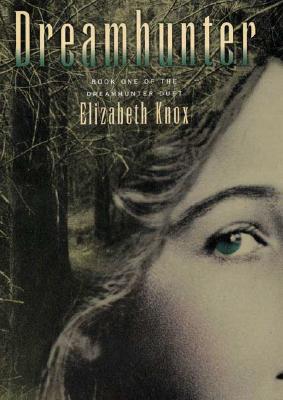
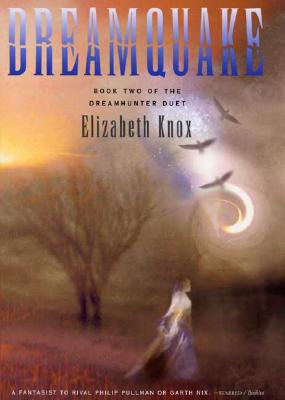
The Dreamhunter Duet
(Dreamhunter & Dreamquake) By Elizabeth KnoxFarrar, Straus & Giroux, 2006 & 2007
When you’re head-over-heels in love, you overlook a person’s flaws. In time, they either become endearing or you pack up and leave, snarling about toilet seats left up or the way he chews a cheeseburger.
That’s how I feel about Elizabeth Knox’s DREAMHUNTER books. The premise, characters, and world-building are marvelous, breath-taking, the writing evocative yet urgent. I couldn’t stop reading. I also couldn’t stop griping, especially at the end of the second book.
This is a young-adult alternate history set in Southland (Knox’s native New Zealand) c. 1905. Our teen protagonists are Laura Hame and her cousin, Rose Tiebold, children of the rich and famous. Laura’s father, Tziga, stumbled as a young man into the Place, a separate dimension tied to the “real” world at various geographical points. He returned having “caught” a dream that he shared with others during sleep—this proved to be a source of solace and therapy, especially in hospitals, but also entertainment. Before long, others learned to enter the Place to catch dreams, and an industry grew up, with dreamhunters selling their dreams to those who needed them for therapy or just wanted the entertainment.
Not everyone can enter the Place, and not everyone who gets in can catch a dream. Tziga’s exceptional talent has made him rich. Ditto Grace Tiebold, Rose’s mother and the wife of Tziga’s brother-in-law and best friend: She is the darling of the Dream Palace, where customers in ornate sleepwear occupy sumptuous bedrooms to share a sleeping hunter’s dream.
Tziga and Grace have constructed a unique family unit. His wife, Laura’s mother, died of cancer, so the families joined households. The two dreamhunters are the breadwinners, but have to spend so much time in the Place that they are hardly ever around to parent and run a household. Those responsibilities are lovingly discharged by Grace’s husband, Chorley, a house-husband who makes films on the side. Laura and Rose are more sisters than cousins, inseparably bonded.
Everybody wants to grow up to be a dreamhunter. When the time comes for Laura and Rose to try, Laura enters the Place but Rose cannot. If you’ve read any YA at all, you see this coming a mile off, simply because Rose wants it so much and Laura doesn’t care. And of course Laura ends up with exceptional dreamhunting talent, inherited mystical abilities, and a hopeless, possibly illegal quest that will uncover hidden evil and throw her and her family into the teeth of danger. Familiar tropes, yes, but so winningly carried out that you’re too breathless to care.
Far less familiar to the YA reader is an omniscient point of view that puts us in the heads of adults, not teens, about 60 percent of the time. This is very, very odd for YA, but I was never in any doubt that the Laura and Rose were the story’s focus. Getting to know the adults so well only added to the richness of the story. My only trouble with the characterization was the way these two feisty, capable girls ended up wimping out at the end—no amount of self-analysis will tell me whether that’s legitimate literary criticism or just me wanting a happy ending. Probably the latter, so take it with a grain of salt.As you read, your brain will keep prodding you for metaphysical logic. You have to ignore your brain because there ain’t none, especially when All Is Revealed at the end of the second book. The time paradoxes alone could kill you. Up to you whether that’s a problem.
A far more serious breach, in my view, is the fact that the Hames and the Tiebolds and the other original European settlers apparently happened upon a completely empty variant of New Zealand: No Maori or other indigenous people. I’m surprised there wasn’t an outcry about this, as there certainly was when an American YA author did much the same thing right around the time these books came out. Political correctness aside, it seems to me that the presence of indigenous people would have enriched the book.
I’m ashamed to say that this didn’t occur to me until about halfway through, but now it’s making me sad. I wish a book with so many wonders in it could have done better.
(Dear FCC: These books were on the reading list for next week’s Children’s Literature New England symposium on Passages of Hope, intended to examine whether it’s possible in this day and age to write authentic stories that also offer hope. This’ll be an interesting discussion, FCC. Drop by if you have minute.)


September 7, 2016
September Book Review Club: THE BURIED GIANT
Click icon for morebook review blogs
@Barrie Summy
The Book Review Club is back and ready to read! Hope the summer was splendid but you got more rain than we did. No high hopes for the apple harvest.
On the other hand, a new crop of books! Don't forget to click the icon for more reviews.
 The Buried Giant
By Kazuo IshiguroHardcover: Alfred A. Knopf, 2015
The Buried Giant
By Kazuo IshiguroHardcover: Alfred A. Knopf, 2015Paperback: Vintage International, 2016
King Arthur is dead and buried. The wars between Britons and Saxons have dwindled to an unsettled truce. And so, the elderly couple Axl and Beatrice feel it’s reasonably safe to travel from their settlement, a warren dug into a hill, to find their son in a distant village.
They don’t exactly remember details about their son. Why are they living apart? Do they really know the way to his village? Not sure.
Blame it on the mist—that’s what everyone calls the odd loss of memory that’s settled on England in recent years. Like a fog, it comes and goes—one minute you don’t remember anything older than a few months, but then the gloom lifts long enough for a dim memory to return. Only to fade again hours later.
Axl and Beatrice are devoted to each other, but they don’t exactly remember how or why they fell in love, or much about their years together. Is this a good thing, this living in the moment? Or are they missing the real beauty of their lives?
THE BURIED GIANT is flat-toned, written in amber. There are no sharp colors, no thrills or real moments of tension, just a vague sense of unease and a gradual awakening. Its author, Kazuo Ishiguro, is adept at characters who don’t reveal all—the Booker Prize-winning THE REMAINS OF THE DAY is one of his books. In this case, the characters’ secrets are hidden from themselves as well as from us.
It sounds like a complete bore, and yet I found this book hard to put down. The characters are just so dear—especially Axl, our primary narrator. His focus is on Beatrice, how to keep her safe and happy, how to deal with that worrying pain she has in her side. And yet we (and he) keep getting hints that he lived a bolder life at one time, a warrior and a trusted emissary.
He and Beatrice have plenty of adventures on their way to find their son. They meet Saxons, Britons, upright knights, bad monks, pixies, ogres, and eventually a dragon. Sir Gawain, King Arthur’s nephew and trusted lieutenant, wanders in and out as a decrepit, befuddled relic of bygone glory. Merlin had his hand in things, long ago.
It’s all told in that flat tone. At one point a potentially thrilling scene even is told in retrospect, all danger over. This should be a buzz-kill but . . . then there are those mysteries. What IS the source of the mist? Who IS Axl?
What does memory do for us? What if we forgot we were at war?
This probably won’t be your book of the year—it’s a tad too muted for that. There’s a feeling that it never really digs down, just skims the surface of things. The mysteries are solved, but the forces behind them remain vague. Nevertheless, it’s a lovely read and will stay with you.
Autumnal, in fact.
(Dear FCC: This was a birthday present, suggested to my beloved by the wizards at Blue Hill Books. Nobody paid me to review it or even cares that I did. Autumnal indeed.)
June 1, 2016
June Book Review Club: SLADE HOUSE
Click icon for morebook review blogs
@Barrie Summy
It's spring even in Maine now, and a slim book is just what you need: easy to carry in your beach satchel, quick to read in between bouts of gardening. I'm not entirely enthusiastic about this one, but if you've enjoyed earlier books by David Mitchell you might like it fine.
The Book Review Club is taking July and August off. Click the icon above for more reviews, and see you in September!
 Slade House
by David MitchellRandom House, 2015
Slade House
by David MitchellRandom House, 2015A lesson to us all, that’s what SLADE HOUSE is. Up to now, I’ve occasionally pondered whether the absolute necessity for a character to be the agent of his own fate was just a kidlit/YA thing. If you were writing for adults, could you get away with a deus ex machina, medieval drama’s god-figure descending to solve everything?
In SLADE HOUSE, David Mitchell answers that question. No, you can’t.
Mitchell is the author of THE CLOUD ATLAS, which I haven’t read, and THE BONE CLOCKS, which I liked a lot. Most—if not all—of his novels take place in a universe that contains “atemporals,” immortals who jigger about with time and with us. There are bad guys, the vampiric Anchorites who suck our souls to stay alive, and there are good guys, the Horologists who try to save us. The books aren’t sequential (they couldn’t be, messing with time as they do) but familiar characters reappear. In SLADE HOUSE, there’s a reference to “bone clocks” (that would be us) and the deus ex machina is a Horologist called Marinus, known to us from the previous book.
There’s a lot to love about SLADE HOUSE, and Mitchell’s universe is intriguing as hell. (I may mean that literally.) The central characters in this round are a set of twins who’ve become Anchorites. They inhabit a very cool London mansion called Slade House, and keep themselves and the house going by imbibing the soul of an “engifted” human every nine years. (I’m not sure what “engifted” means—psychic, maybe. The term may originate from THE CLOUD ATLAS.) Mitchell can be an entrancing writer, and he's having fun here, which is endearing.
This is a slim volume with five sections, one for each soul under attack, set every nine years starting in 1979 and ending in 2015. (The first section apparently debuted on Mitchell's Twitter feed. Huh.) Four sections are told from the point of view of an imbibee, while one of the evil twins narrates the last one.
Therein lies the problem. The evil twins are just evil, not at all compelling as characters, and they're the ones we're visiting the most. The victims are more fun to hang out with, but we get to know them a-a-a-almost enough to care about them and then they’re gone and we’re off to the next case. Each victim appears once more as a vague, ghostly residue trying to warn a successor, but otherwise none of the humans takes any lasting action. It’s up to Marinus the immortal to swoop in at the end, out of nowhere except the previous book. The human reader closes this book feeling flat and cheated. At least I did.
It doesn’t help that I read this just after Salman Rushdie’s TWO YEARS, EIGHT MONTHS AND TWENTY-EIGHT DAYS, in which warring jinn bring their battles to earth with humans as either pawns or allies. The contrast was telling. We know the heroine jinnia very well, having followed her through the book. Her human allies are well known to us and instrumental in their own salvation. It’s a masterful, soul-filling tale. SLADE HOUSE, taken by itself, is not.
Now, here’s the thing. In a multi-course meal, SLADE HOUSE may be intended only as a garnish. THE BONE CLOCKS, although it had its faults, was a far more substantial and satisfying experience, and I have every intention of reading THE CLOUD ATLAS to make sure I’m prepared for the future. A few books from now, we may be sitting back, loosening our belts, and calling for a toothpick.
(Dear FCC: I bought this book for my beloved. It was either for Christmas or his birthday, which is exactly one month before Christmas and a total pain in the prat for the gift-giver. Do something about that, would you?)
May 4, 2016
May Book Review Club: INSTEAD OF THREE WISHES
Click icon for morebook review blogs
@Barrie Summy
It's supposed to be spring, and for most of you it probably is. Here in Maine, the window shows us budding trees, we dance out the door, and we freeze in place. This is why they call it "climate change" rather than "global warming."
On the plus side, more wood stove time. Here's a lovely bit of escapism that would work just as well on a beach if you don't live in The Land the Sun Forgot. Yes, I'm whining.
Don't forget to click the icon for more reviews.
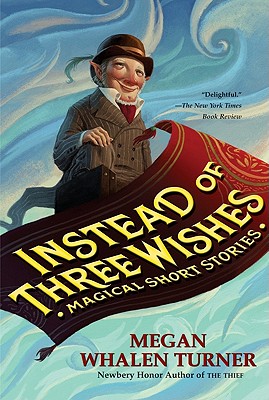 Instead of Three Wishes
By Megan Whalen TurnerGreenwillow Books, 1995
Instead of Three Wishes
By Megan Whalen TurnerGreenwillow Books, 1995Guilty secret: Every now and then, I google “Megan Whalen Turner Book Five,” grasping for news on the promised sequel to the four Queen’s Thief novels. So far, the series consists of THE THIEF, THE QUEEN OF ATTOLIA, THE KING OF ATTOLIA, and A CONSPIRACY OF KINGS, each better than the one before. Which is saying something, considering that THE THIEF won a Newbery honor.
The last book came out in 2010, and Turner has said there would be two more in the series. If that's not true, I will turn into a heap of disappointed dust on the floor.
Last time I guiltily googled, I was reminded that Turner’s first book actually was INSTEAD OF THREE WISHES, a collection of short stories. “Why haven’t I read these?” I muttered, scrambling for the “buy” button.
Why indeed. Unlike the Queen’s Thief books, which are set in a fantasy realm, most of these stories are in my favorite sub-genre, fantasy set in the real world. The stories don't have the literary heft of the novels, but lordy they're fun. My favorite, I think, is the title tale (quoted above), in which a high school student named Selene unwittingly earns the gratitude of an elf prince who grants her three wishes she doesn't really want. One after another, she rejects the coach, a palace, and a charming but dimwitted prince with matrimony on his mind, until the desperate elf turns up on the doorstep pretending to be a history professor who needs to rent a room. (Mom, a historian herself, finds it odd that he's never heard of the Battle of Hastings.)
The conundrum's solution is both neat and heart-warming.
In other stories, a New Hampshire town withstands a leprechaun sighting and onslaught of tourists, a kid goes back in time to rid a Viking settlement of its cockroaches, and a fledgling punk suffers nightmares in which he sees what other people think of him. Ghosts are addicted to reading. A young king masquerades as a baker.
My second-favorite story, the one whose complex texture most resembles Turner's novels, is “Aunt Charlotte and the NGA Portraits.” An elderly aunt enthralls her niece with the tale of a girlhood summer on the North Carolina shore, when she helped a strange but beloved neighbor solve a series of art-related puzzles and challenges. I quibbled a bit with the storytelling aunt device—couldn't see why it was necessary. But the story itself was marvelous.
Elements of this collection took me back to the ironic, deliciously weird short stories that got me through my teen years, written around the turn of the last century by journalist H.H. Munro under the pen-name “Saki.” (If you've never read “The Open Window” or “Sredni Vashtar,” correct this gap in your education immediately.) (None of Turner's stories is as bloody as "Sredni Vashtar," I hasten to add.)
I would love to know if Turner ever read Saki. She has claimed Diana Wynne Jones as an inspiration, so that’s almost as good.
For those of us who are Turner-deprived, these stories do ease the ache.
Also, Ms. Turner, hurry up.
(Dear FCC: Do you not recognize the addiction here? Think I’d wait for someone to pay me or otherwise incite this review? In short, I bought this book and no one cares what I say about it.)
April 6, 2016
April Book Review Club: Grayling's Song
Click icon for morebook review blogs@Barrie SummyWell, it's a good thing there are books, because winter has returned to Maine with freezing temperatures and breathtaking wind. Far from dashing outside and dancing in the sunshine, we're pulling up our socks and huddling by the woodstove, sick of the sight of one another. Time to grab a blanket and turn on the reading light.
I was greatly cheered by this book, and I hope you will be too. Don't forget to click on the icon above for more reviews!
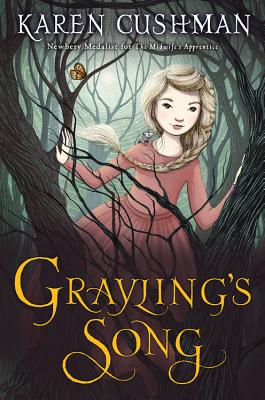 Grayling’s Song Advance Reading CopyBy Karen CushmanClarion Books, June 7, 2016
I do love it when a girl learns to sing her own song. Especially when she’s got that familiar inner voice telling her she can’t do it.
Such is the charm of GRAYLING’S SONG, Karen Cushman’s latest, due out in June. This is Cushman’s first fantasy, although the medieval/renaissance setting will be delightfully familiar to fans of her historical novels (Catherine, Called Birdy; The Midwife’s Apprentice; Alchemy & Meggy Swann, to name a few).
As in many middle-grade fantasies, magic provides the Big Challenge our heroine must overcome, but her success depends less on her mystical powers than on her ability to conquer her inner demons. Magic is all very well, we learn, but courage, wit, insight, and kindness are a person's most powerful weapons.
Grayling is the daughter of a cunning woman, the aptly named Hannah Strong, who serves her neighborhood as healer and counselor. When we meet the two it’s clear that the daughter reveres her talented, fierce-minded mother to the point of feeling utterly inadequate herself. Almost immediately, however, Hannah Strong needs help—some evil force of “smoke and shadow” burns down their cottage and roots Hannah to the ground for a slow transformation into a tree.
Worst of all, the force has spirited away Hannah’s grimoire, the recipe-book for her craft.
It’s up to Grayling to get help, ideally by rescuing the grimoire. Setting off reluctantly, she discovers that most other magical folk also have lost their grimoires and been turned into trees. But she finds that if she sings her mother’s grimoire will answer her, drawing her to it.
Following the grimoire’s song across the countryside, Grayling collects a motley band of helpers: a talking, shape-shifting mouse, a sorceress who ensnares the unwary with her beauty, an elderly magician with a mule, an even more elderly “weather witch” and her sullen apprentice.
Everybody knows more than Grayling does. And yet she finds to her astonishment that she’s always the leader. As the quest goes on, she finds in herself an unsuspected level of intelligence, bravery, and, yes, even what she might call “magic.”
You’ll be purring as you read. At least, I was.
I ransacked the internet to see if there’s going to be sequel to GRAYLING’S SONG, but there’s no hint of that yet. I’m concerned because there seem to me to be loose ends in this book. The first chapter tells us that Grayling’s country is plagued by battling warlords, vastly unequal distribution of wealth (sound familiar?), and drifts of homeless people (“edge dwellers”). We meet a warlord and some edge dwellers, but they don’t contribute much to the plot. I want to know more about them, and I want comeuppance for the person who caused the “smoke and shadow” situation, which I don’t feel I got.
Grayling, moreover, seems ripe for further adventures at the end of the book.
Surely, Ms. Cushman, there will be more?
(Dear FCC: I read an Advance Reading Copy of GRAYLING’S SONG, which I got as a free ebook through NetGalley. I signed up for it because I knew I’d love it, which does seem like cheating. But I’m sure you have bigger fish to fry.)
March 2, 2016
March Book Review Club: Honeydew
Click icon for morebook review blogs
@Barrie Summy
I'm posting this in the teeth of March winds, hoping the power stays on until I push "publish." If the power goes off, all you need is a good book and a headlamp. I'd recommend the book reviewed below. It'll keep you absorbed even if the batteries start to flicker.
Don't forget to hit the icon above for more reviews!
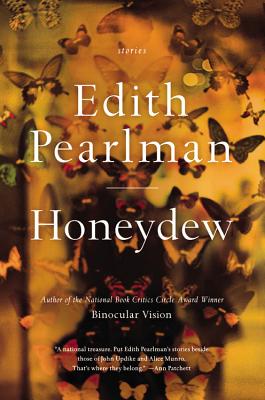 Honeydew
Short stories by Edith PearlmanLittle, Brown & Co., 2015
Honeydew
Short stories by Edith PearlmanLittle, Brown & Co., 2015In a reader’s guide at the end of HONEYDEW, an interview with author Edith Pearlman tells us that each of her stories has originated from “a character and a situation—a dilemma, a conflict, a wish—and a wisp of a hint about the solution or resolution or gratification or disappointment that results.”
Don’t you love author interviews? Especially when you agree with them.
Being a megalomaniac, I insist that my student writers in the local school start their stories the way I do, by learning as much as they can about the main character. “The best stories,” I intone, “start with a character who has a problem.”
That’s probably why I wallowed so joyfully in this collection by Pearlman, a much-admired writer to whom I’d paid no attention up to now because in addition to being a megalomaniac I’m also an idiot. (If you are too, know that she’s a former computer programmer whose first collection of stories was published in 1996 when she was 60. This is her fifth. She’s won big prizes right along, but her last collection, BINOCULAR VISION, won the 2012 National Book Critics Circle Award and was nominated for the National Book Award.)
These are complex, rich stories whose “situations” are interesting (love triangles, obsession, impending death) almost to the point of gimmickry. What saves them is the fullness of the characters and the deft way their author handles them. You’re hooked from the first description.
Chosen at random:
“Like many long-married people they looked like siblings—both short, both with fine thin hair the color of Vaseline, both with a wardrobe of ancient tweeds and sand-colored cashmere sweaters.”
“As for his head, he had brown hair, too much of it, a blunt nose and chin, and a habit, during conversation, of fastening his gaze on one side of your neck or the other.”
“She had performed a solo at the high school graduation two years ago, her long limbs making chaste love to the cello.”
Many of the stories take place in Godolphin, a Boston suburb a lot like Brookline, where the author lives. A high-end antiques store figures in several of them. I loved this—sometimes, the tragedy of short stories is that you feel you’re leaving too soon. It was lovely to stick around, seeing the town and Rennie the shop-owner from this angle and that.
At times there's a touch of magic realism. A worker in a homeless center, for example, may or may not employ a pair of gerbils in a successful exorcism. Even when they seem strictly real, there’s something otherworldly about these stories. If a girls’ school headmistress finds herself pregnant, would marrying an unrelated groundskeeper really keep her from losing her job? In another universe, the answer would be, “No, and what is this author trying to foist on us?”
For Pearlman it works, mostly. In the rare instances when it doesn’t you just move on, eager to meet more characters.
Dear FCC: Got this for Christmas (partly thanks to worthy advisers at Blue Hill Books, Blue Hill, Maine). Now I’m going to read BINOCULAR VISION by the same author. I’ll probably buy that with my own money. Considering the state of my finances, this is the height of honest praise.
February 3, 2016
February Book Review Club: THE DOOR
Click icon for morebook review blogs
@Barrie Summy
Yay! It's great to be back after the Book Review Club's little hiatus. Here in New England it's looking like spring this week--not so in the rest of the country. Snuggle down with a good book, hey? Lots of options available if you click the icon above. Hang in there!
 The Door
By Magda SzaboTranslated by Len RixNew York Review of Books, 2015
The Door
By Magda SzaboTranslated by Len RixNew York Review of Books, 2015All hail the independent bookstore. The Man and I have a books-only rule for Christmas and birthdays, so Blue Hill Books knows our tastes pretty well by now. Bookstore co-founder Nick Sichterman thrust this book into the Man’s hands during his frantic, last-minute December shopping spree, and told him I’d love it.
Nick was right. But I can’t imagine how he figured that out—on the surface, this is the kind of book I’d have trouble getting into: Its characters seem unlikeable at first, and the plot is sedentary.
I was instantly enthralled. Now I’m baffled.
THE DOOR is one of Magda Szabo’s last works, published in Hungarian in 1987. Judging by the brief bio in the paperback I now treasure, it has strong autobiographical elements. Born in 1917, Szabo was an exquisitely educated woman who worked as a teacher during her country’s German and Soviet occupations. She published two books of poetry right after the war and won the 1949 Baumgartner Prize before falling into disrepute with Hungary’s Communist rulers. She re-emerged as a novelist ten years later, winning her country’s most prestigious literary prize, and had a highly successful career during which she also wrote plays, short stories, and children’s verse. Szabo died in 2007.
Like her author, THE DOOR’s unnamed narrator is a successful writer who ran afoul of the government, but now has emerged from isolation to become a monumental success. Needing somebody to cook and clean her big new apartment so that she and her husband can concentrate on work, she arranges an interview with an elderly neighbor, Emerence, who is renowned for her energy and abilities.
Turns out the narrator is not the one conducting the interview—Emerence is checking the two writers out to make sure they pass muster. “I don’t wash just anyone’s dirty laundry,” the old woman proclaims.
Before long, “the lady writer” and her husband are utterly reliant on Emerence, although employing her requires superhuman flexibility and an even temper. The narrator is far from flexible and even-tempered.
In time, she and the old woman come to share an intense love colored by mutual annoyance, bafflement, and frustration. Neither can give the other what she really needs: the narrator desperately wants Emerence’s approval, never forthcoming. And the one time Emerence really needs help, the narrator lets her down.
Here’s how the relationship starts: “No formal agreement dictated the number of hours Emerence spent in our house, or the precise times of her arrival. We might conceivably see nothing of her all day. Then, at eleven at night, she would appear, not in the inner rooms, but in the kitchen or the pantry, which she would scrub until dawn. It might happen that for a day and a half we would be unable to use the bathroom because she had rugs soaking in the tub.”
When she’s not working for the writers, the old lady sweeps the streets and tends to the building in which she has a ground-floor flat, within sight of her employers’ windows. Work is her life.
Emerence has a penchant for unexpected gifts—food, service, a stuffed falcon, an old army boot—and flies into a rage if they aren’t properly appreciated. She will accept no gifts herself, seldom takes orders. The door to her flat is always closed—no one is allowed inside, nor is there any explanation for the strong smell of disinfectant wafting under the door. Deeply secretive about her past, Emerence occasionally tells the narrator some harrowing tale about her childhood, or makes some oblique revelation about a former employer.
As we piece it together by the end, her history and the character it created are weird, rich, and entrancing. I guess that’s why I loved this book so much. Go figure.
The translation by Len Rix seems to be lovely. (How can you tell?) It won the Oxford-Weidenfield Translation Prize in 2006.
The New York Review of Books will publish another of Szabo’s novels, 1963’s IZA’S BALLAD, in 2017. I’ll be waiting for it at Blue Hill Books.
Dear FCC: As stated above, this book was a Christmas gift, and I legitimately loved it. So sue me.
January 9, 2016
There will be a slight delay
Hello and happy new year! The Book Review Club is not dead. I was unable to write a review in December, and we all took January off for various reasons. But we're all reading like maniacs and will be back with reviews the first Wednesday in February. See you then!
November 4, 2015
November Book Review Club: THE BOOK OF SPECULATION
Click icon for morebook review blogs
@Barrie Summy
We have exactly one tree left with leaves on it, so I guess it's time to admit that the Reading Season is upon us. Not to mention the Festive Holiday Madness. Here's a possibility for either or both, although with some reservations.
Don't forget to click the icon above for more reviews!
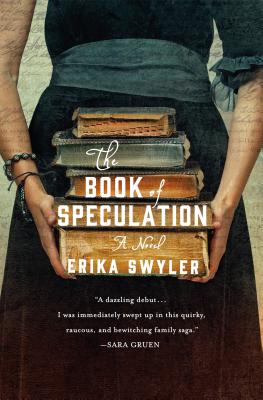 The Book of Speculation: A Novel
By Erika SwylerSt. Martin’s Press, 2015
The Book of Speculation: A Novel
By Erika SwylerSt. Martin’s Press, 2015First-person narration can be a risky business. The narrator has to do more than just tell the story—he has to share bits of himself along the way, endear himself to us even if he’s a villain. A reader has to be willing to invest a chunk of time in this person.
Never in all my days did I expect to enjoy a novel with an essentially bland protagonist/narrator who learns next to nothing from events. THE BOOK OF SPECULATION is just such a novel—rife with good stuff that I really loved, but a struggle to get through at times because the narrator was just so colorless.
My man bought it for my birthday, having listened to it on tape while painting. “This is what you would write if you wrote for adults,” he told me.
Thank you, schnookums. I think.
In many, many ways, this is a fascinating, beautifully written book. When we meet Simon Watson, he’s a lonely reference librarian in a small town far out on Long Island. He’s about to lose his job and erosion is about to send his lifelong home tumbling into Long Island Sound. He is stymied, unwilling to move because the house is the only place his younger sister, an emotionally unstable itinerant circus performer, can really call home. But he can’t afford to shore up the bluff and save the place.
Out of the blue, an antiquities dealer in Iowa sends him a 200-year-old book, the diary/financial ledger of a traveling circus owner called Hermilius Peabody. Written in it is the name of Simon’s grandmother, a circus performer who apparently had the book in her possession for a while.
Simon’s curious but not that fascinated until he sees the 1816 notation of a woman’s drowning—on July 24, the exact date when his mother left her children in the bluff-top house and walked into the Sound, never to return.
Curiosity becomes obsession, and we follow Simon as he does what a research librarian does best, tracking down names and dates and making connections between them. We learn that the women in his family have always had an uncanny ability to hold their breath under water, and for generations have worked as water-tank “mermaids,” sideshow attractions in traveling circuses.
Simon’s mother was a mermaid when his father fell in love with her. He and his sister, Enola, inherited the ability.
Enola works as a fortune-teller rather than a mermaid. Nevertheless, Simon is horrified when she unaccountably is drawn to revisit their seaside home in July. He finds evidence of more drownings on the 24th. The clock starts ticking—can he figure out what’s going on before the fateful date?
The book alternates Simon’s narrative with the tale of Hermilius Peabody and his circus, told in third person. Hand-drawn tarot cards come into play, along with infestations of horseshoe crabs and weird meteorological events. The metaphysical logic never gets spelled out, but who cares. It’s marvelous.
Here’s the thing: I found myself heaving a resigned sigh whenever Simon took back the narration. The chapters set in the 1800s are as textured and richly colored as a Persian rug. The modern chapters are beige vinyl floor tiles.
There are stirring events all over the place, and Simon’s modern situation gets worse and worse in lively fashion. He tells us he’s upset and worried about it all, but we never feel it, or at least I didn’t. He does stuff, but his actions seem vague and indirect, never precise in their attack. As a result, even the July 24 situation lacks the suspense it should have.
The other characters in Simon’s life are interesting, especially his sister and her circus boyfriend, who can turn lightbulbs on by touching them. But you never get deep enough, or even glean enough facts, to understand them or root for them.
In the 1800s, I rooted for everyone—I kept wishing the whole novel was back there. Swyler may be more comfortable and interested writing about the past.
I hope her next novel stays there.
(Dear FCC: As stated above, I got this book for my birthday. For the record, I don't actually call the man "schnookums".)
October 14, 2015
October Book Review Club: THE NIGHT GARDENER
Click icon for morebook review blogs
@Barrie Summy
I just spent a fun and funny week touring Oklahoma and Arkansas with Book Review Club members Barrie Summy, Jody Feldman, and Stacy Nyikos. And, boy, was it a hoot! (Pix are here.) Now I'm home, the leaves are turning, and Halloween's around the corner. Here's a book to scare you silly.
Don't forget to click the link for more reviews!
.
 The Night Gardener
By Jonathan Auxier
The Night Gardener
By Jonathan AuxierAmulet Books, 2014
First sign of a stellar middle-grade novel: You find yourself wanting to reach in and give the main character a good shake. “Wise up!” you whisper, hoping she hears.
I’m looking at you, Molly.
In Jonathan Auxier’s amazing THE NIGHT GARDENER, red-haired Irish waif Molly and her younger brother Kit have lost their parents at sea, stolen a fish cart and a horse called Gallileo, and set off across cold, wet rural England seeking employment. Molly is fourteen, but has lied about her age to get a referral to the Windsor household.
We learn on page one that the Windsors live in a place called “the sour woods,” and that everyone has been telling the waifs that they’re “riding to their deaths.” We feel this might be ominous. But Auxier instantly establishes Molly as A Girl Who Handles Things. Her younger brother is sick and they’re both starving. Despite the elaborate kidnapping tale Molly tells Kit, their parents are almost certainly dead. They need this job to survive, and Molly’s more than a match for any evil influence.
Or so we think.
The Windsor mansion proves to be a sagging wreck covered in black moss, with a giant, ill-favored tree growing right into its walls. The denizens—Constance, Bertrand, and their children Penny and Alistair—have dull, dark hair, pale skin, and dead-soul eyes. Constance has to be strong-armed into hiring Molly and Kit—“This house is no place for you,” she says—and in the end she insists that Kit, at least, will sleep in the stable rather than the house. Is she being snooty, or does she have their best interests at heart?
Well, let’s see. There’s an ominous locked door at the top of the stairs which proves to have one of the tree’s knots imbedded in the wall. Every morning, muddy footprints and dead leaves cover the house—Molly wakes from a nightmare to find them in her room.
The nightmares plague her every night. If she wakes up, she hears the moans of the house’s other sleepers, trapped in their own torments. Also thudding footsteps.
Hey, is her red hair getting darker and duller?
Molly! Wise UP!
This is one of the creepiest books I’ve read in a while. But it’s also lovely, dark, and deep, examining the nature of greed, the benefits of death, what stories do for us, and the difference between stories and lies. “A story helps folks face the world, even when it frightens ’em,” Molly figures out. “And a lie does the opposite. It helps you hide.”
I got a little tired of Molly and Kit’s constant droppin’ of terminal “g’s,” and I could take or leave the fact that they’re Irish immigrants—it seems like an extraneous detail, inserted here and there for no particular reason.
Otherwise, this is a near-perfect book, the kind of rich reading experience that makes me glad there are middle-grade novelists like Auxier. I never read his first book, PETER NIMBLE AND HIS FANTASTIC EYES, and now I plan to. You should too.
Dear FCC: I got this book out of the Blue Hill Public Library. I had to reserve it, because people in Blue Hill, Maine, still are clamoring to read THE NIGHT GARDENER even though it’s been out for more than a year. Nobody paid me to read it. In fact, I bet somebody would have bribed me for my place in line.


