
Ellen Booraem's Blog, page 5
March 26, 2013
The Next Big Thing! Right here on my blog!
Looky here--a post in between book reviews! That crinkling sound--is that Hell freezing over? (Or I guess I should say "the Underworld.")
Anyway, Erin Dionne (author of the upcoming MOXIE AND THE ART OF RULE-BREAKING) tagged me for The Next Big Thing, a blog tour that started in Australia and has been edging its way around the world one author at a time. I'm thrilled to take my turn answering questions about my new book. Read through to the end to find out where we go next!
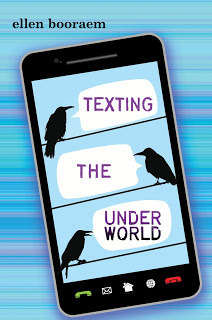 What is the title of your next book?
TEXTING THE UNDERWORLD comes out August 15 and I’m already bouncing around like a ninny.
What it’s about: Perpetual scaredy-cat Conor O’Neill has the fright of his life when a banshee named Ashling shows up in his bedroom. Like all banshees, Ashling is a harbinger of death, and she’s sure someone in Conor’s family is about to require her services. But she’s new at this banshee business, and first she insists on going to middle school. Even as Conor desperately tries to hide her identity from his classmates and teachers, he realizes there’s no way to avoid paying a visit to the underworld if he wants to keep his family safe.
Fortunately, he has a cell phone, and his computer-geek friend, Javier, will be holding down the home front. Here’s my editor’s favorite exchange between Javier and Conor:
“Got your cell?”“Yeah . . . Don’t see what good it’ll do me.”“I’ll text you if anything happens that you should know.”“Text me? Javier, we’ll be in the afterlife.”“You never know. Maybe they get a signal.”
Where did the idea come from for the book?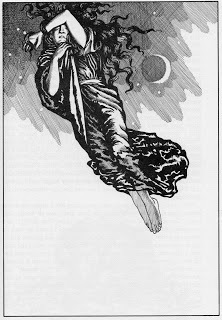 Banshee illustration
by Yvonne Gilbert,
Abbey Lubbers, Banshees & Boggarts
I was leafing through Abbey Lubbers, Banshees & Boggarts, an illustrated encyclopedia of folklore collected by the late Katharine Briggs. I came upon a full-page illustration of a banshee, and she wasn’t what I expected. (My banshee experience started and ended with "Darby O’Gill and the Little People," a Walt Disney film that scared the pants off me when I was a kid.) According to Briggs, banshees weren’t always evil old hags—sometimes they were the spirits of young girls who died too soon. Ashling the banshee popped into my head right then and there, and I had the plot mapped out in three hours.
What genre does your book fall under?
It’s middle-grade fantasy. Depending on who you talk to, “middle grade” ranges from age eight to age fourteen. You can decide for yourself whether banshees and a trip to the underworld constitute "fantasy."
What actors would you choose to play the part of your characters in a movie rendition?
CJ Adams (“The Odd Life of Timothy Green”) would be a great Conor, and Elle Fanning would be good as Ashling. (She’d have to dye her hair red.) The other major character is Grump, Conor’s grandfather, a banshee expert who’s kind of a loveable curmudgeon. Gotta be Clint Eastwood.
Who is publishing your book?
Dial Books for Young Readers, a Penguin imprint.How long did it take you to write the first draft of the manuscript?
Let’s see. I started it in the summer of 2010, and got going on it seriously in the fall. I had a first draft to my editor in June 2011, and we finished revisions a little less than a year later. There were a lot of empty months in there while my editor was considering my various proposals and I was working on other things.
Who or what inspired you to write this book?
On the surface it was just the idea of a young banshee. But also various family members and friends had died over the previous decade, and I had some thoughts about death that made this book even more interesting to me.
What else about the book might pique the reader’s interest?
There’s a mysterious connection between Conor and Ashling that becomes clear only when they finally visit the afterlife.
While she’s visiting Conor, Ashling’s chief source of information about the world is an old Trivial Pursuit game.
It turns out the Underworld does get a cell phone signal. Also internet.
And now (*drum roll*), I hereby tag Lisa Gail Green, author of the upcoming THE BINDING STONE. Take it away, Lisa!
Anyway, Erin Dionne (author of the upcoming MOXIE AND THE ART OF RULE-BREAKING) tagged me for The Next Big Thing, a blog tour that started in Australia and has been edging its way around the world one author at a time. I'm thrilled to take my turn answering questions about my new book. Read through to the end to find out where we go next!
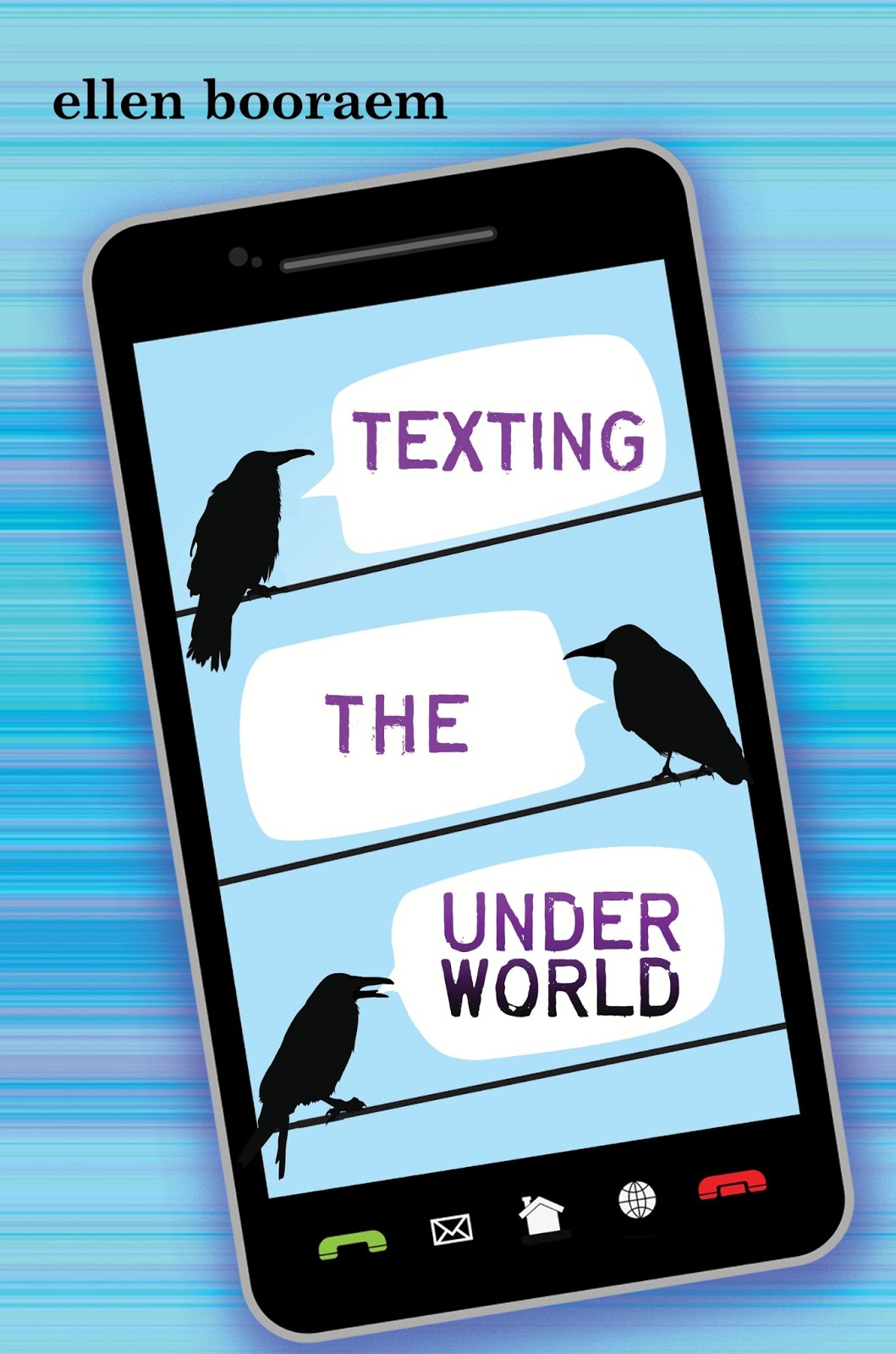 What is the title of your next book?
TEXTING THE UNDERWORLD comes out August 15 and I’m already bouncing around like a ninny.
What it’s about: Perpetual scaredy-cat Conor O’Neill has the fright of his life when a banshee named Ashling shows up in his bedroom. Like all banshees, Ashling is a harbinger of death, and she’s sure someone in Conor’s family is about to require her services. But she’s new at this banshee business, and first she insists on going to middle school. Even as Conor desperately tries to hide her identity from his classmates and teachers, he realizes there’s no way to avoid paying a visit to the underworld if he wants to keep his family safe.
Fortunately, he has a cell phone, and his computer-geek friend, Javier, will be holding down the home front. Here’s my editor’s favorite exchange between Javier and Conor:
“Got your cell?”“Yeah . . . Don’t see what good it’ll do me.”“I’ll text you if anything happens that you should know.”“Text me? Javier, we’ll be in the afterlife.”“You never know. Maybe they get a signal.”
Where did the idea come from for the book?
 Banshee illustration
 by Yvonne Gilbert,
Abbey Lubbers, Banshees & Boggarts
I was leafing through Abbey Lubbers, Banshees & Boggarts, an illustrated encyclopedia of folklore collected by the late Katharine Briggs. I came upon a full-page illustration of a banshee, and she wasn’t what I expected. (My banshee experience started and ended with "Darby O’Gill and the Little People," a Walt Disney film that scared the pants off me when I was a kid.) According to Briggs, banshees weren’t always evil old hags—sometimes they were the spirits of young girls who died too soon. Ashling the banshee popped into my head right then and there, and I had the plot mapped out in three hours.
What genre does your book fall under?
It’s middle-grade fantasy. Depending on who you talk to, “middle grade” ranges from age eight to age fourteen. You can decide for yourself whether banshees and a trip to the underworld constitute "fantasy."
What actors would you choose to play the part of your characters in a movie rendition?
CJ Adams (“The Odd Life of Timothy Green”) would be a great Conor, and Elle Fanning would be good as Ashling. (She’d have to dye her hair red.) The other major character is Grump, Conor’s grandfather, a banshee expert who’s kind of a loveable curmudgeon. Gotta be Clint Eastwood.
Who is publishing your book?
Dial Books for Young Readers, a Penguin imprint.How long did it take you to write the first draft of the manuscript?
Let’s see. I started it in the summer of 2010, and got going on it seriously in the fall. I had a first draft to my editor in June 2011, and we finished revisions a little less than a year later. There were a lot of empty months in there while my editor was considering my various proposals and I was working on other things.
Who or what inspired you to write this book?
On the surface it was just the idea of a young banshee. But also various family members and friends had died over the previous decade, and I had some thoughts about death that made this book even more interesting to me.
What else about the book might pique the reader’s interest?
There’s a mysterious connection between Conor and Ashling that becomes clear only when they finally visit the afterlife.
While she’s visiting Conor, Ashling’s chief source of information about the world is an old Trivial Pursuit game.
It turns out the Underworld does get a cell phone signal. Also internet.
And now (*drum roll*), I hereby tag Lisa Gail Green, author of the upcoming THE BINDING STONE. Take it away, Lisa!


March 6, 2013
March Book Review Club
 Click icon for morebook review blogs@Barrie Summy
Until this morning, it snowed steadily for about 36 hours with absolutely no accumulation to show for it. Yep, it's March. If you're not reading voraciously now, you are way, way too contented with life.
Here's a little March escapism. And don't forget to click the icon for more reviews!
 RevelBy Maurissa GuibordDelacorte Press, 2013
Full disclosure: Maurissa Guibord is a friend, and her publisher sent me a galley so I could interview her for The Enchanted Inkpot.
Teen Me would have been thrilled. This is the kind of book she would have devoured and instantly re-read. Then it would have been rinse and repeat every few months until she could recite half of the text.
Here’s why: Characters and creatures out of Greek mythology, some enticing, others terrifying. A couple of love interests, both tormented, one supernatural. Humor. A mystery that starts on page one and just keeps getting juicier.
Who knew gills could be sexy? (I’ve got your interest now, right?)
The plot is unique, as far as I know.
Orphaned Delia makes her way from Kansas to the strange island where her mother grew up, hoping to connect with her grandmother and find out the truth behind her mother’s deathbed ramblings. (“Don’t let them take the baby” being one. Brrr.)
When she reaches Trespass Island, she finds she’s not welcome. Then she finds she’s more welcome than she wants to be. She meets a young fisherman who seems to be attracted to her but keeps backing off in an odd, unhappy way. Everyone talks about the Revel, but no one will tell her what it is.
And then there’s the pale young man from the sea who seems to be obsessed with her.
There are mysteries everywhere: Why doesn't Trespass appear on any maps? How come its inhabitants seem to be trapped there, surrounded by what seem to be sea monsters? Why did Delia’s mother leave? She'd always said she was terrified of water, so why are there pictures of her happily paddling in the sea?
Sometimes Delia standing on the shore one minute, and up to her knees in water the next--what's that all about?
Guibord unravels the puzzles slowly and seamlessly. The answers are deeply satisfying, although sometimes heartbreaking. By the time we get our answers, we’re thoroughly invested in all the characters, from Delia’s intrepid grandmother to the slightly ditzy teenagers dolling themselves up for Revel.
Delia’s fate is especially cool. And, Ms. Guibord, it just screams for a sequel.
Poor Teen Me. How she would have loved this book.
February 6, 2013
February Book Review Club
Click icon for morebook review blogs
@Barrie Summy
"Scattered flurries" are accumulating on the ground as I write this--a joyful sight in a snowless Maine winter, although I doubt it will be deep enough to ski on it. Nothing for it but to settle down by the woodstove with a good book. Not sure this one will cheer you up--better try it with a sun lamp.
Don't forget to click the icon for more reviews!
 The Casual VacancyBy J.K. RowlingLittle, Brown & Company, 2012
Every Christmas, my man Rob and I give each other nothing but books, all purchased from our crackerjack independent bookstore, Blue Hill Books. Although the staff there know our tastes and are remarkably astute advice-givers, I also take the precaution of mentioning (loudly, and with heft) what it is I’m hoping to read.
This year, as Samantha and I chatted over the front counter, I said I really didn’t think I could handle THE CASUAL VACANCY, the first book for adults by celebrated Harry Potter author J.K. Rowling. This lodged in her overtaxed holiday brain as “Ellen wants that book,” and so she instructed Rob.
You’ve probably read the excoriating reviews this book received, so you know I was expecting the worst: Drab, depressing characters going nowhere in a badly written novel. I actually considered returning it, but then I flipped a few pages.
And by gorry, the writing grabbed me, with that odd mix of coziness and cynicism common to a lot of British novelists of a half-century ago or more: Kingley Amis, for example, or Muriel Spark. Not to modern tastes, perhaps, but for a throw-back like me it was manna.
Here’s one small-town character’s reaction to the book’s catalyst, the death of Parish Councilor Barry Fairbrother:
Naturally Shirley had known, as they slid stock words and phrases back and forth between them like beads on an abacus, that Howard must be as brimful of ecstasy as she was; but to express these feelings out loud, when the news of the death was still fresh in the air, would have been tantamount to dancing naked and shrieking obscenities, and Howard and Shirley were clothed, always, in an invisible layer of decorum that they never laid aside.
Okay, that’s one of the world’s longest sentences, but I’m sucked right in by the abacus imagery and the dancing-naked/clothed-in-decorum juxtaposition, not to mention the insight into this awful marriage.
The book does have serious problems. Oddly, considering that the characters are so well drawn, I had a heck of a time keeping them straight in my head. There are so many of them, and all of them with equal weight—nobody’s the protagonist, except maybe the dead guy. Halfway through the book, I still couldn’t remember who was married to whom and had which kids. It made me determined to re-read Anthony Trollope, the nineteenth century novelist who did the same type of casting but still managed to keep everyone screamingly distinct.
Although Rowling’s wry humor is well represented, there’s no arguing that her book is relentlessly depressing. And you struggle to like any of the small-minded, drug-addled, unhappily mated characters. I kept thinking of E.F. Benson, whose Lucia novels of the 1920s and 30s followed the machinations of a bunch of provincial social climbers. Lucia and friends start out in the first chapter as barely likeable figures of satire, but Benson slowly falls in love with them—especially Lucia—and starts giving them some qualities that will make us love them, too.
Rowling doesn't seem to have fallen in love with these characters, although she’s more sympathetic to the miserable teens than to the damaged and damaging adults.
I’m not sure this book would have been published if it hadn't had Rowling’s name on it--not because it's bad, but because it's delightfully old-fashioned. I also don't think it would have been so badly reviewed if everybody hadn't been expecting a more adult Harry Potter.
Despite the difficulties, I’m glad I read it--partly because I really did admire the writing, and technique was not the Potter novels’ strong suit. But also it gives me hope that, having rid her system of the unused profanities and angst she’d built up up through seven kids’ fantasies, Rowling will write a real winner the next time.
January 2, 2013
January Book Review Club
Click icon for morebook review blogs
@Barrie Summy
Happy New Year! And here's the first 2013 meeting of the Book Review Club--crank up the woodstove! And don't forget to click the icon above for more reviews.
 The Star of KazanBy Eva IbbotsonPuffin Books 2004
Eva Ibbotson is my hero. She published her first middle-grade fantasy at age 50, and by the time she died at 85 she’d done twelve of them, along with seven books for young adults or adults.
Before this I’d only read The Secret of Platform 13. (Interestingly, it came out just two or three years before Platform 9 3/4 gained fame. Asked if she thought JK Rowling had cribbed from her, Ibbotson said kindly, “we all steal from each other,” or words to that effect.) (I can’t find the quote.)
Although Platform 13 is wonderful and is among Ibbotson’s most celebrated works, it didn’t blow me away as much as I’d expected. On the other hand, whether because of my mood or the season or some astrological influence, The Star of Kazan hit me right where I live. Published in 2004, six years before its author’s death, it is the work of a master.
Ibbotson was born in Vienna in 1925 to Jewish parents, and her family prudently made its way to England in the 1930s. The Star of Kazan takes us to an ideal Vienna, before World War I. It’s a child’s dream, painted lovingly from the food to the parks to the Lipizzaner stallions. But it’s an adventure, not a travelogue: her twelve-year-old heroine, Annika, has a deep-seated yearning that takes her away from lovely Vienna, to the brink of disaster and back again.
Annika is a foundling, raised in a fond but odd adopted household consisting of three siblings, all professors, and their kindly but no-nonsense cook and housekeeper. Annika grows up learning to cook and keep house, but also tutored by the professors in their fields of art, music, and science. She goes to school, has friends and good neighbors and a pleasant routine broken by the occasional treat. One of the neighbors is an extremely old woman she visits regularly, a former music hall star who clings to a trunk full of costumes and the reproductions of jewels she sold when fame left her behind.
Despite her idyllic life, Annika dreams of her unknown mother, whom she imagines as a beautiful aristocrat searching the world for her lost daughter.
Imagine her joy when just such a woman turns up at the professors’ door and sweeps Annika off to the north country and an ancestral, moated pile of house called Spittal. (Okay, first hint—this is not Barbie’s dream home.) There, she finds mysteries that she refuses to be troubled by: the missing portraits and carpets, the demoralized family and servants, the decaying farm, the fact that her mother keeps promising some wonderful event that will improve all their lives.
Probably the most admirable of Ibbotson’s feats is the fact that the reader spends more than half the book watching the circumstances become increasingly Dickensian, and yet we completely believe it when this otherwise smart, canny child refuses to catch on. It’s the richness of detail that does it—by the time the glamorous mother shows up, we have thoroughly lived Annika’s wonderful life, and we know that she’ll give it all up—and more—for the knowledge that her birth mother loves her.And it’s the voice: a third person narrator who never departs from a child’s point of view. Here, for example, is our introduction to Annika at age 12:
As soon as she woke, Annika opened her attic window and looked out at the square. She did this every morning; she liked to see that everything was in order, and today it was. The pigeons were still roosting on General Brenner’s head, the fountain had been turned on, and Josef was putting the café tables out on the pavement, which meant it was going to be a fine day. A door opened in the ramshackle little house on the opposite corner and her friend Stefan came out and set off across the cobbles with a can to fetch the milk. He was the middle one of five flaxen-haired boys, and his mother, Frau Bodek, was expecting a sixth child any day. She had said that if it was another boy she was going to give it away.
One paragraph in, we know that Annika likes things orderly and routine, she’s not a snob, and she pays attention when mothers talk about giving away their children. Stay tuned.
I might just mention that the Puffin paperback in my possession is enlivened by the Kevin Hawkes cover and illustrations. Hawkes is from Maine. Naturally.
I’ve only just gotten started on Ibbotson’s books, and I’m pumped. Next up: The Ogre of Oglefort.
Dear FCC: I bought this book with my very own money, because Kevin Hawkes was at the Bangor Book Festival signing books and I liked the cover.
December 5, 2012
December Book Review Club
Click icon for morebook review blogs
@Barrie Summy
Hey, it's the festive holiday season! In the true spirit of the times, here's a nice fantasy about assassins. By January 2, we'll be right in the mood.
Don't forget to click the icon for more reviews. And Happy Holidays!
 His Fair Assassins: Grave MercyBy Robin LaFeversHoughton Mifflin Harcourt, 2012
A disclaimer: Robin LaFevers is a fellow Inkie (a member of The Enchanted Inkpot blog) and wrote a blurb for SMALL PERSONS WITH WINGS. But if this book hadn’t wowed me, I wouldn’t have written about it. So there. Also, I bought the book with my own hard-earned cash.
Robin LaFevers is a sly boots.* In a setting where women were chiefly marriage chattel and needlework aficionados, it’s not easy to create a kick-butt heroine without violating the spirit of the age. So what LaFevers does is fill a medieval convent with the daughters of Mortain, the god of death styled “St. Mortain” as a political bow to Christianity. These young women are trained to do their father’s will—in other words, they’re assassins. Upon graduation, off they go into the world of needlework, armed with shivs, miniature crossbows, and a working knowledge of poison.
GRAVE MERCY is a total hoot. We get to sympathize with the assassins because they kill only those that bear Mortain’s “marque”—a shadow indicating how the target will die, and that he or she deserves to. (A marque around the lips, for example, indicates death by poison.) Late in the book, LaFevers adds a lovely new dimension when her protagonist, Ismae, invokes Death’s merciful aspect, releasing tormented souls from broken bodies.
Ismae leaves the convent to become embroiled in the politics of Brittany, whose young duchess is under pressure from neighboring states—chiefly France—who are salivating over her lands. Anne must make the right marriage to secure her duchy, but first she must stay alive. While she spends the requisite hours in her solar plying her needle, she is far from chattel. She’s a wonderful character: courageous, smart, and well educated, and in circumstances that have given her a modicum of control over her fate.
Anne’s court is a political snakepit, and that, too, is highly entertaining. Ismae is in the thick of it, ferreting out who can be trusted and who’s been bought. One of those whose loyalty she questions is the mysterious Gavriel Duval, Anne’s bastard half-brother who is high on the list of this book’s guilty pleasures. You’ll have to read it to find out why.
One of my recent sorrows has been the death of Diana Norman, the British historian and journalist who wrote the splendid Mistress of the Art of Death series under the pen name Ariana Franklin. She, like LaFevers, managed to adjust her heroine’s circumstances so that she was a free agent in a reasonably truthful medieval society. Norman’s Adelia has a worthy (and possibly more believable) successor in Ismae and her sisters. I’m insanely eager for April and the publication of DARK TRIUMPH, the next volume in the His Fair Assassins series.
*Technical term for us literati.

November 7, 2012
November Book Review Club
Click icon for morebook review blogs
@Barrie Summy
Barely awake after election night, of course. But regardless of how we all feel about the vote, we can agree on one thing: IT'S OVER. And now, free of campaign commercials and phone calls from pollsters, we can get back to what's important: putting our feet up for a good read. Enjoy!
And don't forget to click the icon for great reviews!
 The Likeness
By Tana French
Gotta love the poet Samuel Taylor Coleridge, who also philosophized on art in general. He’s the one who coined the phrase “willing suspension of disbelief”—if a writer endows a fantastical tale with “human interest and a semblance of truth,” the reader will meet him halfway and suspend skepticism.
Tana French manages this feat in The Likeness, but only just. If you can overlook the implausibility of her premise, the characters and suspense in this book will reward you. If you can’t, you probably won’t make it past page fifty.
Set in Ireland, The Likeness features a strong secondary character in French’s debut novel, In the Woods. In the first book, Cassie Maddox was part of a trio of young murder investigators who were drawn into a sinister web of deceit and barely made it out with souls intact. As this book begins, Cassie’s reaction has been to transfer to Domestic Violence and try to sublimate her thirst for perilous investigation.
It all works fine until her boyfriend (also one of the original trio) calls her to a murder scene. Surprise number one is that the murder victim’s name—Lexie Madison—is the fake one Cassie had assumed in a long-ago undercover investigation of a drug ring. Surprise number two (disbelief alert) is that the victim looks exactly like Cassie.
Cassie’s boss in the undercover operation, the charismatic oddball Frank Mackey, knows just how to push Cassie’s buttons. He persuades her to undertake an exceptionally risky deception, telling Lexie’s four housemates that she survived a brutal attack and will be home after a stay in the hospital. After an intense training session, aided by cell phone tapes and photos of Lexie’s life with her housemates, Cassie begins the deception.
The five housemates, all graduate students, have a claustrophobically close relationship centered on their house, which was inherited by one of them, Daniel. They study together, eat together, carpool in to the university and home again, and spend blissful evenings together by the fireside. Their one rule is “no pasts”—nobody gets to talk about anything that happened before they all met.
Cassie, still raw from the events of the earlier book, finds herself attracted to the group’s closeness and sense of family. French is brilliant in tracing the slow unraveling of her defenses, to the point where she starts to “become” Lexie—who, you’ll recall, was a made-up person to begin with. It’s an absorbing and mostly satisfying process for the reader.
The unlikeliness of the premise is a flaw in this book, but not a fatal one. I also felt that there were a few too many loose ends where the housemates were concerned, and never was satisfied that I understood why the dead girl chose the name of Cassie’s made-up alter ego. Nevertheless, this is a book you can sink into—so deeply that you forget there’s an election—and this fall that was worth a lot.
I’m dying to read French’s next book, Broken Harbor, which follows the nut-job undercover boss, Frank Mackey.
Dear FCC: I got this book for my birthday.

October 3, 2012
The Book Review Club: October
Click icon for morebook review blogs
@Barrie Summy Another month, another edition of the Book Review Club. The stakes are higher now, because fall's closing in and the woodstove's cranking up. Gotta line up those winter books! Here's a good one. Don't forget to click the icon for more reviews!
 The Poacher's Sonby Paul DoironSt. Martin’s Press, 2010
Depictions of Maine range from the desperate poverty in THE BEANS OF EGYPT, MAINE to the desperately inaccurate Cabot Cove of the 1980s TV show “Murder She Wrote.” Paul Doiron’s version is somewhere in the middle—there’s truth in THE POACHER’S SON, although we see a lot of it from the passenger seat of a pick-up truck rather than close-to.
Doiron is the editor of Down East: The Magazine of Maine , a gorgeous and highly readable publication whose scenery tends to the Cabot-Coveish. He also is a Registered Maine Guide. An author’s note tells us that this book is rooted in a feature series he wrote for Down East, presumably on the Maine Warden Service, and Doiron’s depth of knowledge about the woods and their denizens serves the book well. He gives the wardens—trained law enforcement professionals whose mission is to uphold fish and game law and protect Maine wildlife—every bit of the respect they deserve while also rendering them human, a feat that made this book an Edgar Award finalist.
This is the first of three mysteries starring fledgling game warden Mike Bowditch, and word has it that more are on the way. I’m looking forward to catching up with ol’ Mike, and it’ll be fun to watch him get seasoned in his job. In this book, he’s a wide-eyed newbie with a shining career ahead of him, eager to confront both marauding bear and unlicensed fisherman.
But Mike has a deep, dark secret: his dad. Jack Bowditch is a man of the Maine woods, able to track and trap and find his way. He’s also a drunk, a womanizer, and a poacher, ravaged by Vietnam, incapable of maintaining a healthy relationship with a wife, a boss, or a son. Mike spent his early years in a series of depressing north woods shacks before his mother escaped with him to gentrified Southern Maine and a better marriage. His contacts with his father have been nasty, brutish, and short.
Mike’s girlfriend has left him, unhappy about the gentle poverty and loneliness of a warden’s life. Still reeling from her departure, he’s in no shape to deal when he finds out a beloved young cop has been killed and the chief suspect is—you guessed it—dear old Dad. He reacts in a succession of increasingly foolhardy efforts to prove that his father’s innocence, risking career, love life, friendships, and, eventually, his life. As he blunders into the woods on his father’s trail, betrayal awaits behind every tree. But there’s also a new clarity about what—and who—matters most to him.
Doiron adds realism by setting his murder in the context of North Woods development, a hot point in Maine politics for the past two decades or more. Developers have bought up paper company land and want to oust those whom the old owners permitted to build camps there. He does not preach, simply uses the situation to wave red herrings under our noses.
It’s all extremely satisfying. This is one of those mysteries that keeps you moaning, “Oh, no! Don’t do that!” and then turning the page. Higher praise does not exist.
Dear FCC: I got the next one for my birthday. I want another for Christmas. See to that, will you?

September 5, 2012
September Book Review Club
Click icon for more
book review blogs
@Barrie Summy
Ooo, look. I'm blogging again. The Book Review Club took the summer off, and I, too, am using that as my excuse. But now it's fall and it's time to face the music. And what better way to start the countdown for Halloween than the first book of a scary series?
Don't forget to click the icon above for more reviews.
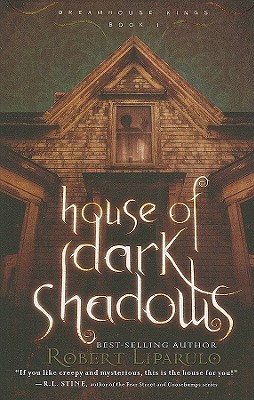 House of Dark ShadowsBy Robert LiparuloThomas Nelson, 2008
A couple of weeks ago, my little town’s tiny gem of a library—always on the alert to get kids addicted to books anytime, anyhow—got in all six books in Robert Diparulo’s Dreamhouse Kings series and displayed them prominently in its YA section.
The series has been moving like hotcakes, the librarian told me. Curious, I put my name on the waiting list for House of Dark Shadows, which starts the series. (And, yes, there was a movie of that name back in 1970, based on the 1960s horror soap “Dark Shadows.” Which spun off into yet another movie this year, starring Johnny Depp.) (Which wasn’t so hot, by all accounts.)
This House of Dark Shadows is definitely not great literature—it’s not even grammatical in places—but I can see the appeal. At thirteen, I would have been eating this up.
Fifteen-year-old Xander King reluctantly moves with his family from L.A. to the tiny Northern California burg of Pineville, where his dad will be the high school principal. In spite of himself, he’s intrigued by the dream house the family moves into: a spooky old manse full of noise distortions, mysterious footprints and, you guessed it, dark shadows.
We already know the house is bad news, because we’ve been treated to a prologue in which a gigantic, sweaty guy carries a struggling woman down a long hallway, pursued by her young sons. Easily repelling their desperate attempts to rescue their mother, the man carries her through a door into a place full of bright light. The door slams behind them, “separating her from her family forever.”
Prologues, I’m told, should be used sparingly. But this one packs a punch: From chapter one on, you’re alternately waiting for the explanation and urging Xander and his younger brother to be much more careful as they explore the house.
Liparulo ups the ante early on, when Xander learns that the house has been unoccupied ever since the mother of the house disappeared thirty or forty years ago, followed by her husband and children. Town lore says the husband reacted to his wife’s disappearance by spiriting the kids away someplace, killing them, then taking his own life.
Xander and family do experience the house’s weird capabilities, and we do get the beginnings of an explanation for it all. But only the beginnings. One frustration of this book is that it is little more than a prologue itself, with a conclusion that barely justifies the term. This struck me as both cynical and lazy, to tell the truth.
Still, House of Dark Shadows is a page-turner, and probably a gem for reluctant readers. Although it’s classified as “young adult”—Amazon has it as age 13 and up—I didn’t see anything in here that would put it out of the reach of a middle-grade reader who could withstand the Goosebumps series.
I almost put this book down halfway, because the writing wasn’t that great and the characters were okay but not hugely compelling. It was the mystery of the house that kept me going, and may even get me into the next book.
Drat you, Robert Liparulo.

June 6, 2012
June Book Review Club
Click icon for morebook review blogs
@Barrie Summy
I'm not even apologizing anymore for being a bad blogger. I yam what I yam.
Speaking of yams, here's a book about bunnies. (Yes, I know that makes no sense. There's a reason I don't blog more.) Don't forget to click the icon for awesome reviews!
 Watership DownBy Richard AdamsMacmillan, 1972
CHARLOTTE’S WEB is delightful, and I re-read THE INCREDIBLE JOURNEY more than once in my far-off youth. On the whole, though, I’ve always avoided animal books. In my view, any book that dresses a toad in a waistcoat is best used as a bookend. (Yes, I do mean WIND IN THE WILLOWS.) (Not Pooh, though…he's a stuffed animal, which is A-OK with me.)
And so it happens that—even though it’s the favorite book of a wide variety of friends and relations (Yep. A rabbit joke)—I have only recently read WATERSHIP DOWN. Or, more accurately, listened to it on an MP3 player.
I always figured this was one of those charming books about bunnies nibbling clover under halcyon skies, raising their glossy heads only to spout a Zen koan.
I was wrong. As a result, I have spent forty forlorn years not knowing that hraka is Lapine for excrement, and that tharn is an economical synonym for that “deer in the headlights” look George W. Bush used to get when speaking to us from the Oval Office.
This is truly exquisite world-building. The rabbits of WATERSHIP DOWN have names and a language and culture. But theirs is a rabbit’s world, not a human one. It’s utterly true to itself —these rabbits know only what real rabbits would know, with nary a waistcoat in sight.
The book was born as a bedtime story for Richard Adams’s children, who eventually challenged him to write it down. While he was doing so, he watched rabbits and consulted an expert on rabbity behavior. He learned how wild rabbits react to weather, food, danger, and one another, how and why they build their warrens, how they treat their ills and communicate their needs. From that knowledge, he built a society.
True, the rabbits talk to one another, using a language called Lapine. There’s also a halting common language that enables rabbits to communicate with birds and other animals.
And true, the story may be a bit less than lapinesque. A prescient young rabbit named Fiver gets intimations of disaster, but cannot convince his head rabbit to evacuate the warrant. As a result, Fiver and his cousin Hazel—the book’s hero—lead a small band of exiles out of the burrow and off to follow Fiver’s sixth sense to a new home. They fight off enemies, figure out how to float across rivers, and launch a quest for does to complete their new warren.
Their adventures take them to a couple of warrens that do not operate according to rabbits’ natural law. One is corrupted by the influence of men, and one under the sway of a rabbit dictator—probably the most unlikely departure from reality.
But by the time we confront these anomalies, we’re so comfortable in the rabbit world that we completely believe the proceedings while understanding how very unnatural these deviant warrens are.
Having won our trust, Adams makes it believable when Hazel and others spring a pair of does from a rabbit hutch. It’s even okay (sort of) when Hazel launches something like a United Nations peace initiative with other species.
I know when I’m wrong. Now, on to THE ART OF RACING IN THE RAIN.

May 2, 2012
May Book Review Club
Click icon for morebook review blogs
@Barrie Summy
Okay, so this isn't about Ghana. And yes, I have experienced an entire blog-free month. I've been writing, see, and ...
*sigh*
Be sure to click the icon above for more reviews!
 An Abundance of KatherinesBy John GreenDutton Books, 2006
This is my first John Green book, after hearing about him incessantly for the past couple of years. He’s got a new YA novel out, THE FAULT IN OUR STARS, that’s being celebrated right and left. Before I sank my claws into it, I felt a compulsion to read one of his earlier efforts.
AN ABUNDANCE OF KATHERINES won a 2007 Prinz Honor and was a finalist for the LA Times Book Award. It deserved the recognition. Green did everything right: Compelling protagonist with interesting afflictions; a sidekick who is a funny, endearing guy as well as an observant Muslim (five years after 9/11, this was a godsend, so to speak); an offbeat setting; and a love interest with problems of her own.
Plus, there’s the voice. No wonder the young world is overrun with Nerd Fighters, rabid fans of the vlogs Green issues twice a week with his brother, Hank. Green is funny in that intelligent, geeky way that gets under the skin of black jeans wearers everywhere. You can almost see the narrator of this book pressing his glasses to the bridge of his nose and holding court at Starbucks.
On behalf of protagonist Colin Singleton—a child prodigy who just graduated from high school and fears the rest of the world is catching up with him—the narrator laments that one seldom sees a want ad like this:
Prodigy
Huge, megalithic corporation seeks a talented, ambitious prodigy to join our exciting, dynamic Prodigy Division for summer job. Requirements include at least fourteen years’ experience as a certified child prodigy, ability to anagram adeptly (and alliterate agilely). Fluency in eleven languages. Job duties include reading, remembering encyclopedias, novels, and poetry, and memorizing the first ninety-nine digits of pi.
That ad’s a fair description of Colin’s talents. What it does not say is that, starting in third grade, Colin has been dumped (more or less) by nineteen girls named Katherine. Our story begins just after Katherine XIX has followed precedent. With a summer to kill before college, Colin and his best friend, Hassan, set out from Chicago for a road trip. Hassan is a funny, “rather fat, hirsute guy of Lebanese descent” who never misses Judge Judy and isn’t sure he wants to exert the energy required to enroll in college.
They end up in Gutshot, Tennessee, whose major tourist attraction is the supposed final resting place of Archduke Ferdinand’s disinterred remains. They take up with Lindsey, whose supposedly wealthy mother owns the factory that has kept the town going for generations. Hired to do an oral history of the town’s inhabitants, they move in with Lindsey and her mother. The summer’s revelations include a boar hunt and fisticuffs with Lindsey’s football star boyfriend.
Throughout it all, fearing that he’s a failed prodigy who will never “matter,” Colin slaves to prove a mathematical theorem that explains every one of his Katherine experiences and, he hopes, predicts the future of any and all love affairs. (Hey, there’s a Game Theory, right?) His goal is a workable Theorem of Underlying Katherine Predictability. Lindsey helps in several ways. I’m not saying any more.
Although the novel is firmly footed in reality, some of its events drift deliciously close to magical realism. It has the polarized atmosphere you get with one of those lomography cameras—real, but slightly off.
I’m hooked.


