Holly Walrath's Blog, page 8
October 5, 2022
NaNoWriMo: The Ultimate Preptober Checklist
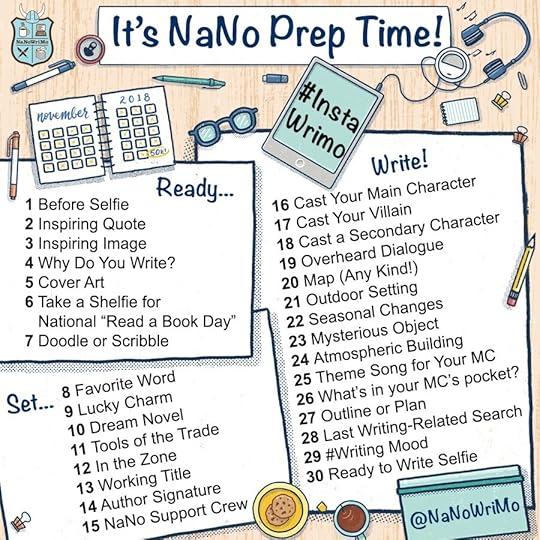
Everything You Need for a Perfect November to Smash Your Word Count Goals


October 3, 2022
HAUNT and the Halloween Haunted House

When I was a kid growing up in the 90s, I was obsessed with Halloween. I trick-or-treated right up until age 14, which I remember vividly as my last Halloween — I finally realized I was too old for the practice.
I grew up in a small town in Texas. Halloween was a big deal in our town, mostly because, as a conservative religious community, Halloween was the one chance kids got to explore otherwise taboo subjects — horror movies, sexy dress-up, and the supernatural (including the forbidden topic of witchcraft.)
In our neighborhood, an older couple put up a backyard haunted house every year. I remember walking through their back gate, and they would have a short, gruesome show every fifteen minutes or so. The wife would pretend to rip out her husband’s guts, or a spooky witch would brew body parts over a smoke-machine-fueled cauldron. Other neighbors set up haunted houses in their houses, complete with snacks, drinks, and games. On other Halloweens, there would be a haunted “maze” set up in the park across the street from my house. It was in line for this haunted maze that I met some of my best friends.
One year, my friends and I went out to a haunted trail in the woods. It was a full production. I’ve always been fascinated with how the haunted-house-as-show works. Inherently, it’s about suspending your disbelief for long enough to get a good thrill. The fun is in knowing that while you may experience fear for a short time, in the end, you will get out safe.
https://medium.com/media/a5f96934f2777ffa7aa6ea55a558f722/hrefWhich is part of why I loved the movie Haunt (2019) so much. Streaming now on Shudder, Haunt follows a group of college students as they enter, and try to escape from, a haunted house on Halloween. This isn’t your standard neighborhood haunted house, but more of a torture chamber. It shadows the recent phenomenon of “extreme” haunted attractions.
One such real-life haunt is McKamey Manor in Summertown, TN. It claims to be so extreme that no one has ever finished the experience, despite promises of a $20,000 prize. In order to enter, participants must sign a 40-page waiver, pass a drug test, have a completed sports physical and doctor’s letter, present proof of medical insurance, pass a background test, and be screened via social media. Not to mention that to enter, you have to watch a two-hour film featuring people who went into the house telling everyone how much they regret the experience.
The haunted house is so controversial that a petition to close it on Change.org gathered hundreds of thousands of signatures. Petitioners argue that the haunted house is merely a torture chamber, and other rumors state even worse claims of the show-runners hiring felons or sexually assaulting guests.
https://medium.com/media/3a3b77fd24cbf0285a0bd69fafa56a67/hrefHaunt takes this context and combines it with the horror tropes of Halloween to devastating effect.
The movie opens with Harper (Katie Stevens) and her roommate Bailey (Lauryn McClain) at home. Someone smashes a pumpkin on their doorstep, and Bailey immediately knows that it is Harper’s boyfriend, who is abusive. We learn that Harper, who will be our final girl, is not only dating an abusive boyfriend but that her father was also abusive to her mother. This ultimately becomes the emotional thrust of the film that drives Harper to survive.
The friends gather after a night of partying to find a “haunt” (the filmmakers tried hard to slide the name of the movie in, but it was a bit heavy-handed). They stumble upon a haunt in the middle of nowhere after Harper is convinced they are being followed. After signing a waiver and handing over their cell phones, the group of friends follows a creepy clown-masked man into a labyrinthian haunted house in an abandoned warehouse.
The film slots characters into standard horror movie roles. Harper is the “different” final girl who is dating an abuser but finds herself falling for the jock, Nathan (Will Brittain). Andrew Caldwell does a fantastic job as comic relief in the character of Evan. The two other girls include Lauryn McClain as Bailey, who could be said to fall into a somewhat stereotypical “brown girl best friend” role but truly steals the final scenes of the film, and Schuyler Helford as Mallory.


Each character is given a plausible backstory for them to work through as they encounter more and more terrifying aspects of the haunt. None of the friends abandon each other, and all are depicted as fairly decent human beings, which is refreshing for a genre that usually devolves into characters leaving each other high and dry (or hung somewhere by their flesh).
The movie is very self-aware and meta, but this works given the premise and never feels overdone. Old Halloween chestnuts like the “stick your hand in a hole and guess the object” game and the “roomful of creepy mannequins” are expected but subverted.
As the friends navigate the haunted house, the delight in watching the film is the creativity put into the set design. Similar to most extreme haunted houses, each room is themed and has a different horrifying methodology. Reminiscent of other gorefest films like Saw (2004) and Hellhouse LLC(2015), the characters must solve an escape-room mystery to get out of each haunted house area.
What I enjoyed about the film is how it slowly unravels, letting us see behind the scenes as the characters break into the fourth wall of the haunted house, where the demented showrunners are pulling the puppet strings. Not only is the house not what it seems, but the masked “workers” of this hell house are also a surprise.
In my opinion, the villains here are the best kind because their motives are unclear and never explained in the film. The most terrifying of monsters is that which we don’t understand. And so, I was pleased that the writers chose not to explain why the baddies do what they do here. Like other horror classics such as Texas Chainsaw Massacre (1974), we don’t need a nuanced backstory of the villains to be scared as viewers. Leaving it unexplained adds tension to the film that is rarely explored in horror these days.
Haunt has some truly creepy and horrific moments. I went into watching it expecting a half-hearted Halloween flick and was surprised at how many twists and turns the film gives viewers. The setup does a fantastic job of laying out the story and then subverting viewers’ expectations. There’s gore here, but it’s not unwatchable. (I only had to hide my eyes in a few scenes!)
Ultimately, the film also does a fantastic job of exploring the final girl trope. Harper is not just a good girl trying to survive — she is strong, capable, and enjoyable to watch figure out the mysteries of the haunt. The past abuse narrative and abuse-cycle tropes work well here to give Harper a deeper past and a satisfying ending. I enjoyed how the film depicted Harper as being able to survive because of her past history as a survivor, a connection most horror filmmakers don’t put together.
In the end, Harper flips the script and makes the villains of the film go through what she went through. As one commenter said on a video for the real-life haunt McKamey manor, “I’d love to see him go through his own game.” Part of the satisfaction of this is seeing the bad guy feel the same fear in retribution.
Haunt takes the haunted house and explores all the psychological trauma necessary to put yourself in danger and then find a way out of that danger. In the end, that’s why we’re so interested in haunted houses as humans. We all have some shadowy past that we need to escape from.

Interstellar Flight Magazine publishes essays on what’s new in the world of speculative genres. In the words of Ursula K. Le Guin, we need “writers who can see alternatives to how we live now, can see through our fear-stricken society and its obsessive technologies to other ways of being, and even imagine real grounds for hope.” Visit our Patreon to join our fan community on Discord. Follow us on Twitter, Facebook, or Instagram.
[image error]HAUNT and the Halloween Haunted House was originally published in Interstellar Flight Magazine on Medium, where people are continuing the conversation by highlighting and responding to this story.
September 28, 2022
Seductive Romantic Thriller DECISION TO LEAVE Steals Hearts

One of my favorite tropes in the mystery genre is when the detective ends up falling for his suspect, and in particular, a female suspect. There’s something entrancing about women killers in film — if only because they are so rare.
Decision to Leave (Moho Film, 2022) is the story of detective Hae-joon (Park Hae-il), who is investigating the death of a climber. When he interviews the dead man’s wife, Seo-rae (Tang Wei), he immediately suspects her for her calmness. Hae-joon begins to fall in love with Seo-rae as he stakes her out, watching and recording her every detail in what will become a sordid affair that tiptoes the lines of propriety — not because Hae-joon is married, but because Seo-rae may be a killer.
https://medium.com/media/bfb61380326bda1fc635f8d20cb82165/hrefThe film is softer than fans of Park Chan-wook may be used to, but it’s infused with elegance and a sardonic, tongue-in-cheek humor that is a delight to watch. The film is also beautifully shot and has a wonderful soundtrack. In short, it is a lovely film to watch and enjoy.
In the screening I saw, the director encouraged the audience to laugh, saying that sometimes audiences aren’t sure if they should laugh given the serious nature of the film. What seems like a basic detective mystery on the surface unfurls into an evocative and charming love story.

The romance is one step forward, two steps back. First, we’re convinced Seo-rae is innocent, then we’re not sure, then we realize she must be guiltless, and so on.
Park Hae-il is convincingly earnest and captivating as a romantic male lead. The slow-burn affair captures why murders are so captivating to audiences. Love is just one step away from obsession. Tang Wei is arrestingly beautiful and carries most of the humor with sharp attention to timing.
All of this adds up to one of the most self-aware thrillers I’ve seen.
While there is much to enjoy here, ultimately, the ending fell flat for me. It was actually quite haunting and depressing. I won’t give it away (you must see this film!), but lets’ just say in a movie that seems to be about a woman finding agency after abuse, it’s truly tragic that the filmmakers went the direction they did for the ending. I wanted something more for Tang Wei’s character.
Decision to Leave is poetic and poignant but holds a disturbing conclusion.
 Park Chan-wook, Image Courtesy Fantastic Fest
*This article is part of our coverage of the 2022 Alamo Drafthouse Fantastic Fest film festival. We thank the Drafthouse for providing us with press access to the festival.
Interstellar Flight Magazine publishes essays on what’s new in the world of speculative genres. In the words of Ursula K. Le Guin, we need “writers who can see alternatives to how we live now, can see through our fear-stricken society and its obsessive technologies to other ways of being, and even imagine real grounds for hope.” Visit our Patreon to join our fan community on Discord. Follow us on Twitter, Facebook, or Instagram.
[image error]Seductive Romantic Thriller DECISION TO LEAVE Steals Hearts was originally published in Interstellar Flight Magazine on Medium, where people are continuing the conversation by highlighting and responding to this story.
September 27, 2022
Indie Comedy UNIDENTIFIED OBJECTS Understands Intersectionality
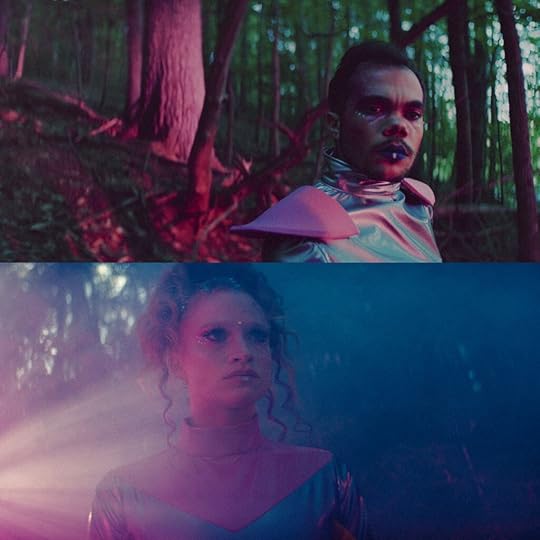 Images Courtesy Unidentified Objects Film, LLC
“Only the language of dreams and fantasies can capture how I (and so many others in this melting pot world) feel. Immigrants and other outsiders share a liminal space together. Neither here nor there.”
— Juan Felipe Zuleta
Every once and a while you come across a film that breaks you open in the best of ways, and for my trip to Fantastic Fest in Austin, that film was Unidentified Objects (Juan Felipe Zuleta, 2022).
The film follows the story of Peter (Matthew August Jeffers), a gay little person dealing with chronic pain and illness, as well as depression after the loss of a friend. When the not-your-average-girl-next-door Winona J, J for Jordan (Sarah Hay) convinces Peter to drive her to Canada, he knows her reasons are disengenous but agrees to go out of economic necessity, since he’s struggled to find work lately.
Peter loves Anton Chekhov, which I’ll forgive (I’m only kidding), and thinks of himself as intelligent, perhaps too intelligent for the world he’s forced to be a part of. He’s also cranky, unsentimental, realistic, and a delightful character to watch the talented Matthew August Jeffers bring to life on screen. This plays well against the starry-eyed, hopeful, and somewhat trashy-yet-loveable Winona, a sex worker who is convinced she has been abducted by aliens.
What follows is an unexpectedly heartbreaking road trip through the strange and magical.
As Peter encounters more and more bizarre phenomena, including manipulations of reality (or fantasies, depending on your interpretation), his character begins to open up both in mindset and emotion. Peter’s daydreams become vivid magical realism sequences where he acts out his desires.
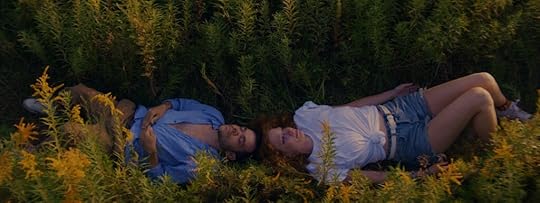
Colombian filmmaker & commercial director Juan Felipe Zuleta does a fantastic job managing the speculative elements of Unidentified Objects — which could be interpreted as metaphor (two outcasts find acceptance by identifying with non-human entities) — but the filmmaker chose to respect the genre and avoid the kind of bait and switch common in low-budget scifi films.
The result is a heartfelt, hilarious, and arresting exploration of intersecting identities in the face of a harsh world. Oh, and lots of beautiful shots with magical bisexual lighting and Rocky-Horror-esque costumes.
The film was created by a first-generation American immigrant and is one of the few films in history to feature a little person in the lead. It was also made by a diverse crew in the height of the pandemic.
The soundtrack perfectly mixes punk and space music and was created in collaboration with lead actress Sarah Hay. Queer musical icon Perfume Genious contributed songs to the film, as well as an analog synthesizer by Sebastian Zuleta. Indeed, every aspect of this indie film was a collaboration, from the writing to sound to cinematography.
In the screening I watched, the director emphasized the importance of highlighting diverse characters. “We were asking ourselves: What characters have we never seen as the lead in a movie? Whose lives need to be lived on the silver screen?”
Matthew August Jeffers, who says that he draws inspiration from actors like Peter Dinklage of Game of Thrones fame, gives absolutely bar-none one of the most nuanced and delightful performances of the year. One of my favorite scenes is when Peter explains himself to Winona as “a circle within a circle within a circle.” It’s a poignant way of describing intersectionality: As a gay man, and a little person, and a person with a disability, Peter’s identity is a constant struggle to him. As the circles get closer and closer, it’s easier to feel more and more removed.
Intersectionality asks us to look at multiple aspects of marginalization. Usually, it’s described as a pyramid — the least marginalized people are at the top. But this image has always struck me as less fluid. Both Peter and Winona are characters struggling to come to grips with different levels of being an outcast. They are trapped in these circles of identity.
“Only the language of dreams and fantasies can capture how I (and so many others in this melting pot world) feel. Immigrants and other outsiders share a liminal space together. Neither here nor there.”
— Juan Felipe Zuleta
Matthew August Jeffers was born with a form of dwarfism so rare that it was initially only referred to as “Matthew’s Disease.” Jeffers does not approach the character with kid gloves, and he was responsible for convincing the director to go the full distance with one of the key scenes in the movie, which I won’t spoil, but I will say it is an extremely vulnerable moment on screen.
“Aside from Unidentified Objects, every part I have played on stage and screen was written for a person of average height,” says Jeffers. “I’ve always had to go into the audition room and change a director’s mind about how they see a role. But this project marks a change for me and for all of us in the LP community. So I’m here with my shovel to try and pave the way for others as much as I can.”
I can say, Matthew, you succeeded.
This one made me smile to watch, and I hope it gets bigger distribution.
After world premiering at 2022 Inside Out, the film won awards this summer at Frameline and Outfest LBGTQ+ film festivals. Fantastic Fest 2022 marks its Texas premiere.
*This article is part of our coverage of the 2022 Alamo Drafthouse Fantastic Fest film festival. We thank the Drafthouse for providing us with press access to the festival.
Interstellar Flight Magazine publishes essays on what’s new in the world of speculative genres. In the words of Ursula K. Le Guin, we need “writers who can see alternatives to how we live now, can see through our fear-stricken society and its obsessive technologies to other ways of being, and even imagine real grounds for hope.” Visit our Patreon to join our fan community on Discord. Follow us on Twitter, Facebook, or Instagram.
[image error]Indie Comedy UNIDENTIFIED OBJECTS Understands Intersectionality was originally published in Interstellar Flight Magazine on Medium, where people are continuing the conversation by highlighting and responding to this story.
September 26, 2022
Indie Film THE ANTARES PARADOX Is a Love Letter to Women in STEM
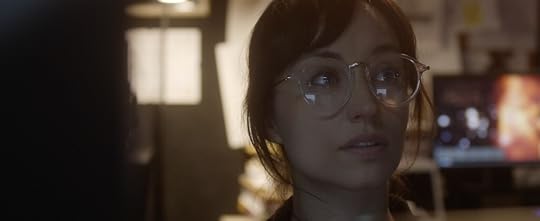
Women are often overlooked in STEM. Even beyond careers in science, women are told they are too dedicated to their professions — whether it be as lawyers, doctors, or creatives. It Is far less likely for a woman to be accepted for choosing work over family. This judgment comes from all sides — and Alexandra’s struggle with it feels particularly fitting.
Lately, I’ve been thinking about how much we lost during the pandemic. I feel that my emotional capacity to manage trauma has severely diminished. And there’s really no looking back — we are at a moment where we can’t change what has happened to the world. Most of us will never be the same, and that can be said of our advances in science too.
A few years before the pandemic, I lost my father to Parkinson’s disease. I had a very clinical view of it that upset my family. In his last months and years, my father lost his ability to speak. His cognitive function was severely impacted. To me, the father I had known was already gone. It seems very cold — but I felt like the only person who had accepted the reality of the situation. Being a logical person is often difficult because to those who live with their hearts on their sleeves, those of us who manage emotions in different ways seem like automatons.
We all manage grief differently, and there is no wrong way to deal with this emotion. I’m not even sure I would call it an emotion — more of a series of emotions strung together to form the phenomenon of grief.
During the pandemic, grief was multiplied by the fact that most people couldn’t visit their sick or dying loved ones. Deathbed calls became the norm. An elderly neighbor of mine was unable to hold a funeral for her husband and fell into depression after losing her volunteer job, the only thing that got her out of the house. When my spouse’s father died in 2021, we hadn’t seen him in two years.
In this context of a world dealing with the grief of a two-year pandemic that we’re told is over comes the heartwrenching indie film The Antares Paradox (Onirikal Studio, 2022).
https://medium.com/media/da7064fdbbda700a6ac541aa52d91fe2/hrefThe film follows Alexandra (Andrea Trepat), a researcher at the made-up observatory of the Spanish arm of SETI (The Search for Extraterrestrial Intelligence). Alexandra is dedicated in her job as a scientist to discovering whether there is life beyond Earth, but the world is against her. Her fellow researchers mock the work she does. Her workplace is slowly losing funding. And even her coworkers are quitting. Not to mention that her family doesn’t understand why she’s so obsessed.
When Alexandra discovers a signal from space, she begins the involved multi-step process of verifying its origin and authenticity. This is the breakthrough she’s been waiting for her entire professional life, and it becomes threatened over and over again by an incoming storm, her irate boss, and technical malfunctions.
The film does a fantastic job of maintaining tension throughout, with more and more escalating problems and conflicting choices Alexandra has to make. The audience is trapped with her, forced to think through her decision-making, and thus it creates an empathetic experience.
Alexandra learns that her father, sick in the hospital, is dying. She has to choose between going to see her father in his dying hour and finding out whether there is life on other planets.
It’s summed up by a question Alexandra gets asked in an interview: If you could choose to either cure cancer or prove that there is extraterrestrial life, which would you choose?
This is a choice Alexandra is forced to make over and over again as the film progresses. Over and over again, we watch her choose science — and not just science, but the acceptance that there is a bigger world out there. That we are not alone.
Of course, when it comes to grief, there are no binary choices.
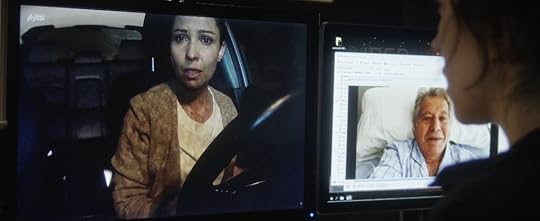
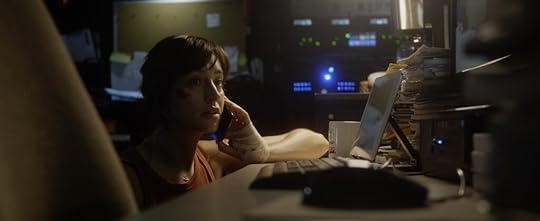
The Antares Paradox was filmed entirely in one room, the SETI observatory that the director created himself. It is an entirely self-funded film, produced, written, and directed by (Name), who works in special effects.
This one-room aspect of the film adds complex dimensionality to how it feels as a viewer. Despite being shot in closeup in a tiny space, the film never feels claustrophobic. In the screening I attended, the director Luis Tinoco explained that he shot the film himself. The director put his life savings into the film, which was shot entirely in one location for three weeks on a GH5 $300 camera. The casting was done in the director’s hometown and was limited by cost. Despite these aspects of the film’s creation, it absolutely does not feel like a low-budget film.
Luis Tinoco explains that he spent over ten hours of video calls with some of the best astronomers in Spain to ask them questions about their work. This research makes the film feel authentic and believable, even though there isn’t truly a set protocol for Outerspace transmissions. The filmmaker had these astronomers send him screenshots of the software they use so it would feel real.
Everything in this movie is authentic— from the faux software that is based on real-life software to even the phone and video calls Alexandra receives. Actors in sound studios made these actual calls in real-time, which gives the leading actress the opportunity to truly embody this character. The director also explained that he had Andrea Trepat learn what every switch and button did on set so it would feel more authentic.
This is also a “real-time” movie. As the clock counts down for Alexandra to authenticate the signal coming from Outerspace, the clock in the SETI observatory literally counts down to the second. Most of this was special effects — the film contains 535 visual effects shots.
The Antares Paradox is a movie for creatives and obsessives, those of us who love our jobs but can’t explain that love to our families. The director spoke about how, when it came to casting, he didn’t care if the lead role went to a woman or a man. But to me, the fact that Alexandra is a woman adds another dimension to the character.
Women are often overlooked in STEM. Even beyond careers in science, women are told they are too dedicated to their professions — whether it be as lawyers, doctors, or creatives. It Is far less likely for a woman to be accepted for choosing work over family. This judgment comes from all sides — and Alexandra’s struggle with it feels particularly fitting.
For me, the film was an emotional roller coaster. The night my father died, I was in Houston and couldn’t make it to see him. We were in the middle of moving, and the moving van was coming in hours. I never felt guilt for this because I knew my father was already gone. The amount of judgment and criticism women get for how they react to grief is far too common. We are taught to be caretakers but never carers of our own grief and personal agency.
The Antares Paradox is a gut punch of a movie. I can only hope it gets brought to the big screen or streaming soon because it’s one of the best movies I’ve seen in a really long time.
*This article is part of our coverage of the 2022 Alamo Drafthouse Fantastic Fest film festival. We thank the Drafthouse for providing us with press access to the festival.
Interstellar Flight Magazine publishes essays on what’s new in the world of speculative genres. In the words of Ursula K. Le Guin, we need “writers who can see alternatives to how we live now, can see through our fear-stricken society and its obsessive technologies to other ways of being, and even imagine real grounds for hope.” Visit our Patreon to join our fan community on Discord. Follow us on Twitter, Facebook, or Instagram.
[image error]Indie Film THE ANTARES PARADOX Is a Love Letter to Women in STEM was originally published in Interstellar Flight Magazine on Medium, where people are continuing the conversation by highlighting and responding to this story.
September 25, 2022
Japanese Film MISSING Surprises with Its Take on the Serial Killer Genre
TW: This review contains discussions of depression, suicide, and abuse of people with disabilities.
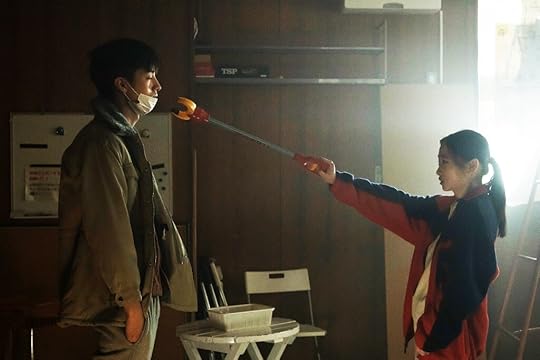
MISSING (Fortissimo Films) is the directorial debut of Katayama Shinzo, a former assistant director of popular Korean filmmaker Bong Joon-ho of Parasite fame. It follows a father named Santoshi (Jiro Sato) who is trying to provide for his daughter Kaeda (Aoi Ito) after the death of her mother (Toko Narushima) from ALS.
In the midst of this family drama comes the film’s villain, a serial killer called “No Name” (Hiroya Shimizu), who draws the family into his web of horror.
Missing opens with a haunting bit of foreshadowing, in which depressed father Santoshi Hirada practices using a small sledgehammer in a courtyard. It is only at the end of the film when the audience learns the true horror of this image.
When Santoshi goes missing, his daughter sets out to find him in less-than-ideal circumstances. Everyone around her abandons her one by one, from a school boyfriend to a teacher. Society has branded her father as an outcast because he is unemployed and commits petty crimes (or so it seems.) Kaeda ultimately falls into the path of the serial killer No Name while searching for her father.
All of the actors in this movie are fantastic. Jiro Sato is a heart-warming father figure, and Aoi Ito is sharp and funny as his daughter. Hiroya Shimizu is satisfyingly equal parts evil and hot as the calm, detached serial killer No Name.
No Name’s modus operandi is to lure depressed women to him so that he can “help” them complete suicide. He targets his victims through social media. No Name believes he is doing the world a service by removing those with depression or disability from it, as he says, “There are some people in this world that want to die. They want to, but they can’t express it.”
The film draws heavily from the serial killer trope in horror, mixing quirks like No Name’s obsession with classical music, a la Hannibal Lecter, and real-life stories of serial killers in Japan.
The character is likely based off of Japanese serial killer Takahiro Shiraishi, who in 2017 killed nine people, including three high school age girls. Shiraishi would lure women to his home after meeting them on Twitter, where he went by the username hangingpro. He would strangle his victims and then dismember them, keeping their bodies in freezers and storage boxes.
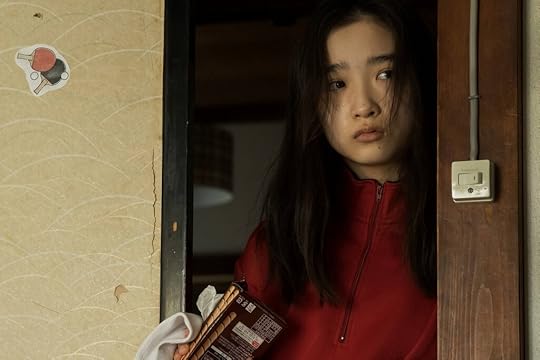
Alert: Spoilers ahead!
This thought-provoking film is full of twists and turns that challenge the serial killer genre in horror with a fascinating exploration of grief, disability, and the moral ambiguity of human desire.
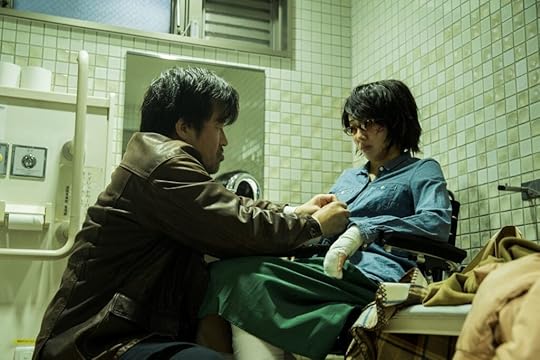
We learn that Santoshi’s wife and Kaeda’s mother was disabled and that Santoshi’s depression is related to the loss of his wife. As her sole caretaker, the burden of caring for her becomes too much for Santoshi to bear. The film flashes back in time several times, showing us the backstory and unraveling the audience’s expectations.
Ultimately, the film struggles to add nuance to its representation of chronic illness and disability, choosing to equate disability with a complete loss of autonomy and joy. While it paints Kaeda’s mother in an empathetic way, the complexity of the caregiver relationship is still represented as a “death is the only way out” deal.
For me, as a chronically ill person, every day is a struggle to put aside the failures of my body and choose joy. And yet, I can understand that not everyone is in a position to find hope. This is why we need better representation — to avoid the tragically disabled trope.
The final victim in Missing is portrayed as unique in that she chooses both death and, unable to commit suicide herself, becomes disabled in the process. So the film both looks at long-term illness and disability as a result of injury as equally soul-crushing circumstances. And while this may be true for some people in these situations (or perceived as such), for others, disability is absolutely not, nor should it be, a death sentence.
Setting this problem aside, I still think the film is worth watching for its management of these complex issues and for a different cultural outlook on them. While it is true that many people who are disabled struggle with depression and suicide, I think the film takes an extreme view of the matter. It highlights how there is far more risk for those who are disabled and without economic support.
Missing is a fascinating film with a deeply complex subject matter and fantastic acting. The viewer walks away feeling a deep sense of dread and disappointment — that the characters couldn’t do better for each other. Those struggling with depression should steer clear; they will find no hope here but plenty of retribution.
*This article is part of our coverage of the 2022 Alamo Drafthouse Fantastic Fest film festival. We thank the Drafthouse for providing us with press access to the festival.
Interstellar Flight Magazine publishes essays on what’s new in the world of speculative genres. In the words of Ursula K. Le Guin, we need “writers who can see alternatives to how we live now, can see through our fear-stricken society and its obsessive technologies to other ways of being, and even imagine real grounds for hope.” Visit our Patreon to join our fan community on Discord. Follow us on Twitter, Facebook, or Instagram.
[image error]Japanese Film MISSING Surprises with Its Take on the Serial Killer Genre was originally published in Interstellar Flight Magazine on Medium, where people are continuing the conversation by highlighting and responding to this story.
September 24, 2022
The Menu Is a Hilarious Satirical Takedown of Restaurant Culture
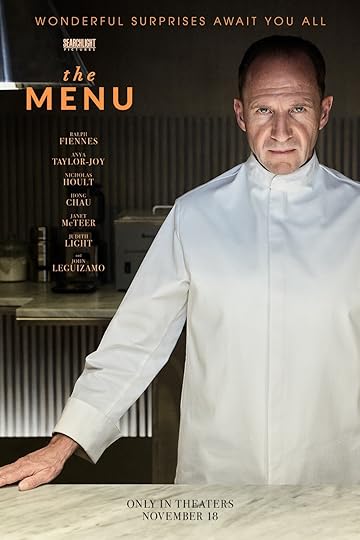
“The filmmakers craft a satire that’s as sharp as a knife, honing in on exquisitely bizarre details that only those familiar with restaurant culture will notice (or, you know, if you watch a lot of Iron Chef.)”
If you’ve never eaten at an avant-garde restaurant run by a Michelin quality chef, let me tell you the story of one I visited recently. Nestled in-between a small winery and the local biker bar T-Bone Tom’s in Kemah, Texas, is Eculent: An “experience” restaurant run by David Skinner that features upwards of 20+ courses over three hours.
There are certain weird hallmarks of such dining experiences. Diners are expecting to pay upwards of $400 or more per person, and if you have to ask how much it costs, you probably can’t afford it. The restaurant I visited featured all kinds of obsessive gastronomic fare — from edible air to flavored cotton candy to soup balls that melt in your mouth. The interiors of such restaurants are often intimate, with maybe 5–7 tables maximum. A different wine is served with every course, and the bottles are as expensive as they are outrageous. And the chefs who run such establishments are often a bit deranged themselves. It’s almost a badge of honor.
Now, there’s nothing wrong with enjoying such a restaurant. But I thought it was a pleasurable, albeit absurd evening. Did I enjoy every precocious minute? You bet your shaved ice and caviar I did. Would I go back? Probably not for a long while, and especially not after seeing the dark comedy THE MENU.
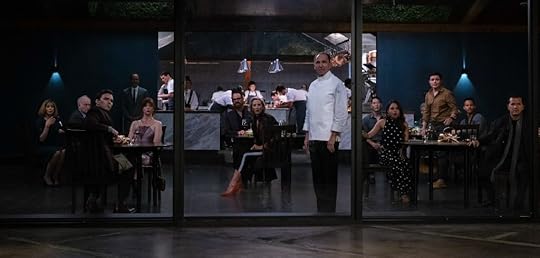
This kind of restaurant is the setting of director Mark Mylod’s latest film THE MENU (Searchlight Pictures), releasing November 18th, 2022, in the US. Ralph Fiennes plays Chef Slowik, a man who worked his way up in the restaurant industry to become one of the most elite chefs who lives and works on a private island serving up dinners at $1200 a head (ba-dum-cha).
When Margot (Anya Taylor-Joy) and Tyler (Nicholas Hoult) head to the island, the audience can assume they are a normal couple simply out on a very fancy date. But as we learn, for every diner on the island, everything is not as it seems. It quickly becomes clear that this experience is going to be one they won’t live through. In short, it’s as bloody as it is rare.
What follows is an absolute feast of satire. As the diners (and staff) are slowly picked off in a series of twists and turns, the filmmakers craft a satire that’s as sharp as a knife, honing in on exquisitely bizarre details that only those familiar with restaurant culture will notice (or, you know, if you watch a lot of Iron Chef.)
https://medium.com/media/20ef184c154461edf381897024d86821/hrefRalph Fiennes delivers a poignant performance as Chef Slowik, embuing what could be a pat villain character with subtlety and intensity that shines through as he delivers lines that take down the restaurant industry and its problematic culture. In one example, one of the cooks on his team admits that he came on to her and that when she refused, he didn’t speak to her for months, forcing her to work in humiliation. In another example, the sous chef admits to hating his job (and his life) because he will never be as good as Chef Slowik.
Psychological warfare in the form of toasted tortillas and a breadless bread course makes this film tense and yet watchable — for every uncomfortable moment of terror is a moment of pure joy at the ridiculous machinations of Chef Slowik’s terrible last meal.
At the screening I watched, the filmmakers were present for Q&A and remarked on Fiennes’ intensity. “He wasn’t only looking into my soul, he was looking into my unborn child’s soul,” one filmmaker remembers one of the actors saying.
The film is perfectly shot, perhaps because a three-star Michelin chef was consulted (Dominque Crenn, the only woman chef to earn such accolades), as well as food photographer David Gelb of the Netflix documentary Chef’s Table.
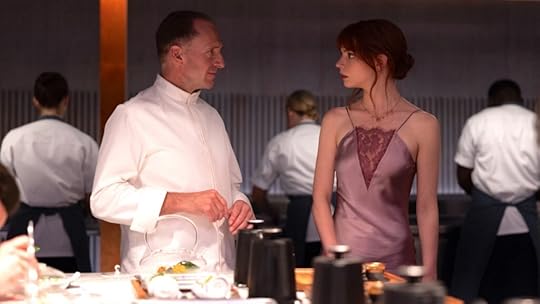
As per usual, Anya Taylor-Joy is delightful as a young woman who catches the chef’s eye because she “doesn’t belong.” She’s not above all this, she’s below it as someone from an average background who isn’t wealthy. Our final girl delivers street smarts and the ability to truly understand the megalomaniac's mind. It’s clear that the improvisation the actors put into the film makes this culinary gem far more appetizing.
I won’t get into the plot too much, as it’s better to come into this film without spoilers. But I will say that The Menu nails how over-the-top such restaurants can be and the people who frequent them. From the “regular” with a hidden past to the over-obsessed foodie fanboy, this movie understands the subject it destroys.
If you’re looking for a horrifically tasty movie that will make you rethink how you look at smores and change the phrase “taco Tuesday” forever, this is the film for you. Or you know, if you just want to watch a movie that’s basically Voldemort running a restaurant from hell.
*This article is part of our coverage of the 2022 Alamo Drafthouse Fantastic Fest film festival. We thank the Drafthouse for providing us with press access to the festival.
Interstellar Flight Magazine publishes essays on what’s new in the world of speculative genres. In the words of Ursula K. Le Guin, we need “writers who can see alternatives to how we live now, can see through our fear-stricken society and its obsessive technologies to other ways of being, and even imagine real grounds for hope.” Visit our Patreon to join our fan community on Discord. Follow us on Twitter, Facebook, or Instagram.
[image error]The Menu Is a Hilarious Satirical Takedown of Restaurant Culture was originally published in Interstellar Flight Magazine on Medium, where people are continuing the conversation by highlighting and responding to this story.
September 23, 2022
Two IFP Books Win the SFPA Elgin Award
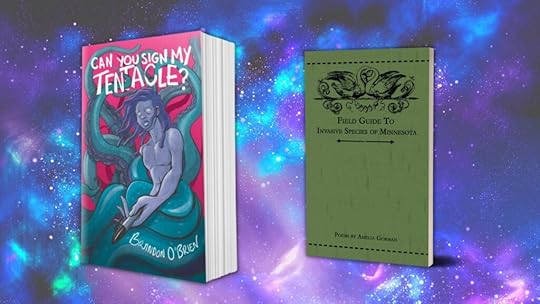
Interstellar Flight Press is delighted to announce that two of our 2021 poetry titles have won the SFPA (Science Fiction & Fantasy Poetry Association) Elgin Award for best full-length poetry book and best chapbook.
The Elgin Awards, named for SFPA founder Suzette Haden Elgin, are presented annually by SFPA for books published in the preceding two years in two categories, Chapbook and Book. Chapbooks must contain 10–39 pages of poetry and books must contain 40 or more pages of poetry.

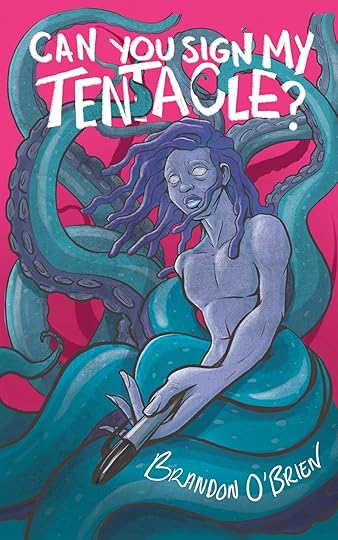
Cthulhu meets hip-hop in this book of horror poems that flips the eldritch genre upside down. Lovecraftian-inspired nightmares are reversed as O’Brien asks readers to see Blackness as radically significant. Can You Sign My Tentacle? explores the monsters we know and the ones that hide behind racism, sexism, and violence, resulting in poems that are both comic and cosmic.
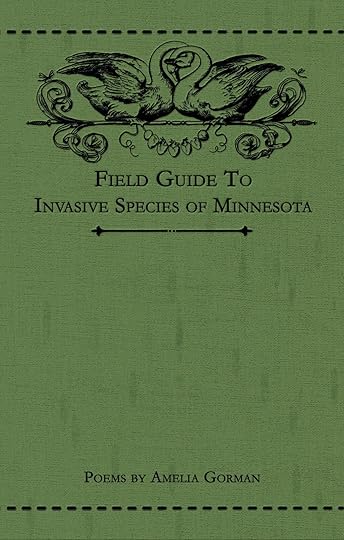
Gorman’s Field Guide to Invasive Species of Minnesota is a poetic journey into the strange and wonderful world known previously only to the wild. Take a walk through the woods of Minnesota, past the Salton Sea, into the high grass of the prairie, beyond the rivers and creekbeds, into a world of the near-future where nature rules all. After all, the biggest ecological danger of invasive species is the monoculture they create.
Congratulations, Brandon and Amelia![image error]Two IFP Books Win the SFPA Elgin Award was originally published in Interstellar Flight Magazine on Medium, where people are continuing the conversation by highlighting and responding to this story.
August 3, 2022
Armadillocon 2022 Schedule
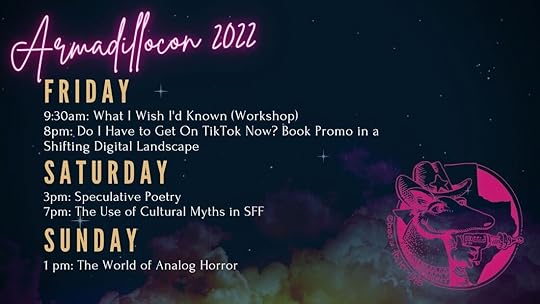 I'll be a guest at Armadillocon this weekend! Come say hi!
 I'll also be in the dealer room for Interstellar Flight Press!
May 23, 2022
The Smallest of Bones Nominated for the SFPA Elgin Award for Best Speculative Poetry Book
 “These tiny poems are large with insight, making me remember certain things I was sure I had forgotten. There’s a range of topics from love/romance, queer sexuality, religion, death, demons/ghosts, and more. Some of these poems will be ones I think of often. And one I already made a copy of and put it on my book cart. I want to look at it every day.” — Ladies of Horror Fiction
I’m honored that my first full-length collection of poetry, THE SMALLEST OF BONES, published by CLASH Books (2021) is nominated for the SFPA (Science Fiction and Fantasy Poetry Association) Elgin Award for best speculative poetry collection!
About The Smallest of Bones
A haunting ossuary of tiny poems covering a wide range of topics such as love, romance, relationships, queer sexuality, religion, death, demons, ghosts, bones, gender, and darkness. The Smallest of Bones guides those on an intimate journey of body acceptance, with sparse words dedicated to peeling back skin and diving bone-deep into the self. Raw, honest, and powerful, this collection is an offering to those struggling to find power in the darkness.
“Over the years, Walrath has easily cemented herself as Houston’s premiere horror poet, and The Smallest of Bones is her best work yet. Just watch out for splinters.” — Jef Rouner, Houston Press
I am also delighted that this book was picked up by Kipple Press — an Italian publisher who does beautifully translated versions of books from English to Italian. You can purchase an Italian version of this book from Kipple Press!
 Il più piccolo fra le ossa
Leggere la raccolta di Holly Lyn Walrath, “Il più piccolo fra le ossa”, mi ha fatto pensare alle mie ossa. In antropologia culturale si uso il termine “heritage”, da “heirs”, eredi. Le mie ossa sono i miei eredi e per la prima volta ho pensato a loro. E, grazie o per colpa loro, ho pensato non solo alla mia morte ma a ciò che accadrà dopo la mia morte. Ciò che accadrà della mia discendenza ossea.
Forse alla fine di questo libro servirebbe una pagina bianca. Un foglio in cui il lettore o la lettrice possano scrivere, o anche solo pensare di scrivere, delle loro ossa e lasciare una traccia. Lasciare una traccia su ciò che lascia una traccia.