Holly Walrath's Blog, page 15
November 26, 2019
Reluctantly Writing About Death

A year and a few months ago, my father died. Today, I signed a contract for a small poetry book on grief and dealing with my father’s death that is going to be translated into Italian and published in Italy. The world spins in weird ways, I guess.
Before my father died, I always looked on books about the death of a loved one in, I’ll admit, a pretty messed up and slightly dismissive way. I hated cancer memoirs, books that dived headfirst into the nitty-gritty details of death: bodies and hospitals and medicine and the grotesque humanity of grief. Also, there was a connotation with these books. When they were written by women about caring for loved ones, they often got lumped into women’s fiction, whereas a man writing about grief was somehow reinventing the wheel.
Read the full article on Medium . . .


November 14, 2019
New Poem Up at Space Cowboy Books Podcast: Confessions of a Supermassive Black Hole
 Confessions of a Supermassive Black Hole
You can’t escape my body.
I deform spacetime, invisible.
I collapse, even as everything surrounds me.
I am the center of you, of your galaxy.
I sieve particles, radiation, light,
searching for the ghost of my former self.
My gravity is also my weakness.
October 31, 2019
New post for Curious Fiction Subscribers: Handmade Rebellion: Dispatches from Zine Fest Houston and Women’s Radicalism
 I have a new early reveal post for subscribers at Curious Fictions. Last month I participated in Zinefest Houston — one of my favorite local events. In this event, local paper artists create zines to sell — small, hand-made, individual books, pamphlets, and other paper ephemera. I’ve participated twice and I always enjoy this well-crafted event (ba-dum cha). What I like about Zinefest is the audience. It’s mostly young people who are interested in meeting other writers and artists. It’s also one of the most diverse and well-attended events I go to every year. I always end up meeting some lovely folks!
Read the entire post here . . .
New Poem up at Medium: We Have Always Lived (Erasure of Shirley Jackson)
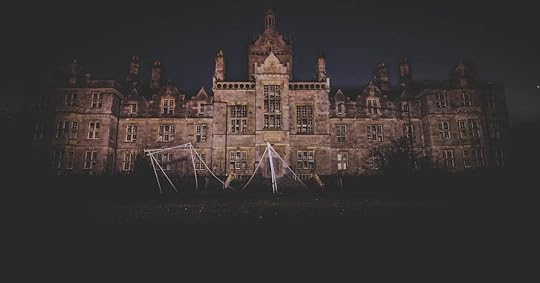 It’s my favorite day of the year, so I thought I’d share a poem from my back catalogue of published work. This poem is an erasure/blackout of Shirley Jackson’s book We Have Always Lived in the Castle.
In case you’re unaware of this form, erasures are a type of found poetry where you “erase” words from a found text and the words left behind form a poem.
Read the poem here . . .
October 27, 2019
New Poem at Apparition Lit: Belly of the Beast
I have a new poem in Apparition Lit #8 (October 2019) - Belly of the Beast. This one is kind of romantic, which I felt like fit the theme of the issue, Euphoria. What is euphoric to you? For me, it's being with the person you love in the weirdest place you can think of.
Let’s live in the belly of the beast.
You can bring a strong IPA
so smooth it’s like milk frothed.
I’ll bring Atwood and Ishiguro and Dickens.
We’ll watch Netflix in the blood vessels
and make love in the open mouth
with the krill and saltwater
pooling at our knees . . .
Read the entire poem here . . .
Add it to Goodreads
Buy it on Amazon:
Let’s live in the belly of the beast.
You can bring a strong IPA
so smooth it’s like milk frothed.
I’ll bring Atwood and Ishiguro and Dickens.
We’ll watch Netflix in the blood vessels
and make love in the open mouth
with the krill and saltwater
pooling at our knees . . .
Read the entire poem here . . .
Add it to Goodreads
Buy it on Amazon:
October 23, 2019
New Medium Article: NaNoWriMo Isn’t Just for Books
 November is National Novel Writing Month (NaNoWriMo), an online community and yearly event where writers make the goal of writing 50,000 words in 30 days. This year, I’m encouraging you to burn the frigging thing down.
Read how here . . .
October 17, 2019
Winning the SFPA Poetry Contest in 2 Categories
 Stellar news today! My poem "The Fox and the Forest" (an erasure of Ray Bradbury) is the winner of the SFPA: Science Fiction and Fantasy Poetry Association contest short form and my poem "The Mining Town," is the winner in the long form category! Very much bowled over by the judge's kind comments on my poems:
"Hybridity brings in endless possibilities when it comes to crafting and interpreting creative work, and these short pieces showcase the complexity of hybrid, speculative poetry."
"When the container for our work is expanded, there’s room to explore braided narratives. These longer poems convey multiple specific stories while still opening themselves up for the audience to imprint their own experiences onto the work."
 The Mining Town
by Holly Lyn Walrath
is all bric-a-brac now. Tourists cram into houses-turned-stores, drink beer on the corners from the new microbrewery in the old mill, buy sweatshirts that say “I mined the deep and all I got was this stupid shirt,” but few take the walk up there, into the hills. It’s better to stay down here, safe among the ghosts of houses, to plunder their wares with big white thumbs and buy things, there are always more things to buy in a ghost town.
What happened to this town?
The Church
bell rings at dawn and dusk. The men paint the white brick black and red roof black and burn the picket fence. They stand to survey their work, cigarettes dangling from their slack jaws, hands black with pitch. At home, they do not wash the darkness away with silver soap but place those hands on the bodies of wives and backsides of children and hips of back-alley lovers and blank pieces of paper longing for ink. You must remember, this was a different time.
Why did they paint the church black?
The General Store
at first sold normal goods. Tack and seed, hay and hen egg. Slowly, strange objects appeared upon the shelves. A single deer’s antler, painted gold. Ant farms, pre-made, the little red bodies within tunneling deeper and deeper. A dozen wooden tokens carved with other Gods. Silver machines, alien in origin. Jars of body parts. Flower buds encased in glass. Japanese swords. The souls of men disguised in clock faces. Irony. Joy. Peace, if you could afford it.
Where did the objects come from?
The Library
There is no library. It sank into the ground years ago. Perhaps an industrious young man might dig his way down, find it deep beneath the sod and worms, and crawl in through a back window, left open by the librarian on a summer’s day, to bring in a bit of the fresh mountain breeze, and there he might find her still, humming a bit, rocking in her chair behind the card catalog, waiting for someone to ask for a book.
Why is there no library?
The Abandoned Mine
The most prominent feature being the stores of abandoned ore. Some piled in carts like great mounds of jewels, other still half-buried in the walls, their shiny faces masks waiting to be removed and to reveal the monster within. Once, the ore was necessary to the planet’s deepest life, and once, it was necessary to human life. Now, it’s merely lonely. It creeps out in tendrils, seeding its jeweled body through the earth, down the path, to the town. It puts out feelers in tidy bed and breakfast gardens, a blue-flame flower here, a ruddy weed there, in with the wheat in the farmer’s fields and creeping through the cracks of the brick on the cobblestone streets.
Why is the ore no longer needed?
The Trail Leading Away from the Mine
is overgrown with brush and wing, birds hopping along moss-covered logs, blooming glens of clover where bunnies forage, deep tufts of ash from the death trees, who burn each night in twilight and then like the phoenix, regrow each morning. The ash is the bodies of those long gone souls—yet a bit of their yearning still remains. The fire is the mountain’s heart rained down. And every curse it whispers is made new again, every morning it awakes forgetting what it forgot.
Why do the trees burn?
The Tenement Roofs
are where the miners went to smoke, and sometimes drink, when their wives didn’t want them around, which was often. Their feet dangled over the edges, all in a row. They said nothing to each other, nothing, except to whisper, “You see the blue light?” and one would say in response, “Aye, I seen the blue light, down in the depths, I seen it.”
Who was the first to follow the light?
The Drummer Boy
used to play on the corner for ha’pennies, picking out a rhythm on his bone-cage banjo and tapping the beat with his foot on his man-skin drum. He made a deal with the devil before such things became unnecessary and then he got curious, and when a boy gets curious all hell breaks loose. He followed the men and picked out each one for the killing, and then ran to the bridge where the bats roosted to tell them the news. They listened, curious, and then swarmed out into the twilight on the hunt.
What were they hunting?
The Foreman
was afraid of the dark. He sent his men down to the caves and tunnels with only a canary and other men for company and he expected no philandering with either, but he never laid eyes on the ore in his own life time. He watched them leave his little cabin, one by one, walk up the trail and disappear into the maw, and he turned away, turned the crank on his music box, and listened to Clementine over and over again. Oh my darling, he sang, oh, oh.
Who gave the foreman his music box?
The Devil
tends the local pub. But he never seemed to have any purpose except to serve another round. He was lonely, dreadfully lonely. His lover died and he kept her picture over the till and dared any man to look upon it without weeping. He once lived in a brighter place, was once a wealthy man with bigger plans. But the devil didn’t realize that once he’d won out, he’d be bored. Now he poisons the well out back with his tears, only a few each night. It’s the least he can do.
Who loves the devil?
October 14, 2019
New Medium Article: Does Publishing Short Stories Matter?
 I have a new article up at Medium today on the economics of short fiction, how commercialism is changing what writers write, & a bit of advice from Shirley Jackson.
“The very nicest thing about being a writer is that you can afford to indulge yourself endlessly with oddness, and nobody can really do anything about it, as long as you keep writing and kind of using it up, as it were.” — Shirley Jackson (“Memory and Delusion,” Published in Let Me Tell You.)
Read the entire article here . . .
October 7, 2019
New Article at Medium: "Yesterday" As A Metaphor for the Creative Process
 What if you woke up tomorrow knowing without a doubt you could write a bestseller? Paint a picture worth a million dollars? Release an album that was guaranteed to go to #1 on the charts?
What would you do?
This is the question behind Yesterday, a charming movie that pays homage to the works of The Beatles by erasing them from the world. Yesterday is a “what if” movie — What if The Beatles never existed? Himish Patel (best known for his work on the British soap Eastenders) plays down-on-his-luck musician Jack Malik, who wants someone to like his music other than his best friend Ellie (played by Lily James).
Read the entire article at Medium . . .
September 30, 2019
GlimmerGlass Girl Wins The 2019 Elgin Award
 I am honored to announce that my chapbook, Glimmerglass Girl, is the winner of the 2019 SFPA Elgin Award for best speculative poetry chapbook. I am grateful to the SFPA (Science Fiction and Fantasy Poetry Association) voting members for supporting this little book of weird poems about womanhood.
 Get your copy here . . .