Dave Zuchelli's Blog, page 6
February 17, 2019
Babies-Rn’t-Us
I was painfully reminded in a recent article that 800,000 babies are aborted each year in this country (that would be fetuses for the P.C. crowd). As a sidelight, the author pointed out that almost forty percent of them are black. I’m not exactly sure why it’s racist to imprison a disproportionate number of our black brothers and sisters, but it’s okay to disproportionately kill their babies. Fortunately for the political crowd, I’m not the one writing the rules of racism, or they would be on the outs (as we used to say).

If you
watch or listen to the news, you probably know the following info. In the state
where I reside, our governor was recently outed as racist for possibly
appearing in blackface in his medical school yearbook. I say “possibly” because
he may have been the other person in the infamous photo—you know, the one clad
in KKK garb. He, of course, denies it all. His claims are rather dubious, but
who can say for sure—not even him, apparently.
Health and Welfare
I point
this out because, in his former life, he was a physician. Not just any
physician, mind you—a pediatrician. He was lauded for his work with improving
the health and welfare of little children. I’m not sure, but I would assume
that included the health and welfare of black children as well.
A few days prior to the outing of his yearbook fiasco, he indicated that he would not stand in opposition to ending the life of a newborn child. Some are using the term “abortion” for such a procedure, but I have a hard time reconciling that term with such a practice. It seems to me there are more appropriate expressions for this—murder comes to mind. Some have called it infanticide, but that sounds a bit too antiseptic.
The
governor’s post-birth abortion stance has been quickly swept under the rug by
his yearbook revelations. Both are untenable, but I can’t help wondering if
there is some connection between the two. Given the history of abortion in this
country (does the name, Margaret Sanger, ring a bell?), the connection between racism and
abortion has been an underlying thread through it all. We can camouflage it as women’s
reproductive rights all we want. The history and the results alike tell a
subtly different story (well, maybe it’s not so subtle after all).
Sheep to the Slaughter
I may be
reaching a bit far with this train of thought. These two portions of the
governor’s life may not be connected at all. But even if he is innocent of this
kind of thinking, there are plenty of others who are following in Sanger’s
footsteps. Some do it intentionally, while others, I suppose, merely fall into
line like sheep.
Scripture tells us that God “knit us together” in our mothers’ wombs. The same Psalm adds that we are “fearfully and wonderfully made.” I can’t help but think that the Lord weeps over what we do to our children—color notwithstanding.
[Dave Zuchelli is a graduate of
Pittsburgh Theological Seminary and currently resides in Aldie, VA.]
The post Babies-Rn’t-Us appeared first on Dave Zuchelli.


February 14, 2019
Women in White
I dislike things like the annual State of the Union Address. They turn me off because of two things. 1) When the President says something I don’t like, it makes me angry. 2) When he says something I like, but a bunch of folks (congress people) sit on their hands instead of, at least, offering polite applause, it burns me up. Rather than get heartburn, I just forgo the entire thing. Besides, everyone and her sister continue to give it wall-to-wall coverage over the following days and weeks. I see and hear enough clips to know what was said.
In this
year’s follow-up to the SOTU (using those letters makes me cool), I noticed
that many folks were wearing white. I later discovered that it was the
Democratic congresswomen who were regaled in such manner. I had to Google it to
find out the deal on that one. As it turns out, their white outfits were a stab
at solidarity and identifying with each other (in opposition to the President,
I believe).
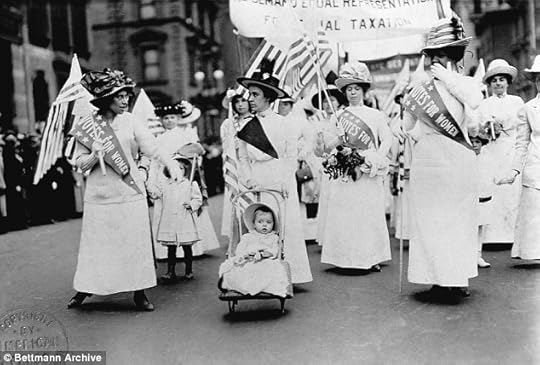
Being an
ex U.S. History major, I found that whole thing to be a bit ironic. It was
particularly so because they were calling them “white suffragette” suits. This,
of course, dates back to the time in the early twentieth century when women
were demonstrating for the right to vote. The ironic thing about it is the fact
that, back in the 1900s, the suffragettes were Republicans.
Solidarity
This now
puts the Democratic politicians (at least the female ones) in solidarity with
women of all stripes (something they don’t always aspire to do). I applaud them
for this, and hope they keep up the unifying trend. I won’t hold my breath,
however.
As a humorous sidelight to all of this, I heard a radio commentator say something that actually made me laugh out loud as I was driving down the highway. He flippantly observed that the last time we saw so many Democrats in white was at a KKK meeting. I’m sure we all have history we’d rather forget, but I couldn’t help myself and chuckled anyway. I suppose the congresswomen had neither of these objectives in mind, but I suspect they never gave any of it much thought.
Can’t Tell the Donkeys from the Elephants
Of course, the Party of Lincoln doesn’t have all that much to brag about these days either. It’s often quite difficult to tell the Donkeys apart from the Elephants. They pretty much act the same and do what they can to give the electorate as many ulcers as possible. Maybe this is their way of promoting medical advancements in our country. The more ulcers, the better chance for a cure…
When Jesus burst on to the scene in His public ministry, His first words were, “Repent, for the kingdom of heaven has come near” (Matthew 4:17). He was announcing a different kind of kingdom than anyone else had ever promoted. Maybe we should all wear white and promote His kingdom. It has to be better than the one we’ve got.
[Dave Zuchelli is a graduate of
Pittsburgh Theological Seminary and currently resides in Aldie, VA.]
The post Women in White appeared first on Dave Zuchelli.
February 12, 2019
Our Brown Babies
A few days ago, celebrated newsman, Tom Brokaw, made some comments that torqued more than a few people off. He quickly apologized, of course, but his apology has been described as “tepid” at best. I listened with interest to what he said, and one of his assertions really caught my attention.

His comments were directed at our Hispanic
population here in the good, ol’ US of A. In general, he said Hispanics should
try harder to assimilate and that “they ought not be just codified in their own
communities” (whatever that means). The inevitable accusations of racism were
quickly hurled at him for such statements, and he attempted to cover his tracks
just as rapidly.
The Big Uproar
I have to say, I can see why the big uproar
ensued. I’m surrounded in life by a significant number of Hispanics, and they
seem (in my experience) to be folks who make considerable efforts to be
Americans. Naturally, first-generation immigrants often have accents and
sometimes struggle with English; but more often than not, second-generation
Hispanics are virtually indistinguishable from the rest of us. From what I can
see, Brokaw is dead wrong on this point, and other journalists have quoted
statistics to prove him erroneous.
But that leads to his statement that garnered the bulk of my attention. As he was discussing relationships between Hispanics and the rest of our culture, he said that some people tell him, “I don’t know whether I want brown grandbabies.” That declaration gave me great pause. I may be naïve, and I hate to disparage anyone by name, but I think Brokaw made that one up out of whole cloth. Who in the world would say that to him (even if they were actually thinking it)? I’m guessing that it supported his narrative, so he just thoughtlessly blurted it out.
The guy writing this (me) has a brown
grandbaby. I didn’t realize she was a brown grandbaby until Brokaw pointed it
out. (We also have a black one and a red one, too, but who’s counting—Brokaw, I
guess.). We have a few white ones, also, but we don’t make those kinds of
distinctions in our family. They’re all our grandbabies, we love them, and
that’s that.
Go Ahead, Assimilate Me
To be honest, I never thought of our little
grandchild as a “brown grandbaby” until Brokaw “codified” her on national TV.
She’s our grandbaby, and it never occurred to me that there should (or could)
be an extra adjective thrown in. Her father (my son-in-law) is a full-blooded,
second-generation Hispanic who speaks better English than me and is as American
as apple pie. In fact, he just might be more assimilated than I. I tend to
emphasize my Italian roots quite a bit (although, I still can’t speak the
language).
The point of my little tirade against people
like Mr. Brokaw is that we already have enough going on in this country to tear
us apart. We don’t need any help from pontificators of myths and fabrications
like them.
[Dave
Zuchelli is a graduate of Pittsburgh Theological Seminary and currently resides
in Aldie, VA.]
The post Our Brown Babies appeared first on Dave Zuchelli.
February 10, 2019
The Five Solas
I recently had the privilege of preaching a funeral in a nearby Lutheran Church building. We were there not because the deceased was a Lutheran—he wasn’t. But it was a large enough sanctuary to hold the expected crowd. As it turned out, there was standing room only as anticipated.

It’s pretty amazing to a guy like me to see
such a crowd at a service of death and resurrection. I’ve been preaching
funerals for about forty years, now, and crowds like that are few and far
between. It’s not unusual to find oneself in a small room with an even smaller
group of mourners. That’s especially true these days—a time when so many tend
to, almost blindly, deny death.
In this case, the departed was young,
well-liked, and rather well-known. He had served his community, made many
friends, and had a lot of acquaintances. They came out in droves to honor his
memory and pay their final respects—and, hopefully, to worship the Lord.
Full Advantage
Not only is it a great privilege to be called
upon to serve at such a time as that, but it’s a wonderful opportunity as well.
Preaching the Gospel of Christ is one of those things I live for, and this was
an extraordinary opportunity to do so. I sought to take full advantage of it.
A lot of things should happen in a service like that. The deceased should be remembered and honored; the family should be comforted with the hope that we’ve been given in Christ; and the Lord should be glorified. I think we were able to accomplish these things and give a dear Brother a beautiful good-bye.
Being in a building that carries the name of
Martin Luther, I couldn’t resist the opportunity to mention the Five Solas—
Sola Gratia, Sola Fide, Sola Christus, Sola Scriptura, Soli Deo Gloria. These
are Latin terms which basically mean that we are saved by grace alone, through
faith alone, in Christ alone, as revealed in the Scripture alone, to the glory
of God alone.
Earning Our Salvation
The Five Solas are the backbone of the great
heritage we’ve received from Luther and his fellow reformers. The reformed
theologians like Jean Calvin helped to transform and renew the church with this
understanding. Their theology helped us to take note that Scripture is clear—we
cannot earn our salvation—it is wholly and purely a gift.
The Five Solas help us learn that we receive the grace of God and the gift of faith in order to be drawn to Christ (the sole sacrifice for our sins). They point us to Scripture which is the sole authority for this understanding, and to the fact that all the glory for this belongs to God—not to any man or woman—certainly not to ourselves.
Scripture tells us that “the righteous will live by faith” (Romans 1:17). Faith is an indescribable gift from God. Without His gift, we’re hopelessly lost. May we live by that faithfulness to His glory alone.
[Dave Zuchelli is a graduate of Pittsburgh Theological Seminary and currently resides in Aldie, VA.]
The post The Five Solas appeared first on Dave Zuchelli.
February 7, 2019
No Longer Affiliated
A couple of weeks ago, an acquaintance passed away. He was younger than me, and when that happens, I take notice. I was asked to preach his funeral service and did so gladly. Jesus specifically said, “No one is good but God.” But if there was a good guy around at all, this guy was him.

After his death, my weekly e-letter
went out as usual the following Friday morning. Later in the day, I checked my
e-mail for any responses. There are usually a few. Some write to agree with
what I said, some to disagree. Occasionally, someone will call me a jerk and
unsubscribe. Sure enough, there were a few responses to my publication. One in
particular caught my attention.
E-Mail From Beyond
I saw it right away, because it was from the
guy who had died (before the e-letter came out, mind you). I’m pretty sure I’ve
never received an e-mail from beyond the grave, so I was eager to check it out.
The subject line announced, “Auto reply from John Doe.” (I’ve changed the name
to protect the innocent.) The first line informed me that “John Doe is no longer
affiliated with Company XYZ.” (Another name change…)
Before I went any further, I chuckled and thought to myself, “They’ve got that right.” As I read further, the memo informed me that, if I had any questions, I could e-mail Jack Sprat (another fictitious name). Then it presented me with a phone number if my preference was to call.
That line gave me pause. I felt an inordinate
urge to call the number and ask them if they’d like to know with whom he was
currently affiliated. I resisted the impulse, however, and it soon passed.
Besides that, I figured someone from that company would be present at the service,
and I could fill them in at that time. So I did.
SRO
As services of death and resurrection go,
this one was one of the more celebrated and moving ones in which I had ever participated
(or attended, for that matter). The music was powerful, the tributes and
memories from the family were poignant, meaningful, and appropriately humorous;
and the place was packed with family, friends, and well-wishers. It was a
standing-room-only situation, and the Spirit of God was strongly felt.
I had the opportunity to share my e-mail from the great beyond, which was good for a laugh from the congregation. Then I told them of John’s current affiliation. It was one he made a long time ago, but it was an everlasting one. It was sealed in the blood of our Savior, Jesus Christ, and no e-mail was needed to confirm it.
Funerals can be very sad, or they can be
glorious. This one was the latter. It celebrated the life of a saint, and, more
importantly, it glorified the One with whom he now resides. I was surprised at
how life-changing a service it was. Sometimes, this is just a job. Other times,
like now, it’s mystical.
[Dave Zuchelli is a graduate of Pittsburgh Theological Seminary and
currently resides in Aldie, VA.]
The post No Longer Affiliated appeared first on Dave Zuchelli.
February 5, 2019
The Great Emu War
I recently ran across an article describing what became known as the “Great Emu War of 1932.” It took place (as you might guess) in the country of Australia. Apparently, the emu population undertakes an annual migration from the drier inlands to the more temperate grasslands of the coastal areas.

This began to occur in
1932 as usual, but it seems the government had given 90,000 hectares of land to
5000 WWI vets. (In case you’re not up on your metrics, one hectare is equal to
10,000 square meters or 2.47 acres. I only know this because I researched it.)
The vets cultivated their new farmland, and, lo and behold, the emus discovered
the feast as they journeyed.
As the article stated, “The
bird giants descended upon the crops.” As you can imagine, the farmers were not
pleased. They tried everything from rifles to machineguns to mobile,
truck-mounted Lewis guns. Against all odds, the unarmed emus (20,000 strong)
were able to minimize their casualties. All in all, the war lasted six days. In
the end, the truck had crashed, 2500 rounds of expensive munitions were spent,
and the emus suffered the loss of only 200 of their fine-feathered friends. A
one percent dent in their population hardly made a difference (except, maybe,
to the one percent).
I’m not exactly sure why,
but this has put me in mind of Gideon (you knew it had to be coming). Gideon
was the famous warrior of Judges fame (see Judges 6 & 7). He was tasked with
waging war against the Midianites who were wrecking havoc on the crops,
livestock, and people of Israel every year. The Lord told Gideon that it was
time to put a stop to that annual incursion.
In an effort to be
compliant with God’s wishes, Gideon amassed an army of thirty-two thousand
fighting men. That army evened the odds somewhat, but Yahweh told Gideon his
army was too large. He instructed Gideon to ask the soldiers if any of them
were afraid. Twenty-two thousand of them answered in the affirmative, and
Gideon sent them home.
This troop reduction was
impressive but still not enough to satisfy the Lord. Through an interesting lap
test (Judges 7:5-8), the army was reduced by
another 9700 men. If I’ve done the math correctly, this left Gideon with an
army of three hundred to assault the Midianites—estimated at 135,000 soldiers.
Some would say the odds were in favor of the Midianites at this point, but
Yahweh seemed to think this ratio was just about right. The reason He gave, of
course, was that (with those odds) no one could mistakenly give Gideon and his
army credit for the victory. The victory belonged to the Lord and no one else.
The long and short of it is that both the emus and Gideon won out despite tremendously negative odds. They each sent the enemy away in defeat in a fight over crops. Moral: Make sure you’re on God’s side (and the emus’).
[Dave Zuchelli is a graduate of
Pittsburgh Theological Seminary and currently resides in Aldie, VA.]
The post The Great Emu War appeared first on Dave Zuchelli.
February 3, 2019
Cis: Not to be Confused with Sis
Suddenly, we’re hearing innovative vocabulary in newscasts. Recently, I heard a guy refer to himself as cisnormative. It was clear from the monologue, he was referring to his sexuality. Among my many attempts at societal success, I was a collegiate biology major. I actually graduated with a degree in that field, so I was a bit embarrassed that I had no clue as to what he was talking about.

In my defense, I
graduated in 1971 (yes, I’m old). As near as I can tell, terms like
cisnormative and cisgender emerged in the mid to late 1990s—a period when I was
thinking less and less about my preferred sexuality. Those sorts of things had
long been established in my life.
It Kept Cropping Up
Consequently, I had to
check this out. The terms kept cropping up, and I didn’t wish to remain in the
dark. Some things can be allowed to slide in life, but human sexuality seems to
be gaining importance as a topic to be mastered. I resisted for a while, but I
finally succumbed.
As it turns out, there are a lot of folks out there who have a considerable amount of knowledge to share on the subject—newness not withstanding. I assume they know what they’re talking about. They are, after all, on the Internet. We all know what that means. Here is a definition that seems to encapsulate the meaning of the prefix, cis.
In Latin, the prefix “cis” means “on the same side”
and “trans” means “on the other side”. So, a cis person is one whose assigned
sex at birth is on the same side as the sex they are. Likewise, a trans person
is one whose assigned sex at birth is on a different side from the sex they
are.
If this doesn’t confuse you, you’re well on your way to understanding twenty-first century society—I think. I completed two years of Latin in High School, but the whole cis thing escaped me at the time. I’m guessing it was of little importance at that juncture. It has, obviously, become a big deal now.
Second Generation
All of this reminds me of
what a deep desire we humans seem to have to label ourselves. We not only want
labels, we want categories, groups, and classes as well. As Americans, we’re
not satisfied with saying we are such. We need to break it down into nation of
origin, state, and occupation. Merely to say, “I’m an American” just doesn’t
seem like enough to us. (I’m an Italian-American, by the way—second generation
if that matters.)
We come by this honestly, though. This practice began a long time ago. One day Jesus was sitting by a well and asked a woman for a drink. Before it was all over, it was established that she was a woman, a Samaritan, a divorcee, and a sinner. This was all done by Jesus, but only to establish that she needed a Savior. Once she knew Him, however, she became a mere Christian.
[Dave Zuchelli is a graduate of
Pittsburgh Theological Seminary and currently resides in Aldie, VA.]
The post Cis: Not to be Confused with Sis appeared first on Dave Zuchelli.
January 31, 2019
Overhearing the Curse
In our society, it’s not unusual to hear people cursing. Sometimes it’s a real curse. Other times it’s simply a habit and thrown out there subconsciously or as an adjective. Occasionally, it’s done in such a way that it even sounds funny.

Cursing, of course, was
never meant to be something funny. When they were first instituted, they were
deadly serious and to be avoided at all costs. The very first ones were levied
by God Himself. You may remember them from Genesis chapter three. Everything
got cursed—the man, the woman, the serpent, the earth—you name it, it was cursed.
We still sing about it when we sing “O Come All Ye Faithful.” Remember the
line, “far as the curse is found?” Yeah, that’s the same curse.
Don’t Pay Attention
Because cursing has
become so prevalent in our society, we ignore it much of the time. As it turns
out, disregarding it is the Biblical thing to do. Koheleth (the author of
Ecclesiastes) had some sage advice concerning the tossing around of curses. He
wrote, “Do not pay attention to every word people say, or you may hear your
servant cursing you—for you know in your heart that many times
you yourself have cursed others” (Ecclesiastes
7:21-22).
I doubt if anyone likes to be cursed by someone. It can be discouraging, disappointing, and demoralizing. At the very least, it’s annoying. Who needs it?
That’s particularly true
if the person doing the afflicting is someone close to you. If it’s from an
enemy of sorts, it’s a tad easier to take—not a lot, but some.
Koheleth’s wise words point
out that there are a lot of spoken words to which we shouldn’t pay any
attention. We should probably use some discretion when observing such an
admonition, but that shouldn’t be all that tough. Life teaches us that certain
statements are pretty important to take to heart.
True Wisdom
Be that as it may,
allowing some of these things to roll off our backs is a response to true
wisdom. This is especially true when we consider the reason for the teacher’s warning.
He implies that one shouldn’t take those kinds of words too seriously when they
come from someone we know (in this case, a servant). The reason seems to be
tied into the concept of forgiveness.
He points out that we, too, have been guilty of cursing others. Even if it’s done in secret, entertaining the very thought of it is wrong. Even though you might not express it verbally, cursing someone is a violent act.
In the Sermon on the
Mount, Jesus stated that someone who is “angry with a brother or sister is
subject to judgment” (Matthew
5:22). He tempered that, however, by also saying that we should forgive
others as we have been forgiven (Matthew
6:12). He is in line with the writer of Ecclesiastes (and vice versa). Being
a little less sensitive to the words of others and a little more forgiving
seems to be in order.
[Dave Zuchelli is a
graduate of Pittsburgh Theological Seminary and currently resides in Aldie,
VA.]
The post Overhearing the Curse appeared first on Dave Zuchelli.
January 29, 2019
A Legend in His Own Mind
There are a lot of fascinating figures in Scripture, but one of the guys who I always found to be most intriguing is the one we often refer to as the “rich, young ruler.” Interestingly enough, the Bible never uses that phrase, but each of the synoptic gospel accounts give little clues as to who he was, and rich, young ruler is the title he receives when we add them all up.

This young man was a lot
like us. In fact, his attitude seems to be very prevalent in our own times. We
could almost pick him up from the pages of Scripture and drop him into today’s
setting. He would fit right in with us.
The Big Question
First of all, he
approached Jesus with a big question. If, once again, we add up the synoptic
passages about this event, his query would sound like this. “Good teacher, what
good thing do I have to do to gain eternal life?” This is a common question,
even among Christians. For some reason, we think there is some good work we can
do to get into God’s good graces.
Jesus immediately cuts him to the quick by reminding him that no one is good except God Himself. After stating that, He essentially says, “If you really want to do something good, get rid of your wealth and come be my disciple.” It became painfully obvious that the young man couldn’t let go of the one thing that was most important to him—his money. The good thing Jesus wanted him to do was not in giving up his wealth (as many assume), but it was for him to follow the Christ. Had he done so, he would have discovered that there wasn’t any good deed or practice that would help him gain eternal life. Eternal life would have been a free gift bestowed on him as a follower of the Messiah.
Three Lessons
There are three lessons
to be learned from this episode. First, no one can earn their ticket to Heaven.
No one is that good. The only available goodness is that which comes from
God—period. The only thing good enough to cover our sin is the sacrifice of the
Savior.
Secondly, many of us have impediments to becoming a disciple of Christ. For the young man, it was his wealth. For us, it could be a myriad of other obstacles—things that are more important to us than Jesus himself. It could be anything—sports, sex, bodybuilding, career, family, status, politics—you name it.
The third and final thing is that we should read the Bible. Had the young man been studious, he would have read Ecclesiastes 7:20 which says, “Indeed, there is no one on earth who is righteous, no one who does what is right and never sins.” Had he understood his Bible (the Old Testament), he would have known he couldn’t be good enough to gain eternal life. Instead, he was a legend in his own mind.
[Dave Zuchelli is a graduate of
Pittsburgh Theological Seminary and currently resides in Aldie, VA.]
The post A Legend in His Own Mind appeared first on Dave Zuchelli.
January 27, 2019
La Hora Loca
“Twenty-five years ago a
Venezuelan couple rang in the New Year in Spain and were intrigued by the
festivities, the costumes, the music and the happiness. They brought the
appearance of the party back home in an attempt to create a new Venezuelan
tradition. The pair decided to start a business aptly named “Hora Loca” in
Caracas; it sells masks, noisemakers, costumes and anything else celebrants
need to add their own crazy hour into a wedding reception or other celebration.
Business boomed, and this store expanded to the United States. It now ships its
supplies all over the world.” ~Classroom~

La Hora
Loca literally means “the crazy hour.” When I first heard it, I assumed it
would be loosely translated as “happy hour.” It was an honest mistake—maybe
even an educated guess, albeit a wrong one.
Happy Hour?
We’re
all familiar with the term happy hour. I seldom stop in at an establishment
primarily to take advantage of happy hour; but I have, many times, ended up in
restaurants during moments that coincided with their advertised exultant time.
When that happens, the waiter gleefully announces to us that drinks and
appetizers are half off (or some such promo). If I wasn’t in a good mood prior
to that announcement, said decree always makes me happier than I was when I
came into the joint. So the term, happy hour, is appropriate.
But, as
I recently discovered, happy hour is not synonymous with crazy hour. Crazy hour
has now become a part of many wedding celebrations. I was ignorant of this
despite the fact that I’ve been performing wedding ceremonies like mad over the
past few years. I guess my ignorance lies in the fact that I usually leave the
premises shortly after the “I wills” and don’t participate in the festivities
thereafter. Thus, the crazy hour concept has eluded me up to this point.
On Steroids
When I
recently heard the term (at a church communications seminar, no less), I became
curious and did a little research. Much to my surprise, although it might be
considered akin to happy hour, happy hour it ain’t. I won’t go into the
details, but I suppose it could be considered a sort of happy hour on steroids.
All the in-style wedding receptions seem to have them these days.
La Hora Loca puts me in mind of Jesus’ first recorded miracle. Yes, you nailed it. It was on the occasion of a wedding reception when the bride and groom ran out of vino. Mother Mary told the head caterer to, “Do what he (Jesus) tells you,” and the rest is history.
My research tells me that La Hora Loca is a twenty-five-year-old Argentinian tradition, but my gut tells me it dates back to the wedding in Cana some two thousand years ago. I’m not sure how crazy the disciples got that day, but I’m pretty positive the other wedding guests were loving it—some to the point of not remembering it the next day.
[Dave Zuchelli is a graduate of Pittsburgh Theological Seminary and currently resides in Aldie, VA.]
The post La Hora Loca appeared first on Dave Zuchelli.