
Jay L. Wile's Blog, page 34
February 2, 2017
No Doubt About It: These Proteins are From Dinosaurs

Fossil of a Brachylophosaurus at the Children’s Museum of Indianapolis. (click for credit)
In 2005, Dr. Mary Schweitzer shocked the paleontology community by reporting that she had found soft tissue in a Tyrannosaurus fossil that was thought to be 65 million years old. Since then, numerous other cases of soft tissue in dinosaur fossils have been reported (see here, here, here, here, and here, for example). Currently, the “record holder” for soft tissue is a worm fossil that is supposed to be 550 million years old!
While such discoveries have been met with skepticism, the overwhelming evidence points to the fact that there is soft tissue in many fossils that are supposed to be millions of years old. Of course, the next obvious issue to address is the chemical makeup of these soft tissues. Are the large biomolecules that we expect to find in soft tissue there? Are they intact or severely decayed? After all, most proteins are expected to decay significantly in as “little” as 30,000 years. Despite this fact, some of these fossils contain what appear to be intact proteins.
Now, of course, there is always the possibility of contamination. Fossil collection isn’t the cleanest of pursuits, and proteins are found pretty much everywhere on the planet. Thus, it is possible that the proteins which have been discovered in dinosaur bones aren’t really from the dinosaurs. However, two recent studies indicate that contamination cannot be the explanation. These proteins are real, and they really are from the dinosaurs themselves.
The first study comes from Dr. Schweitzer herself. Over the years, she has been met with lots of skepticism regarding her revolutionary discoveries, so she is particularly eager to make it clear that the soft tissue and biomolecules her team has found are not the result of contamination. She and her team recently published the most convincing study to date. Essentially, they decided to excavate a dinosaur fossil with the specific intent of making sure there was no way it could be contaminated with biomolecules.
First, they collected the fossil while it was still encased in the sediment surrounding it. They used no preservatives of any kind, and they only exposed the fossil once it was in a lab that was clear of all organic contaminants. The instruments used were also clear of contaminants. In this clean environment, they collected a sample from the femur (the large leg bone) and analyzed it with a mass spectrometer. They found eight sequences that correspond to collagen 1, a common protein found in animals but not bacteria. Two of the sequences match ones that have been found in other dinosaur bones, and six of them are new. They are all similar to sequences found in birds and crocodiles, which one would expect for a dinosaur. Given the painstaking measures used to avoid contamination, it is clear that this collagen really is from the dinosaur.
Another study, done by researchers who aren’t affiliated with Dr. Schweitzer’s group, approaches the problem in a completely different way. They analyzed a dinosaur fossil that is supposed to be 195 million years old. Rather than extracting tissue from the fossil, which could introduce contaminants, they took thin slices of the fossil and scanned them with radiation from the National Synchrotron Radiation Research Center in Taiwan. This allowed them to look for molecules in situ (in their original place). In the rib fossils, they found collagen associated with the blood vessels that supplied blood to the bone. There is essentially no possibility of contamination in this study, since the proteins were analyzed in the bone itself. Thus, it is clear that the collagen is from the dinosaur, despite the fact that the fossil is supposed to be 195 million years old.
How could collagen be preserved for such a long time? They found a lot of iron in the fossil as well, probably from the blood of the dinosaur. They suggest, as Dr. Schweitzer has, that the iron somehow helped to stabilize the protein and keep it from breaking down. From a chemical standpoint, however, that’s not consistent with what has been found in other dinosaur fossils.
I suspect that the most likely explanation for the wealth of soft tissue and intact or nearly-intact proteins found in supposedly ancient fossils is that the fossils aren’t nearly as ancient as most people want to believe.


January 30, 2017
Jay Wile, From a Student’s Perspective
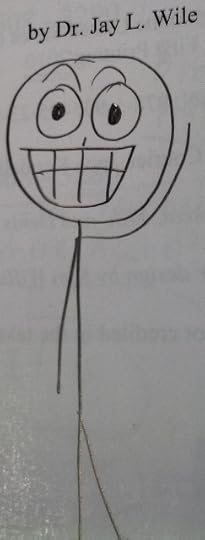
A “portrait” of me, drawn by Jessica M.
I love hearing from students after they have taken a course or two from me and then gone on to pursue their goals. I enjoy each report and am thrilled that my courses meant so much to them. I do have to admit, however, that I enjoy some reports more than others. Some students credit me for their love of science, and that means the world to me! Others suggest that they couldn’t have been successful in pursuit of their goals without my courses. I tend to doubt that, but I appreciate the sentiment. Some students say that my courses have helped them in their spiritual life, and that means the most. There are times, however, that I get a report that is both meaningful and downright hilarious, at least to me! Such was the case a few days ago, when I got an email from Jessica M.She wrote to tell me that she took my general chemistry course (which is out of print – I recommend using this one now) and my advanced chemistry course several years ago and is now in college, pursuing a degree in nursing. She says that college chemistry is going well, and it is bringing back a lot of good memories, so she wanted to thank me for being an integral part of her homeschool-high school years. Of course, that meant a great deal to me. However, I have to admit that I was more intrigued by something else she wrote:
As a homeschooler, you were one of my first “favorite professors” (next to my parents and Andrew Pudewa). Extrapolating from your often-humorous, lighthearted writing style, I invented a jovial stickman-character of you who often appeared in the margins of my books to make comments (together with the three Chemistry Nerds and Mr. Mole).
If you have ever experienced a class with Andrew Pudewa, you would know that it is no insult to finish behind him in a student’s “favorite professors” list, but that’s not what really intrigued me. I wanted to learn more about this “jovial stickman-character,” so I asked her if she would mind sending me some examples, and when she did, I spent the next several minutes laughing out loud!
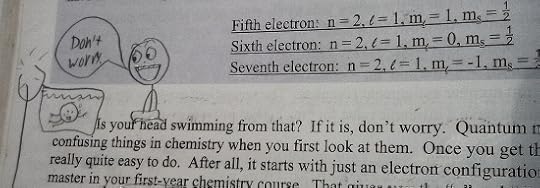
The image above shows you the stick-man character. I think it’s a pretty good likeness, except that I am a lot heavier and have more hair. What I found hilarious, however, is the way Jessica portrayed some of my favorite phrases that I use while teaching. For example, when I am teaching a concept that uses a lot of facts or requires a lot of inferences, I realize that at first glance, it confuses a lot of students. As a result, I usually say something like, “Is your head swimming from that? Don’t worry…” and then explain that by the end of the discussion it will be a lot more understandable. Here’s how Jessica portrayed it:
Probably one of the most challenging topics in general chemistry is the mole concept, which is essentially a way of counting molecules or atoms. If you can figure out the number of moles of a chemical, you can use it to analyze a chemical equation. To do that, however, you need to determine how the moles of one chemical relate to the moles of the other chemicals in the equation. I call that developing “a mole relationship.” Here’s how Jessica portrayed that oft-repeated phrase:
[image error]
The character on the right is called “The Guy Who Hates Mole Jokes.” This one features him as well:
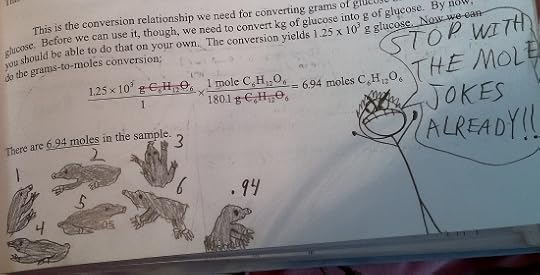
Jessica sent several wonderful cartoons, but I will end with just one more. When I am teaching a topic that requires a lot of mathematical analysis, I find that it is best to introduce the math in the middle of the topic. I explain some of the concepts behind the topic, then I discuss the equations and how to apply them, and then I wrap it up by explaining what it all means. As a result, when I am done with the math, the students can solve the equations, but they don’t fully understand what the solutions mean. At least not yet. Thus, they often have a number to which they can’t assign any real meaning. At that point, I often say something like, “This number doesn’t mean anything to you, but that’s okay.” I then go on to say that eventually, the student will understand what the number actually means. Here’s how Jessica portrayed that one:
[image error]
While I doubt that anyone finds these as funny as I do, I suspect that other students who have suffered through my chemistry and physics courses (both in high school and at the university level) will appreciate them!
NOTE: I asked for and received Jessica’s permission to use her drawings in this post. I also offered to send her the post prior to publication, but she said that wasn’t necessary. I hope she enjoys it!
January 24, 2017
The Future of Creation Science is Bright
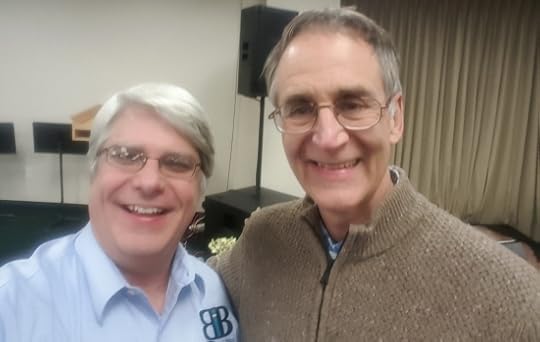
Dr. John Sanford (right) and me (left) at the Creation Science Fellowship Meeting in Costa Mesa, California.
This past weekend, I had the opportunity to walk among giants…well…at least figuratively speaking. I got to participate in panel discussion with Dr. Steve Austin, Dr. John Baumgardner, and Dr. John Sanford. Anyone who has spent much time researching the origins issue will recognize at least one of these individuals, as they are all excellent scientists who write and do research from a creationist perspective. I didn’t think I belonged on the panel, since I consider them all to be much more accomplished and talented scientists than me, but the people at the Creation Science Fellowship in Costa Mesa, California seemed to think I could contribute to the discussion, so I was included.
While the panel discussion was well attended and very productive (I will discuss it a bit in a moment), the most exciting aspect of the trip for me was meeting Dr. Sanford. He is an incredibly gifted geneticist. For example, he co-invented the “gene gun,” a device that can introduce DNA from one organism into a completely different species of organism. He has also done some excellent creationist research (see here and here, for example) and has written what I consider to be the best book about genetics and evolution, Genetic Entropy and the Mystery of The Genome. I have discussed parts of it in previous posts (see here and here).
I was also thrilled to hear about an organization he is leading, which is called Logos Research Associates. It is a group of scientists who are committed to doing original, cutting-edge scientific research from a creationist perspective. Their current projects investigate issues in oceanography, genetics, geophysics, and geology. The more I discussed his organization and its projects, the more excited I became. The projects are incredibly interesting, and the way they are addressing the scientific issues involved is spot-on. He told me about a couple of papers that are in the process of being finalized right now, and once they are published, you can bet that I will write about them.
Scientists like Dr. Sanford and organizations like Logos Research Associates make me think that the future of creation science is very bright.
Of course, the main reason I traveled to Costa Mesa was to participate in a panel discussion that was entitled, “Everything You Wanted to Know about Creation Versus Evolution but Were Afraid to Ask.” Essentially, the four of us (Dr. Austin, Dr. Baumgardner, Dr. Sanford, and myself) sat at a table and answered questions from a packed house. Many of the audience members were laypeople, but there were roughly 20 scientists in the audience as well, and probably half of them had Ph.D.’s. Sometimes, one of them would chime in on areas related to his or her speciality.
When the panel discussion began, we each introduced ourselves and discussed our areas of expertise. I was last, which was good, because I had the least to say. In fact, I introduced myself as the “midget” on a panel of giants. I kept silent for most of the questions, since many of them had to do with biology, earth science, genetics, and geology. The other members of the panel were significantly more qualified to discuss those issues than I was. However, I did contribute where I thought I had something useful to add.
The most interesting question I decided to tackle was about quantum mechanics. The questioner said that quantum mechanics seems to contradict some basic laws of logic. For example, it is obvious that an object cannot be in two different places at the same time. Consider your car. It can’t simultaneously be in your garage and on the highway. However, quantum mechanics seems to contradicts that. It says that a particle can be in two different places at the same time. He wondered whether or not we agreed with that.
Since I was the only one who had used quantum mechanics in his research, I took a stab at that one. I said that quantum mechanics is a really difficult theory that is mostly mathematical. As a result, it is often misused and misunderstood. Quantum mechanics doesn’t really state that a particle can be in two different places at the same time. What it does say is that you cannot determine the precise location of a particle. Instead, its position in space (and possibly time) is based on probability. For example, Thomas Young did a classic experiment in which he shined light on two closely-placed slits. The pattern of light on the other side of the slits was just what you would expect if a large wave had hit the two slits. This demonstrated that light is a wave.
It turns out you can do the same experiment with electrons, and if you look at how the electrons come out the other side, you see exactly the same pattern. Even if you shoot the electrons at the slits one at a time, the pattern still emerges. This demonstrates that under the conditions of the experiment, the electrons behave like waves. Many people therefore conclude that the electron had to pass through both slits at the same time (like a wave would), and therefore, the electron must have been in two places at once.
But that’s just one interpretation of the experimental results, and it is not a particularly good one. In fact, it cannot be supported mathematically. Mathematically, the electron’s interactions with the world are governed by an equation called a “wave function,” and that wave function produces only probabilities for where the electron is. You can’t say exactly where any particular electron is. You can only say that there is a certain percentage chance that you can find it at one place, and there is a certain percentage chance that you find it at another place. From a mathematical standpoint, it isn’t in both places at the same time. It is in one place, but that place cannot be exactly determined.
The reason you see the same result with electrons and light in a double-slit experiment is because both of them are governed by wave functions. As a result, when you use a lot of them in your experiment, you will get the results you expect for a wave. It’s not that a single photon or a single electron passed through both slits at the same time. It’s that with many photons or many electrons, you can finally see the results of the probabilities that are produced by the wave function. This is very difficult to communicate, so instead, it is easier to say things like, “the electrons passed through both slits at the same time.”
Now please understand that quantum mechanics does seem to say some strange things, but that’s mostly because of two issues. First, we are trying to relate what happens at the atomic scale to what we generally experience. However, we don’t experience things at the atomic scale. As a result, we are trying to relate two entirely different worlds. That can lead to a misunderstanding of what is really happening at the atomic scale.
Second, we are trying to take mathematical truths and say them with words. That can lead to a corruption of what the mathematics is actually saying. Nearly 400 years ago, Galileo wrote:
[The universe] cannot be read until we have learnt the language and become familiar with the characters in which it is written. It is written in mathematical language, and the letters are triangles, circles and other geometrical figures, without which means it is humanly impossible to comprehend a single word.
The more we study science, the more it becomes clear that Galileo was right. The universe is written in a mathematical language, and often when we “translate” that language into words, we corrupt its meaning. The can be particularly true when trying to communicate the details of quantum mechanics with people who do not know the mathematics involved.
Please note that the panel discussion will eventually be posted to YouTube, on this channel. I will post the actual link here when I notice that it has become available.
January 19, 2017
College Professors’ Impressions of Homeschool Graduates

A happy college graduate (click for credit)
Many of my readers probably know that I started working with homeschoolers because of my experiences with homeschool graduates when I was on the faculty at Ball State University. As a group, they were not only academically superior to their peers, but they were also significantly more well-adjusted. I often share this fact when I am speaking to homeschool audiences, so it didn’t surprise me when a homeschool blogger (Michelle) sent me some questions about my experiences with homeschool graduates at the university level. As I indicated to her, I have experienced homeschool graduates at both a secular university (Ball State) and a Christian university (Anderson University). Based on my experiences, I can state with some confidence that, on average, homeschool graduates excel at the university level, be it in a secular or Christian environment. Several studies back up those experiences (see here, here, here, here, and here).
Michelle told me that she was writing a blog post about professors’ impressions of homeschool graduates, and she asked me four specific questions. I answered them as best I could and then (like many things) promptly forgot about it. Yesterday, I received another email from Michelle, telling me that she had finished the project and had published her post. After reading it, I decided that I had to share it. I think it provides some really valuable insights, especially for parents who are currently homeschooling and want their children to pursue higher education.
Unlike the studies that I spend a lot of my time discussing, the results of her survey of college professors is not scientific. It has a tiny sample size and makes no attempt to be representative of the population of college professors as a whole. Nevertheless, it is incredibly valuable, because the college professors who were surveyed offer some excellent advice to homeschooling parents, and they provide perspectives about homeschool graduates in higher education that would be hard to measure in a more scientific survey.
I strongly encourage you to read the entire article, but I do want to offer a bit of “color commentary.”
The first thing I noticed, of course, was that all the professors agree that homeschool graduates make excellent college students. That’s not surprising, given the long list of studies that indicate this fact. However, the professors’ responses do give some insight into why. According to these professors, the homeschool graduates are better readers and writers than their peers, and they have a better work ethic. In addition, they seem to have a better attitude than their peers when it comes to earning their education instead of expecting it to be given to them.
One of the excellent questions asked on the survey dealt with the weaknesses that homeschool graduates have in a college setting. I found one response to be quite humorous:
Sort of a funny issue – but I get several homeschool students who forget to put their names on their work. They just forget that this is something I need from them.
I have experienced that as well. Most of the other responses to the question are also issues I have experienced. One professor said that homeschool graduates tend to want immediate feedback on assignments, not understanding that for a professor who has many students, that’s just not possible. Another mentions an over-reliance on the internet for research, and another indicated a lack of experience when it comes to exams. However, the one I consider the most important is:
Some of them (surprisingly to me, a homeschool mom myself who’s learning what she needs to be sure to incorporate in her own “academy”) don’t seem to have much experience taking notes in a class setting where the instructor just keeps moving along. At least one of them didn’t even realize he should copy down the examples we worked in our college algebra math class.
This is why I stress that homeschooled students should have some classroom experience. I think many homeschool families overdo this and end up missing out on some of the real benefits of homeschooling, but others underdo it, producing graduates like the one discussed in the quote above. Like many things in life, this is about moderation. Homeschooled students should have some classroom experience, especially if they are bound for higher education. However, that should represent only a fraction of their academic experience, because many of the real benefits of homeschooling (developing the ability to learn without a teacher, developing strong relationships with parents and siblings, experiencing the freedom to explore the “rabbit trails” of a subject, etc.) can only occur in a traditional homeschool setting.
The professors offer some excellent suggestions to homeschooling parents, encouraging them to emphasize reading, help their children develop time-management skills, emphasize independent learning, and get their children ready to follow strict schedules. However, I want to end with the responses the professors gave to the question, “Is there any other information you would like to offer?” Once again, every response is valuable, but I want to highlight two of them:
I have been so impressed by my homeschool students that I pulled my son from public school.
It’s hard to argue with that one. When we adopted our daughter, we immediately started homeschooling her, because my experiences with homeschool graduates at the university level had already convinced me that it was the best educational opportunity available.
The second quote is very valuable for those who are able to follow the advice:
I also like it when students who are homeschooled let others in the class know. I don’t share this information with the other students, so sometimes they go through a class without anyone knowing. However, I like it when the students say something about being homeschooled. This often becomes a teaching moment for the other students who have preconceived stereotypes about homeschooling. I enjoy seeing their attitudes and ideas shift to see homeschooling in a new, different way.
Obviously, not all homeschool graduates have the kind of personality that will allow them to share personal information like that in a group setting. However, I strongly agree with this professor. Homeschool graduates should, when they feel able, share their homeschooling experience in class. I think it would go a long way towards destroying the ignorant stereotypes that exist among both students and faculty at many colleges and universities.
January 17, 2017
More Archaeological Evidence Supporting Scripture

An aerial view of Khirbat Qeiyafa, which is most likely the Biblical city of Shaaraim.
(click for credit)
It has become fashionable among many Biblical scholars to doubt the historical veracity of the Old Testament. In particular, whereas the Old Testament characterizes Israel at the time of King David as a large empire with active trading over long distances, some popular Biblical scholars characterize it as a simple, agrarian society. In addition, while the Old Testament speaks of King David as a civilized king who ruled over an impressive empire, these same scholars claim that he was more of a tribal war chief. National Geographic, for example, describes how Dr. Israel Finkelstein, an archaeologist at Tel Aviv University, characterizes Israel and its king:
During David’s time, as Finkelstein casts it, Jerusalem was little more than a “hill-country village,” David himself a raggedy upstart akin to Pancho Villa, and his legion of followers more like “500 people with sticks in their hands shouting and cursing and spitting — not the stuff of great armies of chariots described in the text.”
Like many of today’s scholarly ideas, Finkelstein’s view is completely at odds with the scientific evidence, but that rarely stands in the way of a popular ideas, especially among those who study the Bible!
More than three years ago, I wrote about excavations taking place at a city called Khirbat Qeiyafa. The city has been dated to the 11th-century BC, and in that article, I discuss the fact that it contains a palace that the archaeologists think might have belonged to King David. Whether or not the palace belonged to David, the remains of the city clearly indicate a sophisticated kingdom like the Old Testament describes, and the archaeological evidence found in the excavation indicates that it was most certainly an Israelite city.
from that excavation goes further in debunking views like those of Finkelstein and adds even more evidence for the historical veracity of the Old Testament. Interestingly enough, this new evidence was first discovered by an amateur!
The amateur’s name is Joseph Baruch Silver, and he has provided some of the financing used in the excavation. Even though he isn’t a trained archaeologist, he is obviously interested, since he has provided money for and examined the excavation himself. While he was studying a part of the southern wall of the city, he noticed an irregularity in the pattern of the rocks in one section. As he looked more carefully, he became convinced that he was looking at a gate that had been filled in with rocks some time after the wall had been built.
The first reaction of the archaeologists who are in charge of the excavation (Dr. Yosef Garfinkel and Dr. Saar Ganor) was that Silver had made a mistake. After all, they had already excavated a gate in the western wall of the city, and no excavated city in that region of the world from that time period had more than one gate. Besides, they were professionals and had already examined the southern wall. Surely they would have seen a filled-in gate, if there was one. However, when they actually studied that section of the southern wall again, it became clear that Silver was correct! It was, indeed, a gate that had later been closed by filling it with stones.
This was a particularly exciting discovery, because there is a city mentioned in the Old Testament three different times (Joshua 15:36, 1 Samuel 17:52, and 1 Chronicles 4:31). It is called “Shaaraim,” and in Hebrew, that means “two gates.” This excavation is in a location consistent with how Shaaraim is mentioned in the Old Testament, and it has been dated to the corresponding time period. In addition, since the excavation is the only one from that time period with two gates, this gives strong supporting archaeological evidence for those passages in the Old Testament. Most likely, then, the excavation known as Khirbat Qeiyafa is an excavation of the Biblical city of Shaaraim!
A city with two gates is obviously a city that has a lot of traffic, which once again indicates an empire with active, long-range trading. Thus, not only does this excavation provide archaeological support for some specific verses in the Old Testament, it also provides further evidence for the Biblical view of the kingdom of Israel at the time of King David. Of course, I am sure that views like those of Finkelstein will continue to be popular, because evidence often matters very little to some who call themselves “scholars.”
Another really interesting thing about this discovery is that it demonstrates the arrogance that exists in some scholarly journals. The original article that was submitted for publication was rejected, because the amateur is listed as a co-author on the paper. His place as a co-author is only fitting, since he was the one who made the original discovery. However, the journal (Biblical Archaeology Review) does not allow amateurs as authors on papers, for fear that those who financially support an excavation will be listed as authors simply because of the money they have donated.
While there is probably some justification for such a policy, it presupposes that an amateur simply can’t make a discovery that is worthy of publication, and that kind of arrogance has no place in science. I will never forget how an amateur (a high school student) was able to lead me to a chemical discovery that I would never have made on my own! If scientists ignore amateurs, they are potentially ignoring some great discoveries!
January 13, 2017
Ark Encounter Attendance Reported to be High

A view of the Ark Encounter (click for a larger image)
In early August, I toured the Answers in Genesis Ark Encounter. Overall, I was impressed with the facility, and I thought that regardless of your view on origins, it would be a very interesting place to tour, if you can afford it. Of course, there are those who aren’t as favorably disposed towards the Ark Encounter, and they have a different view. Because I try to read all sides of an issue, I visited several anti-Ark websites prior to and after my visit, and many of them claimed that The Ark Encounter wasn’t getting a lot of visitors (see here, here, here, and here, for example.). I didn’t quite understand that, because the day I went (a Thursday in August), the place seemed pretty crowded. As I noted in my article, I had to wait 20 minutes to see one exhibit, because of the long line of people.
That’s why I was interested to read the December 31st entry on Ken Ham’s Blog. In that post, Mr. Ham lists seven ways that God blessed Answers in Genesis in 2016, and number three is:
Number of guests at the Ark. We’ve seen nearly 500,000 guests visit the Ark Encounter since it opened. Almost half a million people—including skeptics—have been encouraged to trust God’s Word and the gospel through the Ark!
The Ark Encounter opened on July 7, 2016. As of December 31, then, it had been open for a bit less than half a year. Thus, it seems likely that by July 6, 2017, the Ark Encounter could have as many as a million guests, perhaps more.
How does this compare to projections? Well, that depends on whose projections we are talking about. When the Ark Encounter filed to take part in Kentucky’s sales tax tourism incentive, the state hired a group named Hunden Strategic Partners, LLC to make attendance projections. Based on how the Ark Encounter describes itself, their analysis indicated that 325,000 people would visit the first year, and after two more years, a maximum of just over 400,000 people per year would come. Obviously, that estimate has been shown to be dramatically wrong.
Of course, Answers and Genesis hired a different firm (America’s Research Group) to make predictions about attendance, and not surprisingly, that firm’s analysis indicated a lot more people would visit the Ark Encounter. In 2008, it projected a minimum attendance of 1.2 million in the Ark Encounter’s first year. However, in 2015, it did a new analysis and increased that number, saying that somewhere between 1.4 and 2.2 million visitors would come in the first year. It’s not clear yet whether the Ark Encounter will meet either one of those minimums, but the projections made by America’s Research Group are obviously more accurate than those made by Hunden Strategic Partners.
In the end, the Ark Encounter hasn’t had the dismal attendance that its critics had hoped for. At the same time, however, it hasn’t had the stellar attendance that Answers in Genesis had hoped for. Nevertheless, the attendance is more in line with the hopes of Answers in Genesis than it is with the hopes of the critics. I see that as a very positive thing.
January 9, 2017
Another Atheist Who Became a Christian

Dr. Yingguang Liu is on the faculty at Liberty University. (click for source)
I recently read a very interesting interview with Dr. Yingguang Liu, who was born and raised in rural China. From as early as he remembers, he was taught atheism, and he didn’t know anyone who had religious beliefs. He lived an impoverished life but was an excellent student. Upon graduating high school, he was accepted into medical school and ended up earning his Bachelor of Medicine degree. Because he had experienced patients with hepatitis, he wanted to find a cure, so he earned his Master of Medicine degree in order to do medical research. However, he quickly became disillusioned. In his words (which are similar to those of Dr. Judith Curry):
During those years, I learned something about the negative side of science. The equation for a scientific career was: Science + politics = grants = fame + fortune. I was disillusioned by the monopoly and hypocrisy of the scientific community.
As a result of his disillusionment, Dr. Liu decided to work as a physician. He spent four years as an infectious disease expert at Jinan Infectious Diseases Hospital. He then moved to the United States to pursue a Ph.D. at Ohio State University, and that’s where he first met Christians.
A Chinese Bible Study group had printed advertisements for a picnic, and he attended it, not really knowing what the group was all about. He said that he was he was attracted by their friendliness and welcoming smiles, so he started attending their Bible study. During their first winter break, he went to a Chinese Christian Conference in Chicago with the group, and at the end of one of the messages, he accepted Jesus Christ as his “Saviour, Master, and Friend.”
Dr. Liu’s story is very meaningful, and I encourage you to read Messianic prophecies in the Old Testament helped lead me to conclude that the Bible was inspired by God.
Second, even though he has probably forgotten more biology than I know, our view of the biological world seems very similar:
As the founding fathers of modern science emphasized, the world can make sense only in the light of benevolent divine design. I cannot comprehend, let alone teach biology, without referring to design and purpose.
I find that to be so very true. The more I study nature, the more it testifies to its Designer. Like Dr. Liu, the only way I can adequately teach and understand biology (as well as chemistry and physics) is from the standpoint that it has all been designed by a Supreme Intellect.
It is inspiring to read about how God spoke so clearly to a man who was brought up in a completely different culture and was raised without any knowledge of Him. Thank you, Dr. Liu, for sharing your story!
January 6, 2017
Climate Scientist Resigns Because of the “Craziness” of the Field
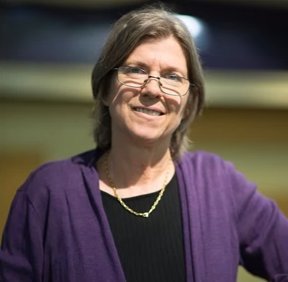
Climate Scientist Dr. Judith Curry
(click for source)
I wrote about Dr. Curry more than six years ago, when Scientific American branded her a heretic. What was Curry’s heinous crime against science? She didn’t toe the party line when it came to global warming. She didn’t claim that global warming wasn’t occurring, and she didn’t claim that people aren’t responsible. Instead, she simply started stressing the real uncertainties involved in climate science. That, of course, is an unpardonable sin, and as a result, she is routinely demonized by those who know significantly less than she does about climate.
Why has she decided to resign, even though she has not reached traditional retirement age? She discusses this on her blog, and I encourage you to read the entire article. Like most of the entries on her blog, it is thoughtful and revealing. She mentions several factors that have contributed to her resignation, and then she says this:
A deciding factor was that I no longer know what to say to students and postdocs regarding how to navigate the CRAZINESS in the field of climate science. Research and other professional activities are professionally rewarded only if they are channeled in certain directions approved by a politicized academic establishment — funding, ease of getting your papers published, getting hired in prestigious positions, appointments to prestigious committees and boards, professional recognition, etc.
How young scientists are to navigate all this is beyond me, and it often becomes a battle of scientific integrity versus career suicide… [emphasis mine]
The sad fact is that her observations are 100% accurate, and they can be applied to at least one other field of scientific inquiry – the investigation of origins.
As a member of the Ball State University faculty, I was forced to choose between scientific integrity and career suicide. Since I would share my views privately with students who asked, I became known among some students as a creationist on campus. At that time, I was working with gifted and talented high school students at a special school on the Ball State University campus. That school had a short term in which 2-week intensive classes were taught. The classes were created by the faculty, and several students asked me to teach a class on origins science. Because I thought it might destroy my career, I was hesitant. However, after much prayer, I decided that “hiding” my views on origins was not the right thing to do, and since students wanted to learn more, I should teach the course.
In the course, I tried to be as even-handed as possible, but obviously, my view that the scientific evidence supported creation came through. The next term, I was asked by some students to participate in a creation/evolution debate on the Ball State University campus. Once again, I thought this might hurt my career, but the alternative was to “hide” my views, which I didn’t think was right. Interestingly enough, the evolutionist I debated came from a nearby Christian university. Students found it quite ironic that the professor from the Christian university was defending evolution while the professor from the secular university was defending creation!
Of course, this gave me the reputation of a creationist across the Ball State University campus, and that effectively ended my career. When I applied for the opportunity to seek tenure, I was denied, despite the fact that I had recently been a finalist for a campus-wide “Excellence in Teaching” award, was named a “Bene Facta Scholar” by Ball State University, and had the second-largest research grant in the department. One of the professors who voted against the decision specifically said to me that “what church you go to” shouldn’t have been a factor in the decision, but it was.
Now don’t get me wrong. I am not angry or upset over that decision. I think it was God’s way of showing me what He really wanted me to do: write science texts for future scientists. Nevertheless, my experience at Ball State University caused Dr. Curry’s words (in bold above) to resonate with me. It’s bad enough that one field of science (origin science) is so politicized. It is truly unfortunate that another field has become like that as well.
Dr. Curry says she is not retiring from her professional life, and that’s good news. As one of the few sane voices left in climate science, she needs to continue to be heard. I can only hope that her resignation is a wakeup call to those in the field of climate science who are more interested in following the data than jumping on the bandwagon.
Only time will tell.
January 3, 2017
Lichen Kept This Secret from Scientists for Almost 150 Years!

The stringy stuff hanging on this tree is a lichen from the genus Bryoria.
(click for credit)
Consider, for example, the longest-studied mutualistic relationship. Way back in 1867, Swiss botanist Dr. Simon Schwendener proposed that a lichen (like the one pictured to the left) is not a single organism. Instead, it is composed of two different organisms, a fungus and an alga (the singular form of algae), that work together so that each benefits. His hypothesis was rejected by the scientific consensus, but as has been the case throughout the history of science, the consensus was demonstrated to be wrong, and Dr. Schwendener was vindicated. Nowadays, the lichen is one of the most common examples given to explain the concept of mutualism. The alga does photosynthesis and shares its food and oxygen with the fungus, while the fungus supports the alga and supplies it with water and salts.
You would think that since Dr. Schwendener proposed this mutualistic relationship nearly 150 years ago, scientists would know pretty much everything there is to know about lichen. However, there was one major mystery that hadn’t been solved over that entire timespan – how can genetically similar lichen be so wildly different? The picture above, for example, is of a specific lichen, Bryoria fremontii. Another lichen from the same genus, Bryoria tortuosa, is composed of the same species of fungus and the same species of alga. From a genetic standpoint, the fungus and alga in both lichens are virtually identical. Nevertheless, one lichen is brown while the other is yellow. In addition, one produces a chemical known as vulpinic acid, while the other does not.
How can two lichen composed of genetically-identical partners look and behave so differently? We may now know the answer, which has been hiding in plain sight for almost 150 years!
According to research published about six months ago, these lichen are actually composed of three distinct organisms! The third organism, a yeast, is found in the cortex of the fungus. Variations in this yeast account for the variations seen among lichen that were once thought to be composed of genetically-identical partners. In the case of the two lichens discussed above, for example, the production of acid is the result of the yeast in the fungus.
The researchers who produced this remarkable study found evidence for yeast in 52 genera of lichen from six different continents. As a result, they suggest that most lichens are composed of three different organisms in a mutualistic relationship (a fungus, an alga, and a yeast)*. I have written about the phenomenon of three-way mutualism before (see here, here, and here). This one is particularly striking, however, because the third partner in the relationship has been overlooked for almost 150 years. Why was it overlooked? In their paper, the authors of this study have a suggestion:
The assumption that stratified lichens are constructed by a single fungus with differentiated cell types is so central to the definition of the lichen symbiosis that it has been codified into lichen nomenclature. This definition has brought order to the field but may also have constrained it by forcing untested assumptions about the true nature of the symbiosis.
(NOTE: Symbiosis is a more general term that includes mutualism)
In other words, the assumption that there were only two organisms involved had been ingrained into the very study of lichens. As a result, whenever anyone saw any evidence of a third partner in the relationship, it was dismissed. After all, the scientific consensus was that lichens are composed of two organisms. Of course, had other scientists who were studying lichens in the past remembered that the scientific consensus is often wrong, they might have been the ones to make this paradigm-changing discovery.
Let that be a lesson to all scientists (present and future). The scientific consensus is often wrong. It is better to follow the data than to follow the consensus!
H/T Dr. Todd Wood: I somehow missed this study when it came out, but it was in Dr. Wood’s “Top 12 Science & Creation Stories”.
December 21, 2016
An Atheist Becomes a Christian After Reading The Lord of the Rings

The view from inside Bag End. (Photo by Kathleen Wile)
If you hadn’t already guess it by now, I am a nerd. As a result, you will probably not be surprised by the fact that I have been a fan of J.R.R. Tolkien’s The Lord of the Rings since I first read the series in the late 1970s. More importantly, however, I am married to one of the world’s biggest fans of the trilogy. She knows pretty much everything about the books and their talented author, and in her mind, they tell the best fictional story ever told. She also liked the movies that were made based on the books, even though she had some issues with them. As a result, when we went on a speaking tour of New Zealand several years ago, we wanted to see at least some of the sites where the films were made.
Pretty much the only place that looks anything like it did in the movies is Hobbiton, the town where Bilbo Baggins lived. My wife and I toured it eagerly and were thrilled to learn that we could actually go into Bilbo’s “home,” Bag End. In actuality, the inside of Bag End seen in the movies wasn’t at the Hobbiton set. It was on a sound stage somewhere else. However, the owners had excavated a small cave behind Bag End’s entrance. We went in, and she took the photo you see above, allowing us to always remember the view from Bag End.
Why am I telling you all of this? Because I ran across a very interesting article entitled, I Was an Atheist Until I Read “The Lord of the Rings.” The title alone is intriguing enough, but longtime readers of this blog are probably aware that I collect stories about atheists who became Christians. If this story isn’t a perfect fit for my blog, then, I don’t know what is!
The author’s name is Fredric Heidemann, and his story is quite thought-provoking. Essentially, he says that reading The Lord of the Rings made him realize that things like beauty and morality aren’t just social constructs, as most atheists suggest. Instead, they are real things that are the result of the fact that our minds are more than just signals traveling around our brains. This concept presented him with some serious problems. As he writes:
My attempts to explain these problems in my naturalistic, atheistic worldview fell flat. The idea that being, beauty, and morality were merely productive illusions imposed on us through biological hardwiring crafted through the random process of natural selection rang hollow.
As a result, he started questioning the atheism in which he was raised. Although he still had many objections, he eventually worked through most of them and joined the Catholic church in 2006. I wish he had spent more time on that process in his article, but his main point was how The Lord of the Rings made him question his atheism, so that’s what he focused on.
I find his story fascinating because it is so different from mine. As I said, I was a huge fan of The Lord of the Rings from the time I first read the books, and that was when I was still an atheist. The story didn’t cause me to question my atheism in the least. In fact, I actually remember writing a high-school paper about how fantasy stories like The Lord of the Rings demonstrate where religions come from: the active imaginations of those who want to believe there is something “more” to this existence than biology, chemistry, and physics.
God truly does speak to our hearts in many different ways, gently calling to us, if we will only listen! I encourage you to read Fredric Heidemann’s story in its entirety.
Jay L. Wile's Blog

- Jay L. Wile's profile
- 31 followers

